Buddy Visits Leopards, Finds Himself On The Menu

Buddy’s back at it, trying to befriend big cats. Emboldened by his success with the tolerant and wise jaguars, the reckless tabby has his sights set on the savanna and its temperamental predators, the leopards. Can Buddy win the admiration of these notoriously dangerous felids, or will he end up as a light snack for a spotted cat?

VIRUNGA NATIONAL PARK, Democratic Republic of Congo — “What the heck is that?”

A leopardess raised her head in response to her mate’s question, gazing down from the sturdy limb of an acacia tree where she’d taken refuge from the scorching midday sun.

Two hundred yards ahead, a tiny gray cat was padding toward them, picking his way carefully around rocks and occasionally disappearing in the high grass.

“There’s nothin’ that a hundred men on Mars could ever do,” the little feline sang as he walked. “I bless the rains down in Africa! I bless the rains down in…”

The diminutive feline stopped near the base of the tree and looked up at the leopards.

“Jambo!” he meowed enthusiastically. “My name is Budvuvwevwevwe Budyetenyevwe Buddabe Ossas!” he announced. “You can call me Buddy!”

Jambo!

The adult leopards were momentarily stunned until one of the cubs awoke from her nap, spotted Buddy and exclaimed: “Look, mommy, lunch!”

The small cat flashed a wide smile.

“That’s a great idea! I’ve already eaten, but you know what they say: a lunch a day barely keeps the rumbles at bay! I’m a three-lunch cat, myself. So what are we having?”

Another cub piped up.

“That’s not lunch, that’s a snack!” he told his sister.

“And what a cute little snack he is!” the female cub said, gracefully dropping from her napping spot in the tree.

Buddy’s eyes bulged.

“You’re…you’re talking about me?”

The male cub did a squeaky impression of a roar.

“Do you see any other single-serve snacks around?”

Buddy licked his lips, his effort to hide his fear betrayed by his rising hackles and tail, which now resembled a quivering spiked club.

“I…I…I am a cat,” he said in his best impression of an authoritative meow. “I’m practically your cousin!”

The female was just paces away now and moving too fast for Buddy’s liking as he backpedaled.

“The question is,” she said, “are you tasty like cousin Serval or cousin cheetah?”

An image of a leopard cub
Credit: RudiHulshof/iStock

Buddy changed tactics.

“This is an outrage! Not even the tigers tried to eat me! This is…this is, uh, catibalism!”

The cubs were circling him now.

“Mommy, can we have a snack?” the male cub called, looking back at his mother on the tree.

“As long as it doesn’t spoil your dinner later,” came the reply.

“It won’t, mamma!”

Buddy gulped.

The cubs closed the distance, ready to strike, and Buddy was babbling while pleading for his life when the earth itself shook.

Branches jolted and leaves dropped. A flock of birds nesting in a nearby tree took off, silhouettes etching ephemeral geometric patterns in the sky. In the distance, a baboon shrieked a warning to its troop.

The cubs went from aggressive to retreat in the span of an instant, and even their parents looked alarmed, taking off after their young.

Buddy watched them flee, wondering if he should bolt in another direction as something incomprehensibly gargantuan lumbered toward him, shaking the trees.

He’d emptied his bowels by the time a gigantic head poked through the foliage, followed by the rest of the colossal beast. It was gray-skinned, leathery and bizarre, unlike anything Buddy had ever seen.

“Giant space aliens!” he screamed, turning around and running right into a tree trunk.


“Ahhhhh! Don’t eat me!”

Buddy awoke in a sweat, his fur damp in the soupy, stifling heat.

An entire platoon of the peculiar beasts stood around him, their sizes ranging from 25 Buddies in mass to freakishly large individuals sporting pairs of prodigious teeth that looked like scimitars made of bone.

“Einstein’s awake,” one of them rumbled, and the rest turned from stuffing themselves with leaves to get a better look at the Liliputian animal before them.

“What is that thing?” one of them asked.

“It’s a fun-size cheetah!” one exclaimed confidently.

“No, it’s a baby Serval!” another said. “But the color’s all wrong.”

In the distance, a giraffe poked its head above the tree line, pausing to munch on the silky pink flowers of a mimosa tree.

Buddy was saved from hungry leopards by friendly giant space aliens!

Buddy cautiously pushed himself up on his paws. These aliens did not seem interested in eating him.

“Greetings,” he said. “I am a feline, a cat from planet Earth! What planet do you come from?”

There was a pause, then trumpeting, cacaphonic laughter.

“‘What planet are you from?'” one of the great beasts mimicked, sparking a second round of giggles that sounded like the trombone section of an orchestra, if someone had slipped the players psychedelics.

“We are elephants, and this is our home,” said the leader, a magnificent female. “And you, little one, are fortunate we happened by.”

Buddy puffed himself up.

“I think you mean the leopards were lucky,” he said, flexing his meowscles. “They didn’t want to tangle with these guns.”

The elephants chortled. “Can we keep him? He’s funny!”

The matriarch shook her massive head.

“He is far from home, and he should return before he runs into leopards again, or something worse,” she said.

Buddy looked unsure of himself.

“But I’m homies with the jaguars and the tigers! I thought…you know, I could be down with the leopards too. Us big cats gotta stick together, ya know? It’s hard out there for an apex predator. By the way, got any lunch?”

One of the elephants raised her trunk, pointing east toward a herd of intimidating horned beasts.

“Lunch,” she said. “Think you can take them?”

Buddy gulped.

“Go home, little one.”


Buddy’s version of events!

“So anyway,” Buddy said, addressing his human, “that’s how I impressed the leopards, and they made me their king. In fact, they bestowed the honorific ‘Paka mkubwa na mwenye misuli hodari,’ which means ‘great and mighty muscled cat’ in Swahili!”

“Sounds like you had quite an adventure! That’s impressive, Bud!” Big Buddy said.

“It is! It is!” Buddy said, nodding vigorously.

Big Buddy made a whistling sound.

“Was that before or after you peed yourself in terror?”

“What? I…no, I told you, they made me their king! Where did you hear this, this slander?”

Big Buddy reached for his iPad, pulling up images of a terrified Little Buddy running from leopard cubs on the savanna, Buddy running head-first into a tree, and Buddy cowering before a herd of elephants.

“A wildlife tour was nearby during your ‘coronation,’ but this is probably just a gray tabby who looks exactly like you and happened to be right where you were crowned,” he said. “Congratulations, Your Meowjesty!”
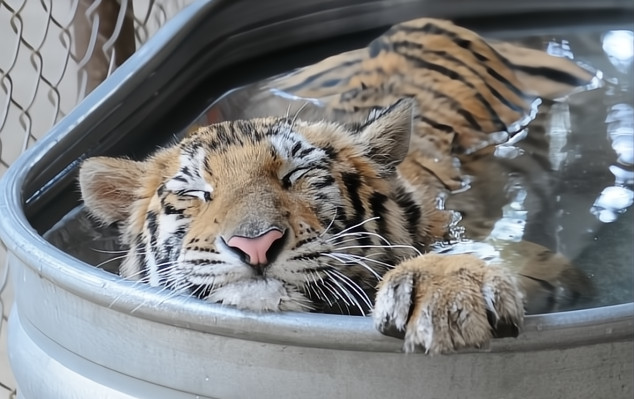
Wordless Wednesday: Awesome Photos Of Tigers Swimming!

For tigers, going for a dip on a hot day is pure bliss.

Most cats wouldn’t go near water if even if you lured them with a giant spread of catnip and Temptations on an inflatable table.

But tigers? They love it. Here are some shots of the world’s biggest cats taking a dip.

A Malayan tiger named Azul going for a swim at the Bronx Zoo. Credit: Julie Marsen Laher, Wildlife Conservation Society

Siberian tigers in a tub at a sanctuary in Russia. Credit: digger03/Flickr

This meme made me laugh.

Aasha was rescued from a traveling circus after an inspector found her sickly, suffering from ringworm and only 30 pounds at 8 months old. She’s flourished since she was brought to a sanctuary where she’s been given proper care, a good diet and a calm environment. Aasha is also pictured in the feature photo up top.

A tigress and her cubs cooling off in a river in India. Credit: Sandesh Kadur

Sundarban tigers are a subspecies of the Bengal who live in mangrove forests and are well-adapted to swimming. This Sundarban tiger was spotted on a wildlife tour in India. Credit: Soumyajit Nandy/Wikimedia Commons

This tiger cooled off on a hot day at the Dortmund Zoological Garden in Dortmund, Germany. Credit: Hans Stieglitz/Wikimedia Commons

The Best Movies About Cats

A comedy, a remarkable documentary, a classic and a surprise hit make the list for the best cat-centric movies.

Keanu (2016): Jordan Peele stars as Rell, a man who is despondent after he’s dumped by his girlfriend. When a kitten shows up on his front step, Rell takes the little guy in and his life is suddenly transformed. He’s enamored with the kitten, whom he names Keanu, can’t stop talking about him, and even begins photographing him in dioramas based on famous films.

But tragedy strikes when drug dealers ransack Rell’s home, mistaking it for the small-time drug dealer’s home next door, and take Keanu. Rell and his cousin, Clarence (Keegan Michael-Key) embark on a quest to get Keanu back no matter what it takes, even if it means posing as a pair of contract killers to infiltrate the criminal world where Keanu’s been taken. It’s every bit as absurd as you’d imagine — but it’s also very, very funny. “Actually, we’re in the market right now for a gangsta pet,” is not a line I’d expect to hear in a movie, but in Keanu it works.

Flow is the surprise hit of the awards season.

Flow (2024): Even the hype of Golden Globe awards and Oscar nominations can’t take away from the powerful impression Flow makes. By now most of us are probably familiar with it through clips or trailers, but they don’t do justice to the beauty of director Gints Zilbalodis’ world, nor how naturally expressive his protagonist, Cat, is.

The animators put in an extraordinary amount of effort into understanding and perfectly replicating every feline behavioral quirk, every hackled coat and curiously bent tail. They accomplish the same with Cat’s companions, including a Labrador, a secretarybird, a lemur and a capybara. And while we’re dazzled by the visuals and energetic narrative, Zilbalodis poses a thematic question as the flood waters take the animals through the ruins of human civilization: without people, the world will go on. What would a world without humans look like? Cat and his companions tell us one story while the environment tells us another, and the result is greater than the sum of its parts.

Tiger: Spy In The Jungle

Tiger: A Spy In The Jungle (2008): What makes this documentary so special is that it was filmed over three years in an Indian tiger preserve, and the filmmakers not only disguised cameras as rocks and tree stumps, they trained elephants how to carry “trunk cams,” achieving shots which no human cameraman could ever hope to get without spooking the subjects of the film.

Tigers don’t hunt elephants because they’re simply too big. Unlike lions, they’re not feeding a whole pride, and they don’t hunt cooperatively. It’s just not worth the effort required to take down the giant, majestic beasts. As a result, tigers and elephants not only tolerate each other, they mostly ignore each other’s presence.

One of the cubs stares curiously at a camera disguised as a rock in Tiger: Spy In The Jungle

That allowed the team to get unprecedented shots of an iron-willed tigress raising a litter of four cubs by herself. We see their dens, we watch the cubs play, and we witness the incredible prowess of the mother, who according to narrator David Attenborough has a remarkable 80 percent success rate while hunting. That’s pretty much unheard of.

With four young mouths to feed in addition to herself, the tigress is determined, and also supremely skilled. The whole jungle erupts in a cacophony of shrieks and alarm calls the instant a single animal gets a whiff of the tigress’ presence, but that still doesn’t stop her from achieving her goal.

Still, the odds are against all four cubs making it, with dangers like adult leopards, sickness and hunger. Through Spy In The Jungle, we get to see the entire journey, from the newborn cubs to the confident juveniles on the cusp of adulthood. There’s no better tiger documentary anywhere.

Shere Khan, right, makes an intimidating villain in The Jungle Book (2016)

The Jungle Book (2016): With so many Disney cash-grabs in the form of live-action remakes of classics that did not need to be remade, it’s easy to dismiss The Jungle Book. The thing is, this movie has heart. Neel Sethi is an earnest Mowgli, Idris Elba voices the infamous tiger Shere Khan, and to balance out the felid villainy with some heroism, Sir Ben Kingsley voices Bagheera, the noble leopard who discovers baby Mowgli in the jungle and protects him as his wolf friends raise the boy. Lupita Nyong’o as the wolf matriarch Raksha, Bill Murray as the honey-obsessed bear Baloo and Christopher Walken as orangutan King Louie round out a great cast.

Rangers In India Race To Capture Man-Eating Tiger Before Mobs Kill It

Angry locals say they’ll kill the tiger if forest rangers do not after the predator ambushed and ate a mother of two in southern India on Friday.

Forest rangers are on the hunt to capture a man-eating tiger who killed a woman and dragged her body into a forest on Friday, while frustrated locals say they’ll destroy the predator if the government does not.

The victim, a 45-year-old woman named Radha, was employed by a local coffee plantation in Mananthavady and was harvesting coffee beans when the big cat ambushed her, according to multiple reports in local media. Mananthavady is a city of about 47,000 people in southern India surrounded by rural farmland.

A Thunderbolt team — a special forces unit trained in counter-insurgency — was patrolling the area when they found blood and signs of a struggle. They followed the tiger’s pug marks into a nearby forest, where they found Radha’s body “half eaten,” the New Indian Express reported.

The victim was a mother of two and was buried in a service earlier today, according to the news service Bharat.

The attack and the livid response of people in the area highlight the conflicts that India must manage as it works to save tigers, the country’s critically endangered national animal, while also protecting the public. India’s government has relocated thousands of families away from the vast country’s 27 tiger preserves, but the big cats are oblivious to the boundaries of the preserves.

Earlier this month, people living in several contiguous towns over a stretch of more than 130 miles in eastern India barricaded themselves indoors, refusing to leave for work or to travel to local markets, after a pair of hungry tigers had drifted off a preserve and had begun to feast on local livestock.

A tiger who was seized and relocated from a roadside zoo operated by Joseph “Tiger King” Maldonado-Passage. Credit: Wikimedia Commons

In Mananthavady, locals threatened a hartal, a form of strike aimed at gaining concessions from the government, if the tiger is not killed. Forest rangers and local government leaders said they would capture and relocate the tiger, who has been spotted on a trail camera, but the locals say that’s not good enough.

“If you can’t shoot the tiger, then shoot us instead,” one protester told forestry officials.

Others said they’d take matters into their own hands if authorities don’t kill the tiger. It’s not an empty threat: in 2019, a mob of enraged villagers beat a tigress to death after she attacked a person.

Radha was the third person to be killed by tigers in the area since 2023, when two farmers were killed by the endangered apex predators in incidents about 11 months apart.

In addition to the anger and grief felt by family and friends of the victims, the government’s compensation program is also controversial. Radha’s family will receive ₹11 lakh, according to reports, which was about $12,800 in USD according to exchange rates on Jan. 25.

The program has been condemned by people who say the government is wrong to put an arbitrary monetary value on human life, and in recent years there have been attempts to provide families with resources like job training in addition to monetary compensation. The issue remains a sore spot and a topic of ongoing litigation because the government did not compensate victim families for decades, and does not automatically provide compensation if the victims trespass onto preserve land.

Tigers are the largest and most dangerous of all cat species, and are arguably the most dangerous land animal on the planet, but the vast majority of them do not attack humans and give people a wide berth. Unlike most other felids, they enjoy water and swimming, especially in warm climates. Credit: Warren Garst/Wikimedia Commons

In the meantime, a team comprised of rangers, veterinarians, expert trackers and others — totaling about 100 people — was racing to get to the tiger before the mobs do, utilizing drones, traps and thermal imaging cameras to find and capture the elusive predator.

“The animal is still roaming in the same vicinity, and we are strengthening local patrols to prevent further casualties,” KS Deepa, chief conservator of forests in the region, told local media.

Most tigers who turn man-eater do so because they can no longer take down their usual prey without difficulty, either due to old age or because their teeth are damaged. The infamous Champawat tigress, who killed 436 people during a decade-long reign of terror from the late 1890s through 1907, turned man-eater when a hunter’s bullet shattered one of her canines.

It’s wasn’t clear what forestry officials planned to do with the tiger if it’s captured, but they told reporters they are forbidden by law from killing the animal unless other options are exhausted.

“There are three ways to capture the tiger,” A.K. Saseendran, India’s minister of forests and wildlife, told The Hindu. “We will try to cage it as the first step. If that fails, we will try to tranquilize it and move it out of Wayanad. Killing the tiger is the last resort.”

The Cost Of Living With Tigers: People In Rural India Hide Indoors As Foresters Track 2 Hungry Big Cats

Tiger attacks are a real danger in rural India, where the big cats kill people and livestock. To protect the species, the government pulls off a difficult balancing act aimed at minimizing inter-species conflict.

In his memoir, Man-Eaters of Kumaon, legendary tiger hunter (and later staunch conservationist) Jim Corbett described how he and his men arrived to find a ghost town when they tracked a man-eating tiger to a rural village.

Every door was closed and locked, shutters were closed tight, and despite the fact that it was harvest time, not a single person was working the nearby fields.

The people who lived there had good reason to be petrified. The infamous Champawat tigress had killed more than 430 people by that point, including a young woman from the village just a few days earlier. Usually the tigress would vanish from an area after a kill, frustrating locals and hunters by popping up virtually anywhere in a 50-mile radius, but for some reason she stuck around the village and sat on the outskirts at night, keeping the local people awake with her calls.

Corbett’s famed hunt of the “demon of Champawat” happened in 1907, and although it might sound like a problem from the past, it’s current reality for people in parts of India, Nepal and, to a lesser extent, the sparsely populated mountain forests in eastern Russia.

In Garwha and Ranchi, two towns in eastern India about 215km (133 miles) apart, “villagers have stopped using forest routes to reach markets and are reluctant to leave their homes for work,” the Times of India reported on Monday.

That’s because hungry tigers have been on the prowl, demonstrating little fear of people as they help themselves to livestock. Between Jan. 1 and Jan. 6, the tigers killed and ate three cattle and a buffalo.

Siberian tiger
Tigers require large, contiguous tracks of land measuring in the hundreds of square miles. India and Russia have both set aside massive preserves for the apex predators to increase their numbers in the wild. Image credit: Wikimedia Commons

So far they’ve eluded camera traps, but forest rangers say they believe there are two tigers because of the distance between Garwha and Ranchi, which is almost three times the typical tiger range.

In places where big cats live in proximity to humans, especially farmers, the government pays compensation to the owners of livestock killed and eaten by the predators.

There’s also a separate, more controversial compensation program for the families of people killed by tigers. Recent court cases in the country have hinged on the cold calculations of attaching monetary value to human life, and whether families are owed compensation if their relatives knowingly entered tiger preserves.

For India, it’s part of a delicate balancing act between conserving the country’s national animal and one of nature’s most beloved species, and avoiding the ire of people who are impacted by their presence. When big cats prey on livestock, if the government does not address the situation, locals will eventually take matters into their own hands and try to kill the apex predators. That usually doesn’t work out well for either side.

On average, about 60 people are killed each year by tigers in India, according to government statistics. There’s been a sharp increase in victims in recent years, with tigers taking 110 human lives in 2022 and 83 in 2023, although it’s not yet clear why.

As for livestock, a 2018 study by wildlife biologists with the Corbett Foundation documented 8,365 reported instances of big cats killing cattle, buffalo and other animals between 2006 and 2015. That works out to about 830 per year, with tigers responsible for 570 livestock kills on average and leopards responsible for the rest.

To reduce the number of inter-species conflicts, the government of India has relocated thousands of families away from the country’s 27 tiger preserves in addition to compensating farmers for their losses.

Tiger sub
A tiger cub on a preserve in India. Credit: Wikimedia Commons

On a tangential note, this is another reason why the persistent claims of big cats stalking the British countryside strain credulity.

To paraphrase wildlife conservationist Egil Droge of the University of Oxford, when big cats live in an area, you know it because the signs are everywhere — massive and unmistakable pug marks (paw prints) on the ground, trees left with deep gauges by males marking their territory, and dung also serving as a territorial marker.

“I’ve worked with large carnivores in Africa since 2007 and it’s obvious if big cats are around. You would regularly come across prints of their paws along roads. The rasping sound of a leopard’s roar can be heard from several kilometres,” Droge wrote in a 2023 post about alleged big cat sightings in the UK.

Last but not least, big cats eat. A lot. A reliable supply of large prey animals is necessary to support even the smallest of breeding populations, and felids of all species are known to go for easy meals — in this case livestock — when the opportunity presents itself.

Still, the idea refuses to die, and there are still regular reports from people who have seen large cats and insist they’re not our domesticated friends.

Leopard in a pub
“So we left the sheep there at the edge of the field and made sure the lady saw us before we buggered off over the fence. Next day, we was in all the papers! A right laugh that was, mate.”