Newly Discovered Monkey Species Has Orange Lips And Croaks Like A Frog

The Likweli are only the fifth new primate species discovered in the last 75 years, and differ considerably from their closest cousins.

Deep in the jungles of the Congo basin, in an area wild and dense with trees and verdant undergrowth, crickets sing.

And cutting into their song, coming from high in the jungle canopy, are deep croaks, but they don’t come from frogs.

The source of the mysterious calls are a new species of monkey called the Likweli by the few locals who are aware of them. Likweli are rare, difficult to find and live between two rivers – the Lomami and the Lilo — about 1,200 kilometers from their closest relatives, the colobus angolensis. (Commonly known collectively as colobus monkeys, they are split into six subspecies.)

Likweli have short black fur like their cousins but differ in the color of their mouths and noses, which range from a beige cream to a tangerine-like hue, as well as the shape of their skulls and their deep, rhythmic, croak-like vocalizations.

They’re only the fifth new primates species discovered in the last 75 years, and the excitement at their discovery has been tempered with concern that they may already be endangered.

It took substantial effort to find, observe and take DNA samples from Likweli, scientists say, and there hasn’t been an opportunity for assessing their numbers yet. However, because Likweli live in a relatively small range and depend on the high canopy to thrive (they eat a diet of mostly leaves and live above most potential predators), they’re vulnerable.

Members of the team who found them published a study this week in the open-access journal Plos One.

The process of tracking, photographing, studying and testing the new species took almost 20 years, according to the study’s authors.

“The first evidence of the new species came in 2008 during exploration of the Lomami Basin by members of the Lukuru Foundation, in an area that later became Lomami National Park. Ashley Vosper and Bernard Ikembelo photographed an unidentified monkey in a high forest canopy on the east bank of the Lomami River in the Courbure Sector, named for six large meanders of the Lomami River,” they wrote. “Although the photograph revealed only part of the animal, the field team strongly suspected that this was not any of the monkey species they already knew from the region. Following the initial sighting, nothing more was reported until November 2018, when Jean Pierre Kapale led a surveillance patrol in the Courbure Sector and photographed a black monkey with pale markings around its mouth and a white perianal patch. These characters were unlike those of any known primate species in the area.”

They were able to find and photograph seven more monkeys before beginning efforts for observational study. Likweli live in small family groups of about six individuals on average, they found.

The discovery is a reminder that our beautiful planet is still capable of surprising us even at a time when human behavior and expansion has placed unprecedented pressure on animal species. It’s a reminder that our planet is irreplaceable, that life continues to find new expressions and niches to branch into, and we shouldn’t give up on it.

No matter what the Elon Musks of the world say, no matter how many renders they share depicting grand cities in domed Martian craters or clinging to the underside of Europa’s thick ice crust inside its subsurface oceans, there is only one place thst is absolutely perfect for us, that we evolved to live on and care for.

Even if the science fiction futures that Musk, Bezos, Thiel, Altman and company envision ever come to pass, even if science fiction technology like terraforming becomes reality, there is no backup. Earth, its fauna and flora are ours to protect, a responsibility we need to take seriously for the collective future of every kind of life that exists here.

Let’s hope the Likweli and all species that follow have a place to thrive.

Buddy Visits Leopards, Finds Himself On The Menu

Buddy’s back at it, trying to befriend big cats. Emboldened by his success with the tolerant and wise jaguars, the reckless tabby has his sights set on the savanna and its temperamental predators, the leopards. Can Buddy win the admiration of these notoriously dangerous felids, or will he end up as a light snack for a spotted cat?

VIRUNGA NATIONAL PARK, Democratic Republic of Congo — “What the heck is that?”

A leopardess raised her head in response to her mate’s question, gazing down from the sturdy limb of an acacia tree where she’d taken refuge from the scorching midday sun.

Two hundred yards ahead, a tiny gray cat was padding toward them, picking his way carefully around rocks and occasionally disappearing in the high grass.

“There’s nothin’ that a hundred men on Mars could ever do,” the little feline sang as he walked. “I bless the rains down in Africa! I bless the rains down in…”

The diminutive feline stopped near the base of the tree and looked up at the leopards.

“Jambo!” he meowed enthusiastically. “My name is Budvuvwevwevwe Budyetenyevwe Buddabe Ossas!” he announced. “You can call me Buddy!”

Jambo!

The adult leopards were momentarily stunned until one of the cubs awoke from her nap, spotted Buddy and exclaimed: “Look, mommy, lunch!”

The small cat flashed a wide smile.

“That’s a great idea! I’ve already eaten, but you know what they say: a lunch a day barely keeps the rumbles at bay! I’m a three-lunch cat, myself. So what are we having?”

Another cub piped up.

“That’s not lunch, that’s a snack!” he told his sister.

“And what a cute little snack he is!” the female cub said, gracefully dropping from her napping spot in the tree.

Buddy’s eyes bulged.

“You’re…you’re talking about me?”

The male cub did a squeaky impression of a roar.

“Do you see any other single-serve snacks around?”

Buddy licked his lips, his effort to hide his fear betrayed by his rising hackles and tail, which now resembled a quivering spiked club.

“I…I…I am a cat,” he said in his best impression of an authoritative meow. “I’m practically your cousin!”

The female was just paces away now and moving too fast for Buddy’s liking as he backpedaled.

“The question is,” she said, “are you tasty like cousin Serval or cousin cheetah?”

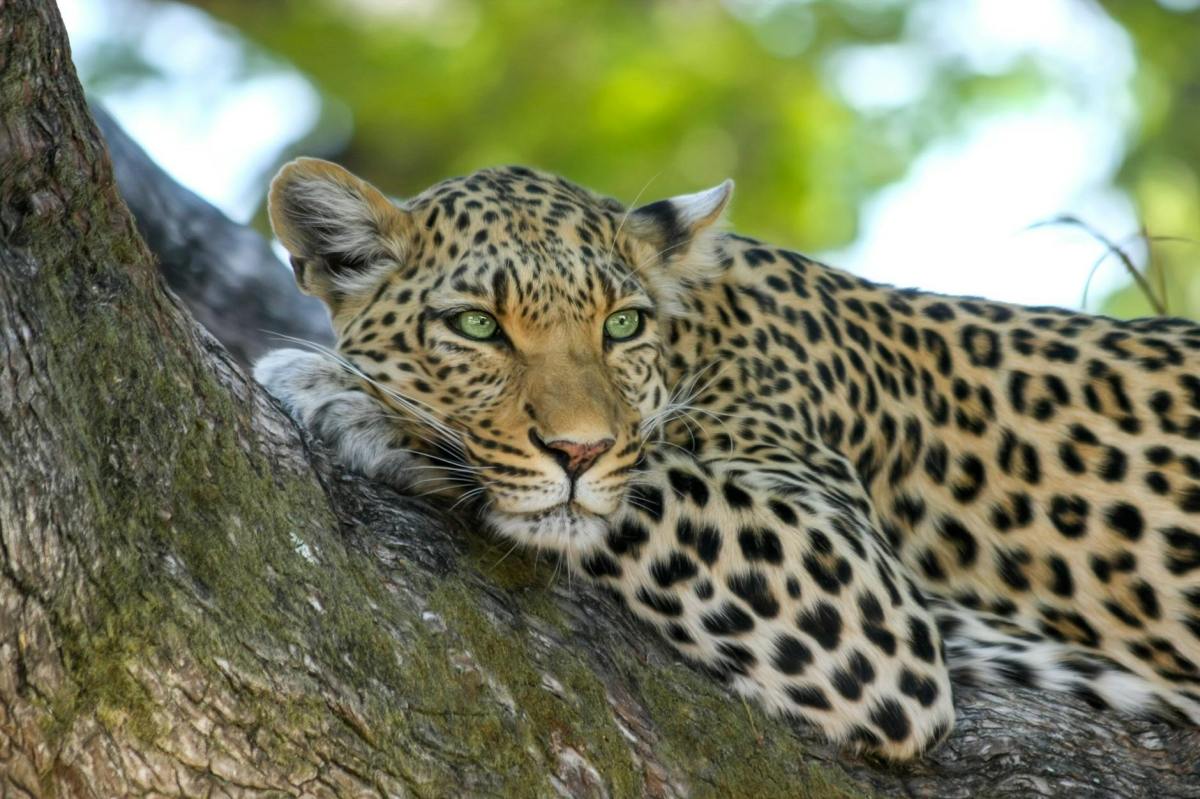
An image of a leopard cub
Credit: RudiHulshof/iStock

Buddy changed tactics.

“This is an outrage! Not even the tigers tried to eat me! This is…this is, uh, catibalism!”

The cubs were circling him now.

“Mommy, can we have a snack?” the male cub called, looking back at his mother on the tree.

“As long as it doesn’t spoil your dinner later,” came the reply.

“It won’t, mamma!”

Buddy gulped.

The cubs closed the distance, ready to strike, and Buddy was babbling while pleading for his life when the earth itself shook.

Branches jolted and leaves dropped. A flock of birds nesting in a nearby tree took off, silhouettes etching ephemeral geometric patterns in the sky. In the distance, a baboon shrieked a warning to its troop.

The cubs went from aggressive to retreat in the span of an instant, and even their parents looked alarmed, taking off after their young.

Buddy watched them flee, wondering if he should bolt in another direction as something incomprehensibly gargantuan lumbered toward him, shaking the trees.

He’d emptied his bowels by the time a gigantic head poked through the foliage, followed by the rest of the colossal beast. It was gray-skinned, leathery and bizarre, unlike anything Buddy had ever seen.

“Giant space aliens!” he screamed, turning around and running right into a tree trunk.


“Ahhhhh! Don’t eat me!”

Buddy awoke in a sweat, his fur damp in the soupy, stifling heat.

An entire platoon of the peculiar beasts stood around him, their sizes ranging from 25 Buddies in mass to freakishly large individuals sporting pairs of prodigious teeth that looked like scimitars made of bone.

“Einstein’s awake,” one of them rumbled, and the rest turned from stuffing themselves with leaves to get a better look at the Liliputian animal before them.

“What is that thing?” one of them asked.

“It’s a fun-size cheetah!” one exclaimed confidently.

“No, it’s a baby Serval!” another said. “But the color’s all wrong.”

In the distance, a giraffe poked its head above the tree line, pausing to munch on the silky pink flowers of a mimosa tree.

Buddy was saved from hungry leopards by friendly giant space aliens!

Buddy cautiously pushed himself up on his paws. These aliens did not seem interested in eating him.

“Greetings,” he said. “I am a feline, a cat from planet Earth! What planet do you come from?”

There was a pause, then trumpeting, cacaphonic laughter.

“‘What planet are you from?'” one of the great beasts mimicked, sparking a second round of giggles that sounded like the trombone section of an orchestra, if someone had slipped the players psychedelics.

“We are elephants, and this is our home,” said the leader, a magnificent female. “And you, little one, are fortunate we happened by.”

Buddy puffed himself up.

“I think you mean the leopards were lucky,” he said, flexing his meowscles. “They didn’t want to tangle with these guns.”

The elephants chortled. “Can we keep him? He’s funny!”

The matriarch shook her massive head.

“He is far from home, and he should return before he runs into leopards again, or something worse,” she said.

Buddy looked unsure of himself.

“But I’m homies with the jaguars and the tigers! I thought…you know, I could be down with the leopards too. Us big cats gotta stick together, ya know? It’s hard out there for an apex predator. By the way, got any lunch?”

One of the elephants raised her trunk, pointing east toward a herd of intimidating horned beasts.

“Lunch,” she said. “Think you can take them?”

Buddy gulped.

“Go home, little one.”


Buddy’s version of events!

“So anyway,” Buddy said, addressing his human, “that’s how I impressed the leopards, and they made me their king. In fact, they bestowed the honorific ‘Paka mkubwa na mwenye misuli hodari,’ which means ‘great and mighty muscled cat’ in Swahili!”

“Sounds like you had quite an adventure! That’s impressive, Bud!” Big Buddy said.

“It is! It is!” Buddy said, nodding vigorously.

Big Buddy made a whistling sound.

“Was that before or after you peed yourself in terror?”

“What? I…no, I told you, they made me their king! Where did you hear this, this slander?”

Big Buddy reached for his iPad, pulling up images of a terrified Little Buddy running from leopard cubs on the savanna, Buddy running head-first into a tree, and Buddy cowering before a herd of elephants.

“A wildlife tour was nearby during your ‘coronation,’ but this is probably just a gray tabby who looks exactly like you and happened to be right where you were crowned,” he said. “Congratulations, Your Meowjesty!”