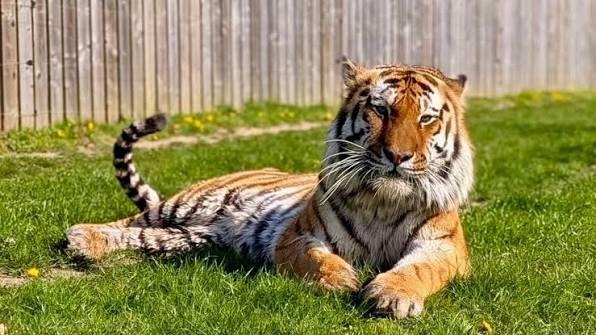
UK Man ‘Bowed Down’ To Tiger While Livestreaming Own Death: Police

The visitor’s strange behavior and the crowd’s panicked screams began to override the tiger’s initial confused curiosity, prompting his predatory instincts to kick in.

A British man killed this weekend by a zoo tiger was mentally “vulnerable” and behaved bizarrely before and during his grisly encounter, police and witnesses said.

William Chapman, described in media reports as “in his early 20s,” was seen laughing and dancing before he hopped the barriers separating guests at Yorkshire Wildlife Park from its Land of the Tigers exhibit.

Chapman suffered from “significant mental illness,” his family wrote in a statement.

In audio captured a few minutes before Chapman’s 1:30 pm death on Oct. 10, the late Briton handed his smartphone to another visitor and asked the woman to take photos of him with the tiger in the background.

“Thank you, lady,” he’s heard saying on the recording before he climbed the barriers in front of horrified guests and dropped into the enclosure housing Altai, an Amur tiger who just turned five years old about two weeks ago.
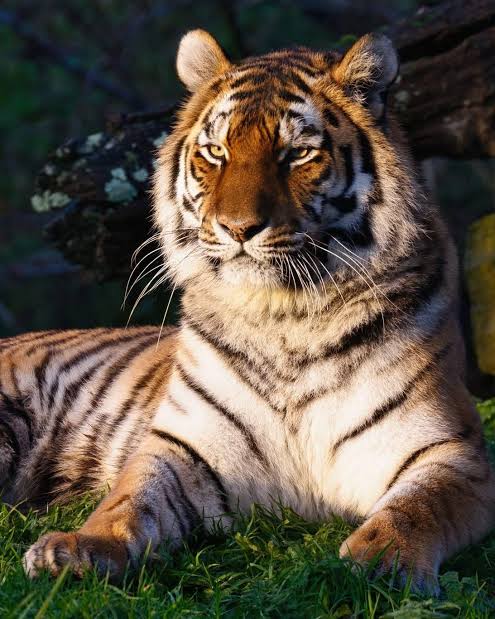
A close-up of a tiger resting on the grass, showcasing its distinctive orange and black stripes, with a focused gaze.
Altai. Credit: Yorkshire Wildlife Park

The encounter took an even stranger turn from there as Chapman, who was live-streaming to Instagram, seemed to welcome Altai. The curious big cat hopped down from a wooden platform where he’d been soaking up the sun and padded unhurriedly toward Chapman, who spread his arms theatrically.

“It looked like a performance,” bystander Anthony Hunt said. “He got down where everyone could see him in the main viewing area. He was on all fours, praying and bowing down to the tiger. It was like he was waiting for the tiger.”

Still images show Altai standing in a confused, non-aggressive posture, with telltale “helicopter ears” indicating curiosity and hesitation about how to respond.

Chapman’s behavior didn’t fit Altai’s cognitive script.

The tiger’s hardwired instincts told him incursions from other members of his species are threats. His experiences in captivity told him humans are caretakers who show up at predictable times as part of a daily routine to feed him, repair his enclosure or introduce enrichment items. This was something entirely new.
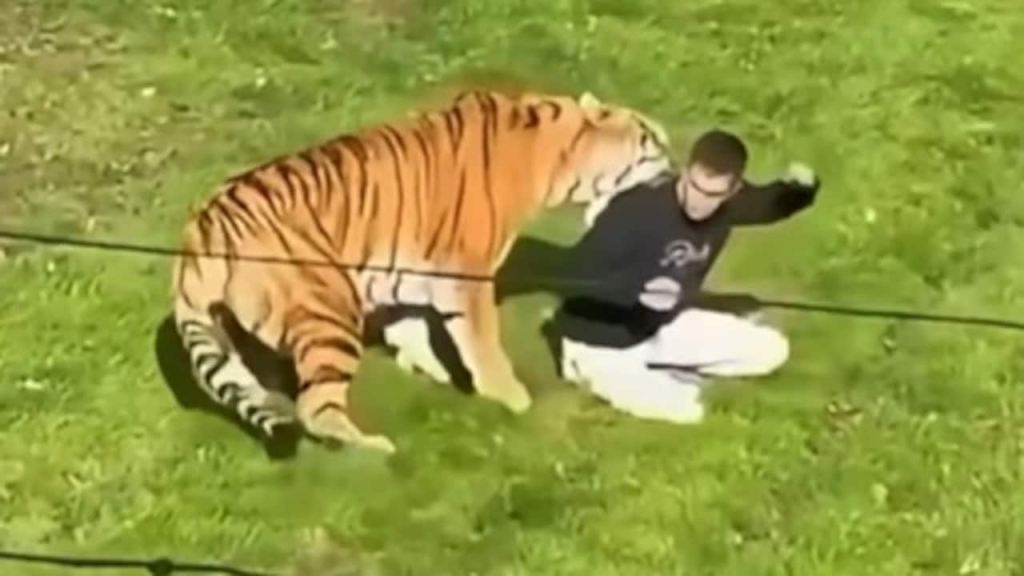
A person kneels on grass while interacting with a large tiger in a natural setting.
A still from footage recorded by a witness to Saturday afternoon’s fatal encounter.

While I’ve learned my lesson when it comes to watching video of things I can’t unsee and have no desire to watch footage of a man’s life ending in a violent mauling, I did watch short clips of the preceding moments. They were compiled from recordings by bystanders and Chapman’s own feed.

The moment the situation changed was unambiguous, and you can see exactly when Altai became overstimulated and his predatory drive kicked in: Chapman dropped to all fours, reducing his physical profile until he resembled prey, and the panicked screams from the crowd of onlookers pushed Altai into overstimulation and hypervigilance.

He knew the encounter had taken a turn, and that’s when he took his first few exploratory swipes, still pulling his punches as he tried to figure out what was happening.

Chapman responded by assuming a defensive posture, raising a finger to the big cat while shouting “No! No!” and chiding him for being “naughty.” To the tiger, Chapman confirmed he was prey.

At the same time the screams from above grew louder. Altai’s predatory instincts were fully engaged, and according to reports that’s when he mauled Chapman and delivered a kill bite to the UK man’s neck.

A young man with short hair and earbuds stands in front of a panoramic landscape featuring rolling hills and lush greenery.
Chapman’s family said he was taking “strong medication” to help manage mental health issues.

Zookeepers who rushed to the scene fired warning shots, sending Altai scurrying for the safety of his den. A medical airlift helicopter arrived a few minutes later, but by then it was too late. Chapman had bled out and was pronounced dead at the scene.

Authorities erected screens to conceal the carnage as staff closed the zoo. Footage of guests leaving showed bystanders in shock, discussing what they’d just witnessed as they shuffled through the exit.

One woman, a mother who tried to stop Chapman from leaping, was particularly disturbed. She did not speak to reporters.

Chapman “looked like he was taking selfies” after dropping into the habitat, 21-year-old Scarlet Hogan told The Telegraph.

“Up until he got attacked, it was like he was in a trance, not in reality at all,” Hogan said.

“He had arms wide open ready for the tiger to attack him. It was quite bad. We were just stood there, frozen… the last thing we saw was the tiger’s jaw on his neck.”

A magnificent tiger resting on green grass, with a background of trees and a logo for Yorkshire Wildlife Park in the corner.
Altai pictured in promotional material for the park.

Chapman, who had traveled from nearby Doncaster to the zoo, was an actor who had roles in productions by the BBC and ITV.

“The man who I saw on the bridge with his AirPods in, dancing, was happily enjoying seeing the tiger,” witness Marie Miller said.

Park staff said Altai, whose subspecies is critically endangered, will not be euthanized, and witnesses who spoke to the BBC said staff promptly took control and shut the park down.

Neither the zoo nor the tiger were at fault, said the University of Reading’s Campbell Murn, a former member of the UK government’s Zoo Experts Committee.

“I view it in the same way a determined thief will get into somebody’s house or somebody’s car,” Murn said, “and despite the best security systems and enclosures sometimes these things happen.”
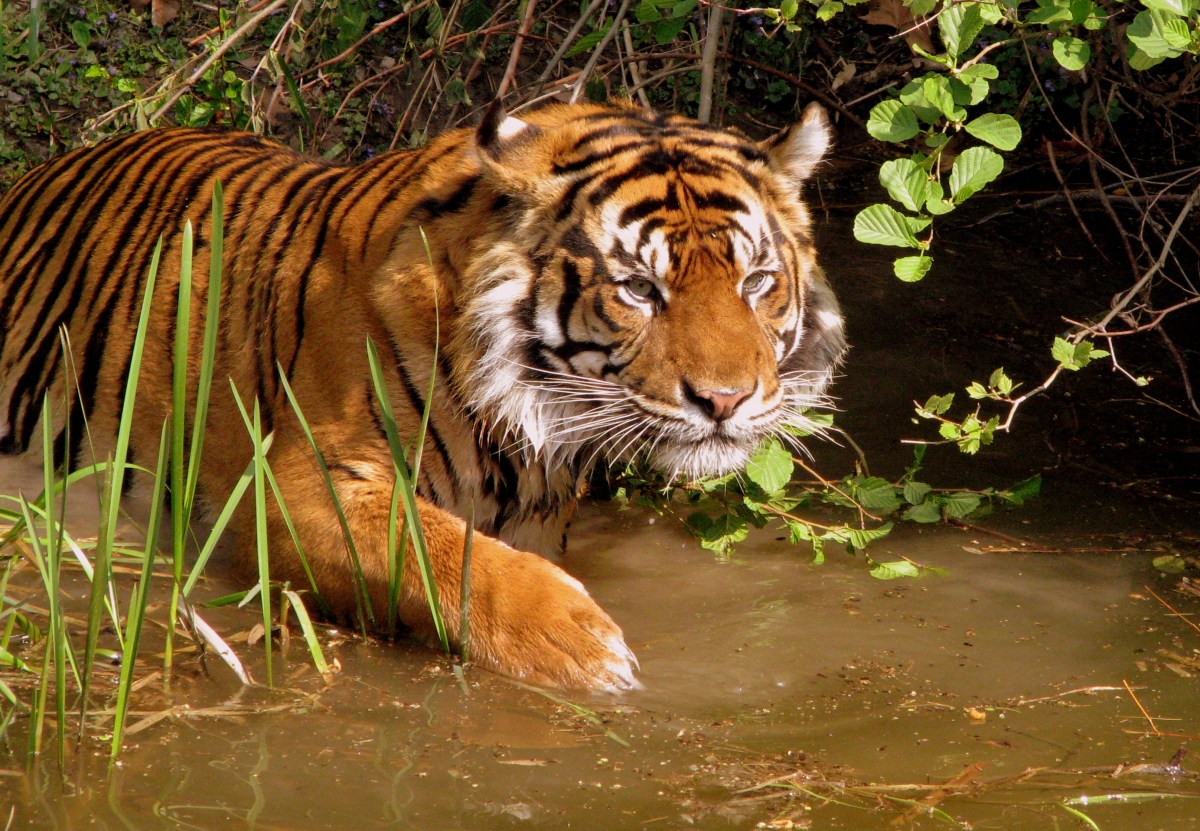
The Cost Of Living With Tigers: People In Rural India Hide Indoors As Foresters Track 2 Hungry Big Cats

Tiger attacks are a real danger in rural India, where the big cats kill people and livestock. To protect the species, the government pulls off a difficult balancing act aimed at minimizing inter-species conflict.

In his memoir, Man-Eaters of Kumaon, legendary tiger hunter (and later staunch conservationist) Jim Corbett described how he and his men arrived to find a ghost town when they tracked a man-eating tiger to a rural village.

Every door was closed and locked, shutters were closed tight, and despite the fact that it was harvest time, not a single person was working the nearby fields.

The people who lived there had good reason to be petrified. The infamous Champawat tigress had killed more than 430 people by that point, including a young woman from the village just a few days earlier. Usually the tigress would vanish from an area after a kill, frustrating locals and hunters by popping up virtually anywhere in a 50-mile radius, but for some reason she stuck around the village and sat on the outskirts at night, keeping the local people awake with her calls.

Corbett’s famed hunt of the “demon of Champawat” happened in 1907, and although it might sound like a problem from the past, it’s current reality for people in parts of India, Nepal and, to a lesser extent, the sparsely populated mountain forests in eastern Russia.

In Garwha and Ranchi, two towns in eastern India about 215km (133 miles) apart, “villagers have stopped using forest routes to reach markets and are reluctant to leave their homes for work,” the Times of India reported on Monday.

That’s because hungry tigers have been on the prowl, demonstrating little fear of people as they help themselves to livestock. Between Jan. 1 and Jan. 6, the tigers killed and ate three cattle and a buffalo.

Siberian tiger
Tigers require large, contiguous tracks of land measuring in the hundreds of square miles. India and Russia have both set aside massive preserves for the apex predators to increase their numbers in the wild. Image credit: Wikimedia Commons

So far they’ve eluded camera traps, but forest rangers say they believe there are two tigers because of the distance between Garwha and Ranchi, which is almost three times the typical tiger range.

In places where big cats live in proximity to humans, especially farmers, the government pays compensation to the owners of livestock killed and eaten by the predators.

There’s also a separate, more controversial compensation program for the families of people killed by tigers. Recent court cases in the country have hinged on the cold calculations of attaching monetary value to human life, and whether families are owed compensation if their relatives knowingly entered tiger preserves.

For India, it’s part of a delicate balancing act between conserving the country’s national animal and one of nature’s most beloved species, and avoiding the ire of people who are impacted by their presence. When big cats prey on livestock, if the government does not address the situation, locals will eventually take matters into their own hands and try to kill the apex predators. That usually doesn’t work out well for either side.

On average, about 60 people are killed each year by tigers in India, according to government statistics. There’s been a sharp increase in victims in recent years, with tigers taking 110 human lives in 2022 and 83 in 2023, although it’s not yet clear why.

As for livestock, a 2018 study by wildlife biologists with the Corbett Foundation documented 8,365 reported instances of big cats killing cattle, buffalo and other animals between 2006 and 2015. That works out to about 830 per year, with tigers responsible for 570 livestock kills on average and leopards responsible for the rest.

To reduce the number of inter-species conflicts, the government of India has relocated thousands of families away from the country’s 27 tiger preserves in addition to compensating farmers for their losses.

Tiger sub
A tiger cub on a preserve in India. Credit: Wikimedia Commons

On a tangential note, this is another reason why the persistent claims of big cats stalking the British countryside strain credulity.

To paraphrase wildlife conservationist Egil Droge of the University of Oxford, when big cats live in an area, you know it because the signs are everywhere — massive and unmistakable pug marks (paw prints) on the ground, trees left with deep gauges by males marking their territory, and dung also serving as a territorial marker.

“I’ve worked with large carnivores in Africa since 2007 and it’s obvious if big cats are around. You would regularly come across prints of their paws along roads. The rasping sound of a leopard’s roar can be heard from several kilometres,” Droge wrote in a 2023 post about alleged big cat sightings in the UK.

Last but not least, big cats eat. A lot. A reliable supply of large prey animals is necessary to support even the smallest of breeding populations, and felids of all species are known to go for easy meals — in this case livestock — when the opportunity presents itself.

Still, the idea refuses to die, and there are still regular reports from people who have seen large cats and insist they’re not our domesticated friends.

Leopard in a pub
“So we left the sheep there at the edge of the field and made sure the lady saw us before we buggered off over the fence. Next day, we was in all the papers! A right laugh that was, mate.”