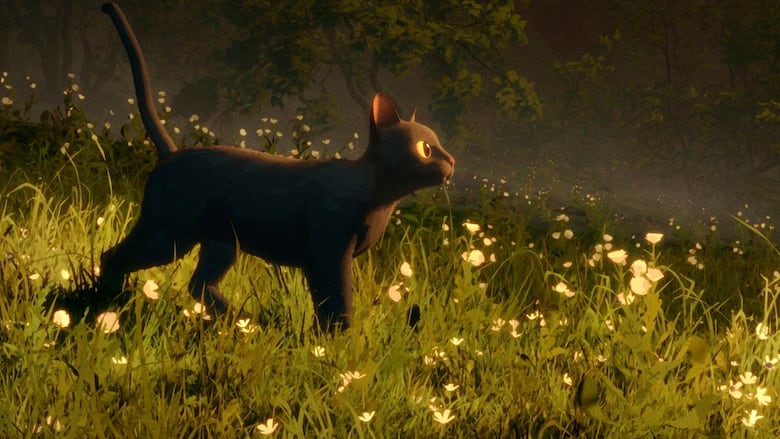
The animated feature about a cat surviving an apocalyptic flood has racked up awards and earned universal acclaim.
It’s been quite a year for Latvian animator Gints Zilbalodis and Cat, the star of Flow.
Their film won an Oscar for best animated feature film, racked up wins at the Golden Globes and smaller film festivals, became the most-watched film in Latvian history, snuggled its way into the hearts of audiences in the US, Europe and Asia, and enjoys incredibly rare universal accolades from critics and viewers alike, scoring 97 and 98 percent with each group respectively on film review site Rotten Tomatoes.
Now Cat has officially recognized his Oscar by doing precisely what his species loves to do. In a short video posted by Zilbalodis, Cat smacks the golden statue off the railing of his boat and onto the deck, to the annoyance of his lemur buddy.
A woman taunts her cat with ultra-processed snacks, then laughs at his disgusted reaction when he gets a taste. The “cute” video has gone viral.
From the bowels of TikTok comes the latest “cute” video of an attention monger abusing her cat, this time by feeding him Flamin’ Hot Cheetos.
The user opened the bag in front of Butters the cat, waved the Cheetos in his face, held them up to his nose, then feebly protested “These are my snacks! It’s spicy!” after getting the little dude interested.
She allowed Butters to eat Cheetos from her hand and lick her fingers, and his reaction is about what you’d expect from an obligate carnivore who just ate ultra-processed food made from cheap corn filler, chili powder, cayenne pepper, and cancer-causing artificial food dyes. He’s disgusted and uncomfortable.
“You can’t have these! Let me wave them in your face and taunt you, so you know you can’t have them! Haha, isn’t that clever?”
The difference is, Butters can’t guzzle milk or water to wash the taste away, so he settles for angrily swatting at his human while she laughs at him.
The woman thought her video was so clever, she’s shared it online and is enjoying the cheap dopamine hit that comes with accumulating internet points, aka likes.
Here’s a question for people who make social media “content” at the expense of their pets: how many likes are worth destroying the trust between you and your cat(s)?
I’m sure some people think I’m a scold, but all it takes is one clown to start a viral trend, and then all of a sudden you have thousands of people, all of them desperate for validation from strangers on the internet, foisting Flamin’ Hot Cheetos and Takis on their unsuspecting cats. As a general rule, the dumbest and most abusive trends go viral.
Veterinary science and research still focuses primarily on dogs, but scientists are trying to change that and help us better understand how to care for our little feline buddies.
“It’s just a cat.”
I’ve heard that so many times, and if you’re a cat lover, you probably have too.
It’s an insinuation that cats are throwaway animals, fungible pets who can be replaced by others of their species because, some people claim, they don’t express themselves as individuals, never really warm to humans in the first place, and besides, it’s not like they have emotions.
Countering those persistent myths is one of the reasons I write this blog. I still didn’t have a full appreciation for how singular and smart cats can be until I brought Buddy home. I never fathomed the depth of his emotions, the strength of his convictions or his willingness to make his opinions known about everything.
In some ways, I’m still shocked at how much he communicates and how well we understand each other.
However, one of my biggest fears is not doing right by him, especially missing signs of declining health as he gets older.
That’s the subject of a column today in the New York Times, in which science write Emily Anthes recalls the subtle signs that her cat, Olive, was sick, and the veterinarian’s assessment that she wasn’t just ill, she was on death’s door.
Credit: Pexels
Anthes points out that, to this day, veterinary training uses canines as the default, and treatments for cats are often just adapted from treatments for dogs, even if there’s no data suggesting those methods actually work for feline patients.
“My anatomy book was ‘Anatomy of the Dog,’” Maggie Placer, veterinary science programs manager at EveryCat Health Foundation, told the Times. “We had PowerPoints and supplements for the cats.”
The differences go beyond body plan, organs and behavior: drugs that work for dogs can be ineffective or dangerous for cats. Treatments otherwise regarded as effective in other animals could be harmful to felines too.
“It’s not reasonable to assume that everything that works in a dog will work in a cat,” Bruce Kornreich, director of the Cornell Feline Health Center, told Anthes. “There’s a lot that we still need to learn.”
Credit: Pexels
The situation with feline veterinary science mirrors the gap in behavioral studies between cats and dogs.
Over the past decade, research teams in countries like the US and Japan have made efforts to close the gap by recognizing that studies must be crafted to feline points of view, and that laboratories are not suitable places for studying the behavior of such notoriously territorial animals. Cats behave differently outside of their environments, rendering data useless if it’s captured in settings where kitties are stressed, unsure of themselves or even just miffed that they’re not at home enjoying a nap.
There are unique challenges when it comes to studying effective veterinary treatments in cats as well. Primary among them is feline stoicism, an evolutionary adaptation.
Simply put, cats will do everything they can to mask injury and sickness because they don’t want to become prey. Unfortunately that means by the time a cat cannot conceal an ailment anymore, the disease or injury has progressed. Even if a cat has lived indoors her entire life, the directive to disguise her pain is hardcoded into her DNA.
Anthes’ cat, Olive, didn’t make it. But her litter mate is chugging along, and to help advance the cause of understanding cat health, Anthes submitted both cats’ fur clippings to geneticist Dr. Elinor Karlsson’s Darwin’s Cats, a “non-profit community science project” that uses DNA submitted by cat owners to better understand our furry friends and unlock the secrets of their health and behavior.
Let’s hope that such projects spark a renaissance in studying cat health, like they have with research into feline behavior, so we can do right by our little buddies.
Buddy’s back at it, trying to befriend big cats. Emboldened by his success with the tolerant and wise jaguars, the reckless tabby has his sights set on the savanna and its temperamental predators, the leopards. Can Buddy win the admiration of these notoriously dangerous felids, or will he end up as a light snack for a spotted cat?
VIRUNGA NATIONAL PARK, Democratic Republic of Congo — “What the heck is that?”
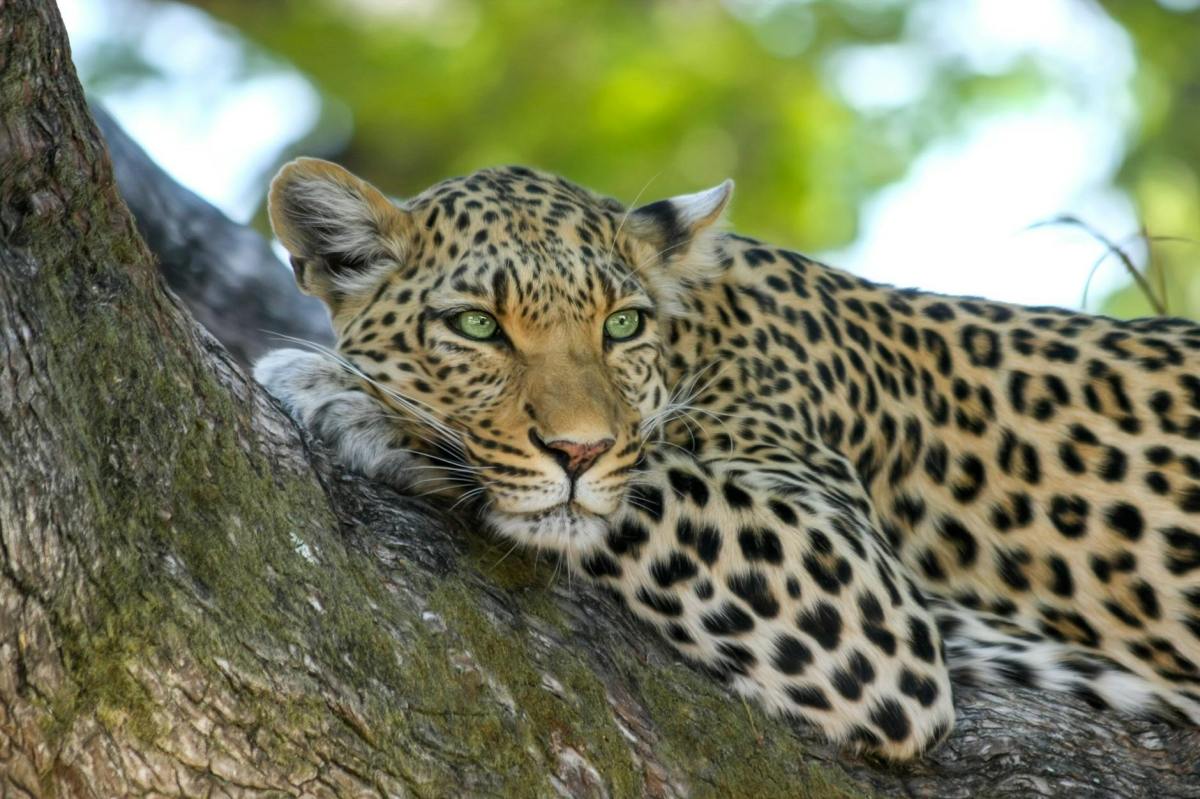
A leopardess raised her head in response to her mate’s question, gazing down from the sturdy limb of an acacia tree where she’d taken refuge from the scorching midday sun.
Two hundred yards ahead, a tiny gray cat was padding toward them, picking his way carefully around rocks and occasionally disappearing in the high grass.
“There’s nothin’ that a hundred men on Mars could ever do,” the little feline sang as he walked. “I bless the rains down in Africa! I bless the rains down in…”
The diminutive feline stopped near the base of the tree and looked up at the leopards.
The adult leopards were momentarily stunned until one of the cubs awoke from her nap, spotted Buddy and exclaimed: “Look, mommy, lunch!”
The small cat flashed a wide smile.
“That’s a great idea! I’ve already eaten, but you know what they say: a lunch a day barely keeps the rumbles at bay! I’m a three-lunch cat, myself. So what are we having?”
Another cub piped up.
“That’s not lunch, that’s a snack!” he told his sister.
“And what a cute little snack he is!” the female cub said, gracefully dropping from her napping spot in the tree.
Buddy’s eyes bulged.
“You’re…you’re talking about me?”
The male cub did a squeaky impression of a roar.
“Do you see any other single-serve snacks around?”
Buddy licked his lips, his effort to hide his fear betrayed by his rising hackles and tail, which now resembled a quivering spiked club.
“I…I…I am a cat,” he said in his best impression of an authoritative meow. “I’m practically your cousin!”
The female was just paces away now and moving too fast for Buddy’s liking as he backpedaled.
“The question is,” she said, “are you tasty like cousin Serval or cousin cheetah?”
Credit: RudiHulshof/iStock
Buddy changed tactics.
“This is an outrage! Not even the tigers tried to eat me! This is…this is, uh, catibalism!”
The cubs were circling him now.
“Mommy, can we have a snack?” the male cub called, looking back at his mother on the tree.
“As long as it doesn’t spoil your dinner later,” came the reply.
“It won’t, mamma!”
Buddy gulped.
The cubs closed the distance, ready to strike, and Buddy was babbling while pleading for his life when the earth itself shook.
Branches jolted and leaves dropped. A flock of birds nesting in a nearby tree took off, silhouettes etching ephemeral geometric patterns in the sky. In the distance, a baboon shrieked a warning to its troop.
The cubs went from aggressive to retreat in the span of an instant, and even their parents looked alarmed, taking off after their young.
Buddy watched them flee, wondering if he should bolt in another direction as something incomprehensibly gargantuan lumbered toward him, shaking the trees.
He’d emptied his bowels by the time a gigantic head poked through the foliage, followed by the rest of the colossal beast. It was gray-skinned, leathery and bizarre, unlike anything Buddy had ever seen.
“Giant space aliens!” he screamed, turning around and running right into a tree trunk.
“Ahhhhh! Don’t eat me!”
Buddy awoke in a sweat, his fur damp in the soupy, stifling heat.
An entire platoon of the peculiar beasts stood around him, their sizes ranging from 25 Buddies in mass to freakishly large individuals sporting pairs of prodigious teeth that looked like scimitars made of bone.
“Einstein’s awake,” one of them rumbled, and the rest turned from stuffing themselves with leaves to get a better look at the Liliputian animal before them.
“What is that thing?” one of them asked.
“It’s a fun-size cheetah!” one exclaimed confidently.
“No, it’s a baby Serval!” another said. “But the color’s all wrong.”
In the distance, a giraffe poked its head above the tree line, pausing to munch on the silky pink flowers of a mimosa tree.
Buddy was saved from hungry leopards by friendly giant space aliens!
Buddy cautiously pushed himself up on his paws. These aliens did not seem interested in eating him.
“Greetings,” he said. “I am a feline, a cat from planet Earth! What planet do you come from?”
There was a pause, then trumpeting, cacaphonic laughter.
“‘What planet are you from?'” one of the great beasts mimicked, sparking a second round of giggles that sounded like the trombone section of an orchestra, if someone had slipped the players psychedelics.
“We are elephants, and this is our home,” said the leader, a magnificent female. “And you, little one, are fortunate we happened by.”
Buddy puffed himself up.
“I think you mean the leopards were lucky,” he said, flexing his meowscles. “They didn’t want to tangle with these guns.”
The elephants chortled. “Can we keep him? He’s funny!”
The matriarch shook her massive head.
“He is far from home, and he should return before he runs into leopards again, or something worse,” she said.
Buddy looked unsure of himself.
“But I’m homies with the jaguars and the tigers! I thought…you know, I could be down with the leopards too. Us big cats gotta stick together, ya know? It’s hard out there for an apex predator. By the way, got any lunch?”
One of the elephants raised her trunk, pointing east toward a herd of intimidating horned beasts.
“Lunch,” she said. “Think you can take them?”
Buddy gulped.
“Go home, little one.”
Buddy’s version of events!
“So anyway,” Buddy said, addressing his human, “that’s how I impressed the leopards, and they made me their king. In fact, they bestowed the honorific ‘Paka mkubwa na mwenye misuli hodari,’ which means ‘great and mighty muscled cat’ in Swahili!”
“Sounds like you had quite an adventure! That’s impressive, Bud!” Big Buddy said.
“It is! It is!” Buddy said, nodding vigorously.
Big Buddy made a whistling sound.
“Was that before or after you peed yourself in terror?”
“What? I…no, I told you, they made me their king! Where did you hear this, this slander?”
Big Buddy reached for his iPad, pulling up images of a terrified Little Buddy running from leopard cubs on the savanna, Buddy running head-first into a tree, and Buddy cowering before a herd of elephants.
“A wildlife tour was nearby during your ‘coronation,’ but this is probably just a gray tabby who looks exactly like you and happened to be right where you were crowned,” he said. “Congratulations, Your Meowjesty!”
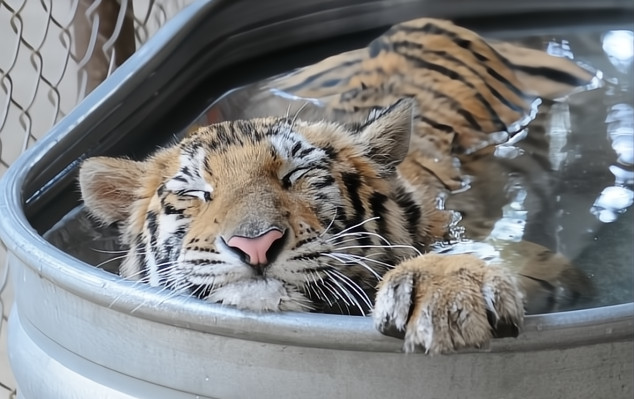
For tigers, going for a dip on a hot day is pure bliss.
Most cats wouldn’t go near water if even if you lured them with a giant spread of catnip and Temptations on an inflatable table.
But tigers? They love it. Here are some shots of the world’s biggest cats taking a dip.
A Malayan tiger named Azul going for a swim at the Bronx Zoo. Credit: Julie Marsen Laher, Wildlife Conservation Society
Siberian tigers in a tub at a sanctuary in Russia. Credit: digger03/Flickr
This meme made me laugh.
Aasha was rescued from a traveling circus after an inspector found her sickly, suffering from ringworm and only 30 pounds at 8 months old. She’s flourished since she was brought to a sanctuary where she’s been given proper care, a good diet and a calm environment. Aasha is also pictured in the feature photo up top.
A tigress and her cubs cooling off in a river in India. Credit: Sandesh Kadur
Sundarban tigers are a subspecies of the Bengal who live in mangrove forests and are well-adapted to swimming. This Sundarban tiger was spotted on a wildlife tour in India. Credit: Soumyajit Nandy/Wikimedia Commons
This tiger cooled off on a hot day at the Dortmund Zoological Garden in Dortmund, Germany. Credit: Hans Stieglitz/Wikimedia Commons







 Pain In The Bud