Buddy Visits Leopards, Finds Himself On The Menu

Buddy’s back at it, trying to befriend big cats. Emboldened by his success with the tolerant and wise jaguars, the reckless tabby has his sights set on the savanna and its temperamental predators, the leopards. Can Buddy win the admiration of these notoriously dangerous felids, or will he end up as a light snack for a spotted cat?

VIRUNGA NATIONAL PARK, Democratic Republic of Congo — “What the heck is that?”

A leopardess raised her head in response to her mate’s question, gazing down from the sturdy limb of an acacia tree where she’d taken refuge from the scorching midday sun.

Two hundred yards ahead, a tiny gray cat was padding toward them, picking his way carefully around rocks and occasionally disappearing in the high grass.

“There’s nothin’ that a hundred men on Mars could ever do,” the little feline sang as he walked. “I bless the rains down in Africa! I bless the rains down in…”

The diminutive feline stopped near the base of the tree and looked up at the leopards.

“Jambo!” he meowed enthusiastically. “My name is Budvuvwevwevwe Budyetenyevwe Buddabe Ossas!” he announced. “You can call me Buddy!”

Jambo!

The adult leopards were momentarily stunned until one of the cubs awoke from her nap, spotted Buddy and exclaimed: “Look, mommy, lunch!”

The small cat flashed a wide smile.

“That’s a great idea! I’ve already eaten, but you know what they say: a lunch a day barely keeps the rumbles at bay! I’m a three-lunch cat, myself. So what are we having?”

Another cub piped up.

“That’s not lunch, that’s a snack!” he told his sister.

“And what a cute little snack he is!” the female cub said, gracefully dropping from her napping spot in the tree.

Buddy’s eyes bulged.

“You’re…you’re talking about me?”

The male cub did a squeaky impression of a roar.

“Do you see any other single-serve snacks around?”

Buddy licked his lips, his effort to hide his fear betrayed by his rising hackles and tail, which now resembled a quivering spiked club.

“I…I…I am a cat,” he said in his best impression of an authoritative meow. “I’m practically your cousin!”

The female was just paces away now and moving too fast for Buddy’s liking as he backpedaled.

“The question is,” she said, “are you tasty like cousin Serval or cousin cheetah?”

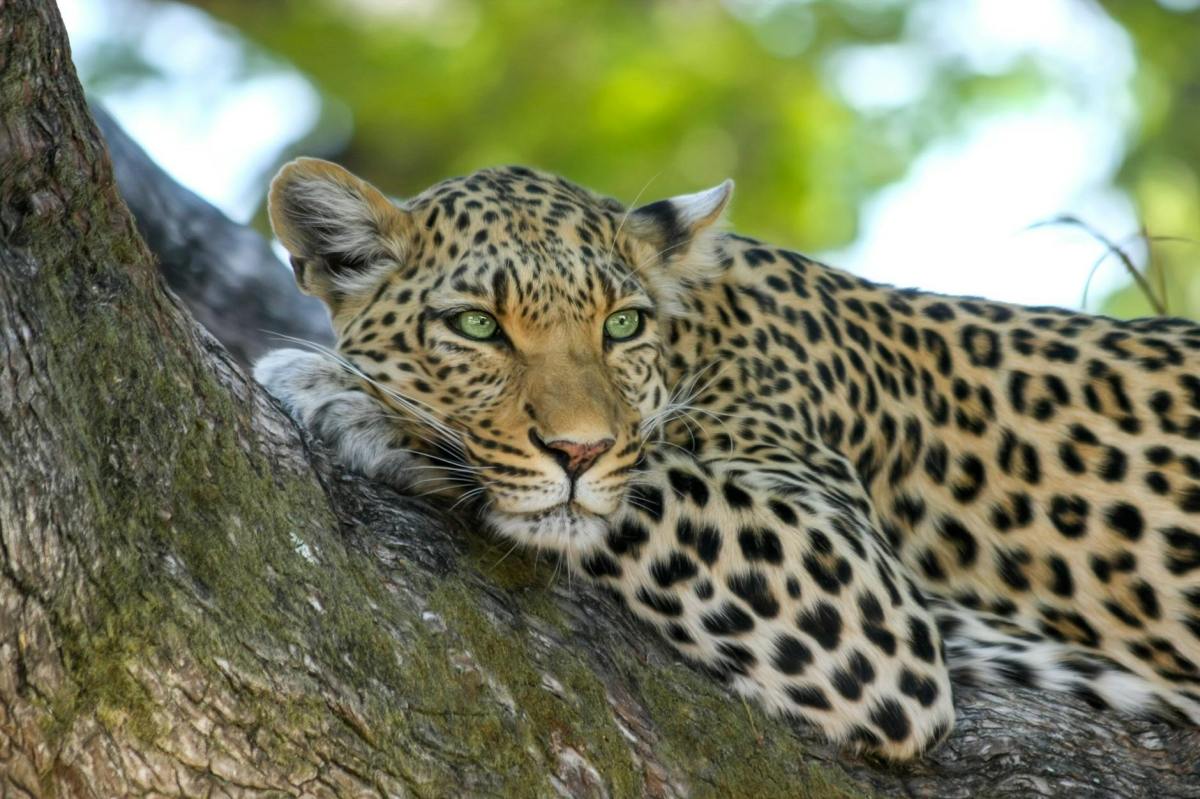
An image of a leopard cub
Credit: RudiHulshof/iStock

Buddy changed tactics.

“This is an outrage! Not even the tigers tried to eat me! This is…this is, uh, catibalism!”

The cubs were circling him now.

“Mommy, can we have a snack?” the male cub called, looking back at his mother on the tree.

“As long as it doesn’t spoil your dinner later,” came the reply.

“It won’t, mamma!”

Buddy gulped.

The cubs closed the distance, ready to strike, and Buddy was babbling while pleading for his life when the earth itself shook.

Branches jolted and leaves dropped. A flock of birds nesting in a nearby tree took off, silhouettes etching ephemeral geometric patterns in the sky. In the distance, a baboon shrieked a warning to its troop.

The cubs went from aggressive to retreat in the span of an instant, and even their parents looked alarmed, taking off after their young.

Buddy watched them flee, wondering if he should bolt in another direction as something incomprehensibly gargantuan lumbered toward him, shaking the trees.

He’d emptied his bowels by the time a gigantic head poked through the foliage, followed by the rest of the colossal beast. It was gray-skinned, leathery and bizarre, unlike anything Buddy had ever seen.

“Giant space aliens!” he screamed, turning around and running right into a tree trunk.


“Ahhhhh! Don’t eat me!”

Buddy awoke in a sweat, his fur damp in the soupy, stifling heat.

An entire platoon of the peculiar beasts stood around him, their sizes ranging from 25 Buddies in mass to freakishly large individuals sporting pairs of prodigious teeth that looked like scimitars made of bone.

“Einstein’s awake,” one of them rumbled, and the rest turned from stuffing themselves with leaves to get a better look at the Liliputian animal before them.

“What is that thing?” one of them asked.

“It’s a fun-size cheetah!” one exclaimed confidently.

“No, it’s a baby Serval!” another said. “But the color’s all wrong.”

In the distance, a giraffe poked its head above the tree line, pausing to munch on the silky pink flowers of a mimosa tree.

Buddy was saved from hungry leopards by friendly giant space aliens!

Buddy cautiously pushed himself up on his paws. These aliens did not seem interested in eating him.

“Greetings,” he said. “I am a feline, a cat from planet Earth! What planet do you come from?”

There was a pause, then trumpeting, cacaphonic laughter.

“‘What planet are you from?'” one of the great beasts mimicked, sparking a second round of giggles that sounded like the trombone section of an orchestra, if someone had slipped the players psychedelics.

“We are elephants, and this is our home,” said the leader, a magnificent female. “And you, little one, are fortunate we happened by.”

Buddy puffed himself up.

“I think you mean the leopards were lucky,” he said, flexing his meowscles. “They didn’t want to tangle with these guns.”

The elephants chortled. “Can we keep him? He’s funny!”

The matriarch shook her massive head.

“He is far from home, and he should return before he runs into leopards again, or something worse,” she said.

Buddy looked unsure of himself.

“But I’m homies with the jaguars and the tigers! I thought…you know, I could be down with the leopards too. Us big cats gotta stick together, ya know? It’s hard out there for an apex predator. By the way, got any lunch?”

One of the elephants raised her trunk, pointing east toward a herd of intimidating horned beasts.

“Lunch,” she said. “Think you can take them?”

Buddy gulped.

“Go home, little one.”


Buddy’s version of events!

“So anyway,” Buddy said, addressing his human, “that’s how I impressed the leopards, and they made me their king. In fact, they bestowed the honorific ‘Paka mkubwa na mwenye misuli hodari,’ which means ‘great and mighty muscled cat’ in Swahili!”

“Sounds like you had quite an adventure! That’s impressive, Bud!” Big Buddy said.

“It is! It is!” Buddy said, nodding vigorously.

Big Buddy made a whistling sound.

“Was that before or after you peed yourself in terror?”

“What? I…no, I told you, they made me their king! Where did you hear this, this slander?”

Big Buddy reached for his iPad, pulling up images of a terrified Little Buddy running from leopard cubs on the savanna, Buddy running head-first into a tree, and Buddy cowering before a herd of elephants.

“A wildlife tour was nearby during your ‘coronation,’ but this is probably just a gray tabby who looks exactly like you and happened to be right where you were crowned,” he said. “Congratulations, Your Meowjesty!”

FBI: Felines Behind Mysterious Drones Spotted In Night Sky

Some observers believe the drone sightings are merely the first stage in an all-out feline takeover of the US. So far, cats have remained mum on their motivations, preferring instead to sow panic among Americans.

WASHINGTON –The caller was breathing heavily and speaking in rapid-fire sentences as if he had only moments to get the words out over the air.

“I’m telling you, Art, it’s the cats — the cats are piloting these drones!” the caller told Coast to Coast AM radio host Art Bell shortly after 1 am ET on Friday.

“Hold on, hold on,” Bell said theatrically. “You’re saying this has nothing to do with aliens or the government?”

The caller sighed.

“The cats may very well be in league with aliens, but I’m telling you, felines are behind…oh God! They’re here!”

The radio broadcast crackled with distorted hissing and yowling, punctuated by the caller’s pleas for mercy.

“Caller? West of the Rockies, are you there?”

The caller screamed a final time and the line went dead.

“Wow,” Bell told his audience of several million overnight listeners. “There you have it, folks. You be the judge, but that sounded like the real deal to me. Cats are piloting the mysterious drones!”

For weeks, Americans have been asking for answers about swarms of suspicious drones operating above homes, businesses, military bases and government buildings at night.

After rampant speculation that the drones could belong to rogue states, or could be part of some secret government flight test, the FBI confirmed Friday that felines are behind the frequent sightings.

Drone at night
A drone flies above a farm and ranch as the sun fades. Drones have been spotted circling chicken and turkey coops, as well as fish markets.

Biden administration officials confirmed to several media outlets that intelligence supported the theory that cats — not Iranians, Russians or some secret Pentagon operation — are operating the drone swarms that have been lighting up the night sky in states like New Jersey and Maryland for several weeks, befuddling local and state officials.

“At first we thought the idea was absurd,” said a high-ranking official, who spoke on condition of anonymity. “Then we received reports of drone swarms circling several meat-packing plants, a Chewy distribution center in Trenton, and two PetSmarts in northern New Jersey.”

So far, the felines’ motivation remains shrouded in mystery, but experts on the small, furry animals ventured guesses on what may have motivated their sudden interest in aviation and airspace.

“No one’s claimed responsibility, so we’re left to speculate,” said Norah Grayer, a feline behaviorist with NYU’s Gummitch School of Veterinary Science. “But it may be that felines, as a whole, have decided the meow is insufficient for getting their demands across. Humans have become adept at tuning out those vocalizations, so this may be the next step in an attention arms race, so to speak.”

Noted cat expert Jefferson Nebula offered a different explanation.

“Cats are notoriously subject to FOMO, which is one reason why they can’t abide closed doors,” he said. “If someone managed to convince them that we humans were holding out on them, and there are entire worlds of yums we keep for ourselves, well, that would spark the wrath of these otherwise friendly little guys.”

Cat with drone
Felines have mastered control over aerial drones despite their lack of thumbs.

For his part, Bell consulted with Michio Kaku, the physicist and science communicator who has been a regular presence on Coast to Coast.

“We physicists have been saying for decades that cats are much more intelligent than we give them credit for,” Kaku said. “This could be retribution for the Schroedinger’s cat thought experiment, or felids may be looking to surpass humanity’s understanding of 11-dimensional hyperspace.”

“Professor, we’ve spoken quite a bit about the Kardashev scale [of civilization progress] in the past,” Bell said. “If we separated human and feline societies, where would we each fall on the scale? Humans are about a zero point seven, are we not?”

“That’s right,” Kaku said. “We physicists believe humanity is on the cusp of a Type I civilization, with things like the internet as a Type I telecommunications system and fusion power on the horizon. However, if you break it down and cats were separated into their own civilization, cats could plausibly already be a Type I civilization.”

“They’re ahead of us?”

“That’s right,” Kaku said. “We physicists believe cats can tap directly into primordial energies and have mastered quantum teleportation. In Star Trek, the Federation is a Type II civilization, and the Caitians — a species of alien cats — are part of the Federation. Yet it’s widely understood that the only reason the Caitians haven’t conquered entire swaths of the galaxy, like the Borg and the Klingons, is because of their strict adherence to their napping schedule and their inherent laziness. These drone swarms may be a signal that real-life cats are fed up enough to disturb their napping schedules, in which case we should all be terrified.”

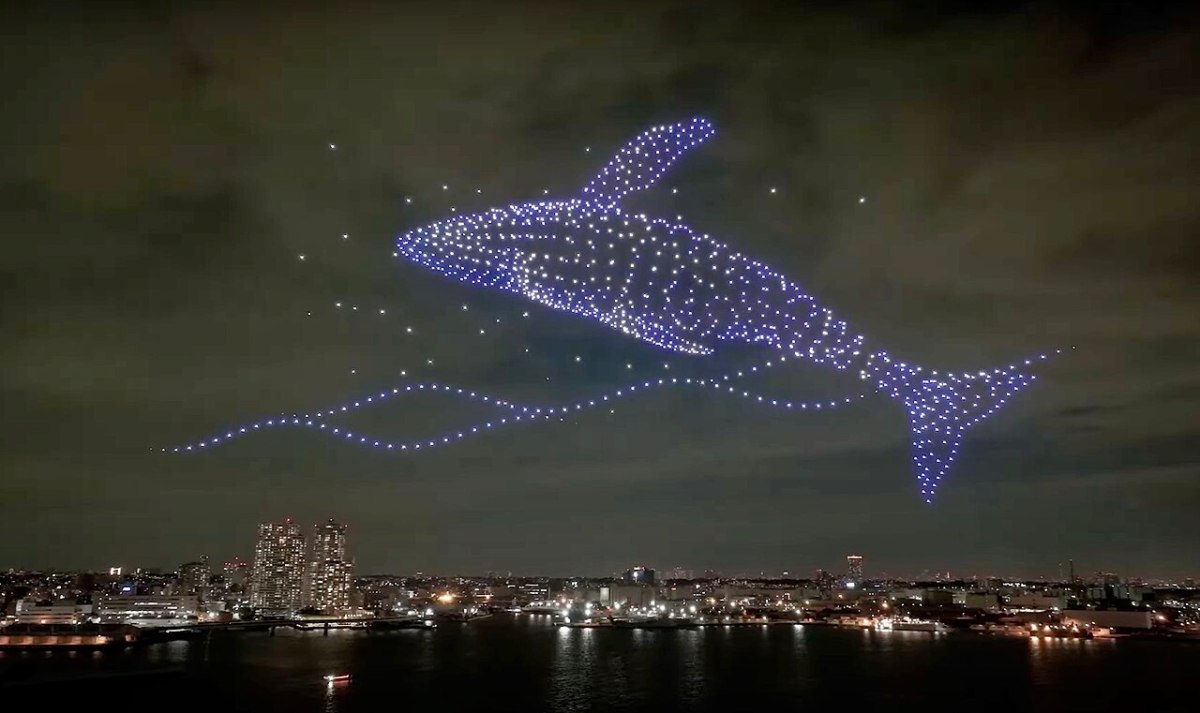
Header image of drone light show credit Wikimedia Commons

Review: Alien Romulus Is The Only Worthy Sequel To The 1979 Original

It took a fresh vision to prove there’s still cinematic life in the xenomorph and its ability to terrify audiences, but Romulus really shines where its affable characters are concerned.

Over four decades and six films — eight if you count crossovers — in the Alien universe, no one had been able to capture even a fraction of the terror, novelty or magic of Ridley Scott’s original 1979 science fiction-horror classic.

James Cameron turned the immediate sequel into a James Cameron movie, which means it’s packed with Velveeta one-liners, Spanish catch-phrases that no Spanish-speaking person would ever utter, and doesn’t exercise an ounce of the restraint Scott used to such cosmic effect.

In the third outing, David Fincher took on the impossible task of trying to reconcile the tone of the first two films and set the entire thing in a drab space prison, while Joss Whedon’s script for the fourth film was Firefly in Alien trappings.

Alien: Covenant
While the xenomorphs never looked better, Alien: Covenant felt like half a movie, ending on a cliffhanger that will never be resolved.

The titular monster had been stripped of nearly all its mystique by the time Scott returned to the franchise with Prometheus and Covenant, the fifth and sixth installments.

Both films were visually spectacular thanks to Scott’s efforts, but suffered from characters audiences couldn’t connect with, and in the case of Damon Lindelof’s script for Prometheus, characters the audience loathed. Instead of leaving the origin of the aliens ambiguous, Prometheus and Covenant offered a bizarre, nearly franchise-killing backstory involving alien-designed panspermia, artificial intelligence gone rogue and half-baked creationism given the veneer of science.

Prometheus
A space jockey chamber in the derelict starship, of the same kind seen in the first film, only this time the ship is powered up. Prometheus and Covenant tried to give us a backstory for the creatures, which only made them more pedestrian.

When Fede Alvarez presented his vision for an Alien film, he understood he had two do two things:

  1. Ignore everything that came after Scott’s original film
  2. Offer something more than the formulaic “monster stalks the cast deck by deck and kills them one at a time, leaving only the Final Girl”

Alien: Romulus sets off on that task by engaging in economical world building to give us more context than the five previous sequels managed together.

It’s tightly focused on our heroes, a group of five twenty-somethings who were born on a fiery world where lava perpetually flows, novel diseases spawn every year and a permanent atmospheric coat of soot and ash hides the sun and sky from the people who live there.

It’s a hellish place, and they’re there because multinational megacorporation Weyland-Yutani (“the company” in Alien parlance) wants the valuable ores within the planet’s crust. Like the crew of the Nostromo, the people are expendable in the company’s pursuit of profit.

Alien Romulus: Jackson's Star
The people who live in the colony at Jackson’s Star can’t even see their own sun as they slave for Weyland-Yutani corporation.

Our heroes work for the company, and they’re all orphans who lost their parents to work-related accidents or diseases from the mines.

Marie Rain Carradine’s (Cailee Spaeny) hope lies in the completion of her indentured servitude. With 12,000 hours of service to the company under her belt, Rain can finally take her brother to the colony world Yvaga, where the air isn’t toxic, people aren’t worked to death, and best of all in her mind, you can see the sun.

When Rain visits a Weyland-Yutani administrative center to formally separate from the company and relocate to Yvaga, a bureaucrat doubles her work requirement to 24,000 hours with the stroke of a key, damning her to another five or six years toiling on a planet that kills everyone eventually. Worse, the bureaucrat transfers her from farming to the mines, where her parents died.

“Know that the company is really grateful for your service,” the Wey-Yu representative says with an infuriating affect, dismissing the shocked young woman.

It’s in the depth of her despair that Rain gets a message from her friend Tyler (Archie Renaux) and listens to his pitch. Tyler and the others were working their orbital jobs miles above the colony’s surface when their computers pinged, alerting them to the approach of a massive starship.

Scans revealed a decommissioned Weyland-Yutani vessel that hadn’t been entirely stripped of its useful parts, slowly drifting through the system. Crucially, the ship still carried functional cryo pods, which would allow the group to sleep out the nine-plus year journey to Yvaga.

It’s freedom, there for the taking “before someone else does,” Isabela Merced’s Kay tells Rain.

When Rain balks at the dangerous and highly illegal plan, Tyler points out Weyland-Yutani will never grant them approval to leave the nightmarish world where they were born.

“I don’t want to end up like our parents,” he says, nodding toward the dead-eyed, soot-covered miners marching back to their utilitarian prefab homes after another shift toiling for the company.

You don’t need to guess that the plan does not go smoothly, nor the reason why.

What most people will need to know, in order to entrust two hours of their time to a franchise that has been beating a dead horse for decades, is that Alien: Romulus is the kind of sequel Scott himself would have made after the original, at the height of his directorial powers, if he hadn’t moved on to other projects.

Romulus replicates the magic of the original by taking things in exciting new directions, and by giving the audience a series of astonishing set pieces, including a gloriously nail-biting sequence that not only captures the beauty of space, but reminds us how hostile it is to our fragile human bodies.

It also takes care to give us reasons to root for characters we’ve just met, to sympathize with their plight and understand why they’d do something so desperate and reckless.

Alien Romulus: Cailee Spaeny
Cailee Spaeny is inarguably the best of the actresses who have tried to take the mantle from Sigourney Weaver’s Ripley in the last several films from the franchise.

Rain and her friends have one important thing in common with the characters from the first Alien film — they’re fighting for survival in more ways than one. There’s the immediate threat to their lives, and their eventual slow, agonizing doom if they don’t find a way off their colony world.

Unlike the characters from the previous sequels, they didn’t volunteer for a military mission, an archaeological expedition or to be pioneers on a world full of life. They’re desperate adults barely out of childhood who know life holds nothing but misery for them if they don’t succeed.

Like the best science fiction, Romulus doesn’t just entertain, it uses an imagined future to comment on our society. AI has now permeated our lives, but mainstream science fiction is still stuck on the same tired “AI evolves, turns on humans for reasons and tries to wipe us out” narratives.

Alien Romulus
Andy (Jonsson) in an airlock early in the film.

For those of us who are genre fans, it’s frustrating to see Hollywood clinging to ideas that were first kicked around many decades ago by science fiction novelists. Besides, the “AI turns on humans” thing has little to do with reality and everything to do with human anxiety that we’ll be judged for our behavior as a species the moment we encounter an intelligence capable of judging us.

Romulus eschews the formulaic stuff to explore a more interesting question: what separates biological intelligence from artificial intelligence, and can the latter really qualify as life? Can machines ever approximate human emotions, or are they limited to simulating them for our benefit? It’s still not the most original idea, but it’s a marked improvement from the same old Terminator and Ex Machina-inspired narratives.

As for the alien itself, it’s more menacing than it’s been since the first film, and it has a few tricks up its sleeve thanks to circumstances that tie directly into the original. To say more would be an injustice, because the twists here are well-conceived. They also make perfect sense given what we already know, and don’t require any great shift in franchise lore.

Lastly, as an admirer of retrofuturism, I can’t let this review pass without praising the set designers, special effects teams and Alvarez for reviving the utilitarian 1970s vision of the future from the original. This is a worn, lived-in universe, not a gleaming utopia. Alien’s aesthetics influenced virtually every science fiction effort over the last 45 years, and for good reason.

Alien Romulus sets design
Set designers at work on an interior for Alien: Romulus

There’s something anachronistic about a civilization that has mastered interstellar propulsion, cryopreservation and advanced artificial intelligence, but remains reliant on monochrome displays with vector graphics and tactile interfaces. And yet that visual shorthand signals to viewers that this is a return to the fundamental elements of the franchise, and a universe where space exploration is corporate and soulless.

Perhaps the best sign that Romulus has revived Alien is the fact that a sequel is already in the works. Spaeny and David Jonsson, who plays Rain’s brother Andy, are already on board for a second installment.

There’s certainly more story to tell, and if Alvarez can maintain the magic blend of homage and novelty that made Romulus such a strong entry, we’re in for another fun ride. To Yvaga!


Alien: Romulus is available to stream on Max, Hulu and Disney+. For a list of alternate sites where the film can be rented or purchased, or to check availability in regions other than the US, check out the movie’s listing on JustWatch.

The Greatest Feline In Science Fiction Film History Is About To Turn 45

Making his debut in 1979’s Alien, Jonesy is one of the most famous felines in cinema history.

There’s a popular meme among Alien fans that depicts Jonesy the Cat walking nonchalantly down one of the starship Nostromo’s corridors with his tail up, carrying the corpse of the recently-spawned alien in his mouth like he’s about to present a dead mouse as a gift to his humans.

The joke is self-evident: if the crew of the Nostromo had allowed Jonesy to take care of business from the get-go, the alien would have been disposed of before it had the chance to grow into the monstrosity that haunted the decks of the Nostromo and the nightmares of viewers.

Jonesy Alien
“Who’s a good boy? Who just saved his crew from certain violent death at the claws of a ruthless alien predator? That’s right, you did!”

Of course then there’d be no movie. No ripples of shock in theaters across the US as audiences were confronted by something more nightmarish and utterly alien than popular culture had ever seen before. No indelible mark left on science fiction.

Despite the film’s retrofuturistic aesthetic, it’s difficult to believe Alien first hit theaters almost half a century ago.

That’s testament to director Ridley Scott working at the height of his powers, the carpenters, artists and set dressers who created the starship Nostromo’s claustrophobic interior, the design of the derelict starship where the alien was found, and the bizarre creature itself.

The alien ship and creature designs were the work of Swiss surrealist H.R. Giger, who was little-known at the time but floored Scott and writer Dan O’Bannon with his hyper-detailed paintings of grotesque biomechanical scenes.

Giger’s work, specifically his 1976 painting Necronom IV, was the basis for the titular alien’s appearance. The alien, called a xenomorph in the film series, is vaguely androform while also animalistic. It is bipedal but with digitgrade feet and can crawl or run on all fours when the situation calls for it. It hides in vents, shafts and other dark spaces, coiling a prehensile tail that ends in a blade-like tip.

But it’s the creature’s head that is most nightmarish. It’s vaguely comma-shaped, eyeless and covered in a hard, armored carapace that ends just above a mouth full of sinister teeth like obsidian arrowheads. There’s perpetually slime-covered flesh that squelches when the creature moves but there are also veins or tendons or something fully exposed without skin, apparently made of metal and bone. Maybe those ducts feed nutrients and circulate blood to the brain. Maybe they help drain excess heat from the creature’s brain cavity.

Regardless, it’s a biomechanical nightmare that the Nostromo’s science officer, Ash, admiringly calls “the perfect organism” whose “structural perfection is matched only by its hostility.”

The alien, Ash declares, is “a survivor, unclouded by conscience, remorse, or delusions of morality.”

Alien xenomorph
The alien, also referred to as a xenomorph, “that thing,” a “dragon,” “the perfect organism” and various other names by characters in the series. Credit: 20th Century Studios

Part of what makes Jonesey so beloved is the fact that, together with the xenomorph and Ripley, he completes the triumvirate of survivors. We see Jonesy scurry into the protection of tiny confined spaces to escape the alien, hissing at it in the dark. We see him dart into the bowels of the ship after sensing the stalking creature, adding another blip to the crew’s trackers. Finally we see him settling into a cryosleep pod with Ripley, like so many other cats with their humans, when the threat has passed.

Jonesy — affectionately referred to as “you little shithead” by Ripley in the second film — appears in the franchise’s two most famous films, his own comic book series titled Jonesy: Nine Lives on the Nostromo, a 2014 novel (Alien: Out of the Shadows), and in hundreds of references in pop culture over the last half century, from appearances in video games (Halo, World of Warcraft, Fortnite) to references and homages in movies and television shows.

Jonesy: Nine Lives On The Nostromo
A page from Jonesy: Nine Lives On The Nostromo, which tells the story of Alien from the cat’s perspective. These panels depict Jonesy watching Ash and Dallas examining Kane in the ship’s medical lab.

He’s like the anti-xenomorph. Cats are predators, after all, and Jonesy might be the xenomorph to the ship’s rodents just like every ship’s cat in thousands of years of human naval endeavors. But to the crew members Jonesy’s a source of comfort, a warm, furry friend to cuddle with. Unlike the xenomorph he’s got no biological programming urging him to impregnate other species with copies of himself in one of the most horrific gestation processes imaginable.

Xenos are like predators on steroids, gorging themselves on their victims to fuel unnaturally swift cell reproduction and growth. As a result, over the decades some have speculated that the alien simply ignored the cat, deeming its paltry caloric value unworthy of the effort to kill.

The idea that Jonesy was too small to interest the alien is proved a fallacy in later franchise canon when we see the aftermath of a xenomorph consuming a dog. It’s indiscriminate in its quest for energy, feasting on adult humans and animals alike until two or three days pass and it’s a 12-foot-tall, serpentine nightmare the color of the void of interstellar space.


Just imagine sitting in a theater in 1979. Your idea of science fiction is sleek jet-age spacecraft, Star Trek and Stanley Kubrick’s clinical orbital habitats from 2001: A Space Odyssey. You’re expecting astronauts, heroes, maybe a metal robot or an alien who looks human except for some funky eyebrows, green skin or distinct forehead ridges.

Instead you get a crew of seven weary deep space ore haulers inhabiting a worn, scuffed corporate transport ship, complaining about their bonuses and aching for home, family and the familiar tug of gravity.

But home will have to wait. The ship has logged an unusual signal of artificial origin broadcasting from a small planet in an unexplored star system. The crew has no choice but to investigate. It’s written into their contracts, which stipulate the crew will forfeit their wages if they disregard the signal.

So they land, suit up, move out and find a derelict starship. An incomprehensibly massive vessel so strange in detail and proportion that it could only have been built by an alien mind, with unknowable motivations and psychology.

The Egg Chamber
The egg chamber of the derelict alien ship, designed by Giger.

Inside, hallways that look like ribcages lead to vast chambers with utterly bizarre, inscrutable machinery that seems to consist of biological material — skin, bone, joints, organs — fused with metal. In one of them the corpse of an alien, presumably a pilot, is integrated into a complex array. It’s at least twice the size of a large human man. Its elephantine head is thrown back in the agony of its last moment, when something exploded outward from its body, leaving a mangled ribcage, torn papery skin and desiccated organs.

And beneath that, a shaft leading to another horror — a chamber that seems to stretch for kilometers in either direction, where leathery eggs are cradled in biomachinery and bathed in a bioluminescent cerulean mist.

The decision to enter that chamber sets off one of the most shocking scenes in cinema history, leads to the birth of pop culture’s most terrifying monster, and sent millions of theater-goers home with nightmares in the spring and summer of 1979.

It’s almost too much to handle. But take heart! The unlikely female protagonist makes it to the end, and so does the cat. What more can you ask for?

Jonesy on the Nostromo
Jonesy grooming himself on the flight deck of the starship Nostromo. Credit: 20th Century Studios

Cat On The Street: Spy Balloons And UFO Scares

What do felines make of the spy-slash-UFO drama that has consumed the popular imagination for the last week?

The humans have been freaking out about a big balloon flying over Humanland, believing other humans sent it to spy on them. But some humans think aliens are behind the nefarious balloons, and they’re not balloons at all — they’re super sneaky alien craft sent here to scout ahead for an invasion. What do you think?