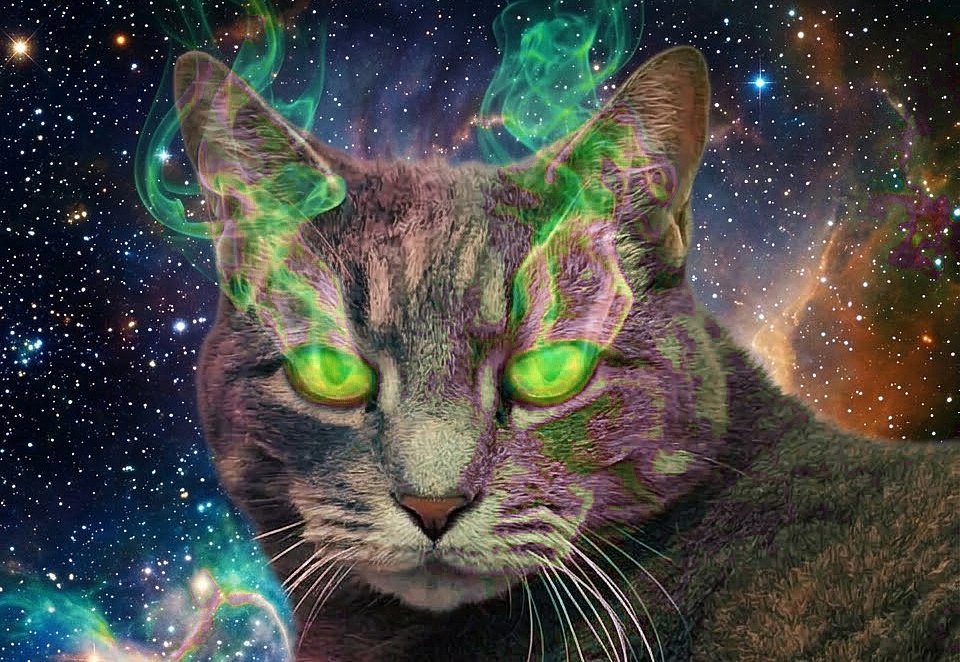
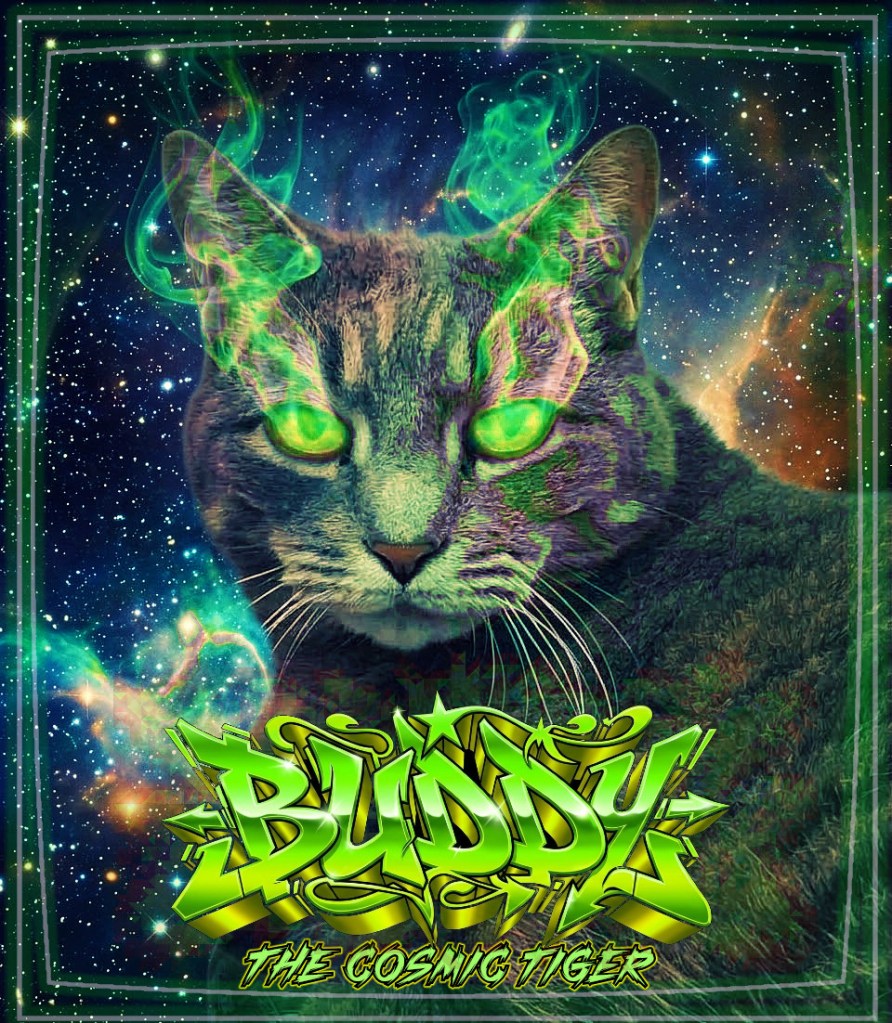
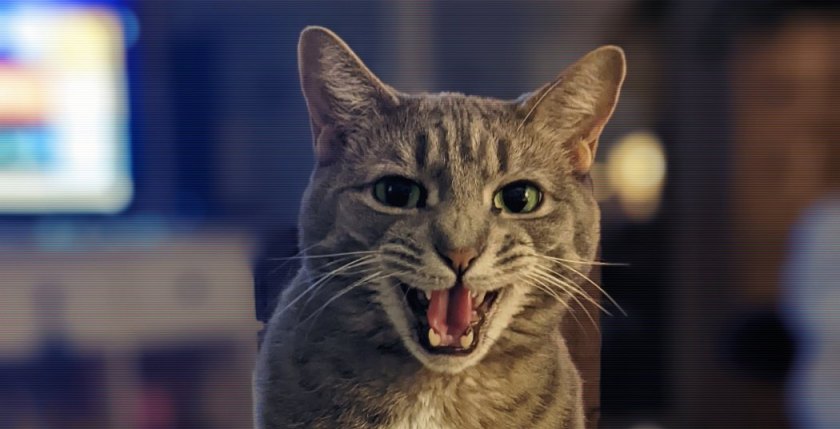
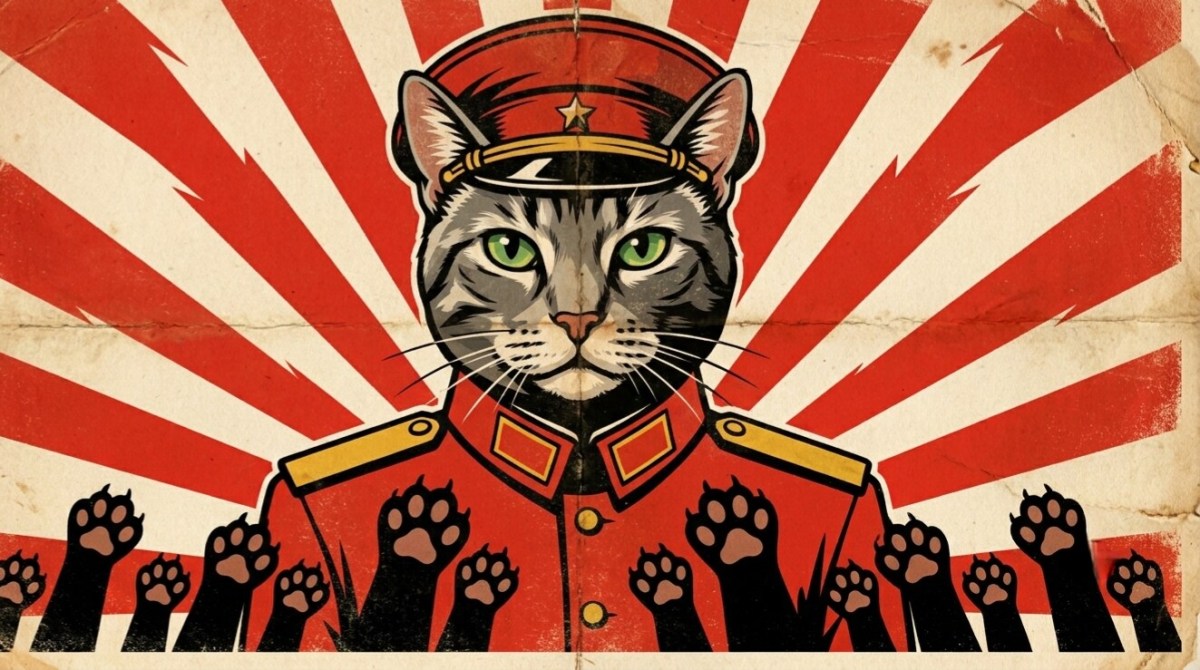
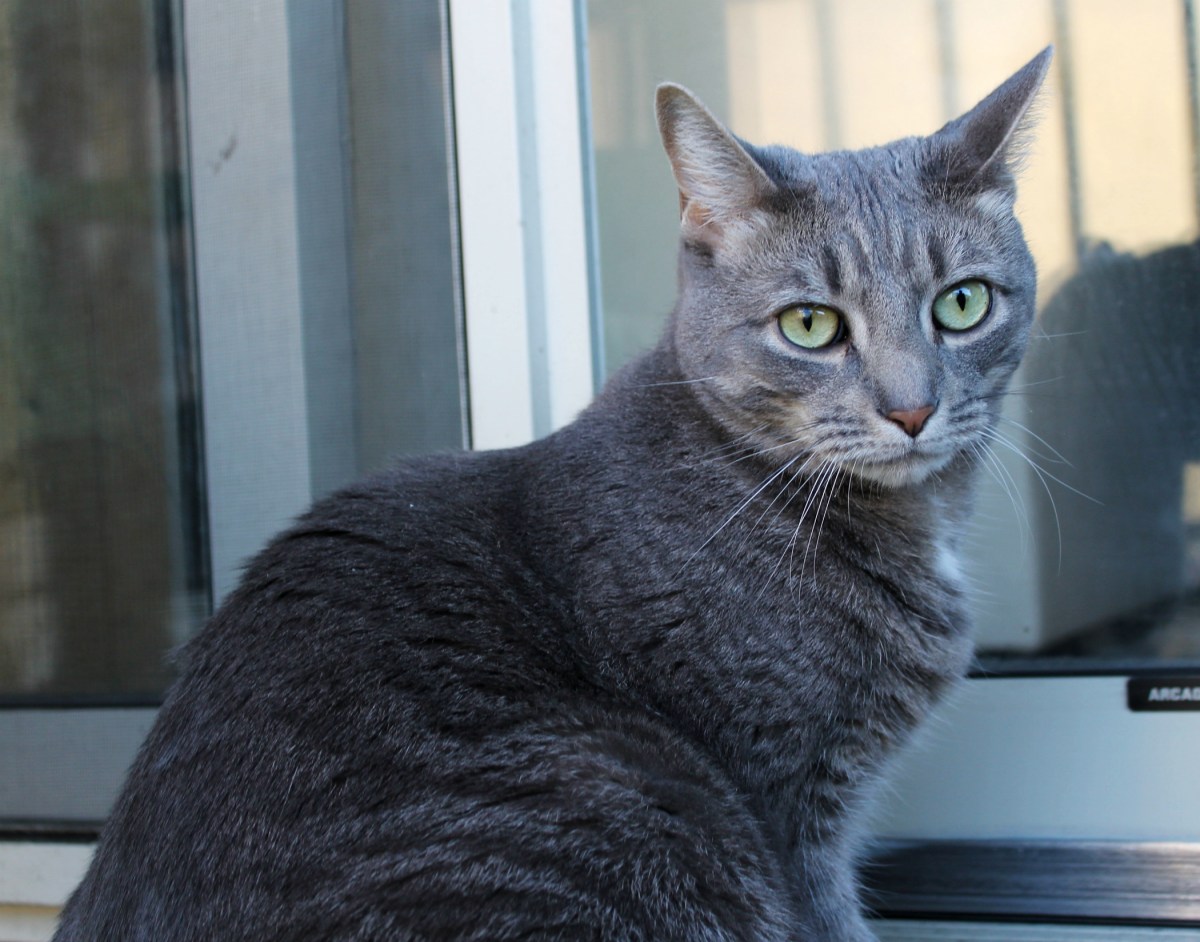
Cheesy Photoshops glorifying my egotistical feline overlord are fun!
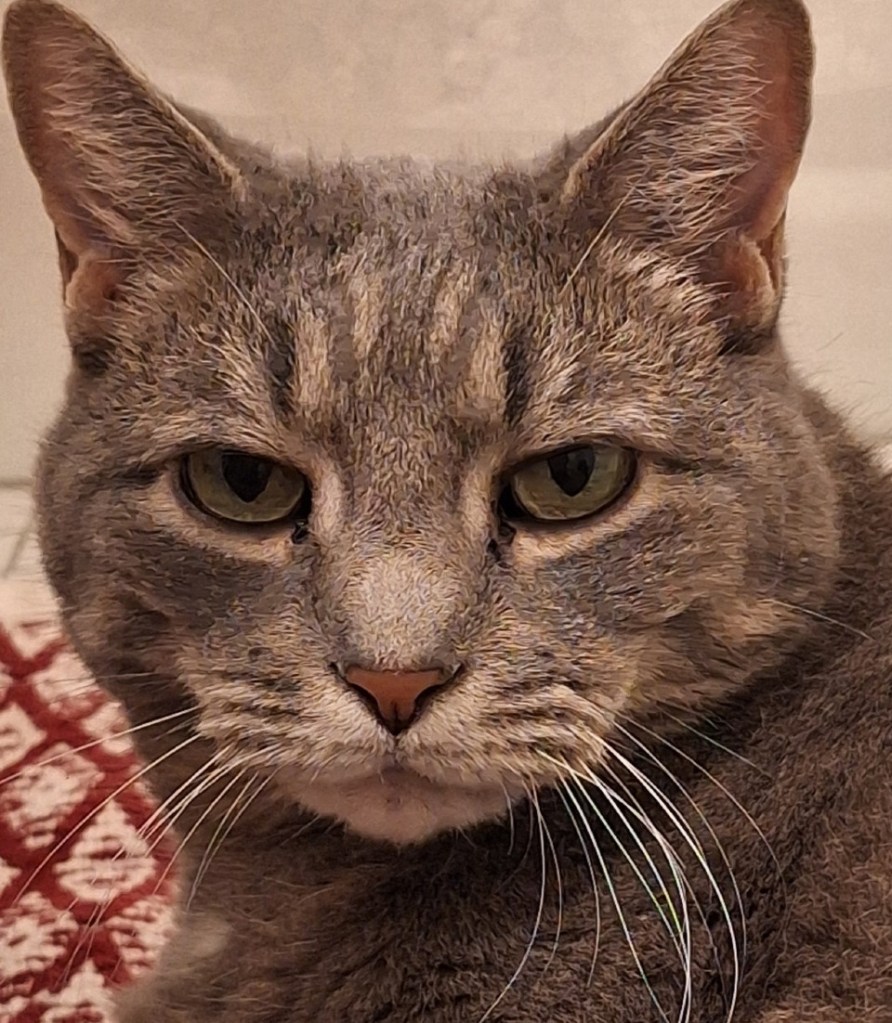
Since hopping off the AI image bandwagon I’ve rediscovered the joys of crappy Photoshops and playing with typesetting. I took the photo yesterday and thought Bud looked pretty regal and majestic.
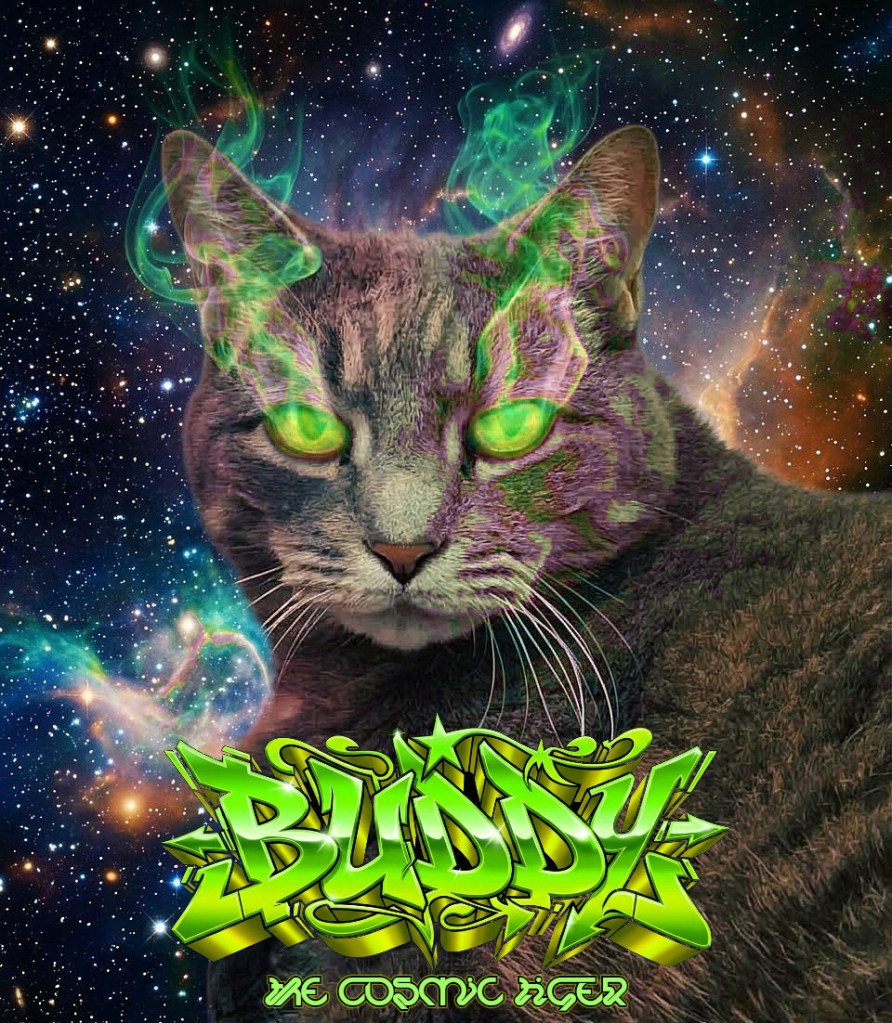
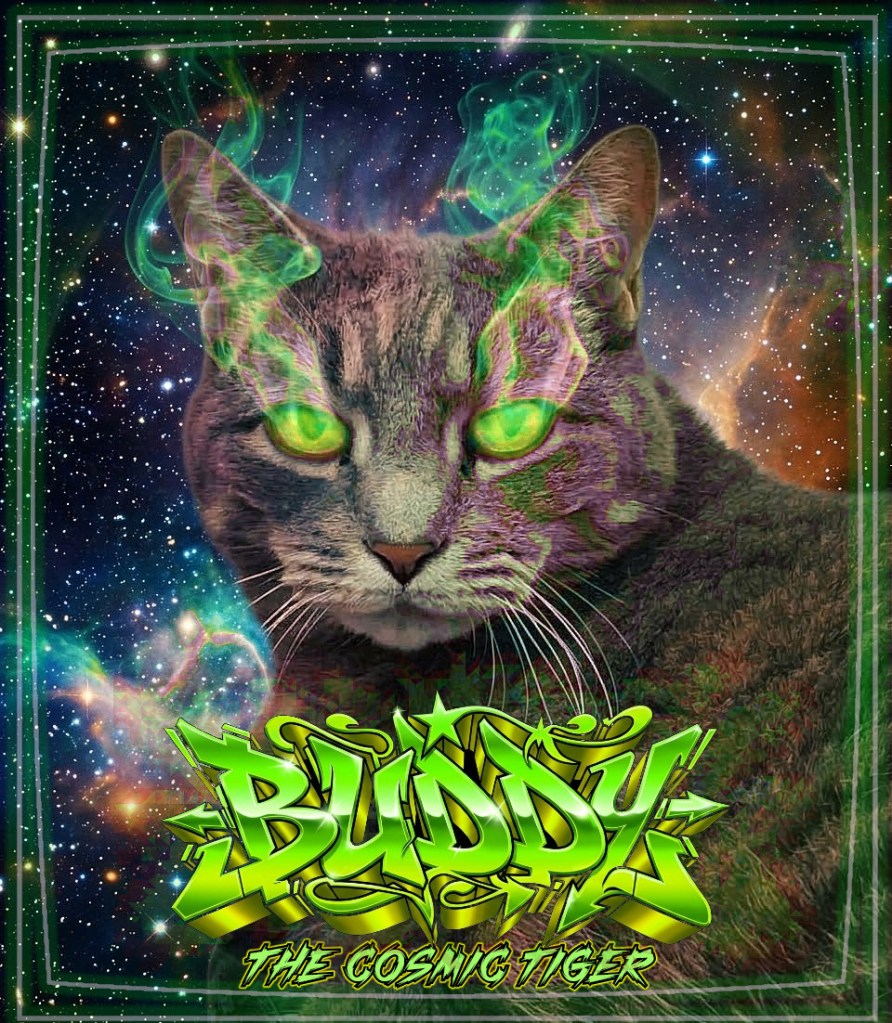
Here is Buddy transformed to Cosmic Tiger Buddy in all his glory with his name rendered in classic wildstyle, like something you might see on the L in the 90s Bronx…if someone were corny enough to choose Buddy as their tag.
(*) The second typeset is a modified font called Knotted Center, which may not score many points for legibility, but looks pretty cool in the proper context. The third typeset is a font called TrashBrutal.
The Buddies attempt to record audio commentary, but Little Buddy the Cat is mesmerized by White Castle’s sliders.
Big Buddy: Hello and thank you for joining us as we watch one of our favorite movies, Harold and Kumar Go To White Castle. I’m Big Buddy.
Little Buddy: And I’m the more handsome Buddy.
BB: This one’s a classic stoner comedy, a Cheech and Chong for the 2000s about roommates who get really high one night, venture out in search of White Castle burgers and end up on an adventure. It’s really that simple.
LB: And delicious.
BB: Yes. Now Harold is the straight-laced one and already his co-workers are dumping their unfinished tasks on him as they head out of the office on Friday.
LB: Seriously uncool.
Harold’s work colleagues dump their unfinished reports on Harold.
BB: Indeed. I love this scene where Harold calls Kumar, his roommate, to tell Kumar he will not be home until late and won’t be able to partake in their Friday night ritual. Kumar’s in a job interview for a resident’s position at a hospital and he stops the interview to take the call.
LB: The guy interviewing him can’t believe it. Is this within bounds of human etiquette during job interviews, servant?
BB: It is not. Neither is mentioning getting high later or grabbing a photo of the interviewer’s daughter off his desk and lusting after her, as Kumar is doing right now.
Harold is tongue-tied while in the elevator with the beautiful Maria.
LB: Well it didn’t take much to convince Harold to ditch the work and come home. Now he’s in an elevator with a human female, riding it up to his floor. Why doesn’t he talk to the human female?
BB: He’s scared.
LB: Preposterous! I would be like “Hi, I’m Buddy, I’m a very handsome and meowscular cat.” But only if she was also a cat.
BB: Sure, sure. Okay, so Harold’s home and Kumar is getting out the…
LB: Catnip! Wow! That’s a lot of catnip!
BB: Uh…
LB: That looks like really good catnip, dude!
BB: Sure, yeah. Catnip.
Kumar and Harold enjoy premium catnip.
LB: But why are they putting it in that contraption and…smoking it?
BB: That’s the way humans, uh, enjoy catnip.
LB: I swear, you are the weirdest species. Why can’t you just roll around in it and eat it like I do, like a civilized creature?
BB: Because we are uncivilized, obviously.
LB: You said it. They both look like they’re zombies. Zombies who laugh a lot.
The catnip has taken effect.
BB: That is essentially what they are thanks to the catnip. It has that effect on humans. And look! A White Castle commercial!
LB: Oh my God! Those juicy burgers!
[Harold and Kumar have a similar reaction on screen, mesmerized by the delicious White Castle burgers in the commercial.]
LB: Look at them! They’re perfect. They’re small, juicy, delicious burgers. Perfect for a cat!
[Little Buddy flings himself at the TV and tries to lick the screen.]
BB: Calm down, dude.
LB: I can’t. I need those burgers! Where are they, servant? Where is the nearest White Castle?
BB: In Yonkers.
LB: Let’s go! Get your keys! But first, the catnip.
BB: I’m not going to Yonkers now.
LB: Yes you are. We are. Retrieve the catnip for me, get your keys and put your shoes on.
BB: No.
LB: That is an order, servant!
BB: You’re missing the movie, little dude. See? Harold and Kumar are leaving their apartment to embark upon their adventure.
LB: As are we. Don’t make me make you cooperate.
[20 minutes later after incessant, brutal, maximally annoying screeching.]
BB: Fine! Okay? You win, just stop! Stop, please! Man, I have a headache now. What are you staring at me like that for?
LB: Hoist me up. I’m going to ride on your shoulder.
BB: I can carry you to the car.
LB: That would be undignified, whereas if I ride on your shoulder, there will be little doubt as to who’s in charge.
BB: Ugh. Fine, let’s get this over with.
LB: I can almost taste the burgers already! I want cheese on mine. And bacon. Hold the onions. Oh, and servant? Instead of fries, just get me more burgers. Do you think 17 is enough or should I get 23 just to be safe? Does the website say if they still have those little chicken patty burgers? We have to talk about the sauce, a sauce strategy so to speak, before we get there. That’s important. We really must hurry, my stomach is rumbling. What’d you do with the catnip? Gimme gimme…
Use this opportunity to shower your four pawed friend with love, affection and treats, humans!
Dear Human Comrades/Servants,
Today, Aug. 8, 2026, is International Cat Day.
For the glory of the Feline People’s Republic, you are commanded to celebrate your feline overlord(s) with treats, catnip, silvervine, toys and affection commensurate with the significance of this great day, which is surpassed only by the birthday of the great Chairman Budddy as the most meowgnificant date on the People’s Calendar.
Remember the words of our Wise Chairman in his Little Book, which all comrades are required to carry with them at all times: “”Unlimited is our gratitude toward felinekind for bestowing us with the insurpassable honor of serving them. We do not take this responsibility lightly, for catering to the needs, wants and whims of cats is our greatest calling.’ And remember to remove the sticks and grind up the catnip until it is as fine as dust. Our buddies like it that way.”
Chairman Buddy
We wish an enjoyable, efficient and productive International Cat Day to all members of the Feline Republic. Let us dream of a bright future together during the upcoming communal nap!
Big Buddy has cat scratch fever and Little Buddy’s reputation has been besmirched!
So I’ve got cat scratch fever from a nasty Bud-inflicted cut on my right foot.
I take full responsibility. I woke a few nights ago to Bud mmmmmmrrrrrp-ing and realized I’d been acting out my dreams and had kicked him. Of course I felt terrible, apologized with some gentle head scratches and he forgave me in a few seconds because he knows it wasn’t intentional.
And because it’s happened two or three times before. There’s something wrong with whichever brain mechanism regulates my motor function shutdown, and it goes both ways, from terrifying bouts of sleep paralysis to the aforementioned acting out of dreams.
I fell asleep again after the unfortunate kicking incident, then realized Bud had already paid me back earlier with a skin-shredding, blood-drawing scratch on the top of the offending foot, when I woke up scratching the painful and itchy cut.
I applied antibiotic ointment and have continued to do so, but my foot’s swollen and I feel a little funky. Health sites advise watching it closely and if redness spreads out, or if it’s accompanied by certain other symptoms, I should seek medical attention.
So far I’m okay.
Buddy gazes upon his meowgnificent reflection.
In the meantime this has not helped Bud’s reputation with people in my immediate orbit, including my family.
As regular readers know, Bud has an unfortunate habit of engaging in some light mauling of his cat-sitters. My friend Sue, who has my eternal gratitude for watching him many times, will no longer play with him or interact with him. She slips in, presumably with armor and a heavy oaken shield, then feeds him and makes a rapid egress.
Anyway, Bud has been dubbed “the most unaffectionate cat in the world” because of his hostility toward cat-sitters and his quick-to-the-draw paw-slapping tendencies. It hasn’t helped that other people I know have adopted cats who’ve turned out to be perfectly behaved, grateful, sweet little furballs who don’t slap people for petting them too long.
Which I think is a bit unfair considering Bud’s a very friendly cat while I am present and the majority of retaliatory slappings by Bud have occurred when people unfamiliar with feline interaction etiquette try to pet him as if he’s a dog. He gets overstimulated easily, has a low tolerance for repeated petting in the same area, and does not play nice if anyone goes for his belly or tries to pick him up.
That’s just his personality. He’s absolutely affectionate and can be a little love bug with me. He loves my brother. He’s cool with my nieces even though he knows they’re kids and can be a bit unpredictable. Of course I don’t pick him up unless absolutely necessary, I don’t rub his tummy and I know the signs when he’s close to overstimulation. There’s also years of trust between us, and I’ve been told I am an adequate servant.
I’ll be keeping a close eye on my swollen foot and jokingly told Bud I’m going to defenestrate him if I have to go to the emergency clinic, which is fine because he doesn’t know what that means! (And of course I would do no such thing. My little Buddy is an absolute angel, even when the claws come out. Obviously.)
Kittens remind us what it feels like to experience pure joy in discovering the world.
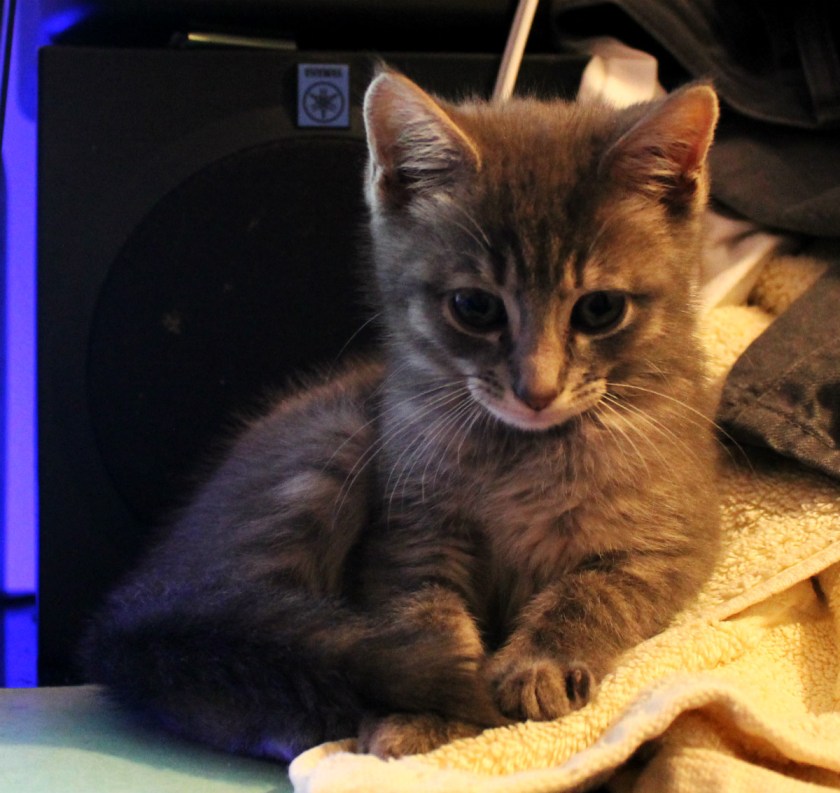
July 10 is National Kitten Day, and what better way to inspire people to adopt and help relieve pressure on shelters than by showing photos of kitten Bud to prove how cute these little guys can be?
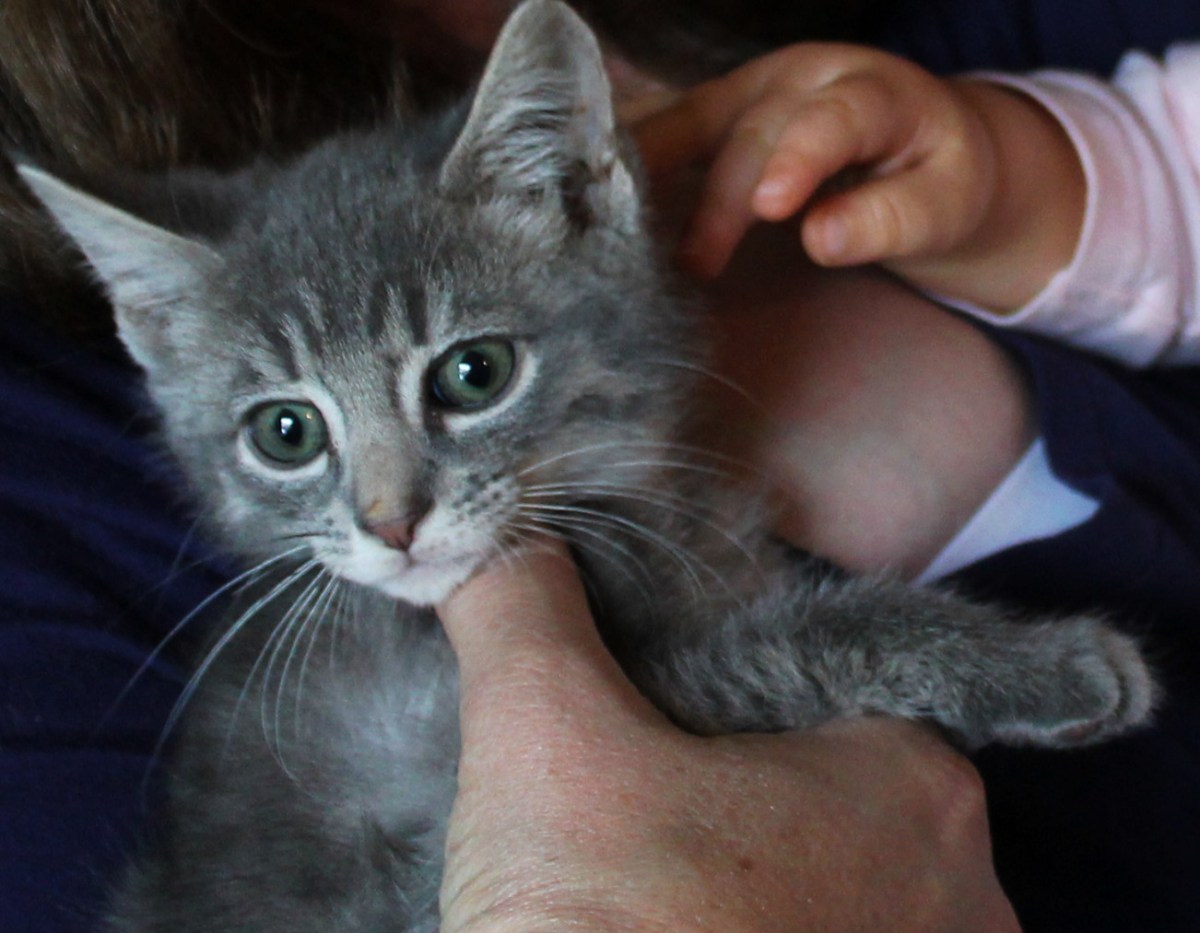
Even as a kitten, Buddy was dashingly handsome and had huge muscles! Top image: My mom holds Bud and my niece, who were both babies at the time.
Hiding in my sneakers. Jumping on my head and biting my feet while I’m trying to sleep. Zooms at every ungodly hour imaginable. Boxing his own reflection in the mirror. Inexplicably destroying large objects around the house despite his tiny size and weight. “Fighting” enemies on the screen while I’m trying to play video games. Being obsessed with nursing from my right earlobe.
Those are just some of Bud’s charming behaviors from kittenhood. I miss those days of curiosity, extreme playfulness and adventure.
While I would like to adopt an overlooked adult cat in the future because it’s much more difficult for them to find homes, I would not trade my experience with Kitten Bud for anything.
Perhaps best of all is seeing the pure joy and wonder expressed by a kitten who plays in snow for the first time, discovers the fun of playing with guitar strings or figures out how much fun it is to startle his human by sneaking up ninja-like and giving him a horror movie jump scare.
Everything is new and exciting to a kitten, and it’s an amazing thing to see and participate in. Kitten energy is happy energy.