I have a lame joke whenever my mom says something like “I’m a pretty good mom, right?”
I say “Sure, if you don’t count like 4,479 other moms,” often going through a list of mothers we know, including her friends, and ranking her below all of them.
But of course she knows I love her wholeheartedly and consider her the best mom, not “just” out of love but also recognition that she had a very difficult job as a single mom to my brother and I. It couldn’t have been easy raising two idiots like us.
My brother turned out to be a good dude, a well-respected member of the community and someone people look up to, and I turned out to be…well, me, but she shouldn’t hold that against herself. One out of two ain’t bad!
Moms make the world work. To be a good mother is to be utterly selfless, to always put your children first no matter how tired you are or how bad of a day you’re having. Moms give of themselves to ensure their children grow up happy, healthy and with a decent shot at life.
From nursing us and wiping our behinds as helpless babies, to soothing us when we scrape our knees as toddlers, to guiding us as we discover the world as kids, tolerating our insistence that we Know Everything as teenagers, and reassuring us during moments of uncertainty as adults, moms are always there for us and want the best for us.
Cats are extraordinary mothers to their kittens, and they don’t have it easy, especially if they are strays or ferals. Their love for their babies is so strong, they’re willing to run into raging fires for them. I’ll never forget a story one reader told me about her adopted stray, Snowy, who delivered kittens shortly after securing her new indoor home. Snowy died defending her babies from a pair of dogs who tried to get at them while they were on a back porch. The woman kept Snowy’s daughter and found good homes for the other kittens.
I’ve blogged about this before, but while I do not call myself Bud’s “dad,” and prefer to think of us as best pals, enablers, and co-conspirators in our ridiculous plots for world domination, I do have parental feelings for my Little Buddy, and consider it my privilege to be his caretaker until the day he finally hits mythical felid maturity and turns into a hulking and fearsome tiger. (Do NOT tell him it’s not going to happen, he is absolutely convinced it’ll be any time now. He’ll be yuge and orange, just you wait!)
But of course he would not be such a fine young Buddy if not for his feline mom, who may not have smacked him upside the head as much as was probably warranted, but nonetheless admirably prepared him to take over his forever home and install himself as King.
So to all the moms out there, human and feline, we love you and we’re eternally grateful for your love.
Happy Mother’s Day!
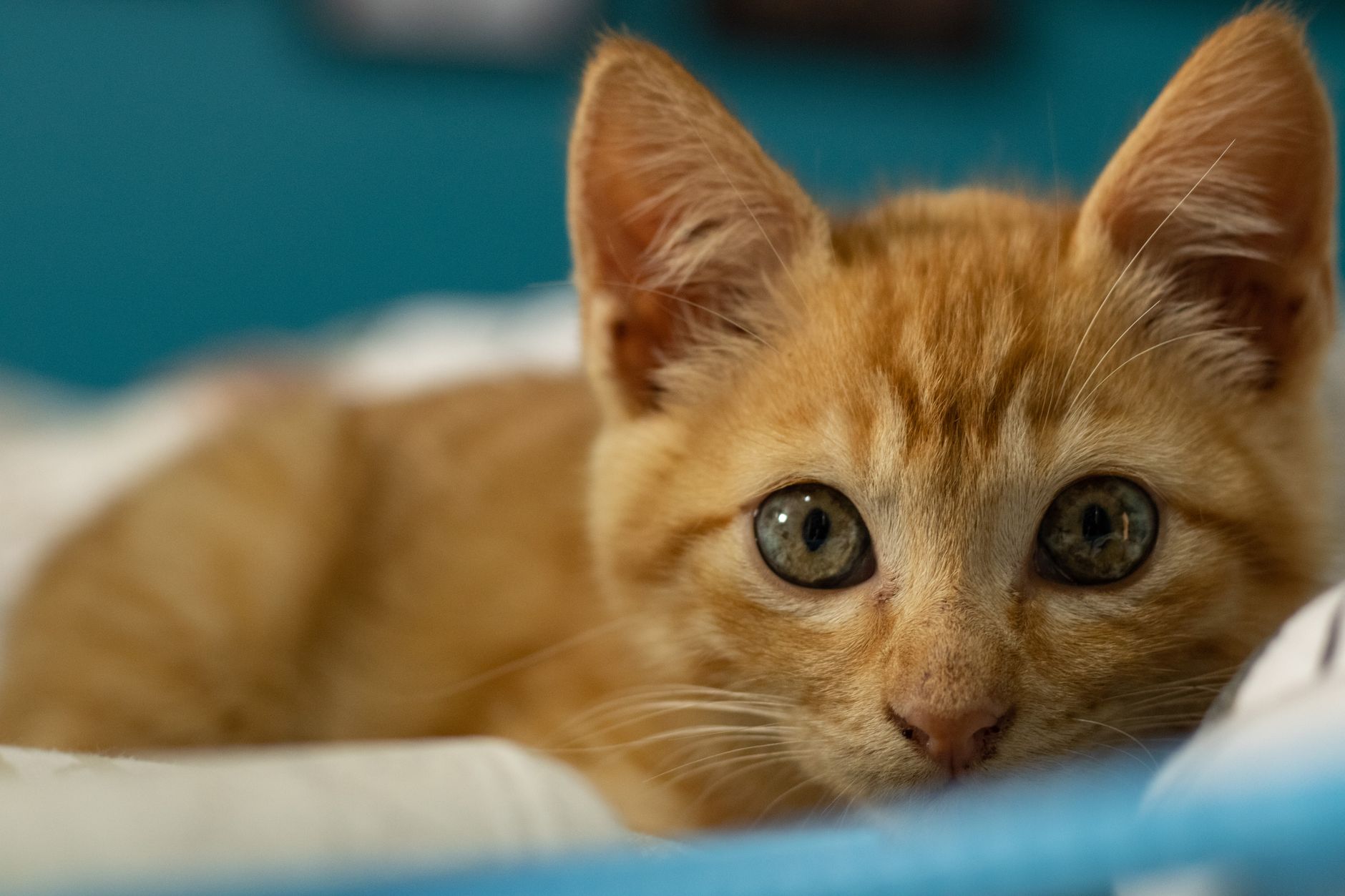
Kitten Buddy lounging in my lap, probably about 10 weeks old.
Maggie Beer was reportedly intrigued by the idea of eating a “pussycat sandwich.”
Meet Maggie Beer, a “culinary icon” from Australia who was convinced to teach cooks at some sort of community kitchen on the promise that another chef would kill a feral cat to make her a “pussycat sandwich.”
Beer was invited to help instruct cooks who volunteer for a program feeding Australian seniors. In return, one of the cooks would show her how to prepare domestic cat meat.
That goes a long way to explaining the state of mind in a country that recently killed millions of cats by poisoning them and has pledged to exterminate all free-roaming cats because self-styled conservationists believe felines — not habitat destruction, mass industrialization, the widespread use of carcinogenic pesticides, windmills, glass buildings and all the other changes wrought by human presence — are the primary drivers of local bird and small mammal extinction.
Beer and Brown, cat eaters.
“We were talking a lot about cooking kangaroo tails and then I also told her about how one of our directors… had recently cooked us a feral cat from Kiwirrkurra,” said Sarah Brown, the CEO of Purple House, which prepares meals for Australian seniors.
“She got very excited about this and I said, ‘Well if you come to Alice Springs and do some cooking classes with us, then Bobby West will teach you how to cook a pussycat and you can have a pussycat sandwich for lunch.'”
Feeding seniors intelligent companion animals is about giving them “joy as well as sustenance,” Brown claims.
Thankfully not everyone in Australia thinks this is amusing, nor do they buy the claims that slaughtering cats will magically solve all the problems facing indigenous wildlife.
A look at the strange and wonderful world of rare books where, of course, you’ll also find cats.
I’ve always liked the idea of antiquarian bookshops.
I am almost completely ignorant on the subject, mostly because chasing after extremely rare print volumes is the domain of people with a lot of expendable income. The most valuable books in my possession are an original 1939 first edition print of Will Durant’s The Life of Greece, and two novels signed by their authors. Their value is sentimental, not monetary.
But I like the general romanticized image of the antiquarian bookseller: an older man or woman in tweed ensconced in a cozy shop in Manhattan, with every shelf filled with dusty volumes and every surface covered by globes, astrolabes and other curiosities. There’s one of those tight winding staircases with wrought iron railings leading to a loft for access to the highest shelves, the music is from a vinyl collection of light jazz, and it’s always raining outside.
A doted-on shop cat dozes on a red leather armchair, tail twitching from some nightmare in which it’s slightly less adorable than it thinks it is.
Collectors in damp trenchcoats drop in, asking after 17th-century occult tomes, grimoires, and Voynich-esque manuscripts with engravings of impossible creatures, trees with visual organs and arcane rituals. Bibliophiles ask after leatherbound collections of classics like Don Quixote, and the occasionally curious passerby peeks in, surprised that such shops still exist in the age of the internet.
It turns out that’s not too far from the truth, especially the bits about the internet and, of course, the cats.
Johnny Depp is constantly smoking and drinking red wine while handling priceless old books in 1999’s The Ninth Gate. Notice the winding staircase in the rare book shop in the top screenshot.
The Booksellers is a documentary that screened in festivals in late 2019 before heading straight to video when the pandemic brought the world to a screeching halt.
It’s an inside look at the annual New York Book Fair and the small world of antiquarian and rare booksellers in New York, a shrinking constellation of people mostly descended from, or formerly apprenticed to, the booksellers of old before Barnes and Noble and Jeff Bezos laid waste to that sector of retail.
Before network TV, cable TV, dial-up internet, broadband, Kindles, iPads and smartphones turned us into a media-gorging — yet paradoxically less literate — society, New York was home to more than 500 bookshops, including generalists and specialists who catered to people with particular and peculiar interests. Now it’s home to fewer than 80, according to the documentary.
When the booksellers were asked about the way the internet has impacted their trade, their weary sighs reminded me of my older colleagues from my brief time experiencing the end of the “good old days” of newspapering, before the internet destroyed or compromised every publishing income stream and delivered us to this moment. This dystopian time when entire swaths of the country have become news deserts, Elon Musk in all his wisdom asserts that Twitter accounts run by anonymous trolls in Belarus are just as reliable — even more trustworthy, in fact — than those liars in legacy media, and corporate raiders are stripping the last handful of newspapers down to assets they can auction off.
A rare book shop in Paris. Credit: Wikimedia Commons
Not all of it’s bad. One rare book dealer laments the fact that “the thrill of the hunt” is gone, meaning it no longer takes years to track down some obscure volume because you can hop online and find it in a few clicks. I get that, but nostalgia for that sort of thing is the ultimate in looking back through rose-colored glasses. Plenty of us could wax nostalgic about the days when we’d hear a song on the radio and have to hum the damn thing to record store clerks, but we’re forgetting about the considerable frustration involved. Given the choice between “fun” ignorance and access to information, I’ll always choose the latter.
As for the cats, it’s not a surprise when many of the book dealers interviewed for the film identify themselves as cat lovers or idly scratch their feline friends while showing off their vast personal collections. Antiquarian bookshops tend to be warm, quiet, gently-lit spaces, perfect napping spots for cats who guard old books from rodents.
If you’re interested in watching The Booksellers, you can find it on Amazon Prime video, or better yet, just click below:
A substantial new reward from a local shelter is providing incentive for the return of Willa the cat, who was stolen from her home by an Uber Eats driver in January.
It’s been two months since a delivery driver working for Uber Eats allegedly stole their cat, but a South Carolina family is determined to get their feline family member back.
Four-year-old Willa the cat was a fixture in her neighborhood, known and loved by neighbors and people taking walking tours of the area. The 17-pound Calico, with her magnificent floof and striking coat pattern, could usually be spotted lounging on the front porch of her home, where she liked to watch people going about their business.
Now Pet Helpers, a shelter in Charleston, is helping keep the story in the news and creating greater incentive for people to join the search for Willa by offering a $2,500 reward for her return, in addition to a reward the family is offering.
On Jan. 15, shortly after delivering Greek food to a home on the same street, Katy Barnes of Goose Creek, SC, allegedly scooped Willa up, carried the Calico to her SUV, and drove off.
Willa’s family, the Layfields, did not have an angle on the cat-napping from their home security cameras, but cameras belonging to neighbors and a gym about a mile away show a woman police have identified as Barnes taking Willa, then pulling over and discarding the feline’s collar and AirTag.
Despite her arrest and the footage, Barnes has refused to cooperate with police, claiming she no longer has the Calico. If she did simply release Willa, as she claims, she did it during the coldest season of the year during a deep freeze, when most of the country was seeing single-digit or sub-zero temperatures. That’s a challenge for any cat, especially a feline accustomed to an indoor life.
“I am amazed that people can be so cruel,” Liza Layfield told PITB. “Why? Why would this person take their animal and then put her out to essentially die? Why would Katy take Willa and refuse to give her back or tell us anything about her whereabouts in the face of freezing temperatures and snow? Why would she want to torture a family over a cat that is apparently no longer in her possession? We cannot understand, and it is keeping us awake at night.”
Despite the stress of the situation, the family has continued their relentless efforts to get Willa back.
Charleston police have taken the case seriously, arresting Barnes and charging her with petty larceny. They secured a search warrant for Barnes’ home, which did not turn up any signs of Willa, and they arrested her a second time, charging her with littering for disposing of the collar and AirTag and keeping her in police lockup overnight twice in two weeks.
The message: they’re not letting this go either. Neither are locals, who have rallied to support the Layfields and have started a petition asking authorities to do as much as they can to help find Willa, and calling on Uber to do more to help. Almost 1,700 people have signed the petition, and it continues to accrue signatures.
In the meantime, the Layfields have turned to their community for help. An email account they set up has yielded promising tips, and neighbors have been on the lookout for Willa in Charleston as well as in Goose Creek near Barnes’ home.
“It is very much an active and ongoing investigation,” Liza Layfield told PITB.
“We love our animals as our children, they are a part of our family, and we can’t rest until she is found.”
The reaction says volumes about our society’s sense of proportionality, our collective understanding of animals, and our ability to politely disagree on topics we feel strongly about.
This hasn’t been a great week for feline PR.
Not only did two celebrities come out with bizarrely forceful anti-cat sentiments, but from their statements, they both “hate” cats because they’ve misinterpreted feline behavior.
The fallout hasn’t been good either, for the actress and rapper involved, or for the more extreme animal lovers who have responded with disproportionate rage.
The first comes from rapper Docheii, who insists cats “genuinely aren’t friendly animals.”
“yall be scratched and beat tf up by your own animals I can’t lmaoooo,” the towering intellect from Florida wrote on social media.
Cats, she asserted, “don’t wanna be domesticated.”
Presumably she got that information from the Pew Center for Feline Public Opinion, and the rest of us simply aren’t privy to the latest opinion polls among cats. And here I thought our furry friends were mostly ambivalent about anything that doesn’t involve napping, playing and eating. (I took an informal poll of Bud. He responded with a simple “Fetch me a snack, will you, human?”)
A promo shot of Doechii, real name Jaylah Ji’mya Hickmon
Regardless, even if there was some way to ascertain how cats feel about a process their ancestors initiated — one that takes thousands of years to result in speciation — it’s irrelevant. The decision was made 10,000 years ago when The First Kitteh was drawn to a human settlement by the promise of rodential prey in abundance.
Modern cats have no more say in the matter than we have in our ancestors slaughtering dodos. It happened. We can’t change the past.
The actress vs the ‘pedigree bitch’
The second bit of anti-feline sentiment comes from Jessie Buckley, an Irish actress who is weirdly proud of forcing her husband to ditch his two pet cats when they began dating. She talks as if she’s been waging a personal war against the species, and her reason for disliking felines also indicates a fundamental misunderstanding of their behavior.
Buckley’s comments were made on a podcast late in 2025, but resurfaced this week and went viral as her Oscar buzz reached its peak. On the podcast, Buckley said one of her husband’s cats was a “pedigree model bitch” who was orchestrating a “coup” against her.
She thinks the cat had it out for her: “I’d come home and there’d just be, like, poo on my pillow.”
This is actually sad, because people who really know cats, who understand why they behave certain ways, will immediately understand that they don’t have accidents out of spite. If the cat was eliminating outside her litter box, there was a legitimate underlying problem causing her a great deal of stress.
She could have been injured, she could have been sick, or she could have been plagued by the cumulative stress brought on by the presence of a hostile woman who ludicrously saw her as competition. Our furry friends are much more perceptive than generally realized, especially when it comes to our emotional states, and Buckley’s hostility would have been immediately apparent.
Buckley with co-star Paul Mezcal, who was equally enthusiastic in his intense dislike of felines, telling an interviewer: “Yeah, f— cats!”
Alas, Buckley didn’t reluctantly ask her then-boyfriend to give up his cats. She demanded it, then did a victory lap when he complied, which makes me suspect she was merely taking the whip out for a test drive before further commitment. If he’s willing to abandon two pets, he’s almost certainly going to be a pushover when she begins to prune his friends from his life, starts dressing him the way she likes, maybe even monitors his phone. *shudder*
“It’s me or the cats,” Buckley said she told her husband. “But I won!”
Congratulations, I guess?
The rage of cat lovers
As ludicrous as it seems, the backlash may cost Buckley an Oscar. Personally I don’t keep up with the approximately 200 awards ceremonies actors hold to fete themselves annually, but apparently Buckley turned in a solid performance in a movie called Hamnet.
She was considered the front-runner for an Academy Award. Now critics are openly wondering about her chances.
As always, these sorts of statements reveal a lot more about the people involved than they do about cats. I just wish people understood the species a little better, so maybe attitudes won’t default to anger or hostility if, say, a scared cat scratches a person who corners her, or a kitty with a stomach bug pukes on the carpet.
When a toddler gets sick, we don’t respond by yelling at the kid, blaming him and chasing him off. We make sure he’s okay, give him some medicine or take him to the doctor, and clean up the mess. Cats are essentially furry little toddlers, with the same innocence as children. When we adopt them, we agree to care for them.
Both Buckley and Docheii have been hammered on social media since their comments went viral, and it’s important to address that too. They expressed opinions. That doesn’t make them “pieces of s—,” “worthless human beings,” “scum” or any of the other nasty things some people have been saying.
We can disagree with them without overreacting, even in the age of dehumanizing online conversation.
Maintain yourselves!
And honestly, it makes all of us look bad. The day Walter Palmer returned to work is forever seared into my mind. Palmer was the American dentist who infamously and illegally lured Cecil the lion out of a protected area and killed him to take his head as a trophy in 2015.
Worse, Palmer — who had a history of getting in trouble for breaking the law while hunting — killed Cecil with a bow and arrow in order to claim some meaningless hunting record for himself and bungled the point-blank kill shot his guides had lined up for him. Cecil, who was an iconic lion with a distinct mane, suffered for hours before he died.
People were understandably angry, and protesters showed up outside Palmer’s office the day he returned to work. Most of them behaved themselves. But as Palmer made his way toward the front door of his dental practice, one of the protesters let loose a blood-curdling scream and shouted “WAAAAALTER PAAAAALMER!“, vowing vengeance for Cecil.
Palmer returning to work while media and protesters crowd him.
That moment of unhinged, unregulated rage overshadowed the good intentions of every person who registered their displeasure calmly and politely — and provided ample ammunition to those who enjoy painting all animal lovers as lunatics.
Buckley and Doechii expressed opinions we don’t like, and that’s their right. The best thing we can do is explain why they’ve misinterpreted feline behavior, and show them that cats really are loving, friendly animals — it just takes a little patience and trust. I say that as the faithful servant of a cat who can be particularly prickly and a complete lovebug, depending on the circumstance.
In the meantime, celebrities who hate cats should probably take a pass on broadcasting their intense dislike and save themselves the resulting headache. Sadly, we no longer have any sense of proportionality when it comes to disagreements, and no one gets a fair shake when things are litigated via social media.