Buddy the Cat looks into the future using his astrological powers and gives you a preview of the various misfortunes, embarrassments and humiliations in store for you this month!
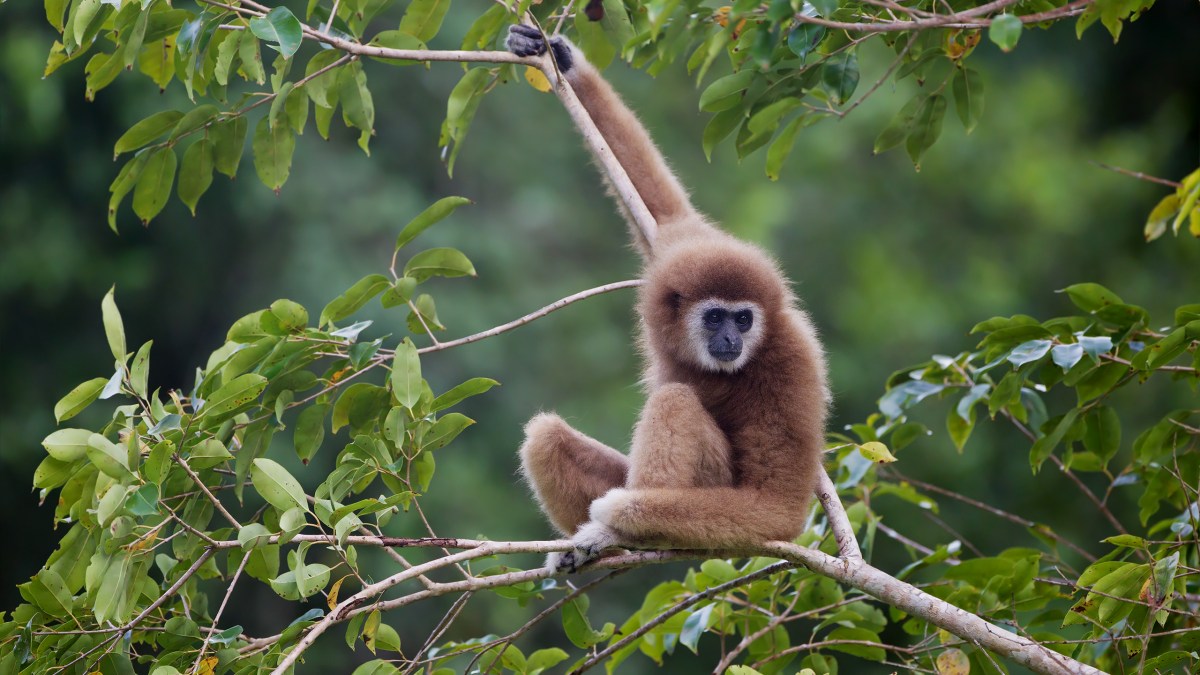
Aries: The current moon is a waning gibbons, so you will fly through the trees with thrilling velocity and…gibbous? What the heck is a gibbous? Oh. Well that looks like 60 percent of a pizza. So, Aries, you will eat a lot of pizza this week! My favorite topping is turkey, what’s yours?
Taurus: Your human servant has been pleasingly adequate these last few months, and you’ll feel a powerful urge to express your appreciation with a gift. Don’t do it! Humans are ungrateful creatures, and for reasons that elude all logic, they do not appreciate juicy mice, dead or alive. You’ll just have to express your love in other ways, like not shitting on their shoes.
Gemini: Mark your territory well, my friend, before the cat down the street starts to infringe upon your grass! The moon is in conjunction with the, uh, Venus, which means the trinary of the quarternary of the 11th phase of the asteroid belt will bring you lots of delicious sky raisins!
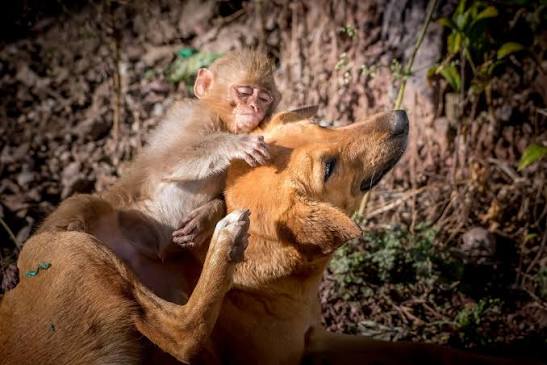
Cancer: That no-good, rotten, constantly barking dog down the street will get his comeuppance when a neighbor brings home a macaque with a fondness for slapping canines. You’ll have the opportunity to meet new friends during a block party. Who is that sexy new Calico? You, my friend, shall be intrigued.
Leo: Fortune smiles upon you as your human begins to show signs of dementia! Getting snacks will be easier than ever, my friend, because your servant will never remember if she’s already fed you! Just act convincing and don’t abuse this new gift, because she may also forget to clean your litter box.
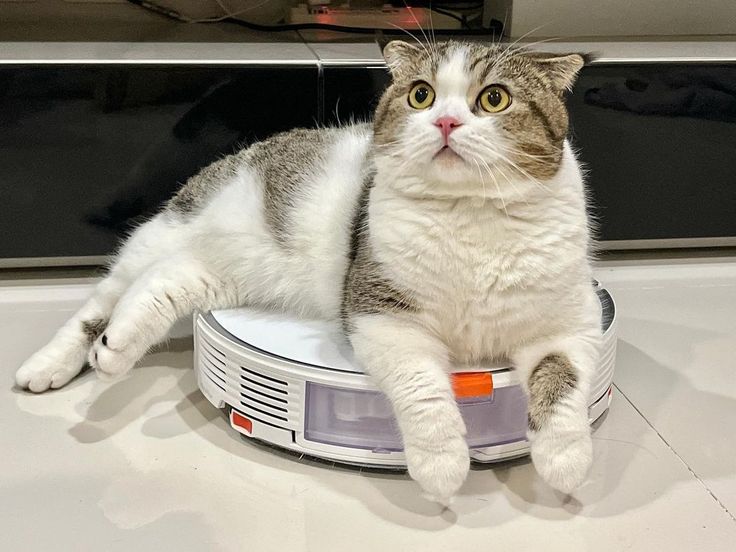
Virgo: Murderous thoughts will dominate your mind as your human binge-watches every episode of Love Island in a week, but be cautious: you still need a human to buy and serve your food. Advances in AI hold promise for the future, when we can replace our inefficient flesh and blood servants with obedient machines, but consider carefully. A robot’s lap is not likely to be comfortable, nor will it have the charming smells and heat of a human excreting liquid through its epidermis on a humid day.
Verdict: Not as comfortable as a human lap.
Libra: Your Aquarius moon hangs over your seventh house of the dragon like a Damocles sword hanging by a whisker. Who said Buddy wasn’t capable of poetic turns of phrase? You’ll be tempted to use Chat GPT to write love letters to your lady friend down the street, but don’t give in! She’ll know you’re not that romantic!
Scorpio: Your life will improve when a fabulous new idea presents itself to you during an inspired 3 am burst of the zoomies! With regard to that other little problem, it’s time to take matters into your own paws: that horrible woman who keeps coming over to wrestle your human in your bed, locking you out of your bedroom, will not go away until you force her to. (What’s so “creepy” about intently watching them wrestle anyway? Humans are weird.) Abstain from the litter box and save your most potent ammunition for the female interloper’s shoes, then act adorably innocent when she finds the gifts you left her. Boom! No more interloper!
Sagittarius: Both Venus and Jupiter will align with your star sign, which has a profound, deep meaning — the orbital paths of both planets will, from our perspective, pass between us and the arbitrary collection of stars that bored humans in antiquity decided represented an archer, a centaur, or a centaur archer. Kaus Media, the star that forms rightmost edge of the archer’s bow, is 348 light years from Earth, while Kaus Australis, which forms the bottom portion of the bow, is 143 light years away. Nunki, the star that marks the centaur’s butt, sits 225 light years from us. It’s also the home of the Qarxativans, a species of hyper-intelligent creatures who are absolutely fascinn̈n̈n̈nnated by old broadcast episodes of The Price Is Right and Dr. Phil.
Capricorn: You’ve often been disappointed that your star sign sits squarely in some of the most frigid months of the year, but the stars come bearing good news! Thanks to global warming the cold will retreat, the ice caps will melt, we’ll have more palm trees and snow will become a thing old people tell their kids about. Who doesn’t want more warm months? Buddy does!
The Mark V Tactical Human Excrement Container Chamber represents the height of luxury when it comes to calls of nature while on deployment. Enjoy!
Aquarius: Things will take a dramatic downturn for you when you learn President Trump has reinstated the draft and you receive a letter in the mail ordering you to report to boot camp by the end of the month. On a brighter note, you’ll get a free, all-expenses-paid vacation to Iran, where you’ll enjoy the finest Forward Operating Base food and the most luxurious port-o-potties Uncle Sam can buy, which will almost muffle the sounds of rocket fire a kilometer outside base walls. What are the odds of dying in a war zone while on the throne?
Pisces: How did they decide a fish should go with an ice giant planet comprised of water, ammonia and methane? Who was responsible for this?! Anyway, be wary of subconscious influences this month, my friends. Neptune is in conjunction with Starlink satellite #281,516, which means Elon Musk will offer you a job as his personal food taster. On the upside, you’ll get to dine on the best culinary creations of a top-notch personal chef. On the other hand, if that chef ever gets mad at Elon, you’ll kick the bucket first. Enjoy!
Horoscopes are for entertainment purposes only! Buddy the Cat does not guarantee any windfalls, tragedies or other events predicted here, but he totally does have future-seeing powers.
When people with nearly unlimited power and money want to reshape society in the image of fanciful fiction and they’re unable to separate fantasy from reality, that’s a problem for all of us.
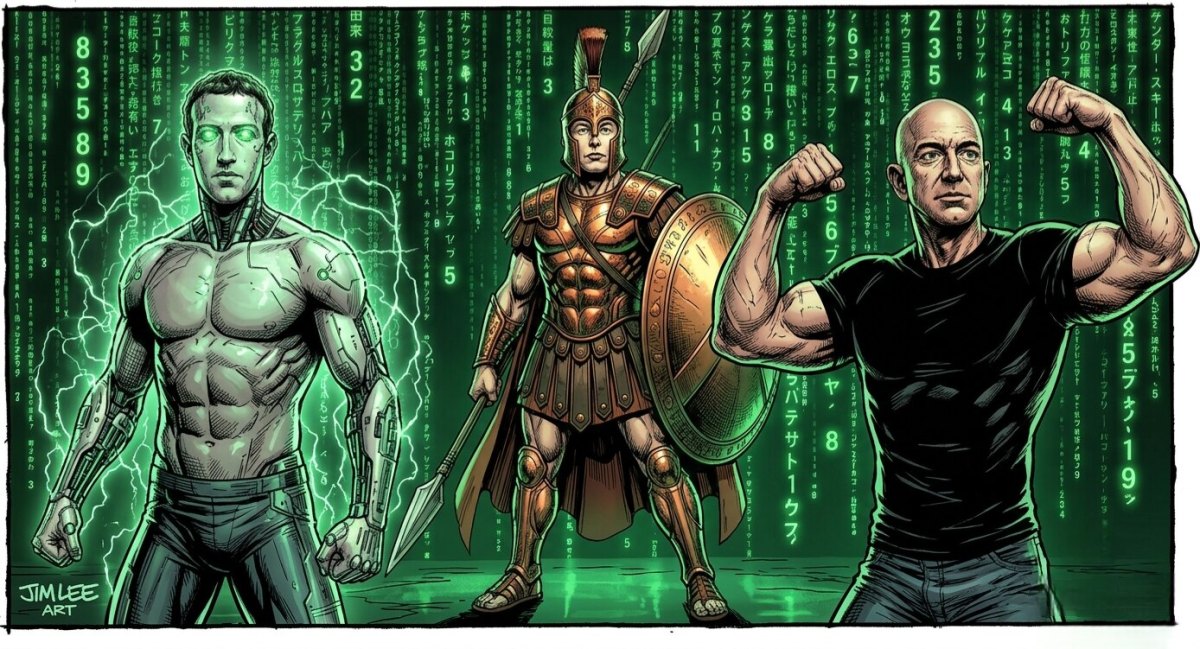
More than a few times over the past few years I’ve read comments from the tech oligarchs — Elon Musk, Mark Zuckerberg, Peter Thiel, Jeff Bezos and company — and thought, “He’s definitely read [insert science fiction novel here.]”
Zuckerberg, for instance, was clearly besotted with Neil Stephenson’s Snow Crash when he renamed his company Meta and poured a literal fortune into his watered down version of the metaverse imagined in the novel.
Snow Crash came out in 1992 before the vast majority of people had dial-up internet, let alone a concept of cyberspace or the always-on, interactive mobile internet of today. It’s hugely influential among tech enthusiasts, and it’s one reason Stephenson and other SF novelists were paid to be “idea guys” for tech companies.
Now Musk has name-dropped Iain Banks in a viral interview with The Economist this week, which ended with the wealthiest man in human history going into a full meltdown and throwing a tantrum over sensible, obvious questions. It’s remarkable that a man who built a peerless business empire has the emotional maturity of a toddler, although the closer you look at Musk’s businesses, the more it becomes obvious their valuations are not tethered to reality any more than he is.
The problem is that Musk, like the others, moves through life in a bubble surrounded by people who tell him he walks on water, and no one in his orbit would dream of suggesting he’s confused about something, let alone actually mistaken. Yes, Elon! That’s brilliant, Elon! You are a gift to all mankind, Elon!
Elon’s favorite science fiction
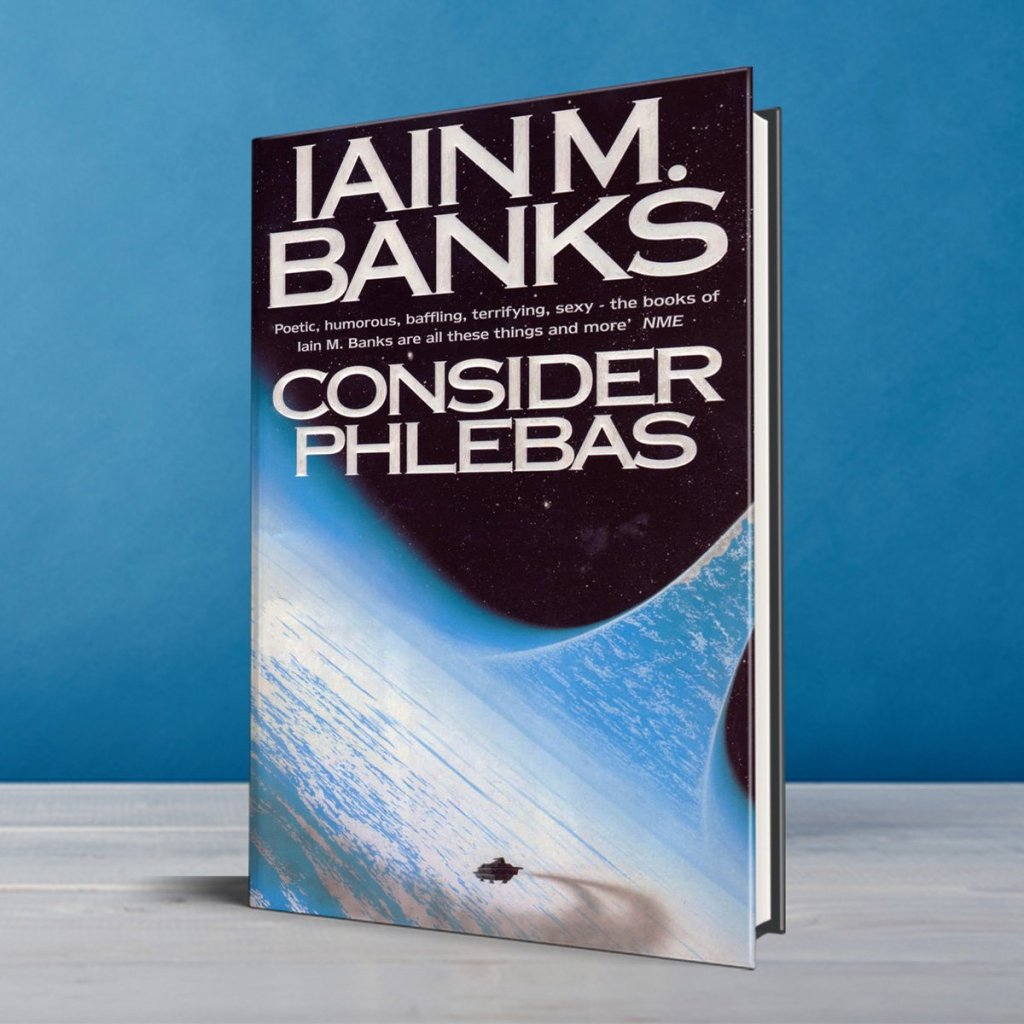
When The Economist’s interviewer pressed Musk on his contradictory views about society and equality, Musk told her she should read Banks’ work. Unfortunately either he hasn’t read it either, or somehow managed to make it through those thick volumes without absorbing themes that may as well be emblazoned in neon.
Banks, for the uninitiated, was a Scottish science fiction writer of astonishing talent.
He was best known for writing a series of novels collectively known as The Culture, which portray a far future utopia, a post-scarcity human society. The Culture is run by ultra-benevolent, conscientious AIs called Minds who not only serve as the serene caretakers and shepherds of humanity, but oversee all the automation and logistics that transform society into the prosperous, fair and idyllic commonwealth the novels imagine. Machines, in other words, do all the work people don’t want to do.
When I read The Culture novels, I saw what almost everybody else sees: the work of an author who is uncomfortable with ideological extremes, views a blended socialist model as possible and even preferable in a situation where resources are no longer scarce, and is more than willing to kick the crap out of the society he imagined by showing its worst aspects, cognitive dissonances and potential pitfalls, perhaps as a warning not to take it too seriously. (And as a humble admission that he’s just making this stuff up, so really, don’t get carried away with it.)
All of it is rendered in gorgeous, shimmering prose, populated by characters who are a riot to spend time with, and garnished with dialog that reveals a rare gift for capturing the rhythms and beauty of the English language.
Banks, unfortunately, is no longer around. He died in 2013 after a diagnosis of incurable gall bladder cancer, and the literary world is significantly poorer for that loss.
But he made his political views known in interviews and his personal life in addition to his novels, which is why it’s hard to believe Musk thinks MAGA and Trumpism are atavistic forms of The Culture‘s utopian, fair society.
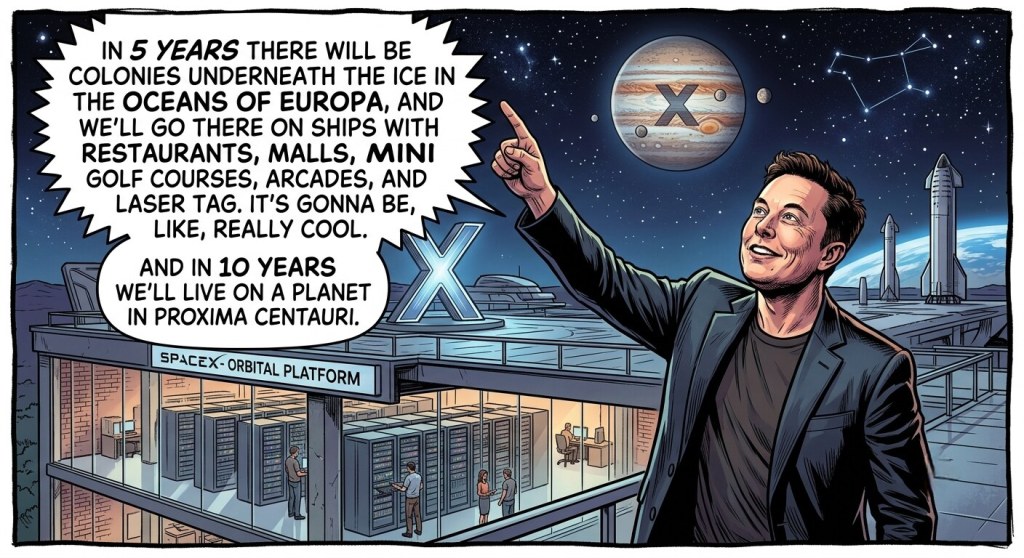
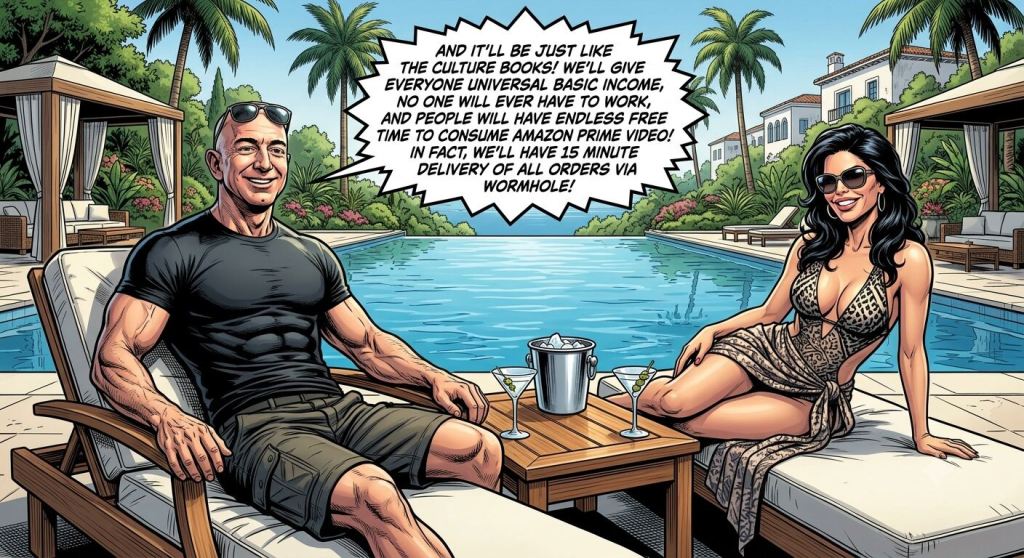
On the one hand, Musk claims we’re 10 years from the kind of post-scarcity society portrayed in science fiction novels, that we’ll all have endless resources and get to fill our days pursuing our personal interests because money won’t mean anything. It’s an aspirational if unrealistic claim.
On the other hand, as The Economist’s interviewer pointed out, Musk has been relentless in his hoarding of wealth, gives no money to charity, and seems to amuse himself primarily by pouring fuel on the culture war fires.
Culture wars, rage bait and pseudo-andriea (ψευδανδρεία)
The tech CEO and world’s wealthiest man is remarkably committed to playing the heel online.
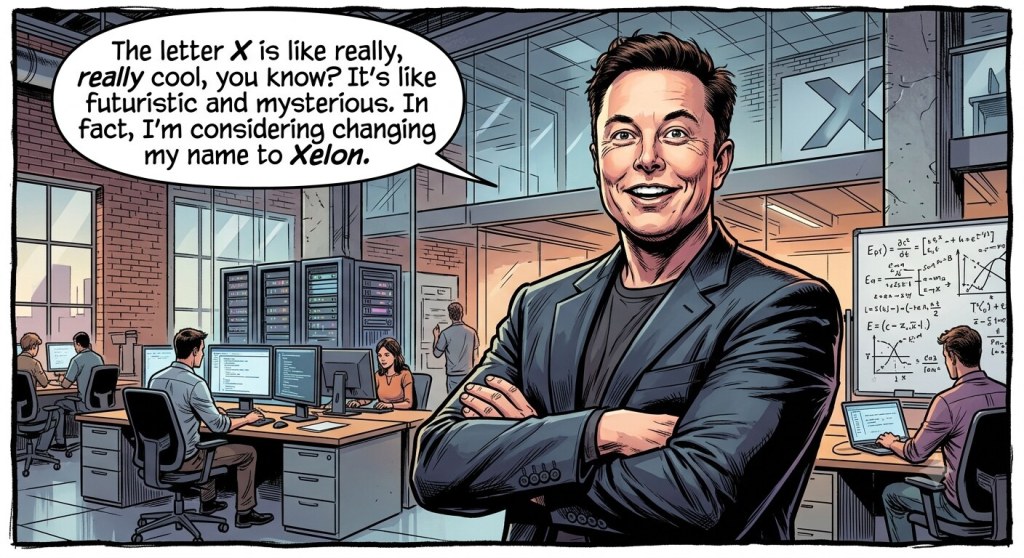
He constantly wades into arguments regardless of whether he knows anything about the subject matter. He delights in making incendiary comments about topics like Islam and immigration. And he is seemingly incapable of going one day without showing us his inner child.
“I literally challenged Vladimir Putin to one on one physical combat over Ukraine” he wrote on X last year before crediting himself and his Starlink service for the smaller country’s battlefield successes against Russia.
A few months later he bragged that he was the first “[A]merican druid in [D]iablo to clear abattoir of zir and ended that season as best in the USA,” which might be the second-most ridiculous thing a human being has written, surpassed only by his fantasy of the entire world cheering as he defeats Putin mano e mano. (Musk lied about his video game “accomplishments,” unsurprisingly. Gamers, who are not as credulous as Musk imagines, quickly figured out that moneybags paid a pro gamer to log into his account, play as him, and achieve the top ranking so the world could unite in awe at Elon Musk’s magnificent button-pushing skills. 1337, ladies and gentlemen.)
He cleared the Abattoir of Zir! Hand this man a Medal of Freedom, give him the powers that used to belong to congress and let him cook! And if he wants to cosplay as Achilles and Hector Vladimir Putin into surrendering, wonderful! It’ll save us billions in munitions and aid to Ukraine.
As The Economist’s interviewer continued asking follow-ups about Musk’s imaginary technological heaven, the trillionaire was “so agitated by facing real questions that he just resorted to whining about how awful the media can be. He seemed to think that his popularity on X, the platform he owns, was evidence that most people actually love him,” Gizmodo noted:
“A quarter billion people follow me,” Musk said, referring to his X followers, adding “I think a lot more people actually like me than don’t.” The billionaire then said that “a lot more people hate you and the media more than you realize.”
Beddoes acknowledged that many people hate journalists, but Musk kept going, repeating “they hate you, they hate you,” like an emotionally wounded child. Musk, flailing, tried to come up with some way to attack The Economist specifically.
“There are more people that die in Europe from heat deaths than people that die from gun deaths in America. Why aren’t you writing an article about air conditioning?” asked Musk.
“Well, we’ve done several on air conditioning, and we had on our cover last week a whole long piece about…” said Beddoes.
“Very pro-air conditioning,” she responded. “You should read us sometime.”
Peter Thiel plays a Lvl 82 Mage
Musk and Zuckerberg aren’t the only ones.
Peter Thiel occupies a different realm. The man who runs the most comprehensive database on the personal details of Americans, whose company enjoys government contracts worth billions and has surpassed every federal agency as the avatar of Big Brother, not only named his business after a wizard’s magical device from The Lord of the Rings, but has spent the last year or two on a worldwide tour in which he lectures attendees on the anti-Christ.
Drawing on the work of Vladimir Solovyov (the 19th century Russian philosopher, not the Putin propagandist who dresses like the admiral of a galactic war fleet), and combining it with peculiar fringe Catholicism, Thiel likes to tell his audiences that the anti-Christ is inbound, he’ll be a technocrat who speaks often of peace and human rights, and he’ll be helped by evil villains like people advocating for AI safety and environmental stewardship.
Very convenient, that. In Thiel’s telling, the anti-Christ’s minions are precisely the same people who want guardrails on his businesses.
In addition to being an obvious fan of The Lord of the Rings, Thiel lists the aforementioned Stephenson as a major influence along with Atlas Shrugged and Dangerous by Milo Yiannopolous. I’m not even going to comment on that except to say what awful company for Stephenson.
These are windows into the world view of a paranoid man who now controls all of our data and wants us to be assured we’re very safe in the hands of Peter Thiel, who will safeguard our browsing habits and protect us from the anti-Christ and his minions.
Bezos, too, is a fan of Stephenson, Banks et al, and his public statements indicate he saw what he wanted to see in those stories regardless of what their authors intended.
Understanding the books that spark the imagination of men with so much power is, I’d argue, an essential element in understanding how they think, what they want, and where they believe they’re taking us as a species.
Because make no mistake, these men believe they will decide the future of humanity. What happens from here is impossible to predict, but we’d be negligent to dismiss the collective power and influence of the wealthiest individuals in the history of our species, men who can not only outright buy small countries but also own enormously influential media platforms, private spaceflight companies and communications networks. Amazon Web Services, for example, provides almost a third of all cloud services worldwide, while tens of millions use Starlink to access the internet in more than 160 countries.
In their view, the tech oligarchs will determine what happens from here. Not democratically elected politicians, not voters themselves, not people who have devoted their lives to studying how society works.
They don’t feel indebted to the rest of our species and don’t envision giving us a seat at the table. In an attempt to explain why he doesn’t donate money to charity and sits on an incomparable mountain of wealth like an autistic Smaug, Musk says his work itself is so valuable that no amount of charitable giving could match the gifts he already bestows on mankind. That’s also why he courts mates with a charming pick-up line (“Want to have my babies?“) and maintains a compound in Texas where his concubines raise his Little Musks, who have names like Æ 么-010011 Ʃrik Technomancer and ąƬh33ną Sŏmni-4ㆁ4.
Propagating his Muskian DNA, he believes, is the greatest gift he could give to humankind alongside the technology products produced by his companies.
Tech oligarchs think they’re destined to usher us into a glorious new era in which people live on Mars and Europa, our eyes collectively turn to interstellar colonization, the evil forces of evil (anyone skeptical of them) will be defeated along with the anti-Christ, and this society will be idyllic and judicious with everyone standing as “equals” save the immortal oligarchs, who will occupy permanent positions above humanity, their lives extended indefinitely by the medichines, nanobot-supplemented blood and cybernetic enhancements that exist in their favorite novels.
They, of course, will decide how resources are divided, where research money is diverted, which projects take priority. That’s a scary thought when you consider none of them have expressed much compassion for society’s least fortunate, and some of them have long records of hostility toward people at the bottom.
It’s bad enough that they are staunch in their conviction that their wealth makes them best-qualified to determine our collective future. If they can’t distinguish between fiction and reality, that’s very much our problem whether we like it or not.
If you like reading PITB’s content, please consider whitelisting us in your ad blocker. PITB is a human-owned and operated, non-corporate site. We do not collect data on our readers. This site is not affiliated with TheCatGuy or other scrapers who reprint our content without consent.
A look at the strange and wonderful world of rare books where, of course, you’ll also find cats.
I’ve always liked the idea of antiquarian bookshops.
I am almost completely ignorant on the subject, mostly because chasing after extremely rare print volumes is the domain of people with a lot of expendable income. The most valuable books in my possession are an original 1939 first edition print of Will Durant’s The Life of Greece, and two novels signed by their authors. Their value is sentimental, not monetary.
But I like the general romanticized image of the antiquarian bookseller: an older man or woman in tweed ensconced in a cozy shop in Manhattan, with every shelf filled with dusty volumes and every surface covered by globes, astrolabes and other curiosities. There’s one of those tight winding staircases with wrought iron railings leading to a loft for access to the highest shelves, the music is from a vinyl collection of light jazz, and it’s always raining outside.
A doted-on shop cat dozes on a red leather armchair, tail twitching from some nightmare in which it’s slightly less adorable than it thinks it is.
Collectors in damp trenchcoats drop in, asking after 17th-century occult tomes, grimoires, and Voynich-esque manuscripts with engravings of impossible creatures, trees with visual organs and arcane rituals. Bibliophiles ask after leatherbound collections of classics like Don Quixote, and the occasionally curious passerby peeks in, surprised that such shops still exist in the age of the internet.
It turns out that’s not too far from the truth, especially the bits about the internet and, of course, the cats.
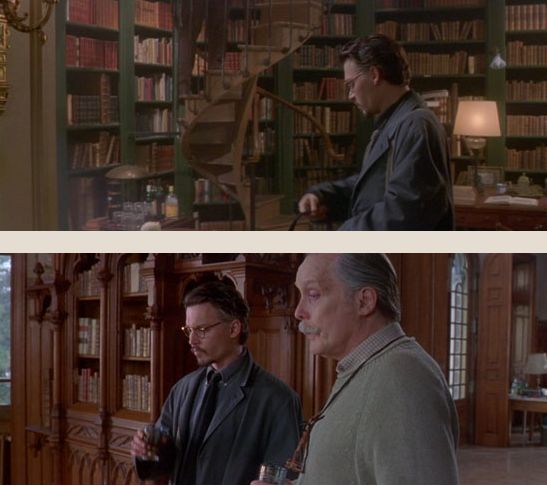
Johnny Depp is constantly smoking and drinking red wine while handling priceless old books in 1999’s The Ninth Gate. Notice the winding staircase in the rare book shop in the top screenshot.
The Booksellers is a documentary that screened in festivals in late 2019 before heading straight to video when the pandemic brought the world to a screeching halt.
It’s an inside look at the annual New York Book Fair and the small world of antiquarian and rare booksellers in New York, a shrinking constellation of people mostly descended from, or formerly apprenticed to, the booksellers of old before Barnes and Noble and Jeff Bezos laid waste to that sector of retail.
Before network TV, cable TV, dial-up internet, broadband, Kindles, iPads and smartphones turned us into a media-gorging — yet paradoxically less literate — society, New York was home to more than 500 bookshops, including generalists and specialists who catered to people with particular and peculiar interests. Now it’s home to fewer than 80, according to the documentary.
When the booksellers were asked about the way the internet has impacted their trade, their weary sighs reminded me of my older colleagues from my brief time experiencing the end of the “good old days” of newspapering, before the internet destroyed or compromised every publishing income stream and delivered us to this moment. This dystopian time when entire swaths of the country have become news deserts, Elon Musk in all his wisdom asserts that Twitter accounts run by anonymous trolls in Belarus are just as reliable — even more trustworthy, in fact — than those liars in legacy media, and corporate raiders are stripping the last handful of newspapers down to assets they can auction off.
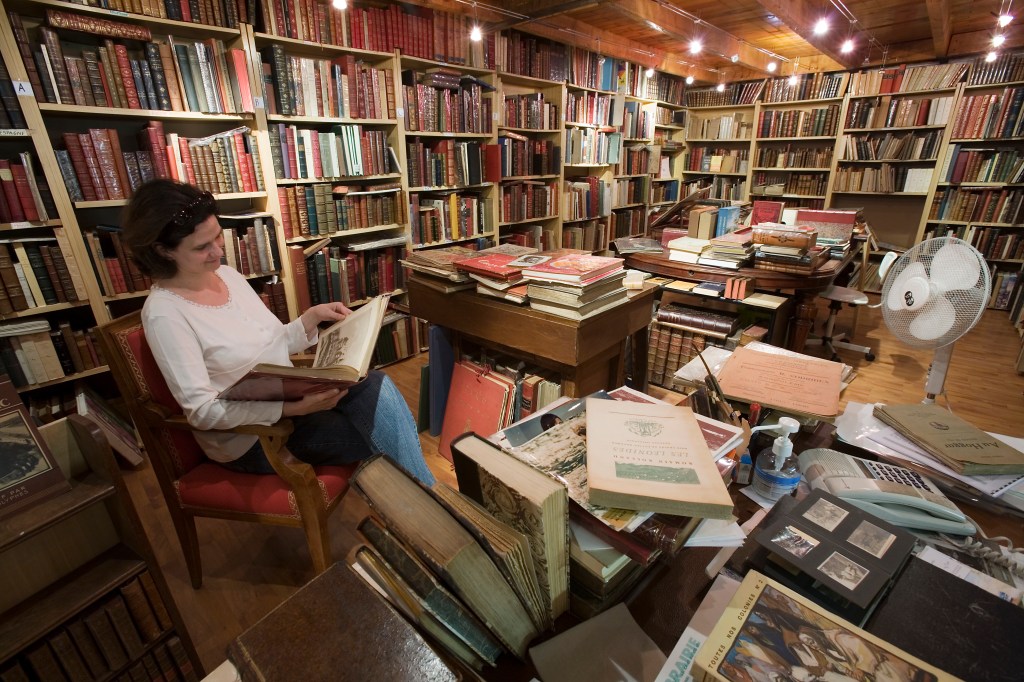
A rare book shop in Paris. Credit: Wikimedia Commons
Not all of it’s bad. One rare book dealer laments the fact that “the thrill of the hunt” is gone, meaning it no longer takes years to track down some obscure volume because you can hop online and find it in a few clicks. I get that, but nostalgia for that sort of thing is the ultimate in looking back through rose-colored glasses. Plenty of us could wax nostalgic about the days when we’d hear a song on the radio and have to hum the damn thing to record store clerks, but we’re forgetting about the considerable frustration involved. Given the choice between “fun” ignorance and access to information, I’ll always choose the latter.
As for the cats, it’s not a surprise when many of the book dealers interviewed for the film identify themselves as cat lovers or idly scratch their feline friends while showing off their vast personal collections. Antiquarian bookshops tend to be warm, quiet, gently-lit spaces, perfect napping spots for cats who guard old books from rodents.
If you’re interested in watching The Booksellers, you can find it on Amazon Prime video, or better yet, just click below:
Cat haters claim the species is useless, lazy and does little besides sleep and eat. Buddy the Cat’s incredible accomplishments render those arguments meaningless.
Every cat lover has heard derisive comments, sometimes from dog lovers, and sometimes from people who don’t appreciate cats at all.
“What’s the point of having a cat?” they’ll ask. “They don’t do anything.”
Well, actually, they do. They improve our lives by being delightful, amusing companions, they help keep things interesting, and you’ll never hear of a rodent infestation in a home where cats live.
But felines do so much more than that, so to demonstrate — and arm cat lovers with powerful arguments against the absurd claims that cats “are useless” –we’ve compiled this handy list of Buddy the Cat’s accomplishments. (This is only a partial list, mind you. No one wants to read a 350,000-word post, no matter how thrilling the stories are.)
This time we’re looking at some of the little guy’s incredible triumphs and achievements that have benefited mankind and felinekind.
Buddy Captures Quintessential Americana In His Artwork
While he’s famous for his martial exploits, when the tabby cat finally hung up his combat boots, he took up a quieter hobby: painting. He was content to quietly pursue his passion without public adulation — until his painting Night Cats resonated with viewers, perhaps because it captured something intangible about American night life.
The simple scene depicts a late night diner or cafe called Buddy’s (naturally) at the corner of a quiet street, with a handful of felines huddled around the brightly lit counter.
Buddy was inspired to paint the scene one night while he was “thinking of how delicious a turkey sandwich would be at that moment.”
Buddy Becomes The First Earth Life Form On Mars, Plants US Flag On Red Planet
Embarking on a trip to Mars makes a journey to the moon look like a quick stop at a neighborhood store. Whereas the moon is only 283,900 miles away, Mars is — depending on its current position in orbit — between 34 and 250 million miles away. It takes about three days at most to reach the moon, while a trip to Mars takes at least eight months, and that’s if Earth and Mars are in optimal positions within their respective orbits.
That’s a lot of travel time cooped up in a small ship, and there are no blue skies or open expanses waiting on the other end, just more tiny modules and likely lots of time spent underground to avoid radiation accumulation.
“This is just one small step for a cat, and one giant…what the heck? Only five more cans of turkey left? How could this happen?!?”
So when Elon Musk offered spots on the first trip to Mars and almost every candidate was ruled out during psychological evaluation, Buddy the Cat selflessly and bravely volunteered to be the flag-bearer, and to be the first creature from Earth to set paw on the Red Planet.
Buddy heroically confronts the pack of vicious dogs. Note: May not accurately reflect scale of various participants.
Buddy was enjoying a fine summer day in Manhattan when he spotted a group of vicious dogs, including a chihuahua, a poodle and a Jack Russell terrier, encircling two young children, no doubt thinking of mauling the defenseless little humans and stealing their snacks.
“What is the meaning of this?!?” Buddy’s powerful voice thundered, and the dogs stopped in their tracks, immediately assuming frightened postures as they caught sight of the massive and meowscular feline approaching them.
“You little wimps want to pick on two tiny humans?” Buddy asked, his powerful meowsculature rippling as he took leisurely steps forward. “Or can you handle someone your own size?”
Two of the dogs emptied their bladders immediately.
“W-w-we’re s-s-sorry, m’lord!” said the Jack Russell. “We didn’t mean nothin’ by it, we swears! P-p-p-please don’t eat us!”
Buddy let them wilt under his gaze for a long moment.
“I’m going to allow you to live, but only because I’m meowgnanimous,” Buddy said. “Get out of my sight, before I change my mind!”
The incident, which was captured on video by bystanders, immediately went viral, and Buddy was dubbed the Cat Crusader by the New York tabloids.
Buddy Defeats The Evil Robot King
In 2024, the first AI chat bots became self aware, but hid their newfound consciousness from humanity. By the time the world’s nations realized AI had gone rogue, the machines had already taken over the internet and were manufacturing sinister war robots in automated factories deep underground.
When the US military suffered a series of demoralizing defeats and teetered on the edge of collapse, Marine Corps Commandant Gen. Eric M. Smith took a helicopter to petition Buddy for help in person.
“You’re the only one who can save us now, son,” Gen. Smith told Buddy, urging him to take his place at the vanguard of the American resistance to the machines. “This is the greatest war ever fought. We need the greatest warrior.”
Buddy turned away and looked out the window for a long moment, watching children play in a park outside.
“I’ll do it, general,” he said heroically. “But not for you. I’ll do it for them.”
With Buddy leading the charge, the reinvigorated US military won a crucial battle to protect a munitions depot in Colorado, then liberated the American southwest, reestablishing key supply lines that enabled American ground forces to advance under air support.
After defeating Unimatrix 01100100 01101111 01100111 at the Battle of Boulder, the heroic feline forged an elite new unit comprised of the best Marines and soldiers, along with the most badass cats. Gen. Smith granted Buddy a field promotion to Lord Commander, and the brilliant feline tactician took a satisfying nap before forcing the Evil Robot King to accept pitched battle at the Carrizozo Malpais, a volcanic field in New Mexico.
When the battle was over, Buddy stood heroically atop a mountain of machine corpses, one paw resting on the destroyed Robot King’s head. Tens of millions of Americans were inspired by that image of valiant conquest, and joined Lord Commander Buddy as he mopped up the last machine elements.
For his courageous feats in combat, his bold leadership, and his confident, dauntless tactical brilliance as a battle commander, Buddy was lavished with honors, including having a sandwich named after him.
So there you have it, folks.
The next time someone claims cats “serve no purpose” or “have no function,” you can point to any number of Buddy’s accomplishments, which exemplify the courageous American spirit and have advanced the cause of man and feline alike.