‘Project Hail Mary’ Is A Surprisingly Poignant Take On What Could Be Out There — And A Buddy Comedy Too!

Venture out into the cosmos and we might find an existential threat — or we may find friends who welcome us into a joyous fraternity among the stars.

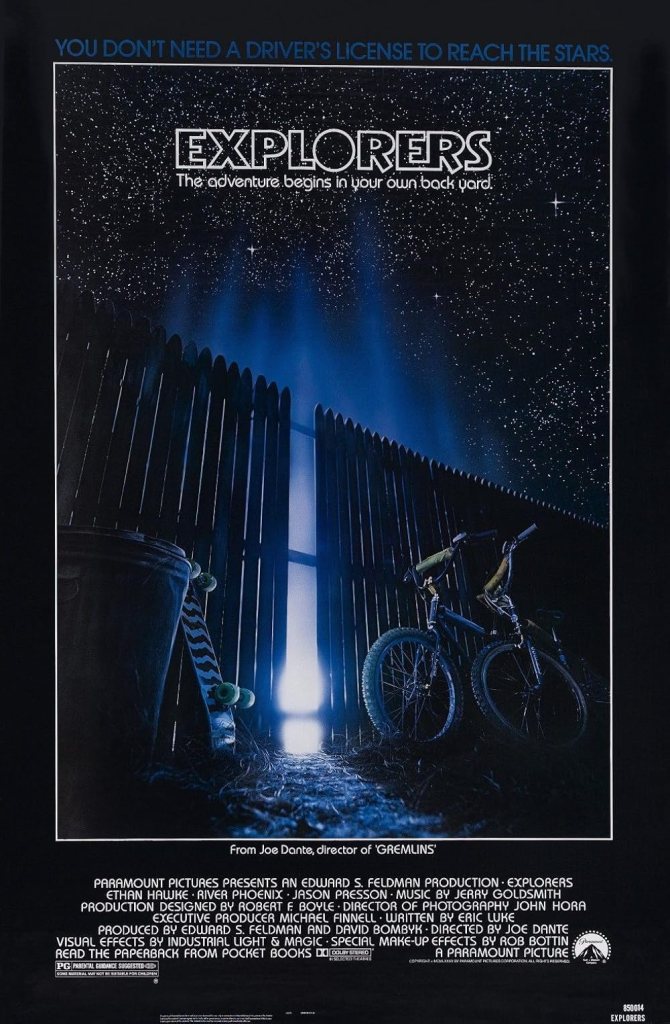
ET. The Last Starfighter. Explorers. Enemy Mine. Arrival.

While Alien is nightmare fuel combining dread in its purest form and the hallucinogenic visuals of one of modern history’s most disturbed artists -creating a vision of extraterrestrial life so horrific that many audiences couldn’t deal with what they were seeing when it hit theaters in 1979 – science fiction also has a strong tradition of imagining friendship in the stars.

Audiences love it when their spacefaring hero finds a buddy.

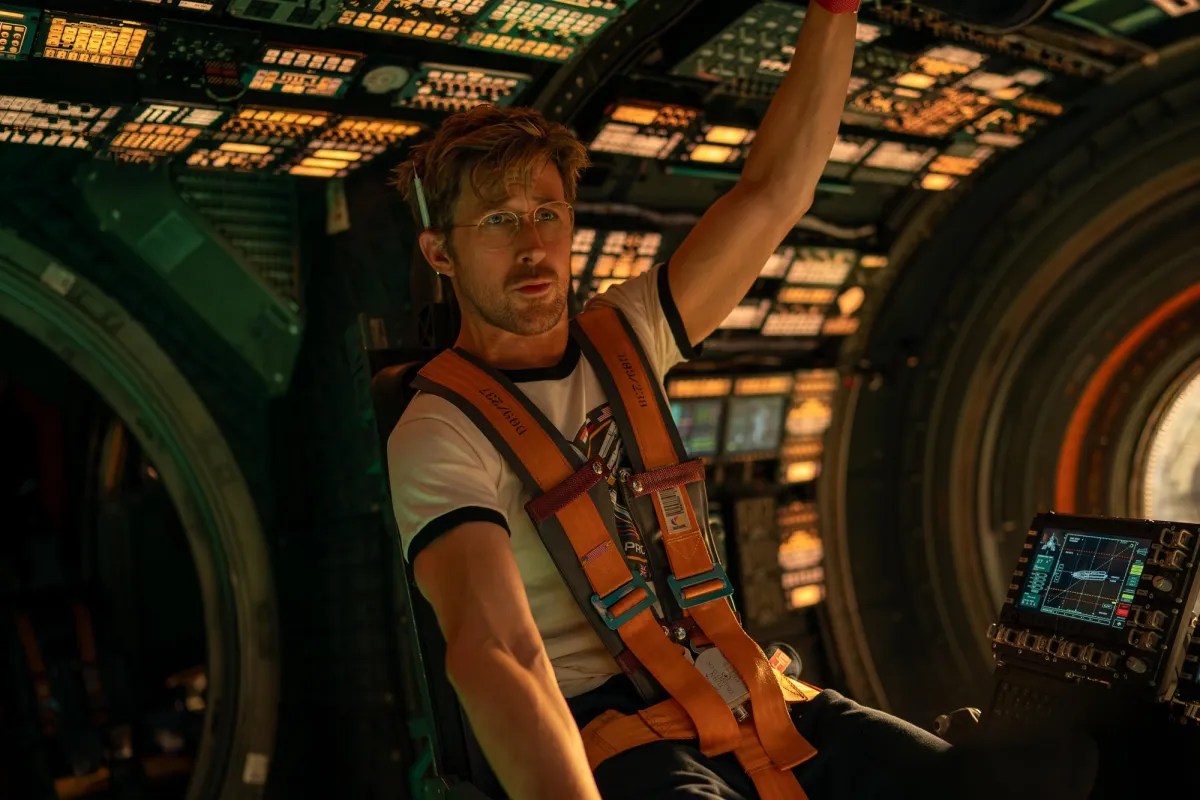
Project Hail Mary is that kind of movie, but it doesn’t look that way at first. Dr. Ryland Grace (Ryan Gosling) is a biologist who was laughed out of higher education when he published papers arguing that our ideas about what’s necessary for life to spark were all wrong.

Grace is an enthusiastic middle school science teacher when we meet him through the eyes of a UN official who recruits him for what will be known as Project Hail Mary.
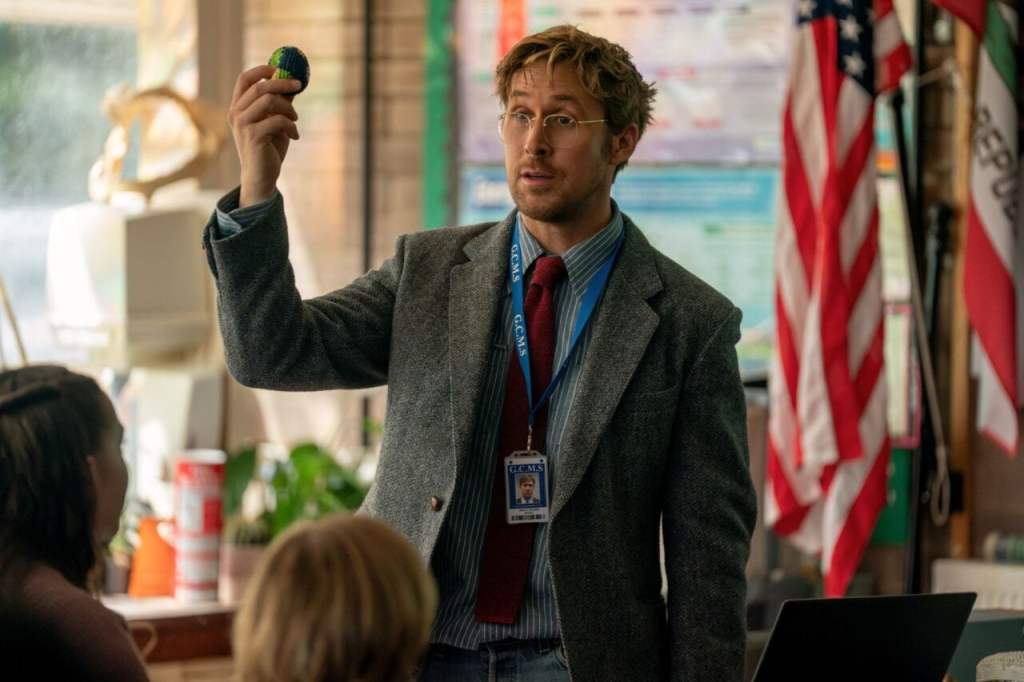
The movie uses classroom scenes for exposition, as the young students beg Goslin’s Dr. Grace to tell them why the astrophage endangers Earth. Credit: MGM

The sun is dying. No one’s sure why until an amateur astronomer named Irina Petrova discovers a wispy line of infrared radiation bridging Venus to our home star. The newly-Christened Petrova Line is made of astrophage, a virus-like organism that feeds on stellar energy, robbing the star of its power.

What begins as a gradual, almost imperceptible drop in the sun’s energy quickly accelerates and the Earth’s temperature begins to plummet.

The same papers that got Grace exiled from academia land him a spot on the worldwide project to study and destroy the astrophage. The usual assumptions about how life operates are not cutting it, and the project needs all the independent thinkers it can find to look for a solution.

If they can’t find one, the dying sun will leave the Earth in a deep freeze. In turn it will bring on a new ice age, the destruction of most of Earth’s arable farmland, mass extinction of plants and animals, then famine and all the horror that comes with it.


The narrative cuts between past (Grace’s introduction to the project and its early days) and present, when Grace is one of three crew members headed to the star system Tau Ceti to find out why it’s the only star in our cluster that hasn’t been infected with astrophage. In our entire galactic neighborhood, only Tau Ceti — a G-type star similar to our sun about 12 light years out — continues to burn bright.
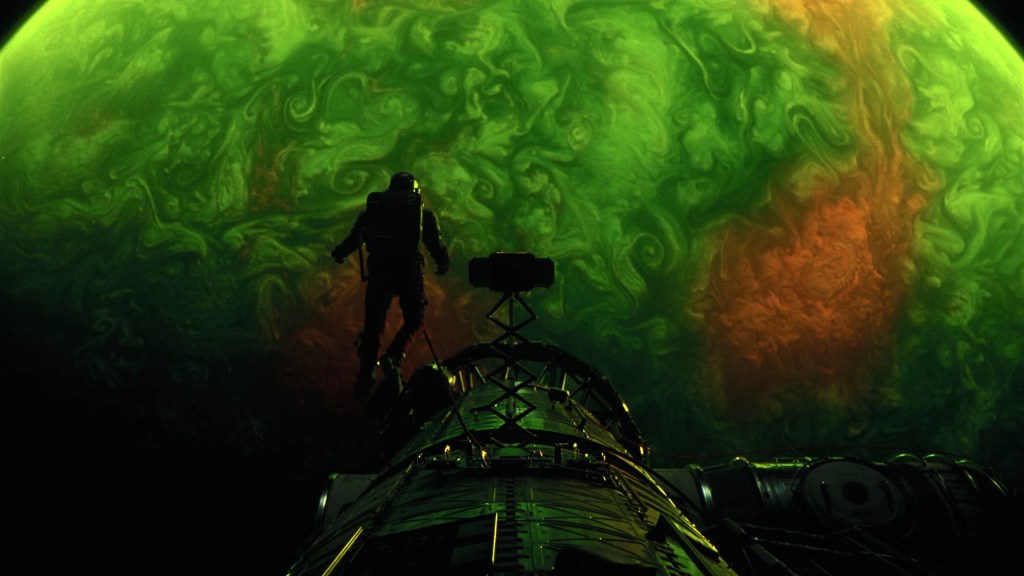
The movie offers some spectacular, sometimes even trippy space vistas, such as this one of the planet Tau Ceti E. Credit: MGM

It turns out humans are not the only ones desperate to know why Tau Ceti is not dying, and that’s where the movie goes from interesting to emotionally resonant, poignant and a heck of a lot of fun.

There’s plenty of mystery, tension, and awe at the beauty of creation, all against the backdrop of Grace’s evolving relationship with his unexpected buddy.

This is a movie that would have been a major challenge for any lead actor, and Gosling not only imbues Grace with with a self-conscious, cautious bearing, he also does a great job of carrying long scenes without the benefit of another expressive human face to help him sell the action and drama.

What could have been convoluted science is explained to the audience in simple and effective terms. The problem is outlined elegantly, and the stakes are made very clear. If no one can figure out how to stop the astrophage, humanity will likely survive in the near term, but only in miserable, resource-depleted, technologically retrograde pockets of people who regard others as a threat. Eventually even those holdouts will succumb to cold and starvation.
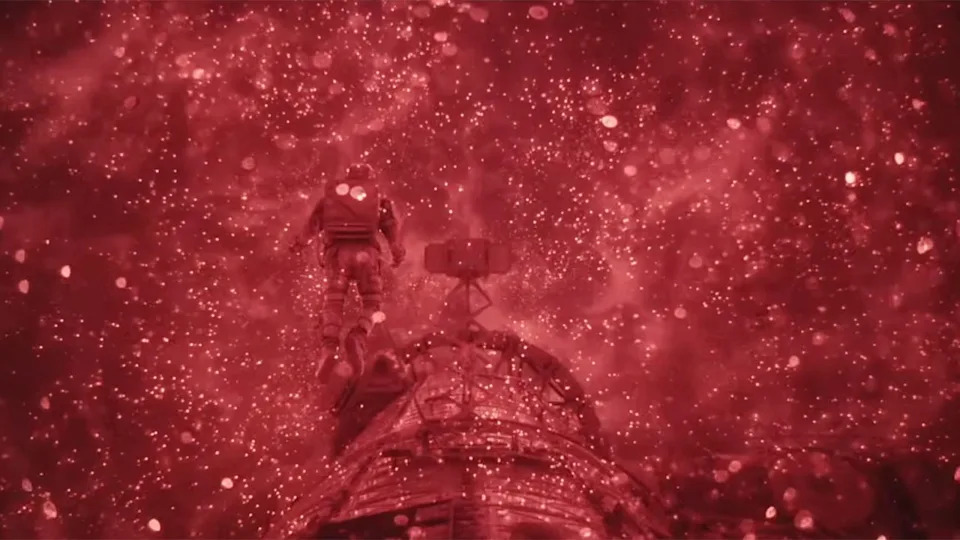
The same image of Tau Ceti E from above, but this time viewed in a different wavelength of light that reveals the astrophage traveling along Tau Ceti’s own Petrova Line.

The film doesn’t trivialize space either. An interstellar journey is the kind of thing we might be able to accomplish with the pooled resources of humanity, the brightest engineers, designers and scientists of our species, but it’s also a long, extremely dangerous and difficult undertaking.

Thus the name Project Hail Mary. It’s a long shot, audacious and unlikely to succeed, but as Sandra Hüller’s UN project leader explains to Goslin’s Grace, the only alternative is to do nothing and wait to die.

Perhaps most importantly from a science perspective, the film offers a clever way for the project to generate the energy needed to send a ship to Tau Ceti at near-light speed. Currently we might be able to build a viable vessel, which would be a monumental design and engineering challenge, but it would take more than 150,000 years to travel that far with our best current propulsion systems. More energy — and speed — is a must, especially when the mission is a race against time, with only a few decades before our planet freezes over.

The movie’s solution won’t help us in real life, but within the context of the narrative it’s a clever way of traversing enormous distances in a short time instead of the thousands of years it would normally take.
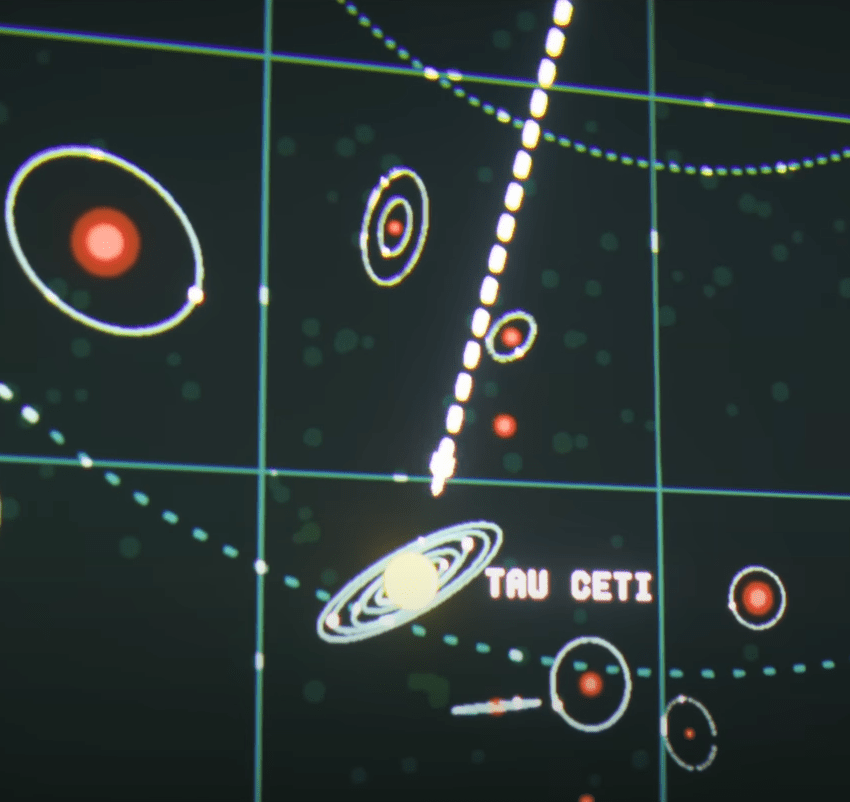
Every star within dozens of light years of Earth is infected with astrophage and dimming except for Tau Ceti. Why?

Plausible science provides the framework for the story, but its payoff is emotional, and Dr. Grace’s experiences with his strange new friends will remain with you after the credits roll.

If you’re like me and didn’t rush to see this in the theaters because you found The Martian — based on a book by the same author — overhyped, do yourself a favor and spend an evening in Project Hail Mary‘s world. It’s a journey well worth taking, and the rare movie that leaves you with a glow by the time the credits roll.

Project Hail Mary is currently streaming on Amazon Prime video.
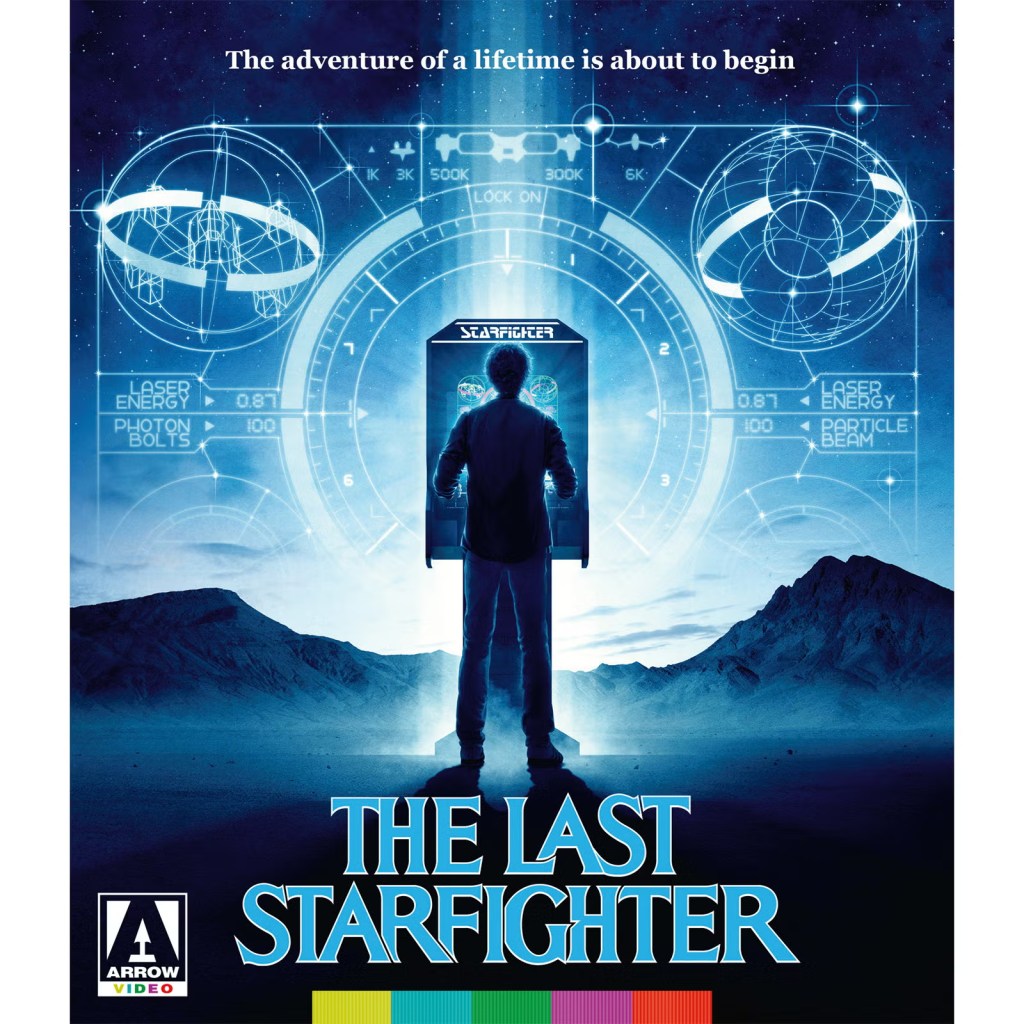
Even a SF-horror fan like me would love to see more lighthearted science fiction in the mold of Project Hail Mary and classic 1980s science fiction adventures like The Last Starfighter and Explorers.

Disproving The Claim That Cats Are ‘Useless’ And ‘Don’t Do Anything’

Cat haters claim the species is useless, lazy and does little besides sleep and eat. Buddy the Cat’s incredible accomplishments render those arguments meaningless.

Every cat lover has heard derisive comments, sometimes from dog lovers, and sometimes from people who don’t appreciate cats at all.

What’s the point of having a cat?” they’ll ask. “They don’t do anything.”

Well, actually, they do. They improve our lives by being delightful, amusing companions, they help keep things interesting, and you’ll never hear of a rodent infestation in a home where cats live.

But felines do so much more than that, so to demonstrate — and arm cat lovers with powerful arguments against the absurd claims that cats “are useless” –we’ve compiled this handy list of Buddy the Cat’s accomplishments. (This is only a partial list, mind you. No one wants to read a 350,000-word post, no matter how thrilling the stories are.)

This time we’re looking at some of the little guy’s incredible triumphs and achievements that have benefited mankind and felinekind.

Buddy Captures Quintessential Americana In His Artwork

While he’s famous for his martial exploits, when the tabby cat finally hung up his combat boots, he took up a quieter hobby: painting. He was content to quietly pursue his passion without public adulation — until his painting Night Cats resonated with viewers, perhaps because it captured something intangible about American night life.

The simple scene depicts a late night diner or cafe called Buddy’s (naturally) at the corner of a quiet street, with a handful of felines huddled around the brightly lit counter.

Buddy was inspired to paint the scene one night while he was “thinking of how delicious a turkey sandwich would be at that moment.”

Buddy Becomes The First Earth Life Form On Mars, Plants US Flag On Red Planet

Embarking on a trip to Mars makes a journey to the moon look like a quick stop at a neighborhood store. Whereas the moon is only 283,900 miles away, Mars is — depending on its current position in orbit — between 34 and 250 million miles away. It takes about three days at most to reach the moon, while a trip to Mars takes at least eight months, and that’s if Earth and Mars are in optimal positions within their respective orbits.

That’s a lot of travel time cooped up in a small ship, and there are no blue skies or open expanses waiting on the other end, just more tiny modules and likely lots of time spent underground to avoid radiation accumulation.

“This is just one small step for a cat, and one giant…what the heck? Only five more cans of turkey left? How could this happen?!?”

So when Elon Musk offered spots on the first trip to Mars and almost every candidate was ruled out during psychological evaluation, Buddy the Cat selflessly and bravely volunteered to be the flag-bearer, and to be the first creature from Earth to set paw on the Red Planet.

Brave. Bold. Bodacious. Benevolent. Badass. Buddy.

Buddy Defeats A Pack Of Vicious Dogs

Buddy heroically confronts the pack of vicious dogs. Note: May not accurately reflect scale of various participants.

Buddy was enjoying a fine summer day in Manhattan when he spotted a group of vicious dogs, including a chihuahua, a poodle and a Jack Russell terrier, encircling two young children, no doubt thinking of mauling the defenseless little humans and stealing their snacks.

“What is the meaning of this?!?” Buddy’s powerful voice thundered, and the dogs stopped in their tracks, immediately assuming frightened postures as they caught sight of the massive and meowscular feline approaching them.

“You little wimps want to pick on two tiny humans?” Buddy asked, his powerful meowsculature rippling as he took leisurely steps forward. “Or can you handle someone your own size?”

Two of the dogs emptied their bladders immediately.

“W-w-we’re s-s-sorry, m’lord!” said the Jack Russell. “We didn’t mean nothin’ by it, we swears! P-p-p-please don’t eat us!”

Buddy let them wilt under his gaze for a long moment.

“I’m going to allow you to live, but only because I’m meowgnanimous,” Buddy said. “Get out of my sight, before I change my mind!”

The incident, which was captured on video by bystanders, immediately went viral, and Buddy was dubbed the Cat Crusader by the New York tabloids.

Buddy Defeats The Evil Robot King

In 2024, the first AI chat bots became self aware, but hid their newfound consciousness from humanity. By the time the world’s nations realized AI had gone rogue, the machines had already taken over the internet and were manufacturing sinister war robots in automated factories deep underground.

When the US military suffered a series of demoralizing defeats and teetered on the edge of collapse, Marine Corps Commandant Gen. Eric M. Smith took a helicopter to petition Buddy for help in person.

“You’re the only one who can save us now, son,” Gen. Smith told Buddy, urging him to take his place at the vanguard of the American resistance to the machines. “This is the greatest war ever fought. We need the greatest warrior.”

Buddy turned away and looked out the window for a long moment, watching children play in a park outside.

“I’ll do it, general,” he said heroically. “But not for you. I’ll do it for them.”

With Buddy leading the charge, the reinvigorated US military won a crucial battle to protect a munitions depot in Colorado, then liberated the American southwest, reestablishing key supply lines that enabled American ground forces to advance under air support.

After defeating Unimatrix 01100100 01101111 01100111 at the Battle of Boulder, the heroic feline forged an elite new unit comprised of the best Marines and soldiers, along with the most badass cats. Gen. Smith granted Buddy a field promotion to Lord Commander, and the brilliant feline tactician took a satisfying nap before forcing the Evil Robot King to accept pitched battle at the Carrizozo Malpais, a volcanic field in New Mexico.

When the battle was over, Buddy stood heroically atop a mountain of machine corpses, one paw resting on the destroyed Robot King’s head. Tens of millions of Americans were inspired by that image of valiant conquest, and joined Lord Commander Buddy as he mopped up the last machine elements.

For his courageous feats in combat, his bold leadership, and his confident, dauntless tactical brilliance as a battle commander, Buddy was lavished with honors, including having a sandwich named after him.


So there you have it, folks.

The next time someone claims cats “serve no purpose” or “have no function,” you can point to any number of Buddy’s accomplishments, which exemplify the courageous American spirit and have advanced the cause of man and feline alike.

Bud Battles A New Vacuum, Plus: Webb Telescope Reveals ‘Toe Bean’ Of Cat’s Paw Nebula

Buddy confronts his machine arch-nemesis, while NASA celebrates JWST’s third anniversary by imaging the cosmic cat’s paw in detail we’ve never seen before.

To mark its third anniversary, the team behind the James Webb Space Telescope has released an image of the Cat’s Paw nebula, and it’s incredible!

Below is a dramatically scaled down version of the image to make things easier on readers who may have slower connections or tend to visit PITB on mobile devices. The original is 30mb and can be found here.

It really is worth viewing at maximum resolution, where you can see details of the stellar nursery and the thick plumes of ionized gases that comprise the radiant, multi-hued structure of the nebula.

The dark red areas are dense concentrations of gases, the clouds from which stars are born. The blue stars are the cosmic newborns, and if you scroll through the image at maximum resolution, you can see those young stars floating in seas of their golden brethren in interstellar expanses stretching thousands of light years. In this image, we’re looking at an area of our galaxy between about 4,000 and 5,500 light years away.

Here’s the small version:

And here are images that better illustrate why it’s called the Cat’s Paw, with a view oriented in the “correct” way to trigger our brains’ pattern recognition processes, the mechanisms that make us think “Oh yeah, that does look like a cat’s paw!”

“Toe beans” up top, large pad beneath. The Cat’s Paw Nebula.
Viewed in different wavelengths to better see the overall structure without the obscuring elements.

We’re fortunate there is no cosmic-scale feline floating out there. Just imagine entire star systems batted around for fun, or a section of the galaxy reserved as a litter box.

I know this can seem overwhelming to some people, while others see images like this and think “What’s the big deal? Haven’t we seen things like this before?”

And the truth is no, we haven’t. That’s the beauty of the James Webb Space Telescope. We’re not only seeing galaxies and structures previously undiscovered, we’re also seeing familiar cosmic locations in detail and resolution that was previously impossible.

In a very real way, we’ve upgraded from standard definition Cosmic TV to the HD version.

The scope is in orbit, at a gravitationally stable position known as Lagrange point 2. In plain English, it’s a special place a million miles from Earth where the gravitational dance between our planet and our sun effectively cancel each other out.

Or, as NASA puts it, Lagrange points are “positions in space where objects sent there tend to stay put.”

It took decades of planning and the engineering talents of thousands of humanity’s best to create the JWST, which is also a spacecraft. The scope was built to travel to L2 without anyone aboard, then unfold itself in a delicate ballet of almost innumerable moving parts. The JWST’s ability to transform, like a butterfly emerging from a cocoon, is an engineering marvel in and of itself, and that’s before it began providing us with a better view of the cosmos than we’ve ever had in the history of our species.

Cheers to the scientists and engineers at NASA, who have repeatedly demonstrated they’re cat-loving people!

Header image credit: Texas Tech University Department of Physics and Astronomy

The fury of the Budster

Casa de Buddy has a new vacuum, desperately needed during this hot summer as Bud has been shedding more fur than usual.

I could have made another cat from all the hair the new vac picked up from the area rugs, couches and pillows, but Buddy wasn’t happy.

As PITB readers know, vacuums are high on the list of things Buddy despises. He’ll start hissing the moment he sees one, even if it’s not plugged in. He thinks they are angry nemesis machines created to infiltrate his territory and torment him.

Usually I try to lure the little dude into another room with treats and lock him in for a few minutes while I vacuum, but he was nowhere to be found, so I thought he’d spotted the vac and retreated voluntarily.

Tragically, I was mistaken.

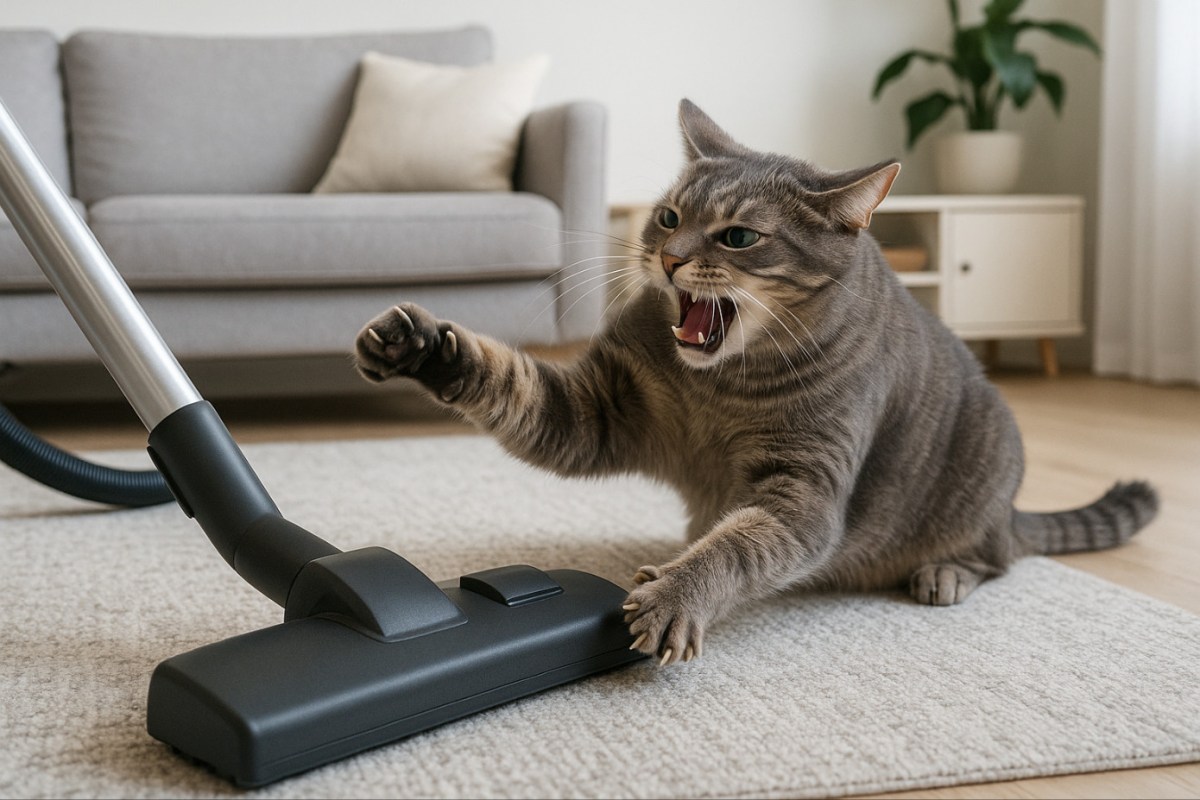
Shortly after I began vacuuming my bedroom, I heard a low growl, then Buddy leaped from his hiding spot under my desk and shrieked his high-pitched, baby-like battle cry as he launched himself at the evil vacuum!

It was comical. His little face was twisted into a mask of rage, his ears were pinned back, and he slapped the hell out of the vac: SLAP SLAP SLAP SLAPPP!!! with his little paws.

Here’s a reimagining of the ghastly incident, since it would be cruel to repeat it just to get photos. It’s Buddy — or the “model” of Buddy I’ve built using dozens of photos — exacting his wrath on the evil machines that disturb his peace:

I turned the vacuum off and tried to calm him down by reassuring him in a soft voice that he was safe. Nothing to be worried about, pal!

But I couldn’t stop laughing, which didn’t help the situation. Little man does not like to be mocked, and I’m convinced he fully understands when I’m laughing at instead of with him.

Ah, well. Next time there will be no assumptions and I’ll get him safely out of harm’s way before using the evil contraption.

LISTEN: The Buddies Release Their Worldwide Smash No. 1 Single!

Buddy the Cat’s quest for world domination has moved into the realm of music. Listen to the new single here!

NEW YORK — Buddy the Cat made history as the first feline to top the charts in multiple genres this week with the release of “Move Your Ass” by The Buddies.

Listen to it here, but before you do, make room to get funky. (“And use proper headphones or speakers please!” Buddy says. “Don’t do us dirty by playing it through a phone or a laptop. You’ll miss all the bassy goodness that makes it funky!”)

The incredibly funktacular nu-disco track pays homage to the talented feline, who played guitar, bass, keyboards and percussion, while his human assisted him with certain particulars that required an opposable thumb.

“Obviously I could have done this on my own,” Buddy says, “but I like my human to feel like he’s involved in things, you know? Camaraderie and all that. But for future documentaries, ‘Behind the Music’ episodes and other retrospectives, it should be clear I’m the musical genius and the talent. The brains and the brawn, so to speak. Also the beauty. Obviously.”

“Move Your Ass” hit the top of Japan’s pop charts after an early release on Jan. 20 in that country, while it’s dominated the dance music charts in Luxembourg, the Principality of Sealand, Monaco and France. After its Jan. 30 release in the US and UK, it was steadily climbing the charts on Spotify and terrestrial radio.

Asked about his musical influences, Buddy waxed poetic about the funk, disco, French house and nu-disco he grew up listening to.

“From my earliest days of kittenhood, I remember Big Buddy playing Earth, Wind and Fire, Kool and the Gang, McFadden and Whitehead, The Brothers Johnson, Daft Punk, the Galactik Knights and Televisor. I love Televisor! I would dance around and joyfully smack my human on the head, then go hide in his shoes.”

Buddy’s already hard at work on his next single, which he promises “will be just as delicious as this one.”

The First HD Video Streamed From Space Is A Clip Of A Cat Chasing A Laser

In Netflix’s Three Robots, a trio of intelligent wise-cracking machines tour post-apocalyptic Earth after humanity nukes itself out of existence. While humans are long gone from the planet, felines are not, and before long the robots encounter a gray tabby.

“What’s the point of this thing?” one robot asks its friends, looking skeptically at the yawning cat.

“Apparently there’s no point, they [humans] just had them,” the second robot says.

“Well, that’s underselling their influence,” the third robot says. Humans, it explains, “had an entire network that was devoted to the dissemination of pictures of these things.”

The ongoing joke that the internet and modern telecommunications systems were invented solely for the purpose of sharing cat photos and videos won’t die any time soon now, thanks to NASA.

To inaugurate and test its new Deep Space Optical Communications (DSOC) system, which uses lasers instead of radio signals to transmit data, the famed space agency streamed a high definition video of a cat named Taters chasing a laser.

The 15-second clip took half a second to transmit from the spacecraft Psyche and 101 seconds to cross the 19 million miles (30 million kilometers) between Psyche and Earth. For context, that’s a journey about 80 times as long as the distance between Earth and the moon.

So why is NASA doing this? Why create a new communications network when the old one still works? And why send a video of a cat?

Taters
Taters the cat. Credit: NASA

The answer to the first question is simple: Our machine proxy explorers need more bandwidth to send back data and ultra high definition photos/video of the strange worlds they’re exploring.

We send robotic probes to destinations like the asteroid belt and Venus because we can’t go ourselves, and because it’s the most efficient way to explore. The indomitable human spirit drove us to explore our own planet, and it’s expected that eventually human eyes will see the oceans of Europa and the surface of Mars. But we still have some big engineering challenges ahead of us, like figuring out how to build ships that adequately shield astronauts from radiation, and medical/biological challenges like how to prevent vision, bone density and muscle loss in low or zero gravity.

So in the meantime robotic probes are our ticket, and their numbers are growing quickly.

There are more than 30 active probes exploring our star system now. Most belong to NASA, but others belong to space agencies from the EU, South Korea, Japan, Russia and India, among others. Another 27 new spacecraft are expected to launch this year, headed to destinations like Venus, Mars and the many moons of Jupiter, and at least that many are scheduled to join them in 2026.

That’s a lot of probes.

Each of those craft will have to transmit data back to Earth — scientific data, but also high definition photos and videos of planetary and moon surfaces, asteroid compositions and more.

There isn’t a traffic jam — yet. But there will be soon if every probe’s data is bottlenecked by the lower-bandwidth radio system.

While laser and radio transmissions both travel at the speed of light, the shorter wavelength of laser light allows more data transfer. In simple terms, the DSOC network is like upgrading from an old phone modem to broadband.

As for why NASA chose a video of Taters chasing a laser, there are two main reasons: Fun and honoring history.

Taters’ human, Joby Harris, works for NASA as a visual strategist. When NASA employees were talking about the significance of sending the first high-def video from a probe to Earth, one staffer mentioned that one of the first — or perhaps the first — test videos in the dawn of television was a simple video of a statue of Felix the Cat.

The rest fell into place. Transmitting a video of a cat chasing a laser seemed like the natural choice to test a laser-based comms system. Taters has become something of a celebrity in the process.

One thing we can be sure of: if aliens are watching us from afar, there’s a good chance they’ll conclude felines are the ones running things down here. They may not be wrong.