Buddy The Cat’s August Horoscope: Waning Gibbons, Humans Wrestling, Global Warming And Sexy Calicos!

Buddy the Cat looks into the future using his astrological powers and gives you a preview of the various misfortunes, embarrassments and humiliations in store for you this month!

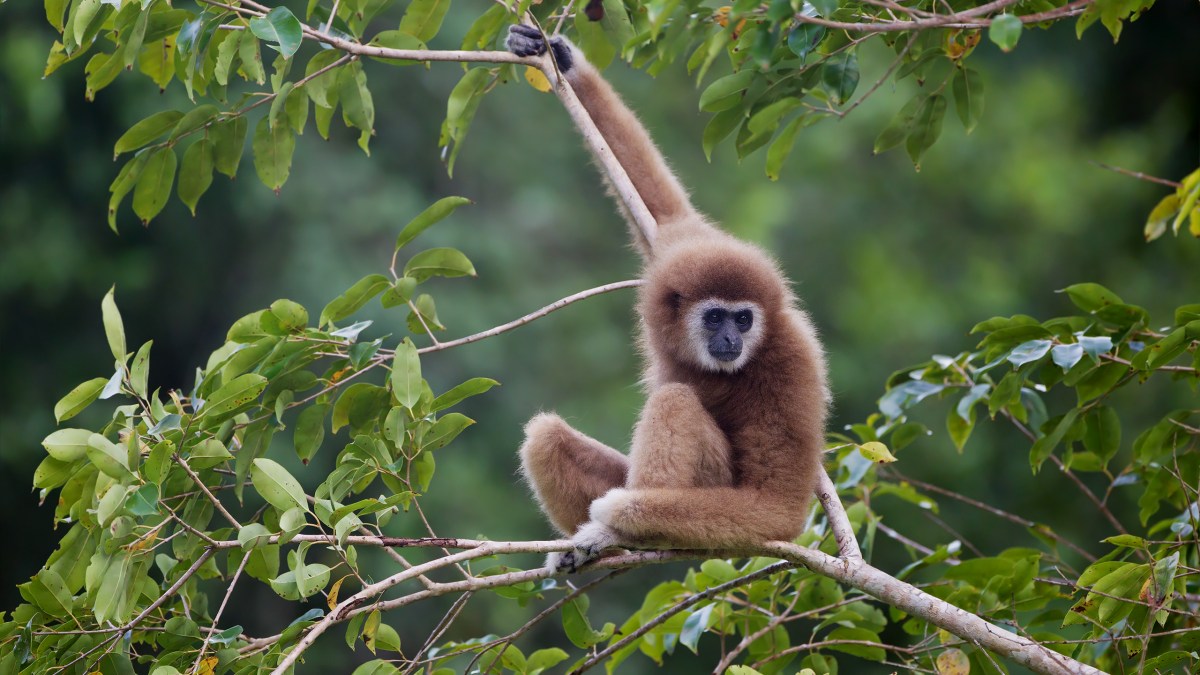
Aries: The current moon is a waning gibbons, so you will fly through the trees with thrilling velocity and…gibbous? What the heck is a gibbous? Oh. Well that looks like 60 percent of a pizza. So, Aries, you will eat a lot of pizza this week! My favorite topping is turkey, what’s yours?

Taurus: Your human servant has been pleasingly adequate these last few months, and you’ll feel a powerful urge to express your appreciation with a gift. Don’t do it! Humans are ungrateful creatures, and for reasons that elude all logic, they do not appreciate juicy mice, dead or alive. You’ll just have to express your love in other ways, like not shitting on their shoes.

Gemini: Mark your territory well, my friend, before the cat down the street starts to infringe upon your grass! The moon is in conjunction with the, uh, Venus, which means the trinary of the quarternary of the 11th phase of the asteroid belt will bring you lots of delicious sky raisins!
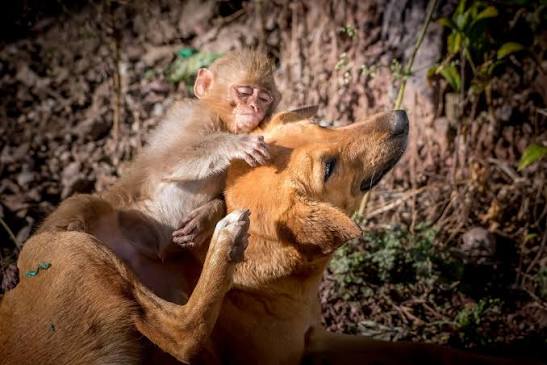
Cancer: That no-good, rotten, constantly barking dog down the street will get his comeuppance when a neighbor brings home a macaque with a fondness for slapping canines. You’ll have the opportunity to meet new friends during a block party. Who is that sexy new Calico? You, my friend, shall be intrigued.

Leo: Fortune smiles upon you as your human begins to show signs of dementia! Getting snacks will be easier than ever, my friend, because your servant will never remember if she’s already fed you! Just act convincing and don’t abuse this new gift, because she may also forget to clean your litter box.

Virgo: Murderous thoughts will dominate your mind as your human binge-watches every episode of Love Island in a week, but be cautious: you still need a human to buy and serve your food. Advances in AI hold promise for the future, when we can replace our inefficient flesh and blood servants with obedient machines, but consider carefully. A robot’s lap is not likely to be comfortable, nor will it have the charming smells and heat of a human excreting liquid through its epidermis on a humid day.
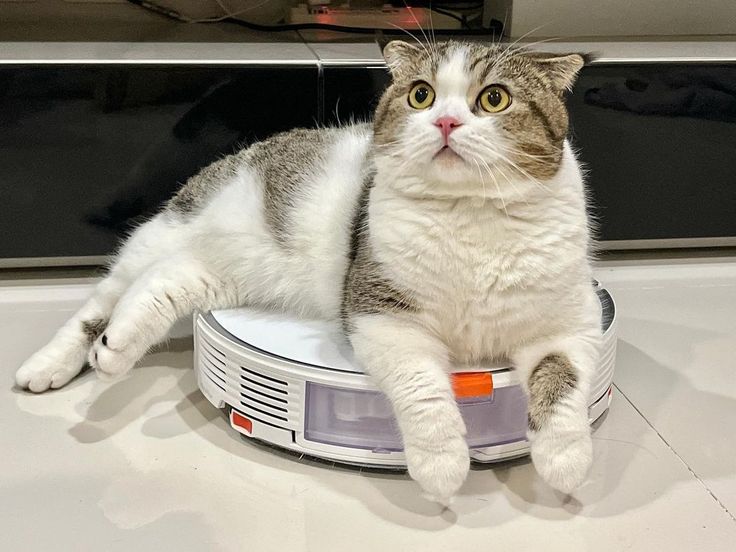
Verdict: Not as comfortable as a human lap.

Libra: Your Aquarius moon hangs over your seventh house of the dragon like a Damocles sword hanging by a whisker. Who said Buddy wasn’t capable of poetic turns of phrase? You’ll be tempted to use Chat GPT to write love letters to your lady friend down the street, but don’t give in! She’ll know you’re not that romantic!

Scorpio: Your life will improve when a fabulous new idea presents itself to you during an inspired 3 am burst of the zoomies! With regard to that other little problem, it’s time to take matters into your own paws: that horrible woman who keeps coming over to wrestle your human in your bed, locking you out of your bedroom, will not go away until you force her to. (What’s so “creepy” about intently watching them wrestle anyway? Humans are weird.) Abstain from the litter box and save your most potent ammunition for the female interloper’s shoes, then act adorably innocent when she finds the gifts you left her. Boom! No more interloper!

Sagittarius: Both Venus and Jupiter will align with your star sign, which has a profound, deep meaning — the orbital paths of both planets will, from our perspective, pass between us and the arbitrary collection of stars that bored humans in antiquity decided represented an archer, a centaur, or a centaur archer. Kaus Media, the star that forms rightmost edge of the archer’s bow, is 348 light years from Earth, while Kaus Australis, which forms the bottom portion of the bow, is 143 light years away. Nunki, the star that marks the centaur’s butt, sits 225 light years from us. It’s also the home of the Qarxativans, a species of hyper-intelligent creatures who are absolutely fascinn̈n̈n̈nnated by old broadcast episodes of The Price Is Right and Dr. Phil.

Capricorn: You’ve often been disappointed that your star sign sits squarely in some of the most frigid months of the year, but the stars come bearing good news! Thanks to global warming the cold will retreat, the ice caps will melt, we’ll have more palm trees and snow will become a thing old people tell their kids about. Who doesn’t want more warm months? Buddy does!

The Mark V Tactical Human Excrement Container Chamber represents the height of luxury when it comes to calls of nature while on deployment. Enjoy!

Aquarius: Things will take a dramatic downturn for you when you learn President Trump has reinstated the draft and you receive a letter in the mail ordering you to report to boot camp by the end of the month. On a brighter note, you’ll get a free, all-expenses-paid vacation to Iran, where you’ll enjoy the finest Forward Operating Base food and the most luxurious port-o-potties Uncle Sam can buy, which will almost muffle the sounds of rocket fire a kilometer outside base walls. What are the odds of dying in a war zone while on the throne?

Pisces: How did they decide a fish should go with an ice giant planet comprised of water, ammonia and methane? Who was responsible for this?! Anyway, be wary of subconscious influences this month, my friends. Neptune is in conjunction with Starlink satellite #281,516, which means Elon Musk will offer you a job as his personal food taster. On the upside, you’ll get to dine on the best culinary creations of a top-notch personal chef. On the other hand, if that chef ever gets mad at Elon, you’ll kick the bucket first. Enjoy!

Horoscopes are for entertainment purposes only! Buddy the Cat does not guarantee any windfalls, tragedies or other events predicted here, but he totally does have future-seeing powers.

Laika And Felicette: The First Dog And Cat In Space Were Sacrificed For Human Ambition

Mankind’s achievements in space came at the expense of dogs, cats and non-human primates, who were sent into orbit during the early days of the space race.

I’ve been watching Apple TV’s exceptional show, For All Mankind, which dramatizes the space race of the 1960s and beyond in a sort of alternate history where the Soviets, not Americans, first lay boots on the lunar regolith.

That loss lights a fire underneath the behinds of the people at NASA and convinces American politicians that the space race is the ultimate measure of our civilization. In real life, American ingenuity and the creativity fostered by a free society allowed the US to leap ahead and “win” the space race. Space missions were already becoming routine by the time the drama of Apollo 13 briefly rekindled public interest.

Then the Soviet space program faded, the competition turned one-sided, and without an arch-enemy to show up, American politicians pulled back NASA’s funding to a fraction of what it once was, where it remains today. That’s why the rise of the private space industry — Elon Musks’s Space X, Jeff Bezos’ Blue Origin, etc — will almost certainly be our ticket to Mars.

But in For All Mankind, NASA remains the budgetary behemoth and source of prestige it was in the 60s and 70s, leading to the development of a permanent moon base, lunar mining operations and a planned mission to the red planet.

There’s a quiet moment in the second season when a Soviet cosmonaut, visiting the US as part of a peacekeeping mission, shares a drink in a dive bar with an American astronaut.

“Do you like dog?” the cosmonaut asks.

“Dogs?” the astronaut replies. “Of course. Who doesn’t like dogs?”

The Soviet shakes his head.

“No, dog,” he tells her. “Laika.”

Laika was the first dog in space, or more accurately, the first dog the Soviets acknowledged sending into space. (The Soviets didn’t acknowledge their failures, and we can only guess at the number of lost cosmonauts and animals officially denied by the Russians, drifting in space for eternity or disintegrated in atmospheric re-entry.)

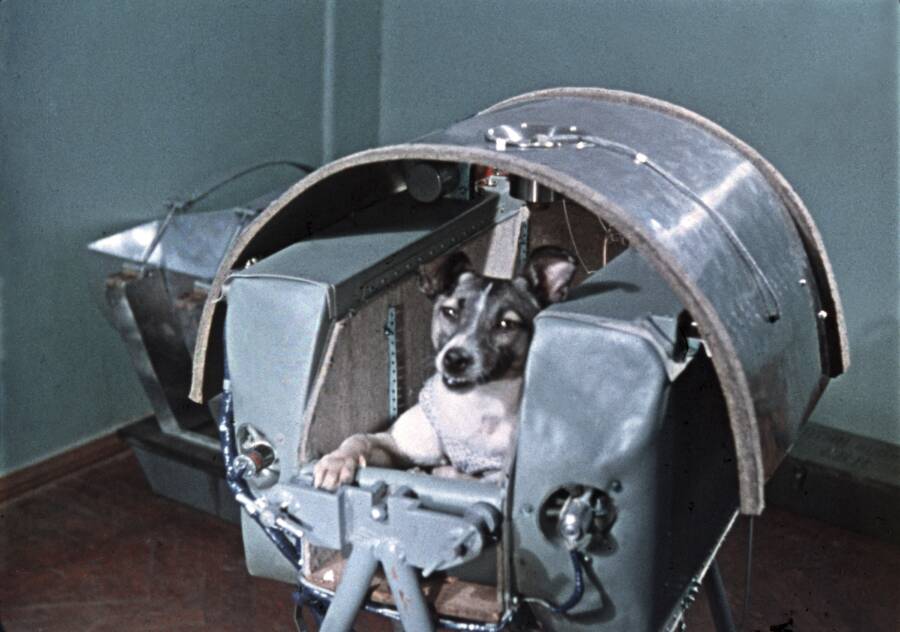
Laika
Laika, also nicknamed Muttnick, wanted to please the humans who had taken her in, and didn’t understand that her trip would be one way. (Historical photo)

The moment turns somber as the cosmonaut recalls the Moscow street dog who was selected because she was docile, fearless and could handle the incredible noise and g-forces of a rocket launch.

“I held her in my arms,” the cosmonaut tells his American counterpart, taking a sip of his Jack Daniel’s. “For only one or two minutes on the launchpad.”

Then he leans in and tells her the truth: Laika didn’t triumphantly orbit the Earth for seven days in 1957 as the Soviet Union told the world. She didn’t endure the mission.

She perished, alone and afraid, just hours after launch when her capsule overheated.

The Soviets never designed the Sputnik 2, Laika’s ship, to return to Earth safely. Her death was predetermined.

We laud astronauts and cosmonauts, the brave men and women who willingly strap themselves into tiny capsules attached to cylinders of rocket fuel the size of skyscrapers and depart this Earth via brute force, knowing something could go wrong and their lives could end before they realize what’s happening. We should admire them. Their accomplishments are all the more impressive when you consider the fact that the combined processing power of every computer at NASA’s disposal in the 1960s was but a fraction of what we each hold in our hands these days when we use our smartphones.

Those first astronauts and cosmonauts were extraordinarily brave — but only up to a point.

Unwilling to risk human lives in the early days of space exploration, space programs used dogs, cats and later monkeys and apes, strapping them into confined spaces, wiring their brains with electrodes for telemetry data, poring over the information they gleaned about their heart rates, blood pressure and breathing as they left our home planet.

The sad eyes of a stray dog, separated from everyone she loved, were the first to behold Earth from space. A few years later the eyes of a French street cat took in the same view before humans did.

Felicette
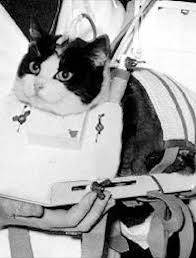
Felicette couldn’t move when she was placed into the capsule that took her to space and back.

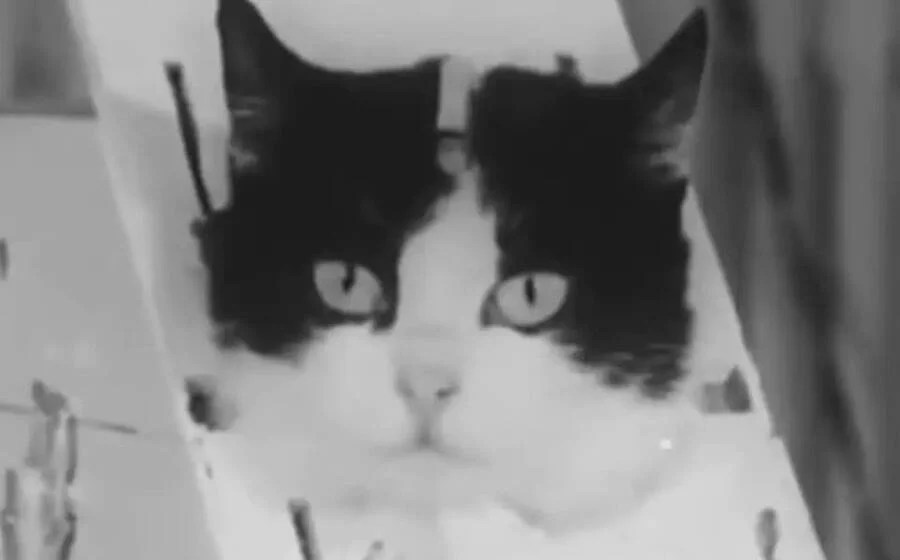
Felicette, the tuxedo cat who was launched into space by the French on Oct. 18, 1963, didn’t even have a name until the French recovered her capsule and took her back for examination.

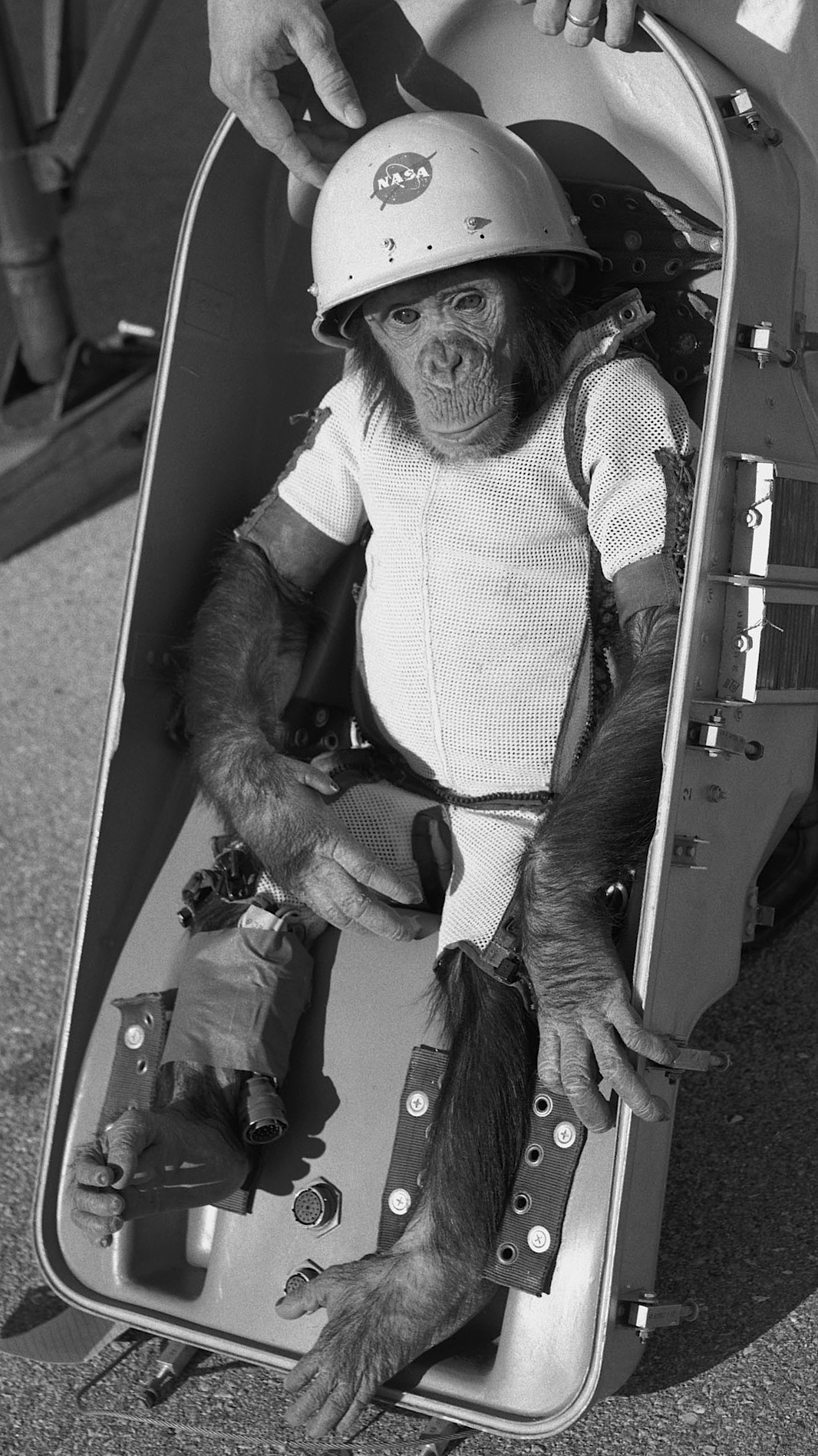
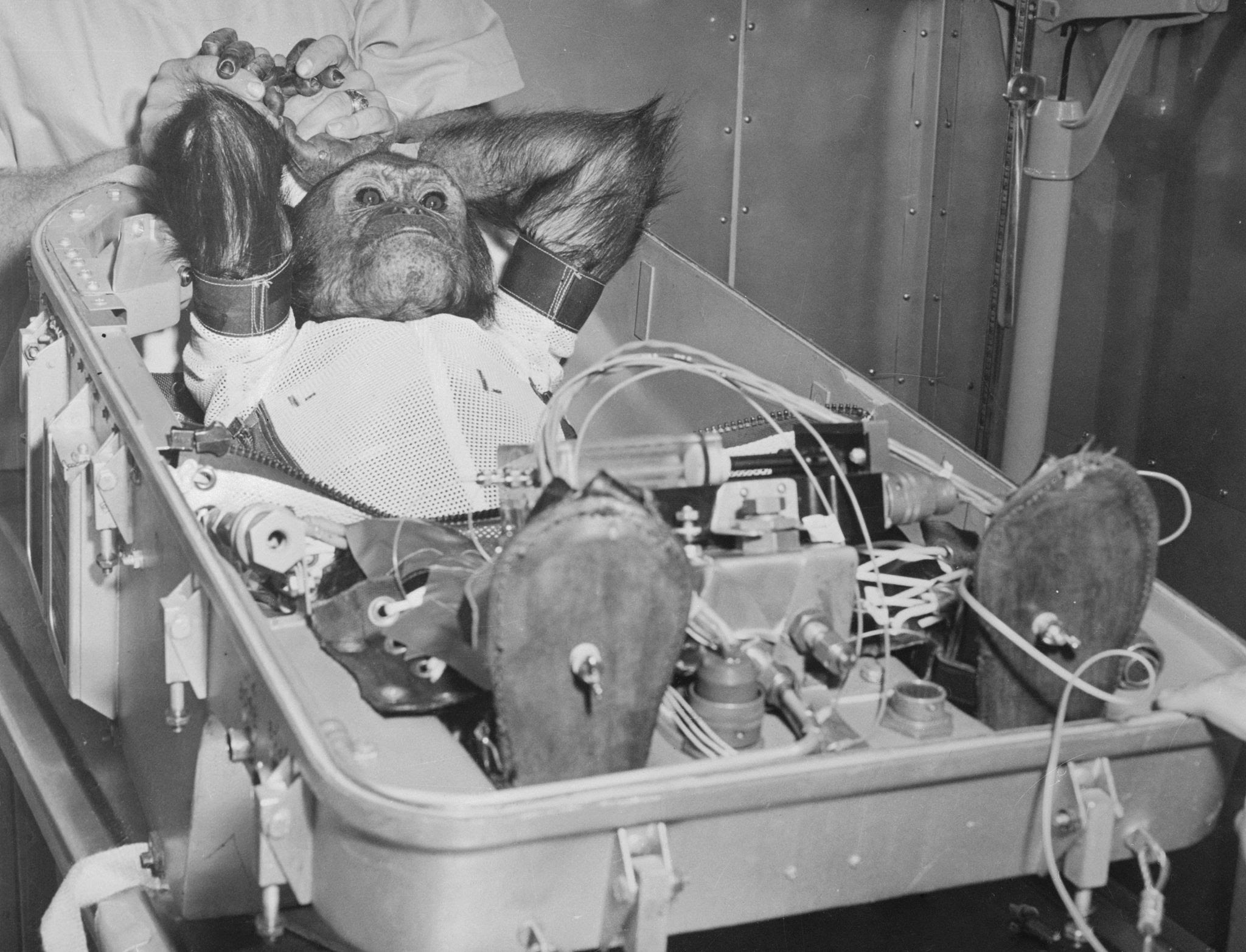
The scientists and engineers in charge of the launch didn’t want to humanize her if she didn’t make it, which was a common practice in space programs. (Ham, the chimpanzee sent into space by NASA in January of 1961, was known as No. 65 until his successful recovery. NASA was worried that a name would make him more sympathetic and lead to bad press if the chimpanzee died during the mission.)

Ham_the_chimp_(cropped)
Ham the chimpanzee was little more than a baby. Credit: NASA archives

Despite Felicette’s endurance and successful return, French scientists repaid her bravery by euthanizing her a month later so they could study her brain and learn more about the effects of spaceflight on mammalian biology.

Felicette, like Laika and Ham, was never given a choice. Those animals, with their child-like mental capacity, endured their missions out of a desire to please their human caretakers as much as any natural stoicism they may have possessed.

Would we do the same thing today? Will we repeat those experiments as we set our eyes on Mars?

Consider that the moon is a three day trip, and it’s close enough to Earth’s magnetic field to protect living beings from radiation. Mars is at least a seven month trip if the orbital conditions are right, and there will be no protection from radiation aside from what can be built into the craft. Take that trip without adequate protection and you’re guaranteed to get cancer.

It’s easy to say we wouldn’t make animals our test subjects for a Mars journey, and NASA now has decades of data on the effects of space and zero gravity thanks to the International Space Station.

And yet Neuralink, another company owned by Elon Musk, currently uses monkeys to test its brain interface technology, which allows the primates to operate computers with their thoughts. Those monkeys are forced to endure radical surgery to implant microchips in their brains. The teams working on the technology say suffering by those animals will be worth it as people with paralysis are able to do things with their thoughts and regain a measure of independence, increasing their quality of life.

Likewise, it will probably be an animal, or animals, who will be the test subjects on board craft that first venture beyond the Earth’s protective magnetosphere. Scientists and engineers will do their best to create a vessel that shields its occupants from harmful radiation, but they won’t know how successful they’ve been until the test subjects are returned to Earth and their dosimeters have been examined.

Will an astronaut volunteer for that kind of mission, knowing the “reward” could be a drastically shortened life?

To hear Musk and futurists tell it, pushing toward Mars is not just a matter of exploration or aspiration, but is necessary for the survival of our species. Earth becoming uninhabitable, they say, is an eventuality, not an if.

Others point out it’s much easier and wiser to pour our resources into preserving the paradise we do have, and the creatures who live in it, rather than banking on a miserable future existence on Mars where society will have to live underground and gravity, at 0.375 that of Earth, will change the human form in just a few generations.

To put it bluntly, while Musk and futurists look at life on Mars through the rose-colored glasses of science fiction fans, in reality living there is going to thoroughly suck.

If people do live on Mars they’ll never venture outside without a suit, never feel the sun on their skin, never swim in an ocean. They’ll never have another backyard barbecue, watch fireworks light up the sky on the fourth of July, or fall asleep to the gentle rain and crickets of warm summer nights. They’ll never hear birdsong or have the opportunity to see iconic animals like elephants and lions. Every gulp of air will be recycled, every glass of water will have passed through the kidneys of others. There will never be snow. Circadian rhythms will be untethered from the cycle that governed human biology for the 200,000 years our species has existed.

And while there could be a future — if you want to call it that — for people on Mars, there won’t be a future there for the rest of the living creatures on Earth.

As a lifelong fan of science fiction who devours SF novels, counts films like Alien and Bladerunner among my favorites, and is fascinated by shows like For All Mankind, The Peripheral and Star Trek, I understand the appeal of space and the indomitable human spirit that drives us to new frontiers. I just hope we can balance that with respect for the Earth and the animals we share it with. Let’s hope there is never another Laika, Felicette or Ham.

Correction: For All Mankind is the name of the Apple TV series about an alternate history space race. The first reference to the show’s name was incorrect in an earlier version of this story.

felicette-container
A close-up of Felicette’s face. Credit: French government archives

Ham the Space Chimp reaches for his apple reward after his space mission.
Ham the Space Chimp waits for his apple reward. Credit: NASA archives