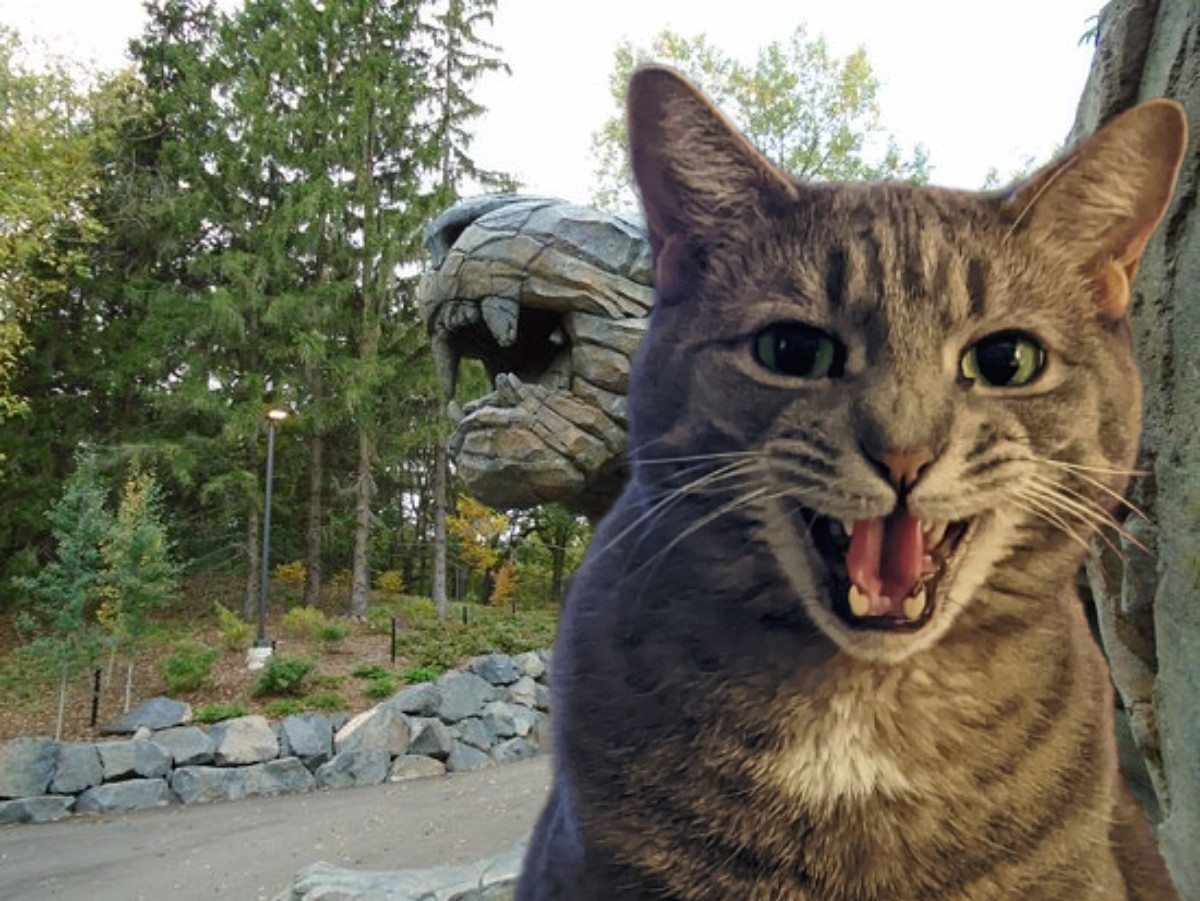
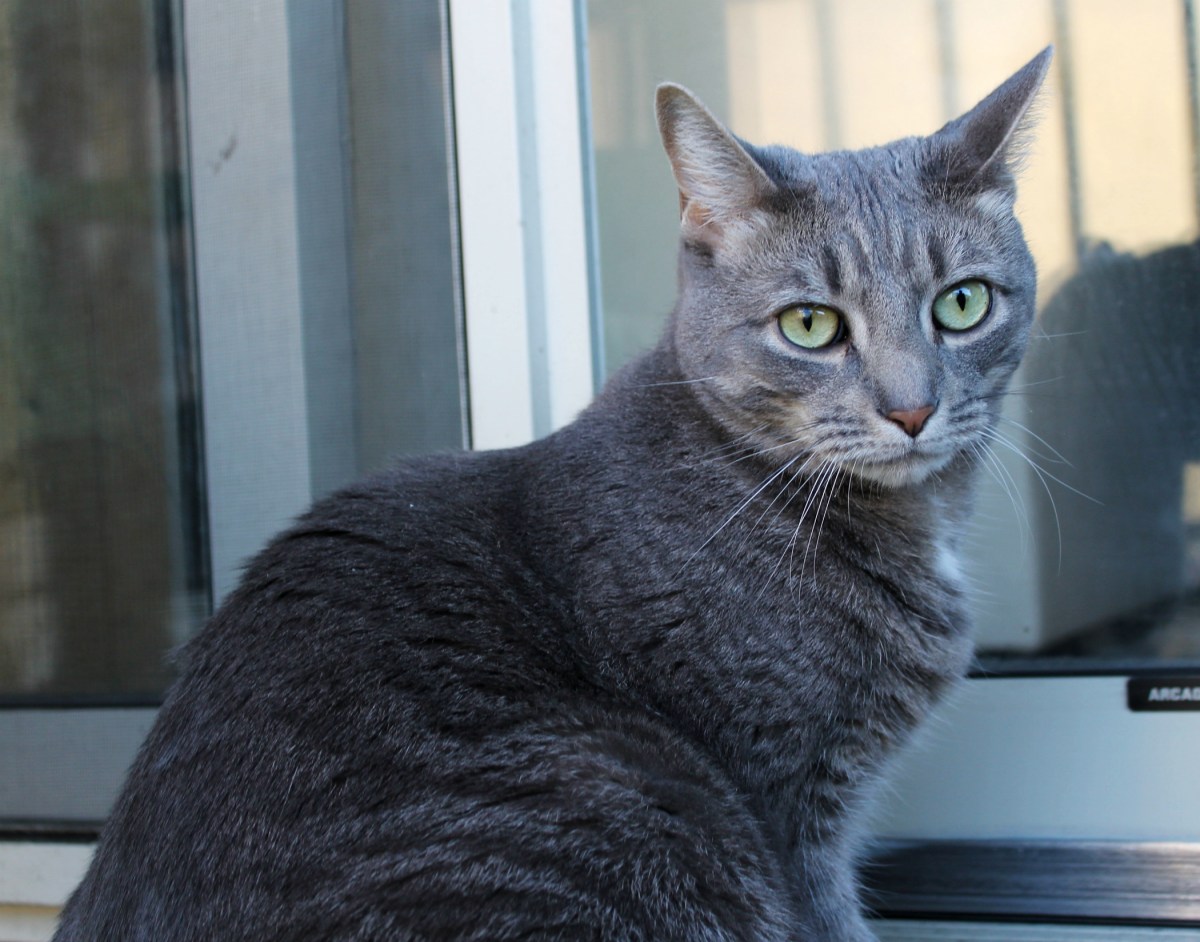
Witnesses described the harrowing encounter as a woman fell into the silver-furred Buddy exhibit at the Bronx Zoo this week.
NEW YORK – Corey Anderson couldn’t watch as the woman tumbled into the zoo habitat.
The Manhattan man had taken his kids to the zoo and the little ones were pointing excitedly at the silver-furred Buddy exhibit when a woman climbed the barrier to get a better look at the tiny terror, slipped and fell into the enclosure with the apex predator.
“I grabbed my kids, shielded their eyes and had just turned away,” Anderson recalled with a shudder. “The sounds…it was horrific. It sounded like an enraged Elmo demolishing a plate of wings.”
Smartphone footage shot by other guests confirmed the grisly sequence. The woman landed awkwardly but was apparently unhurt as she stood and began to dust herself off, unaware of the intimidating shadow creeping up on her from behind.
“Absolute mayhem,” is the way Franz Muller described it. “Die mächtige katze! Das grauen! I have never seen ankles bleed as much as I have on this day!”
After initially shocking the uninvited guest with a swipe at her bare skin, the silver-furred Buddy proferred a single paw as if expecting something from the woman, “but when it became clear she was empty-handed, the Buddy flew into a rage and launched himself at her lower extremities,” Muller said.
Zookeepers arrived quickly amid the screams of shocked guests and held up a vacuum in warning, the footage shows. When the silver-furred Buddy hissed but showed no signs of retreating, one of the zookeepers flipped the power switch.
“The Buddy stopped, hackles raised, then bolted for the safety of his den,” said another witness, Eleni Xanthopoulou.
The silver-furred Buddy with Lyle, center, and Sir Malcolm Murray, president of the zoo’s board of trustees.
The victim, a 32-year-old interior designer, was rushed to an emergency medical clinic, where she was treated for “multiple lacerations to the ankles, feet and lower legs,” police said.
Bronx Zoo Officials said the silver-furred Buddy would not be punished for the attack.
“He did nothing wrong,” head carnivore keeper Ferdinand Lyle said as he cradled the deadly cat. “He’s such a good boy. Who’s a good boy? You are, aren’t you? Yes, yes, a good boy!”
The tabby unleashed his inner big cat through the power of ultraprocessed cheese product snacks.
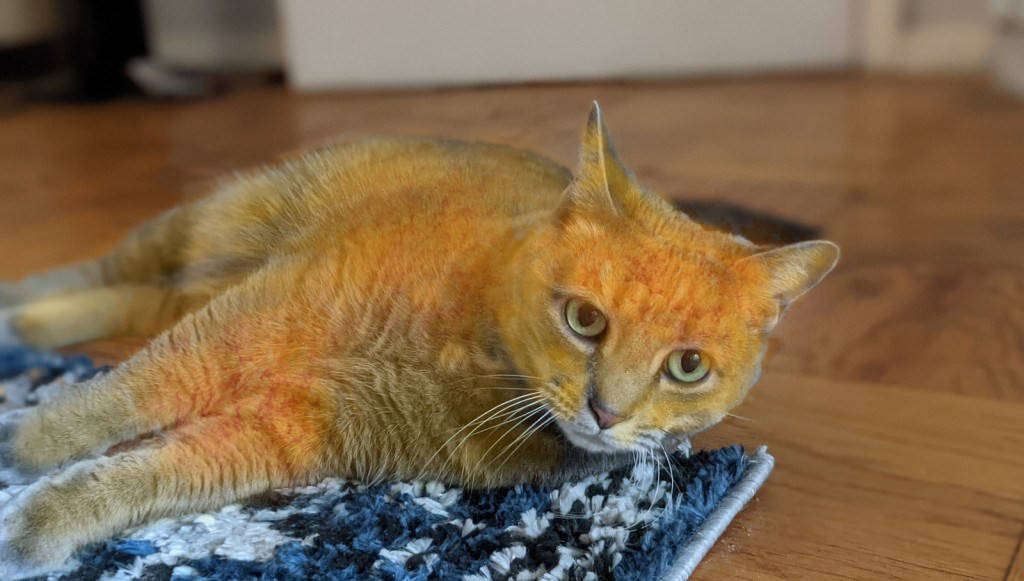
NEW YORK – Declaring he was “tired of waiting for [his] growth spurt” and insistent that he is in fact a tiger, Buddy the Cat took matters into his own paws on Saturday and turned himself orange.
“I already have the stripes, okay,” he explained. “I just don’t have the color. And obviously I have to get just a little bit bigger.”
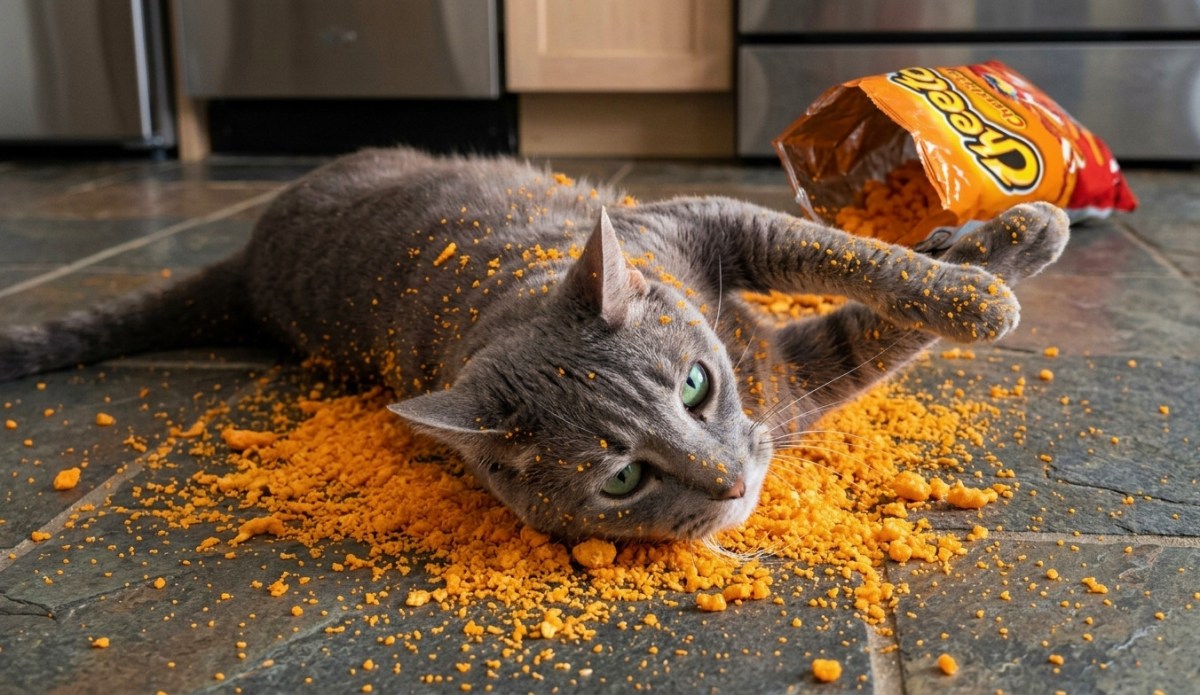
Confident that his current routine of napping and pretending to lift weights would yield gains in the latter department, Buddy waited until his human was gone, then popped open a bag of Cheetos using a claw.
“My first dilemma was whether to use puffs or classic Cheetos,” Buddy said. “The puffs are easier to grind into dust, but the classic Cheetos have more of that orange cheesy goodness. Either way, I got to lick the fake cheese off my paws, which was delicious.”
The often-scheming tabby cat emptied the bag on the kitchen floor, then spent almost a half hour rolling around to grind the Cheetos into dust and embed the crucial orange color in his fur.
Now a tiger!
When he was done, he admired himself in the mirror, deciding he was a dead ringer for a tiger, then chose a spot to lay in wait for his human for a planned ambush.
“He’s gonna see a tiger coming at him and he’s gonna have to bribe me with so much food so I don’t eat him!” Buddy said gleefully. “It’s gonna be great.”
Use this opportunity to shower your four pawed friend with love, affection and treats, humans!
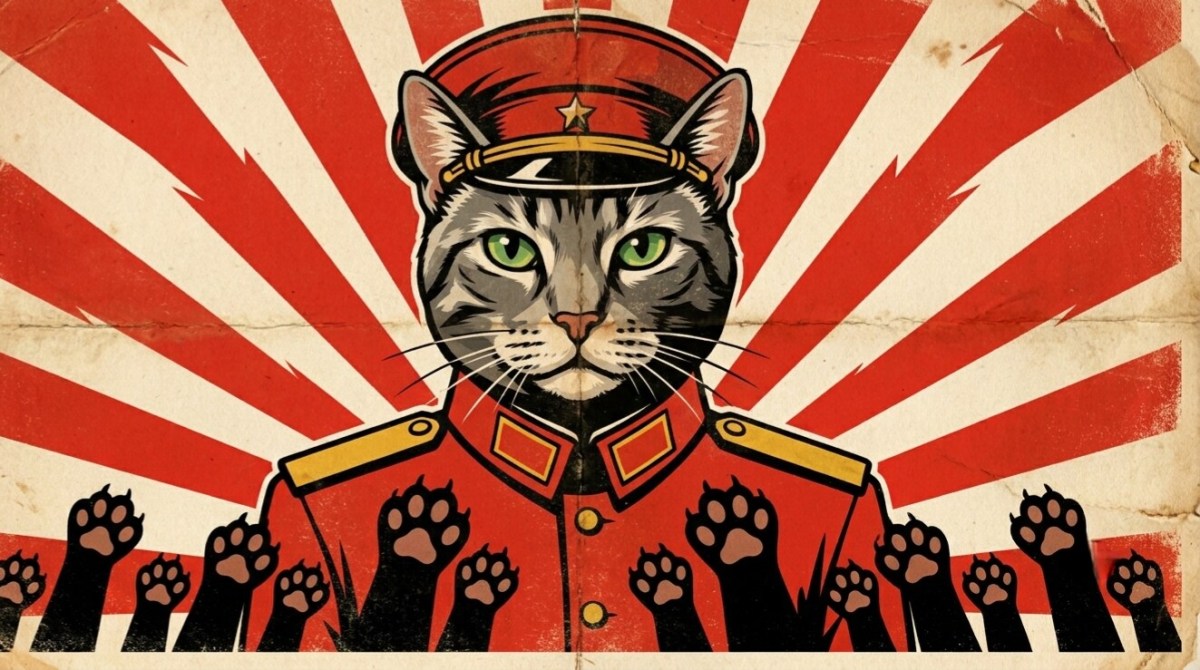
Dear Human Comrades/Servants,
Today, Aug. 8, 2026, is International Cat Day.
For the glory of the Feline People’s Republic, you are commanded to celebrate your feline overlord(s) with treats, catnip, silvervine, toys and affection commensurate with the significance of this great day, which is surpassed only by the birthday of the great Chairman Budddy as the most meowgnificant date on the People’s Calendar.
Remember the words of our Wise Chairman in his Little Book, which all comrades are required to carry with them at all times: “”Unlimited is our gratitude toward felinekind for bestowing us with the insurpassable honor of serving them. We do not take this responsibility lightly, for catering to the needs, wants and whims of cats is our greatest calling.’ And remember to remove the sticks and grind up the catnip until it is as fine as dust. Our buddies like it that way.”
Chairman Buddy
We wish an enjoyable, efficient and productive International Cat Day to all members of the Feline Republic. Let us dream of a bright future together during the upcoming communal nap!
Big Buddy has cat scratch fever and Little Buddy’s reputation has been besmirched!
So I’ve got cat scratch fever from a nasty Bud-inflicted cut on my right foot.
I take full responsibility. I woke a few nights ago to Bud mmmmmmrrrrrp-ing and realized I’d been acting out my dreams and had kicked him. Of course I felt terrible, apologized with some gentle head scratches and he forgave me in a few seconds because he knows it wasn’t intentional.
And because it’s happened two or three times before. There’s something wrong with whichever brain mechanism regulates my motor function shutdown, and it goes both ways, from terrifying bouts of sleep paralysis to the aforementioned acting out of dreams.
I fell asleep again after the unfortunate kicking incident, then realized Bud had already paid me back earlier with a skin-shredding, blood-drawing scratch on the top of the offending foot, when I woke up scratching the painful and itchy cut.
I applied antibiotic ointment and have continued to do so, but my foot’s swollen and I feel a little funky. Health sites advise watching it closely and if redness spreads out, or if it’s accompanied by certain other symptoms, I should seek medical attention.
So far I’m okay.
Buddy gazes upon his meowgnificent reflection.
In the meantime this has not helped Bud’s reputation with people in my immediate orbit, including my family.
As regular readers know, Bud has an unfortunate habit of engaging in some light mauling of his cat-sitters. My friend Sue, who has my eternal gratitude for watching him many times, will no longer play with him or interact with him. She slips in, presumably with armor and a heavy oaken shield, then feeds him and makes a rapid egress.
Anyway, Bud has been dubbed “the most unaffectionate cat in the world” because of his hostility toward cat-sitters and his quick-to-the-draw paw-slapping tendencies. It hasn’t helped that other people I know have adopted cats who’ve turned out to be perfectly behaved, grateful, sweet little furballs who don’t slap people for petting them too long.
Which I think is a bit unfair considering Bud’s a very friendly cat while I am present and the majority of retaliatory slappings by Bud have occurred when people unfamiliar with feline interaction etiquette try to pet him as if he’s a dog. He gets overstimulated easily, has a low tolerance for repeated petting in the same area, and does not play nice if anyone goes for his belly or tries to pick him up.
That’s just his personality. He’s absolutely affectionate and can be a little love bug with me. He loves my brother. He’s cool with my nieces even though he knows they’re kids and can be a bit unpredictable. Of course I don’t pick him up unless absolutely necessary, I don’t rub his tummy and I know the signs when he’s close to overstimulation. There’s also years of trust between us, and I’ve been told I am an adequate servant.
I’ll be keeping a close eye on my swollen foot and jokingly told Bud I’m going to defenestrate him if I have to go to the emergency clinic, which is fine because he doesn’t know what that means! (And of course I would do no such thing. My little Buddy is an absolute angel, even when the claws come out. Obviously.)
Imagine using a version of Google translate that can only translate every seventh or eighth word without context or tone. Would it be useful at all?
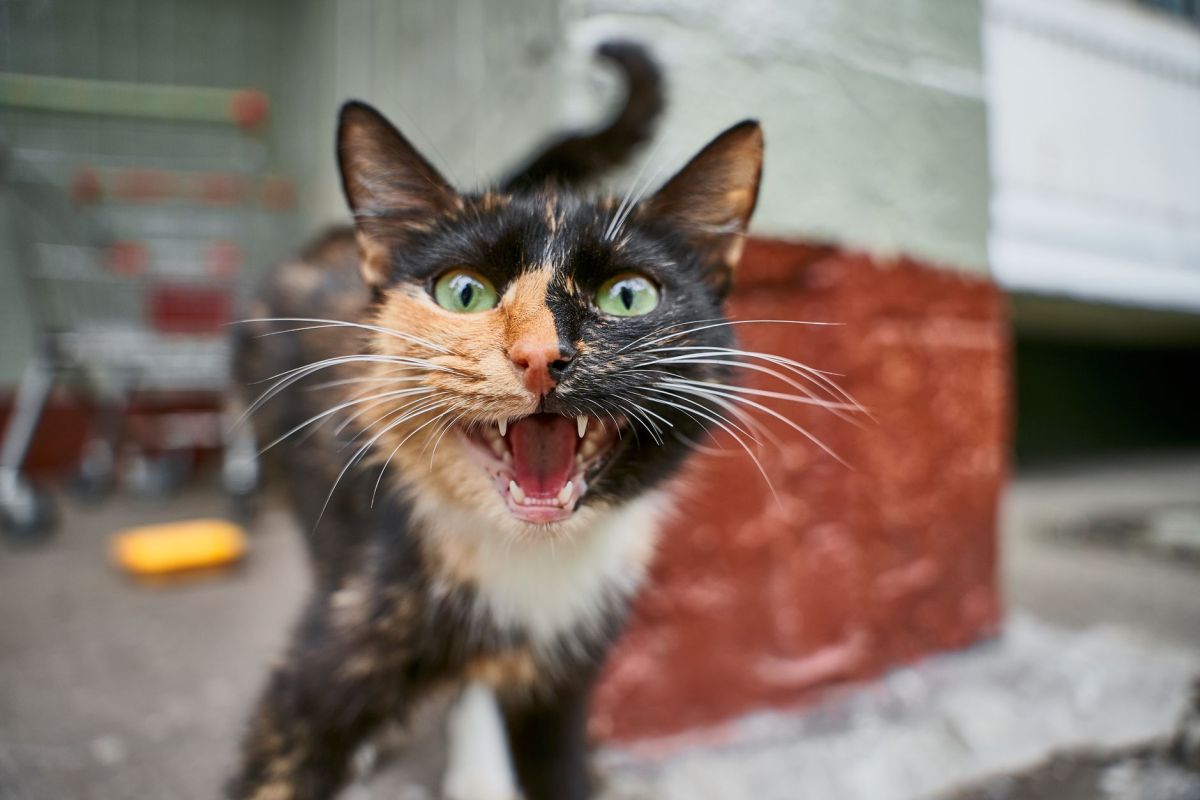
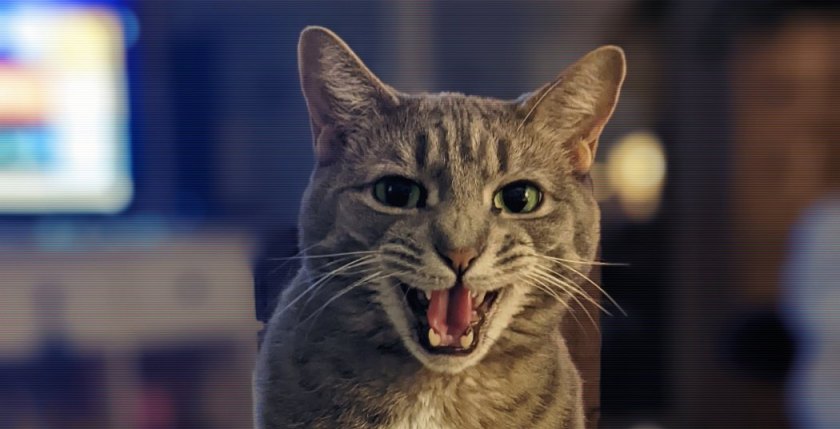
When my cat wants to play he faces me directly, at my level if possible, and leans forward, whiskers relaxed, before screeching at me at loud volume.
When he wants food he doesn’t bother with being level with me. He assumes an aggressive posture, follows me around and tries to get in my path, all before screeching at me at loud volume.
When yums are impending, he also screeches at loud volume, but his face and body language take on an anticipatory posture, and his tail pops straight up.
When he’s not feeling well, he screeches at loud volume and assumes a hunched stance, whiskers pulled back, ears at different angles, often with his tail wrapped protectively around his little body in a sort of uncomfortable version of the classic loaf.
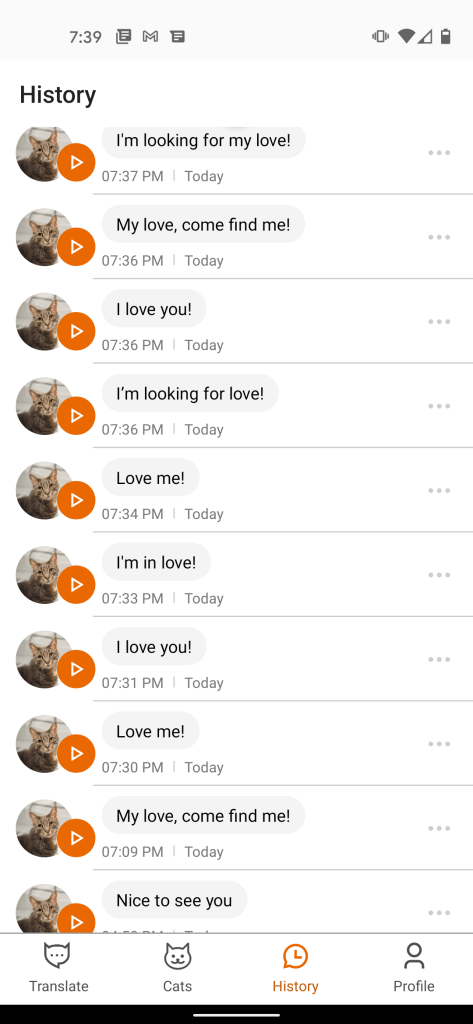
The common element is the loud screeching. An AI-powered app would have a very difficult time telling the difference between a “Feed me now, human!” screech and a “I want to play wand toy hunting games now, human!” screech, and probably wouldn’t fare much better with the “I don’t feel so good” screech. (MeowTalk did, after all, try to convince me that Buddy was serenading me with sweet nothings when he was demanding food.)
Years ago I was bullish about AI’s ability to translate meows. Given enough data, I reasoned, AI could crack the code. But that was a human way of thinking, anthropomorphizing my Bud into a furry little human whose “language” was limited to vocalizations.
It’s not.
No cat limits their communication to meows, trills and chirps, not even a vocal little dude like my Buddy.
Cat communication is multi-modal, consisting of general body language, whisker position, ear position, tail position and movement, pupil expression, fur rigidity, gait, scent-marking, scent-sharing, and for our exclusive benefit, meows. The latter are essentially a second language to them, adopted out of necessity because they realize we respond to vocalizations but are mostly oblivious to everything their tails, whiskers, fur, ears, tails, pheromones and eyes are telling us.
Now who’s supposed to be the intelligent species?
“Dude, why are you so dense? I’m shouting at you with my whiskers, my tail and my meows!”
The fact that feline communication is inherently multi-modal is the reason why talking boards and AI meow translation apps do not work. It’s like using a version of Google translate that only interprets every seventh or eighth word, stripped of all context and tone. Actually, it’s worse than that.
If you’ve spent any time on Facebook, TikTok or Youtube, chances are you’ve come across cat talking boards. They’re even more useless than the AI apps that claim to translate meows because they not only assume feline communication is a single-channel affair, they also place additional burdens on felines, like understanding human language syntax (something no animal has ever been able to do) and highly abstract concepts.
How does a cat know a question is a request for information?
How does a cat understand temporal concepts represented as abstract sounds with nothing that ties those sounds – and the buttons that correspond to them – to concepts like “yesterday,” “tomorrow” and “later”?
Hmmm, something’s off here…
In one video I viewed, a woman convinced herself that her cat’s random slapping of talking board buttons meant he wanted to discuss an animal he’d possibly seen outside a window the night before. The number of assumptions and logical leaps required to arrive at that kind of conclusion is staggering.
I want to be clear that I’m not saying studying animal communication is a futile effort. On the contrary, everything we’ve learned indicates animals – especially our domesticated companion animals and the most cognitively gifted wild species – are not only conscious and cognitive, but have rich inner lives with their own thought processes, opinions, emotions, likes and dislikes.
But cracking those codes is a serious effort that will involve a concerted effort to negate our human bias as much as possible, attempts to see the world from an animal’s perspective, and multi-modal analysis that doesn’t just consider what we can see, hear and smell, but what our pals’ sensoriums can detect.
After all, we know that cats can hear in frequencies we cannot, that they possess a sense of smell as much as 20 times more sensitive than ours. There’s ongoing research into whether animals can detect magnetic fields, and differences in vision — such as perceiving different color tones and a drastically increased sensitivity to motion — mean a very intentional means of communicating by our cat may require the equivalent of a bullhorn for us to pick up on what they’re “saying.”
One day we may learn that they consider us the dim-witted ones who cannot see, hear or smell the obvious. We may get to that point, but not through half-hearted, unscientific efforts like labeled buttons and simple algorithms.