Australian Celebrity Chef Salivates Over Prospect Of Feral Cat Meat Sandwich

Maggie Beer was reportedly intrigued by the idea of eating a “pussycat sandwich.”

Meet Maggie Beer, a “culinary icon” from Australia who was convinced to teach cooks at some sort of community kitchen on the promise that another chef would kill a feral cat to make her a “pussycat sandwich.”

Beer was invited to help instruct cooks who volunteer for a program feeding Australian seniors. In return, one of the cooks would show her how to prepare domestic cat meat.

Note that this was reported by a major Australian media outlet as a quirky culinary story, just a bit of fun to have a laugh over.

That goes a long way to explaining the state of mind in a country that recently killed millions of cats by poisoning them and has pledged to exterminate all free-roaming cats because self-styled conservationists believe felines — not habitat destruction, mass industrialization, the widespread use of carcinogenic pesticides, windmills, glass buildings and all the other changes wrought by human presence — are the primary drivers of local bird and small mammal extinction.

Beer and Brown, cat eaters.

“We were talking a lot about cooking kangaroo tails and then I also told her about how one of our directors… had recently cooked us a feral cat from Kiwirrkurra,” said Sarah Brown, the CEO of Purple House, which prepares meals for Australian seniors.

“She got very excited about this and I said, ‘Well if you come to Alice Springs and do some cooking classes with us, then Bobby West will teach you how to cook a pussycat and you can have a pussycat sandwich for lunch.'”

Feeding seniors intelligent companion animals is about giving them “joy as well as sustenance,” Brown claims.

Thankfully not everyone in Australia thinks this is amusing, nor do they buy the claims that slaughtering cats will magically solve all the problems facing indigenous wildlife.

Grieving Family Wants Answers After Amazon Driver’s Theft Of Their Cat Ends With His Death

A Kansas City family is in anguish after an Amazon delivery driver stole their senior cat, beginning a sequence of events that led to his death. Once again, Amazon treated the situation like a routine customer service issue.

At this point it feels like the certainties in life are death, taxes and Amazon delivery drivers stealing pets.

If there’s a fourth, it’s Amazon’s predictably awful response to customers whose cats and dogs are stolen by the company’s drivers. Whether asking distraught customers how much the pet was worth, offering credit, or offering to send stuffed animals as replacements, Amazon has generally been unhelpful. This is a pattern going back years now and Amazon still hasn’t come up with a protocol to handle these situations.

A recurring problem is that Amazon treats the incidents like regular customer service complaints. Their customer service representatives aren’t trained for the possibility, they are apparently reluctant to go off-script, and the result is that the reps treat the missing pets like fungible products, as if these situations can be rectified by sending a replacement or reimbursing a customer.

That’s the last thing anyone wants to hear. Pets are companions, considered family by most Americans who have cats and dogs in their homes. Hearing “And how much would you say Fluffy’s worth?” exacerbates the frustration and worry.

In the latest incident, surveillance footage shows an Amazon driver picking up a cat named Sidney from his family’s driveway in Kansas City on April 20. At 16 years old, dependent on medication with his health failing, Sidney was near the end of his life, Marsha Reeves told the local Fox affiliate.

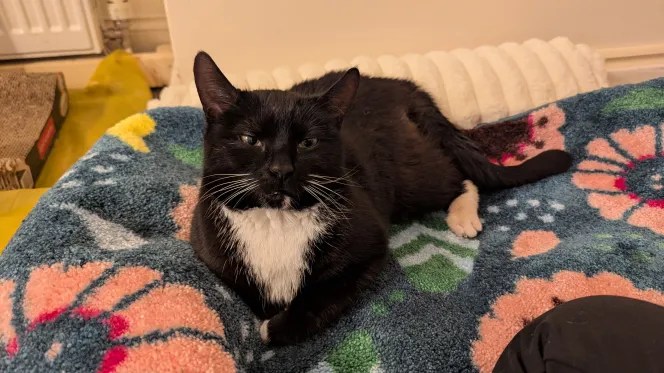
Sidney

“I knew his time was near, and I just wanted him to be comfortable and at home when it came,” she said.

Because of the driver’s actions, Sidney’s last days were spent in distress and confusion, separated from the people who loved him. The driver surrendered him to a shelter the next day, and Sidney was bounced between shelters and animal control with his family frantically trying to track him when a veterinarian at a rescue group euthanized him.

“I cannot even imagine what he was thinking,” she said. “He did not deserve to die on a metal table with strangers poking him. He should have been at home in my arms when he took his last breath.”

Marsha Reeves, Sidney’s human

It’s a tragic and horrific end for a cat whose family wanted to fill his last days with love. They’re denied closure, and to add to the awfulness of the situation, Reeves said the mega-corporation was not helpful, at first not admitting one of its drivers took the cat, then slow-walking the response.

“I cannot even imagine what he was thinking,” Reeves said. “He did not deserve to die on a metal table with strangers poking him. He should have been at home in my arms when he took his last breath.”

We’ve written about this before, and previous cases make it clear: people who find themselves in this situation should not wait for Amazon (or any other company) to handle it, because it’s not a priority for them. In every case in which a family has successfully regained their cat, the common denominator was they took it upon themselves to lead the effort and were relentless in searching, posting flyers locally, rallying support online and making noise in local media. Sometimes even that’s not enough, but it increases the odds of a happy reunion by orders of magnitude compared to putting faith in a corporation and police.
In this case, there’s been no word from Amazon about consequences for the driver or changes to the way the company trains its delivery workforce and customer service representatives.

The driver “needs to come with a supervisor and face me and my family members who this has affected,” Reeves told the local Fox affiliate. “I think Amazon needs to be held accountable. I think this young woman needs to be held accountable. She needs to realize that there are consequences to her decision making.”

So far the company hasn’t admitted wrongdoing or offered an apology, which is consistent with cases in the past involving drivers who have stolen pets.

“Why won’t Amazon just come out and say ‘we screwed up?’”

Another Delivery Driver Steals A Cat, Proving We Need Better Laws

Under South Carolina law pets are considered property, and the maximum penalty for stealing someone’s beloved animal amounts to a slap on the wrist.

Another day, another story about a delivery driver stealing a cat.

This time it happened in Charleston, South Carolina, and while local police worked quickly to identify the woman behind the wheel and arrest her, the feline is still missing.

Daniel and Liza Layfield said they knew something was wrong on Jan. 15 when an AirTag attached to their cat’s collar showed she was several blocks away. After checking their own security camera footage and video captured by other cameras on the street, they saw a local food delivery driver stop her car, scoop up four-year-old Willa, then drive off with her.

The woman tossed Willa’s collar and AirTag nearby. Thankfully, police took the matter seriously and the local community helped spread the word, leading to a quick arrest.

The family is relying on help from the community to find Willa.

But there are two problems that are common to these thefts of opportunity: Willa is still missing, and the most severe charge police could lodge against the suspect is petty larceny. That’s a misdemeanor that carries light penalties (a fine and up to 30 days in county jail) on conviction. That’s not a deterrent.

We wrote about this problem just last week, when the quick recovery of a cat stolen by an Amazon delivery driver in the UK illustrated the difference a stronger law makes.

Stealing a pet in the UK can land the thief in prison for up to five years in addition to fines. Police are more likely to devote resources when the law gives them appropriate charges to file, and five years in prison would make most people think twice about impulsively stealing a family’s well-loved pet.

By contrast, most US states treat pets as property, meaning courts do not take into account their sentimental value, bond with their people, or trauma to animal and human when someone steals a pet. South Carolina is among those states: in that state’s penal code, petty larceny is a charge that applies when someone steals property worth less than $2,000.

The suspect, a DoorDash/Uber Eats driver, has not been helpful in the Layfield family’s efforts to find their feline family member. In the meantime, the family hopes a $1,000 reward will prompt someone to come forward, or that Willa turns up at a local shelter and has her microchip scanned.

“We want to find Willa, we want to know where she is. It’s going to be 20 degrees for the next several days,” Liza Layfield told the local NBC affiliate. “The idea of her being loose and on the run is horrific.”

The Layfields’ daughter holding Willa, who has been missing since she was stolen on Jan. 15 by an Uber Eats/DoorDash driver.

Wordless Wednesday: Loaf Of Bud

Freshly baked Bud.

A freshly baked Bud loaf!

Edit: I am compelled to include the following image, commissioned by Buddy himself and titled “Buddy: Jungle Portrait of Meowscularness.”

It’s so, uh…representative.

Animal Rights Groups Are Begging For This UK Influencer To Be Banned From Owning Pets

The woman has been dubbed a “serial killer” of animals after eight of her pets and one of her horses met early ends, and several others simply disappeared. She’s part of an unfortunate trend of influencers and quasi-celebrities popularizing exotic pets, with “ownership” of the animals frequently leading to tragedy.

So apparently Katie Price is some sort of proto-Kardashian, a pioneer of the “famous for being famous” genre of hybrid reality/online celebrity, to use the term loosely.

Wikipedia says she got her first taste of fame in the 90s posing topless for British tabloid newspapers before moving on to loftier pursuits, like appearing on Big Brother and holding court on important topics, like whether toes have bones.

The background really doesn’t matter, except to establish that Price is someone with a lot of money, minimal common sense and extraordinarily poor judgment who has gotten so many of her pets killed or injured, PETA and other animal rights groups in the UK have begged politicians to write new laws preventing serial pet-killers from purchasing more animals.

Sort of a “10 strikes and you’re out” rule, if you will.

Four of Price’s dogs have been hit by cars, including one killed by a pizza delivery driver on her property. Another got stuck in an electric armchair and was crushed after Price gave him cannabis oil, pleading ignorance on its effects.

Previously, one of her breed cats was euthanized under mysterious circumstances at five months old, her rare chameleon fell ill and died because he wasn’t kept in a properly heated enclosure, and her “guard dog” was apparently intentionally killed by someone, although the information on that death comes from Price so there’s no way of telling what the actual circumstances were.

A horse Price owned was killed on the same road where two of her dogs met their end, which would bring the tally to nine depending on whether you consider a horse a “pet.”

Price, pictured this year.

There have also been animals — kittens, puppies, animals gifted by boyfriends, fiances, and friends — who were featured on Price’s social media feeds as babies and never heard from again, according to the UK’s Mirror. Some of them were given away to assistants and acquaintances. The fates of the others are unknown.

Price currently owns at least four chihuahuas and five Sphynx cats. An incident with one of the Sphynxes has animal lovers and welfare groups renewing calls to prevent her from buying new pets. (Price, like so many social media influencers, exclusively purchases breed pets for thousands of dollars each.)

In a new video posted online, Price — who has been dubbed a “serial killer” of animals by PETA — makes duck lips at the camera and rubs one of her Sphynx cats, Kevin, explaining that the little guy suffered sunburns.

“Oh Kevin you have been in the sun today, you have got sun burnt despite us putting sun cream on you… look at his little face,” Price said in the video. A caption written by Price claims “Trying to keep the cats out of the sun is hard work.”

A screen shot from Price’s recent video in which she shows one of her cats who suffered sunburn during the ongoing heat wave.

The latest incident is drawing fresh attention to a petition that calls for the UK government to step in to stop Price from owning animals.

As of July 10, there were 37,728 verified signatures on the Change.org petition, which mentions a number of additional disturbing incidents involving Price’s pets. One accusation claims Price’s guard dog — it’s not clear if it was the dog who was killed, or a new guard dog — bit the tail off one of her cats.

“Anyone who warns Katie not to hurt the animals she takes in might as well be screaming into the wind, for all she seems to care,” PETA’s Elisa Allen said. “And here we go again: her cat is sunburnt – something she was likely warned about when acquiring a gimmick cat, bred to look odd and be hairless.”

For her part, Price claims the deaths and unfortunate incidents that have befallen animals in her care are simply the result of bad luck and circumstances outside her control. Her representatives have also accused animal welfare groups of using the influencer’s fame to raise money.

That has not changed the narrative as new incidents continue to pile up. In a 2023 live TikTok stream, Price allegedly slapped her then-puppy, Tank — who she’s since discarded — for sitting on a hoodie. “Get off! You’re sitting on my jumpers, my jumpers that I love,” Price said after the sound of a loud slap off camera, leaving viewers fuming.

Price is not alone in the world of influencers, quasi-celebrities, Real Housewife types and entertainers who apparently view animals as disposable amusements.

Hilaria Baldwin, Alec Baldwin’s wife, has earned the nickname “Cruella Seville” from her detractors for her alleged treatment of her breed cats and dogs. The nickname is a play on the character Cruella de Vil from 101 Dalmations and the Spanish city of Seville, where Baldwin claimed to have roots before claiming she was born in Mallorca.

Baldwin with two of her Bengal kittens. New kittens have appeared in her Instagram posts several times in recent years, apparently replacing older Bengals she’d purchased previously.

Baldwin, you may recall, was enthusiastically Spanish until she wasn’t. She was essentially exiled from celebrity-adjacent society in 2020 after Twitter users dug up videos of her fluctuating accent and performative “forgetting” of English words like cucumber, outlet and onion. Former classmates, acquaintances and friends came forward to say she was the Boston-born Hillary Hayward-Thomas and didn’t go by Hilaria — or speak with an accent — until around 2010, when she met Alec Baldwin.

But the actor’s wife never stopped posting to social media, and in addition to animal lovers calling foul on videos that show her allegedly mishandling her dogs, her online posts show a rotating cast of Bengal kittens. Critics have called for action against Baldwin for her alleged treatment of animals, as well as buying Bengals despite the fact that it’s against the law to keep them as pets in New York City. PETA, which previously worked with Alec and Hilaria Baldwin on a publicity campaign, also called on the couple to stop buying exotic pets.

In the music world, mainstream pop artists like Justin Bieber and Rihanna have both come under fire for purchasing baby monkeys — a capuchin in the case of Bieber, and a slow loris for Rihanna.

The Rihanna incident, in which she shared a photo of herself with a slow loris pet to social media, resulted in raids on illegal wildlife markets in Thailand, where Rihanna allegedly acquired the animal. There are nine subspecies of slow loris, ranging from vulnerable to critically endangered in conservation status, per the World Wildlife Fund.

Rihanna posing with a slow loris, a nocturnal, arboreal animal that is notably the world’s only venomous primate. The venom glands are removed from slow lorises sold on the illegal wildlife market. People continue to poach and sell them despite their declining numbers in the wild.

Bieber named his monkey Mally OG and famously ditched the then-infant in Germany in 2013, when officials there seized the primate from his private plane after it touched down in Munich, citing his lack of permits and purchase records for the animal. (They essentially accused Bieber of buying Mally on the illegal wildlife market.)

“Honestly, everyone told me not to bring the monkey. Everybody,” Bieber told GQ magazine in an interview several years later. “Everyone told me not to bring the monkey. I was like, ‘It’s gonna be fine, guys!’ It was the farthest thing from fine.”

Bieber with his pet capuchin monkey, Mally OG, who was just an infant when he was ripped from his mother’s arms so he could be sold to the pop singer.
Bieber with another capuchin monkey as part of a skit in which he joked about German authorities seizing his first monkey pet.

The singer said he’d return for his pet after retrieving the paperwork from one of his US homes, but he never did, and Mally OG was placed in a sanctuary after a long rehabilitation period.

In a follow-up story five years later, Asta Noth of Serengeti Wildlife Park said Mally was still trying to imitate human speech, and didn’t know how to communicate with his own species. That’s a common problem with monkeys who are former pets, as they do not understand the complex social dynamics of troops and family units.

His developmental problems stem from the fact that “he was taken away from his mother and natural family way too early,” Noth said. “He did not learn to be a monkey.”