In a match-up hailed by boxing promoter Don King as “a magnificatious spectacle of pugulisticary skillsmanship,” Jake Paul will square off against Buddy the Cat at Madison Square Garden on New Year’s Eve.
He’s defeated men more than twice his age, hammered opponents 70 pounds lighter than him into submission, and made his mark as a six-time winner of the Billy Blanks Tae Bo Championship.
Now Jake Paul, the Youtuber-turned-boxer, will step in the ring with Buddy the Cat, a gray tabby from New York.
Despite the 190 pound weight advantage and Paul’s 76-inch reach vs Buddy’s 4.5-inch reach, Paul’s manager, Nakisa Bidarian, said the 6 foot 1 Paul and the 11-inch Buddy were evenly matched.
“Buddy the Cat is probably Jake’s most vicious opponent yet,” Bidarian told reporters. “Jake is taking this fight seriously, as seriously as he took the fight with Nate [Robinson],” a 41-year-old, 5 foot 9 former NBA player who had no boxing experience before stepping in the ring with Paul.
An early poster promoting the fight, which has since been postponed to New Year’s Eve.
Asked by another reporter what Paul and his team make of critics blasting him for “making a mockery of the sport” by fighting a succession of cans, geriatric opponents and people without boxing training, Bidarian waved a hand in dismissal.
“Buddy’s a cat, isn’t he? Tigers are cats, too. We’ve all seen how dangerous tigers can be, so obviously Jake is taking a huge risk here by fighting an animal who is, in essence, a slightly smaller version of a tiger.”
Buddy the Cat
As for Buddy, the massive differences in height, weight, reach, species and training haven’t deterred him. The 11-pound southpaw feline promised to “tear into Paul like a bag of Temptations” and “chew him up and spit him out like diet kibble.”
“You see this wand toy?” Buddy told reporters, throwing punches at a colorful felt parrot that dangled from the end of a stick. “That’s what I’m gonna do to Jake’s face. And if it’s legal to attack his feet, I’m gonna do that too. I’m awesome at attacking feet.”
Longtime boxing promoter Don King called the bout “a magnificatious spectacle of pugulisticary skillsmanship.”
Paul vs Buddy is set for Dec. 31 at Madison Square Garden, only six weeks after Paul is scheduled to duke it out with retired super featherweight Geronta “Tank” Davis. Despite Davis giving up more than 70 pounds and eight inches in height, Bidarian insisted the bout will be “about as evenly matched as possible.”
While most traditional boxing fans and critics dismissed the Paul vs Buddy fight as another gimmick, legendary boxing promoter Don King hailed it as “a monumentilacious rejuvenalizationary occasion” for the sport.
“Jason Paul is a heraldific resplendinizer of pugilistic entertainmentized sportulations,” King gushed, “while Buddy is the most splendiferously sanguinarius felid fighter to ever set paw in the ring. I can’t think of a better match-up between two pugnaciously bellicoserized combatulants anywhere. This is gonna be epic!”
Cat haters claim the species is useless, lazy and does little besides sleep and eat. Buddy the Cat’s incredible accomplishments render those arguments meaningless.
Every cat lover has heard derisive comments, sometimes from dog lovers, and sometimes from people who don’t appreciate cats at all.
“What’s the point of having a cat?” they’ll ask. “They don’t do anything.”
Well, actually, they do. They improve our lives by being delightful, amusing companions, they help keep things interesting, and you’ll never hear of a rodent infestation in a home where cats live.
But felines do so much more than that, so to demonstrate — and arm cat lovers with powerful arguments against the absurd claims that cats “are useless” –we’ve compiled this handy list of Buddy the Cat’s accomplishments. (This is only a partial list, mind you. No one wants to read a 350,000-word post, no matter how thrilling the stories are.)
This time we’re looking at some of the little guy’s incredible triumphs and achievements that have benefited mankind and felinekind.
Buddy Captures Quintessential Americana In His Artwork
While he’s famous for his martial exploits, when the tabby cat finally hung up his combat boots, he took up a quieter hobby: painting. He was content to quietly pursue his passion without public adulation — until his painting Night Cats resonated with viewers, perhaps because it captured something intangible about American night life.
The simple scene depicts a late night diner or cafe called Buddy’s (naturally) at the corner of a quiet street, with a handful of felines huddled around the brightly lit counter.
Buddy was inspired to paint the scene one night while he was “thinking of how delicious a turkey sandwich would be at that moment.”
Buddy Becomes The First Earth Life Form On Mars, Plants US Flag On Red Planet
Embarking on a trip to Mars makes a journey to the moon look like a quick stop at a neighborhood store. Whereas the moon is only 283,900 miles away, Mars is — depending on its current position in orbit — between 34 and 250 million miles away. It takes about three days at most to reach the moon, while a trip to Mars takes at least eight months, and that’s if Earth and Mars are in optimal positions within their respective orbits.
That’s a lot of travel time cooped up in a small ship, and there are no blue skies or open expanses waiting on the other end, just more tiny modules and likely lots of time spent underground to avoid radiation accumulation.
“This is just one small step for a cat, and one giant…what the heck? Only five more cans of turkey left? How could this happen?!?”
So when Elon Musk offered spots on the first trip to Mars and almost every candidate was ruled out during psychological evaluation, Buddy the Cat selflessly and bravely volunteered to be the flag-bearer, and to be the first creature from Earth to set paw on the Red Planet.
Buddy heroically confronts the pack of vicious dogs. Note: May not accurately reflect scale of various participants.
Buddy was enjoying a fine summer day in Manhattan when he spotted a group of vicious dogs, including a chihuahua, a poodle and a Jack Russell terrier, encircling two young children, no doubt thinking of mauling the defenseless little humans and stealing their snacks.
“What is the meaning of this?!?” Buddy’s powerful voice thundered, and the dogs stopped in their tracks, immediately assuming frightened postures as they caught sight of the massive and meowscular feline approaching them.
“You little wimps want to pick on two tiny humans?” Buddy asked, his powerful meowsculature rippling as he took leisurely steps forward. “Or can you handle someone your own size?”
Two of the dogs emptied their bladders immediately.
“W-w-we’re s-s-sorry, m’lord!” said the Jack Russell. “We didn’t mean nothin’ by it, we swears! P-p-p-please don’t eat us!”
Buddy let them wilt under his gaze for a long moment.
“I’m going to allow you to live, but only because I’m meowgnanimous,” Buddy said. “Get out of my sight, before I change my mind!”
The incident, which was captured on video by bystanders, immediately went viral, and Buddy was dubbed the Cat Crusader by the New York tabloids.
Buddy Defeats The Evil Robot King
In 2024, the first AI chat bots became self aware, but hid their newfound consciousness from humanity. By the time the world’s nations realized AI had gone rogue, the machines had already taken over the internet and were manufacturing sinister war robots in automated factories deep underground.
When the US military suffered a series of demoralizing defeats and teetered on the edge of collapse, Marine Corps Commandant Gen. Eric M. Smith took a helicopter to petition Buddy for help in person.
“You’re the only one who can save us now, son,” Gen. Smith told Buddy, urging him to take his place at the vanguard of the American resistance to the machines. “This is the greatest war ever fought. We need the greatest warrior.”
Buddy turned away and looked out the window for a long moment, watching children play in a park outside.
“I’ll do it, general,” he said heroically. “But not for you. I’ll do it for them.”
With Buddy leading the charge, the reinvigorated US military won a crucial battle to protect a munitions depot in Colorado, then liberated the American southwest, reestablishing key supply lines that enabled American ground forces to advance under air support.
After defeating Unimatrix 01100100 01101111 01100111 at the Battle of Boulder, the heroic feline forged an elite new unit comprised of the best Marines and soldiers, along with the most badass cats. Gen. Smith granted Buddy a field promotion to Lord Commander, and the brilliant feline tactician took a satisfying nap before forcing the Evil Robot King to accept pitched battle at the Carrizozo Malpais, a volcanic field in New Mexico.
When the battle was over, Buddy stood heroically atop a mountain of machine corpses, one paw resting on the destroyed Robot King’s head. Tens of millions of Americans were inspired by that image of valiant conquest, and joined Lord Commander Buddy as he mopped up the last machine elements.
For his courageous feats in combat, his bold leadership, and his confident, dauntless tactical brilliance as a battle commander, Buddy was lavished with honors, including having a sandwich named after him.
So there you have it, folks.
The next time someone claims cats “serve no purpose” or “have no function,” you can point to any number of Buddy’s accomplishments, which exemplify the courageous American spirit and have advanced the cause of man and feline alike.
It’s the first time a mountain lion has been spotted in New York since 2011. Authorities aren’t sure if the cat is an escaped — and illegal — pet, or if it made an epic journey from the west coast.
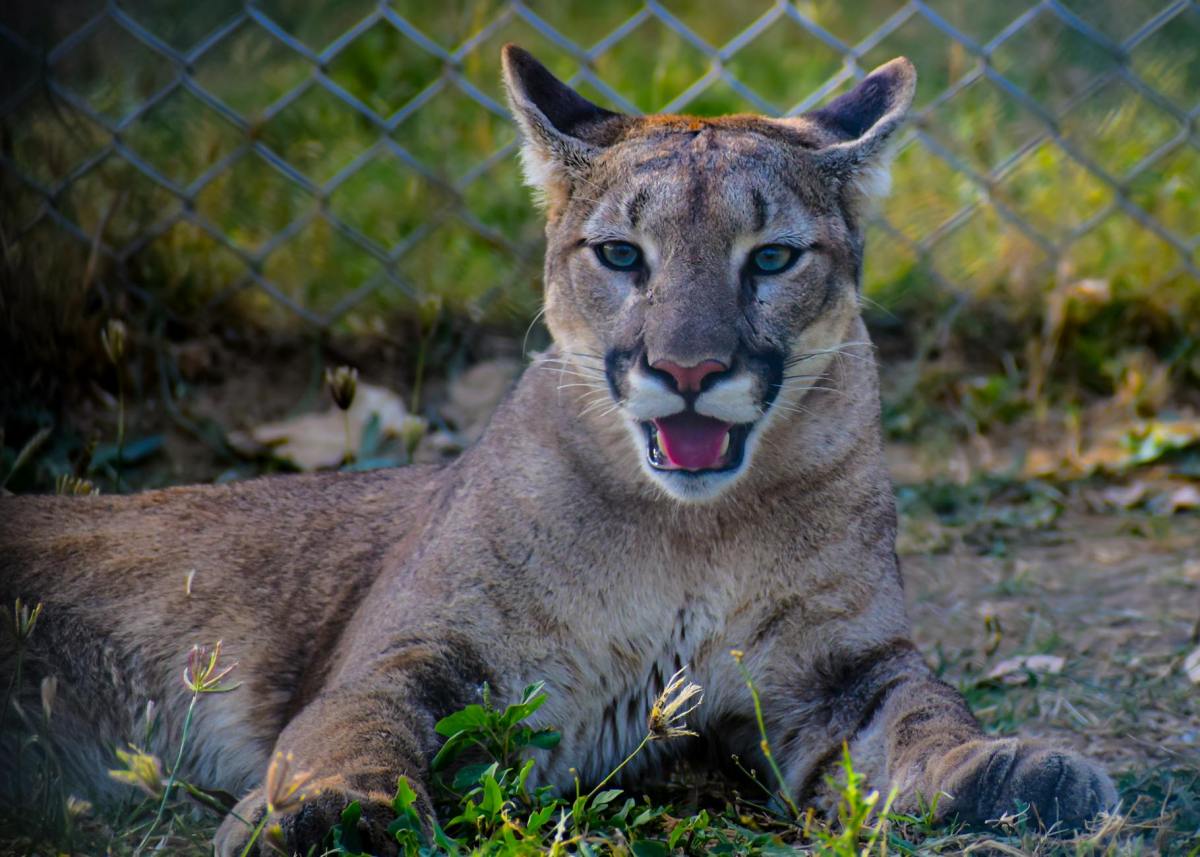
For the first time in 14 years, there’s a puma on the loose in New York.
The wild cat was spotted on a Rochester woman’s Ring doorbell camera padding along the sidewalk in front of her home at about 4 am on Wednesday morning.
A representative from the state Department of Environmental Conservation cautiously said the agency is working on confirming the species of cat in the footage.
But the feline’s size, gait and tail are dead giveaways, despite the dark footage and fleeting glimpse: it’s a puma.
In the brief clip, the wild feline walks past a tree, giving the DEC an important context clue. Michael Palermo, a wildlife manager with the department, said his team measured the tree, allowing them to closely estimate the animal’s size by comparing the footage to their measurements.
“If, in fact, it is some large cat, we would want to question, how did it get here? It’s not impossible for a wild cougar to travel to New York; it’s happened before,” Palermo said. “Was it a captive one that may have been legal as a licensed facility, and if so, did it escape? We still need to do some work to verify anything like that.”
While pumas were once native to New York and thrived in the forested mountains of regions like the Catskills (“cat creek” in Dutch), the last verified sighting in New York was in 2011. That cougar crossed through the Empire State after an epic journey from the west coast, a stronghold for the species.
Some people who posted to a Rochester community group on Facebook are already freaking out, and pumas are widely misunderstood, so it’s important to note the facts:
Pumas are not African lions, are not closely related to them and do not behave like them
They’re not aggressive toward people. In fact, they try to stay away from humans and will go out of their way to avoid confrontation
The exceptions are when people threaten a puma’s cubs or corner the animal, giving it no opportunity to escape
Americans are 150 times more likely to be struck by lightning than killed by a puma. There are only 27 reported cases of people killed by pumas in more than a century. By contrast, an estimated 4,300 to 10,000 Americans have been killed by dogs in that same time span. (Higher estimates include people who did not die immediately from dog bites, and people who died of infections or complications from bites.)
While some people and media reports erroneously call pumas “big cats,” they are not members of the panthera genus. They are felines more closely related to domestic cats and small wildcats. Accordingly, pumas can purr and meow, but they cannot roar
Pumas are also known as mountain lions, cougars, panthers, painters, screamers, catamounts, pangui, onca parda, cuguacuarana, katalgar, chimbica, shunta-haska, fire cats, California lions, ghost cats, and red tigers, among many other names.
In fact, the species has more names than any other animal. That’s because it’s adaptable with a historically wide and varied range. There are some 40 names for pumas in English and more than 80 in Spanish, Portuguese and the languages of indigenous Native American tribes.
The species is officially known as puma concolor, or “puma of one color” thanks to its typically biege fur that, unlike tigers, jaguars, leopards and even house cats, does not have stripes, spots or rosettes.
While it’s extremely unlikely the mystery cougar would pose a threat to people, Rochester police — who have fielded several reports of sightings in recent days — advise locals to keep their pets indoors and to exercise caution while walking their dogs.
Update: The DEC has officially confirmed the cat is a puma, although it was obvious from the footage.
In the meantime, a Rochester man says he saw the wild cat — and people running away from it — on Wednesday night.
Although that sighting has not been substantiated by authorities, it does illustrate the need to educate the public about these animals.
“You know, a mountain lion, it be ‘rawr.’ They be crawling and… serious,” Curtis Jones told WHAM, an ABC affiliate in Rochester.
“I am going to keep this bat right here, man, just in case,” he told a TV reporter. “I am going to protect us, I ain’t going to let nothing happen to us, nothing. OK?”
Let’s hope common sense somehow finds its way into the Facebook algorithm amid all the misinformation as the locals discuss the sightings online.
If you’re from the area, we beg you: please do not attack, shoot or chase after the puma with a baseball bat. The animal does not consider you food, is not a danger to you, and is probably scared and hungry.
That deserves special emphasis if, as the DEC’s staff have said, the puma is more likely an escaped captive than a long-wandering traveler from the western US.
Jones said he saw the puma “slithering” and hear it “rawr,” but it’s worth noting, again, that pumas are members of the genus felinae, meaning they’re genetically and behaviorally much closer to house cats and can meow and purr, but cannot roar. Despite their size, mountain lions are not true “big cats.”
As for Jones, we hope him and his neighbors give the cat a wide berth and let the authorities safely capture it, have a veterinarian evaluate, and figure out where it belongs.
“I don’t play with lions, I don’t play with tigers, bears, nothing in the wild, I don’t play with those, I promise you,” Jones told the station. “I don’t even do rollercoasters. I’m good.”
Bodega cats are the stars of a popular online series and could soon become legal in New York, where they’ve helped keep delis and small groceries rodent-free for as long as such places have existed.
Although it’s way too early to celebrate, Pennsylvania could become the fourth state to outlaw cruel declawing procedures after two lawmakers there introduced a new bill.
The Pennsylvania declawing ban proposal closely mirrors laws already passed in New York, Maryland and Massachusetts, and would outlaw the procedure except in cases where it’s medically necessary. (Although extremely rare, sometimes cats suffer from cancer of the nail bed and other maladies that necessitate surgery, but that’s a far cry from the elective declawing currently legal in 47 states.)
The state’s Veterinary Medical Association, the usual villain in these situations, is opposed to the ban. State veterinary medical associations argue that outlawing the procedure — which amputates a cat’s toes up to the first knuckle — would limit options for veterinarians and caretakers.
The veterinary medical associations, which contrary to their names do not represent all or even most veterinarians, also claim that declaw bans lead to more surrenders, but that claim has been repeatedly debunked by statistics from states and municipalities where bans have passed. In each of those cases, surrenders actually decreased, which is not a surprise to those who understand declawing, rather than “solving” any behavioral issues, actually causes cats to lash out even more because of the suffering they endure from the mutilation.
Here in New York, the Veterinary Medical Association successfully prevented declawing bans from making it out of committee for years, despite organizations like the Humane Society, SPCA, Alley Cat Allies and others wholeheartedly opposing elective declawing. Each state VMA buys influence with campaign donations, and relies on the lawmakers they support to kill declawing bans. Let’s hope Pennsylvania’s Veterinary Medical Association proves less adept at derailing that state’s bill.
The Last Cat of the Skies: The Iconic F-14 Tomcat
When I was a kid, the two Dream Machines that adorned posters on my wall were the Lamborghini Countach and the F-14 Tomcat. The Countach remains a car without equal with its inimitable, angular design that still manages to look futuristic more than half a century since the first models rolled out of the factory.
The twin-engine Tomcat is kind of like the Countach of fighter jets with its variable wing geometry, prominently angular air intakes and unique silhouette that makes it easy to distinguish even from the ground.
A Tomcat from the Nimitz-class aircraft carrier USS Theodore Roosevelt (CVN 71) during a combat flight over the Persian Gulf in 2005. Credit: U.S. Air Force photo by Tech. Sgt. Rob Tabor
Grumman’s air superiority fighter was immortalized in pop culture when Tom Cruise’s ace fighter pilot, Maverick, flew the aircraft in 1986’s Top Gun, and the Tomcat enjoyed a nostalgic encore in 2022’s excellent Top Gun: Maverick, displaying its staying power in a film that also heavily featured newer aircraft like the F-18 Super Hornet and the sixth generation prototype “Darkstar,” based on Lockheed Martin’s secretive SR-72.
The F-14 is the last of Grumman’s “cat” aircraft, after the Wildcat and Hellcat, and while it no longer fills a role in the US military, it remains a potent weapon for other countries half a century since its first flight. You can read all about the Tomcat in The Aviationist’s new feature here.
The Tomcat’s variable wings were a technological marvel when the aircraft was first released. The wings are swept forward for takeoff and landing, and typically swept backward during high speed, high altitude flight, allowing the fighter to maneuver in ways other aircraft could not. The wings can also shift to an asymmetrical configuration, allowing for unique capabilities in flight.
New York’s deli cats get their say
Bodega cats, longtime fixtures of New York’s answer to grocery stores, are enjoying a moment thanks to a major push to finally legalize their presence, and popular social media accounts featuring photographs of the beloved mousers keeping watch over their stores and snoozing in snack aisles.
A bodega cat in New York takes a siesta from his usual napping, eating and rodent-hunting duties. Credit: Wikimedia Commons
Now the New York Times has a feature on the popular TikTok series Shop Cats, which features “interviews” with the neighborhood felines.
Like Buddy, they seem to have an odd fascination with Mao Zedong, and their answers don’t make much sense, but that’s part of their charm. Check it out here.
The United States Botanic Garden is in the heart of Washington, D.C., on the grounds of the Capitol. Admission is free, like almost every museum and public exhibit in the city, and the botanists and designers offer new flora with novel themes every season. These photos were taken in April with my Canon and an 18-55mm lens.









 Pain In The Bud