Today’s a good day to do something special for your little pal(s), and to help spread awareness that felines are sentient, intelligent animals with feelings.
Happy International Cat Day!
Today marks the 23rd annual observance of the special day, which was established by the International Fund for Animal Welfare, a nonprofit originally founded in the late 1960s to stop the commercial hunting of seals off Canada’s coasts.
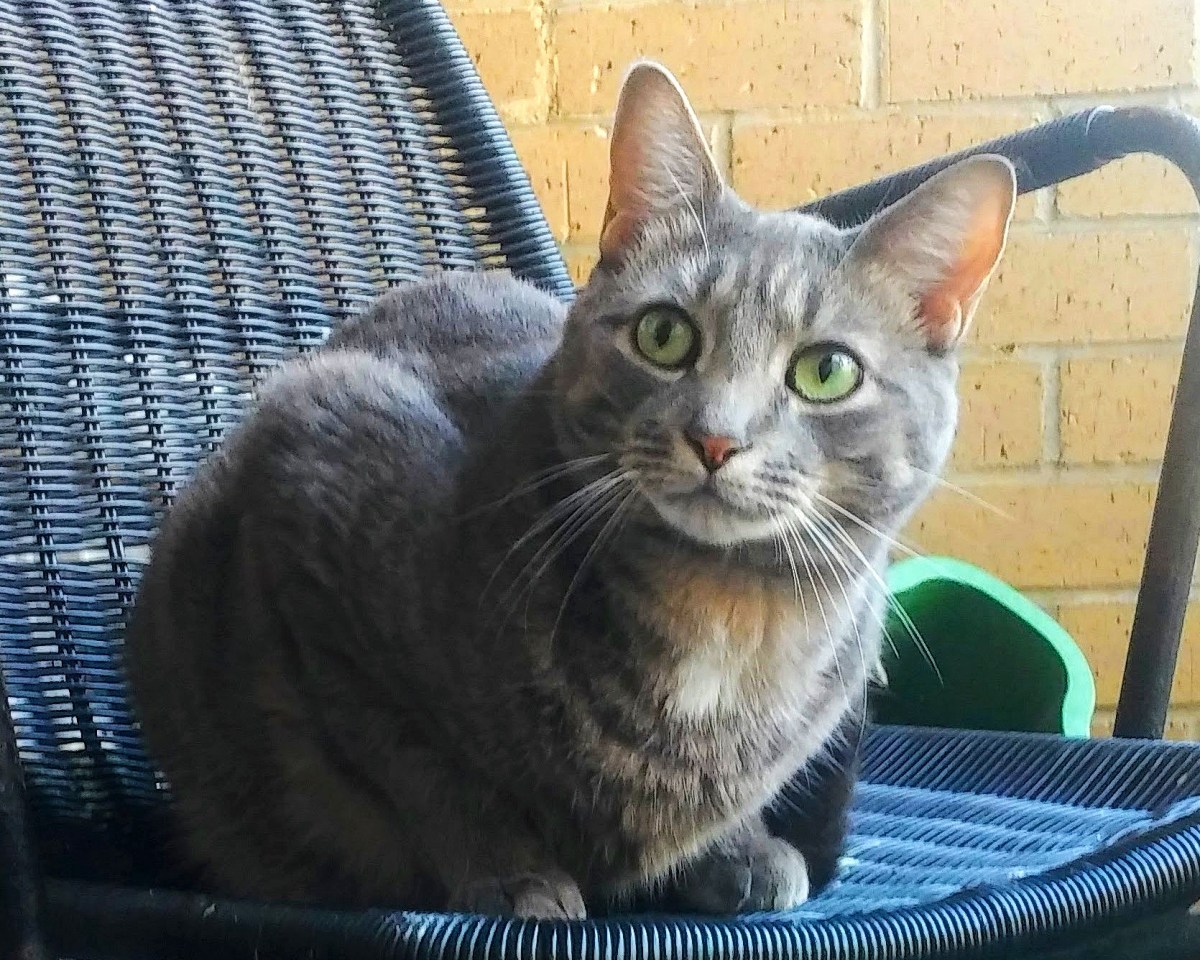
Buddy sits on his vanquished foe, an alien xenomorph. “I don’t understand how these things gave humans so much trouble,” he said.
In more than half a century since, the group has expanded to an international operation with projects aimed at improving conditions for wild and domestic animals. They do wildlife rescue, rehabilitation, preserve management and more.
International Cat Day was intended to help raise awareness about cats, their behaviors and the best ways to interact with them and give them good homes.
For those of us who are already wrapped around the paws of our feline overlords, it’s an occasion to do something extra for our buddies. Here at Casa de Buddy, that means spending more time with little man, giving him catnip, and his favorite human food treat: cheese.
The thing that matters most to him is Buddy Time, when we hang out, play games with his wand toys, and eventually he snuggles up in my lap.
We hope all of you are enjoying International Cat Day and have the opportunity to spend some extra time with your furry pal(s) today. For all they do to improve our lives, a little expression of gratitude is the least we can do.
The trail camera is operated by a team studying the behavior of wolves, but this felid became the main character for a short while, posing majestically right in front of the lens.
Happy Monday! We’re starting the week off in style with an amazing video courtesy of the Voyageurs Wolf Project.
As its name implies, the project is a collaboration between wildlife biologists, ecologists and academics to learn more about wolves, specifically how they survive in the summer months.
While there’s a wealth of research on the behavior of wolves during winter, the pack animals go their separate ways in the warm weather to raise newborn cubs and hunt smaller prey.
Because it’s much more difficult to track individual wolves under the cover of heavy brush compared to following entire packs in the snow, the project relies on a combination of GPS collars and trail cameras. The latter pick up all sorts of wildlife in the Minnesota wilderness, which is how the Voyageurs Wolf Project captured this clear, close-up footage of a stunning medium size wild cat:
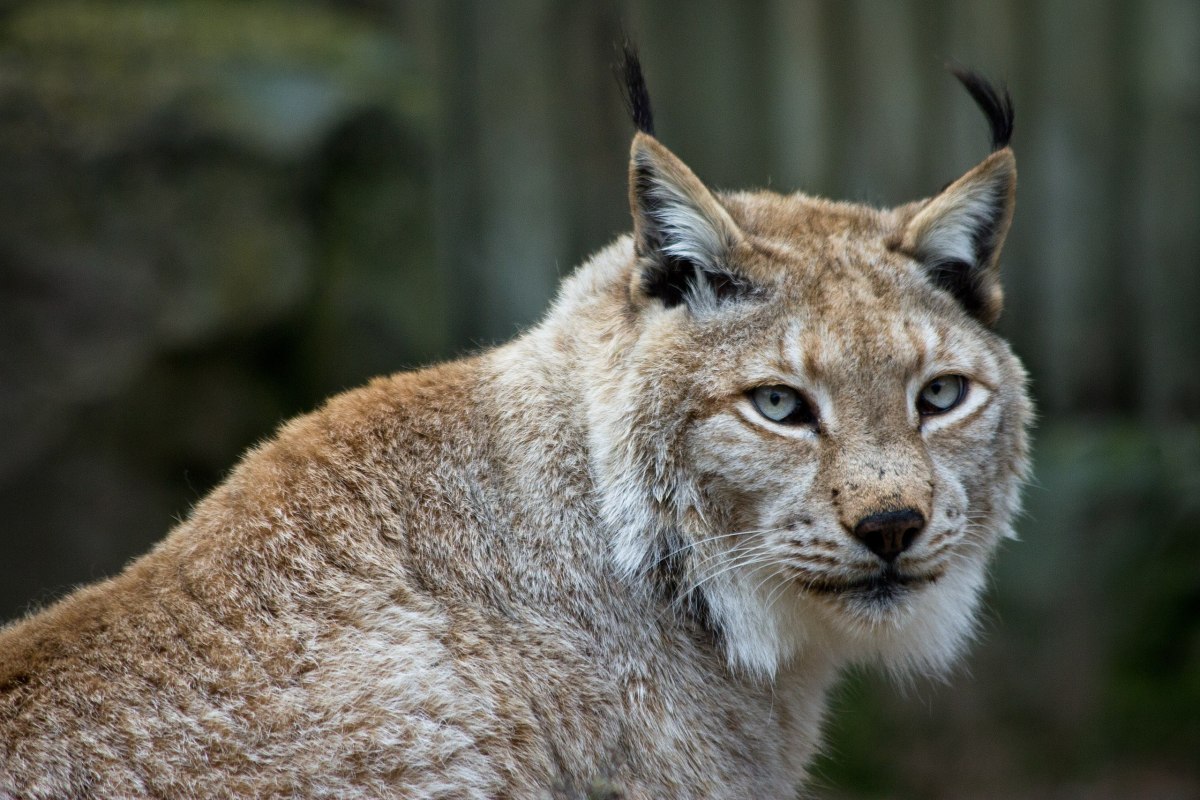
We captured some really neat footage of lynx this past year on our cameras but this is definitely the coolest. In fact, might be the best video of a lynx we have ever captured, not least because the lynx decided sit right in front of the camera…
— Voyageurs Wolf Project (@VoyaWolfProject) July 31, 2024
That’s lynx canadensis, better known as the Canadian lynx, and the footage is so perfect it’s as if the wild cat said “Ah, a trail camera! I’m gonna sit right here and let the humans see how beautiful and regal I am!”
From its pronounced ear tufts to its snow-soft fur and dark stump of a tail, this lynx is a fantastic example of its species. Canadian lynx are well adapted to the demands of their environs in Canada and the northern US, with heavy coats and soft, wide feet that allow it to traverse snowy landscapes quickly and silently.
They’re famously elusive and difficult to track in the wild, but maybe all we have to do is give the lynx a chance to strut its stuff.
Top image credit Carlos Delgado/Wikimedia Commons.
Nicholas was orphaned and severely injured as a cub as he and his mother tried to cross a busy highway. He’s settling into his new home, where he will have his own habitat, den and even his own pond.
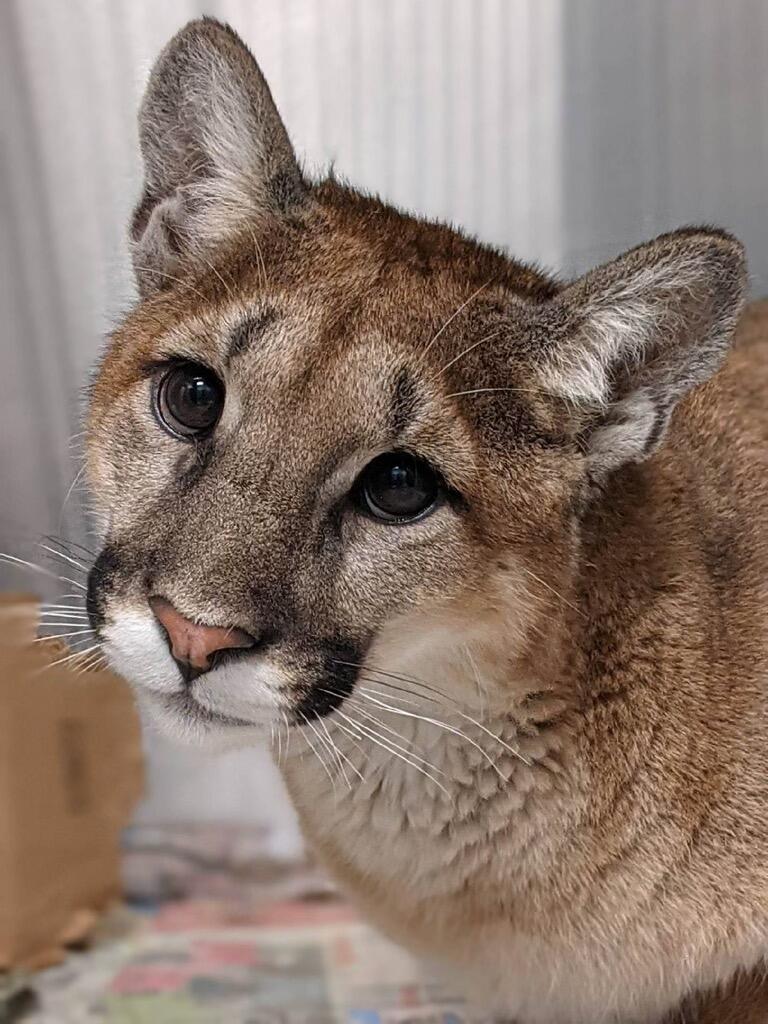
Nicholas the mountain lion has a beautiful home waiting for him with his own pond, a rock den, a grassy area where he can run around and several other little hideaways where he can enjoy some privacy and naps.
But first the three-year-old puma will have to clear quarantine and become more comfortable with his new surroundings and new caretakers.
“He’s doing really well but he’s still very scared, he’s a very timid cat, so we’re just taking it really slow, day by day and the keepers are taking some quiet time with him,” said Bobbi Brink, the founder of San Diego County-based Lions, Tigers and Bears, Nicholas’ new home.
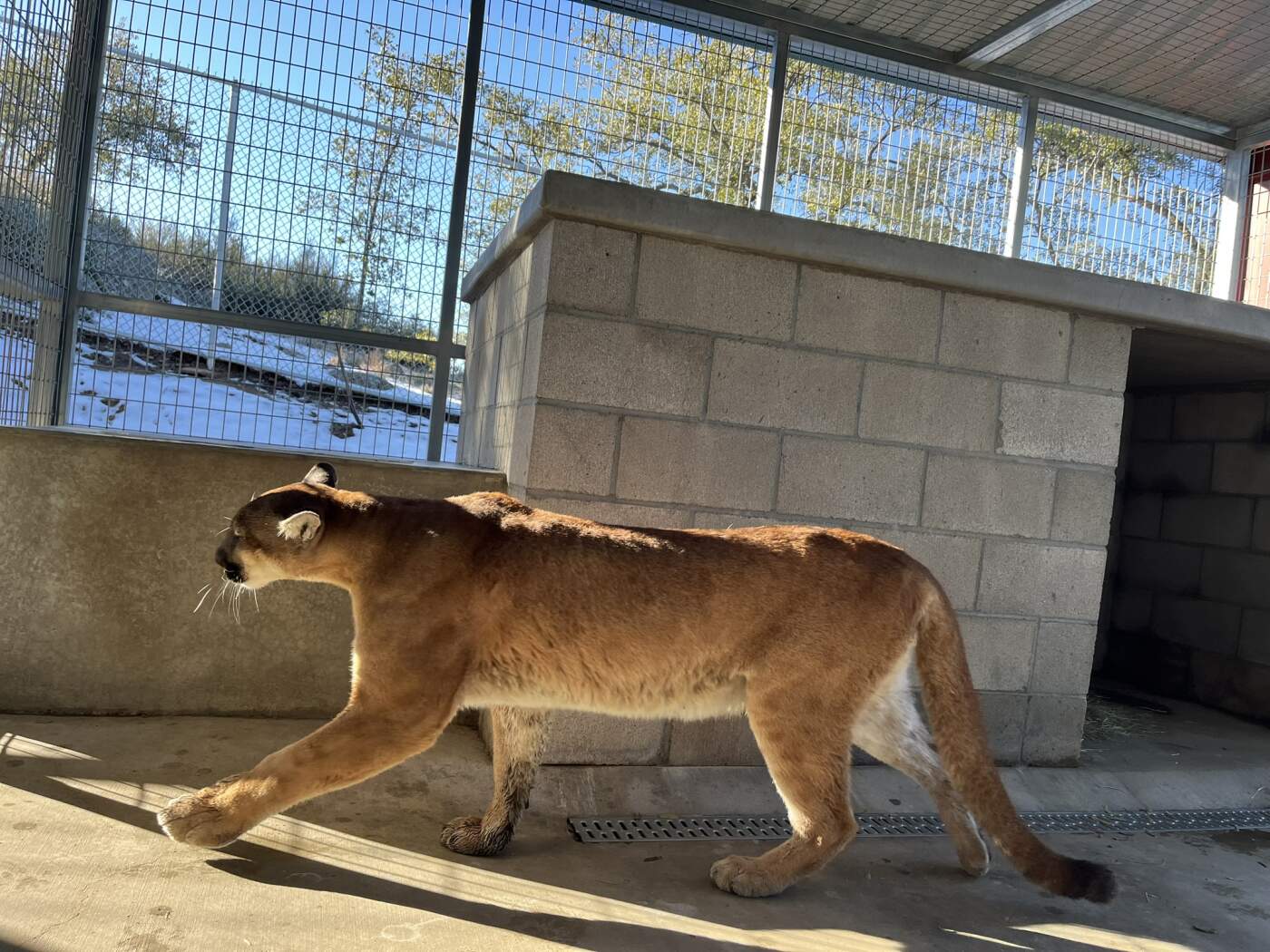
Nicholas stretches his legs in quarantine as he awaits the move to his own habitat. Credit: Lions, Tigers and Bears
The golden-coated feline with an expressive face has had a tough journey to the 93-acre sanctuary that will be his permanent home.
In 2020 when he was just a cub, Nicholas was following his mother across a busy highway when both were struck by a car. Nicholas was badly injured and his mom was killed in the collision, an unfortunately common fate for members of their species as their longtime habitats are increasingly fragmented by new developments and highways.
Because they require about two years with their mothers to learn how to survive on their own, it’s almost impossible to release orphaned pumas back into the wild. Unlike, say, the orphaned orangutans of Borneo and Sumatra, who can usually be taught to successfully fend for themselves because humans can show them how to physically manipulate their surroundings, there’s no way to teach orphaned pumas how to select prey, stalk, pounce and deliver kill bites.
A sanctuary in northern California provided a home for Nicholas for about three years, but recently went bankrupt, so the staff at Lions, Tigers and Bears secured him, prepared a habitat for him and took on the Herculean task of transporting him to San Diego County.
Nicholas’ case is even more complicated because he has lasting neurological damage from the car crash that killed his mother, including a pronounced head tilt that worsens when he’s scared.
Brink told PITB it’s normal for cats like mountain lions to be spooked by the commotion and uncertainty of a move, as well as leaving everything they know behind. Nicholas is simply obeying his wild instincts, which urge him to be guarded. But he’s got a loving team of caretakers who will work with him, as well as veterinary specialists who are well versed in caring for animals with neurological damage.
“Sometimes it can take (animals like Nicholas) a month, sometimes it can take three months to build up that trust,” Brink said. “His biggest need is he’s very afraid, so we’re gonna have to work around his fear so we don’t scare him more.”
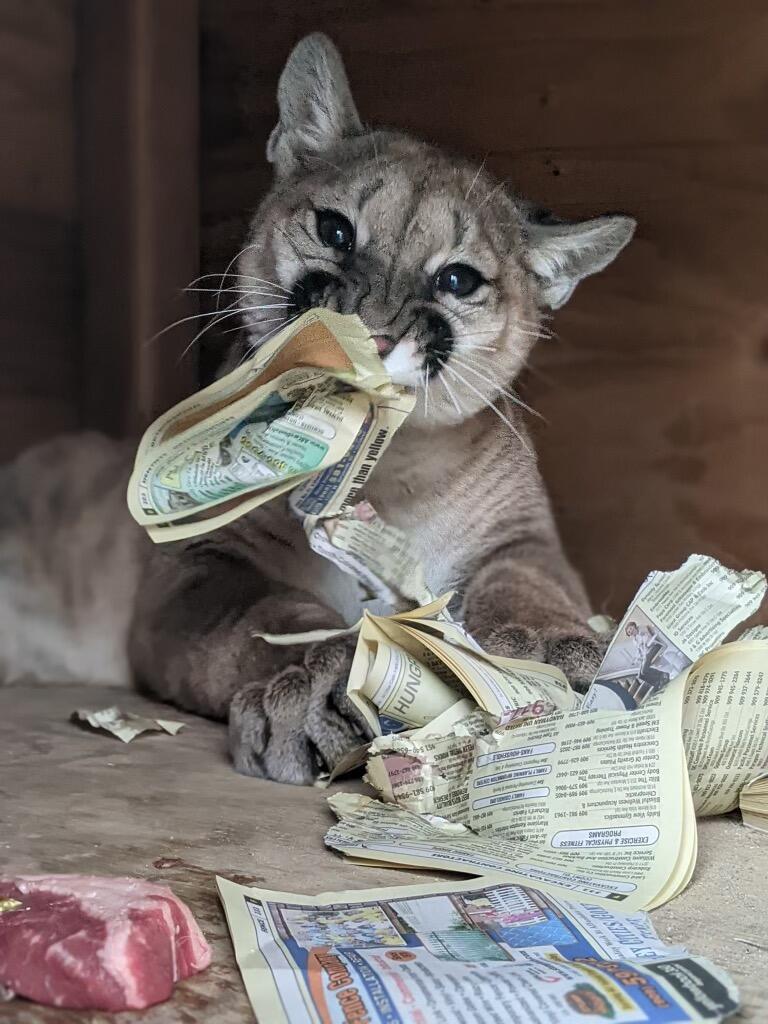
Despite their impressive size, pumas are more closely related to domestic cats than the big cats of the panthera genus. Like their house cat cousins, pumas enjoy tearing up paper and playing with toys. Credit: Lions, Tigers and Bears
While Nicholas will have his own habitat and can keep to himself as much as he likes, recent observations of his secretive species have shown that pumas have “secret social lives,” and Nicholas will have the opportunity to meet and interact with other mountain lions if he’s comfortable with it.
Pumas — which are known by the scientific name puma concolor and are also called mountain lions, cougars, panthers, catamounts, screamers, painters, gato monte and many other names — are among the most adaptable felids in the world and range from the southernmost edge of South America to just over the Canadian border. They’re able to thrive in mountains, tropical regions, deserts, forests, human-adjacent rural areas and even in urban population centers, as the famed “Hollywood Mountain Lion” P-22 did for more than a decade in Los Angeles.
Their ability to adapt has served them well in a changing world, but they’re not immune to the pressures of human expansion.
In California their habitats have been carved up by the state’s busy and deadly highways, leaving the cats in genetically isolated pockets. Pumas who strike out in search of their own ranges are extremely vulnerable to vehicle traffic. P-22 famously crossed several of the world’s busiest highways to reach his eventual home in LA’s Griffith Park, but others like Nicholas and his mom aren’t so lucky.
Solutions like the $90 million Wallis Annenberg Wildlife Crossing, currently under construction in Los Angeles County, can connect fragmented ranges and give pumas, coyotes, foxes, deer, rabbits and other animals safe passage. But experts point out that they are just one component in a long-term solution that must include more careful zoning, fences to funnel animals toward safe crossings, and options like tunnels that run under highways, since not all animals will use overpasses.
As planners and wildlife experts figure out new ways to ensure the survival of wildlife in an increasingly crowded, human-dominated world, sanctuaries like Lions, Tigers and Bears play a crucial role by caring for the innocent animals who are injured, displaced and rescued from bad circumstances.
To learn more about Lions, Tigers and Bears or support their ongoing efforts to provide safe, stimulating and comfortable homes for wild animals, visit the non-profit’s site. To receive updates on Nicholas and the other animals at the sanctuary, follow Lions, Tigers and Bears on Instagram and Facebook. Readers who live in the California area can book guided educational tours or visit during one of the sanctuary’s special events. Thanks to Bobbi Brink and Olivia Stafford for allowing PITB to tell Nicholas’ story. All images and videos of Nicholas courtesy of Lions, Tigers and Bears.
It’s been an exciting and eventful year for Buddy the Cat, and he’s just getting started!
Happy New Year everyone!
While other Asian nations celebrate the year of the goose or the bull or whatever, did you know 2023 is the Year of the Cat in Vietnam and among the Vietnamese diaspora? Yep. Pretty cool!
As we look forward to a 2023 filled with all sorts of awesome stuff, let’s take a moment to fondly recall the highlights of 2022:
January: With the humans of North America paralyzed with fear at the impending invasion of the Polar Bear King and his vast army of huge bears, Buddy the Cat heroically traveled on his own to the frozen wastelands — also known as Canada — to confront the belligerent bear. In an act of bravery that will be remembered in songs for centuries, Buddy defeated the Evil Polar Bear King in a dance-off, staving off invasion and saving humankind.
February: Buddinese Space Industries, the rocketry and spacecraft company founded by Buddy, announced a goal of putting kitties on Mars by 2030 and establishing a state-of-the-art base there — complete with luxury boxes, scratchers and ample window perches — within two more years. After Elon Meowsk expressed skepticism on Twitter, Buddy replied with a simple “Hold my beer,” garnering a record 11.2 million likes.
March: Buddy appeared on the cover of Modern Cat Magazine, looking suave and handsome.
April: Celebrating Big Buddy’s birthday and Little Buddy’s adoptaversary, the former enjoyed Impossible Burgers while the latter ate delicious turkey.
May: Pumped up by an inspiring pep talk from Buddy the Cat, New York Yankees outfielder Aaron Judge caught fire, putting on a display of power that would ultimately result in an American League record 62 home runs. Judge credits Buddy for his success: “Bud showed me the way. He helped me unlock my potential. Without the confidence he instilled in me, I wouldn’t have hit half as many home runs or looked half as good doing it.”
June: More than 50 bands and music acts paid tribute to everyone’s favorite tabby at the 7th annual Festival of the Buddies, a three-day gathering of peace, love and turkey.
Buddy the Cat
July: Buddy raised more than $2.2 million for various animal charities by auctioning off a dinner date with himself. Thousands of women bid on the prize, but in the end one lucky woman — said to be a princess from an undisclosed European country — was able to secure the company of the charming kitty for an evening of good food and meowversation.
August: More than 85 million people tuned in to watch Buddy host Saturday Night Live, registering the show’s highest ratings in decades. Millions more watched the delightful feline’s monologue on YouTube.
September: With his city overrun by rats, New York City Mayor Eric Adams begged Buddy to tackle the threat. Buddy magnanimously agreed, and since Sept. 7 not a single rodent has been observed in the five boroughs. Adams and the city council passed a resolution later that month funding the construction of a statue of Buddy, which will be installed in front of City Hall.
October: Netflix premiered The Buddy the Cat Mysteries, its most popular show since Squid Game. The streaming giant immediately renewed the feline detective show for three more seasons.
November: Buddy the Cat enjoyed turkey on Thanksgiving and every other day of the month.
December: Millions of Americans were able to endure record cold temperatures despite losing power when they found they could raise their body temperature by 8.7 degrees just by looking at posters of Buddy.
That’s quite a year Buddy’s had! Not one to rest on his laurels, he’s already looking ahead to 2023 when he’s expected to make his debut as an opera singer and finally stage a long-awaited bout with Mike Tyson.
Little Buddy and Big Buddy wish all of you a happy and healthy New Year, and we thank each and every one of our 27 million monthly readers for making PITB their site of choice!
A screening of ‘Cat Daddies’ will benefit the Little Lion Foundation, which specializes in caring for neonatal and abandoned kittens.
A trailer for ‘Cat Daddies‘ comes right out with it: Men who love cats are often stereotyped as oddballs.
“People see a cat dad and they think ‘Oh he must be weird and creepy,” says one guy, who is shown hilariously working out his biceps by lifting his cats in place of weights. “I feel like we’re getting to a point where it’s okay [to say] ‘Yeah, I have cats.'”
Another man recalled a conversation with his college buddies in which one of them floated the idea of adopting a few cats.
“The reaction was ‘No man, you can’t do that,'” he says with an amused look on his face.
Of course, PITB readers know it’s perfectly natural for men to love cats, especially cats as muscular, intimidating and tiger-like as Buddy.
But if you’ve ever wondered what the experience is like for guys who want to adopt kitties, ‘Cat Daddies’ takes a look at several men from different backgrounds and their beloved felines, from a homeless man in New York who won’t part with his tabby even it means he won’t get housing, to an Instagram star whose rise to fame has been propelled by his feline masters.
Californians can catch the documentary in person, and help fund a good cause, at an April 16 screening in Long Beach, CA, on behalf of the Little Lion Foundation. The California-based nonprofit specializes in caring for neonatal and young, abandoned kittens, as most shelters aren’t equipped to care for them and such kittens are often euthanized if they land in an animal control or kill shelter.
For the rest of us, check out the Cat Daddies site for a list of virtual screenings and festival events.
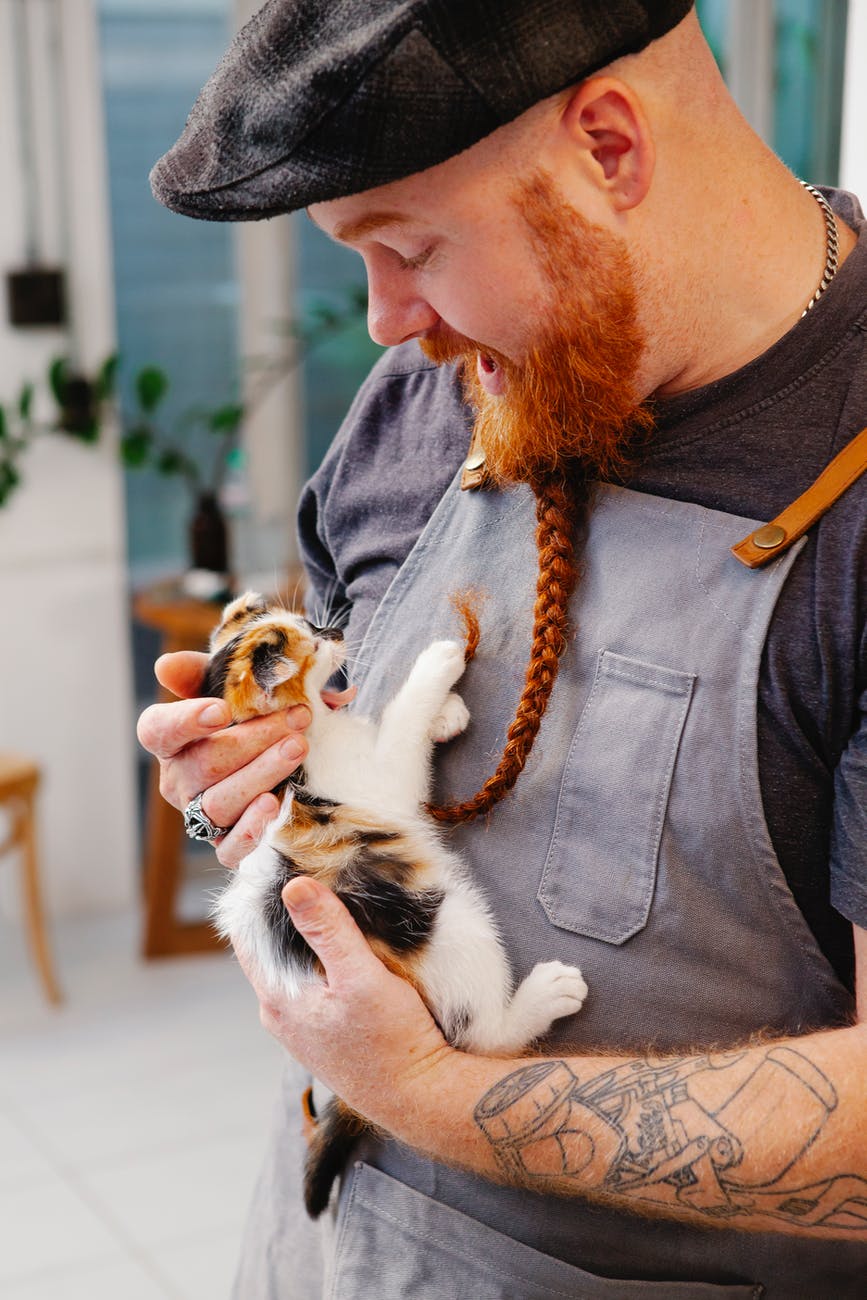
Credit: Tim Douglas/Pexels
A grieving woman explains why she’s cloning her late cat
Kris Stewart adopted Bear, a five-year-old ragdoll “with a big, bold, sassy look,” in March of 2021.
Stewart, the CEO of a senior care company in Canada, described Bear as “the smartest animal I’ve ever owned,” and said the resourceful cat could work out how to open locked doors and windows.
“What I didn’t realize was his need for adventure and exploring,” she wrote in a column for Newsweek.
After “cat-proofing” her backyard and taking Bear on walks via a harness, Stewart decided the ragdoll needed to be outside to be happy. Bear “was off-leash by May 2021,” she wrote.
“Then, one day in January 2022, I let him out about 4.30pm and within about 20 minutes I heard something, saw cars backing up down the street and ran outside. Bear had been hit. Obviously it was my fault. I’m his guardian and I made the wrong decision, and I have to live with that.”
Stewart acknowledges that cloning is a process that involves mistakes, although it’s not clear if she’s aware just how gruesome the process can be. Likening it to “human parents who want to go through IVF rather than adopt,” she said she’s hoping the clone will have the same temperament as her beloved Bear.
“I would much rather replicate Bear’s genetic material into another cat than adopt again because I would love to see the personality of Bear live on,” she wrote. “He was the most brilliant animal I’ve ever owned. Research tells us that a significant portion of personality is carried in genes so I’m willing to take the chance. I’ve said before that Mother Earth is not finished with Bear and Bear is not finished with Mother Earth. So, if I can bring back his genetic material in the form of another cat, I would like to do that. If their personalities are a little different, that’s OK, I’ll be happy regardless.”
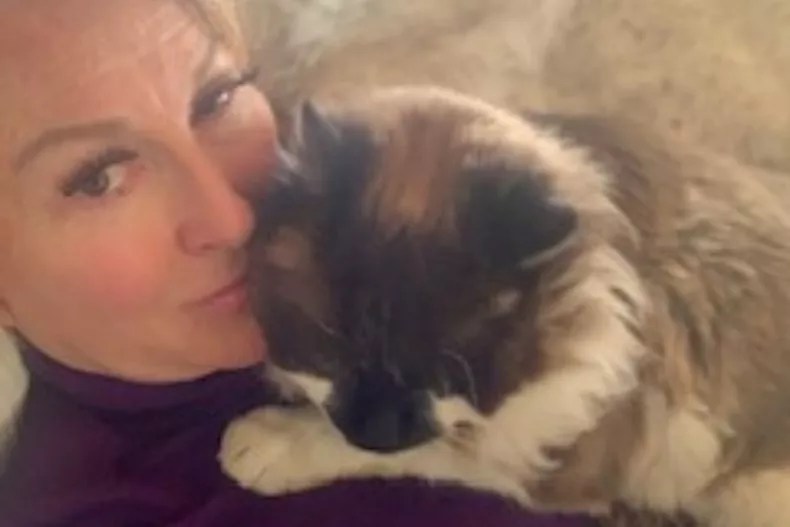
Stewart with Bear.
It’s clear Stewart is devastated by losing Bear, and we don’t want to sound callous by criticizing her decision. Grief leads people to do all sorts of things, and there’s no “correct” way to cope. We all handle it differently.
At the same time, it’s wishful thinking to believe a clone is somehow a continuation of the original, or that cloning can bridge the considerable gap between nature and nurture. That’s just not how it works. Sadly, Mother Earth is done with Bear — there’s no continuity of consciousness.
Even in science fiction stories where cloning technology is flawless and human cloning somehow exists despite considerable moral and religious objections, it’s clear that cloning is, well, cloning: Even if the clone is perfect in every way, even if the process manages to faithfully reproduce personality and memories can somehow be transferred, there is no “bridge” between the original and the copy. For the person who is cloned, life ends when their consciousness blinks out, and nothing can resurrect it.
We hope Stewart finds peace and loves her new cat, but we don’t believe cloning is right answer when grieving the loss of a pet.






 Pain In The Bud