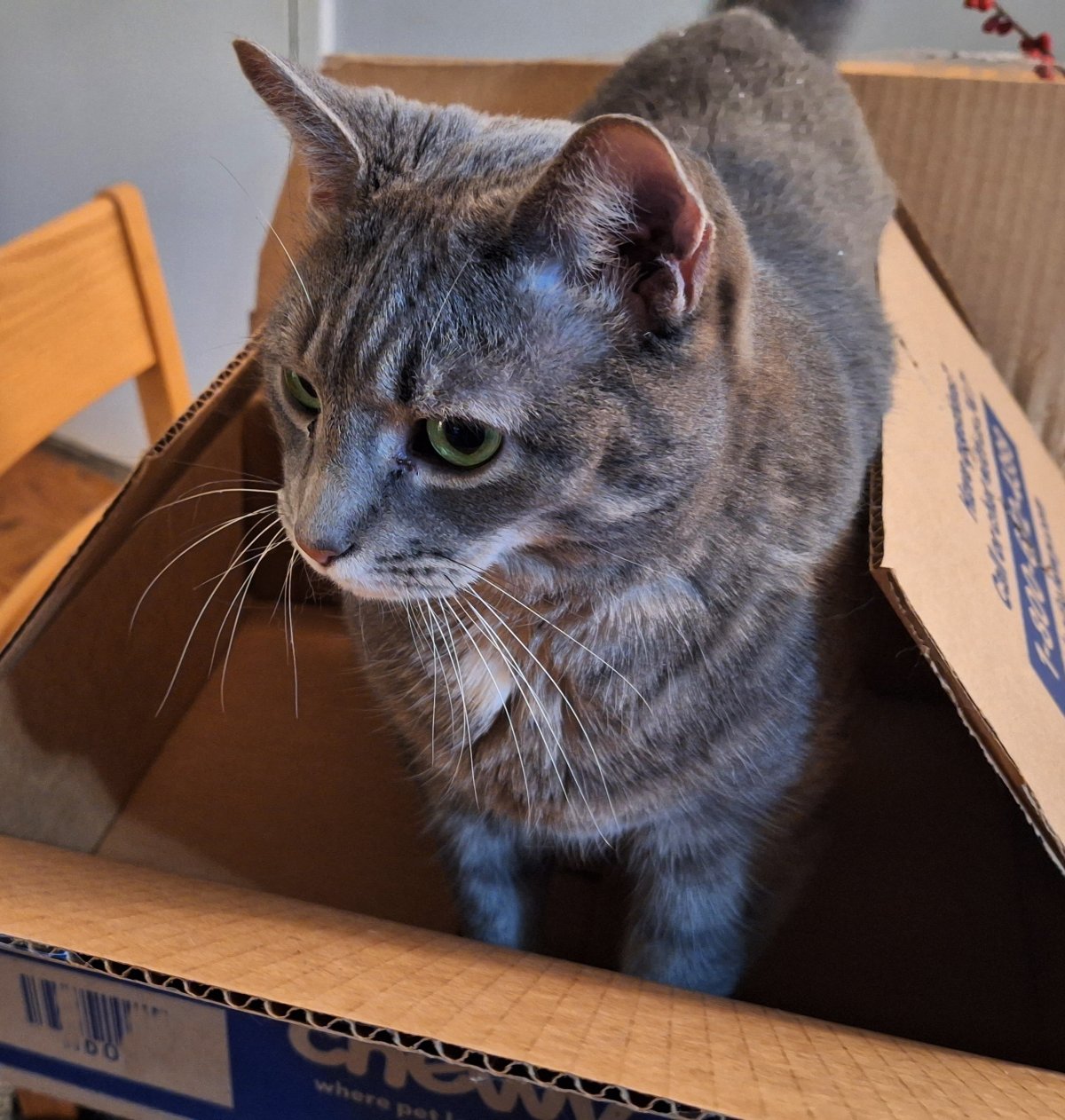
It’s International Cat Day, which means you should totally do awesome stuff for your cat.
Hello there, PITB readers! I have taken over the blog from my inept human on this most auspicious of days, International Cat Day, to offer some great suggestions on how to honor your feline overlord!
Let’s get right into it, shall we?
10) Human snacks: Let’s be serious here for a moment. I’m sick of getting the same old crunchy treats, meaty sticks, soft Buddy Biscuits, Churus and party mix. I want cheese! I want filet mignon! I want roast turkey! I want a cheeseburger! Day after day we have to sit here, our mouths watering as you humans stuff your faces with all sorts of food we would love to eat. Well, today’s the day. Start cookin’, servants!
Yes! More cheese, hold the lettuce and tomatoes. Credit: Juan Santos/Pexels
9) Roombas. That’s right. It’s 2024 and I still don’t have a Roomba. I’m very angry about that. When do I get my mighty steed? Let it be today!
8) Catnip and silvervine. Sure, we get these on other days, but this day absolutely must not go by without you giving us at least a few doses of the good stuff. Hurry up! I need to get my fix!
7) Sweet cat drip that shows you’re owned by a cat. My Big Buddy just got two t-shirts. One shows a roaring jaguar with the word “Savage,” because I am savage, and the other is a kitty samurai with a cool sword. Aside from the fact that this is premium drip, everyone will know that you answer to a fluffy, benevolent overlord back home. That’s what’s important.
The drip.
6) A throne. I’ve wanted a throne since I was a kitten. It doesn’t need to be an Iron Throne with the melted swords of everyone I’ve conquered, a la Game of Thrones. It can be something humble, made of gilded metal, velvet cushions and maybe a lion crest or cool tiger heads on the paw rests. I’m not picky as long as it looks awesome. What’s important is the symbolism and comfort.
5) Hire a mariachi band to parade through the streets hoisting an image of your cat, performing songs in your feline overlord’s honor. This is another humble offering that says “I serve a cat, and I’m proud of it!” When people ask what the hell is going on, hand them Cuban cigars and say “We are celebrating el jefe!” They’ll know who you mean.
“We sing of the great, wise, handsome and meowscular Buddy the Cat!”
4) Hire a portraitist to paint your kitty. Again, it doesn’t have to be extravagant. As a humble cat, I don’t mind being portrayed as a naval commodore, a king, a great warrior of world renown, or a massive tiger. The important thing is that it looks cool and you hang the picture above the couch in the living room. Get on it, human.
3) Massages. Schedule them throughout the day, sprinkling them around naps and meal times. Do you know how satisfying it is to enjoy a nice massage after Food O’Clock? I like to have my chin rubbed and the top of my head scratched while being told what a good, handsome, awesome, amazing, handsome, meowscular feline I am.
2) Toys. Not just for Christmas, you know. In fact, go ahead and consider this Kitty Christmas In Summer. Wand toys, track toys, new boxes, those little plastic ring things from milk gallon containers, stuffed animals that we can hunt and murder like the apex predators we are. You don’t have to wrap them, just bend the knee and present them as tribute. You’ll have our thanks, and our favor.
1)Hang out with us! It really is that simple. The most important thing you can do on International Cat Day is spend time with your cat! Many of the above suggestions fall under this category, including playing with us, giving us massages and reading epic poems you’ve composed about us. Personally I like settling down to nap on top of my Big Buddy after a massage. There’s something about having my chin scratched that makes me start yawning, and there’s no better place to nap than on my human, where it’s safe and there’s body heat and he can’t get up to use the bathroom because it would disturb me. That’s love.
I hope these suggestions are helpful! I’ve tried to list really easy, basic, humble stuff, but if you feel like constructing a 426-room cardboard box castle, well, I won’t stop you. In fact, that would be pretty cool. But like I said, the most important thing is that we get to hang out with you. And eat filet mignon.
A rare prequel that matches or exceeds the original, Day One explores relationships feline and human in a harrowing, life-or-death situation. With its Manhattan setting and post-apocalyptic vibe, the film also invites comparisons to the chaos and insanity of 9/11, when shocked survivors were just beginning to grapple with what they’d experienced.
If there’s one thing director Michael Sarnoski knows about cat people, it’s that putting a feline in danger is a reliably manipulative way to ratchet up tension.
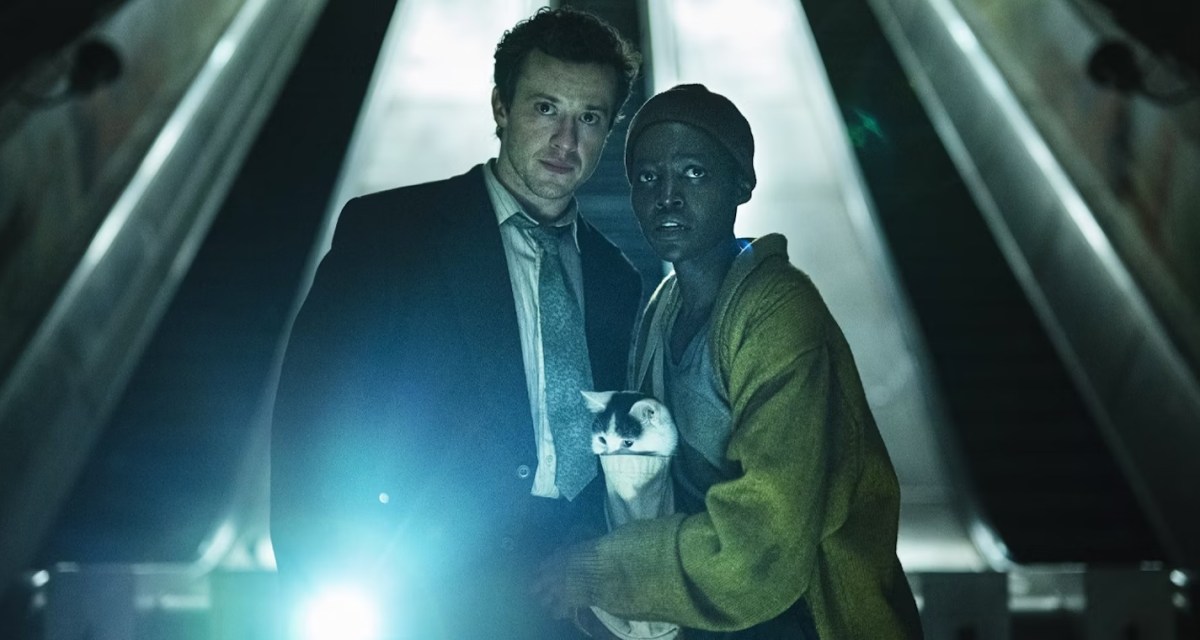
Frodo the cat, therapy pet to Lupita Nyong’o’s Sam in A Quiet Place: Day One, is every bit the handsome co-star.
In a story about a woman and her cat trying to survive an apocalyptic event in New York City, the cat gets plenty of screen time. There are entire sequences following the little guy as he dashes away from danger (and sometimes toward it) and as he follows his feline instincts, which might not be the right instincts in a world that suddenly has its rules rewritten.
Nyong’o’s Sam, right, introduces Frodo to a young admirer in a Manhattan theater during the early minutes of A Quiet Place: Day One. Credit: Paramount
A Quiet Place: Day One is the third installment of the Quiet Place films. The first one thrilled audiences with a tight script, tense acting and a quiet/loud dynamic that made the absence of sound more sinister than sound itself.
A Quiet Place (2018) and its sequel (2020) take place about 16 months after the arrival of monstrous creatures of indeterminate origin. The aliens are blind, but that doesn’t impede their ability to rampage through human cities. They have an unearthly sensitivity to sound and can echolocate. Even a whisper can be enough to draw their attention if they’re in relatively close proximity.
We meet the Abbott family (John Krasinski, Emily Blunt and their children) some 16 months after the initial invasion, when they’re living silently on their isolated farm in upstate New York.
The audience is told nothing about where the creatures came from or what they are, and except for a short sequence in the very beginning of the sequel, we don’t see their arrival. The first two films deal exclusively with the aftermath, with scattered survivors trying to eke out an existence.
A curious Frodo watches Quinn’s character, Eric, emerge gasping from a flooded subway station. Credit: Paramount
Day One is a different beast entirely, both from a plot perspective and through the lens of Sarnoski, who leaves his fingerprints all over the franchise and imbues the prequel with a surprisingly poignant relationship between Nyong’o’s Sam and Joseph Quinn’s Eric, a young British student who moved to New York for law school. (If you’re a fan of Stranger Things, you’ll know Quinn as Eddie Munson, the D&D-playing metalhead and stand-out character from the show’s fourth season. He also had a brief appearance in the seventh season of Game of Thrones, and will appear in the upcoming sequel to Ridley Scott’s Gladiator.)
Sam and Eric are strangers thrown together by circumstance and quickly grow close. Eric, overwhelmed by the world being turned upside down in a country he’s not yet accustomed to, needs someone to latch onto. Sam, who has isolated herself as she wastes away from cancer, finds the companionship she didn’t know she needed.
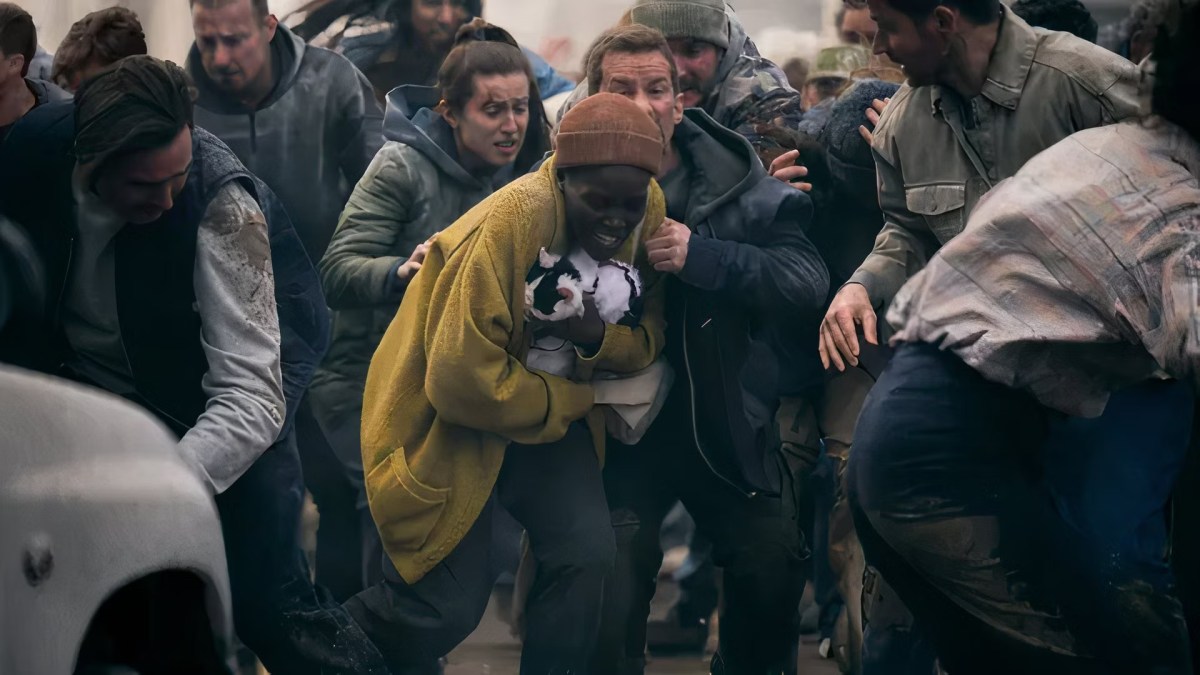
While tens of thousands of New Yorkers heed the US military’s call to head to South Street Seaport for evacuation via boats, as the Death Angels apparently cannot swim, Sam is determined to reach Patsy’s pizzeria in Harlem, where she believes the world’s last slice of their beloved thin-crust pizza awaits. Unlike the other survivors, she doesn’t have the possibility of a future if she makes it to safety.
Walking from Chinatown in lower Manhattan to Patsy’s in Harlem is a hike, about nine miles as the crow flies. It would take most people the better part of three hours to walk under normal circumstances. In an invasion, when the slightest sound can mean death, it’s an extraordinarily dangerous and long journey.
Still, being determined to get the very last slice of pizza in an apocalypse is precisely the sort of ridiculous thing I’d do, so I sympathize with Sam.
In an amusing scene early in the film, a man in a bodega tells Nyong’o’s Sam she can’t have a cat in the store — while his own shop cat lounges on the counter next to him. Bonus point for the Knicks hat. Credit: Paramount
As for Frodo, he’s one cute little dude! I appreciate the fact that Michael Sarnoski elected to have an adult cat rather than a kitten, not because I have anything against kittens, but because Frodo is a reminder that felines of all ages are beautiful, and there are plenty of Frodos in shelters.
Nico and Schnitzel, the cats who play Frodo, are great animal actors. In one scene Frodo sees Quinn emerge from a flooded subway and stops, curiosity playing across his little face. He looks at the stranger and his mouth opens ever so slightly, as if in shock. How many takes did Sarnoski need to get that?
Nico and Schnitzel split duties as Frodo. Credit: Paramount
Frodo is also a survivor. His hunting instincts kick in when he sees a rat, drawing him closer to danger, and at one point curiosity beckons him toward the ruined shell of a building where the Death Angels are apparently nesting.
Incredibly, he never meows. There are times when he freaks out and runs, as cats are known to do, but he reliably finds his way back to Sam, and he has a knack for remaining absolutely still and silent when he needs to be.
There were so many moments when I imagined myself in Sam’s shoes and Buddy in Frodo’s paws, and we’d have been dead in all of them. As I noted in my post about the “Quiet Place Challenge” trend on social media, the Budster and I would have a life expectancy of approximately 60 seconds in the film’s world. Death by Buddy would be my fate, as inescapable as his mealtime screeching.
There is also a visceral 9-11 feel to the opening sequences of the invasion, and any New Yorker old enough to remember that day will be reminded of it. It’s impossible not to with the scenes of ash-covered survivors huddled inside buildings, crowds of dead-eyed people walking away from disaster and the eerie sight of a sooty Manhattan bereft of its usual bustle and life.
There are of course plot holes in Day One, or at least unanswered questions to things that don’t seem to make sense. When the military’s helicopters sweep over Manhattan, announcing via loudspeakers that survivors should head to the ports because “the enemy cannot swim,” I wondered: did these aliens just land in Manhattan? If so, why? Surely they don’t recognize the arbitrary municipal boundaries of humanity, and the whole area is one seemingly endless metropolis.
Quinn, left, and Nyong’o, right, panic as a Death Angel crashes down from above, listening for its prey. Credit: Paramount
The Death Angels are obviously sentient, but whether they’re sapient is another matter. They don’t seem to have much in the way of a sense of self-preservation, and there is no method to their madness. During the aforementioned helicopter scene, the characters watch as hundreds of Death Angels race toward lower Manhattan, drawn by the sound of the choppers and the loudspeaker. It’s impossible not to think it would be trivial to draw the lot of them with the loudest possible sound, then drop a few daisy cutters on them and call it a day.
Of course if any of that happened there would be no movie and no drama, so as with most stories like this, it’s best to let the film pull you along without stopping to over-analyze what you’re seeing.
If you’ve watched the first two films, you also know the reasons for the invasion are nebulous. The Death Angels don’t eat their kills, as Krasinski’s Lee Abbott learned, and if they’re the vanguard of a more intelligent species, doing all the dirty work before the masters arrive, well, we’ve yet to see who’s pulling the strings.
Overall, like horror master Mike Flanagan taking on a sequel to the tepid Ouiji earlier in his career, Sarnoski doesn’t view the fact that Day One is a prequel as an excuse to phone in a performance. He approaches the film with enthusiasm and energy as if it’s one of his own creations, and that’s evident in every frame. It’s a Sarnoski movie that happens to be a genre film, not the other way round.
There’s a surprising poignancy to Day One that makes it more than the sum of its parts. We’re not here to spoil anything, but if you’re a cat lover, we will say that Day One doesn’t pull an I Am Legend. You can watch the film with reassurance that Sarnoski has better tricks up his sleeve for stirring your emotions than gratuitous animal-involved violence.
It’s rare when a sequel or a prequel reaches the same heights as the original. How many of us wish franchises like Alien and The Matrix stopped at one film? Thankfully that’s not the case here. There’s life in A Quiet Place yet, and like the best science fiction, it’s a film that uses extraordinary circumstances to tell a very human story.
Perhaps the best part is the experience has made a cat lover of Nyong’o. In a short promo (below), she explains that she’s always been afraid of cats, viewing them as miniature lions.
“Now,” she says with a laugh, “somehow, I love them!”
She’s not just saying that either. After filming Day One, she adopted her own cat, Yoyo, and it takes just a glance at her Instagram page, which is festooned with photos of the orange tabby, to know that she really does love the little guy.
Buddy is many things, but he’s NOT quiet. His incessant chattiness can kill my sleep and my peace and quiet, but in the world of A Quiet Place, it would kill me! Would your cat get you killed in the movie franchise’s monster-stalked reality?
As a cat lover, big time science fiction fan and appreciator of the first two A Quiet Place installments, the very first thing I thought when I saw the trailer for A Quiet Place: Day One was “I hope the cat doesn’t meow!”
My second thought? Bud and I would be so, so dead.
Dead immediately. Dead a thousand times over.
Apparently I’m not the only one, because fans have taken to social media to participate in the “Quiet Place Challenge,” which involves reenacting some of the scenes from the movie with their own cats to see if their furry overlords can stay silent.
As PITB readers know, Buddy never shuts up. He’s got something to say about everything, he often narrates his activities in real time, and he’s got an entire meowing ritual that starts at least a half hour before Food O’Clock, gaining in volume and annoyingness until a fresh bowl of turkey is placed before him. His personal patois, the Buddinese dialect, makes heavy use of trills, chirps, grunts, chuffs and sniffs to elaborate on his meows.
If you’re unfamiliar with the Quiet Place movies, they imagine a world that’s been invaded by so-called Death Angels, dread creatures of extrasolar provenance who are completely blind, but have extraordinarily sensitive hearing. The first movie, about a family surviving on their farm in upstate New York months after the initial invasion, was universally lauded for its taut script, effective tension and novel use of a quiet/loud dynamic that is a marked departure from the usual horror-thriller formula.
John Krasinksi directs and stars in the original A Quiet Place as Lee Abbott, a father who survives the invasion along with his wife (real life spouse Emily Blunt) and their two children. Credit: Paramount Pictures
In A Quiet Place (2018), its 2020 sequel and the recently-released prequel, Day One, entire minutes pass soundlessly. As a viewer you can’t help but wince and tense up when a character errs and makes noise, knowing the consequences can be immediately tragic.
There’s simply no way Bud and I would survive more than five minutes, and if I had to put money on it, I’d wager we’d probably be dead within 60 seconds of the terrifying monsters showing up.
Indeed, the movie doesn’t dither: the Death Angels make planetfall at around the 12 minute mark. Mild spoilers from the beginning of the film follow:
12:31 – On Chinatown’s ruined Pell Street, within a haze of dust so thick you can’t see more than a few feet in any direction, a man shouts loudly into his smartphone, telling the person on the other end that something meteor-like had landed just a few hundred feet away. He’s pulled suddenly and violently into the smog, his scream ending as abruptly as it began. Verdict: Death by Buddy. He’d probably meow in protest at the dust and get us both killed immediately.
12:53 – A female National Guard soldier sees Nyong’o’s Sam and shouts at her to take cover. The guardswoman’s radio crackles with the panicked screams of her comrades saying the enemy is everywhere, and then she’s dispatched as quickly as the guy on the phone. Verdict: Death by Buddy. He’d almost certainly huff derisively at the soldier’s order to take cover, and we’d both be crushed underneath the foot of one of the lumbering beasts.
13:34 – Sam huddles behind a vehicle with another woman when a panicked man screams, drawing the aliens like moths to a flame. Verdict: Death by Buddy. Little dude’s default reaction when he’s scared is to run screaming and hide behind my legs. He’d draw the monsters right to us and we’d die.
13:50 – Sam wakes up inside a theater several minutes after an explosion knocked her out. She’s about to speak when Djimon Hounsou’s Henri clamps a hand over her mouth and raises a finger to his lips. Unfortunately that doesn’t work with a cat. Verdict: Death by Buddy. Attempts to get him to shut up would be fruitless, and while I’d know my only chance for survival would be to throw him like a football so the aliens track his indignant screech, I wouldn’t have the heart to do it. We’d die together.
Frodo, the feline co-star of Day One and “service cat” to Lupita Nyong’o’s Sam, is precisely the opposite. He’s a Good Boy extraordinaire, consistently calm in his mother’s arms and reliably silent when he needs to be.
Frodo is a handsome and resourceful little guy, and much of Day One’s tension comes from putting him in danger. Credit: Paramount Pictures
Without meows to rely on, director Michael Sarnoski gets quite a performance out of Nico and Schnitzel, the two cats who play Frodo. They’re expressive felines who could teach Nicolas Cage a thing or two about how to emote with subtlety, as in one scene when Frodo sees a man emerge gasping from a flooded subway station. Frodo regards the stranger with curiosity, his little face registering surprise at the man’s sudden appearance with just the slightest twitch of his mouth and whiskers.
It’s effective and very cute, but we never forget about the incredible danger that faces Frodo and Sam as they return the One Ring to Mount Doom navigate the ruins of New York City amid blind predators with extraordinarily sensitive hearing.
“LOL I got you killed, dude! Hey! Wake up! I’m hungry! Turkey time! I’ll take my evening meal on the balcony and dine al fresco this evening, okay? Big Bud? Dude?”
If Day One’s world was reality — and I’m extremely thankful it’s not — I suppose it’s possible I’d get lucky if we were in a deep subterranean level of a building for some odd reason, and if Bud decided it’s not worth disturbing his nap to investigate the ruckus above.
But the moment his belly rumbles and he starts screeching for yums, or the second he gets it into his little head that he just has to tell me his latest theory regarding entangled subatomic particles, it would all be over, for me at least. I could totally see Bud making noise, then dashing to his customary hiding place behind my legs while a “Death Angel” impales me with one of its giant claws.
What about the rest of you? Is your cat a Frodo, a Bud or another sort entirely? Would you be dead as quickly as we would be, or do you think you could survive with your furry pal?
Requirements for adopting Pepper included a sense of humor and experience caring for birds. He’s now found a home with patient caretakers and another mercurial parrot to hang out with.
It’s too bad cats can’t swear.
While kittens don’t often have problems finding homes due to their overwhelming cuteness and antics, it usually takes a sad story to drum up considerable interest when an adult feline is up for adoption.
As the SPCA of Niagara learned, talkative parrots, especially birds who can swear up a storm, have their pick of homes.
In June, a potty-mouthed parrot named Pepper was surrendered to the shelter, and when the SPCA put the call out — specifying they’d prefer someone with experience caring for birds and a sense of humor — the applications kept rolling in, totaling more than 400.
“His famous line is ‘Do you want me to kick your ass?'” a shelter employee said in an interview last month shortly after announcing Pepper was up for adoption.
Shelter staff asked applicants to include photos of their bird enclosures in addition to the usual pre-adoption questions, eventually narrowing the Pepper Sweepstakes down to 10 potential homes.
This past week, Pepper was finally taken to his new abode in Olean, a small city in western New York. The couple who adopted him are not only experienced with birds, they know all about avian vulgarity. They have a parrot named Shelby who apparently “makes Pepper look like a saint.”
As for Pepper, it looks like he’s getting his bearings before heaping abuse on his new caretakers.
“He hasn’t cursed at them yet, but we know it’s coming,” shelter staff wrote in an update.
In recent decades, research has shown birds can be exceptionally intelligent. Crows, for example, use tools, can differentiate between human faces, and remember which humans have wronged them or treated them well.
While many people assumed parrots merely imitate human language, long term behavioral studies show the birds are able to use words in context and invent novel combinations of words. As with other animals, syntax remains elusive.
The most famous example was Alex the African Gray, who was the subject of research by animal cognition expert Dr. Irene Pepperberg. Alex, who died in 2007 at the age of 31, was able to count and could perform simple calculations. He was talkative, conversant and often told his caretakers how he was feeling, what he wanted, and what he thought of the tests they’d give him. (Like a child, Alex would try to get out of exercises he was bored with by asking for water, saying he was tired and wanted a nap, or just flubbing his answers.)
We are not above crude humor here at PITB, and in the past we’ve written about Ruby, our favorite talking parrot. Ruby lives in the UK with her owner, Nick Chapman, and the pair were among the very earliest Youtube stars thanks to videos of Ruby’s shockingly vulgar, extremely British tirades and Chapman’s infectious laugh.
Warning for those who are offended by bad language or are viewing at work: Ruby is known for liberal use of c-bombs-, t-bombs, f-bombs and just about every other linguistic bomb you can think of, in addition to British slang like “bollocks.” If that’s a problem for you, skip this video.
Eric the Legend, a parrot who lives in Australia, is also a favorite on Youtube for his habit of declaring himself “a fookin’ legend!“
We’re glad Pepper has found a home where his idiosyncratic nature will be cherished, and we hope the future will bring videos of Pepper and Shelby going back and forth. Parrots are social animals, after all, and what fun are insults if you’ve got no one to trade them with?
The dragons of the Game of Thrones universe are so well-designed, with such attention to detail and writing that imbues them with their own personalities, that they feel like real creatures. They’re a sight to behold.
The Budster was just a kitten when the fourth season of Game of Thrones premiered, and I vividly recall trying to tire the little guy out with extra play time on Sunday nights so I could watch my favorite show in peace.
The effort was mostly in vain with such an energetic, curious and chatty kitten, but eventually Bud would settle down in my lap and watch with me.
Enamored as I was with the tiny animal in my care, I found myself especially appreciative of the fact that the dragons of the Game of Thrones universe are so lovingly, realistically rendered and given such unique personalities that they feel like real animals. A lot of thought and care went into their design, from their anatomies to the biomechanics of how they move and fly, to their chittering, calls and roars.
If you look closely when they open their mouths menacingly, you can even see the glands that secrete the accelerant allowing them to breathe fire.
Both shows — the original Game of Thrones and its prequel, House of the Dragon — have done such a good job developing the dragons as characters that I’ve found myself more disturbed by the unfortunate deaths of a few of the majestic beasts than I was by the grisly fates of some human characters. That’s saying a lot for a fictional universe infamous for shocking, emotionally manipulative, gut-wrenching deaths, a universe that immediately established no one is safe after killing off its main character — played by its highest-profile actor — before the first season was over.
The willingness to do what no other TV show has done in 60-plus years of television is part of what makes Game of Thrones and its spinoff such compelling drama. No one is safe. Heroes can die agonizing, undignified deaths. Villains can triumph, infuriatingly. But just when you think you know where the narrative will go next, it subverts your expectations yet again.
Now that we’re a few episodes into the second season of the prequel, House of the Dragon, and I’ve taken to trying to get my cat to respond to commands in High Valyrian as if he were a dragon himself, I compiled this official Buddy-approved list of our favorite dragons in both series:
Syrax
Syrax is golden and regal.
The beautiful golden-scaled Syrax is protagonist Rhaenyra Targaryen’s dragon, so it’s fitting that she’s the first of the eponymous creatures we see in House of the Dragon, soaring across the skies over King’s Landing in the first scene of the first episode.
Teenage Rhaenyra Targaryen with Syrax after a flight over the Westerosi capital city, King’s Landing.
As was tradition with Targaryen children, Syrax’s egg was place in infant Rhaenyra’s crib, with child and dragon raised together to create their indelible bond. The show makes it clear why that bond is so important in the third episode, when Rhaenyra arrives dramatically atop Syrax to defuse a confrontation among her uncle and the king’s men that was on the verge of bloodshed.
“Take care not to startle Syrax, my lords,” Rhaenyra says as she dismounts, pulling off her riding gloves. “She’s very protective of me.”
Syrax is a young and growing dragon at the time of HotD’s first episode, when Rhaenyra is just 15 years old.
Vermax
Nom-noms for Vermax?!
Vermax is a juvenile when we meet him for the first time in House of the Dragon, in a scene showing Princess Rhaenyra’s young son, Jacaerys Velaryon, learning to bond with his dragon. (A time skip in the first season moves the action forward some 15 years.)
Vermax is young and wants all the snacks. Note the accelerant gland in his mouth, visible on the right side. When the dragons of the Song of Ice and Fire universe breathe fire, a natural accelerant is secreted from the gland, mixing with the dragon’s breath to create flame hot enough to turn men to dust in their plate armor.
It’s the first time since the early seasons of Game of Thrones that we see a sub-adult dragon, and Vermax almost looks like a fire-breathing velociraptor as we watch him roast his own dinner at Jace’s command.
We also get to see the dragon keepers instruct the young prince on how to “call [his] dragon to heel,” issuing commands in High Valyrian like “dohaeris” (serve), “umbās” (wait or hold) and the most famous command, “dracarys,” which instructs the beasts to spit fire.
Meleys
We don’t meet Meleys until late in HotD’s first season, but the wait is worth it. Known as the Red Queen, Meleys is massive, terrifying and already has a storied history by the time we set eyes on her.
She stars in arguably the most spectacular scene involving a dragon in HotD’s first season, prompting several characters to soil themselves as Meleys makes an unforgettable entrance and threatens them with a deafening roar.
The formidable Meleys. Here too you can see the fire glands in Meleys’ mouth as she roars.
While dragons like Syrax and Dreamfyre are graceful and sleek, Meleys is all menace and sharp edges, resembling the two most famous, most feared dragons in GoT lore — Drogon and Balerian the Black Dread, who were both the personal dragons of Targaryen conquerors.
Meleys is ridden by Princess Rhaenys Targaryen, styled as The Queen Who Never Was due to her strong and spurned claim to the Iron Throne. Rhaenys and her dragon, however, are a force to be reckoned with.
Caraxes
Caraxes is one of the most battle-hardened dragons, and his rider, Daemon Targaryen, is a lunatic. That makes the pair extraordinarily dangerous and unpredictable.
Known as the Blood Wyrm, Caraxes has an unmistakable serpent-like look to him, with a long neck, finned tail and dark red-black scales.
Just as humans can be born with deformities so can dragons, and Caraxes owes his strange anatomical features to an unidentified congenital condition. Caraxes is fierce, fearless and has seen more combat than almost any other living dragon in House of the Dragon.
At first it seems as if Caraxes is a different breed of dragon, perhaps from a sister taxa, but the fearsome fire-breather actually suffers from congenital deformations that somehow make him even more terrifying.
Caraxes is also notable for the man who rides him: The mercurial and often brutal Daemon Targaryen, brother of King Viserys. Daemon is an accomplished warrior and loose cannon, which makes him and his dragon unpredictable and very dangerous. He’s not above using Caraxes to intimidate, and Caraxes seems to enjoy his part.
Rhaegal
Rhaegal and his brothers, Viserion and Drogon, were born when Daenerys Targaryen, Mother of Dragons, carried their eggs into an inferno and emerged at sunrise with three baby dragons clinging to her.
We see him and his brothers grow from tiny and cute infants to living manifestations of absolute terror, destroying entire navies and razing castles with their dragonfire. At the time of their birth, dragons had been extinct from the world of Game of Thrones for centuries. (Game of Thrones takes place about 200 years after House of the Dragon, despite being the first of the two series adapted by HBO.)
Rhaegal is named for Daenerys’ late brother Rhaegar Targaryen, and his eventual rider is Jon Snow. Rhaegal participates in Daenerys’s toppling of the ruling class in one of the Slaver’s Bay cities, and he and Snow eventually participate in the most pivotal, existential battle in the show’s history. Rhaegal is a beautiful example of his species, with dark green scales, and like his brothers, he’s fiercely loyal to Daenerys.
Vhagar
Vhagar is absurdly huge and is the largest living dragon during the reign of King Viserys I in House of the Dragon.
Vhagar is old, ridiculously massive and — at the time of House of the Dragon — the most powerful and celebrated dragon alive.
Age is evident in every one of her features, from her broken teeth, worn scales and tattered wings, to her lugubrious gait as she’s risen from sleep during a key scene late in HotD’s first season.
The earth shakes as Vhagar lumbers forward, launching her colossal frame into the air.
But once she takes to the skies, there is no force in the show’s universe that can stop her. It’s astonishing to see a dragon the size of a damn aircraft carrier, and I can’t wait to see how Vhagar and her rider, Prince Aemond Targaryen, impact future events.
Drogon
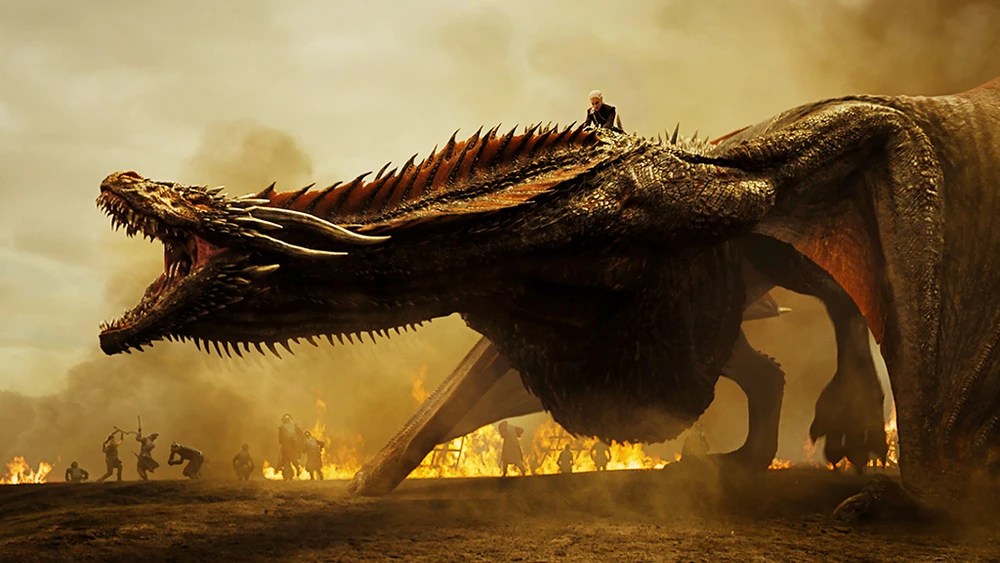
Even if you’re unfamiliar with Game of Thrones, chances are you’ve seen ads, promotional clips or giant billboards in Times Square depicting a golden-haired woman atop a behemothic dragon with dark crimson and black scales.
The woman is Daenerys Targaryen and the beast is Drogon, who is said to be the reincarnation of Balerion the Black Dread, the largest and most powerful dragon in recorded history.
Drogon is the symbol of the rebirth of dragons almost two centuries after the last of the species died. He’s the most destructive force in the original Game of Thrones, but he’s also dearly loved by his mother, Daenerys, and he’s even had a few comical, light-hearted moments, like the death stare he fixes on Jon Snow when the latter kisses Daenerys.
“That’s my mom, dude,” Drogon seems to say. “Be respectful or I’ll burn you to a crisp and make a light snack of you.”
This GIF is taken from that very moment, when Jon locks lips with Dany, senses the dragon’s eyes on him, and looks up to see Drogon staring intently at him:
When Drogon and his brothers are born, the people of Westeros and Essos can hardly believe it. For the first time in two centuries dragons lay claim to the sky, their calls echoing for miles across mountains, plains and open water. They also have voracious appetites, helping themselves to thousands of farm animals, wild prey and enemy soldiers as they grow.
Drogon and the boys have a big part to play in the events of the series, but like all animals, they’re born virtually defenseless. The last time we see Drogon he rivals the biggest dragons in history, but the first time we see him he’s the size of a kitten, squealing as he rides his mother’s shoulder.
Daenerys with Drogon (shoulder), Viseryon and Rhaegal in Qarth, the mythical eastern-most city of Essos.
Drogon as an adorable baby dragon, roasting his first nom noms.
Drogon, his brothers and Daenerys were never more vulnerable than they were in those early days, and a succession of ill-intentioned characters try to take or kill them. Drogon, more than any of his kind, proves that “owning” a dragon and getting him to do what you want are two different things, not unlike cats.
Arrax
Who’s a good boy? Arrax is! As the bonded dragon of Princess Rhynaera’s second son, 14-year-old Lucerys (Luke) Targaryen, Arrax is the baby of the group.
We don’t see much of him, but he’s a good-looking little guy with gray-purple scales and a darker purple ridge along his spine. As a young dragon, Arrax is spooked by flying during a storm and needs to be calmed by Luke, bravely taking off and navigating winds, lashing rain and lightning.
Vermithor
We see Vermithor only once in HotD’s first season when Prince Daemon approaches him, singing an old Valyrian tune to calm the ancient dragon, who hasn’t had a visitor in some time.
Vermithor doesn’t look too pleased to be bothered and lets loose a mighty roar and enough dragonfire to waste a small city. Indeed, it’s been years since a human rode the old dragon, who is second only to Vhagar in size and age.
But Vermithor recognizes Daemon as a Targaryen, sees that Daemon is not afraid of him, and doesn’t do him any harm. Vermithor will undoubtedly have a big role to play going forward in HotD as a war of succession rages across Westeros in the wake of King Viserys the Peaceful’s passing.
Balerion the Black Dread
Balerion is the largest dragon in history, the last living creature to see the glory of Old Valyria — the empire that once ruled almost every corner of Game of Thrones’ fictional universe — before its fall.
Balerion is long dead by the events of House of the Dragon and Game of Thrones, so the only real indication we get of his majesty is in the Red Keep, where the legendary beast’s skull remains on display in a shrine to his power and significance:
Balerion’s skull as it appears in scenes from HotD and GoT.
Only a handful of families survived the end of the Valyrian empire, and the most famous of them was led by Aegon Targaryen, also known as Aegon the Conqueror, the man who invaded Westeros with a few dragons and a small army, conquering everything in his path and uniting seven kingdoms under one banner and one rule.
That was only possible with the power of dragons, and Aegon accomplished the feat atop Balerion’s back. When Aegon and Balerion reduced Harrenhal — considered the most impregnable of all castles — to melted rubble and marched north, the lords of the north wisely opted to bend the knee to Aegon and his dragons rather than face the likely extinction of their families.
The most prominent of the northern lords, the Stark family, were rewarded by Aegon Targaryen, who named them the Wardens of the North and gave them dominion over the vast, icy expanses of their realm. As such, they were beholden to the crown, but enjoyed a limited sovereignty that no other house could claim.
Artist Lindsey Burcar’s vision of Balerion.
We’ve left out Sea Smoke, Ser Leanor Valaryon’s dragon, Viseryon, brother to Drogon and Rhaegal, Sunfyre — considered the most beautiful of all the dragons — and several dragons who haven’t been seen yet, like Moonfyre, Tyraxes and Silverwing. Sorry, guys! But the second season of House of the Dragon promises to reveal several dragons we haven’t yet seen, so perhaps we’ll include them in a follow-up.









 Pain In The Bud