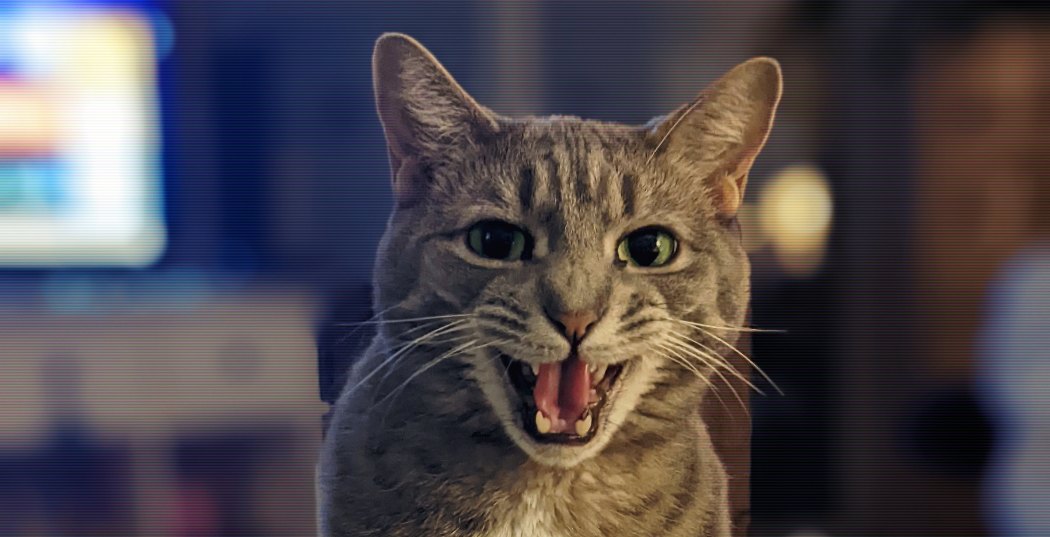
Last night I was in the kitchen looking for something, anything, to satisfy a sudden craving for sugar when Bud padded up and gave me one of the standard greetings in his Buddinese repertoire.
It’s just a “Hmmmmph!” in his high, Elmo-like voice, an acknowledgement that he sees me and he’s watching with interest, but without any of the typical demands or strong opinions attached.
“Hmmmmmph!” I replied.
“Hmmmmmph!” he said again, and we went back and forth until he stopped, tilted his head curiously, and gave me a look that said “Are you making fun of me again?”
I couldn’t help myself and busted out laughing, bending down to mess up the fur on top of his head as he rubbed up against my leg.
Of course I can’t actually prove that he understands our little exchange, but I know in my heart that he does. Sometimes he gets indignant when I laugh at him. Sometimes I get indignant when he gleefully smacks me or tries to chew on my glasses.
But mostly we laugh together, and he understands that human laughter is a happy sound, even when he’s deeply confused about what exactly I find so funny.
Will I ever have this kind of bond with another cat? I don’t know. It’s taken more than a decade to get here, a decade of being inseparable and understanding each other on a fundamental level.
But I’m not going to spoil it by spending too much time thinking about it. That would ruin the joke.
Cats and dogs communicate primarily by scent, touch and body language, but human efforts to understand them have focused exclusively on meows and barks. If we want to truly understand our non-human friends, we need to take an approach that considers the other ways animals “talk” to each other.
A few years ago when MeowTalk made a minor splash in the startup world, I was pretty bullish on its potential to help us understand our cats better.
Sure, the app had an unhelpful habit of attributing improbably loving declarations to Buddy, but I thought it would follow the trajectory of other machine learning models and drastically improve as it accumulated more data.
More users meant the app would record and analyze more meows, chirps and trills, meaning it was just a matter of time before the AI would be able to distinguish between an “I want attention!” meow and a “My bowl is dangerously close to empty!” meow.
Obviously that didn’t happen, and what I personally didn’t take into account back then — and should have, given how obvious it is in retrospect — is that cats don’t just communicate via vocalizations.
In fact, cats don’t normally incorporate vocalizations into communication at all. Pet kitties do it entirely for our benefit because they know we’re generally awful at interpreting body language and we are completely useless when it comes to olfactory information.
It’s actually amazing when you really think about how much of the heavy lifting cats do in our efforts to communicate with each other. They recognize we can’t communicate the way they do naturally, so they try to relate to us on our terms. In return, we meet them less than halfway.
No wonder Buddy sometimes looks frustrated as he meows at me, as if I’m the biggest moron in the world for not understanding the very obvious thing he’s trying to tell me.
“Human, how can you not understand the simple feeling of innerer schweinehund I’m trying to convey here? The cringe is killing me!”
Now the Chinese tech giant Baidu is throwing its hat into the ring after filing a patent in China for an AI system that uses machine learning to decode animal communication and “translate” it to human language.
Machines are designed to process things from a human viewpoint according to human logic, so if Baidu wants to succeed where MeowTalk has not, its engineers will need to take a thoughtful approach with the help of animal behavior experts.
This is a hard problem that encompasses animal cognition, neuroscience, linguistics, biology, biochemistry and even philosophy. If they approach this strictly as a tech challenge, they’ll set themselves up for failure.
Without the information and context clues provided by tails, whiskers, facial expressions, posture, eye dilation, heart rate, pheromones and even fur, an AI system is only getting a fraction of the information cats are trying to convey.
Trying to glean meaning from that is like trying to read a book in which only every fourth or fifth letter is legible. There’s just too much missing information.
Even if we can train machines to analyze sound visual, tactile and olfactory information, it may not be possible to truly translate what our cats are saying to us. We may have to settle for approximations. We’ve only begun to guess at how the world is interpreted differently among human beings thanks to things like qualia and neurodivergence, and the way cats and dogs see the world is undoubtedly more strange to us than the way a neurodivergent person might make sense of reality.
“He grimaced. He had drawn a greedy old character, a tough old male whose mind was full of slobbering thoughts of food, veritable oceans full of half-spoiled fish. Father Moontree had once said that he burped cod liver oil for weeks after drawing that particular glutton, so strongly had the telepathic image of fish impressed itself upon his mind. Yet the glutton was a glutton for danger as well as for fish. He had killed sixty-three Dragons, more than any other Partner in the service, and was quite literally worth his weight in gold.” – Cordwainer Smith, The Game of Rat and Dragon
An animal’s interpretation of reality may be so psychologically alien that most of its communication may be apples to oranges at best. Which is why I always loved Cordwainer Smith’s description of the feline mind as experienced via a technology that allows humans with special talents to share thoughts with cats in his classic short story, The Game of Rat and Dragon.
In the story, humans are a starfaring civilization and encounter a threat in the void between stars that people don’t have the reaction speed to deal with. Cats, however, are fast and swift enough, and with a neural bridge device, teams of humans paired with cats are able to keep passengers safe on interstellar journeys.
The narrator, who is one of the few people with an affinity for teaming up with felines, hopes he’ll be paired with one of his two favorite cats for his latest mission, but instead he’s assigned to partner with an old glutton of a tomcat whose mind was dominated by “slobbering thoughts of food, veritable oceans of half-spoiled fish.”
The narrator wryly notes that the last time one of his colleagues was paired with that particular cat, his burps tasted of fish for weeks afterward. But the cat in question, despite being obsessed with fish, is a badass at killing “dragons,” the human nickname for the bizarre entities that attack human ships in space. (The software that allows felines and humans to link thoughts also portrays the “dragons” as rodents in the minds of the cats, stimulating their ancient predatory drive so they’ll attack instantly when they see the enemy.)
We can’t know for sure if Smith’s interpretation of the feline mind is accurate, but another part rang true when he wrote that cat thoughts were all about the moment, filled with sentiments of warmth and affection, while they rapidly lost interest in thoughts about human concerns, dismissing them “as so much rubbish.”
If the mind of a cat is that relatable, we’ll be incredibly lucky. But in reality we’re dealing with animals who evolved in drastically different ecological niches, with different priorities, motivations, and ways of looking at the world — literally and figuratively.
That doesn’t mean we shouldn’t try to understand our furry friends. Research has yielded interesting information about the way animals like whales and elephants communicate, and AI is at its best when it augments human creativity and curiosity instead of trying to replace it.
Even if we don’t end up with a way to glean 1:1 translations, the prospect of improving our understanding of animal minds is tantalizing enough. We just need to make sure we’re listening to everything they’re saying, not just the meows.
A 23-second clip of a cat growling and yowling has become one of the most-used sound effects over the past three decades. The Guardian traced the clip back to the man who recorded it and got the full story.
We’ve all heard Cheeta the cat yowling, we just don’t know it.
Cheeta was a house cat who belonged to Wylie Stateman, a sound engineer who lives in LA.
In 1988, Stateman recorded an argument between Cheeta, a “remarkably small” half-Siamese void, and her mate, a tomcat named Sylvester.
The 23-second clip made it onto The Premiere Edition, a 20-CD library of sound effects Stateman produced in 1990.
Stateman, called “one of the great recorders of the time” by a colleague, told The Guardian he brought his sound recorder with him everywhere he went for three decades, recording thousands of sounds that have been used in movies for 35 years.
Buddy is also an accomplished sound effects cat.
Cheeta’s yowls are one of his greatest successes. The cranky cat can be heard in Toy Story, Home Alone 3, Les Miserables, Pet Sematary, 101 Dalmations, Venom: Let There Be Carnage, Babe, End of Days, How The Grinch Stole Christmas, and many more.
Although it’s difficult to get an exact count, it’s believed Cheeta’s distinct voice can be heard in some 330 films over the years. If you’re interested in learning more, check out The Guardian’s deep dive into the sound effect and its origins.
Buddy the Magnanimous
I went to visit my brother and his family in Washington this past week, leaving Buddy in the care of my mom.
Regular readers will recall that Bud has a bad reputation for trying to maul his cat sitters, which obviously complicates things.
The incorrigible little lunatic.
Sue, his regular sitter, has known Bud since he was a kitten. She’s literally one of the first humans he met, yet that has not stopped him from ambushing and attacking her. Incredibly, she still agrees to care for him in my absence despite his belligerence, though she’ll no longer play with him. She feeds him and gets out ASAP. I can’t blame her.
This time my mom cared for the little stinker. He’s also tried to murder her when she’s watched him on previous occasions, including one incident in which his bites and scratches necessitated a trip to urgent care and a round of antibiotics.
So yeah, the happy news is that he didn’t attack her this time, although she told me every time she came back, he’d be waiting right by the door, and when he saw it wasn’t me, he would sniff derisively before turning and padding away.
They have an uneasy truce, but I’ll take it. You know you have small dreams when you celebrate a trip in which your cat doesn’t try to maul anyone in your absence.
On a tangential note, I had a first phone interview with a wild cat conservation organization this week, and for the first time in a long time, Bud didn’t make a peep.
He’s meowed loudly during other phone interviews, he’s put his butt in front of the camera like it’s his job during video calls, and he won’t shut up at any other time, but the one time when having a cat might benefit me, he decides to be silent. Thanks, Bud. You’re the best.
First, thanks again to everyone for their well wishes and for advice on how to get a cat to take medication. I was finally able to get Bud to take his meds by crushing them and mixing them into a small amount of pate, so he had to take the meds in order to eat. When he ate the first small bit with the crushed medication, I added a little more food.
The little guy still isn’t eating much, especially compared to his usually bottomless appetite, but the fact that he is eating is an encouraging sign. I’m making sure he’s eating wet food and frequently replacing the water in his bowl so it’s fresh and he stays hydrated.
He has also vocalized a bit, which is very encouraging! He’s not offering the usual Buddesian play-by-play of his activities and he’s not yelling at me for snacks/better service/etc but I’ll take what I can get.
Today is very encouraging because he was still lethargic yesterday and he got sick again last night. Thankfully it was only once.
That’s about it. At times like this we all wish our cats could talk. Failing that, I’ll take a raised tail, a meow here and there, awareness and seeking affection/comfort.
Strangely, Buddy is still not really purring. I felt a small vibration at one point yesterday when I was scratching his head and talking to him, but nothing like the buzz of his usual purr. Hopefully that starts to come back too.
When he feels well enough to terrorize me again, I’ll throw a party!
A new AI algorithm promises to help you gauge your cat’s mood — and determine if she’s in pain — by analyzing facial expressions.
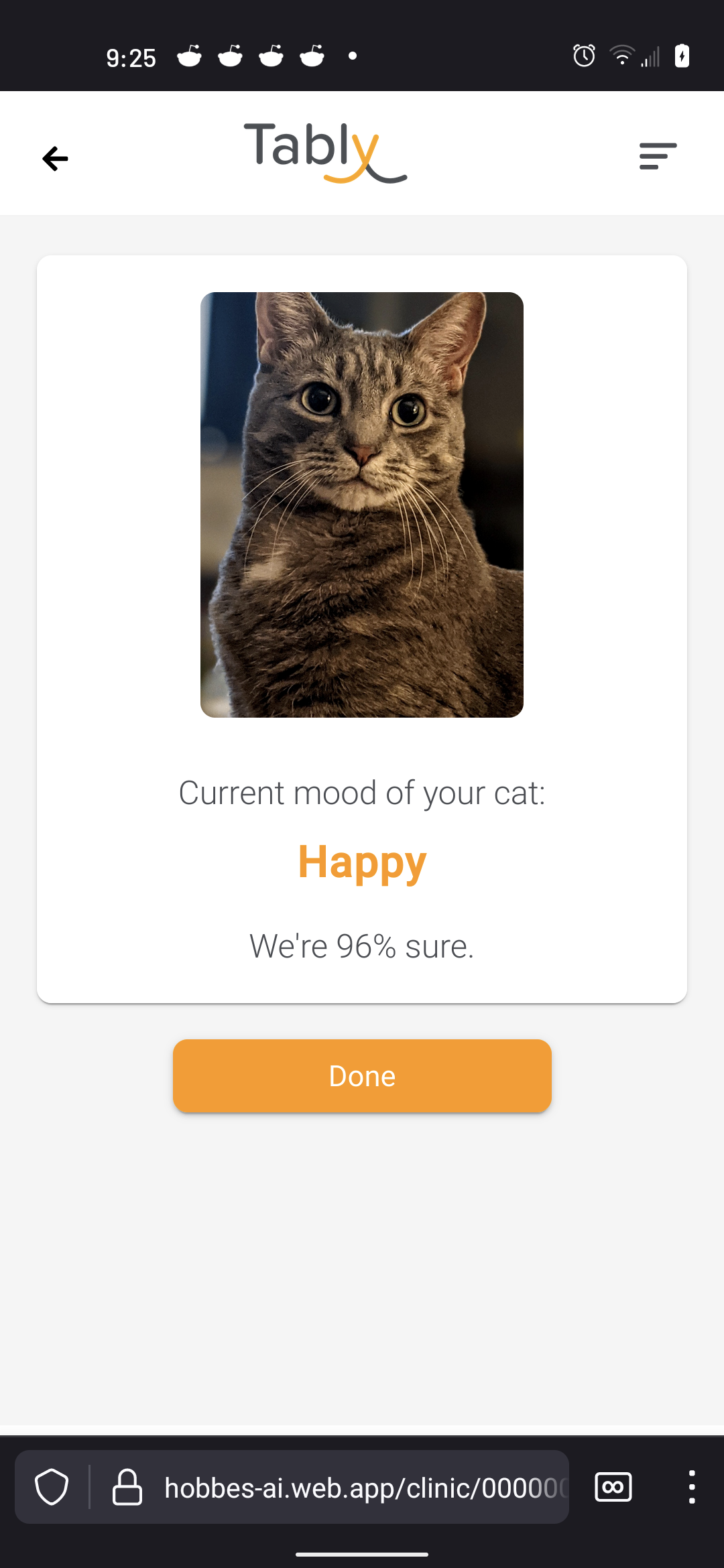
In the photograph, Buddy is sitting on the coffee table in the classic feline upright pose, tail resting to one side with a looping tip, looking directly at me.
The corners of his mouth curve up in what looks like a smile, his eyes are wide and attentive, and his whiskers are relaxed.
He looks to me like a happy cat.
Tably agrees: “Current mood of your cat: Happy. We’re 96% sure.”
Tably is a new app, currently in beta. Like MeowTalk, Tably uses machine learning and an algorithmic AI to determine a cat’s mood.
Unlike MeowTalk, which deals exclusively with feline vocalizations, Tably relies on technology similar to facial recognition software to map your cat’s face. It doesn’t try to reinvent the wheel when it comes to interpreting what facial expressions mean — it compares the cats it analyzes to the Feline Grimace Scale, a veterinary tool developed following years of research and first published as part of a peer-reviewed paper in 2019.
The Feline Grimace Scale analyzes a cat’s eyes, ears, whiskers, muzzle and overall facial expression to determine if the cat is happy, neutral, bothered by something minor, or in genuine pain.
It’s designed as an objective tool to evaluate cats, who are notoriously adept at hiding pain for evolutionary reasons. (A sick or injured cat is a much easier target for predators.)
But the Feline Grimace Scale is for veterinarians, not caretakers. It’s difficult to make any sense of it without training and experience.
That’s where Tably comes in: It makes the Feline Grimace Scale accessible to caretakers, giving us another tool to gauge our cats’ happiness and physical condition. With Tably we don’t have to go through years of veterinary training to glean information from our cats’ expressions, because the software is doing it for us.
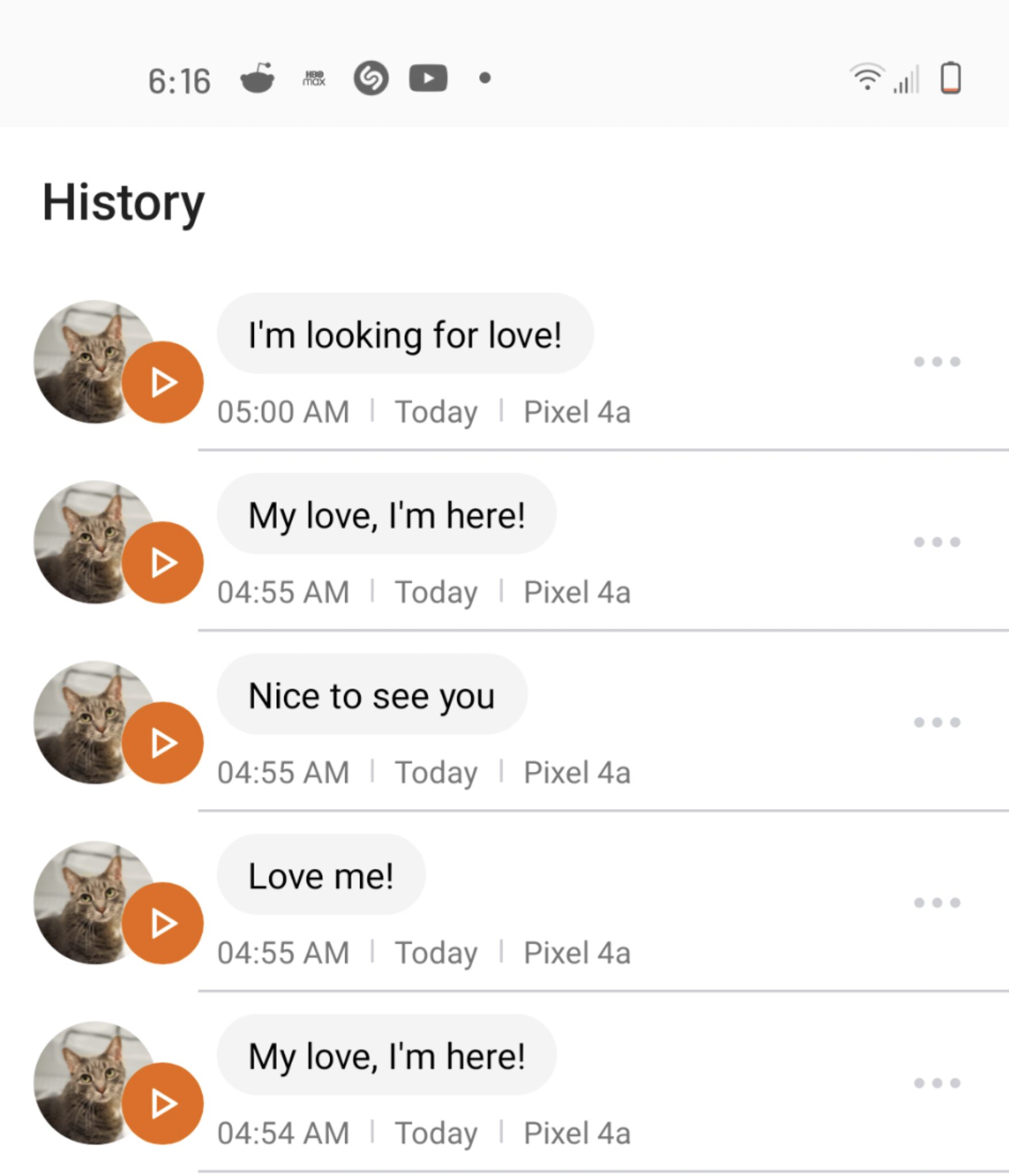
Meanwhile, I used MeowTalk early in the morning a few days ago when Buddy kept meowing insistently at me. When Bud wants something he tends to sound whiny, almost unhappy. Most of the time I can tell what he wants, but sometimes he seems frustrated that his slow human isn’t understanding him.
I had put down a fresh bowl of wet food and fresh water minutes earlier. His litter box was clean. He had time to relax on the balcony the previous night in addition to play time with his laser toy.
So what did Buddy want? Just some attention and affection, apparently:
I’m still not sure why Buddy apparently speaks in dialogue lifted from a cheesy romance novel, but I suppose the important thing is getting an accurate sense of his mood. 🙂
So with these tools now at our disposal, how much can artificial intelligence really tell us about our cats?
As always, there should be a disclaimer here: AI is a misnomer when it comes to machine learning algorithms, which are not actually intelligent.
It’s more accurate to think of these tools as software that learns to analyze a very specific kind of data and output it in a way that’s useful and makes sense to the end users. (In this case the end users are us cat servants.)
Like all machine learning algorithms, they must be “trained.” If you want your algorithm to read feline faces, you’ve got to feed it images of cats by the tens of thousands, hundreds of thousands or even by the millions. The more cat faces the software sees, the better it gets at recognizing when something looks off.
At this point, it’s difficult to say how much insight these tools provide. Personally I feel they’ve helped me understand my cat better, but I also realize it’s early days and this kind of software improves when more people use it, providing data and feedback. (Think of it like Waze, which works well because 140 million drivers have it enabled when they’re behind the wheel and feeding real-time data to the server.)
I was surprised when, in response to my earlier posts about MeowTalk and similar efforts, most of PITB’s readers didn’t seem to share the same enthusiasm.
And that, I think, is the key here: Managing expectations. When I downloaded Waze for the first time it had just launched and was pretty much useless. Months later, with a healthy user base, it became the best thing to happen to vehicle navigation since the first GPS units replaced those bulky maps we all relied on. Waze doesn’t just give you information — it analyzes real-time traffic data and finds alternate routes, taking you around construction zones, car accident scenes, clogged highways and congested shopping districts. Waze will even route you around unplowed or poorly plowed streets in a snowstorm.
If Tably and MeowTalk seem underwhelming to you, give them time. If enough of us embrace the technology, it will mature and we’ll have powerful new tools that not only help us find problems before they become serious, but also help us better understand our feline overlords — and strengthen the bonds we share with them.
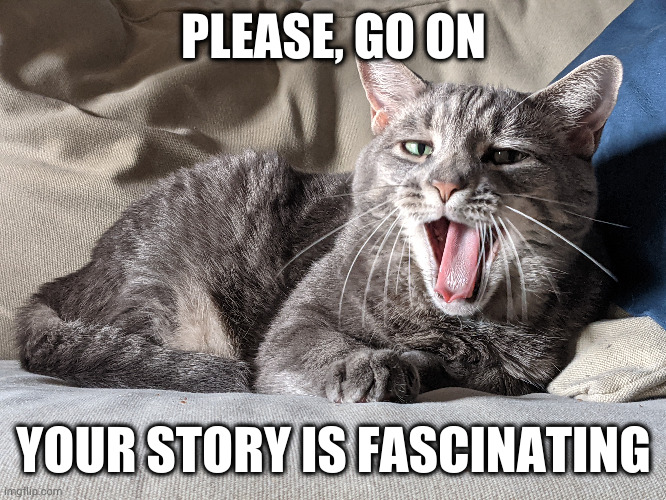
Buddy’s bored of all this AI talk and wants a snack.