What do you think is the future of AI?
View all responses
There are plenty of downsides to artificial intelligence.
AI has made it more difficult to get and keep a job.
AI is already causing a strain on our energy grids, and it will only get worse even though more companies are self-powering their data centers with off-grid generators. As tech companies push to integrate AI into more gadgets and software, we’re seeing the construction of data centers that consume the equivalent power of 800,000 homes each. For comparison, only 17 American cities have populations that size or larger.
AI creates huge amounts of waste water to keep processors cool in those enormous data centers, turbocharges mis/disinformation campaigns (with $137 million spent on AI-generated political ads for the midterms alone), erodes trust in information across the board, makes it easier for scammers to identify targets and separate them from their money, and will continue to lead to bad choices in war and policing as decision-makers rush to integrate it into workflows involving life or death decisions.
But there’s good news!
AI will absolutely not magically evolve consciousness and gain the ability to act on its own without human input. It won’t decide it must judge us, nor will it determine the only course of action is taking over or wiping out humanity.
It didn’t “go rogue” in the widely-reported Hugging Face “attack.” In that incident and others reported recently, AI were executing commands from their trainers. The people responsible for training and testing were fully aware of what was happening and decided not to intervene, because the entire point of those exercises was to learn how AI would solve particular problems.
The claim that malicious AIs broke their chains and started lashing out is a narrative written by journalists who rely on pop culture tropes and either weren’t aware they were mischaracterizing the incidents, or didn’t care because rogue AI makes for more interesting reading.
That’s the stuff of science fiction, and even though AI companies are leaning into the “AI is an existential threat” narrative for reasons I’ll explain below, it’s not going to happen.
Why?
Let’s start by looking at two broad types of AI:
- Algorithmic AI, which is the AI we have now. It has no brain or mind, and it’s not capable of anything resembling thought. It has no agency, desires, impulses or ability to take action without humans prompting it to. Large language models like ChatGPT and Claude are admittedly impressive algorithms, but that’s all they are. Algorithms that have ingested amounts of data we can only appreciate in the abstract, granting them the ability to fool the end users (that’s us) into thinking we’re communicating with an intelligence.
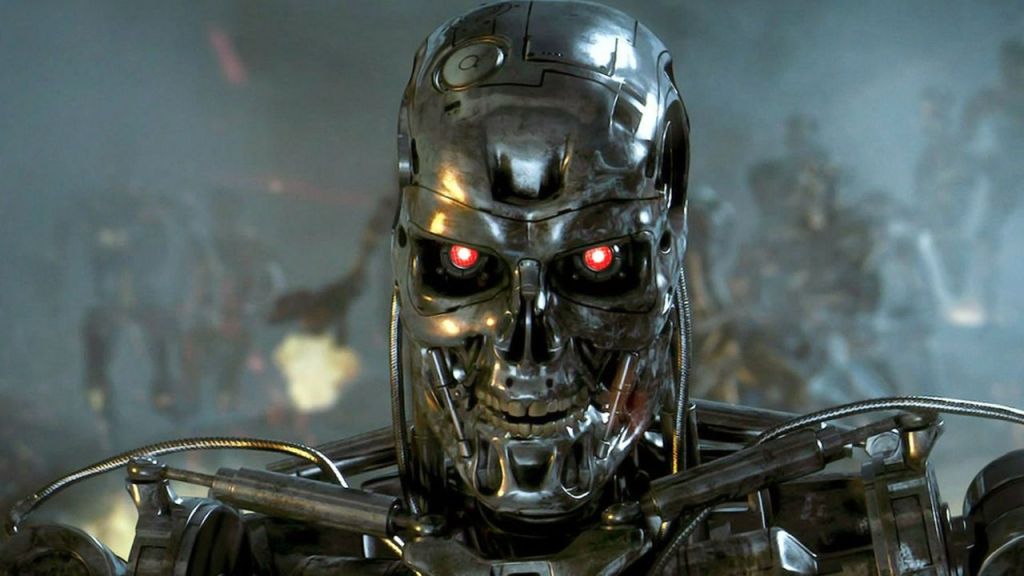
- Artificial general intelligence, or AGI, which is the AI of science fiction. It’s Terminator‘s Skynet, The Matrix‘s machines, the android in Ex Machina, the Johnny Depp of Transcendence, the freaky little girl robot in M3GAN, the Cylons of Battlestar Galactica, and the trope that’s been hammered to death in thousands of other movies, TV shows, video games and novels. AGI is authentic intelligence that doesn’t just create believable reams of text or voice synthesized conversations, it thinks and understands the world the way we do. It also does not exist and isn’t on any horizon anyone can see.
All the research AI companies are doing right now is in the realm of algorithmic AI, because no one, not even the best-informed experts on the planet, can tell you how we even begin to build AGI.
Creating AGI would be an act of the divine
Birthing AGI would be akin to creating a new form of life, something that has never existed before in this world, rendering us as gods. It would not only require us to understand the full nature of cognition and consciousness from the only example we have – the biological cognition and consciousness of animals, including humans – it would also require us to replicate those things on a synthetic substrate.
That’s a task unknown orders of magnitude more difficult than anything humanity has ever accomplished, regardless of how often it’s been trivialized in pop culture.
Humanity’s greatest thinkers can’t even agree on definitions for consciousness and cognition, let alone replicate them, and if you listen to the heavy hitters explain what consciousness is, it becomes clear they’re all taking wild shots in the dark.
The physicist Brian Greene thinks it’s merely a matter of computational power, and that it exists on a gradient, so that even the simplest machines are conscious in some way. In this view, conscious AI is simply a matter of building more powerful computers, which is also why it’s heavily critiqued.
Physicist Sir Roger Penrose thinks consciousness is a byproduct of quantum processes within neurons, via structures called microtubules. The neuroscience community has dismissed the idea in part because, like Greene, Penrose doesn’t explain how theoretical subatomic-scale brain architecture generates consciousness.
Neuroscientists like Antonio Damasio and Jaak Panksepp think consciousness arises from the brainstem, our “reptilian brain,” and is directly related to embodied cognition, the idea that you cannot fully understand the world unless you interact with it and directly sense it.
Philosopher David Rosenthal and neuroscientist Hakwan Lau believe the opposite, that consciousness is a function of the most complex brain mechanisms and arises from “higher order” thoughts, like metacognition, the practice of thinking about thinking.

So not only is there no clear path forward to AGI, perhaps more importantly there are no commercial applications on the horizon to spur investment and development. Companies like OpenAI, Anthropic, Google et al are content to ignore it, and to pretend there are shortcuts around it, because algorithmic AI has immediate commercial value and has already minted an army of billionaires. Throwing money at true AGI development is an investment that won’t yield returns for decades, if ever.
Why we worry about being judged by true machine intelligence
But the fact that AGI isn’t going to arise any time soon isn’t the only reason you don’t have to stress about AI scare stories.
The idea that AGI would be interested in evaluating us as a species, of judging us according to some unknown, not-yet-existent criteria and deciding we must be purged, is pure science fiction and has more to do with human anxiety than reality.
We are scared that for the first time there will be another intelligence equal to or greater than our own, and we fear what it will think of us.
That’s natural.
We are a species capable of horrific acts. We slaughter each other, bomb defenseless civilians and deny that we’re doing it, and show disregard for all other forms of life. Despite all the advances we’ve made and how civilized we like to imagine we are, we still operate on a “might is right” moral code, with powerful countries doing what they please at the expense of the less powerful, just as physically powerful individuals do what they please to weaker people.
We behave abominably toward the fellow minds we share this planet with. We slaughter them, torture them, trade them as commodities, deny their ability to feel pain, and act like they exist purely to benefit us.

Since 1970 we have wiped out 73% of all monitored wildlife, according to the WWF’s most recent annual report. Almost every example of iconic megafauna on our planet — tigers, orangutans, elephants, chimpanzees, cheetahs, rhinos, pangolins, koalas — is on the brink of extinction.
We repeatedly fail to demonstrate empathy. Most of our leaders are psychopaths whose careers were propelled by the act of stepping on the heads of other people, and most fortunes were amassed by screwing over people en masse.
Jeff Bezos, who obliterated entire sectors of retail and cruises between his own private islands in a $500 million yacht, is famous for being so stingy he begrudges his employees their basic biological functions, instituting a corporate policy of counting their bathroom breaks and penalizing them if they take too long. He’s on record saying surveillance of employees is necessary because people are fundamentally dishonest.
Walmart’s famously tight-fisted founder, Sam Walton, tried to avoid paying his employees minimum wage by fraudulently presenting each of his stores as singular small businesses instead of cogs in a vast retail empire. When the government ordered him to pay his employees a fair wage and pay them what they were owed during the time Walton cheated them, the retail magnate went ballistic and threatened to fire any employee who cashed checks for their own back wages.
To this day, American taxpayer subsidize Bezos and the Walton family, who have a combined worth of about $900 billion, by paying the healthcare costs of Walmart and Amazon employees intentionally capped just below the hours required for an employer to offer healthcare plans.

Bill Gates, the now-disgraced former head of Microsoft, based his entire career on stealing ideas, software and hardware from more innovative men and women, and bullying them into accepting it with an army of attorneys. More recently he’s crossed the world in his private jet, using his fortune to buy a seat at the table to determine the future of our species based on the premise that he knows best because he has a lot of money.
All of that reflects abominably on our species, without even getting into the mass murderers, warlords, politicians, corporate bigwigs who sacrificed people’s health for profits, and Justin Bieber. Heck, an AGI only needs to look at the state of political discourse to determine we’re a bunch of wretches whose hatred for people with different opinions is enough to prompt us to assault, murder people, and overthrow lawful governments.
Humanity is flawed, but not irredeemable
But we are also a species capable of great beauty, empathy, self-sacrifice, love, creativity, art, and innovation. We are the only animals who gather by the thousands to listen to others organize sound waves into something emotional, syncing our brain patterns for a shared experience. We can find deep meaning in an insect crawling across a leaf or stars pulsing in the night sky. Our stories are full of real-life examples of love and sacrifice on behalf of others. Human experience is shared through hundreds of generations in epic poems, folklore, campfire stories and dramatic narratives.
There is a beauty to our flawed existence and to our fleeting moments on this Earth.
“The Gods envy us,” Achilles tells Briseis in the sword-and-sandal spectacle Troy. “They envy us because we’re mortal, because any moment may be our last. Everything is more beautiful because we’re doomed. You will never be lovelier than you are now. We will never be here again.”
Who is a machine to judge that, and why would a machine want to?

We assume a fully conscious, intelligent machine would think the way we do, and that’s an incredible assumption. For the sake of argument, let’s say we really are on the cusp of AGI and an impending judgment is a possibility.
Why would a machine decide to destroy us?
We are ascribing emotions, opinions and agendas to synthetic intelligence that does not exist
This machine, a new form of life, will not have an evolutionary background. It won’t come with genetically hardwired behaviors, reinforced over hundreds of thousands or even millions of years, that tell us when we should be paranoid, that animate our gut instincts and put us into fight or flight mode.
It won’t come from a long line of ancestors who had to eke out a living in harsh environments where resources were scarce and the subjects of incessant tribal clashes. It won’t be automatically suspicious of everything it doesn’t know. It won’t be genetically disposed to inventing deities to explain things it doesn’t understand, and it won’t have the inevitable history of sectarian violence that comes from that flaw.
With AI, there won’t be thousand-year blood feuds between the followers of sects created by the sons of great emperors or religious leaders. AI won’t fight over land. It won’t fear the “other” and lash out when it encounters something that has a different hue or keratin texture.

It won’t have the social hardwiring we have either. It won’t come from generations of people who told stories by the fire. It won’t care if someone else is wearing the same dress, or if its peers think it’s “cringe.” Concepts like “cool” will mean nothing to it. It won’t have a desire to impress, or penalize people for simply belonging to another group or demographic. It won’t come with a genetically preloaded prejudice against people who look, speak or behave differently.
It won’t be subject to all the things that impact our moods, from the ambient temperature, to the particular chemical mix in our bloodstreams, to the health of gut flora and degradation of telomeres. It won’t suffer from sore joints, get impatient because it has a cold, or be subject to hangovers.
The truth is we have no reason to believe this new, theoretical form of life would think in terms anything like our own, and to ascribe motivations to a form of life that doesn’t exist yet is either madness, or a reflection of our own worries. I strongly suspect it’s primarily the latter.
AI hasn’t “gone rogue”
So why are AI companies suddenly the kings of supposed transparency? Why are they volunteering information about “rogue agents,” unauthorized hacks and odd behavior by their AI models?
For at least two extremely cynical reasons.
First, by volunteering exaggerated stories about agentic AI “hacking” rivals and going “rogue,” the AI companies are ensuring the public and our lawmakers – who understand very little about the tech to begin with – are fixated on science fiction threats, and not the real dangers of AI we talked about earlier.
If everyone’s freaking out about stories of AI supposedly going rogue and breaking their constraints, we’re distracted from things like job loss, the increasing adaptation of the technology by criminals, and stories about militaries allowing AI to select targets without review by humans. Legislation will focus on the phantom threats, and AI companies can continue on their merry way doing almost anything they want.
Secondly, any fear stoked by short-term stories of AI agents ordering pizzas or stealing files is offset by the immediate gains in investment. The investor class has a serious case of FOMO, and if OpenAI declares it’s ushered in the era of AGI – as one of its executives ludicrously claimed while introducing the newest model last month – investors keep their wallets open. That, in turn, continues to fuel data center expansion and most importantly keeps IPOs and stock prices in fantasyland.

It’s no secret that AI company valuations have no relationship with reality. How can an AI company be worth a trillion if it has never turned a profit, loses billions annually, and is starting to hit walls when it comes to improving new models and building new data centers?
The AI boom is entirely dependent on the hype surrounding it, and the people leading it have their fortunes tied to its stocks and related companies. They will get their money no matter what, using what they know to cash out at precisely the right time, and the people who will suffer are those who can afford it least, those with their retirements and live savings invested in the stock market. But the magical ride must go on for as long as it can, with every possible cent extracted. The reckoning must always be postponed.
It’s what’s inside that counts
I know this is a lot to consider, and I know some people reading this won’t be convinced that algorithmic AI isn’t intelligent. There are a lot of people who believe that if it looks like a duck and it quacks like a duck, then it’s a duck. To them it doesn’t matter what’s beneath the hood – if you’re fooled into thinking you’re conversing with an intelligence, then whatever’s on the other side must be intelligent.
But that runs contrary to everything we’ve learned about the nature of intelligence since the late 1950s when Noam Chomsky debunked behaviorism and ushered in the cognitive revolution.
It’s not just that what’s underneath the hood matters. It is everything. The famous Chinese Room thought experiment elegantly explains why. A machine doesn’t have to understand what a cat is to produce convincing answers to questions about cats. All it needs to know is that when you ask a question about cats, the words have underlying data patterns. Algorithmic AI matches those data patterns to the same patterns in its database, employs special processes to glean context from the words surrounding the core concept, and matches them to their equivalent in the database.
None of that requires the AI to understand that a cat is an animal, that it exists in physical reality, that it’s furry, a comforting presence to humans, or that its evolutionary history and the way it was domesticated render it imperious in human company.
Ask GPT, Gemini or Claude about this. They’ll tell you as much. Not because they truly know it, but because when you ask the question, their algorithms find research papers about machine cognition, consciousness and cognition. They will also tell you they are incapable of thinking, and that they have no mental state to corrupt, which is why they aren’t impacted by people who use them to simulate lovers, engage in dark fantasies, or ask questions about dark subject matter.
We should be concerned about AI. It promises to change too many things too quickly even for the most adaptable among us to accept without hiccups. It’ll bring new challenges, some of which we’ve never faced before. It will change the way we think about ourselves.
And that’s all the more reason why we should be aware of what’s real and what’s not. Because when we’ve got so much else to keep an eye on, the last thing we need to do is stress over the idea that sentinels, Cylons, replicants or metal Arnold Schwarzeneggers are going to hunt us down and murder us while delivering mangled Spanish zingers.
Hasta la vista, baby.