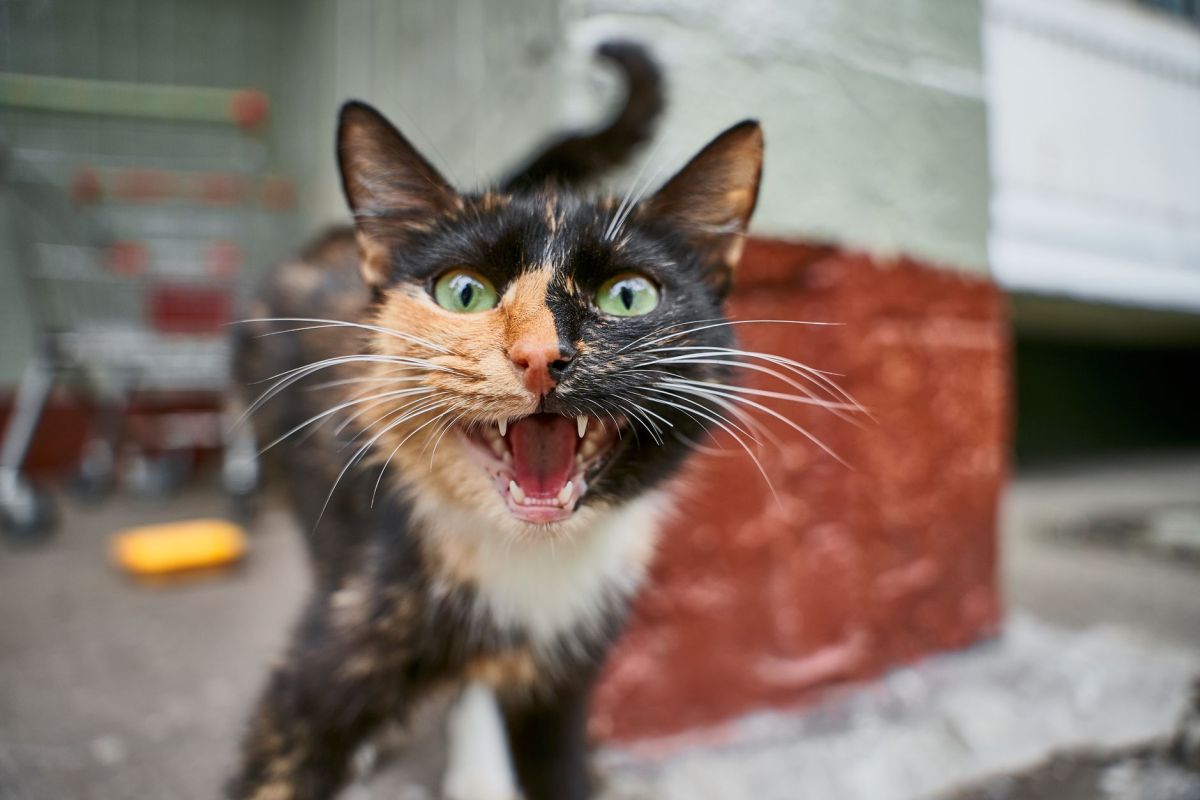
When my cat wants to play he faces me directly, at my level if possible, and leans forward, whiskers relaxed, before screeching at me at loud volume.
When he wants food he doesn’t bother with being level with me. He assumes an aggressive posture, follows me around and tries to get in my path, all before screeching at me at loud volume.
When yums are impending, he also screeches at loud volume, but his face and body language take on an anticipatory posture, and his tail pops straight up.
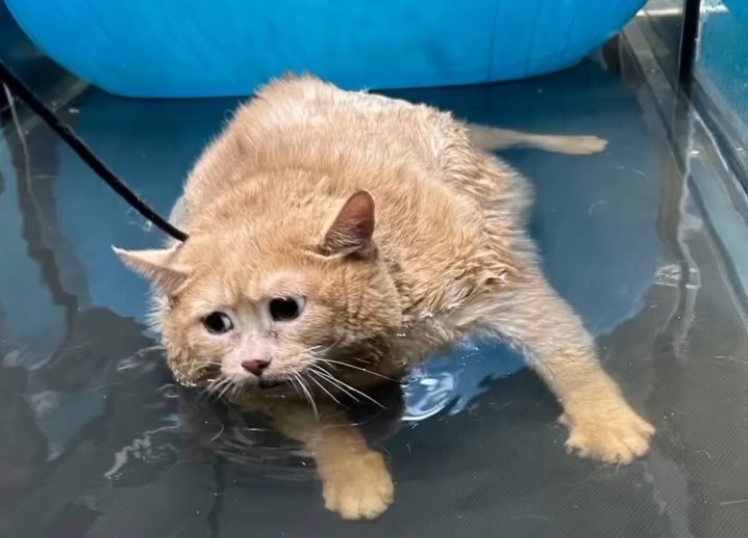
When he’s not feeling well, he screeches at loud volume and assumes a hunched stance, whiskers pulled back, ears at different angles, often with his tail wrapped protectively around his little body in a sort of uncomfortable version of the classic loaf.
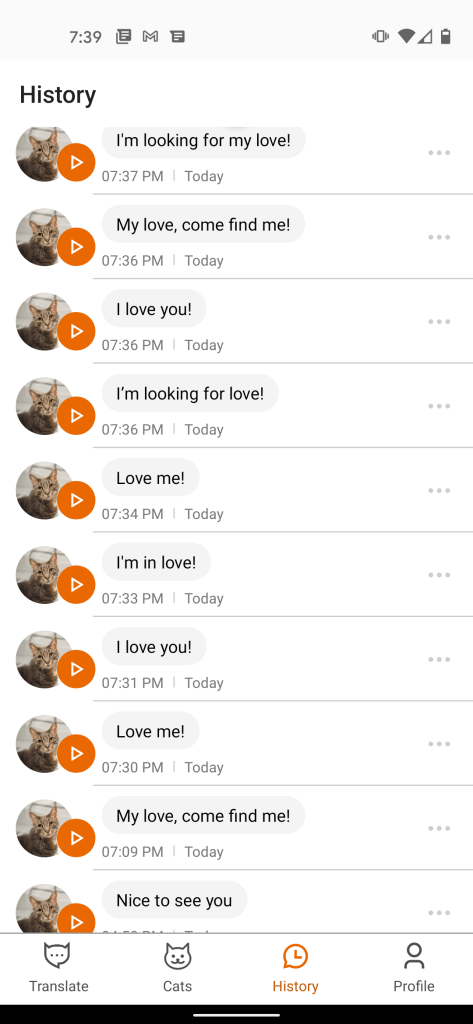
The common element is the loud screeching. An AI-powered app would have a very difficult time telling the difference between a “Feed me now, human!” screech and a “I want to play wand toy hunting games now, human!” screech, and probably wouldn’t fare much better with the “I don’t feel so good” screech. (MeowTalk did, after all, try to convince me that Buddy was serenading me with sweet nothings when he was demanding food.)
Years ago I was bullish about AI’s ability to translate meows. Given enough data, I reasoned, AI could crack the code. But that was a human way of thinking, anthropomorphizing my Bud into a furry little human whose “language” was limited to vocalizations.
It’s not.
No cat limits their communication to meows, trills and chirps, not even a vocal little dude like my Buddy.
Cat communication is multi-modal, consisting of general body language, whisker position, ear position, tail position and movement, pupil expression, fur rigidity, gait, scent-marking, scent-sharing, and for our exclusive benefit, meows. The latter are essentially a second language to them, adopted out of necessity because they realize we respond to vocalizations but are mostly oblivious to everything their tails, whiskers, fur, ears, tails, pheromones and eyes are telling us.
Now who’s supposed to be the intelligent species?
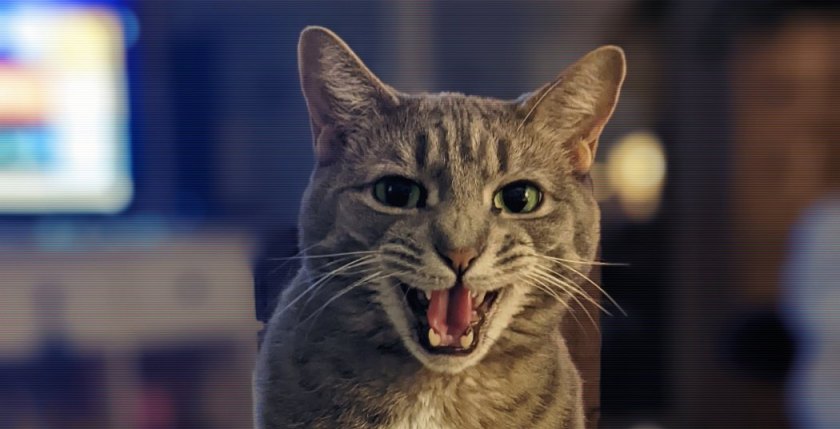
The fact that feline communication is inherently multi-modal is the reason why talking boards and AI meow translation apps do not work. It’s like using a version of Google translate that only interprets every seventh or eighth word, stripped of all context and tone. Actually, it’s worse than that.
If you’ve spent any time on Facebook, TikTok or Youtube, chances are you’ve come across cat talking boards. They’re even more useless than the AI apps that claim to translate meows because they not only assume feline communication is a single-channel affair, they also place additional burdens on felines, like understanding human language syntax (something no animal has ever been able to do) and highly abstract concepts.
How does a cat know a question is a request for information?
How does a cat understand temporal concepts represented as abstract sounds with nothing that ties those sounds – and the buttons that correspond to them – to concepts like “yesterday,” “tomorrow” and “later”?
In one video I viewed, a woman convinced herself that her cat’s random slapping of talking board buttons meant he wanted to discuss an animal he’d possibly seen outside a window the night before. The number of assumptions and logical leaps required to arrive at that kind of conclusion is staggering.
I want to be clear that I’m not saying studying animal communication is a futile effort. On the contrary, everything we’ve learned indicates animals – especially our domesticated companion animals and the most cognitively gifted wild species – are not only conscious and cognitive, but have rich inner lives with their own thought processes, opinions, emotions, likes and dislikes.
But cracking those codes is a serious effort that will involve a concerted effort to negate our human bias as much as possible, attempts to see the world from an animal’s perspective, and multi-modal analysis that doesn’t just consider what we can see, hear and smell, but what our pals’ sensoriums can detect.
After all, we know that cats can hear in frequencies we cannot, that they possess a sense of smell as much as 20 times more sensitive than ours. There’s ongoing research into whether animals can detect magnetic fields, and differences in vision — such as perceiving different color tones and a drastically increased sensitivity to motion — mean a very intentional means of communicating by our cat may require the equivalent of a bullhorn for us to pick up on what they’re “saying.”
One day we may learn that they consider us the dim-witted ones who cannot see, hear or smell the obvious. We may get to that point, but not through half-hearted, unscientific efforts like labeled buttons and simple algorithms.