Why Pet Talking Boards, Meow Translating Collars And Apps Don’t Work

Imagine using a version of Google translate that can only translate every seventh or eighth word without context or tone. Would it be useful at all?

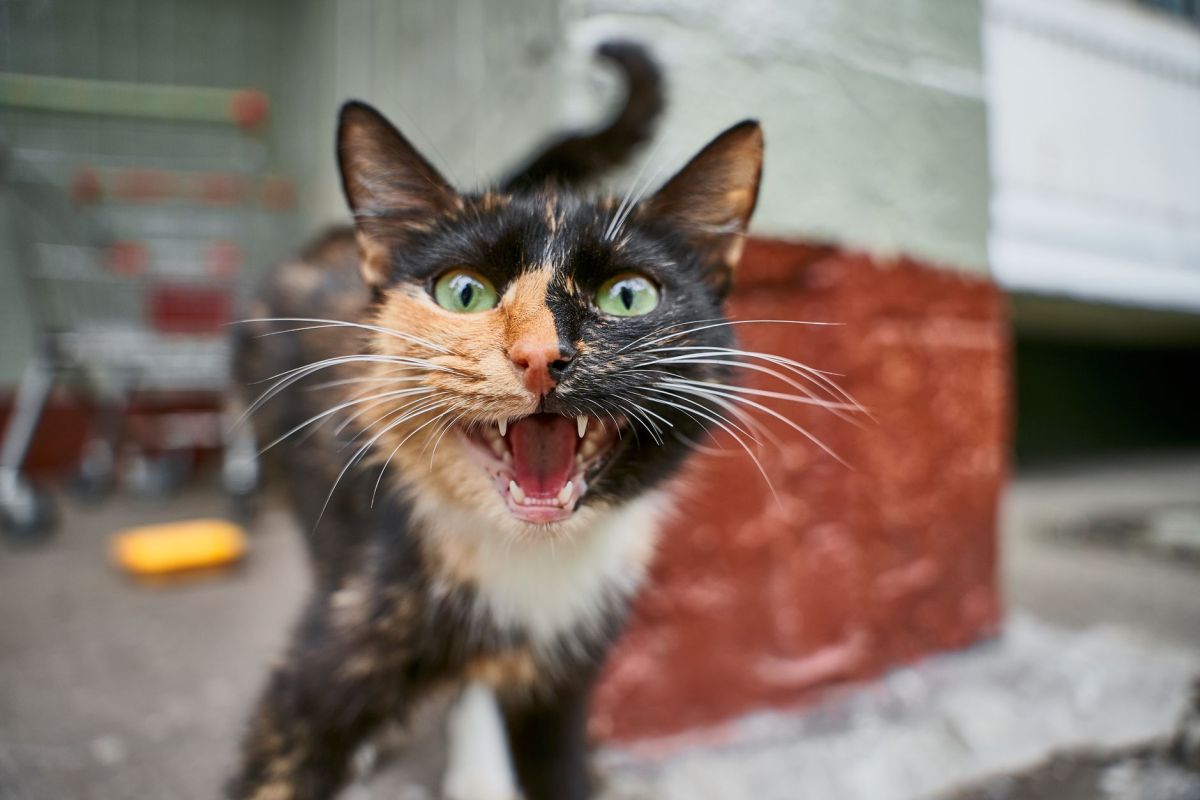
When my cat wants to play he faces me directly, at my level if possible, and leans forward, whiskers relaxed, before screeching at me at loud volume.

When he wants food he doesn’t bother with being level with me. He assumes an aggressive posture, follows me around and tries to get in my path, all before screeching at me at loud volume.

When yums are impending, he also screeches at loud volume, but his face and body language take on an anticipatory posture, and his tail pops straight up.

When he’s not feeling well, he screeches at loud volume and assumes a hunched stance, whiskers pulled back, ears at different angles, often with his tail wrapped protectively around his little body in a sort of uncomfortable version of the classic loaf.

The common element is the loud screeching. An AI-powered app would have a very difficult time telling the difference between a “Feed me now, human!” screech and a “I want to play wand toy hunting games now, human!” screech, and probably wouldn’t fare much better with the “I don’t feel so good” screech. (MeowTalk did, after all, try to convince me that Buddy was serenading me with sweet nothings when he was demanding food.)

Years ago I was bullish about AI’s ability to translate meows. Given enough data, I reasoned, AI could crack the code. But that was a human way of thinking, anthropomorphizing my Bud into a furry little human whose “language” was limited to vocalizations.

It’s not.

No cat limits their communication to meows, trills and chirps, not even a vocal little dude like my Buddy.

Cat communication is multi-modal, consisting of general body language, whisker position, ear position, tail position and movement, pupil expression, fur rigidity, gait, scent-marking, scent-sharing, and for our exclusive benefit, meows. The latter are essentially a second language to them, adopted out of necessity because they realize we respond to vocalizations but are mostly oblivious to everything their tails, whiskers, fur, ears, tails, pheromones and eyes are telling us.

Now who’s supposed to be the intelligent species?
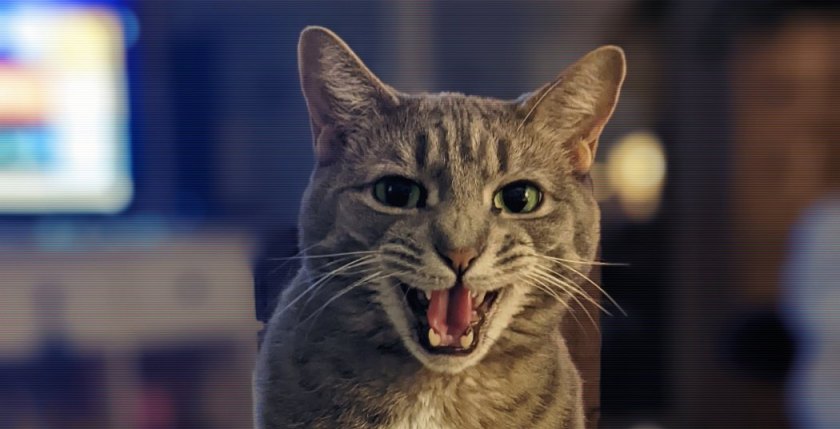
“Dude, why are you so dense? I’m shouting at you with my whiskers, my tail and my meows!”

The fact that feline communication is inherently multi-modal is the reason why talking boards and AI meow translation apps do not work. It’s like using a version of Google translate that only interprets every seventh or eighth word, stripped of all context and tone. Actually, it’s worse than that.

If you’ve spent any time on Facebook, TikTok or Youtube, chances are you’ve come across cat talking boards. They’re even more useless than the AI apps that claim to translate meows because they not only assume feline communication is a single-channel affair, they also place additional burdens on felines, like understanding human language syntax (something no animal has ever been able to do) and highly abstract concepts.

How does a cat know a question is a request for information?

How does a cat understand temporal concepts represented as abstract sounds with nothing that ties those sounds – and the buttons that correspond to them – to concepts like “yesterday,” “tomorrow” and “later”?
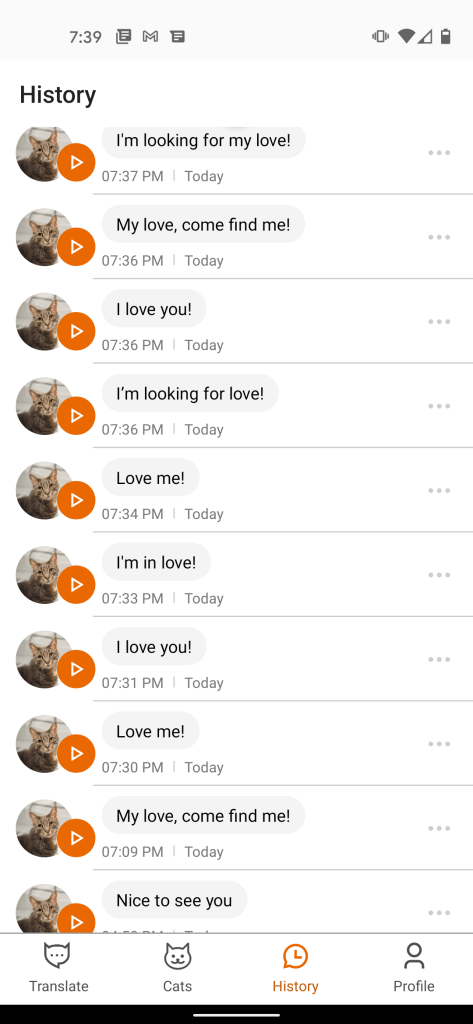
Hmmm, something’s off here…

In one video I viewed, a woman convinced herself that her cat’s random slapping of talking board buttons meant he wanted to discuss an animal he’d possibly seen outside a window the night before. The number of assumptions and logical leaps required to arrive at that kind of conclusion is staggering.

I want to be clear that I’m not saying studying animal communication is a futile effort. On the contrary, everything we’ve learned indicates animals – especially our domesticated companion animals and the most cognitively gifted wild species – are not only conscious and cognitive, but have rich inner lives with their own thought processes, opinions, emotions, likes and dislikes.

But cracking those codes is a serious effort that will involve a concerted effort to negate our human bias as much as possible, attempts to see the world from an animal’s perspective, and multi-modal analysis that doesn’t just consider what we can see, hear and smell, but what our pals’ sensoriums can detect.

After all, we know that cats can hear in frequencies we cannot, that they possess a sense of smell as much as 20 times more sensitive than ours. There’s ongoing research into whether animals can detect magnetic fields, and differences in vision — such as perceiving different color tones and a drastically increased sensitivity to motion — mean a very intentional means of communicating by our cat may require the equivalent of a bullhorn for us to pick up on what they’re “saying.”

One day we may learn that they consider us the dim-witted ones who cannot see, hear or smell the obvious. We may get to that point, but not through half-hearted, unscientific efforts like labeled buttons and simple algorithms.


Dear Buddy: Can Cats Sense Ghosts?

Buddy denies that he’s scared of stuff, and explains why some humans might fool themselves into believing kitties sense spirits.

Dear Buddy,

Can cats sense ghosts? My Mr. Cuddles sometimes stares at blank walls or gets up and starts zooming around the house for no apparent reason at 3 a.m.

I’m pretty sure he can see and sense ghosts. After all, what other explanation can there be for that kind of behavior? But since you’re the smartest cat in the world and an expert on everything, I thought I’d ask you first.

Thanks!

Ghost Believer in Great Britain


Dear Ghost Believer,

First I’d like to take the opportunity to set the record straight: I did NOT run screaming when I watched The Ring with my human, and I did NOT run to my litter box and cry when we watched Alien. Those are vicious lies invented by Los Gatos, the criminal catnip cartel, who will stop at nothing to discredit me. Now for the answer to your question:

According to Occam’s razor, “entities should not be multiplied beyond necessity.” Or to put it another way, “It is pointless to do with more what can be done with fewer.”

Consider, my friend, that the burden of proof rests with the person who claims ghosts exist. Not once in the history of humans — or cats — has anyone been able to provide legitimate evidence of the supernatural. In fact, the word supernatural itself precludes existence on the physical plane: If we can see it, hear it, smell it and feel it, it exists in the physical world, and therefore cannot be supernatural.

This is why, invariably, supernatural phenomena turn out to be things we just don’t understand yet, and by understanding them we remove all the mystery.

The sun isn’t a god riding a chariot across the sky, it’s a star and our world is caught in its orbit. Lightning isn’t an angry Zeus hurling bolts from Olympus, it’s an electrostatic discharge that produces a flash of extreme heat in the atmosphere, leading to a visible flash and a shockwave we call thunder. The Pythia at Delphi wasn’t an oracle who communed with the gods, she was just really, really high off gases that seeped up from a fault line beneath the temple.

Cat Zeus
“I am Cat Zeus! Fear me, for my lightning bolts are powerful and my epic beard is comprised of cats!”

So, too, do our odd feline behaviors have mundane explanations:

  • We can hear things you can’t hear. If you see us staring at blank walls, we’re probably engaged in deep thought (I like to ponder the Fermi paradox and quantum entanglement), or maybe we’re looking in the direction of a sound we can hear, but falls outside of your hearing range. (We felines can hear sounds up to 64,000 Hz, while your inferior human ears can’t catch anything above 20,000 Hz.) That means you may be oblivious to the mice chirping behind the wall, but we know all about them.
  • We can see things you can’t see. You think it’s pitch black? That’s cute. While you stumble around with your eyes useless in the dark, we can see just fine. In fact, even the tiniest sliver of light — an amount imperceptible to you — is enough for us to successfully navigate obstacles in a room or catch movement in our field of vision. You may think we’re pawing at invisible entities at bedtime, but really we’re just swatting flies in the dark.
  • We can feel micro-changes in air density. Our whiskers aren’t just about making us look good. They help us navigate tight spaces and they’re super-sensitive. How sensitive? They’re so packed with nerves and blood vessels at the base that they’re at least as sensitive as your fingertips! You can silently pass wind in the hallway and we’ll be aware of it in the bedroom as our whiskers register the tiniest shifts in air current. Your farts stink, by the way.
  • We can smell things you can’t smell. Speaking of stinky, did you know we have 200 million olfactory receptors? You humans only have five million. Who’s the superior species now, huh? You think we’re furry little wizards who can sense you coming home, or possess powers of precognition, but the truth is we just pick up your nasty Axe body spray from half a mile away. Ghosts don’t wear Axe body spray, or Curve, or Cool Water for that matter.

By now you should have noticed a common theme. You might have bigger brains than us because your heads are huge, but we know all about all sorts of good stuff happening around us while you humans remain oblivious to it. Heck, sometimes you don’t even see or hear things happening right in front of you because you’ve always got your faces buried in those stupid screens!

Buddy's Whiskers
Bud’s Whiskers: Stylish and functional!

If we did sense ghosts, you can be sure we’d meow at them for treats and demand they let us in the bathroom, but we don’t. Also, I personally wouldn’t be scared, but lesser cats might get freaked out if they see ghosts, and you’d know because they’d go all white and try to hide under the blankets.

Hope that clears things up!

Your friend,

Buddy