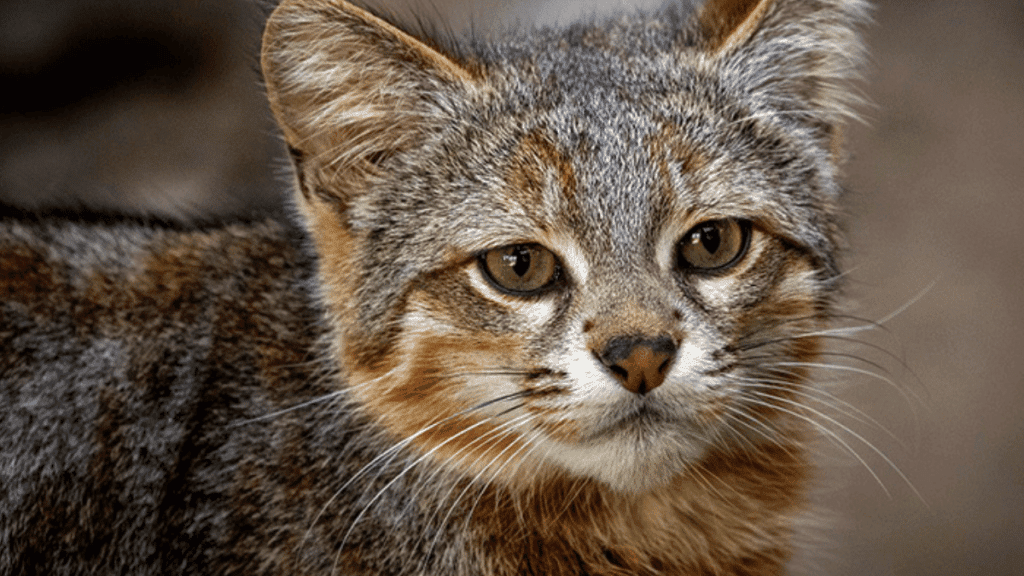
Amazing Cats: The Adorable Colocolo, Feline Of The Pampas

With a perpetual kitten-like appearance and mismatched coat patterns, colocolos may look like the product of AI or Photoshop, but these little ones are very real — and very feisty.

We’re heading back into obscure territory with this edition of Amazing Cats, focusing on a little-known species that ekes out an existence in the forests and plains of South America.

The colocolo, also known as the Pampas cat, superficially resembles the familiar house cat, but a closer look reveals some striking differences.

Colocolos are small, about the same size and weight as felis catus, but their tails can be quite a bit shorter and extremely fluffy.

Colocolo full
Colocolos have pattern and color combinations seen only in their species. This one has rosettes on his body and tabby stripes on his limbs and tail. Some colocolos have thick tails with tabby-like rings, while others have bushy tails more commonly associated with long haired domestic cat breeds.

There are at least five variations of fur color and pattern, ranging  from marbled to jaguaresque rosettes and, most strikingly, a seemingly mismatched pattern in which the legs have dark stripes over rusty/cinnamon-colored fur, which contrasts dramatically with the gray, gold, silver or tan of their bodies. The overall effect makes some colocolos look like they’ve been photoshopped, or assembled from spare parts.

Some colocolos appear to have solid-color coats which are actually an agouti pattern with barely visible bands of slightly darker fur.

While the species may look stocky, conservationists say it’s smaller than it appears, with its fur making up the majority of its “bulk.”

Colocolo color variant
This photo might look like a fake, but it’s a documented combination of coat pattern and color among colocolos.
Colocolo color variant
Another photograph of a colocolo with the rusty/cinnamon limb coloring.

As if that wasn’t enough to distinguish them, Pampas cats have neotenous features that give them an even stronger kittenlike appearance compared to house cats and comparable species like the rusty spotted cat.

In other words, they’re very cute and looking at them can trigger the same protective instincts we feel when we see kittens and cute adult cats. But don’t let their disarming features deceive you — these little guys are not cuddly, don’t respond well to people who get close, and will turn aggressive if you encroach on their space.

Cute colocolo
This adorable colocolo appears to be giving the side-eye to someone. Note the slight suggestion of the classic tabby “M” on the forehead.

While they’re alternately called the Pampas cat, the word “colocolo” comes from the language of the Mapuche, an indigenous group that lived in lands that are parts of modern day Chile and Argentina.

In the Mapuche language, Colo Colo was the name of a Mapuche warrior who led his people in their resistance against Spanish conquistadors in the 16th century, but it’s also the name of an evil rat-like creature in Mapuche folklore. It’s not clear how a feline came to bear the name, but the species — leopardus colocolo — is often called gato colocolo to distinguish between the historical figure and the modern-day Chilean football club, Colo-Colo.

Colocolo
You might feel an urge to hug a colocolo, but that would not be a good idea. Experts say the small cats don’t take kindly to close human proximity.

Although they’re associated with the pampa, the flatlands in and around Peru best known for the mysterious Nazca lines, colocolo are adaptable and thrive in forests, jungles, wetlands, and mountain ranges like the Andes, among other terrain.

Their range stretches from Argentina in the south through Chile, Bolivia, Paraguay, Ecuador, western Brazil and an isolated population in Uruguay.

Despite their relatively wide distribution and variety of habitat, colocolos are not well understood. Experts still haven’t settled the question of whether they’re all one species or whether subgroups qualify as their own subspecies. Their hunting habits are not well-documented, although it’s known they prefer small rodents, and there is ongoing debate about whether they are crepuscular, like most felid species, or nocturnal.

Colocolo share a continent with jaguars, pumas, ocelot, jaguarundi, margay, oncilla, kodkod, Geoffrey’s cat and the Andean cat, and the fact that they live in the deep wilderness makes them more difficult to study.

Because their coloration and coat patterns can vary so widely, Pampas cats are often mistaken for other small wildcats living in South America, and people unfamiliar with their species sometimes mistake them for domestic felines.

They’re also very rare in zoos, with only one US zoo (Cincinnati) counting them among their exhibits, and only four Pampas cats in captivity worldwide. (Excluding private captivity by poachers and illegal wildlife traders.)

Like virtually every species of wildcat, the colocolo’s numbers are declining due to a number of factors, primarily human activity like habitat destruction, sport hunting and development cutting populations off from each other.

The more people are aware of these beautiful and little-known felines, the better their chances for long term survival as conservation groups receive more donations to help protect them, and lawmakers are pressured to protect the wilderness where they live.

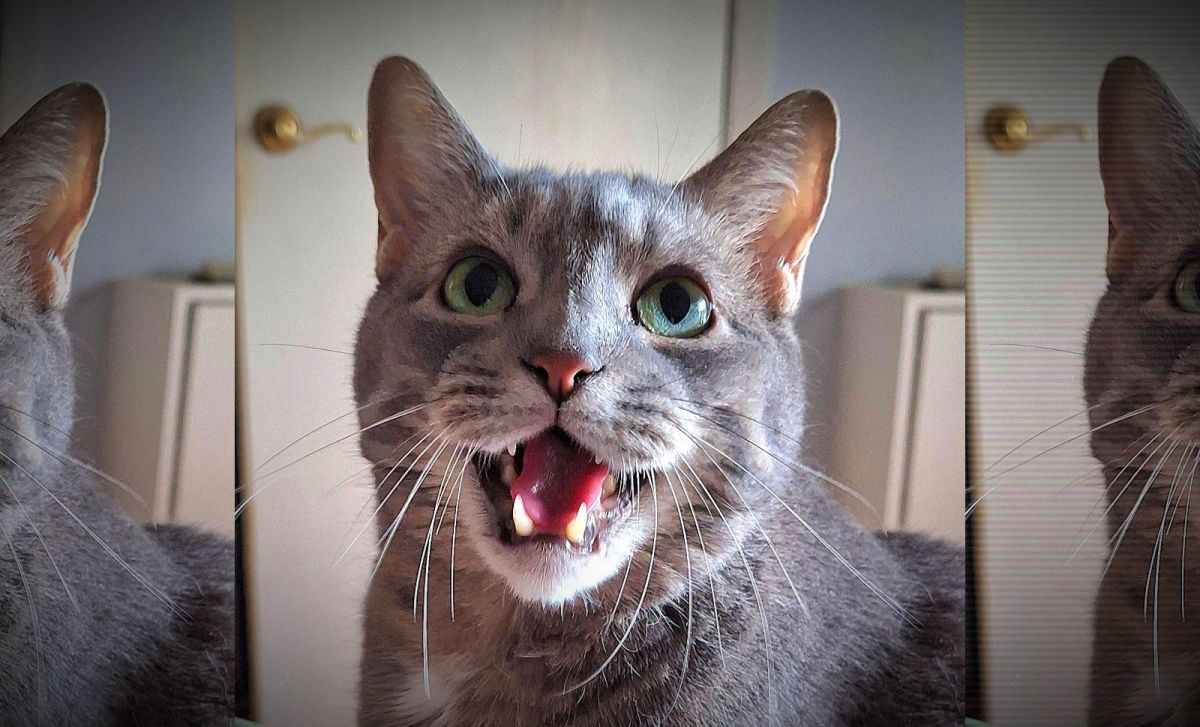
Yawning colocolo
Like all cats, colocolos appreciate the value of a nice nap.

Previously:

Amazing Cats: The Mysterious Marbled Cat
Amazing Cats: The Rusty-Spotted Cat
Amazing Cats: ‘He Who Kills With One Bound’
Amazing Cats: The Puma
Amazing Cats: The Sunda Clouded Leopard

10 Ways To Celebrate International Cat Day, According To Buddy The Cat

It’s International Cat Day, which means you should totally do awesome stuff for your cat.

Hello there, PITB readers! I have taken over the blog from my inept human on this most auspicious of days, International Cat Day, to offer some great suggestions on how to honor your feline overlord!

Let’s get right into it, shall we?

10) Human snacks: Let’s be serious here for a moment. I’m sick of getting the same old crunchy treats, meaty sticks, soft Buddy Biscuits, Churus and party mix. I want cheese! I want filet mignon! I want roast turkey! I want a cheeseburger! Day after day we have to sit here, our mouths watering as you humans stuff your faces with all sorts of food we would love to eat. Well, today’s the day. Start cookin’, servants!

closeup of delicious double patty cheeseburger
Yes! More cheese, hold the lettuce and tomatoes. Credit: Juan Santos/Pexels

9) Roombas. That’s right. It’s 2024 and I still don’t have a Roomba. I’m very angry about that. When do I get my mighty steed? Let it be today!

8) Catnip and silvervine. Sure, we get these on other days, but this day absolutely must not go by without you giving us at least a few doses of the good stuff. Hurry up! I need to get my fix!

7) Sweet cat drip that shows you’re owned by a cat. My Big Buddy just got two t-shirts. One shows a roaring jaguar with the word “Savage,” because I am savage, and the other is a kitty samurai with a cool sword. Aside from the fact that this is premium drip, everyone will know that you answer to a fluffy, benevolent overlord back home. That’s what’s important.

savage
The drip.

6) A throne. I’ve wanted a throne since I was a kitten. It doesn’t need to be an Iron Throne with the melted swords of everyone I’ve conquered, a la Game of Thrones. It can be something humble, made of gilded metal, velvet cushions and maybe a lion crest or cool tiger heads on the paw rests. I’m not picky as long as it looks awesome. What’s important is the symbolism and comfort.

5) Hire a mariachi band to parade through the streets hoisting an image of your cat, performing songs in your feline overlord’s honor. This is another humble offering that says “I serve a cat, and I’m proud of it!” When people ask what the hell is going on, hand them Cuban cigars and say “We are celebrating el jefe!” They’ll know who you mean.

Mariachi band
“We sing of the great, wise, handsome and meowscular Buddy the Cat!”

4) Hire a portraitist to paint your kitty. Again, it doesn’t have to be extravagant. As a humble cat, I don’t mind being portrayed as a naval commodore, a king, a great warrior of world renown, or a massive tiger. The important thing is that it looks cool and you hang the picture above the couch in the living room. Get on it, human.

3) Massages. Schedule them throughout the day, sprinkling them around naps and meal times. Do you know how satisfying it is to enjoy a nice massage after Food O’Clock? I like to have my chin rubbed and the top of my head scratched while being told what a good, handsome, awesome, amazing, handsome, meowscular feline I am.

2) Toys. Not just for Christmas, you know. In fact, go ahead and consider this Kitty Christmas In Summer. Wand toys, track toys, new boxes, those little plastic ring things from milk gallon containers, stuffed animals that we can hunt and murder like the apex predators we are. You don’t have to wrap them, just bend the knee and present them as tribute. You’ll have our thanks, and our favor.

superhandsomebuddy1

1)Hang out with us! It really is that simple. The most important thing you can do on International Cat Day is spend time with your cat! Many of the above suggestions fall under this category, including playing with us, giving us massages and reading epic poems you’ve composed about us. Personally I like settling down to nap on top of my Big Buddy after a massage. There’s something about having my chin scratched that makes me start yawning, and there’s no better place to nap than on my human, where it’s safe and there’s body heat and he can’t get up to use the bathroom because it would disturb me. That’s love.

I hope these suggestions are helpful! I’ve tried to list really easy, basic, humble stuff, but if you feel like constructing a 426-room cardboard box castle, well, I won’t stop you. In fact, that would be pretty cool. But like I said, the most important thing is that we get to hang out with you. And eat filet mignon.

Buddy Scores Meowscular Victory Over Vakuum, That Infernal Machine

Vakuum, the terror of many a cat, was put on notice by Buddy’s display of astonishing bravery. If AI and robots ever try to take over the Earth, Buddy is a natural choice to lead the combined armies of cats and men to victory over the machines.

NEW YORK — Buddy the Cat was particularly pleased with himself on Thursday after he successfully scared off one of his mortal enemies by using his powerful roar.

The gray tabby cat had just finished his second Food O’Clock meal of the day and was settling down for 5th Nap when the infernal machine known as Vakuum the Disturberizer encroached upon the Buddesian domicile and began its high-pitched shriek.

While previously he’d hiss at the accursed machine and retreat to the safety of the bedroom, Buddy decided to put his paw down, sources said. It was time to make a stand.

buddyvsvacuum
The heroic sequence of events that led to Vakuum beating a hasty retreat.

Rising up to his full height of almost a foot, Buddy let loose a mighty, blood-curdling roar — and was shocked when Vakuum immediately stopped making its pestiferous racket.

“That machine took one look at me and decided it didn’t want a piece of this,” Buddy said, his primordial pouch jiggling as he flexed. “It helps to be a meowscular and intimidating cat, you know. We jaguars are quite ferocious when we need to be.”

A spokescat for the Yguara Nation of the Americas confirmed that while Buddy is an honorary jaguar and was bestowed the name Kinich Bajo, meaning “Tiny Sun-Eyed One,” he is not in fact an actual jaguar.

Buddy Terrorizes Block With Reluctant Jaguar Pal

With some muscle to back him up, Buddy the Cat becomes the scourge of the neighborhood.

NEW YORK — Taking refuge from the heat of an unusually humid early June day, cats and dogs alike were gathered around the neighborhood’s most popular watering hole when their quiet lapping was disturbed by a kittenish, falsetto-like meow.

“Coming through!” Buddy the Cat yelled. “Make way!”

The silver tabby ordered everyone to “vacate the premises,” declaring the water his “personal drinking spot.” One of the toughest cats on the block, a battle-scarred orange tom named Buster, continued drinking.

“Ahem!” Buddy said loudly. “Perhaps you didn’t hear me. Vacate the pond, Buster!”

Buster eyed Buddy derisively. “Or else what, pip squeak?”

Buddy pretended to file his claws nonchalantly.

“Or else my jaguar is not going to be happy,” Buddy replied.

Buster began laughing, then caught sight of the enormous apex predator and backed up warily.

“That’s right!” Buddy said. “Back up if you don’t want to become a light snack, Buster!”

Ek B’alam, Buddy’s jaguar friend, raised a paw sheepishly.

“Um, do we have to threaten violence? I’m not interested in hurting…”

“Shhhh! Yes, yes we do have to threaten them!” Buddy whispered. “Let’s see that intimidating pose you do…great, now roar!”

The jaguar let loose a primal rumble, sending every cat, dog, bird and squirrel within a mile running for cover.

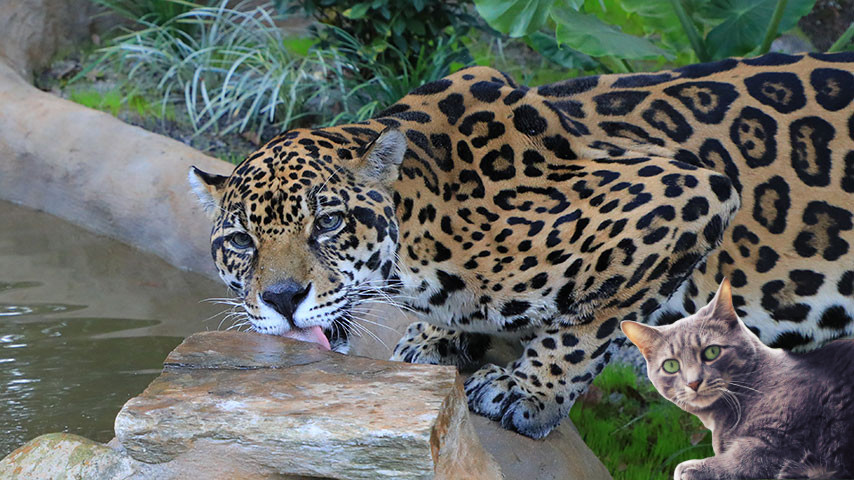
Buddy and Ek B'alam
Buddy and Ek B’alam enjoying a prime drinking spot after bullying its previous occupants.

After enjoying a leisurely drink with the pond to themselves, Buddy and Ek B’alam took a lazy route to a nearby dog park where the pair terrorized a pitbull and a gang of Dobermans.

Witnesses said Buddy strolled into the Doberman circle, needled the dogs with insults and told them they’d have to hand over their treats promptly or face dire consequences.

“Oh yea?” the canine leader said, his tail twitching with anticipation. “Says who?”

“Says my jaguar!” Buddy said theatrically, holding both paws out like a magician.

The dogs paused, looked at each other and laughed uproariously.

“Get outta here, you pudgy little…oh! Oh! He’s really got a jag…I mean, I d-d-didn’t…”

Buddy feigned indifference as Ek B’alam padded out from behind a tree. The dogs emptied their bladders.

“You were saying something about me being pudgy, weren’t you? We don’t like insulting little mutts, do we, Ek B’alam?”

“No, we do not, Buddy,” the big cat replied.

“Sometimes we eat them for breakfast, don’t we, Ek B’alam?”

“Yes we do, Buddy. Better than bacon and eggs, with an agreeable aftertaste!”

The dogs whimpered, tails between their legs.

“Leave your toys and treats and scram!” Buddy said, making the canines flinch as he faked a leap toward them.

“You were right, this is kinda fun!” Ek B’alam said as he ate the dogs’ snacks. “Who do we terrorize next?”

Buddy rested his chin on his right paw thoughtfully.

“We could rob Los Gatos of every ounce of catnip they possess. We could put the fear of God into those ‘hunters’ who shoot at our puma buddies. I also have a revenge list of everyone who ever insulted me on the internet. That could be fun!”

As of late Tuesday night, local police scanner frequencies were buzzing with reports of two cats, one small and the other enormous, gleefully tearing apart industrial vacuum cleaners at a nearby Stanley Steemer shop.

DNA From Dead Sheep In UK Matches Big Cats, But Is That Proof Of Their Presence?

Rumors of big cats in the UK countryside have persisted for years, with witness claims from all over the country. The latest reported sighting was in northern England.

People who really want to believe big cats are running around the British countryside are ecstatic with the news that a DNA sample from a dead sheep reportedly tested positive for panthera DNA.

The DNA sample was swabbed from a freshly-killed sheep carcass “at an undisclosed upland location” in Cumbria, northwest England, a witness told BBC Wildlife. It’s exactly the kind of countryside where people have been reporting big cat sightings for years, although the sightings aren’t confined to that area, with other witnesses claiming they’ve seen large felids as far as the UK’s southern coast.

Sharon Larkin-Snowden, who lives nearby, told a big cat enthusiast podcaster that she disturbed the “big cat” while it was feeding. The startled felid took off and jumped a stone wall, leaving the partially-eaten sheep, Larkin-Snowden said.

“I assumed at first it was a sheepdog, but then I did a double take and realised it was a black cat,” she said. “It was big – the size of a German shepherd dog.”

Jaguar in a pub
“I could really go for a Chinese! Anyone else wanna go for a Chinese?”

A swab was collected — the details are sketchy on who did the collecting and when exactly they submitted the sample — and sent to the University of Warwick’s Robin Allaby, a professor of life sciences.

Allaby, whose specialty is studying the genetics and evolution of domesticated plants, began offering a DNA testing service for the public some 12 years ago in response to the persistent rumors of big cats in the countryside. In the past samples have yielded DNA from foxes and other animals, but Allaby says this one matched the genetic profile of a big cat, although he cannot say which species.

It’s not unusual for a DNA sample to match to a genus, in this case panthera, but not to a specific species if the sample was degraded or only partial.

Rick Minter, who has made a career of tracking alleged big cat sightings across the UK, says he believes the mystery cat is a leopard. Leopards and jaguars are the only two big cats who have true melanistic color morphs — meaning some of them have virtually all-black coats — and Minter says he believes it’s more likely the former.

Neither are native to the UK or Europe: Leopards range from Africa to Asia, while jaguars range from south to Central America, with some populations edging slightly into the US.

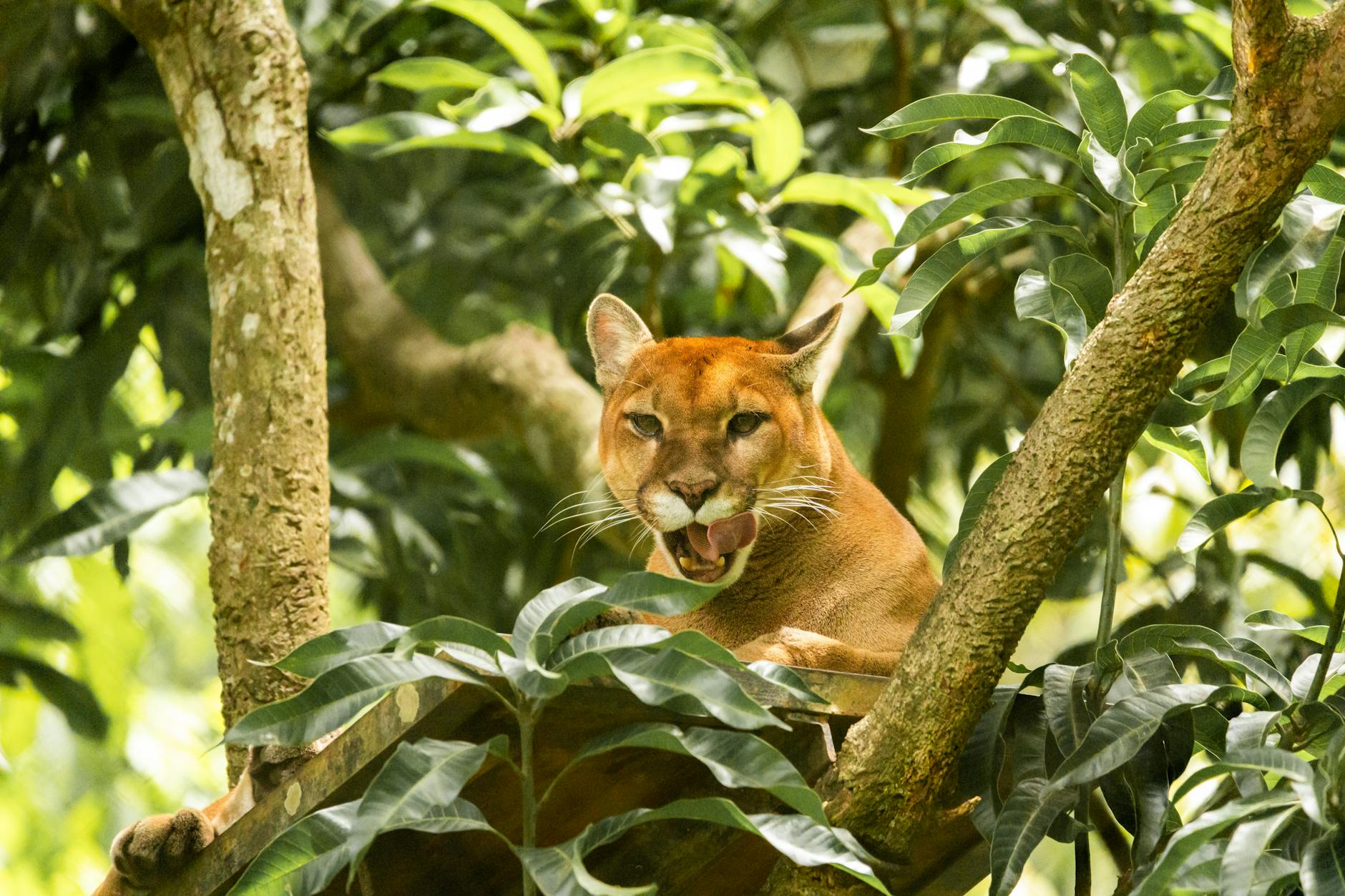
puma sits on tree
Britain’s big cat enthusiasts say they believe pumas are among the wild cats living in Credit: Jean Paul Montanaro/Pexels

Why isn’t a DNA match evidence of big cats in the UK?

If the lab results say the sample came from a big cat and that result is consistent with the witness account, what’s the problem?

Chain of custody, for one. We don’t know anything about who took the sample, where it was taken, the time elapsed between the kill and the sample swab, or who may have handled it before it reached Allaby.

In fact, we don’t know if there was a dead sheep to begin with.

If I were a prankster living in the UK, for example, and was friendly with a keeper at a local zoo, I could have the keeper swab an animal, bag it and hand it over to me. There are dozens of conceivable ways a person could obtain a sample even if they don’t know someone who works in a zoo.

Leopard in a pub
“So we left the sheep there at the edge of the field and made sure the lady saw us before we buggered off over the fence. Next day, we was in all the papers! A right laugh that was, mate.”

The problem is the provenance of the sample and what happens to it between the time it’s collected and ends up in the hands of a scientist like Allaby.

This is why chain of custody is paramount in criminal trials, and why there must be a complete record of who handled samples from collection in the field to the lab. Even in the absence of foul play, an improperly handled sample can be contaminated and render test results meaningless.

It’s not a matter of trust, it’s the simple fact that extraordinary claims require extraordary evidence, as Carl Sagan was fond of saying. Short of capturing one of these animals or getting clear, indisputable footage, any other claimed proof has to be ironclad.

Speaking of footage, that’s another issue. It’s extremely difficult to believe that a breeding population of big cats can exist in the UK countryside for years or even decades without a single definitive photo or video. The UK’s rural areas may not be blanketed by CCTV cameras like London, but they’re not the Amazon either. People live, work and farm in those regions, cameras are more ubiquitous than ever, and farmers take steps to protect their livestock, including installing cameras.

Big cats don’t just feed and vanish into the mist. They mark trees with their claws and urine, they leave distinct pug marks, they leave distinctive bite marks on their prey, and they make noise. To paraphrase one naturalist, when big cats are living nearby, you know it. Even if you don’t see them, signs of their presence are ubiquitous.

To accept the claims of tigers, leopards and pumas gallavanting in the fields around small towns and villages, we’d have to suspend disbelief or conclude that these are some sort of previously unknown ghost cats who can fade in and out of the physical plane.

I’m not a skeptic to be a killjoy. If big cats really were running around the UK, that would be a hell of a story. But we’d still need convincing evidence, and this isn’t it.