An old enemy lies in wait in the far reaches of the galaxy, ready to exact revenge on the most dashing, clever and dashingly clever captain in Starfleet!
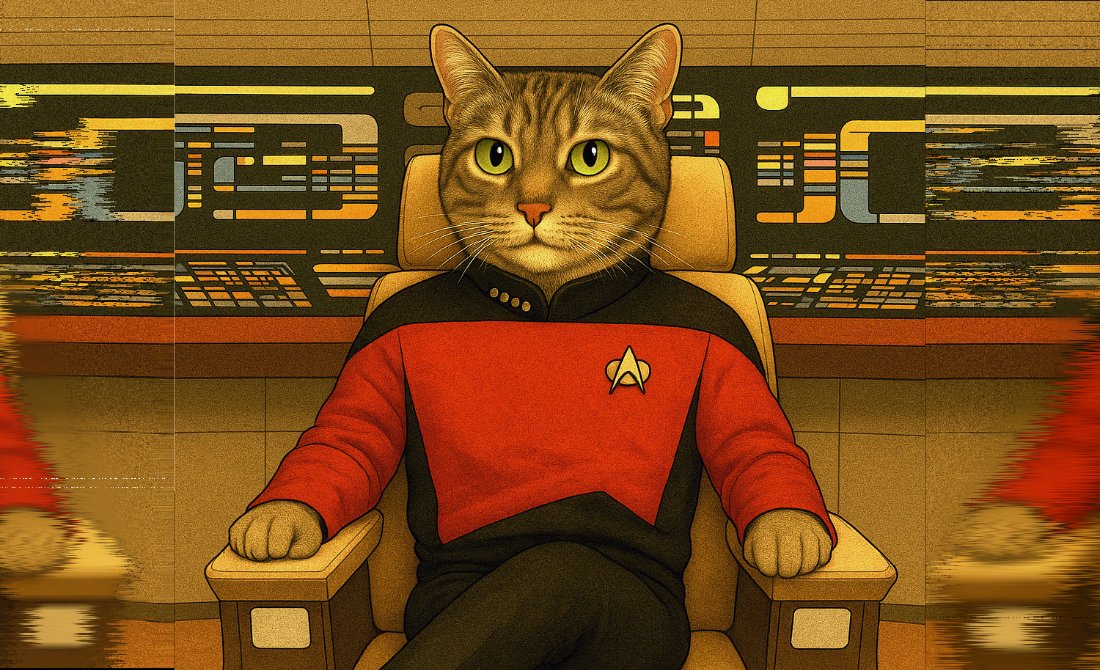
ALPHA QUADRANT, Milky Way Galaxy — Captain Buddy is back for his most thrilling, treacherous and scrumptious adventure yet!
As the commanding officer of the USS Fowl Play and a legend within the galactic community, Captain Buddy and his trusty crew get the call to investigate reports of the malevolent Borg raiding colonies on the edge of Federation space.
Our intrepid captain arrives just in time to fend off a Borg cube attacking Dawn’s Edge, one of the largest colonies on the Felinian Rim. After mounting a heroic defense and defeating the diabolical enemy spacecraft, brave Captain Buddy discovers the Borg weren’t just trying to assimilate the peaceful Caitians living in the colony: they were after the colonist’s turkey, tuna and dilithium reserves as well!
With reinforcements several days away, Captain Buddy is tasked with defending the colony, reassuring terrified colonists, and managing a dwindling supply of sandwiches and snacks…
Can Captain Buddy of the USS Fowl Play outsmart the Klingons once again to save his crew and salvage his nap?
USS FOWL PLAY, NCC-2014A — Captain Buddy emerged from the turbolift, batting at the wrinkles in his uniform with his paws in a fruitless attempt to look more presentable.
“Not that it matters with these nap-interrupting brutes,” he sighed. “On screen!”
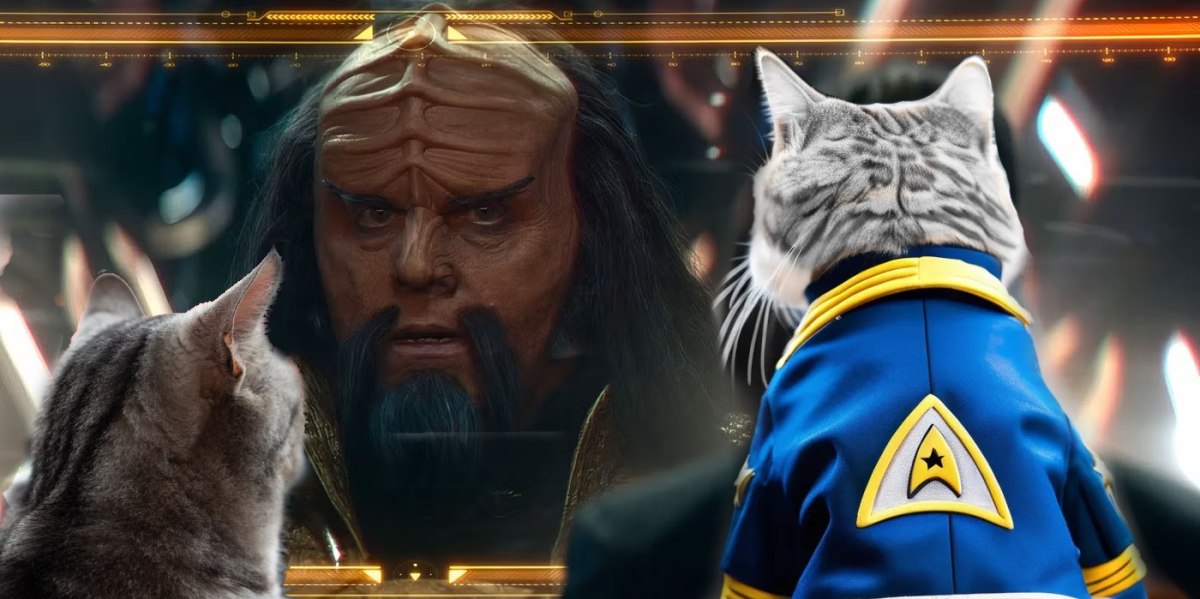
The helm officer tapped a sequence into his console and an image of a scowling Klingon materialized on the ship’s view screen, replacing the view of space and the sleek Klingon Warbird that had decloaked in front of the USS Fowl Play.
“Gruthnok vupar! This is the warship Dra’akkthar of the mighty Klingon empire!” the face on the view screen snarled. “Power down your pitiful excuse for a ship and prepare to be boarded!”
Captain Buddy smiled.
“Good to see you too, Captain Hrakhuul,” he said. “How are the wife and the kids?”
Hrakhuul snorted derisively.
“Only a fool jests during the hour of his doom!” the Klingon spat. “Have you no honor?”
Captain Buddy scratched his chin fur, pretending to consider the question.
“None,” he said, “but I do have a bone to pick with you. You woke me up during nap time. Again. Not cool, Hrakhuul. Not cool.”
Captain Buddy, commanding officer of the Federation starship USS Fowl Play, Galaxy class registration NCC-2014A
Hrakhuul growled.
“Your species is insolent, lazy and takes ten naps a day!”
“Why, thank you, Captain Hrakhuul! And may I say, you’re looking particularly savage today.”
“This is your last warning, Federation cat! Power down your shields and weapons or be destroyed!”
Captain Buddy yawned.
“I think I’ll have my crew serve me turkey sandwiches instead. Yeah. Turkey over obliteration, no brainer.”
This enraged the Klingon. “Prepare to taste your own blood at the tip of my ancestral bat’leth, feline fool!”
Buddy collapsed into his captain’s chair and kicked his feet up.
“Can we just skip this and get to the part where I outsmart you and go back to my nap?”
Hrakhuul cackled maniacally.
“So your fate is sealed, then. You shall fall before the might of the Klingon Emp…”
Captain Buddy cut him off.
“I wouldn’t be so confident if I were you. This is a..an, uh…” He turned to Lieutenant Pawson, the tactical officer, whispering: “What kind of ship is this again?”
“A Galaxy class, sir. Same as the flagship.”
“A Galactic class starship!” Buddy said confidently, projecting the calm of a seasoned captain. “And we have, like, uh…”
“Sixteen phaser banks and two photon torpedo launchers, sir,” Pawson whispered helpfully.
“Lasers! Like 27 of them! And torp…er, missiles and stuff! Very powerful missiles. They make yuge explosions!”
Behind him, operations Lt. Commander Cleo hid her face in her paws.
Schemeowtics for the USS Fowl Play, Captain Buddy’s awesome starship.
“Enough of your meaningless babble,” Captain Hrakhuul barked. “Prepare to die!”
Captain Buddy’s eyes went wide with shock.
“Oh no! We have a warp core breach! Abandon all decks and get to your escape pods!”
Captain Hrakhuul snarled, fear in his eyes.
“What?!?” If you think I will fall for this again, you tribble with a tail…”
“Fine, but don’t say I didn’t warn you, Hrakkie,” he said. “You’re in the blast radius.”
Captain Buddy made a cut-off motion to the helmsman and the screen returned to its default view of a placid star field.
The bridge crew erupted into applause.
“The Klingon ship is backing up, full reverse thrusters, sir!”
Buddy cleared his throat.
“Fire a few of those proton missile things to create an explosion, then hit the gas, warp nine!”
The Captain yawned into the back of his paw as he walked toward the turbolift.
“I am returning to my nap,” he told his crew before the lift doors closed, “and anyone who interrupts me will be thrown out of an airlock!”
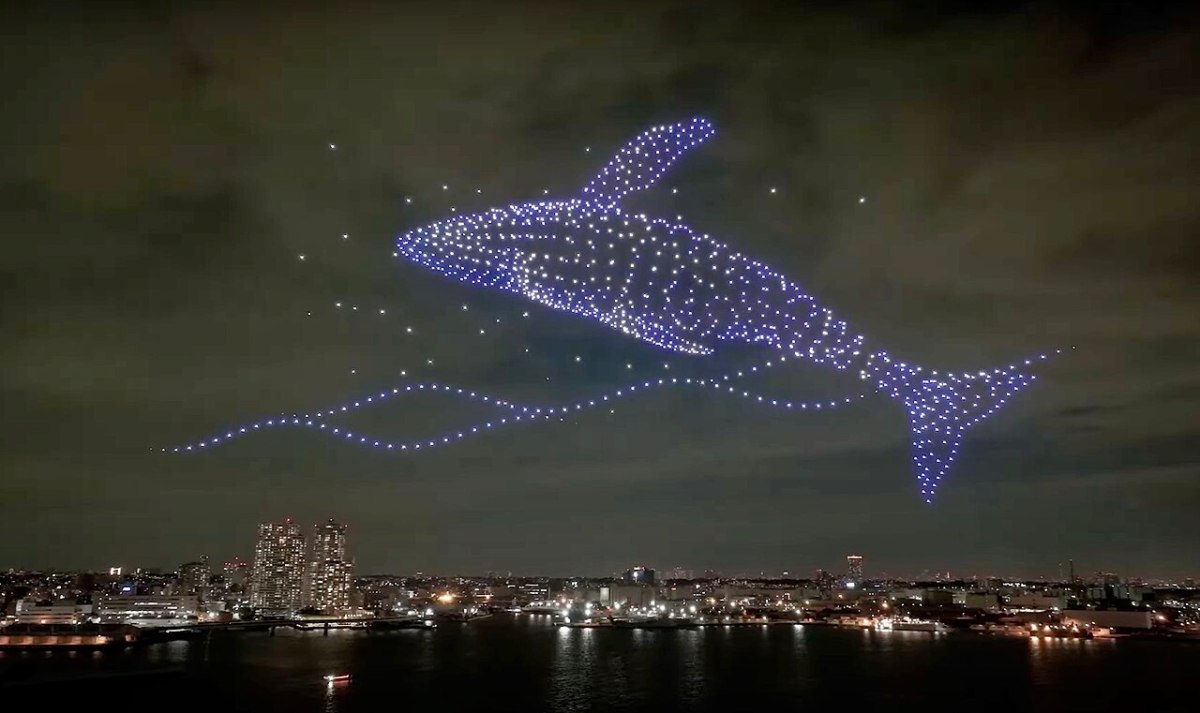
Some observers believe the drone sightings are merely the first stage in an all-out feline takeover of the US. So far, cats have remained mum on their motivations, preferring instead to sow panic among Americans.
WASHINGTON –The caller was breathing heavily and speaking in rapid-fire sentences as if he had only moments to get the words out over the air.
“I’m telling you, Art, it’s the cats — the cats are piloting these drones!” the caller told Coast to Coast AM radio host Art Bell shortly after 1 am ET on Friday.
“Hold on, hold on,” Bell said theatrically. “You’re saying this has nothing to do with aliens or the government?”
The caller sighed.
“The cats may very well be in league with aliens, but I’m telling you, felines are behind…oh God! They’re here!”
The radio broadcast crackled with distorted hissing and yowling, punctuated by the caller’s pleas for mercy.
“Caller? West of the Rockies, are you there?”
The caller screamed a final time and the line went dead.
“Wow,” Bell told his audience of several million overnight listeners. “There you have it, folks. You be the judge, but that sounded like the real deal to me. Cats are piloting the mysterious drones!”
For weeks, Americans have been asking for answers about swarms of suspicious drones operating above homes, businesses, military bases and government buildings at night.
After rampant speculation that the drones could belong to rogue states, or could be part of some secret government flight test, the FBI confirmed Friday that felines are behind the frequent sightings.
A drone flies above a farm and ranch as the sun fades. Drones have been spotted circling chicken and turkey coops, as well as fish markets.
Biden administration officials confirmed to several media outlets that intelligence supported the theory that cats — not Iranians, Russians or some secret Pentagon operation — are operating the drone swarms that have been lighting up the night sky in states like New Jersey and Maryland for several weeks, befuddling local and state officials.
“At first we thought the idea was absurd,” said a high-ranking official, who spoke on condition of anonymity. “Then we received reports of drone swarms circling several meat-packing plants, a Chewy distribution center in Trenton, and two PetSmarts in northern New Jersey.”
So far, the felines’ motivation remains shrouded in mystery, but experts on the small, furry animals ventured guesses on what may have motivated their sudden interest in aviation and airspace.
“No one’s claimed responsibility, so we’re left to speculate,” said Norah Grayer, a feline behaviorist with NYU’s Gummitch School of Veterinary Science. “But it may be that felines, as a whole, have decided the meow is insufficient for getting their demands across. Humans have become adept at tuning out those vocalizations, so this may be the next step in an attention arms race, so to speak.”
Noted cat expert Jefferson Nebula offered a different explanation.
“Cats are notoriously subject to FOMO, which is one reason why they can’t abide closed doors,” he said. “If someone managed to convince them that we humans were holding out on them, and there are entire worlds of yums we keep for ourselves, well, that would spark the wrath of these otherwise friendly little guys.”
Felines have mastered control over aerial drones despite their lack of thumbs.
For his part, Bell consulted with Michio Kaku, the physicist and science communicator who has been a regular presence on Coast to Coast.
“We physicists have been saying for decades that cats are much more intelligent than we give them credit for,” Kaku said. “This could be retribution for the Schroedinger’s cat thought experiment, or felids may be looking to surpass humanity’s understanding of 11-dimensional hyperspace.”
“Professor, we’ve spoken quite a bit about the Kardashev scale [of civilization progress] in the past,” Bell said. “If we separated human and feline societies, where would we each fall on the scale? Humans are about a zero point seven, are we not?”
“That’s right,” Kaku said. “We physicists believe humanity is on the cusp of a Type I civilization, with things like the internet as a Type I telecommunications system and fusion power on the horizon. However, if you break it down and cats were separated into their own civilization, cats could plausibly already be a Type I civilization.”
“They’re ahead of us?”
“That’s right,” Kaku said. “We physicists believe cats can tap directly into primordial energies and have mastered quantum teleportation. In Star Trek, the Federation is a Type II civilization, and the Caitians — a species of alien cats — are part of the Federation. Yet it’s widely understood that the only reason the Caitians haven’t conquered entire swaths of the galaxy, like the Borg and the Klingons, is because of their strict adherence to their napping schedule and their inherent laziness. These drone swarms may be a signal that real-life cats are fed up enough to disturb their napping schedules, in which case we should all be terrified.”
Header image of drone light show credit Wikimedia Commons
Think you can decipher the rhythmic clicks and whistles of dolphins or the grunts and alarm calls of monkeys? A foundation is offering big prizes for progress in communicating with animals.
Looking to prompt renewed efforts at decoding animal communication, a non-profit founded by an investor and a university are offering prizes — including a hefty $10 million — to teams that can figure out what animals are “saying.”
Entrants aren’t asked to come up with a Star Trek-like “universal translator” for animals. Rather, the people behind the Coller Dolittle Challenge want to see methods that allow for two-way communication between humans and individual species.
“We are open to any organism and any modality from acoustic communication in whales to chemical communication in worms,” said Yossi Yovel, a professor at Tel Aviv University and co-chairman of the challenge.
The grand prize is a $10 million grant or $500,000 in cash, chosen by the winner, while the Foundation will offer $100,000 prizes each year for the best entries that make significant progress toward communicating with animals. The yearly prizes will be assessed “for significant contributions to decipher, interface or mimic non-human organism communication.”
While it may seem far-fetched — and there are those who believe humans will never be able to fully understand animal communication in proper context — there have been efforts to communicate with and decode the communications of bats, dolphins, whales and some primate species. Scientists have also pushed the boundaries on understanding group communication, such as the coordination involved in avian murmurations.
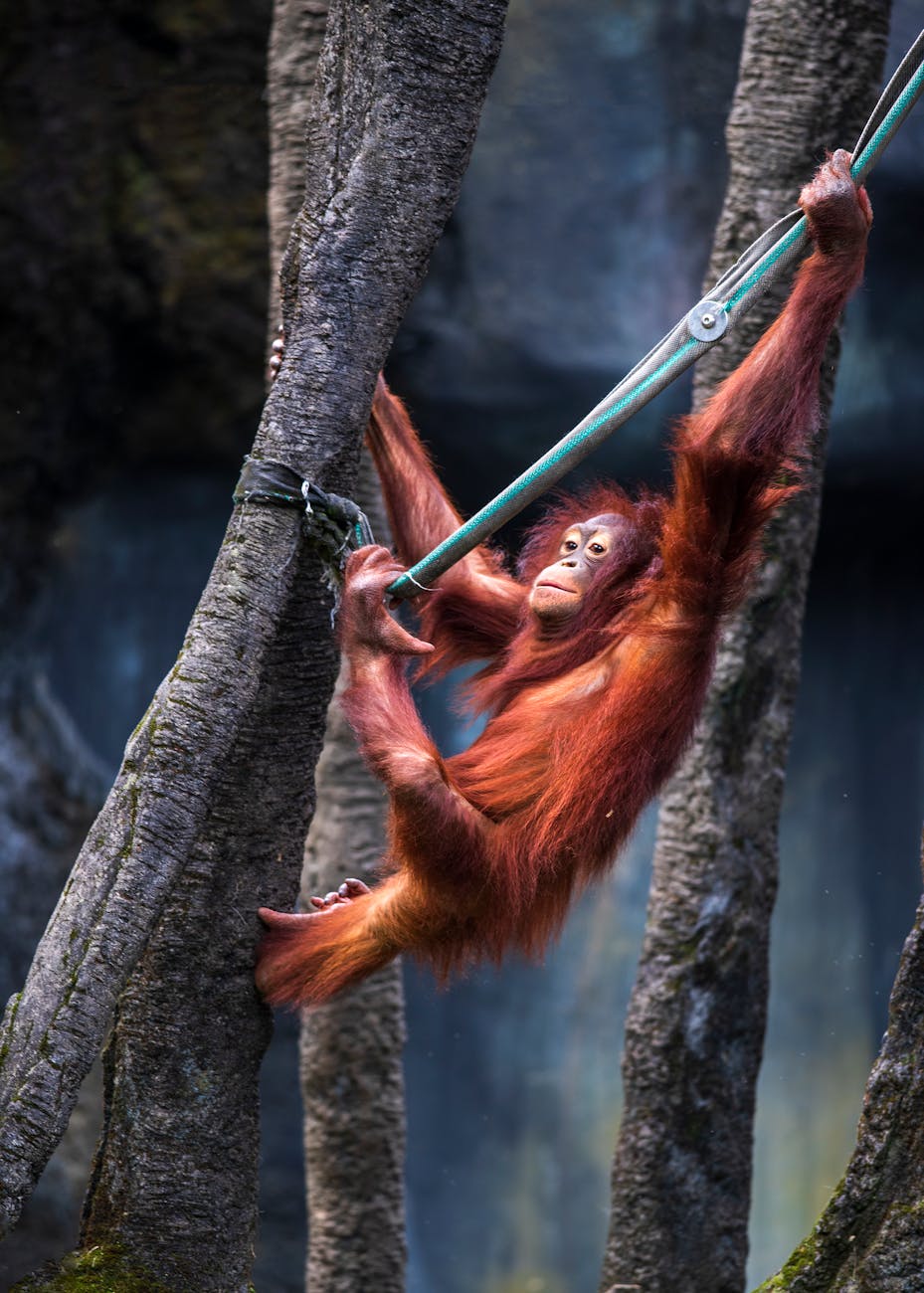
Orangutans have demonstrated the ability to understand abstract concepts, like using money, rudimentary sign language, and have even deceived humans. One orangutan in the 1960s repeatedly escaped his zoo enclosure by hiding a small strip of metal in his mouth and using it to pick a lock. Credit: Klub Boks/Pexels
The organizers believe artificial intelligence will be the tool that ultimately helps crack the communication barrier, but entrants aren’t required to use AI. The technology is incredibly useful for tasks involving pattern recognition and sorting large amounts of data, both of which are important in this kind of work when researchers are tasked with analyzing thousands of audio samples or hundreds of hours of footage.
Alas, we don’t think the foundation will be interested in the Buddinese language, which boasts 327 different ways of demanding food and features a timekeeping and calendar system based on meals and naps. A short trill followed by a series of staccato meows, for example, means “I expect prompt service at salmon o’clock,” while a truncated meow ending with a scoff is used to indicate displeasure when a human napping substrate tosses too much during sleep.
Still, maybe we’ll dress it up to make it look properly academic and give the challenge a try. Those prizes could buy a lot of Roombas!
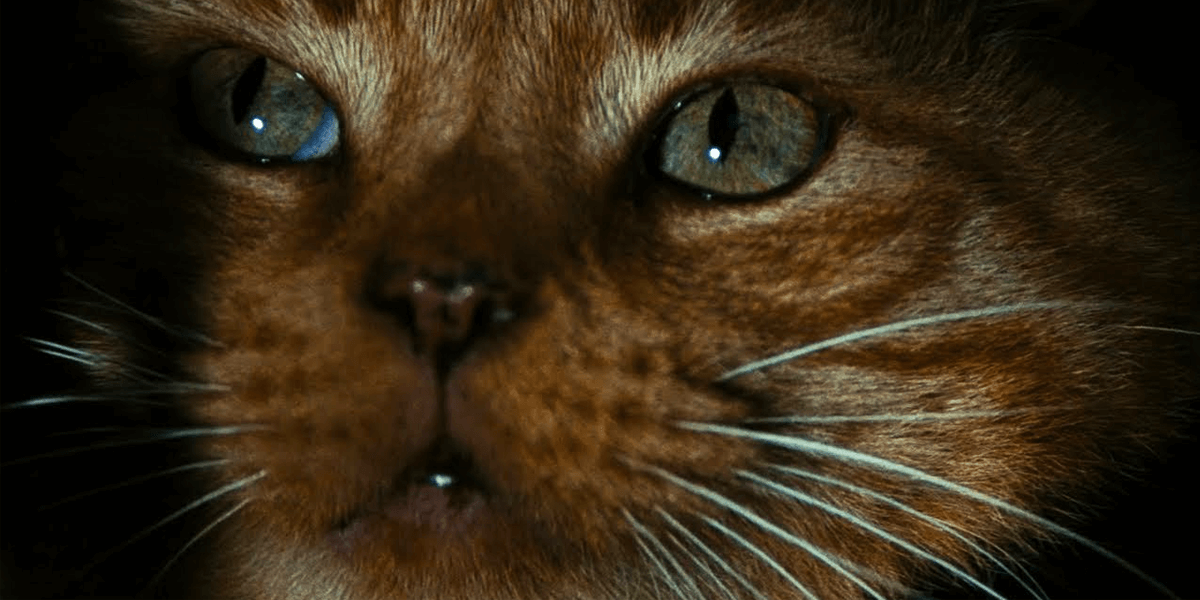
Making his debut in 1979’s Alien, Jonesy is one of the most famous felines in cinema history.
There’s a popular meme among Alien fans that depicts Jonesy the Cat walking nonchalantly down one of the starship Nostromo’s corridors with his tail up, carrying the corpse of the recently-spawned alien in his mouth like he’s about to present a dead mouse as a gift to his humans.
The joke is self-evident: if the crew of the Nostromo had allowed Jonesy to take care of business from the get-go, the alien would have been disposed of before it had the chance to grow into the monstrosity that haunted the decks of the Nostromo and the nightmares of viewers.
“Who’s a good boy? Who just saved his crew from certain violent death at the claws of a ruthless alien predator? That’s right, you did!”
Of course then there’d be no movie. No ripples of shock in theaters across the US as audiences were confronted by something more nightmarish and utterly alien than popular culture had ever seen before. No indelible mark left on science fiction.
Despite the film’s retrofuturistic aesthetic, it’s difficult to believe Alien first hit theaters almost half a century ago.
That’s testament to director Ridley Scott working at the height of his powers, the carpenters, artists and set dressers who created the starship Nostromo’s claustrophobic interior, the design of the derelict starship where the alien was found, and the bizarre creature itself.
The alien ship and creature designs were the work of Swiss surrealist H.R. Giger, who was little-known at the time but floored Scott and writer Dan O’Bannon with his hyper-detailed paintings of grotesque biomechanical scenes.
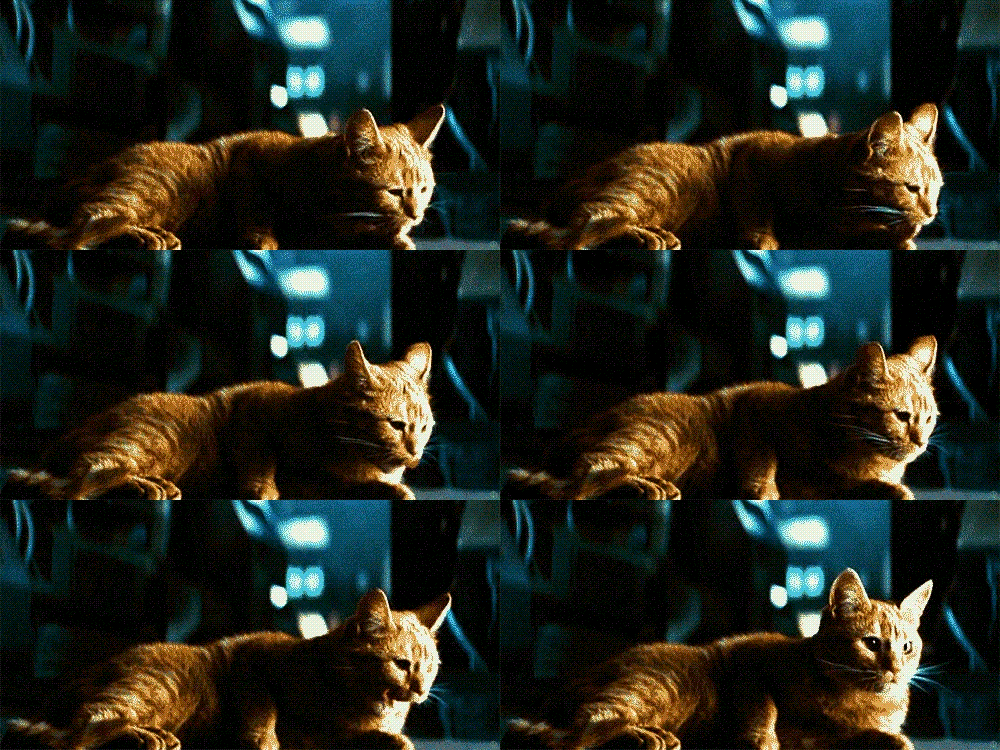
Signourney Weaver and one of the cats who played Jonesy in the first film.
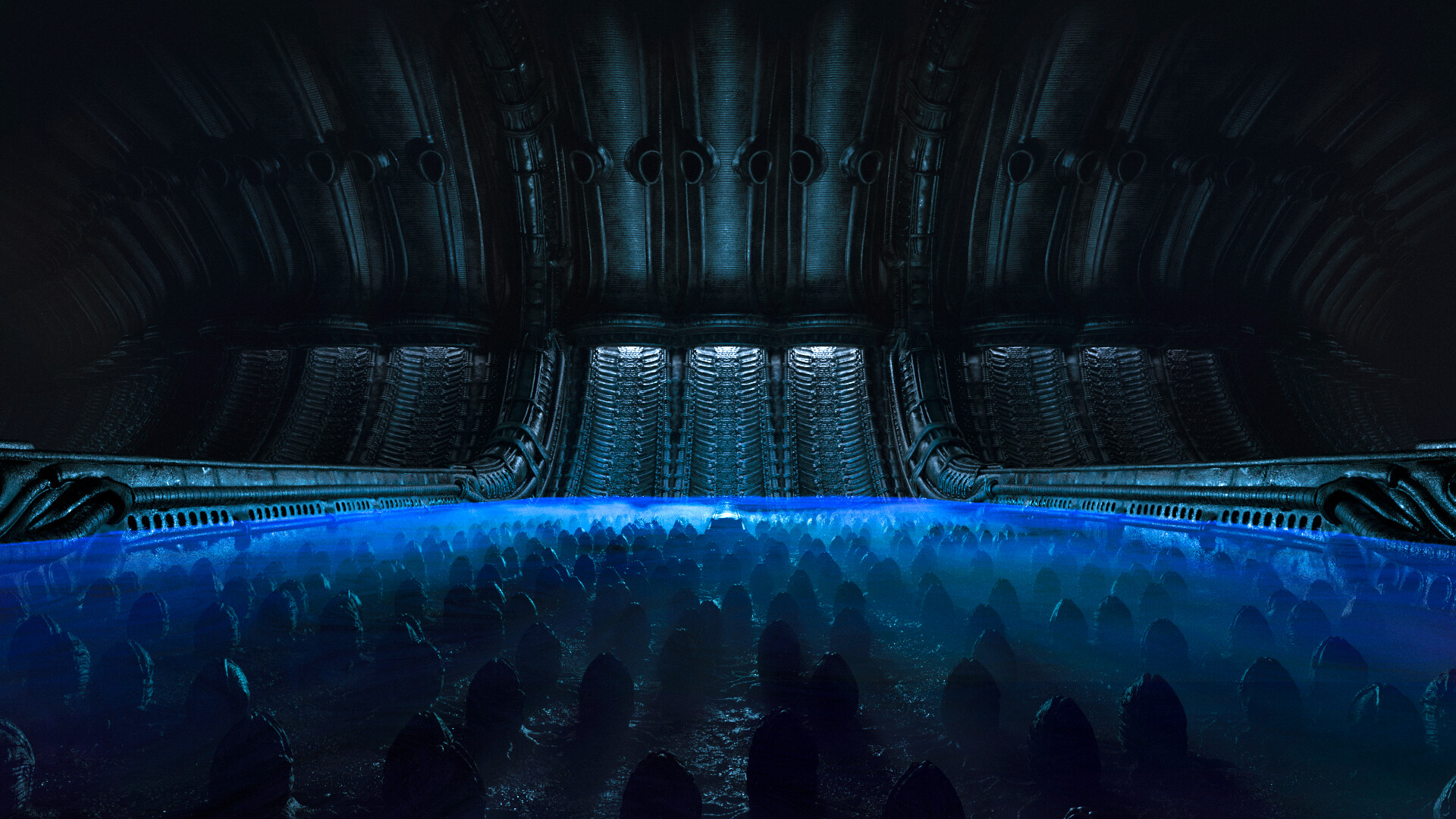
Kane explores the infamous egg chamber in the derelict alien ship.
Fan art of Jonesy
A close-up shot of the retrofuturistic tech used in the series, a design decision that departed from the gleaming visions of the future common at the time.
A set photo showing the first film’s crew on the iconic space jockey set.
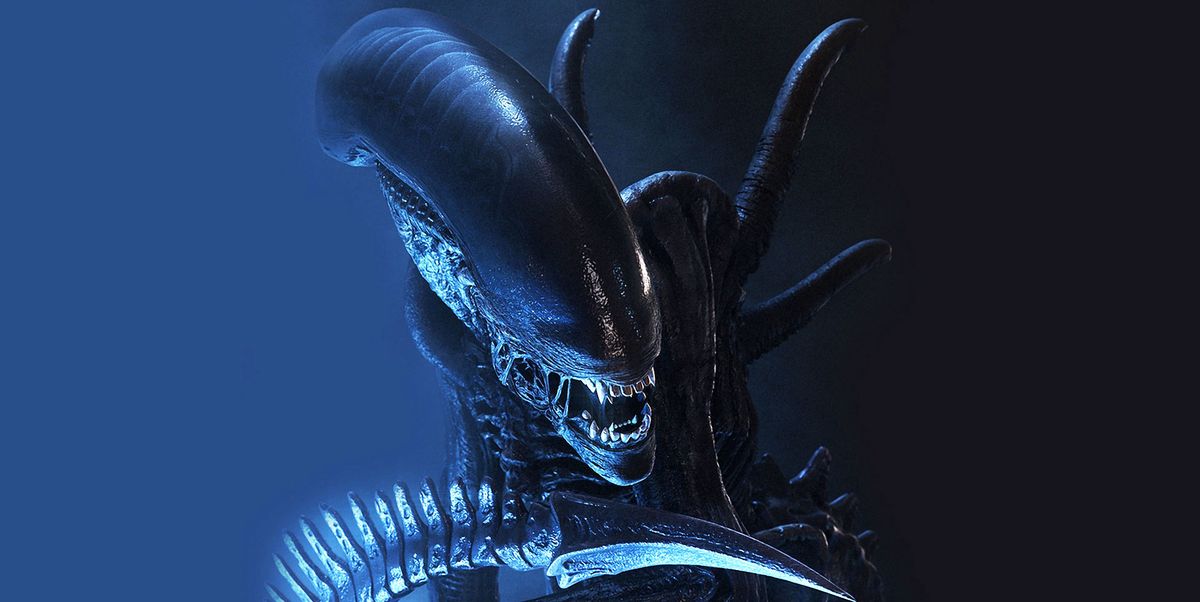
Giger’s work, specifically his 1976 painting Necronom IV, was the basis for the titular alien’s appearance. The alien, called a xenomorph in the film series, is vaguely androform while also animalistic. It is bipedal but with digitgrade feet and can crawl or run on all fours when the situation calls for it. It hides in vents, shafts and other dark spaces, coiling a prehensile tail that ends in a blade-like tip.
But it’s the creature’s head that is most nightmarish. It’s vaguely comma-shaped, eyeless and covered in a hard, armored carapace that ends just above a mouth full of sinister teeth like obsidian arrowheads. There’s perpetually slime-covered flesh that squelches when the creature moves but there are also veins or tendons or something fully exposed without skin, apparently made of metal and bone. Maybe those ducts feed nutrients and circulate blood to the brain. Maybe they help drain excess heat from the creature’s brain cavity.
Regardless, it’s a biomechanical nightmare that the Nostromo’s science officer, Ash, admiringly calls “the perfect organism” whose “structural perfection is matched only by its hostility.”
The alien, Ash declares, is “a survivor, unclouded by conscience, remorse, or delusions of morality.”
The alien, also referred to as a xenomorph, “that thing,” a “dragon,” “the perfect organism” and various other names by characters in the series. Credit: 20th Century Studios
Part of what makes Jonesey so beloved is the fact that, together with the xenomorph and Ripley, he completes the triumvirate of survivors. We see Jonesy scurry into the protection of tiny confined spaces to escape the alien, hissing at it in the dark. We see him dart into the bowels of the ship after sensing the stalking creature, adding another blip to the crew’s trackers. Finally we see him settling into a cryosleep pod with Ripley, like so many other cats with their humans, when the threat has passed.
Jonesy — affectionately referred to as “you little shithead” by Ripley in the second film — appears in the franchise’s two most famous films, his own comic book series titled Jonesy: Nine Lives on the Nostromo, a 2014 novel (Alien: Out of the Shadows), and in hundreds of references in pop culture over the last half century, from appearances in video games (Halo, World of Warcraft, Fortnite) to references and homages in movies and television shows.
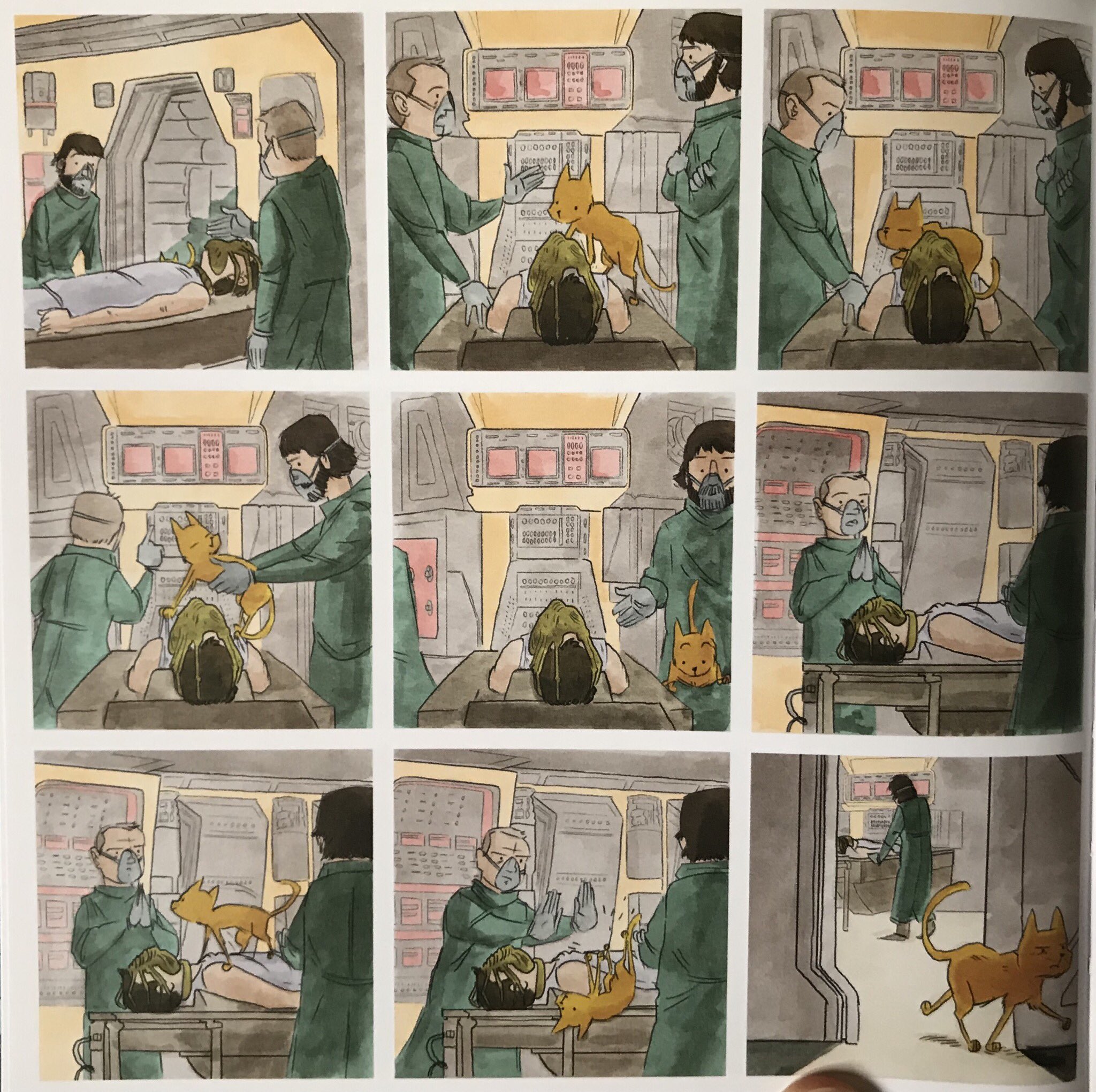
A page from Jonesy: Nine Lives On The Nostromo, which tells the story of Alien from the cat’s perspective. These panels depict Jonesy watching Ash and Dallas examining Kane in the ship’s medical lab.
He’s like the anti-xenomorph. Cats are predators, after all, and Jonesy might be the xenomorph to the ship’s rodents just like every ship’s cat in thousands of years of human naval endeavors. But to the crew members Jonesy’s a source of comfort, a warm, furry friend to cuddle with. Unlike the xenomorph he’s got no biological programming urging him to impregnate other species with copies of himself in one of the most horrific gestation processes imaginable.
Xenos are like predators on steroids, gorging themselves on their victims to fuel unnaturally swift cell reproduction and growth. As a result, over the decades some have speculated that the alien simply ignored the cat, deeming its paltry caloric value unworthy of the effort to kill.
The idea that Jonesy was too small to interest the alien is proved a fallacy in later franchise canon when we see the aftermath of a xenomorph consuming a dog. It’s indiscriminate in its quest for energy, feasting on adult humans and animals alike until two or three days pass and it’s a 12-foot-tall, serpentine nightmare the color of the void of interstellar space.
Just imagine sitting in a theater in 1979. Your idea of science fiction is sleek jet-age spacecraft, Star Trek and Stanley Kubrick’s clinical orbital habitats from 2001: A Space Odyssey. You’re expecting astronauts, heroes, maybe a metal robot or an alien who looks human except for some funky eyebrows, green skin or distinct forehead ridges.
Instead you get a crew of seven weary deep space ore haulers inhabiting a worn, scuffed corporate transport ship, complaining about their bonuses and aching for home, family and the familiar tug of gravity.
But home will have to wait. The ship has logged an unusual signal of artificial origin broadcasting from a small planet in an unexplored star system. The crew has no choice but to investigate. It’s written into their contracts, which stipulate the crew will forfeit their wages if they disregard the signal.
So they land, suit up, move out and find a derelict starship. An incomprehensibly massive vessel so strange in detail and proportion that it could only have been built by an alien mind, with unknowable motivations and psychology.
The egg chamber of the derelict alien ship, designed by Giger.
Inside, hallways that look like ribcages lead to vast chambers with utterly bizarre, inscrutable machinery that seems to consist of biological material — skin, bone, joints, organs — fused with metal. In one of them the corpse of an alien, presumably a pilot, is integrated into a complex array. It’s at least twice the size of a large human man. Its elephantine head is thrown back in the agony of its last moment, when something exploded outward from its body, leaving a mangled ribcage, torn papery skin and desiccated organs.
And beneath that, a shaft leading to another horror — a chamber that seems to stretch for kilometers in either direction, where leathery eggs are cradled in biomachinery and bathed in a bioluminescent cerulean mist.
The decision to enter that chamber sets off one of the most shocking scenes in cinema history, leads to the birth of pop culture’s most terrifying monster, and sent millions of theater-goers home with nightmares in the spring and summer of 1979.
It’s almost too much to handle. But take heart! The unlikely female protagonist makes it to the end, and so does the cat. What more can you ask for?
Jonesy grooming himself on the flight deck of the starship Nostromo. Credit: 20th Century Studios








 Pain In The Bud