People Think This Nebula Resembles A Smiling Cat, PLUS: What Kind Of Music Soothes Felines?

Your cat’s taste in music may or may not align with your own.

Before we get into today’s cat news, I received an email asking why there hasn’t been much Buddy on the site lately.

Fear not, friends of Buddy! The little guy is down in the Amazon visiting his jaguar pals, but he’ll be home in time for the most important holiday of the year, Turkey day. He wouldn’t miss it for the world!

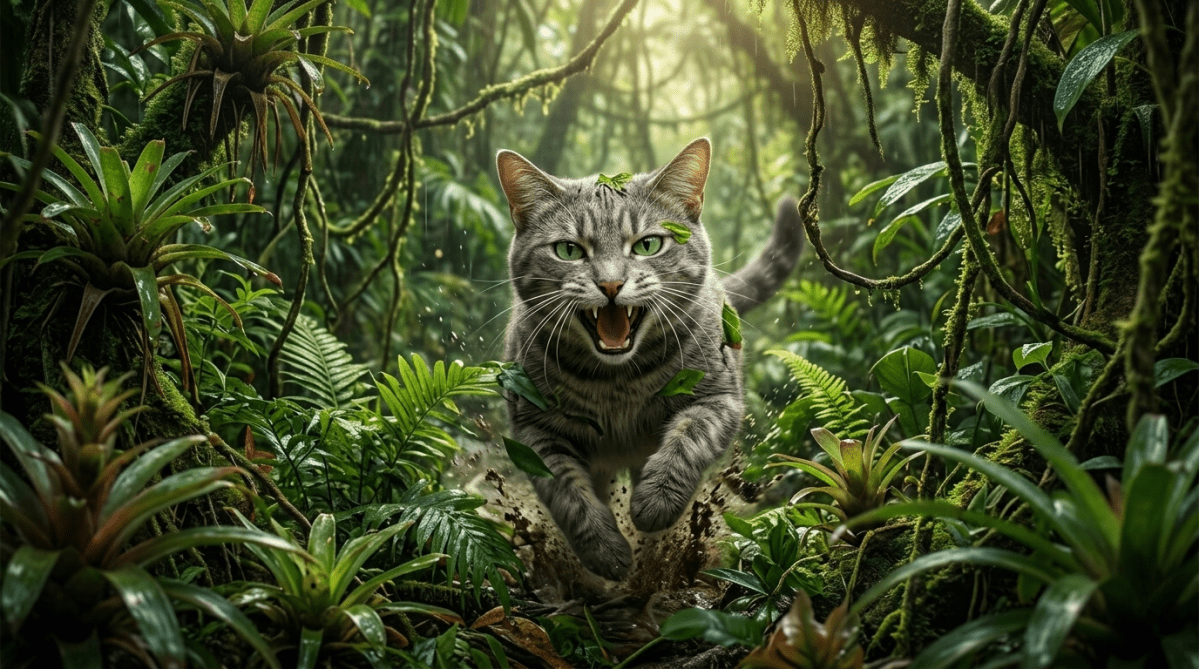
Buddy with a jaguar buddy in the Amazon, where there’s a special felid conference on new napping techniques.

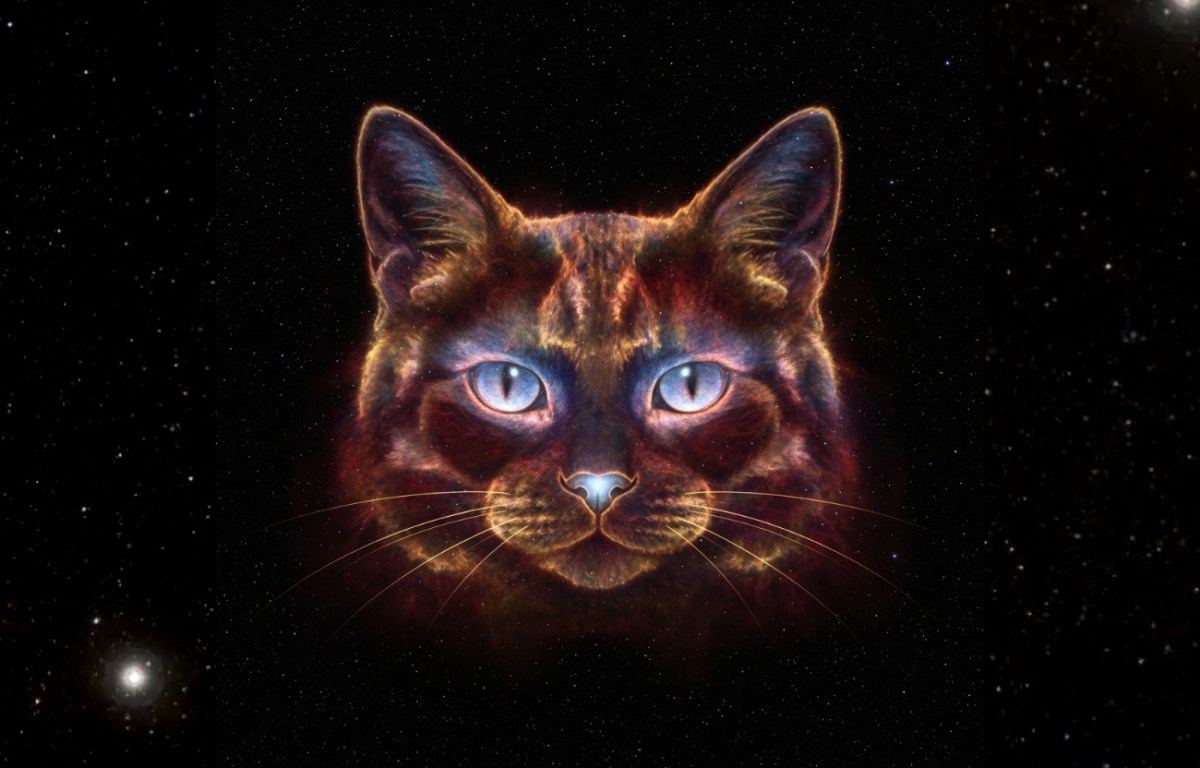
A smiling cat?!

A story on Space.com says people see a “smiling cat” in images of a nebula, although we’re not so sure.

The nebula in question is Sh2-284, or Sharpless 284. It spans about 150 light years and sits about 15,000 light years from our star system near the edge of the Milky Way, in an outer spiral arm.

From a certain orientation, there may be suggestions of cat-like ears and eyes, although if there is a smile, it’s crooked and deranged-looking. Maybe the cat’s on pain pills from the vet?

There’s an opportunity here, since the nebula doesn’t have a nickname. The Buddy Nebula has a nice ring to it!

Here’s an image from NASA:

This spectacular picture of the Sh2-284 nebula has been captured in great detail by the VLT Survey Telescope at ESO’s Paranal Observatory. Sh2-284 is a star formation region, and at its centre there is a cluster of young stars, dubbed Dolidze 25. The radiation from this cluster is powerful enough to ionise the hydrogen gas in the nebula’s cloud. It is this ionisation that produces its bright orange and red colours. This image is part of the VST Photometric Hα Survey of the Southern Galactic Plane and Bulge, led by Janet Drew at the University of Hertfordshire in the UK.

And here’s an annotated image from astrophotographer Jim Thommes that shows us what we’re looking at and the immediate galactic neighborhood:

In Star Trek there’s always a convenient nebula nearby when the Enterprise — or Voyager, Titan or Discovery — needs to “hide” from some well-armed belligerent, and science fiction in general creates the impression that they’re like space swamps.

In reality nebulas are regions where the interstellar medium — the space between stars — is filled with gas, cosmic dust and inert matter. Some are stellar nurseries — places where stars are “born” — and some are the remnants of dead stars and the planets that orbited them.

They can seem to glow red, orange, green or blue depending on the elements present. Some of them reflect starlight while others are like filters, with the gases and dust lending their color to the nebulae structure.

Cats are pretty well-represented in the cosmos, from a human perspective. From the cat’s paw nebula to the Cheshire Cat galaxies, to the Lynx, Leo and Leo Minor constellations, astronomers have seen cats in the sky for millennia.

Does music help cats relax?

Although the research is limited, some studies have indicated certain genres of music can help our little buddies chill out. And if research into the canine response to music is any indication, we should expect to see more evidence for cats enjoying tunes.

When it comes to what kind of music is most effective, studies point to classical music with a slow tempo, as well as reggae and soft rock “with simple rhythms, slower tempos and no heavy percussion,” according to a new story from the BBC.

Just listening to some meowsic!

A 2016 study looked at the effect of music on 12 female cats who were recovering from spay surgery. The research team played “three different genres of music: classical music (CM), ‘Adagio For Strings (Opus 11)’ by Samuel Barber; pop music (PM), ‘Torn’ by Natalie Imbruglia; and heavy metal (HM), ‘Thunderstruck’ by AC/DC.”

The team measured heart rate, breathing rate and pupil dilation, concluding that classical music was most effective, followed by the Imbruglia song and AC/DC last. (Maybe next time they can slide The Tony Danza Tapdance Extravaganza in there for some extra fun.)

Anecdotally, Bud did not respond well to composer David Teie’s Music for Cats, but he hangs out and nods along to funk, classic 90s New York hip hop, retrowave, nu-disco, reggae and certain kinds of rock, which is almost certainly because he grew up hearing that stuff with me.

So maybe there’s a nature vs nurture element to feline musical preferences, although I wouldn’t hold out hope for cats who enjoy the Tony Danza Tapdance Extravaganza. Some things are best left alone.

Cops: Wannabe Rapper ‘Ritually Sacrificed’ Cat To Promote Music

David Mosley wanted attention and allegedly killed a cat on camera to promote his Satanist-themed music.

What to do when you want to be a famous music artist, but your tunes are abominably awful and your gimmick is infantile?

If you’re David Mosley, apparently you beg the internet to notice you exist by allegedly murdering a cat.

The 26-year-old Bronx man was initially gleeful after sharing video and photos showing a dead cat in his Fordham North hovel surrounded by candles and a bunch of nonsense, including the word “SATAN,” spray painted on the walls.

“You should have heard the little bih squeal lol,” Mosley wrote on Instagram alongside a photo of a bloodied and dead cat in his apartment.

“I’m the king, n—a,” Mosley said in a follow-up video after mocking people who were upset that he allegedly killed the cat. “I can reach through the camera and put spells on you like that! That easily! I hexed you through the phone, through the camera. Ya’ll know I do f—ing voodoo, so don’t even call me delusional.”

Mosley during a live stream, during which he claimed supernatural powers.

A relevant question here: who adopted a cat out to this guy? I went through what felt like a CIA-level background check when I first went to adopt, and this Satanist who thinks he’s a wizard apparently had no problem just waltzing into a shelter and walking out with a cat.

Apparently angry that no one turned up to the first “show” in his illustrious music career, Mosley said he was going to take things to the “next level” with another “sacrifice” on Halloween night. In his musical endeavors he called himself Church of Ububal, with the latter word a reverse spelling of “Labubu” in reference to the viral toys.

“Be there or be square,” he wrote, per a screenshot posted to Reddit. “Like I said at my first show and no one came. But you will be at this one. Grab popcorn.”

When he got the attention he wanted, but not the reaction he wanted, he backpedaled during a live stream, claiming he found the already-deceased feline.

By that point, furious Redditors in a Bronx subreddit had closed in on his identity and exact location, and were pestering the NYPD to grab Mosley.

“Y’all are soft for falling for cheap parlor tricks” Mosley said during the live stream.

Incredibly, Bronx criminal court Judge Harold E. Bahr let Mosley walk free without having to post bail after a preliminary hearing this week, and adjourned a hearing this week after Mosley’s original attorney was not present. It’s not clear if that attorney will continue to represent Mosley.

Bahr must be confused about which decade this is. Constituents should (politely) register their displeasure with his office. People from several local cat rescues have already done so.

“We want the judge to take this seriously. We cannot wait for another crime like this to happen,” local animal welfare activist Rachel Ejsmont told News12 Bronx.

Mosley was initially charged with criminal mischief and aggravated cruelty to animals at his Oct. 30 arraignment. Activists are pushing the district attorney for more serious charges.

The court hasn’t set a date for Mosley’s next hearing after the Nov. 12 adjournment. We hope the scrutiny and his mounting legal troubles dissuade him from trying to get attention through violence again.

Lastly, I usually keep my mouth shut about this sort of thing because I know emotions run high and most people are well-intentioned, but already there are grifters latching onto this incident and using it to beg for donations for their activism, which amounts to little more than grumbling about this stuff on social media.

Be careful about who you donate to and make sure you’re giving to registered organizations with financials listed on Charity Navigator or Charity Watch. Donate your hard-earned money to groups that really do make a difference, such as the Humane Society, SPCA and local rescues that do outstanding work, like New Jersey’s Tabby’s Place. A transparent, effective charity will feature its IRS Form 990 on its website and use at least 75 percent of its revenue from donations on program spending. Be wary of “influencers,” people who say outrageous things for attention, clicks and donations, and anyone who claims they have special access to, or influence over, authorities.

Header image via News12 Bronx (screencap)

LISTEN: The Buddies Release Their Worldwide Smash No. 1 Single!

Buddy the Cat’s quest for world domination has moved into the realm of music. Listen to the new single here!

NEW YORK — Buddy the Cat made history as the first feline to top the charts in multiple genres this week with the release of “Move Your Ass” by The Buddies.

Listen to it here, but before you do, make room to get funky. (“And use proper headphones or speakers please!” Buddy says. “Don’t do us dirty by playing it through a phone or a laptop. You’ll miss all the bassy goodness that makes it funky!”)

The incredibly funktacular nu-disco track pays homage to the talented feline, who played guitar, bass, keyboards and percussion, while his human assisted him with certain particulars that required an opposable thumb.

“Obviously I could have done this on my own,” Buddy says, “but I like my human to feel like he’s involved in things, you know? Camaraderie and all that. But for future documentaries, ‘Behind the Music’ episodes and other retrospectives, it should be clear I’m the musical genius and the talent. The brains and the brawn, so to speak. Also the beauty. Obviously.”

“Move Your Ass” hit the top of Japan’s pop charts after an early release on Jan. 20 in that country, while it’s dominated the dance music charts in Luxembourg, the Principality of Sealand, Monaco and France. After its Jan. 30 release in the US and UK, it was steadily climbing the charts on Spotify and terrestrial radio.

Asked about his musical influences, Buddy waxed poetic about the funk, disco, French house and nu-disco he grew up listening to.

“From my earliest days of kittenhood, I remember Big Buddy playing Earth, Wind and Fire, Kool and the Gang, McFadden and Whitehead, The Brothers Johnson, Daft Punk, the Galactik Knights and Televisor. I love Televisor! I would dance around and joyfully smack my human on the head, then go hide in his shoes.”

Buddy’s already hard at work on his next single, which he promises “will be just as delicious as this one.”

Does Your Feline Overlord Have A Favorite Genre Of Music?

Cats have exceptional hearing abilities and can detect sounds in frequencies well beyond what the human ear is capable of hearing, but can they appreciate music?

The question of whether cats appreciate music is an interesting one, and we still don’t have definitive answers despite attempts to make music for our furry friends and study the way they respond to sound.

We’ve mentioned the ongoing efforts to make tunes for felines on this blog before, and previously experimented by playing composer David Teie‘s Music for Cats for our brave volunteer, Buddy.

Excited by the possibility of music specifically designed for cats, and a study in the Journal of Feline Medicine and Surgery that found it had a calming effect on the species, we queued up a track and watched the Budster’s reaction:

“Using Buddy as my test subject, I went to Youtube, selected the track Cozmo’s Air from “Music for Cats” and sat back, expecting Bud to start nodding his furry head at any moment.

Instead his ears pricked up, did their radar-dish swivel toward the speakers, and his eyes went wide. As the song gained volume and intensity, Bud’s ears and whiskers snapped back and he let out a clearly anxious “yerrrrrrrrrrppp!” I tried to calm him down, to no avail, and a second track didn’t improve things.

He wasn’t having it.”

Over at Catster, Christopher Bays writes about his cat, Olga, and her relationship with music.

Olga “has listened to classic rock, jazz, blues, classical, heavy metal, punk (or new wave?), and accordion tunes from Hungary, and it all sounds the same to her,” Bays concludes.

djfunkybud
“Spinning the megamix, bro.”/PITB

Noting that our tastes change as we age, Bays said he’s thankful Olga wasn’t around during his teenage punk and metal phase (ditto), and notes she’s not particularly interested in any sounds coming from electronic devices, with the exception of the roaring MGM lion. (Fun fact: The famous “lion’s roar” is actually a recording of a tiger played over footage of a lion yawning. The creators apparently felt lions don’t sound sufficiently badass enough.)

Bays points out our cats don’t exactly have control over what we play, and while that’s true, if you’re a genre-hopper like me, you’ve probably observed your furry friend’s reaction to various types of music.

Given the fact that the small amount of research done so far indicates cats do respond to tunes — and the existence of music-loving animals like Kiki and Snowball — I think felines probably are capable of enjoying the organized, rhythmic arrangements of sounds we call music.

I can’t say whether a favorite track can unleash a wave of emotion, nostalgia or energy the way it can for us humans, but I’ve played a lot of music around Bud and even played music for him on my guitar and keyboard.

He seems very comfortable with old jazz, soul and funk, he comfortably loafs when I’m in the mood for classic 90s hip hop, and he seems to tolerate the prog rock of Coheed and Cambria well enough. More recently he’s been on a 90s nostalgia trip with me: Blues Traveler, the Spin Doctors, Nirvana, Oasis, Better Than Ezra, Letters to Cleo, Ash, Weezer, Blur, The Roots.

And he seems especially chill in the sonic presence of synthwave, also called retrowave, an EDM-inflected genre that evokes nostalgia for an era that never really existed outside of 80s retrofuturism. It’s highly rhythmic, with steady 4/4 beats and vintage synthesizers cranking out arpeggios that rise and fall like waves, which may be a source of comfort to a species that likes things just the way they are without any big surprises.

Have you noticed your cats responding to music? What’s your kitty’s favorite genre or song? Is there anything they clearly don’t like?

This Parrot Loves Earth, Wind And Fire

The last few decades have revealed birds like crows and parrots possess astonishing intelligence. “Bird brain” might not be much of an insult after all.

Meet Kiki the cockatiel, a bird who loves Earth, Wind and Fire so much that he sings the band’s classic hit, September, regularly — whether he’s just chilling by himself, singing along to the recording or driving his human crazy by whistling the catchy hook at ungodly hours.

“Kiki, it’s seven in the morning!” she tells him in one clip, raising an admonishing finger. “Silence!”

Kiki regards her for moment as if her request is absurd, then launches right back into September.

Hey, hey, hey
Ba-dee-ya, say, do you remember?
Ba-dee-ya, dancin’ in September
Ba-dee-ya, never was a cloudy day

In another video Kiki’s human sets her phone to record and leaves the room, and Kiki busts out his favorite song again. He’s got great taste in music!

I’ve always thought parrots are a fascinating example of animal cognition and further proof that we share our planet with billions of other minds who think and feel.

Humans and birds last shared a common ancestor more than 300 million years ago. That means between them there’s been more than 600 million years of divergent evolution resulting in radically different physiology, abilities and minds.

Yet parrots can speak while non-human primates (apes and monkeys) cannot!

For decades scientists thought apes and monkeys, by virtue of their relative similarity to humans, possessed an inmate affinity for language and that the physical limits of their vocal apparatus is what keeps them from speaking.

But a 2016 study by a team from Princeton University found monkeys do possess the vocal “hardware” to speak, meaning their mouths and throats are capable of making the sounds necessary for human language. It’s the lack of associated brain circuitry that prevents them from talking.

If the ability to speak and the ability to dance/appreciate music and rhythm is uniquely human among the primate order, and birds arrived at it at a different point in their evolutionary history, that means language and appreciation for music/rhythm developed separately along two divergent evolutionary lines!

That’s incredible and has intriguing implications for the cognitive abilities of animals.

A common argument is that birds with the ability to form human speech are simply mimicking sounds and don’t understand what they’re saying. That’s a natural assumption given what we think we know about non-human capacity for understanding language, but research suggests it’s wrong.

Take a look at this video of the famous late African grey parrot, Alex:

When Dr. Irene Pepperberg asks Alex how many blue blocks are present on a tray with a random assortment of blocks, balls and triangular toys in different colors, Alex can’t give a rote answer. First he has to understand that a question is a request for information and not part of the strange human ritual called small talk. He can’t simply count or guess at the number of blocks either.

Instead, Alex has to perform two calculations. He must tally the blue objects and count the number of them that are blocks, or he’s got to count the number of blocks and figure out how many of them are blue.

If he was simply repeating information in context — like saying “Hello!” when a person walks into a room — Alex wouldn’t be able to correctly answer the questions, and Pepperberg’s research funding would have dried up. Instead, Alex became a focal point of research that persisted for decades.

There’s no indication Alex could master syntax, which has proven elusive for even the smartest animals. But the African grey, who died in 2007 at 31 years old, was curious, asking questions that were unique and unexpected of an animal. He once asked his caretakers to describe his physical appearance, and the night before he died, he told Pepperberg: “You be good. I love you. See you tomorrow.”

We’ve talked about parrots before on PITB, including Snowball the dancing cockatiel who not only appreciates music and has a great sense of rhythm, but also has an entire repertoire of unique dance moves. Then there’s my personal favorite, Ruby the African grey, who has demonstrated mastery of absolutely vile, uniquely British insults.

Sure, there may not be much research value in hearing Ruby hurl verbal abuse at her very loving human, Nick Chapman, but few things have made me laugh as hard as that extraordinarily foul-mouthed bird. She has to be seen and heard to be believed. (But if you’ve got kids in the room, stick with the wholesome Snowball. He’s got serious moves.)

Snowball the dancing parrot
Scientists credit Snowball with choreographing his own dance routines, with dozens of individual dance moves and combinations, and moves that change depending on the song he’s rocking out to.

Now if you’ll excuse me, I’m off to teach a certain feline a few Earth, Wind and Fire songs in the hope that he’ll give up on the screeching meows and use his natural falsetto for a more gentle wake-up experience.

Hey, hey, hey
Ba-dee-ya, hey there my Big Buddy
Ba-dee-ya, Little Buddy’s hungry!
Ba-dee-ya, get your lazy ass up and feeeeeed me!

Bud close up