‘They’re A Really Dope Companion’: Jordan Poole Is The NBA’s Most Doting Cat Dad

The Washington Wizards’ Jordan Poole loves cats, and he’s showing his fellow NBA players what awesome little buddies they can be.

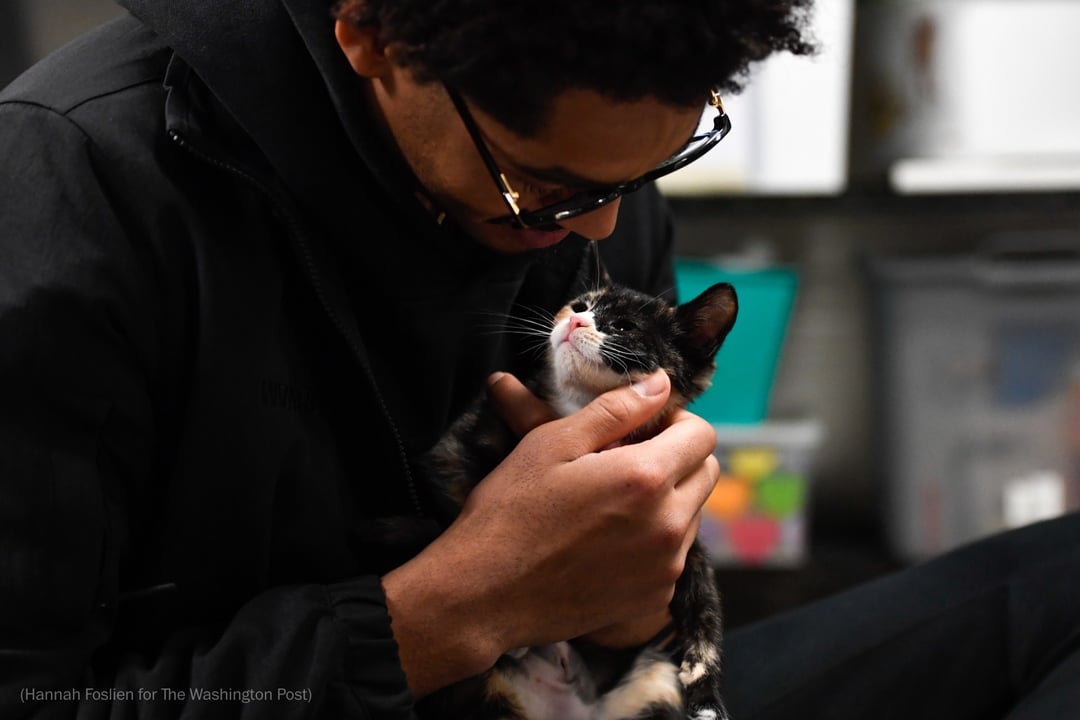
Jordan Poole finds it difficult to leave the Falls Church, Va., animal shelter where he volunteers.

He likes the staff and fellow volunteers, but most of all he hates leaving while knowing the cats he’s interacted with still need homes.

“Every time I come, it’s: ‘Let me leave with all of them! Give me 14 of them right now!’” he joked to the Washington Post’s Candace Buckner, who calls him “the lead crusader of the Secret Society of NBA Cat Dads.”

Some aren’t so secret: teammate Tristan Vukcevic recently adopted a cat after Poole converted him to the dark side, and a coy Poole says he “may have” convinced NBA superstar Stephen Curry to adopt a feline friend.

Poole with one of his tabby cats, brothers he adopted together from a California shelter when he was with the Golden State Warriors. Credit: Jordan Poole/Instagram

In a 2022 profile in The Athletic, Poole’s mother Monet says her son adopted his first cat when he was in high school.

“And when I tell you he fell in love with cats,” she said. “He loves his cats. … And he’s got some pretty cats too.”

When Poole was drafted by the Golden State Warriors in 2019, his cat stayed with his mom back in Michigan because she wouldn’t have adjusted well to the move to the west coast, as well as an empty apartment when Poole was on road trips with the team. Later that year, the then-rookie adopted brother cats who had been abandoned by their former owner.

Since he was traded to the Washington Wizards, Poole has volunteered at a Virginia shelter.

His enthusiasm is one reason why he’s been able to get teammate and friends interested in adopting. The NBA has other notable cat dads, including twins Brook and Robin Lopez, whose cats hilariously can’t stand each other. But Poole takes it to another level.

“A lot of guys are dog people, but just the energy [and] the way I talk about [cats], the pictures and videos and stuff that I show them, it just gives them a little bit more interest,” Poole told the Post. “So I give them a different perspective. Maybe they’re not as much maintenance, but they’re still a really dope companion and friend to have. You don’t have to really take them out three or four times a day. You can still get your rest. Normally [my peers] like to explore it. I’ve had a lot of friends and teammates who are also cat people.”

Former Knicks center Robin Lopez, pictured with his cat Edward, says his brother’s cat is sneaky and evil for attacking Edward: “The second I lay eyes on him, he’ll act like, ‘I’m a cherub. I’m innocent.’ I’m not buying it.”

The 25-year-old Poole is averaging 20.3 points, 4.8 assists, 3.1 rebounds and 1.5 steals per game this season while shooting an excellent .391 on three-point attempts. The 6’4″ guard spent his first four seasons with Golden State before he was traded to Washington.

Is Scotland Really Considering A Ban On Pet Cats To Protect Wildlife?

A report commissioned by the Scottish government blames cats for killing 27 million birds annually in the country.

“They may take our lives, but they’ll never take our freedom! Except maybe to keep pet cats.”

Mel Gibson’s iconic pre-battle rallying cry as Braveheart’s William Wallace might have to be amended if some Scottish politicians get their way and restrict the ownership of pet cats.

Cat lovers in Scotland were up in arms this week after several reports in Scottish and UK media said the Scottish National Party — Scotland’s most powerful political party, which controls almost half the seats in its parliament — is looking to ban cats in a bid to protect local wildlife.

They point to a recently released Scottish Animal Welfare Commission (SAWC) report that claims there are some 800,000 outdoor cats roaming the country, and those felines are responsible for 27 million birds every year, in addition to small mammals.

Meanwhile, other Scottish press pushed back on the claim, saying the SNP hasn’t voted to ban cats yet and isn’t really looking to stop people from having pet cats.

The truth is somewhere in the middle. The SAWC report did blame cats for killing tens of millions of animals annually, and it did recommend legislation to limit or prevent people from keeping cats in some areas.

A report from the Scottish government recommends restricting cats to indoors, among other measures. Credit: Wikimedia Commons

In addition to a law requiring people to keep their pet cats indoors, the report suggested curfews and, yes, legislation that would forbid people from keeping pet cats if they live in certain places deemed “vulnerable” to feline predatory habits. That means if wildlife biologists identify an endangered bird that nests in an area, for example, people who live there would not be permitted to have pet cats.

However, the report does not call for a general or widespread ban, as some media reports suggested.

The report credited Australia, where several states have enacted strict measures forbidding people from allowing their cats outside, prohibiting them from owning cats in some places, and even embarking on an infamous campaign to kill three million domestic cats by air-dropping sausages laced with a poison that is lethal to felines, but supposedly not harmful to other animals. 

That measure preceded several years of “biblical” rodent plagues, with hordes of mice rampaging across entire swaths of the country and causing billions of dollars in damage to residential and commercial property. Cats are, of course, the natural predators of rodents, and domestic cats wouldn’t exist as a species if they weren’t attracted to human settlements where mice and rats feasted on grain reserves.

CreditL Wikimedia Commons

I haven’t had the chance to take a deep dive into the SAWC report yet, so I don’t know precisely how the commission arrived at the numbers it did, or if the research is original. Hopefully I’ll have a follow up on that soon.

While the truth is somewhere in the middle, so is the solution. People who love cats are happy to voluntarily meet certain guidelines, and they should be, because if we’re uncooperative, someone will eventually turn to compulsion through law. Likewise, concern for the welfare of cats and wild animals aren’t mutually exclusive. 

In the meantime, Scotland’s government is likely to spend more money studying the problem before acting.

Vet’s Urgent Warning Over Laser Toys, Plus: US Now Has 200+ Cat Cafes

People who frequent cat cafes say they feel relaxed among the little ones. Hundreds of thousands of felines find their forever homes via cafes in the US, which are typically integrated with local shelter and rescue networks.

You may have noticed that most journalists don’t actually interview anyone these days, and the majority of “news” stories are either rewrites or lazily-assembled, 300-word virtual birdcage liners about which celebrity or influencer is “clapping back” at haters for “throwing shade” at them, with quotes directly copied and pasted from X or Instagram.

It’s cheap, easy content — far cheaper than funding war correspondents or impactful investigative journalism — and it doesn’t require reporters to leave their desks, speak to sources on the phone, or even fact-check what they’re writing.

“Well, they said it” is good enough for modern newsrooms, which is why we can’t have a national story or a disaster like the wildfires without waves of misinformation getting amplified by press and influencers alike. And the executives of the handful of remaining news companies wonder why trust in media is at historically low levels.

So these days, a veterinarian warning about laser toys via a TikTok video is considered international news. Nina Downing, a veterinarian with UK pet charity PDSA, took to the social media platform to warn about “laser pointer syndrome,” which she says can result in obsessive compulsive behavior in cats and dogs.

Our furry friends can become frustrated that they never actually capture the elusive red dot, according to proponents of the theory, and too much laser pointer play can result in a pet who barks at shadows or tries to tackle anything that moves.

“Cats have a hunting sequence to follow which is replicated in play, however if it doesn’t come to a successful capture at the end, this can cause them to become really agitated,” Downing warns.

Credit: WIkimedia Commons

Happily, Buddy is impervious to this alleged syndrome because he doesn’t actually have a “hunting sequence.” Born indoors, he’s known nothing but warmth and comfort, and food is something that’s served to him on a precise schedule, not something that needs hunting.

Accordingly, when we play with wand toys, Bud’s version of a “kill” is to grab the plush toy or feathers while dancing around on his back paws. He bobbles the toy while he dances, lets it go and resets the game.

The concept of a kill bite is completely alien to him, and apparently not even his feline instincts are enough to tell him there’s another step to “winning” the game. Still, I tell him he’s a good boy and a fierce little tiger because we can’t have fragile egos getting bruised.

That said, if you find lasers are one of the few reliable ways to get your kitty moving, it’s probably a good idea to wind down by switching to a wand toy. Let the little one simulate a kill, get a few rabbit kicks in and feel like a champ. There’s little or no research supporting the concept of laser pointer syndrome, but it still couldn’t hurt to give your feline overlord something tangible to “kill” at the end of a play session.

Cat cafes are more popular than ever in the US

USA Today has a story today about the apparent ubiquity of cat cafes in the US, and how they’re changing things for the better, for felines as well as people.

Using data from Yelp, the newspaper found there were 200 cat cafes, give or take, across the country at the end of 2024, up from about 75 in 2020.

“When we started, people weren’t quite sure what they were, there was a lot of explaining how they worked and what they were,” said Laura Konawalik, owner of a chain of three cafes featuring felines in North Carolina. “Nowadays people come in knowing the general concept.”

The same data shows searches for strings like “cat cafes near me” have increased 78,700% between February of 2020 and February of 2024, USA Today reported.

Patrons playing with cats at a cafe in Osaka, Japan. Credit: Wikimedia Commons

While cafes in some other countries are populated by felines owned by the proprietors, most cat cafes in the US are integrated with their local shelter and rescue networks, so patrons can adopt if they fall in love with the little ones they meet while having a cup of coffee or tea.

That means some of the oldest cat cafes in the country have facilitated thousands of adoptions and continue to find forever homes for their animals.

About 330,000 cats were euthanized in the US in 2023, the most recent year for which complete statistics are available, according to Shelter Animals Count, a national database that keeps track of shelter intakes and cat/dog euthanasia figures. Data for the first half of 2024 showed a decrease from the previous year’s numbers, but numbers from the latter half aren’t available yet.

Jet Taylor, a regular at Konawalik’s Mac Tabby cafes, says he keeps coming back to destress and feel calm.

“I would be willing to bet,” he said, “you could put a heart rate monitor on me and when I’m sitting there petting a cat, my heart rate goes down.”

Increasingly Frustrated Buddy Insists He’s Not Wearing Eyeliner

Despite repeated denials, Buddy the Cat has been dogged by allegations that he wears eyeliner as he campaigns to once again enter the White House as president of the Americats.

NEW YORK — As he crosses the country in his bid to win a second term as president of the Americats, Buddy the Cat has outlined his policy vision, including banning dogs from parks and making bacon one of the major food groups.

But to his frustration, there’s one topic he can’t seem to shake.

“Mr. President,” one reporter asked during a campaign stop in Skokie, Ill., “why do you wear eyeliner?”

Buddy hammered a paw onto the podium before taking a breath and composing himself.

“I don’t wear eyeliner, okay? Next question.”

Buddy
Buddy the Cat has been accused of wearing eyeliner to accentuate his bright green eyes.

A Washington bureau chief from CNN (Cat News Network) was called on by the Buddy campaign’s spokescat.

“Mr. President, what would you say to those voters who are convinced you wear eyeliner, and how does your use of eyeliner align with the American Heartland values you claim to champion?”

Buddy’s paws held the podium in a death grip.

“I. Do not. Wear. Eyeliner!” he said, emphasizing each syllable. “My coat pattern has natural dark lines around my eyes. I don’t wear makeup, okay? Can we let this go already?”

Someone coughed in the back of the room, and the CNN staffer took the microphone back.

“So guyliner then,” she said declaratively.

“Not guyliner either! Does anyone have a question about my campaign or the great ideas we have for the country?”

Buddy Americat President
Americat Purrsident Buddy announces sanctions on canines during a press conference on Oct. 30, 2019.

A journalist from Spyglass Magazine in New York spoke up.

“Yes, Mr. President, you said you’d make it a priority on day one to ban all canines from public parks.”

“Yes, that’s right,” Buddy said, nodding. “They’ve had the parks for decades. It’s our turn.”

The reporter looked down at her notes, then back up at Buddy.

“Do you think a politician who wears eyeliner is the right cat to confront the canine species on this topic?” she asked as steam began jetting out of Buddy’s ears. “Shouldn’t the message come from a feline who doesn’t wear cosmetics?”

The room fell silent until a journalist in the back called out: “Perhaps you can share your makeup tips with the country?”

The camera feed cut off just as former President Buddy leapt off the podium toward the press corps. For a few seconds yowling could be heard over the feed before it cut out entirely, replaced by a static message saying the network was experiencing technical difficulties.

Meower

While a press release from the Buddy campaign claimed the candidate was “merely hugging his favorite member of the media,” the hashtag #BuddyWearsEyeliner went viral on Meower, with more than 32,000 meows about the former president’s alleged use of the cosmetic.

‘No One Goes Hungry On Our Watch’: A Pet Food Pantry And A Tribute To An Incredible Cat

Misty the Cat “was an agent of chaos and misrule,” had a Krameresque entrance style and was deeply loved by his people.

With inflation taking a major toll on families over the last few years, one of the most frequently cited reasons for surrendering pets is that their people can’t afford them anymore.

A vet tech in Ohio is trying to prevent that from happening to people in her area with The Little Black Cat Collective, a pet food pantry she founded in honor of her late rescue cat, Lila, who died at 16 years old.

Laura Zavadil founded the pantry — which also helps people with dogs, guinea pigs, ferrets and rabbits — in 2021, and since then it’s grown, serving “30 to 40 families and more than 200 animals each month,” she told her hometown newspaper, the Vindicator of Warren, Ohio.

“I wanted to do my part to help the community through struggles,” Zavadil told the paper. “The pantry’s main goal is to get the needs of these animals met and help the people, but also — considering the limited amount of shelter space in the area — if it means the animals can stay in the home, that’s just icing on the cake.”

Remembering Misty the Cat, whose death “drained all the colour from the world”

Speaking of honoring deceased pets, Keith Miller has a heck of a tribute to his cat, Misty, in The Guardian.

It’s been six months since Keith Miller’s beloved cat (pictured above), came up to him “with a series of unusual cries, stretched his mouth wide like a yawning lion, shivered, collapsed and died.” Misty, Miller wrote, “was a fortnight shy of his ninth birthday,” and his absence has been keenly felt.

Tributes are difficult to write, and tributes to pets may be harder still. It’s tough to feel you’re doing justice to an animal you loved while conveying their personality, and in the back of your mind you’re thinking of the people who don’t get it, who don’t have pets and might find your tribute saccharine or melodramatic.

Miller strikes just the right notes and makes the reader feel Misty’s loss without knowing the little guy.

“I have thought a lot about this particular cat and this particular loss. I think what most pains and enrages me about it has something to do with the role Misty played in our life: a larger-than-life vibe, faux-heroic and mock-epic (and so often richly comic). He used to skid on the floor when he came into a room, like Kramer in Seinfeld. He was an agent of chaos and misrule, knocking objects off surfaces with gallumphing carelessness one day, dead-eyed precision the next. He was gormless yet prodigious, a fluffier cousin of Homer Simpson. He didn’t shyly solicit affection, as his sister does; he demanded it by right, thrusting his jaw up and out like Mussolini to accept strokes on his throat and chest.

All in all, he didn’t really have the makings of a tragic character. And he wasn’t a will-o’-the-wisp, either, on loan from another world, as most cats are. His unscheduled exit wasn’t just an emotional body blow; it was a violation of the rules of genre.”

The Mussolini bit resonated with me, since I’ve referred to Bud as “a furry little Genghis Khan” on occasion, and often joke that he’s a tyrant ruling over the place with an iron paw. Miller’s homage to his pal isn’t overly long, and I recommend reading the whole thing.