These are some ideas Buddy and I have been working on. We welcome your feedback!
- Cat Servant

2. Retrocat

3. Cat Boxer!

4. Sunblade Buddy / “Sanburēdo Badi” (サンブレードバディ)

5. Retrowave Puma

6. Retrowave Jaguar

7. Lionhead

For those who want the world to know they’re loyal servants to felines.
These are some ideas Buddy and I have been working on. We welcome your feedback!
2. Retrocat
3. Cat Boxer!
4. Sunblade Buddy / “Sanburēdo Badi” (サンブレードバディ)
5. Retrowave Puma
6. Retrowave Jaguar
7. Lionhead
Witnesses praised the slothful feline’s dedication to the path of least resistance.
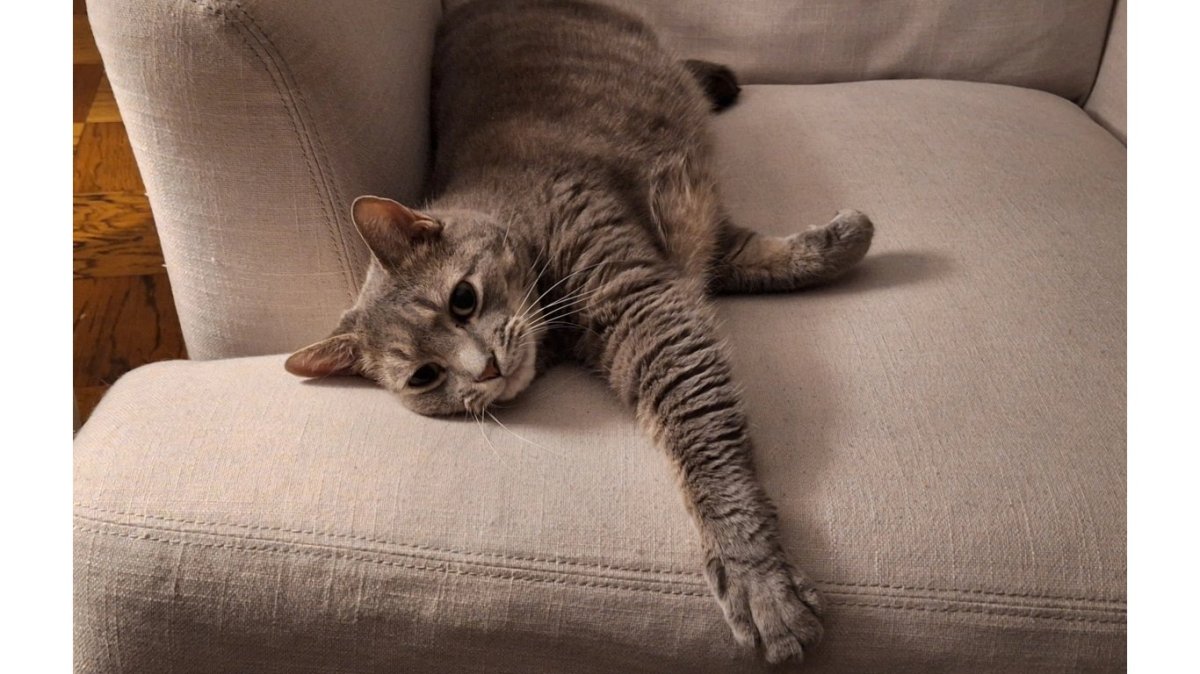
NEW YORK — In a sluggish ballet involving gravity, the malleability of couch cushions and an ironclad commitment to expending minimal effort, Buddy the Cat unburdened the couch of his weight on Saturday.
Sources said the feline signaled his intent to leave the couch with a subtle shift of his weight, applying just enough pressure to angle the cushion downward and allow gravity to assert its tug on his portly frame.
What followed was a 15-minute process sources described as “like watching the last glob of ketchup slide out of a glass bottle.” Yawning with the non-effort, Buddy allowed gravity to shift his bulk millimeter by millimeter until part of his pudgy primordial pouch and one chonky leg dangled over the edge of the cushion.

Within another five minutes the remarkably lazy tabby cat had crossed a gravitational Rubicon and the edge of the cushion gave way, allowing him to drip languidly off the side of the couch and onto the floor.

Buddy sat up, licked his left paw, then roused himself with a trill and sauntered over to his dining nook to lap up some water.
“It’s a bit like watching paint dry, but I applaud his unwavering commitment to laziness,” said a witness. “This is obviously a cat for whom even the thought of burning a single calorie is deeply offensive.”
Buddy was last seen screeching at his human to fetch him a snack to replenish his “electrolytes and stuff” after his arduous walk to his bowls in the adjacent room.

Free-ranging cats do have a negative impact on wildlife, but we’re not going to solve the problem by demonizing them and culling them by the millions.
The Literary Hub story starts off with a provocative question: what if cats ruled the world?
This is a question I find amusing to ponder, so instantly my mind was filled with images of cats scandalizing foreign heads of state by insouciantly swiping gifts off tables, angering diplomats by yawning and nodding off during summits, and financing the construction of massive and unnecessary coastal walls, on the off chance the ocean decides to move inland and get them wet.
Then the writer cited the repeatedly-debunked “study” that credulous media of all stripes still reference without bothering to read the text — that infamous 2013 Nature Communications paper, published by birders who author books with titles like “Cat Wars: The Consequences Of A Cuddly Killer.”
Some journalists don’t know any better, some are overworked, and some are frankly too lazy to read the study with a critical eye, but I think one of the more likely reasons people continue to cite the paper is because it’s easier to blame felinekind for wildlife extirpation than it is to admit we’re the primary culprits. After all, according to the WWF’s most recent annual review, we’ve killed off 73 percent of Earth’s wildlife since 1970, and we certainly didn’t need house cats to help us push elephants, rhinos, every species of higher non-human primate, and innumerable other species to the brink of extinction.
We did that. We did it with our relentless development, consuming and fracturing wild habitats. We did it with careless industrialization, by dumping chemicals and garbage into our rivers and lakes until more than half of them were rendered too polluted to swim in or drink from. We did it by bulldozing old growth forest and jungle, by exploiting species for fur, folk medicine, ivory, sport hunting and in the illegal wildlife trade.

More than 47,000 species — that we know of — are headed toward extinction. It’s so much easier to blame it on anyone or anything else than admit we need to make major changes to our lifestyles and policies.
But don’t take my word for it. Here’s what Alley Cat Allies has to say about the 2013 meta-analysis and its derivative papers:
“The Smithsonian-funded study published in Nature Communications is not rigorous science.
It is a literature review that surveys a variety of unrelated, older studies and concocts a highly speculative conclusion that suits the researchers’ seemingly desperate anti-cat agenda. This speculative research is highly dangerous. It is being used by opponents of outdoor cats and Trap-Neuter-Return (including the authors) to further an agenda to kill more cats and roll back decades of progress on TNR. And it is being spread unchecked by the media.“
Here’s what a group of ethicists and anthropologists wrote about the claims against cats in the journal Conservation Biology, lamenting the lack of nuance and danger in arguing that cats must be stopped “by any means necessary.” The drive to blame felines, they argue, has “fueled an unwarranted moral panic over cats”:
“Contrary to Loss and Marra’s claims that the scientific consensus is consistent with their views that cats are a global threat to biodiversity, the actual scientific consensus is that cats can, in certain contexts, have suppressive population-level effects on some other species (Twardek et al. 2017). This is something that is true of all predators, native or not (Wallach et al. 2010). Thus, cats should not be profiled as a general threat a priori and without reference to important factors of ecological context, situational factors, clear definition of harms, and evidence thereof.”
“There are there are serious reasons to suspect the reliability of the new, extreme cat-killer statistics,” wrote Barbara J. King, retired chairwoman of the department of anthropology at The College of William and Mary.

Like we’ve often noted here on PITB, the authors of the Nature Communications study can’t even say how many free-ranging felines exist in the US. They say it’s between 20 and 120 million. That’s a 100 million difference in the potential cat population! How can they tell us how many birds and mammals are killed by cats if they can’t even tell us how many cats there are? No amount of massaging the numbers can provide an accurate picture if the initial data is shaky or nonexistent.
Furthermore, the nature of a meta-analysis means the authors depend on earlier studies for estimates on predatory impact, but the 2013 Nature Communications paper does not include any data —not a single study — on feline predatory impact. In other words, they have no idea how many animals free-ranging cats actually kill.
In authentic studies that actually do measure predatory impact, the data varies widely in geographic and demographic context. Data derived from the D.C. Cat Count, for example, shows that cats living more than 800 feet from forested areas rarely kill wildlife, and are much more likely to kill rodents.
Those who cite the bunk study and its derivatives are “demonizing cats with shaky statistics,” King wrote, adding she was alarmed by “an unsettling degree of uncertainty in the study’s key numbers.”

Ultimately, we agree with Wayne Pacelle, former president of the Humane Society of the United States.
The meta-analysis authors “have thrown out a provocative number for cat predation totals, and their piece has been published in a highly credible publication, but they admit the study has many deficiencies. We don’t quarrel with the conclusion that the impact is big, but the numbers are informed guesswork.”
Cats do have a negative impact on wildlife, it varies according to local circumstances, and those of us who love cats have a responsibility to keep our pets indoors and help manage free-ranging populations.
But cooler heads must prevail, approaches to managing cats must be evidence-based, and the effort requires people of all kinds working together — which becomes much more difficult when agenda-driven pseudoacademics whip people into a frenzy by portraying felines as bloodthirsty, invasive monsters who need to be wiped out “by any means necessary.”
When that kind of rhetoric drives public policy, you get countries like Australia killing two million cats by air-dropping poisoned sausages, vigilantes gunning down cats with shotguns in public parks, and local governments offering cash prizes to children who shoot the most cats and kittens. Those efforts aren’t just cruel and inhuman, there’s not a shred of proof that they do a damn thing to help other species.
Solving the problem of free-ranging cats requires us to own up to our own role in species extinction and to take measured, evidence-based steps to protect vulnerable wildlife. Otherwise, we’re inflicting a whole lot of suffering on sentient creatures and accomplishing absolutely nothing.
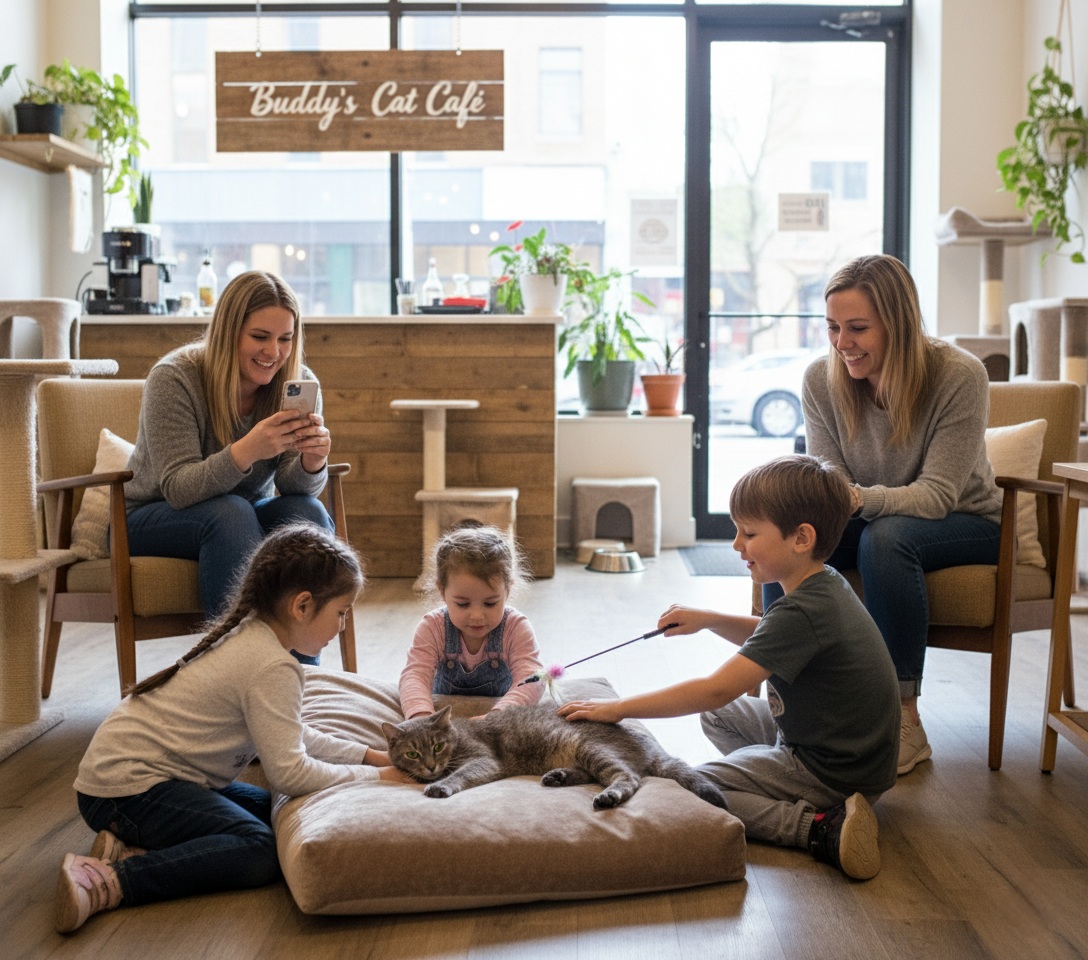
Buddy’s Cat Café and Catnip Lounge has become a neighborhood fixture where feline lovers can enjoy their favorite caffeinated beverages while lavishing snacks and catnip on Buddy himself.
NEW YORK — When Buddy’s Cat Café and Catnip Lounge first opened its doors in late 2023, skeptics were quick to predict its demise.
“A cat cafe featuring only one cat sounds more like the selfish plot of the proprietor feline and less like a legitimate cat cafe experience,” the New York Times sniffed, while the New York Post derided the venture as “one chubby cat’s ludicrous scheme to gorge on endless snacks and catnip while customers line up to shower him with affection.”
Two years later, with a 4.8 out of 5 rating on Google and hundreds of regulars, Buddy’s Cat Café has not only been a success, it’s inspired other felines to open their own single-cat locations.

Mrs. Tomoko Nakamura, a teacher at the Japanese Academy of Manhattan, has been taking her class to Buddy’s since the cafe opened.
“Badi-chan very handsome and charming,” Mrs. Nakamura said, smiling as her students giggled and offered an array of crunchy treats to the lounging feline. “All my students love him!”
Sisters Dierdre and Stephanie Sullivan are regulars who say they take their kids to Buddy’s almost weekly.
“Madisyn, Skyelarr and Jaxon just love little Buddy,” Stephanie Sullivan said, calling other cat cafes “a tragedeigh in comparison.”

Since its opening, Buddy’s has featured an array of themed nights that cater to regulars with shared interests.
On Saturdays a lively crowd of people wearing perms, neon clothes and big shoulder pads flock to the cafe for Retro 80s Night. Sunday crowds gather to watch football with Buddy on the big screen TV, and Tabletop Tuesdays cater to miniature wargamers, with Buddy and his regulars continuing long-running campaigns in Dungeons and Dragons and Warhammer 40K.
One of the most popular themed nights is Freestyle Fridays, when local rappers and hip hop heads gather to spit bars, smoke blunts and collaborate on beats.


Da Ill Collektah, a local underground emcee, rolls catnip blunts for the tabby proprietor so he can fully participate in the levity.
“Oh, that’s good ish!” Buddy said on a recent Friday as he exhaled a nimbus cloud of ‘nip smoke to cheers from the assembled hip hop heads.
“Watch out!” beatsmith Biggity Biggity Bryce exclaimed. “Buddy gonna bless us with a fiyah freestyle!”
Lysander The Lyrical Destroyer, a Brooklyn emcee and longtime “associate” of Buddy, said no other cat cafe could hope to compete.
“Buddy’s cafe got the freshest jams, the livest atmosphere, and the bang bang boogie don’t stop the boogie,” he noted. “But most of all, it’s got Buddy.”
Positive contact with our furry friends releases happy chemicals for both human servant and feline master, improving their bond.
Happy Cater, uh, unday!
We’ve got no immature cat humor for you today, but I thought PITB readers might be interested in this essay from The Conversation, which despite its ominous title actually goes into some detail about research showing the positive effects of bonding with a cat.
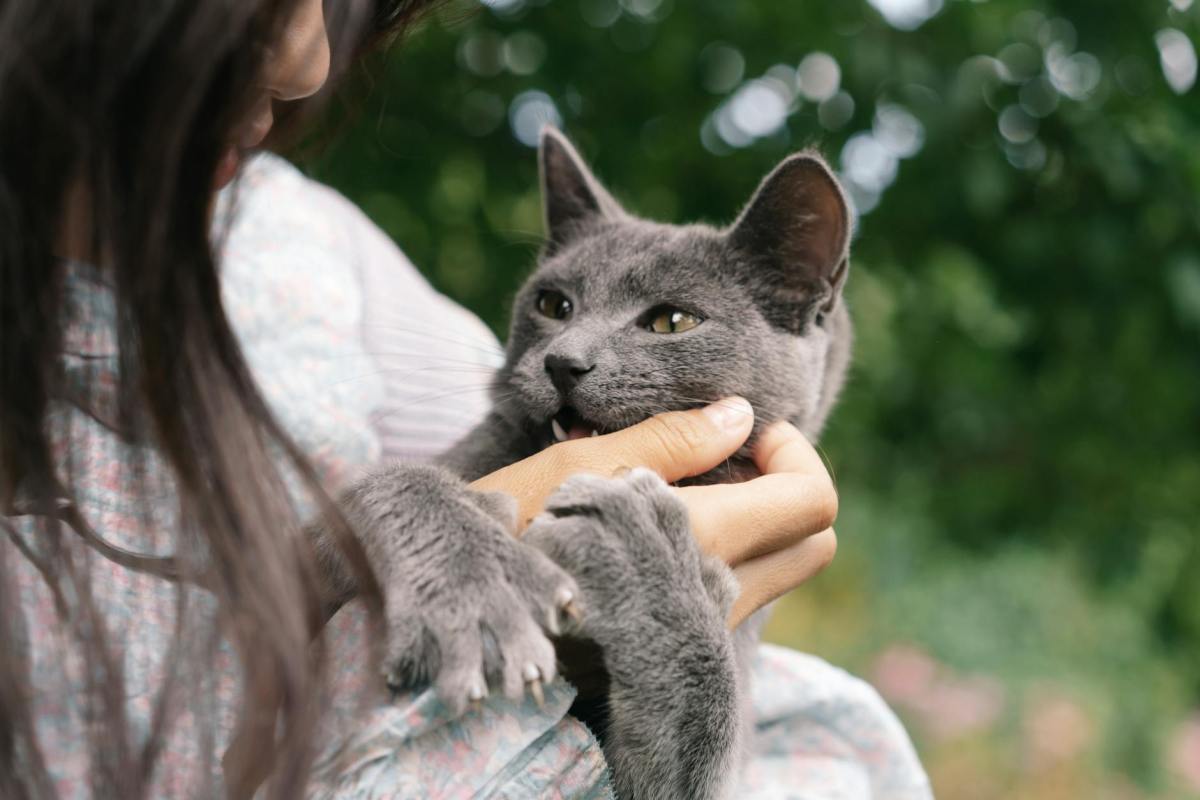
Affection between you and your feline friend results in a burst of oxytocin — the happy brain chemical — for both of you.
But crucially (and here’s where I feel validated for constantly preaching this), your cat enjoys the benefit only if the little one is securely attached and is not forced into interaction.
I’ve said it so many times, I feel like a broken record, especially because the web is saturated with articles that ask “How Can I Make My Cat Like/Love Me?“
And the answer, of course, is that you can’t.
That’s part of what makes cats so awesome. We have to earn their trust and affection, and a major part of that process is respecting our cats’ feelings. That means we let them come to us, we stop petting them when they’ve had enough, and we don’t prevent them from leaving when they decide they want to lay on the couch or the floor instead of our laps.

Cats grant us benefits beyond oxytocin boosts, of course, and the linked article goes into that as well. It’s well worth a read, even if you’re an old pro at cat whispering.
It’s obvious I model President Buddy’s behavior after a certain someone in addition to dialing his own traits up to 11, but in the wake of recent news, a story I’d written no longer feels funny.
Not because it was offensive, but because satirizing current events just feels inappropriate with all that’s been going on, from our extreme polarization and political violence, to the sad state of global affairs.
At the same time, I spent quite a bit of time making another denomination of Cat Dollars, and since there’s no longer any satirical story for it, I figured I’d share it here.
President Buddy sure does like seeing his portrait everywhere. This time I skipped the powdered wig and gave him a more modern appearance:

Meowster Money and Meowster Delicious are the treasurer and secretary of yums, respectively. A thousand cat bucks is a lot of cans! (Or snacks.)
In the meantime I’ve been working on some designs I hope to turn into t-shirts and possibly other things like prints. They range from a regal-looking lion to a jaguar roaring in the night with a retrofuturistic feel. Watch this space for more details in the near future!