The palm oil and logging industries have killed so many orangutan mothers, there are now more than a dozen major orangutan orphanages in Borneo and Sumatra. The pressure on orangutans, with whom we share 97% of our DNA, shows no signs of abating.
Orangutans are critically endangered, and the biggest threat to their continued existence comes from the agricultural sector, which has razed 55 percent of the species’ habitat in recent decades.
Jarang, a baby orangutan born in 2023. Credit: Blackpool Zoo
Logging companies clearing irreplaceable, old-growth jungle to claim more land for palm oil plantations have no compunction when it comes to flattening jungles despite the presence of orangutans hiding in the trees. The loggers often shoot the large apes on sight, leaving terrified, traumatized babies still clinging to their dead mothers, or taking them to sell as pets.
Of those left to die, the lucky babies are rescued before they starve and are brought to one of the many orangutan orphanages in Borneo and Sumatra, where they attend “school” to learn how to do everything from climb to forage. It takes at least eight years to teach them how to survive on their own, which is about the time it takes orangutan mothers to do the same job in the wild.
The unlucky babies end up as local pets, sold off to entertainment troupes or shipped off to places like Dubai, where wealthy clients will pay a premium for them.
Caretakers must start by teaching rescued orphans the most basic things, like how to climb and move through the jungle Credit: Borneo Orangutan Survival FoundationLogos, an orphaned baby orangutan who was rescued in 2023 by the Jakarta Animal Aid Network (JAAN) Credit: International Animal Welfare Fund (IAWF)Baby Galaksi (Indonesian for galaxy), was found wandering the jungle without his mother in 2021 by a villager in Borneo. He’s now in a “school” that teaches orphaned orangutans how to do everything from evading predators to discerning edible fruit from harmful and poisonous varieties. Credit: Samboja Lestari Orangutan Rehabilitation Centre
So what is palm oil, and why are countries in Asia bulldozing ancient jungles and forests to clear room and make more plantations?
Per the WWF:
“Palm oil has been and continues to be a major driver of deforestation of some of the world’s most biodiverse forests, destroying the habitat of already endangered species like the Orangutan, pygmy elephant and Sumatran rhino. This forest loss coupled with conversion of carbon rich peat soils are throwing out millions of tonnes of greenhouse gases into the atmosphere and contributing to climate change. There also remains some exploitation of workers and child labour. These are serious issues that the whole palm oil sector needs to step up to address because it doesn’t have to be this way.
…
Palm oil is in nearly everything – it’s in close to 50% of the packaged products we find in supermarkets, everything from pizza, doughnuts and chocolate, to deodorant, shampoo, toothpaste and lipstick.”
Palm oil is in constant demand, and it’s an easy to grow, incredibly efficient crop. Indonesia and Malaysia, the only two countries in the world where orangutans exist, produce 85 percent of the world’s palm oil.
Images of orangutan babies in wheelbarrows are common on social media, but usually stripped of context. Orphanages use the wheelbarrows to bring infants and toddlers to and from “school” every day. Credit: International Animal RescueAsoka was found crying in the jungle by a fisherman in Borneo. He was brought to an orphanage in Borneo. Credit: International Animal Rescue’s rehabilitation Centre in Ketapang, West Kalimantan
We share 97 percent of our DNA with orangutans, making the species our second-closest cousins from a genetic standpoint. Some studies claim orangutans are our closest relatives based on our phenotypical similarities.
Orphaned orangutans attending “school” to learn how to survive in the wild. Credit: Borneo Orangutan Survival FoundationA baby at an orangutan orphanage is fed by a caretaker. Credit: Borneo Orangutan Survival Foundation
Want to read more and learn how to help?
Here are some links to get you started. PITB is a big fan of the Jakarta Animal Aid Network, which successfully pushed Jakarta’s municipal government to ban the incredibly cruel “topeng monyet” monkey street shows:
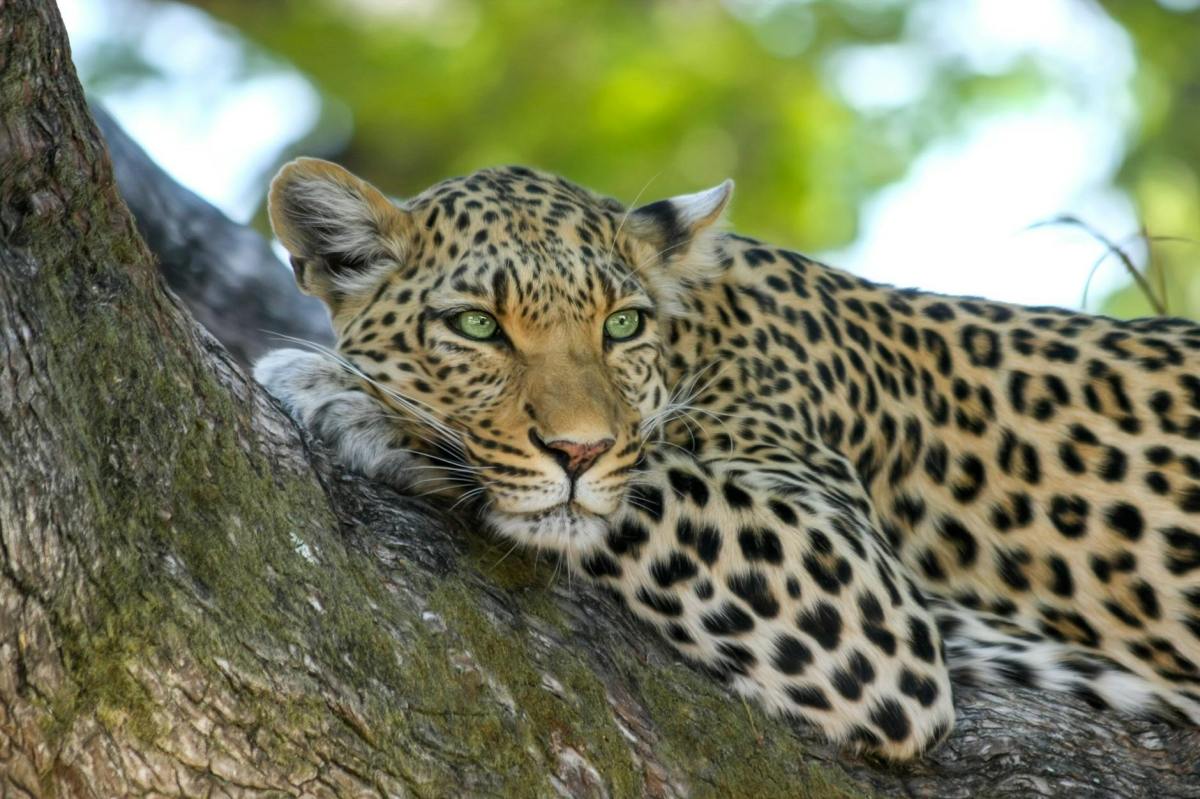
Buddy’s back at it, trying to befriend big cats. Emboldened by his success with the tolerant and wise jaguars, the reckless tabby has his sights set on the savanna and its temperamental predators, the leopards. Can Buddy win the admiration of these notoriously dangerous felids, or will he end up as a light snack for a spotted cat?
VIRUNGA NATIONAL PARK, Democratic Republic of Congo — “What the heck is that?”
A leopardess raised her head in response to her mate’s question, gazing down from the sturdy limb of an acacia tree where she’d taken refuge from the scorching midday sun.
Two hundred yards ahead, a tiny gray cat was padding toward them, picking his way carefully around rocks and occasionally disappearing in the high grass.
“There’s nothin’ that a hundred men on Mars could ever do,” the little feline sang as he walked. “I bless the rains down in Africa! I bless the rains down in…”
The diminutive feline stopped near the base of the tree and looked up at the leopards.
The adult leopards were momentarily stunned until one of the cubs awoke from her nap, spotted Buddy and exclaimed: “Look, mommy, lunch!”
The small cat flashed a wide smile.
“That’s a great idea! I’ve already eaten, but you know what they say: a lunch a day barely keeps the rumbles at bay! I’m a three-lunch cat, myself. So what are we having?”
Another cub piped up.
“That’s not lunch, that’s a snack!” he told his sister.
“And what a cute little snack he is!” the female cub said, gracefully dropping from her napping spot in the tree.
Buddy’s eyes bulged.
“You’re…you’re talking about me?”
The male cub did a squeaky impression of a roar.
“Do you see any other single-serve snacks around?”
Buddy licked his lips, his effort to hide his fear betrayed by his rising hackles and tail, which now resembled a quivering spiked club.
“I…I…I am a cat,” he said in his best impression of an authoritative meow. “I’m practically your cousin!”
The female was just paces away now and moving too fast for Buddy’s liking as he backpedaled.
“The question is,” she said, “are you tasty like cousin Serval or cousin cheetah?”
Credit: RudiHulshof/iStock
Buddy changed tactics.
“This is an outrage! Not even the tigers tried to eat me! This is…this is, uh, catibalism!”
The cubs were circling him now.
“Mommy, can we have a snack?” the male cub called, looking back at his mother on the tree.
“As long as it doesn’t spoil your dinner later,” came the reply.
“It won’t, mamma!”
Buddy gulped.
The cubs closed the distance, ready to strike, and Buddy was babbling while pleading for his life when the earth itself shook.
Branches jolted and leaves dropped. A flock of birds nesting in a nearby tree took off, silhouettes etching ephemeral geometric patterns in the sky. In the distance, a baboon shrieked a warning to its troop.
The cubs went from aggressive to retreat in the span of an instant, and even their parents looked alarmed, taking off after their young.
Buddy watched them flee, wondering if he should bolt in another direction as something incomprehensibly gargantuan lumbered toward him, shaking the trees.
He’d emptied his bowels by the time a gigantic head poked through the foliage, followed by the rest of the colossal beast. It was gray-skinned, leathery and bizarre, unlike anything Buddy had ever seen.
“Giant space aliens!” he screamed, turning around and running right into a tree trunk.
“Ahhhhh! Don’t eat me!”
Buddy awoke in a sweat, his fur damp in the soupy, stifling heat.
An entire platoon of the peculiar beasts stood around him, their sizes ranging from 25 Buddies in mass to freakishly large individuals sporting pairs of prodigious teeth that looked like scimitars made of bone.
“Einstein’s awake,” one of them rumbled, and the rest turned from stuffing themselves with leaves to get a better look at the Liliputian animal before them.
“What is that thing?” one of them asked.
“It’s a fun-size cheetah!” one exclaimed confidently.
“No, it’s a baby Serval!” another said. “But the color’s all wrong.”
In the distance, a giraffe poked its head above the tree line, pausing to munch on the silky pink flowers of a mimosa tree.
Buddy was saved from hungry leopards by friendly giant space aliens!
Buddy cautiously pushed himself up on his paws. These aliens did not seem interested in eating him.
“Greetings,” he said. “I am a feline, a cat from planet Earth! What planet do you come from?”
There was a pause, then trumpeting, cacaphonic laughter.
“‘What planet are you from?'” one of the great beasts mimicked, sparking a second round of giggles that sounded like the trombone section of an orchestra, if someone had slipped the players psychedelics.
“We are elephants, and this is our home,” said the leader, a magnificent female. “And you, little one, are fortunate we happened by.”
Buddy puffed himself up.
“I think you mean the leopards were lucky,” he said, flexing his meowscles. “They didn’t want to tangle with these guns.”
The elephants chortled. “Can we keep him? He’s funny!”
The matriarch shook her massive head.
“He is far from home, and he should return before he runs into leopards again, or something worse,” she said.
Buddy looked unsure of himself.
“But I’m homies with the jaguars and the tigers! I thought…you know, I could be down with the leopards too. Us big cats gotta stick together, ya know? It’s hard out there for an apex predator. By the way, got any lunch?”
One of the elephants raised her trunk, pointing east toward a herd of intimidating horned beasts.
“Lunch,” she said. “Think you can take them?”
Buddy gulped.
“Go home, little one.”
Buddy’s version of events!
“So anyway,” Buddy said, addressing his human, “that’s how I impressed the leopards, and they made me their king. In fact, they bestowed the honorific ‘Paka mkubwa na mwenye misuli hodari,’ which means ‘great and mighty muscled cat’ in Swahili!”
“Sounds like you had quite an adventure! That’s impressive, Bud!” Big Buddy said.
“It is! It is!” Buddy said, nodding vigorously.
Big Buddy made a whistling sound.
“Was that before or after you peed yourself in terror?”
“What? I…no, I told you, they made me their king! Where did you hear this, this slander?”
Big Buddy reached for his iPad, pulling up images of a terrified Little Buddy running from leopard cubs on the savanna, Buddy running head-first into a tree, and Buddy cowering before a herd of elephants.
“A wildlife tour was nearby during your ‘coronation,’ but this is probably just a gray tabby who looks exactly like you and happened to be right where you were crowned,” he said. “Congratulations, Your Meowjesty!”
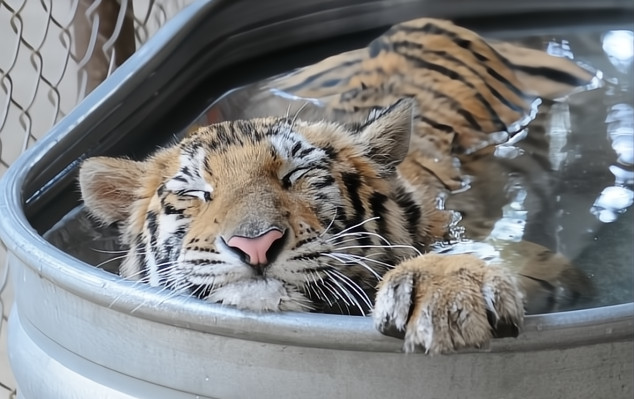
For tigers, going for a dip on a hot day is pure bliss.
Most cats wouldn’t go near water if even if you lured them with a giant spread of catnip and Temptations on an inflatable table.
But tigers? They love it. Here are some shots of the world’s biggest cats taking a dip.
A Malayan tiger named Azul going for a swim at the Bronx Zoo. Credit: Julie Marsen Laher, Wildlife Conservation Society
Siberian tigers in a tub at a sanctuary in Russia. Credit: digger03/Flickr
This meme made me laugh.
Aasha was rescued from a traveling circus after an inspector found her sickly, suffering from ringworm and only 30 pounds at 8 months old. She’s flourished since she was brought to a sanctuary where she’s been given proper care, a good diet and a calm environment. Aasha is also pictured in the feature photo up top.
A tigress and her cubs cooling off in a river in India. Credit: Sandesh Kadur
Sundarban tigers are a subspecies of the Bengal who live in mangrove forests and are well-adapted to swimming. This Sundarban tiger was spotted on a wildlife tour in India. Credit: Soumyajit Nandy/Wikimedia Commons
This tiger cooled off on a hot day at the Dortmund Zoological Garden in Dortmund, Germany. Credit: Hans Stieglitz/Wikimedia Commons
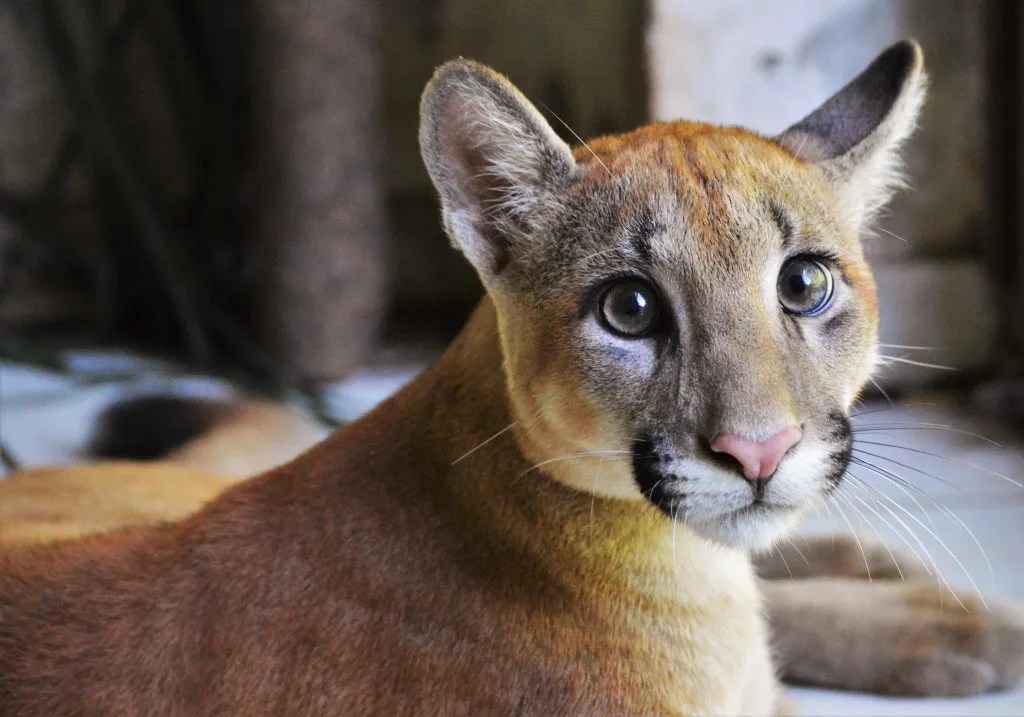
The puma, also known as the mountain lion, cougar, screamer, panther, catamount, suçuarana, pangui, American lion and dozens of other names, looks like a big cat but is genetically closer to our domestic Feline friends.
Credit: Merazonia Animal Refuge of Ecuador
Credit: Wikimedia Commons
Credit: Elizabeth Lucas
Credit: Wikimedia Commons
Credit: Wikimedia Commons
Credit: Wikimedia Commons
Click images for full high resolution versions. Baby puma image credit Elizabeth Lucas. Prints available here.








 Wait a second, this last jaguar cub looks kinda familiar…
 Pain In The Bud