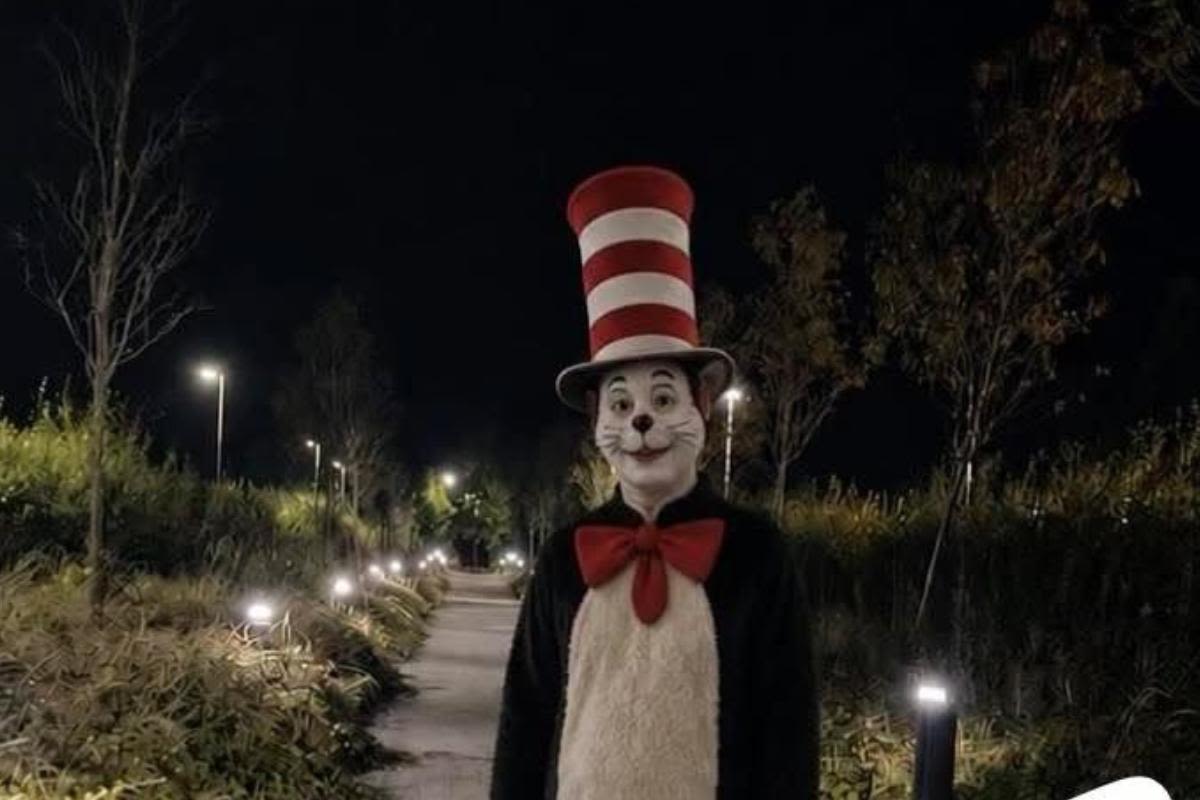
Viral videos show figures dressed as the Dr. Seuss character terrorizing unsuspecting people in mostly quiet suburban settings.
There’s a new freak-out among the terminally online, mostly relegated to Gen Z and people who spend significant amounts of time on TikTok – they think a Dr. Seuss character made flesh is popping up in the suburbs of the UK and Ireland to stalk and scare the pants off people.
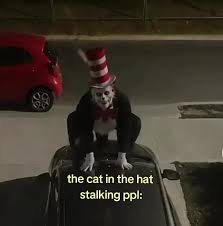
Videos featuring the iconic children’s story character have gone viral on the platform in the last week or two, each of them showing similar scenes: it’s night, usually in some safe-looking suburb, and a person wearing a full size Cat In The Hat costume pops out of the bushes or from behind a car to terrify unsuspecting passersby.
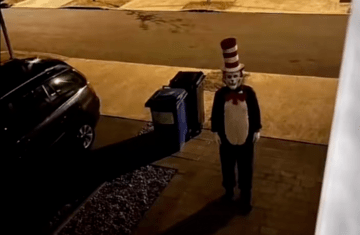
Others show the costumed creeps simply standing in driveways or in the middle of the street and silently observing people in their homes.
The alleged perps favor a more sinister look than the traditionally friendly-looking creation of Theodor “Dr. Seuss” Geisel in 1957. These cats in hats wear a disturbing grin or a sneer, and some videos depict the costumed weirdos leaping onto cars with feline athleticism or stalking the people they encounter.
While the footage looks real enough that it initially fooled UK media as well as kids, police in several jurisdictions have looked into the reports and concluded the videos are AI generated, likely with Chinese-made tools like Wan and Skywork.
OpenAI, one of the leading AI companies in the US, shut down its Sora AI video generator earlier this year amid widespread criticism and abuse of the tool.
While Sora had guardrails preventing users from generating certain kinds of content or violating intellectual property (you could not, for example, generate a video of a laughing Mickey Mouse gunning down a crowd of people with an Uzi), many of the Chinese-made video generation tools do not place restrictions on videos.
Some western companies have tried to compete in that space, including TripleTaco, which runs quite possibly the creepiest ads touting “AI that never says ‘no.'”
In any case, the panic over the Cat In The Hat mirrors a similar freak-out in India earlier this year when social media was flooded with realistic videos showing tigers and leopards mauling people having their morning tea outdoors or snatching them from moving trains.
The Cat In The Hat videos haven’t really caught on in the US, possibly because it stretches credulity to believe trigger-happy ‘Mericans wouldn’t just shoot weirdos stalking through our neighborhoods.
Regardless, it’s a good reminder to take everything with a grain of salt, especially anything you see on social media.
Not all pets are created equal, but not all studies are either.
A new study claims we’ve gotten it wrong all these years, that pet cats and dogs aren’t good for young children, while kids who grow up with pet fish, turtles and hamsters learn empathy and develop better mental balance.
The authors of the study claim cats are “the only common pet linked to more mental health problems in children.”
Furthermore, the authors claim, pets like turtles, fish and hamsters are “linked to” positive mental health in children, while data shows dogs have no effect.
To understand what we’re dealing with here, we’ve got to break down “study,” “linked to” and “data” in relation to the report by researchers at the University of Valencia in Spain.
“Study” here means a meta-analysis of data collected by the INMA Project, a collaboration of universities, biomedical institutes and medical conglomerates in Spain. INMA is primarily concerned with researching the impact of environmental pollutants on early childhood development.
The INMA data was not collected specifically for this new study dealing with pets.
Secondly, while INMA did “track” some 1,900 participants from birth through six or seven years old, the “data” itself primarily consists of subjective reports by the parents of the children along with “environmental measurements and clinical tests.”
Credit: isaac mijangos/Pexels
It’s not clear if the original data collection effort had anything to do with the presence of pets in the homes, or if that was just one of many data points gathered in a larger assessment. For example, the INMA questionnaires may have simply asked if the families have pets and what kind of pets they have without any further elaboration or information about whether, or how often, the children interact with the pets. There can be enormous variation in that area alone.
Then there’s “linked to,” a very specific choice of words by the authors. They’re using “linked to” instead of “caused by” because the data they have – if you can appropriately use the word data to describe the results of self-reported questionnaires based on subjective feelings – cannot distinguish between correlation and causation and really says nothing at all except certain animals were present in the homes of young children.
In all, 8.7 percent of the children lived in homes with a cat, which works out to a sample size of 165, all from Spain.
So we’re already on really shaky ground here. I don’t think there’s any real scientific value in information that comes from questionnaires distributed to parents, and certainly not when it comes to topics like mental health and behavioral problems.
The definition of bad behavior varies widely between parents in different families and even mothers and fathers in the same family. Was there a baseline? Did the participants receive instructions on how to describe their assessments so they’d at least roughly resemble uniform reports? Were there other commonalities among the children who lived in homes with cats? We don’t know the answers to these questions.
Credit: David Brown/Pexels
What we do know is that, putting all other concerns aside, the report claims that 165 children live in homes that have cats, or had cats at one time, and some of them have varying degrees of behavioral problems.
That the conclusions are vaporous becomes even more obvious when the authors go on to speculate, with no data, why children who live with, or previously lived with, cats are allegedly more likely to suffer behavioral issues.
They repeat common misconceptions about felines being aloof, claiming the nature of cats “limits emotional bonding” compared to other companion animals.
“Having fish, turtles and hamsters on a constant basis does seem to protect children from mental health problems,” the authors concluded, although again the reasons are pure guesswork.
I’m not sure how anyone can say feline behavior “limits emotional bonding,” then in the very next paragraph claim fish and turtles, animals with which there can be very little or no real interaction, “protect” kids from mental health issues. Not even “help protect,” but full on “protect.”
The authors also point to a common boogeyman, toxoplasma gondii. The parasite can be transmitted to humans dozens and potentially hundreds of different ways, including contaminated water and undercooked meat, but cats are blamed because they’re easily infected by it and can pass it to humans.
To be clear, toxoplasma gondii does not figure anywhere in the data and the researchers did not test the children for infection.
Credit: Cristian Loayza/Pexels
But the bit that sets off the most alarm bells in my mind is the claim that dogs have no impact on the mental health of children.
That should have immediately prompted the research team to go back and figure out where their analysis went funky.
There are so many studies linking cats and dogs, and especially dogs, to tangible improvements in mental health and mood that anyone who claims the opposite has a lot of work ahead of them to demonstrate why their findings are accurate and the abundance of studies that concluded the opposite are flawed. (Dogs are better studied than cats because they’re easier to control, so the abundance of studies on dogs shouldn’t be confused for a stronger impact on human health.)
Whenever I write something like this, I always worry I’m contributing to the anti-science positions of some people who view the entirety of science with suspicion.
Science is nothing more than a formal process for learning about the natural world. It doesn’t have an agenda. It’s important for us to separate our qualms with the methods and standards of particular studies from the idea of science itself. A study may be flawed, but the scientific method remains the best, most time-honored way to expand human knowledge we’ve managed to come up with.
There are also major differences between “soft” sciences like psychology and hard sciences like physics and chemistry. The latter are primarily black and white, true or untrue, while the former deal with uncountable shades in between. It’s hard to quantify human feelings, thoughts and behaviors.
I’m sure the researchers involved in this project mean well, but unless we begin to see other studies placing fish, turtles and hamsters atop the pet hierarchy for their impact on mental health, I think we can file it as an anomaly and move on.
The news site that reported the chief mouser’s death is going with the “we were hacked” excuse.
“If your mom tells you she loves you, verify it with a second source.”
If that sounds absurd, well, it’s meant to be, but it was also a favorite maxim of news editors before the “publish now, verify later, never admit mistakes” style of journalism became the norm.
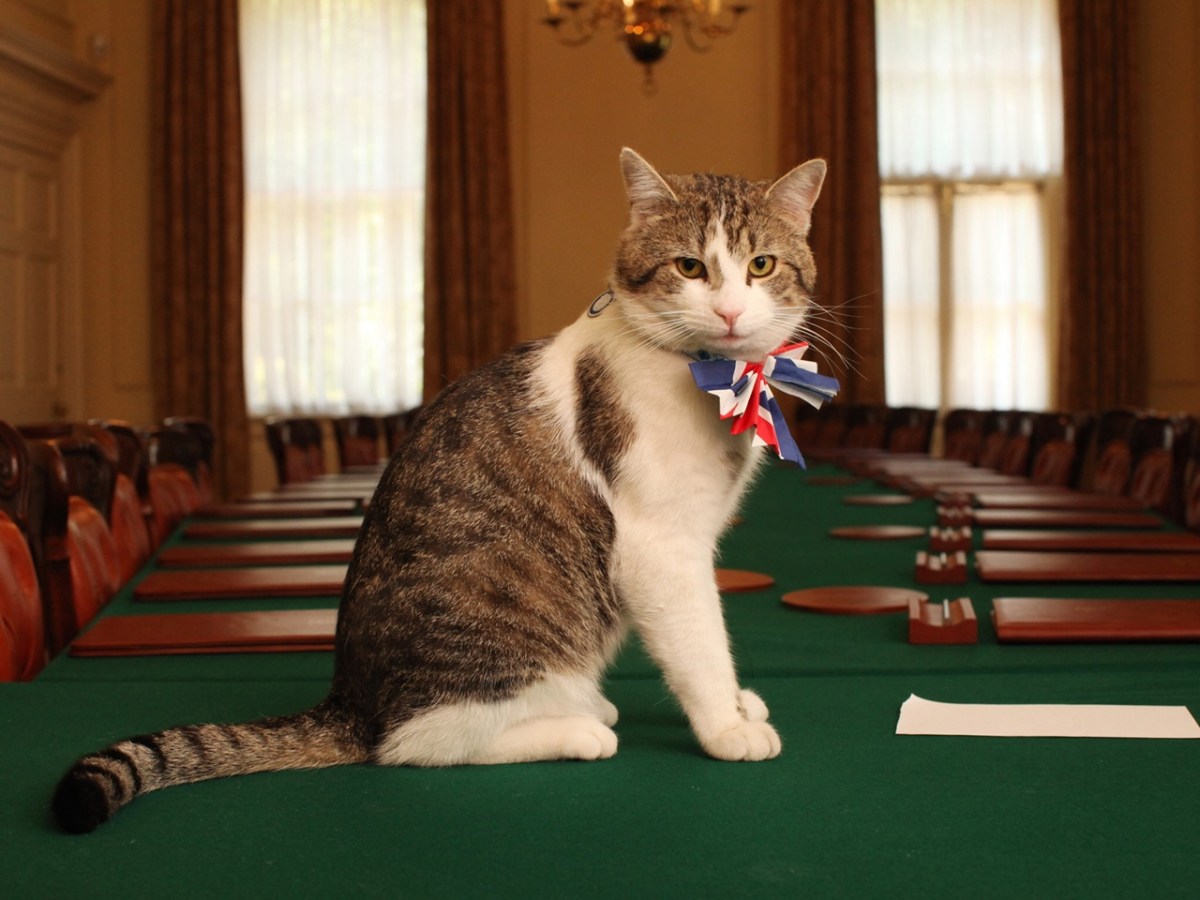
Rushing to publish without verifying is precisely why Politics UK – a news site founded by British populist Nigel Farage – ended up with egg on its face after it reported the death of the beloved 19-year-old mouser at London’s No. 10 Downing St., Larry the Cat.
The site’s editors went with the “we was hacked!” excuse, or a variant of it, claiming their usually reliable source had been compromised by a hacker who wanted to cause mischief.
Even if that’s true, it could have been avoided by simply picking up the phone and calling the prime minister’s office at Downing Street. That’s journalism 101.
Getting a statement from the prime minister’s office would have been part of the reporter’s job here anyway.
While making a big deal over the alleged death of a cat might sound ludicrous to people outside the UK, Larry isn’t just a mouser. He’s become an avatar of stability in a chaotic era that has seen prime ministers swept out of office as quickly as they ascended.
His presence at the UK’s seat of power and his antics are ready-made for the British press, who frequently assemble outside the building while waiting for government announcements. Those reporters and photographers have a front row seat every time Larry chases off an interloper, fights a territorial battle or checks an ego by snubbing a powerful politician.
The press and public are deeply invested in Larry’s adventures, and his natural indifference to political developments is a calming counterweight to the often depressing news.
Meanwhile the real Larry remains blissfully unaware of the momentary distress caused by the false report of his demise, and was recently photographed napping on a windowsill at No. 10.
Larry’s unofficial X account also reassured the British public and admirers worldwide that the UK’s true leader is doing just fine:
We are very glad the iconic feline, who first took over chief mouser duties in 2011 and is now on his seventh prime minister, is alive and healthy.
In a statement, Americat President Buddy said he was relieved to hear from his counterpart across the Atlantic.
“Larry is a Tremendous cat, one of the best cats ever, believe me. They Love him Over There, its incredible,” Buddy wrote. “Now if the Canadian’s don’t send me 50 Ton’s of Turkey by 8 pm tomorrow I’m gonna hit them with Tariff’s the likes of which no one has ever seen! Tariff’s of AT LEAST 700,000%!!! The Governor of the State of Canada needs to Bend the Knee! Thank you for youre attention to this matter!”
Update 1:36 am: Added background on Larry’s time at No. 10.
When OG Anunoby teamed up with local New York cat rescues to promote an adoption event in June, the marketing materials were curiously devoid of any mention of Anunoby having a feline of his own.
The Knicks were still basking in the glow of their incredible run to the NBA championship, and Anunoby was doing a good thing, but there was a piece of the story missing.
Why was he helping cats?
Now we know.
Anunoby says he loves all animals, “but especially cats.” He just doesn’t have a cat of his own yet for a very practical reason: he’s on the road constantly as a professional athlete, and his job is extremely demanding on his time.
“Because of the season and the scheduling and all the travel I have to do, it’s hard to have one,” he told NBC Sports. “So, I don’t have one right now, but I do want to get one in the future.”
Some professional athletes make it work. Jordan Poole is the NBA’s most prominent cat lover and was a regular volunteer at a local shelter when he played for the Washington Wizards.
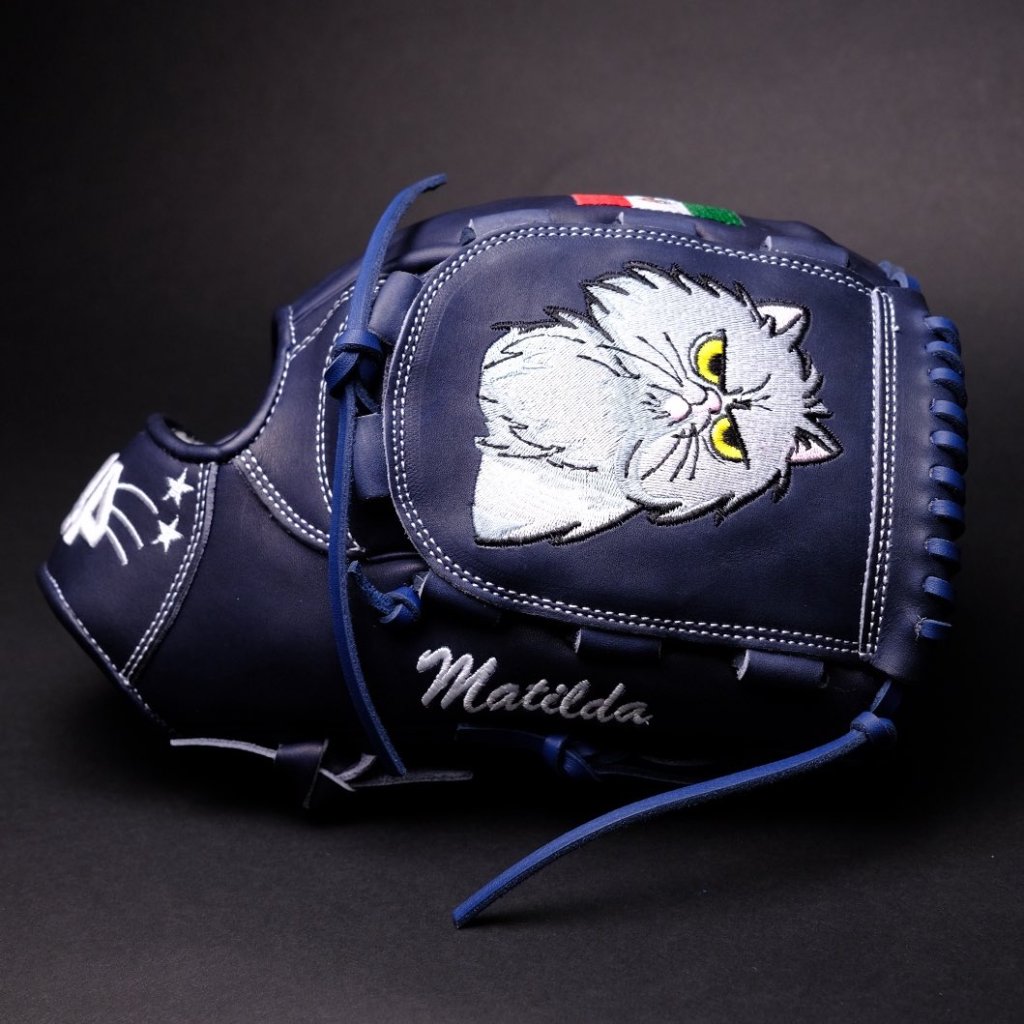
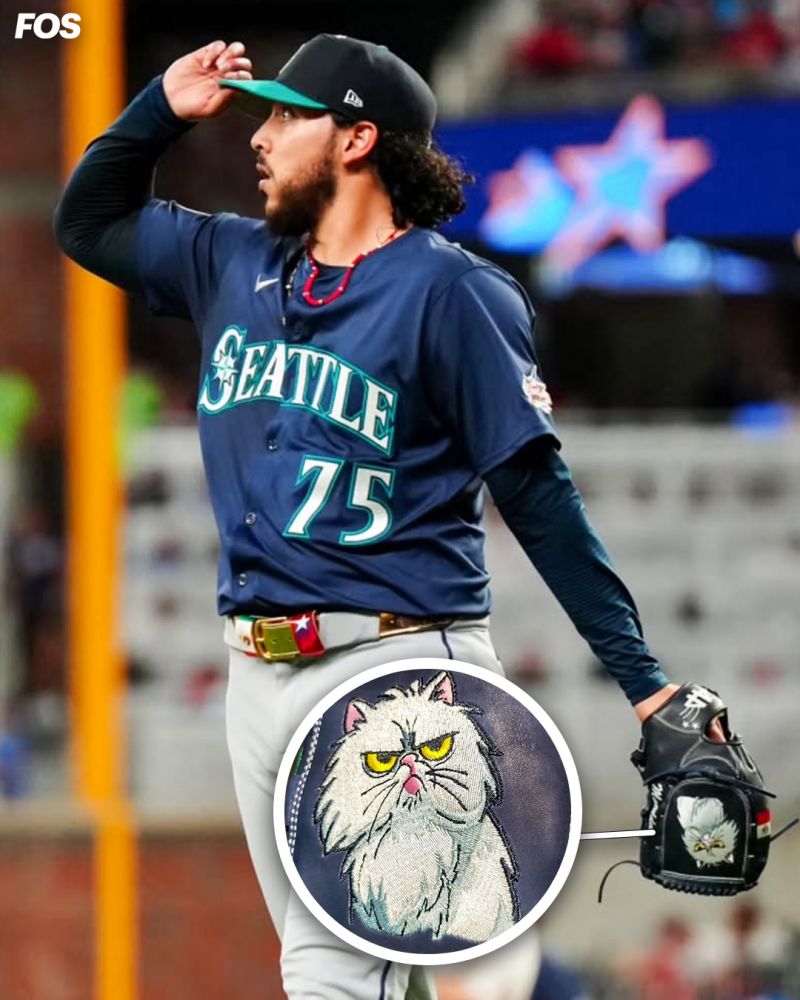
A close-up of Muñoz’s custom glove with his cat’s name and likeness.Munoz using his custom glove during an MLB game.
In Major League Baseball, 27-year-old Seattle Mariners closer Andrés Muñoz is famous for his devotion to his cat, Matilda. He had her hilariously sneering face and paw prints stitched onto a custom glove, and his wife brings Matilda with her on the road when the Mariners embark on road trips, so Muñoz can have his family with him.
Even Seattle fans love Matilda and she’s become an unofficial team mascot with her own bobblehead doll.
After picking a “starting five” of adoptable cats in June, Anunoby is currently partnering with Royal Canin in a campaign to urge people to take their cats to the vet for preventative care.
He’s beloved in New York not only for being an absolute badass on the court and for exceeding expectations as he hit one of basketball’s most iconic game-winning shots. He’s also loved for his demeanor. The dude’s a space cadet.
After the Kicks won it all, Anunoby stared quietly, immersed in his own thoughts during a national TV morning show appearance with his teammates, completely oblivious to the anchor who was asking him a question. The rest of the Knicks were doubled over in laughter.
He’s the kind of introvert who would probably make a good cat dad, so when he retires — or maybe when he gets a guarantee of stability, like a no-trade clause in his contract — he’ll provide a good home.
In the meantime, he said what every fan likes to hear. The Knicks enjoyed their championship, they basked in the celebration, but they know there are 29 hungry teams ready to stop them from repeating as champions, so now they’re back in the gym and putting in the work to level up.
Those of us with even a modicum of writing talent are suddenly bumping up against hostile readers who insist we’re purveyors of AI slop. The people we have to thank for this new experience? The purveyors of AI slop.
Fresh off reading a fiction novel and highly amused by the author’s tendency to go on bizarre tangents, I wrote a few hundred satirical words mimicking his style and shared it to a subreddit.
I expected like-minded people to respond. Hopefully they’d find it amusing. At the very least, it should spark a conversation.
Instead I checked back the next day to find my post hidden by downvotes.
The top comment: “AI slop, f— off loser.”
The second-highest rated comment was simply “ChatGPT.”
I should have cut my losses and moved on, but it bothered me that something I wrote could be so easily and thoughtlessly dismissed as the product of AI. So I responded explaining that I had in fact written the post, slapping it together during some downtime because I thought fellow readers might get a kick out of it.
I have many deficiencies as a writer which frustrate me to no end, but I do have a modest talent for literary mimicry that I’ve deployed at various times to make observations about novelists like George R.R. Martin, popular essayists like Mitch Albom, and people like Donald Trump, whose speech patterns are practically emblazoned in neon.
No, the commenters told me. You didn’t write that post, you used ChatGPT, you are a loser, and you need to f— right off with your AI slop.
Apparently it is now inconceivable that human beings with even moderate talent exist, that anyone would spend 15 minutes jotting down a satirical take on a popular book or TV show, or put any effort into anything at all when we can cognitively offload everything.
It just happened to me again twice in recent weeks, bringing the total to probably half a dozen times since January. It doesn’t happen here because readers know me, and the blog has been around for seven years. If I’ve been using a large language model to write this blog, then I must have a time machine that allowed me to access the tech at least two years before its first crude incarnations were tested in-house at OpenAI.
Plus there’s no other idiot out there who writes absurd stories glorifying his pet cat for fictional adventures like running a criminal catnip empire. It’s not as if there’s a line of people trying to emulate what we do here, nor is there profit in it. It’s a labor of love not just because I love cats, but also because I love my cat. He’s changed my life for the better and I enjoy writing about his antics.
Credit: Hatice Baran/Pexels
There is also a strong argument for not caring. Social media and general forums are not lacking for miserable cynics and people who work through their real life frustrations by vomiting bile in every direction.
I don’t need to justify myself to every cynic and malcontent, nor do I want to take on the burden of proving a negative.
The real-life impact of AI on the news and publishing industries
Unfortunately it’s becoming more difficult to ignore because it’s beginning to impact more than just online dialog.
Generative AI has put the editors of genre magazines and periodicals on their back feet. Editors, already overworked, find themselves trying to navigate “a swamp of slop.” Some have shut down general submissions entirely. Others have adopted convoluted processes or require known writers to vouch for the submitter, as if they’re applying for membership in an exclusive social club.
Generative AI is also destroying what’s left of the news industry, and the damage is now so widespread that it isn’t only impacting people who used to crank out simple daily stories. When entire publications fold and companies like Gannett turn formerly excellent broadsheets into little more than AI-generated shells for advertising inserts, investigative journalism jobs disappear and government employees at the municipal, county and state level operate without anyone keeping watch.
Credit: Mart Production/Pexels
I think about some of the stories I wrote: A series about an unusually high number of suicides on particular bridges in New York that led to major changes in safety features on those bridges. A comprehensive account of extensive fraud in the state jail system. An investigation into New York-based charities guilty of outright corruption or abysmal program spending, run by people who paid themselves well and held glitzy charity galas, but actually raised very little or nothing for the causes they claimed to represent. An interview with the traumatized dad of a mass shooter who kept blaming himself and asking “Where did I go wrong as a father?”
And the story I’m most proud of, an 11th-hour rush job about an abducted girl, an article I scrambled to get done by the print deadline and submitted just minutes before pagination files were sent to pre-press. The story ran in one of our sister papers in New Jersey, leading to a reader recognizing the kidnapper the same day it was published. The reader called police, who found the man with the young girl he’d abducted.
I helped save a kid from a horrific, life-altering trauma! I don’t say that to toot my own horn, but to emphasize the value of real journalism, of human beings prioritizing a story and making every effort to get it done and published when there are real stakes. The story wasn’t anything special, it didn’t stretch my abilities or win any awards, but it impacted the lives of a real family for the better.
A machine could not have taken a call from a panicked mother, reassured her every effort would be made to get the story out, driven to the detective bureau after hours to verify the details, found out where the abductor had roots, and made sure the story ran in the newspaper covering the area where the abductor likely fled with his victim.
That kind of journalism cannot be replaced by AI or bloggers. It takes training, strong news judgment, the ability to navigate bureaucratic circles of hell, and lots of patience in dealing with people who consider reporters irredeemable bottom-feeders.
At least as it stands now, generative AI can’t replace a thoughtful interviewer, a true investigative reporter, or honest analysis of important stories. An investigative reporter can use AI to help scour thousands of documents for a needle in a haystack or to search for hidden patterns, but that is an example of incorporating the tech into a workflow, using it to make drudge work easier, not using it to replace a human. Human consciousness and judgment is still the guiding force behind the effort.
Still, I’d be lying if I said it didn’t bother me that this is happening as often as it has been recently. We may be living in an age of algorithmic AI, of simulated intelligence instead of AGI and true machine cognition, but this is not what I envisioned while imagining the ways AI could impact society.
It’s also frustrating that my writing is now automatically dismissed as “slop” because it doesn’t have some arbitrary lack of polish to it, or because people are cynical in general.
My writing is the closest thing to my consciousness, to my mind, to me.
Obviously I format and attempt to copy edit my own posts. A replica of my stream of consciousness wouldn’t make for coherent, entertaining reading. But when I write a post about an issue impacting animals, my feelings for my best Bud, or something else that I’ve got an opinion on, you’re reading my thoughts on the subject.
That is a direct result of who I am. To offload that to a machine seems insane, an abdication of my mind, personality and voice to a fancy bit of code.
AI-generated content is even more ubiquitous than we realize
When I finish my novel — a narrative that weaves elements of space opera with themes about species conservation and appreciation for our one and only home planet — will I run into skeptical editors? Will some people dismiss it out of hand if they deem it too polished or they’ve been inundated with submissions from people who see AI as a shortcut to getting published? Will there still be a book publishing industry?
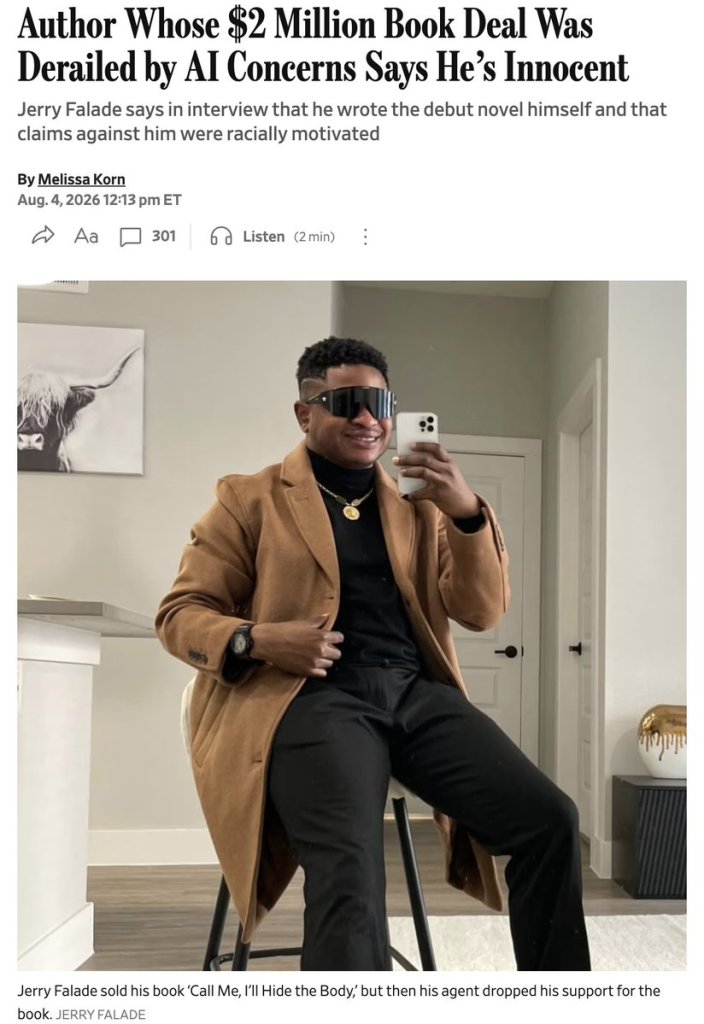
A Wall Street Journal story about the most recent AI publishing scandal.
The doors are already closing. In the latest scandal, a publishing company withdrew a multimillion-dollar advance to an author whose debut had sparked a bidding war because he used AI to write the novel. (The claimed author, Jerry Falade, says he did not use AI and argues he’s a victim of racism targeting black novelists, though it’s worth pointing out that it wasn’t just the publishers who bought the rights in the US and UK who cancelled the book. His agent dropped him too, saying she “could no longer substantiate” Falade’s insistence that he wrote the book.)
Given the fact that they’re voluntarily shelving a novel that was likely to move copies and make them a tidy profit, it’s difficult to believe the publishers and agent made the decision lightly.
The fact that Falade is an academic does not shield him from suspicion. The writer Sam Kriss has called out several people in higher education for using AI, including Narges Bajoghli, an assistant professor of Middle East Studies at John Hopkins University. Kriss cited this passage, which screams “I wrote this with ChatGPT”:
“Not a ceremony. Not a transition. A series of viral moments. A missile arc across a pale sky, and below it, the world already changed.”
Indeed, that precise sentence construction appears in another bit of AI writing highlighted by Kriss, and you can find it in AI-generated writing all over the internet. “Not an X. Not a Y. A Z,” followed by a bit of purple prose that sounds vaguely poetic but says nothing. Why the large language model likes to phrase things that way is a mystery, but it must have appeared in annotated data sets used by OpenAI to train the algorithm, and now it’s popping up with alarming regularity in essays, news stories and fiction writing “authored” by people who have suddenly and miraculously transformed into prolific, polished writers.
Not an accident. Not a happy coincidence. A blaring klaxon forged in ones and zeroes, summoned by prompt engineers communing with the machine gods.
That’s just one example, but AI’s penchant for using certain phrases and rhythmic structures has led to an unsettling, self-reinforcing homogeneity. The more AI uses these constructions, the more we’re hammered over the head with them, the more they leak into our own conversations and writing. It’s like going on vacation with a friend and coming back two weeks later to realize you’ve picked up on their favorite exclamations. Except that friend is now everywhere at once, and half your work colleagues have incorporated his -isms into their everyday dialog.
I use AI for images, which makes me a hypocrite
This has, of course, led me to reevaluate my use of generative AI images on this blog.
I’ve justified it by telling myself there was never going to be a situation in which I’d commission a professional artist to paint images of my cat dunking over NBA players in a summer league game, looking comically ridiculous in a powdered wig as a captain aboard a 17th century ship of the line, or riding through the jungle on the back of a jaguar 10 times his size.
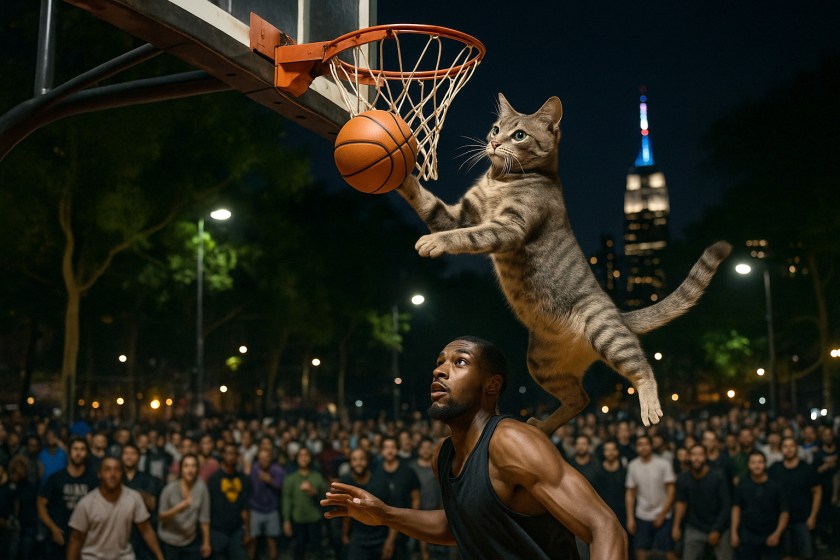
An AI-generated image of Buddy playing street ball at a Manhattan court. I tend to use AI for two things: to explain physics concepts I have difficulty wrapping my head around, and to generate images of my cat in ridiculous situations.
There’s also a crucial difference in that I’m using AI images to illustrate humor stories on a blog, not submitting them to galleries or publications as my own work, then accepting payment and plaudits for them, which is what many people are doing with AI-authored writing.
While that’s true, it’s also true that I’m participating in the devaluing of art on some level. More recently I’ve made a conscious effort to limit its use here, but that still makes me a hypocrite. I relied on it too heavily in the past and now routinely see blogs that use it for every post. I’m not judging those bloggers, merely observing how much we’ve all come to rely on the technology.
The improbably prolific new masters of prose
On the writing side, there’s also been a deluge of new “storytellers” who write generic stuff in a punchy style, with minimalist sentences and formatting that is unmistakably the output of a large language model. They blog under names like “Stories from the Mind Of…” or “Weekend Stories With…” and they always seem to have the right anecdote to illustrate some generic societal ill.
Many of these new, astonishingly prolific writers are publishing their AI-generated stories on platforms like WordPress, WebNovel, Royal Road and Youtube, and people are eating it up despite the fact that it’s machine-generated, generic content. It’s not coincidence that Amazon suddenly has three times as many book titles for sale, or that there are entire YouTube channels dedicated to genre stories — horror, science fiction, romance — that contain all the hallmarks and language quirks of AI, including nearly identical plots, recycled character names, and recycled phrases. Nor is it happenstance that they’ve all materialized out of nowhere in the last year or two.
A Youtube channel that posts science fiction stories narrated by AI, with images created by AI, and music created by AI, by a person who claims he does not use AI to generate his stories despite all the hallmarks of AI-generated writing.
Some publish stories of 8,000 to 10,000 words several times a week or even daily! As a writer who came up in a daily news environment, I’ve learned to pump out accurate, polished posts with regularity. It is a requirement of the job.
If you can write in a busy newsroom with phones ringing, police scanners buzzing, and more than 100 coworkers in an open office plan chatting away, you can write just about anywhere.
And yet I cannot dream of dropping polished 8,000-word fiction stories every single day. No human being can do that. Even if you can keep that pace for a short while (and very few people can), before long you’ll be derailed by burnout, a lack of new ideas, stories that just don’t come together the way you envisioned. Or maybe life just gets in the way.
The hidden physical cost of AI
A server room at CERN, the large hadron collider in Switzerland. Credit: Wikimedia Commons
While I don’t want to come off as one of those people who reflexively condemns new forms of tech, the more I learn about the infrastructure behind AI, the less I like it.
AI requires massive data centers that rival or exceed cities in power consumption. While it’s true that data centers have existed for decades, the centers that power AI are a new breed, orders of magnitude more power-hungry than their predecessors.
Advanced processors require cool ambient temperatures but they also generate lots of waste heat, meaning data centers are also a huge drain on water reserves. That’s the second law of thermodynamics. With summers getting hotter, what happens when there are droughts? If you think the government will tell big tech to ease up on data center water consumption, you’re probably not aware that our government doesn’t even protect cities and states from overwhelming water consumption by foreign-owned industrial farms.
There are communities in the southwest that have become endangered because, for example, Saudi-owned alfalfa farms consume so much water that there’s none left over for the people who live there. Politicians listen to the people who have the deepest pockets and a town of 10,000 in Arizona can’t compete with the vast wealth at the disposal of Saudi Arabian interests, even when those constituents have been reduced to frantically filling gallon containers in the brief interludes when new rainfall temporarily replenishes reservoirs.
Don’t like it? Go to Costco and stock up on spring water. No, the congressman cannot take your call. He’s got a meeting on data center expansion this afternoon.
If our elected representatives side with foreign investors over their own voters, we have little chance of them siding with us over deep-pocketed technology giants, headed by tech oligarchs who cut checks to lawmakers in every election cycle and already have their tendrils deep in government at every level.
Finally, about that cognitive offloading we talked about earlier: the mind and brain depend on keeping skills sharp. If we don’t use it, we lose it. It’s very easy to see how capabilities and intelligence may regress in our society if everyone uses AI for virtually everything.
Maybe all this is pointless. Maybe I am, in the words of Kriss, merely expressing “the rage of a rapidly obsolescing ape.”
I’m not condemning anyone who uses AI and I’m not saying I’ll never use AI again. That would make an even bigger hypocrite out of me, and it would be an act of self-harm not to keep up with such a rapidly-evolving technology. But I am going to make an effort to use it sparingly, hopefully only when absolutely necessary, and never to write a single word for me.
As a one-man band without a budget, for example, I rely on free-license photos from Wikimedia Commons and Pexels to provide visuals for my posts. Which is fine for the majority of topics, but sometimes there are obscure stories that cannot be illustrated with existing free photos.
For the other stuff, I’ll go back to the simple charms of bad Photoshops of Buddy as a Godzilla-size cat stomping around Manhattan in search of similarly massive turkeys.
And let’s hope services like Pangram, which claims 99 percent accuracy in detecting AI-generated writing, stay ahead in the arms race. Already people determined to use AI to become authors and storytellers are using so-called “humanizers” in an attempt to fool those apps. I suspect the next few years will look an awful lot like the unending battle between hackers and security companies in their own arms race to stay ahead of exploits.