Lupita Nyong’o not only shares the screen with a feline co-star in the new film A Quiet Place: Day One, she’s also a devoted cat mom to a ginger tabby named Yoyo.
Although I haven’t seen most of Lupita Nyongo’s movies — I really liked her performance in Us and her voice work in Disney’s Jungle Book remake — I’m a big fan now that I know she’s a cat lover.
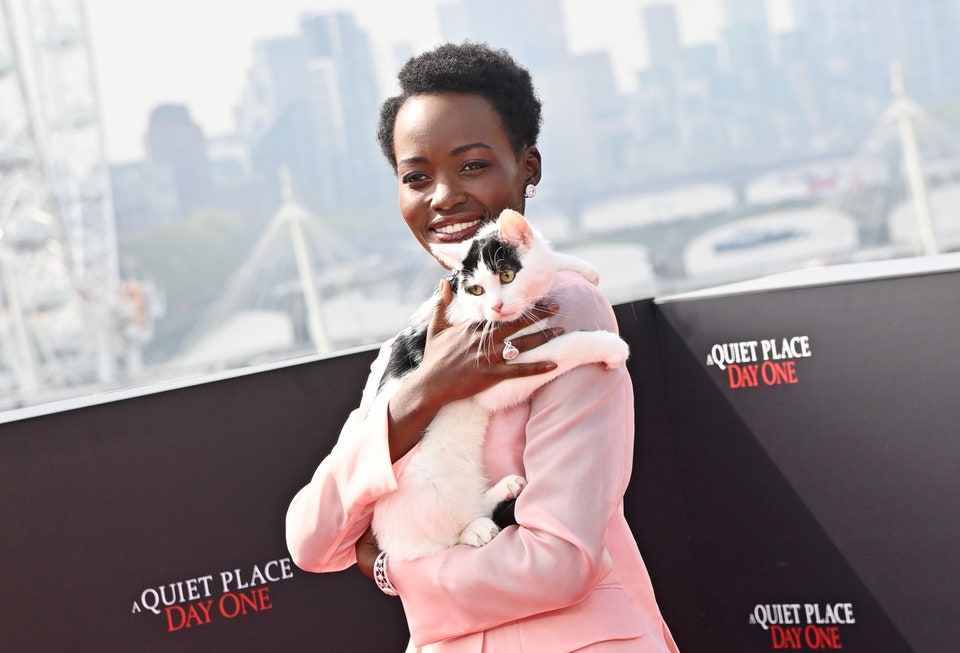
Nyong’o took to the red carpet for the premiere of her newest film, A Quiet Place: Day One in London on Wednesday, and her plus-one was a cat named Schnitzel, who also stars in the movie. Photos show Nyong’o posing along co-star Joseph Quinn, smiling as she cradles Schnitzel in her arms.
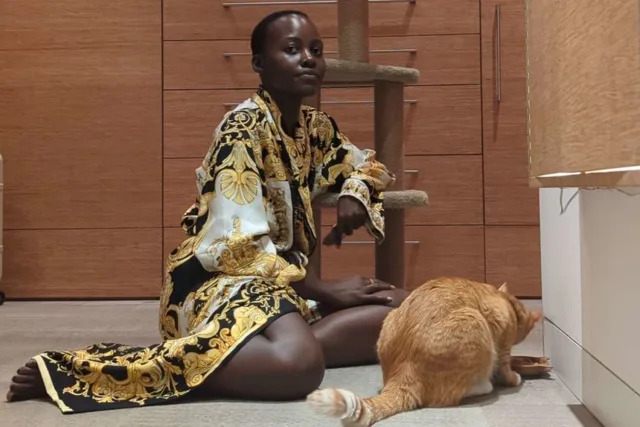
Lupita Nyong’o with her cat, Yoyo. In addition to posing with a cat on the red carpet premiere of her new film, Nyong’o proudly dotes on Yoyo and mentions him often. Credit: Lupita Nyong’o/Instagram
A Quiet Place is a 2018 film about a family that lives a completely silent life on a farm after the civilization has fallen to monstrous creatures that can’t see but are exceptionally sensitive to sound.
The film received nearly universal positive reviews for its use of sound — and the complete absence of it for long stretches — as a tension-building device, and a 2020 sequel continued the story.
Day One, which hits theaters on June 28, promises audiences a look at how the creatures appeared and civilization collapsed.
Schnitzel’s role isn’t entirely clear, but if it’s anything like 2022’s Prey, cats will fill their usual niche as predators, highlighting the difference between terrestrial and extraterrestrial hunters.
Caring for a cat in a world like A Quiet Place could be a double edged-sword: a super vocal cat like my Buddy wouldn’t last very long unless he quickly learned to keep a lid on his constant commentary, but cats are also incredibly sensitive to things that pass beneath the notice of us humans.
Thanks to their incredible hearing, exceptional sense of smell, the advantage of an extra olfactory organ and whiskers that pick up even the slightest stirring, felines are keenly aware of their surroundings.
As for Nyong’o, while Schnitzel is not her cat, she’s the proud cat mom of Yoyo, an orange tabby she fostered in late 2023. It only took her three days of fostering the little guy before she realized “I could not give him up,” she said last year shortly after the adoption was made official.
“I never understood people whose phones were full of photos and videos of their pets — now I am one of those people,” she wrote when she adopted the tabby. “It may look like I saved Yoyo, but really, Yoyo is saving me.”
Lupita Nyong’o with Yoyo. Credit: Lupita Nyong’o/Instagram
“I’ve noticed everyone’s super stressed lately,” Buddy said. “People need hugs. I’m fluffy and adorable. It’s the perfect solution.”
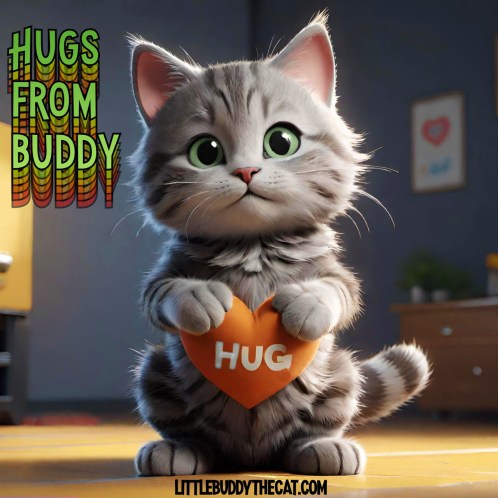
NEW YORK — Buddy the Cat announced the launch of a new program, Hugs From Buddy, to “help the humans calm down a little bit, because things have gotten crazy.”
The normally mercurial tabby cat, whose concerns are typically limited to his own gastronomical satisfaction with meals and snacks, said he had the idea for Hugs From Buddy after watching the movie Civil War with his human and seeing footage of police and students clashing on college campuses.
“The world is crazy right now,” Buddy told reporters at a press conference in Manhattan. “War in Ukraine, Haiti, Gaza and Syria. People punching strangers on the street for Youtube ‘pranks.’ Protesters and police clashing. People threatening to kill one another, banning books they haven’t even read, Karening each other in the grocery store, brawling on passenger flights. Even dogs, bless those simple-minded beings, seem stressed!”
Buddy the Cat is offering hugs to anyone who needs them!
Buddy paused to address a bystander who was holding a pepperoni pizza.
“You gonna eat that? Here, give Buddy a slice, I’ll give you a hug,” he said, embracing the young woman before returning to the podium with a slice of pizza.
“Where was I?” he asked, chewing thoughtfully. “Oh! Right. The crazy, stressed out humans.”
He belched, then continued.
“I’m here today to offer myself up as the nation’s emotional support animal. If you’re in need of a hug or a snuggle, well, Little Buddy’s got you covered.”
Then he looked to the reporters, who were seated six or seven rows deep for the press conference.
“Look under your seats!” he said excitedly as the journalists mumbled in surprise, finding small gift-wrapped boxes there. “You, the young lady from CBS News! You get a hug! You, the angry guy from InfoWars! You get a hug! BBC, you get a hug too! You all get hugs!”
A print advertisement for the new Hugs From Buddy campaign.
The press conference was supplemented with an announcement of a $20 million television ad buy publicizing the Hugs From Buddy program, as well as a new site where the angry and stressed can log on, request a hug from Buddy, and make travel arrangements to bring him to their cities.
Reaction to the announcement was mixed.
A panel on Real Time with Bill Mahar concluded Buddy was sincere, trying to be helpful, and “absolutely adorable.”
But in a statement issued later Friday, catnip cartel Los Gatos International accused the New York feline of “shameless self-promotion, which he will undoubtedly parlay into goodwill for his own catnip empire,” while former Fox News host Tucker Carlson declared Buddy a threat to national security.
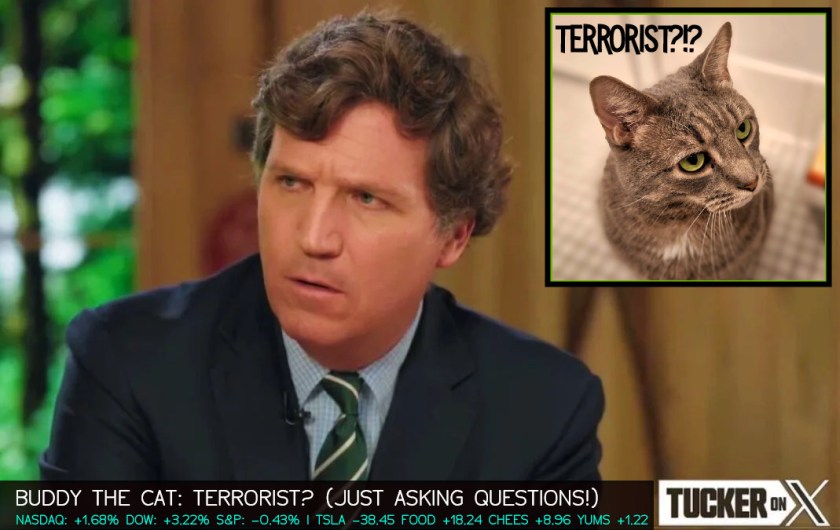
“Buddy the Cat is a dangerous tiger in kitten’s clothing,” Carlson declared on his X show as a chyron scrolled below with the headline: “IS BUDDY THE CAT WORKING FOR TERRORISTS?”
Former Fox News host Tucker Carlson wasn’t convinced of the feline’s supposedly noble intentions.
“You might say Buddy the Cat is a danger to America, softening us up at precisely the time when we need to be tough to fight China, North Korea, Iran, the school board of Boise, Idaho, Taylor Swift, and the WNBA,” Carlson said, pounding a fist on his desk. “Up next, a conversation with Nick Fuentes. But first: Is Buddy the Cat a Chinese operative? Is he an agent of anti-American cat ladies who want us all to be hummus-eating vegans? Why does he ignore the beauty of the Moscow subway system? And is there any truth to the rumor that he’s working with the San-Ti from 3 Body Problem to help them invade Earth? Just asking questions here, folks. Nothing wrong with that.”
Roadside zoos persist despite recent law changes, but even the best zoos fail to provide adequate facilities and enrichment for big cats, the report found.
The Amur tigress at Bearsdley Zoo is the lone occupant of her enclosure, which is large by the zoo’s standards, outfitted with a pool, toys and other enrichment, but small compared to what her natural range would be.
When I visited last summer, I spent the better part of an hour watching her pace the perimeter of her enclosure, walking in an endless loop as if in a daze, never stopping, altering her stride or reacting to anything.
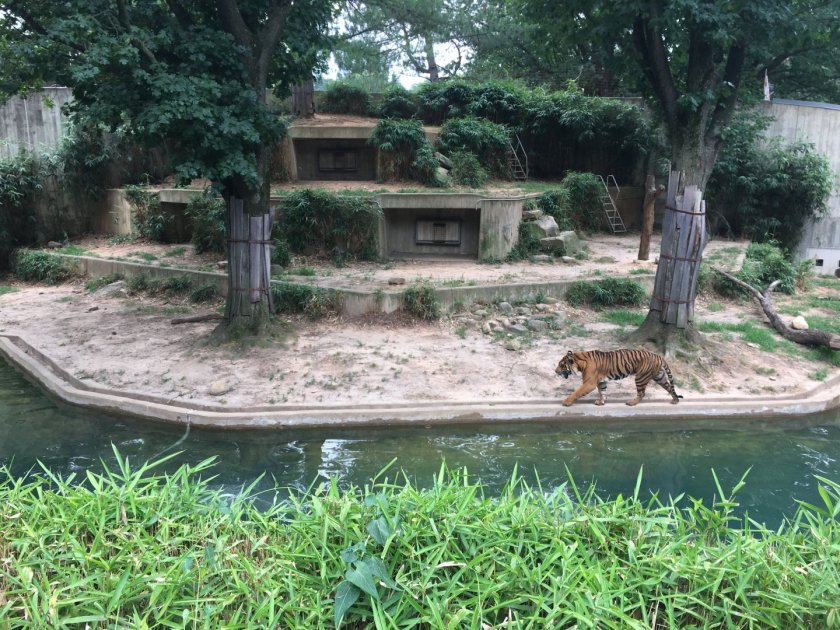
But what made me realize how bad captivity really is for big cats was what I saw at the Smithsonian National Zoo, a well-funded world class facility. The tigers there have two outdoor enclosures with a topographic design: they’re vertical spaces separated into tiers, with large trees and narrow “caves” for shelter from the elements. Both enclosures are surrounded by wide moats that ring the perimeter just inside the security fencing.
One of two similar Bengal tiger habitats in the Smithsonian National Zoo in Washington. Credit: ZooChat
It was feeding time on a hot summer day. Lionesses chowed down on large slabs of meat and licked blocks of ice, but the lone male tiger next door was pacing in a circle. He paced and paced, covering the same 10 to 12 feet, ignoring his food. I watched him for a long time. His behavior was a clear sign of zoochosis.
If a tiger in a national accredited zoo — where an entire team of keepers and caretakers is responsible for enrichment and welfare — suffers from clear signs of captivity-induced distress, what chance do tigers in other facilities have?
When we think of big cats suffering in captivity, we think of the roadside zoos where the Joe Exotics and Doc Antles of the world exploit them for financial gain, drug them, force them to take selfies with visitors and keep them in cruel conditions. But a new report from Born Free USA goes beyond roadside zoos and says big cat arrangements, even in the best zoos, are inappropriate, unhealthy and demoralizing for the animals.
“Unable to escape the crowds of humans, unable to follow some of their fundamental urges such as hunting and roaming over large distances, unable to fulfil their social needs – whether that be living solitarily or forming a pride with others – big cats show us their mental anguish by adopting abnormal behaviors,” reads the report [PDF], Clawing at the Cages. “These behaviors, known as stereotypies, manifest in obsessive pacing. Some big cats spend most of their days tracing the same, short, tedious route around their enclosures. This behavior is a recognized sign of stress, and only documented in captive animals.”
A captive jaguar. Credit: Yigithan/Pexels
The wild lives of animals like tigers are fundamentally at odds with the concept of zoos. In the wild, tigers range up to 50 miles in a single day, occupying vast ranges. Male tigers protect their home ranges, their mates and their cubs from other males as well as threats of all sorts.
That sort of lifestyle, which is hard-coded into their DNA, is not compatible with a guest-oriented operation in which habitats are designed primarily to give people the best view of the animals.
Lions might have it slightly better, though that’s arguable. As a social species they can interact with each other and they tend to have larger enclosures, but zoos rarely group animals according to their preferred family units or prides, instead matching individuals according to breeding plans as part of conservation efforts.
Yet even the conservation aspect is iffy, according to Born Free USA. Because of restrictions on “importing” animals and a population that is descended from just a handful of big cats, inbreeding is rampant. There’s a lack of scientific research on the captive zoo-held population, but the authors cite a 1983 study that found “six animals out of the approximately 1,000 Siberian tigers held in zoos in 1983 were responsible for 69.4% of the founder representation of the living population at that time. 70% of the population had a positive inbreeding
coefficient.”
Because little has been done to remedy that genetic bottleneck, “genetic viability remains low, and inbreeding of big cats in zoos can only have increased in the intervening years since these studies,” the report states.
Inbred cats suffer more health problems, don’t live as long and are much more susceptible to birth defects.
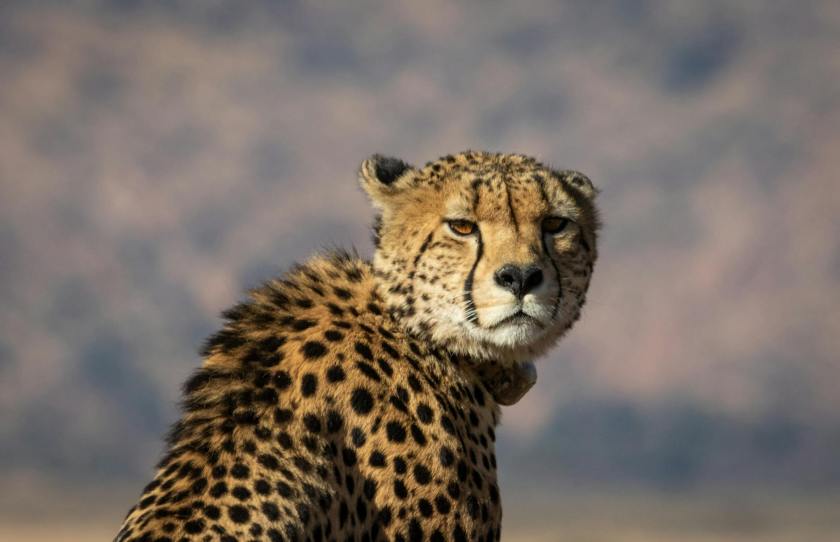
A cheetah. Credit: Magda Ehlers/Pexels
Despite the passing of the Big Cat Public Safety Act, Born Free USA’s report notes, roadside zoos still exist, and many of them have simply ignored the new laws because their operators know inspectors are overworked and lack manpower. Years can elapse between inspections, even at roadside zoos operated by serial offenders with long histories of keeping animals in abysmal conditions.
For example, Single Vision of Melrose, Florida — which bills itself as a “conservation” facility — openly flaunts its mistreatment of big cats with enormously popular video content from “Safari Sammie” on Youtube, TikTok and Instagram, despite the fact that it’s been the subject of dozens of violations and has an ignominious record when it comes to the health of its big cats. The facility was charged with 20 violations of animal rights laws in the previous two years, and has had multiple cases of animals dying due to neglect, yet continues to sell “experiences” in which “guests” can interact with heavily sedated tigers, jaguars, cheetahs and other wild cats.
In her videos, “Safari Sammie” — an employee of Single Vision — is routinely seen interacting directly with the apex predators, treating them like house cats and creating dangerous situations.
Other roadside zoos and animal “experience” operators continue to intentionally inbreed big cats to create “exotic” white tigers as well as ligers, tigons and other hybrids that aren’t found in the wild but are big attractions.
Overall, the report found:
Zoos fail to provide adequate environments for big cats, including lack of space, lack of ability to hide from public view, and the regular practice of locking big cats in tiny night quarters during the hours when zoos are
closed. The latter often results in big cats spending the vast majority of their time significantly confined.
Social and behavioral needs are not met in zoos. For example, solitary big cats are often forced to live with conspecifics, and social big cats are prevented from creating natural prides. Big cats are prevented from
hunting live prey – a behavior fundamental to them – while often housed alongside prey animals who also suffer stress from being forced to live near predators.
Inbreeding of big cats has become commonplace due to limited genetic diversity among captive populations, as well as unethical and deliberate inbreeding of color morphs such as white tigers and lions,
resulting in significant health issues for the cats involved.
Due to the inbreeding of big cats in zoos, as well as their habituation to humans, big cats kept in zoos are generally not candidates for release to the wild. As such, extensive and ongoing breeding programs simply serve to ensure that zoos remain “stocked” with these animals.
Monitoring of data on big cats in captivity is incomplete, with significant numbers of individuals disappearing from studbooks – the databases ostensibly responsible for tracking living big cats in captive facilities.
The licensing system intended to implement the Animal Welfare Act in the United States only achieves superficial monitoring of big cats in zoos, due in part to its risk-based assessment protocols as well as lack of meaningful
information in reporting that would allow effective public understanding and external expert oversight.
Despite the introduction of the Big Cat Public Safety Act in the U.S. in early 2023, some facilities continue to engage in dangerous activities with big cats, both in violation of, and in compliance with the new law.
Zoos around the world have killed healthy big cats due to overcrowding and lack of perceived usefulness to breeding programs. Other healthy big cats have been killed when human error or enclosure failure allowed their escape, or when attacked by conspecifics in their enclosures.
Due to all the issues above, and others, the overall health and welfare of big cats is compromised in zoos. This results in high mortality (particularly in infants), and recognizable signs of stress in the form of significant occurrences of stereotypic behaviors.
The report includes detailed anecdotes of typical problems in captive situations involving jaguars, lions, tigers and cheetahs, documents persistent problems with habitat design and security, and outlines loopholes and other problems with existing laws, which still don’t go far enough to ensure some of the world’s most iconic apex predators aren’t exploited and forced to endure lifelong misery.
You can find the report’s landing page, with links to a petition, a summary and the full text here.
The respondents also admitted they “forget” to feed their furry friends an average of three times a week. Say what?!?
Americans don’t know basic facts about their cats, fail to properly care for them and overestimate how well they do as pet parents, according to a new poll.
The survey of cat owners commissioned by PetSafe found most people in the US who have cats in their home don’t know their feline friends typically have 18 toes, for example, and don’t realize cats purr when they’re content as well as when they’re trying to soothe themselves.
Respondents said they frequently forget to refill their furry little buddies’ water bowls, but the thing that really blew my mind is that people supposedly forget to feed their cats an average of three times a week.
How is that possible?!?
The number of times Bud has missed a meal in 10 years is precisely zero. Even when I had COVID, even when half my face was frozen with Bell’s Palsy and I was throbbing with the worst headache I’d ever endured, I fed the little guy according to his schedule.
It’s not just that he reminds me. There’s a whole ritual around it, an elaborate series of increasingly affirmative and urgent meows that quickly give way to panic if Buddy doesn’t see activity associated with a bowl of fresh wet food and water delivered to his nook.
The pre-reminder reminders begin about 45 minutes to an hour before feeding time, with Bud’s infallible internal clock signaling upcoming meal time.
At the 30 minute mark Bud will put himself directly in my line of sight and stare at me. Then he’ll start to meow at regular intervals, and if I’m not up and heading to the kitchen by T-minus 15 minutes to yums, the meowing begins in earnest.
Even the act of retrieving a pack of wet food from the Buddy Cabinet is highly formalized and ritualistic: the little dude grunts and trills excitedly as I open the seal, dump the food in his bowl, mash it up and pile it in the middle the way he likes it.
Then he leads me back to his nook, looking over his head every few paces to make sure I’m right behind him, even though we’ve done this song and dance literally 7,318 times as of today. (It’s probably more than that since I fed him more than twice a day when he was a kitten, and doesn’t include his bowl of dry food for his late night snack/overnight emergency supply so he doesn’t have to wake me up if he’s hungry.)
I realize Bud’s a bit of a tyrant and there’s no peace until he gets what he wants, but still. Cats are cats. So really, how does anyone “forget” to feed their cat?
As Charles Darwin pointed out, the difference between humans and animals is one of degree, not kind. That should factor into discussions on the value of animal life.
The headline — ‘My Boyfriend Said He’d Save Our Cat but Not a Stranger if Both Were Drowning’ — comes from the New York Times via its Ethicist column, in which NYU philosophy professor Kwame Anthony Appiah answers questions from readers about moral rights and wrongs.
Here’s the full text of the question:
My boyfriend and I were talking about protecting human life, and he said that he doesn’t believe that human life is necessarily worth more than any other kind of life. For example, he said that if one of our cats were drowning next to a human who was a stranger to us (who was also drowning) and he could save just one, he would choose our cat. Is this morally wrong?
Appiah, in his very first sentence in response, regretfully calls pets “fictive kin” before pointing to a study by an experimental psychologist in which participants were asked whether they’d save their pets or a foreign tourist if both stepped in front of a bus at the same time. Forty percent of respondents picked the pet.
To his credit, Appiah notes the people who chose their pets don’t have “some grave defect of character,” and said the impulse to save a companion pet is “very human,” given all we share with our animals, including “affection, companionship, loyalty, all twined around a whole lot of memories.”
“Buddy sad. Buddy needs snack.”
That said, Appiah says human life is more valuable:
“But yes, it’s very wrong. (In states with “duty to rescue” laws, it could be illegal too.) Those human strangers? They had rich emotional lives and they had plans, short-term and long-term, big and small; it’s a good guess that they were also part of other people’s plans, other people’s emotional lives.”
I’m not going to get into the question of whether human or animal life has more value. That’s a mine field, I don’t subscribe to the idea that we should work out hierarchies of life’s value as if we’re ranking favorite ice cream flavors, and it seems to me these “what if?” questions involving oncoming buses or trains don’t have much value in gauging reality.
After all, how many people do you know were forced to make life or death decisions in a millisecond, let alone decisions involving a complex moral and emotional calculus? Appiah seems to agree, while also pointing out that what people say in a questionnaire doesn’t necessarily predict what they’d do in the moment.
Life is life. It’s all valuable, and the survey doesn’t have much use outside the classroom or ethics columns.
Buddy the Cat: Brains as well as brawn.
However, I do think it’s worth pointing out that much of what Appiah assumes is the difference between human and animal life — particularly rich emotional lives, cognition and value to others — can indeed be attributed to animals.
There’s been a seismic shift in the way most scientists view animal cognition over the past decade, and in many ways the acknowledgement of non-human sentience and potential sapience is long overdue — there are literally thousands of studies confirming animals are conscious, sentient, and possessed of the full range of primary and secondary emotions.
Every time we set new barriers for what distinguishes human from non-human, we’re forced to change the goalposts. When behaviorism was the dominant model, the distinction was internal thought processes. In dismantling behaviorism, Noam Chomsky helped launch the cognitive revolution. Then it was emotion and love, which crumbled with the ugly Harry Harlow studies into maternal deprivation in monkeys. Then it was capacity to reason, tool use, innovation — and every time, we’ve revised our definitions, solid in our conviction that we’re fundamentally different.
In fact, the only thing that’s held up is Charles Darwin’s original observation in 1871 that “the difference in mind between man and the higher animals, great as it is, certainly is one of degree and not of kind.”
In other words, humans aren’t some higher order of being. We are animals. Upjumped animals in some sense, but animals all the same, subject to the same diseases, physical limitations and helplessness in the face of greater forces like nature.
We may live in an age when our planet is blanketed in satellites, scientists are on fusion’s doorstep and each one of us has the entire sum of our species’ knowledge at our fingertips, but it’s shocking how quickly the veneer of civilization can collapse when people are scared, the food runs out, social order breaks down and those primal motivations — the ones we think we’ve out-evolved — drive our actions again. The early days of the COVID pandemic was just a small reminder of that.
We don’t like talking about these uncomfortable truths because they lead to more uncomfortable truths about the billions of non-human minds we share the planet with, and how we treat them.
I can’t claim to be a philosopher, although I minored in the subject over the objections of my advisor. (He should have warned me off journalism!) But when it comes to animal cognition I do have a great teacher, an 11-pound ball of fur who won’t let me forget he’s got his own wants, needs and strong emotions. Doesn’t he deserve consideration too?





 Pain In The Bud