Buddy The Cat: Recommend Some Good Cat Toys, Humans!

Buddy has grown tired of most of his toys and his beloved birdie is in danger of disintegrating. This cannot stand!

Since my human has been working on some other stuff, I thought to myself, “Budster, why don’t you take over that there site and deputize its readers as my servants?”

So congratulations, you have the great honor of being my secondary staff!

Now to the meowtter at paw: I require new toys. The old ones are boring, I’ve torn my favorite birdie to shreds, and there are only so many times I can terrorize Big Buddy by doing cannonballs onto his stomach while he sleeps. If he has a heart attack, who will feed me?

What I need from you humans are some suggestions. You’re the inferior species when it comes to napping, lounging, being fearsome, roaring, being ridiculously good looking, and bathing yourselves.

But you do make good toys!

Just a heads up, I’m terrified bored of those floppy fishes, I have two of those track toys where you slap the ball around with your paw, and I have a cat tunnel and my very own mini camping tent. I am also the proud owner of a variety of excellent boxes!

I need something fresh, something exciting. My human says I need a toy that gets me up, running and jumping. Grudgingly, I admit he may be onto something. My incredible hunting skills must be honed and maintained with regular practice.

So, yeah. Tell me about fun toys, humans!

Happy International Cat Day!

Today’s a good day to do something special for your little pal(s), and to help spread awareness that felines are sentient, intelligent animals with feelings.

Happy International Cat Day!

Today marks the 23rd annual observance of the special day, which was established by the International Fund for Animal Welfare, a nonprofit originally founded in the late 1960s to stop the commercial hunting of seals off Canada’s coasts.

Buddy sits on his vanquished foe, an alien xenomorph. “I don’t understand how these things gave humans so much trouble,” he said.

In more than half a century since, the group has expanded to an international operation with projects aimed at improving conditions for wild and domestic animals. They do wildlife rescue, rehabilitation, preserve management and more.

International Cat Day was intended to help raise awareness about cats, their behaviors and the best ways to interact with them and give them good homes.

For those of us who are already wrapped around the paws of our feline overlords, it’s an occasion to do something extra for our buddies. Here at Casa de Buddy, that means spending more time with little man, giving him catnip, and his favorite human food treat: cheese.

The thing that matters most to him is Buddy Time, when we hang out, play games with his wand toys, and eventually he snuggles up in my lap.

We hope all of you are enjoying International Cat Day and have the opportunity to spend some extra time with your furry pal(s) today. For all they do to improve our lives, a little expression of gratitude is the least we can do.

Muahahaha! The Cat Distribution System Has Bestowed A Kitty On My Brother’s Family

Twix the cat is a beautiful Calico living in sunny coastal Italy.

Wary as he may be of them sometimes, Bud is the “family cat” to my nieces.

Now 12 and 8, they’ve wanted a cat for a long time but were vetoed by their parents, since the family was moving to Italy and it appeared my younger niece had allergies.

Well, now they’re finally settled in Italy, tests have confirmed my niece is not allergic to cats, and it turns out their new home comes with a feline.

A beautiful, super-friendly and affectionate Calico named Twix, who was fed, spayed and given veterinary care by the home’s previous family.

“She is super affectionate and lets us pet her a lot,” my brother texted me along with photos of Twix on a window sill and on the grass outside, enjoying scritches from the kids. “Even rolls on her back and has her stomach scratched.”

“Shiiit,” I responded. “Touching the stomach would get you killed with Bud … Well, you got a cat, whether you like it or not.”

The friendly Twix with the girls.

It also looks like Bud will have a potential lady friend. I plan to visit for an extended amount of time and use my brother’s house as a base from which to explore Europe, and there’s just no way I’m going to leave Bud for months, especially when he’ll be 12.

He can handle a long weekend and even a couple of weeks, but months? I don’t think that would be good for either of us, and I worry that he may think I’m not coming back. We have never been separated for that long. He’s coming to Italy with me.

As for Twix, it looks like she’s been living on the property for quite a while. The kids have set up a little shelter for her with blankets. I advised my brother to make sure she has a water bowl that’s refilled regularly with fresh water, they’re feeding her wet food, and I’ll work on getting little Twix inside permanently if she isn’t already a house cat by the time I get there. I can be persistent! It looks like she can come and go as she pleases, so it may not be long before she decides it’s better to be inside and safe.

A friend once taught me that you can “speak Italian” by adding -are (“RA”) onto anything. “Grazie! La felinare!”

Mars, The Pet Food Company, Claims There’s A ‘Treat Gap’ Between Cats And Dogs

The makers of Temptations want you to feed your cats more snacks, as if they don’t get enough!

In yet another indication that some people don’t seem to pay attention to their feline masters, the Wall Street Journal reports on Mars and its internal operation “Cattitude,” which as far as I can tell amounts to a few people within the company realizing they haven’t squeezed every last dollar of revenue from people who have cats.

That’s a problem, the company realized, because more people are adopting cats, younger generations are more likely to adopt felines, and anyone who hasn’t had their head in the sand knows the little ones rule the internet with their cuteness.

Through “Cattitude,” which apparently involves everything from executives walking around the office wearing cat ears, to handing out “I Love Cats” decals and consulting with “cat parents” on products, the company says it’s identified a “treat gap” between felines and canines, with dogs as the far more frequent beneficiary of yums:

“Feline insecurity can be self-fulfilling. If you think your cat doesn’t care, you might be less likely to shower them with perks. That may be why dogs get way more treats. 

Mars launched a campaign in May that spotlights the “treat gap” by the numbers: Dogs are nearly 32% more likely to get daily treats than cats in dogs-only and cats-only households; in homes with both, 38% of parents said they don’t give the same number of treats.

The story does not say how the company arrived at those numbers. Probably market research in the form of surveys. Not exactly scientific, as these things go.

This is one of those stories that makes me wonder if these people actually have cats.

From the moment I wake up until the second I settle into bed, Bud shrieks at me for snacks. He won’t even let me stumble into the bathroom before the first shrill reminders. He demands snacks before dinner, after dinner, after he’s had snacks, and sometimes while he’s eating them.

If he could speak English and hold a bull horn, I have no doubt he’d spend the majority of his day blasting the demands into my ears: “MOAR SNACKS, BIG BUDDY! MOAR! MOAR!”

Mars should know this. One of its most popular products, Temptations, turns cats into slobbering addicts. I had to wean the Budster off them, then stupidly bought them again months later and had to wean him off the Temps again because he has a one-track mind when they’re in his bloodstream. Two are not enough. Six are not enough. Ten are not enough.

One time, I left a big tub of the damn things unattended for a minute and he managed to pop the top off by knocking it off the coffee table. When I walked back into the living room, he was dragging his jaw along the floor like a bulldozer, inhaling as many as was felinely possible into his little mouth.

Frantically, I shooed him away and began picking them up, but the damage was done. He threw up a few minutes later. Then he shrieked for more!

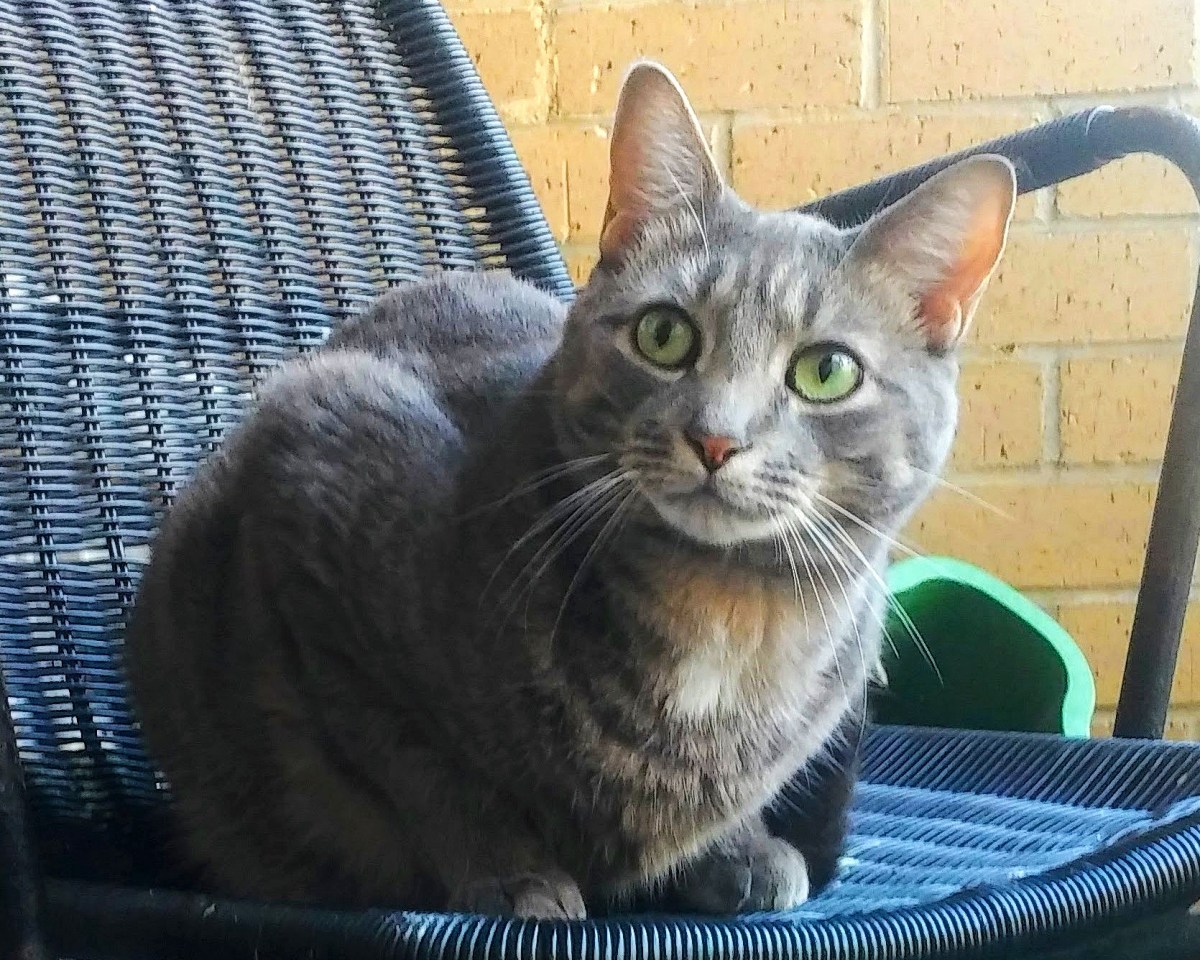
He always looks innocent, doesn’t he?

Interestingly, the WSJ notes that if you type “Does my cat” into Google, the first two auto-complete suggestions are “Does my cat love me?” and “Does my cat know I love her?”

And that brings us to a point on which I agree with the people at Mars: cats still aren’t well understood.

Dogs happily slobber over their people. Cats show their love in subtle ways, like proximity, head bunting and momentary contact.

Just like the whole “cats love milk” thing is half myth, half misunderstanding, so is the idea that your cat doesn’t love you unless he’s leaping into your arms to hug you as saccharine orchestral music swells in the background.

While there are always outliers, most cats don’t like being hugged or picked up, and most have hard limits when it comes to the amount of physical affection they’ll tolerate. It’s not because they don’t care for us, but because they’re semi-domesticated carnivores who still retain the skittish tendencies of their wild brethren, and because they get easily overstimulated, among other reasons.

If Mars’ Cattitude is an ongoing thing, I hope the decision-makers in the company come to what I believe are two of the most important conclusions to keep in mind when it comes to cats. Giving them your love means giving them your time and attention, and treating them like the sentient, emotional creatures they are.

The best piece of advice I ever got was to always take your cat’s emotions into consideration.

It really is that simple.

Now if you’ll excuse me, I have snacks to dispense.

Animal Rights Groups Are Begging For This UK Influencer To Be Banned From Owning Pets

The woman has been dubbed a “serial killer” of animals after eight of her pets and one of her horses met early ends, and several others simply disappeared. She’s part of an unfortunate trend of influencers and quasi-celebrities popularizing exotic pets, with “ownership” of the animals frequently leading to tragedy.

So apparently Katie Price is some sort of proto-Kardashian, a pioneer of the “famous for being famous” genre of hybrid reality/online celebrity, to use the term loosely.

Wikipedia says she got her first taste of fame in the 90s posing topless for British tabloid newspapers before moving on to loftier pursuits, like appearing on Big Brother and holding court on important topics, like whether toes have bones.

The background really doesn’t matter, except to establish that Price is someone with a lot of money, minimal common sense and extraordinarily poor judgment who has gotten so many of her pets killed or injured, PETA and other animal rights groups in the UK have begged politicians to write new laws preventing serial pet-killers from purchasing more animals.

Sort of a “10 strikes and you’re out” rule, if you will.

Four of Price’s dogs have been hit by cars, including one killed by a pizza delivery driver on her property. Another got stuck in an electric armchair and was crushed after Price gave him cannabis oil, pleading ignorance on its effects.

Previously, one of her breed cats was euthanized under mysterious circumstances at five months old, her rare chameleon fell ill and died because he wasn’t kept in a properly heated enclosure, and her “guard dog” was apparently intentionally killed by someone, although the information on that death comes from Price so there’s no way of telling what the actual circumstances were.

A horse Price owned was killed on the same road where two of her dogs met their end, which would bring the tally to nine depending on whether you consider a horse a “pet.”

Price, pictured this year.

There have also been animals — kittens, puppies, animals gifted by boyfriends, fiances, and friends — who were featured on Price’s social media feeds as babies and never heard from again, according to the UK’s Mirror. Some of them were given away to assistants and acquaintances. The fates of the others are unknown.

Price currently owns at least four chihuahuas and five Sphynx cats. An incident with one of the Sphynxes has animal lovers and welfare groups renewing calls to prevent her from buying new pets. (Price, like so many social media influencers, exclusively purchases breed pets for thousands of dollars each.)

In a new video posted online, Price — who has been dubbed a “serial killer” of animals by PETA — makes duck lips at the camera and rubs one of her Sphynx cats, Kevin, explaining that the little guy suffered sunburns.

“Oh Kevin you have been in the sun today, you have got sun burnt despite us putting sun cream on you… look at his little face,” Price said in the video. A caption written by Price claims “Trying to keep the cats out of the sun is hard work.”

A screen shot from Price’s recent video in which she shows one of her cats who suffered sunburn during the ongoing heat wave.

The latest incident is drawing fresh attention to a petition that calls for the UK government to step in to stop Price from owning animals.

As of July 10, there were 37,728 verified signatures on the Change.org petition, which mentions a number of additional disturbing incidents involving Price’s pets. One accusation claims Price’s guard dog — it’s not clear if it was the dog who was killed, or a new guard dog — bit the tail off one of her cats.

“Anyone who warns Katie not to hurt the animals she takes in might as well be screaming into the wind, for all she seems to care,” PETA’s Elisa Allen said. “And here we go again: her cat is sunburnt – something she was likely warned about when acquiring a gimmick cat, bred to look odd and be hairless.”

For her part, Price claims the deaths and unfortunate incidents that have befallen animals in her care are simply the result of bad luck and circumstances outside her control. Her representatives have also accused animal welfare groups of using the influencer’s fame to raise money.

That has not changed the narrative as new incidents continue to pile up. In a 2023 live TikTok stream, Price allegedly slapped her then-puppy, Tank — who she’s since discarded — for sitting on a hoodie. “Get off! You’re sitting on my jumpers, my jumpers that I love,” Price said after the sound of a loud slap off camera, leaving viewers fuming.

Price is not alone in the world of influencers, quasi-celebrities, Real Housewife types and entertainers who apparently view animals as disposable amusements.

Hilaria Baldwin, Alec Baldwin’s wife, has earned the nickname “Cruella Seville” from her detractors for her alleged treatment of her breed cats and dogs. The nickname is a play on the character Cruella de Vil from 101 Dalmations and the Spanish city of Seville, where Baldwin claimed to have roots before claiming she was born in Mallorca.

Baldwin with two of her Bengal kittens. New kittens have appeared in her Instagram posts several times in recent years, apparently replacing older Bengals she’d purchased previously.

Baldwin, you may recall, was enthusiastically Spanish until she wasn’t. She was essentially exiled from celebrity-adjacent society in 2020 after Twitter users dug up videos of her fluctuating accent and performative “forgetting” of English words like cucumber, outlet and onion. Former classmates, acquaintances and friends came forward to say she was the Boston-born Hillary Hayward-Thomas and didn’t go by Hilaria — or speak with an accent — until around 2010, when she met Alec Baldwin.

But the actor’s wife never stopped posting to social media, and in addition to animal lovers calling foul on videos that show her allegedly mishandling her dogs, her online posts show a rotating cast of Bengal kittens. Critics have called for action against Baldwin for her alleged treatment of animals, as well as buying Bengals despite the fact that it’s against the law to keep them as pets in New York City. PETA, which previously worked with Alec and Hilaria Baldwin on a publicity campaign, also called on the couple to stop buying exotic pets.

In the music world, mainstream pop artists like Justin Bieber and Rihanna have both come under fire for purchasing baby monkeys — a capuchin in the case of Bieber, and a slow loris for Rihanna.

The Rihanna incident, in which she shared a photo of herself with a slow loris pet to social media, resulted in raids on illegal wildlife markets in Thailand, where Rihanna allegedly acquired the animal. There are nine subspecies of slow loris, ranging from vulnerable to critically endangered in conservation status, per the World Wildlife Fund.

Rihanna posing with a slow loris, a nocturnal, arboreal animal that is notably the world’s only venomous primate. The venom glands are removed from slow lorises sold on the illegal wildlife market. People continue to poach and sell them despite their declining numbers in the wild.

Bieber named his monkey Mally OG and famously ditched the then-infant in Germany in 2013, when officials there seized the primate from his private plane after it touched down in Munich, citing his lack of permits and purchase records for the animal. (They essentially accused Bieber of buying Mally on the illegal wildlife market.)

“Honestly, everyone told me not to bring the monkey. Everybody,” Bieber told GQ magazine in an interview several years later. “Everyone told me not to bring the monkey. I was like, ‘It’s gonna be fine, guys!’ It was the farthest thing from fine.”

Bieber with his pet capuchin monkey, Mally OG, who was just an infant when he was ripped from his mother’s arms so he could be sold to the pop singer.
Bieber with another capuchin monkey as part of a skit in which he joked about German authorities seizing his first monkey pet.

The singer said he’d return for his pet after retrieving the paperwork from one of his US homes, but he never did, and Mally OG was placed in a sanctuary after a long rehabilitation period.

In a follow-up story five years later, Asta Noth of Serengeti Wildlife Park said Mally was still trying to imitate human speech, and didn’t know how to communicate with his own species. That’s a common problem with monkeys who are former pets, as they do not understand the complex social dynamics of troops and family units.

His developmental problems stem from the fact that “he was taken away from his mother and natural family way too early,” Noth said. “He did not learn to be a monkey.”