Another Serial Cat Killer, This Time Fresh From Prison, Goes Right Back To Killing Strays. Clearly, Existing Laws Are Not Enough

When serial cat killers serve sentences of less than a year due to plea deals and early release for good behavior, how much deterrent value do our laws have? Not much, it seems.

Note, 5/3/2025: We’ve heard from two readers who say the MyNorthWest report contains inaccuracies. We’ve reached out to the police and will follow up with police and courts on Monday to verify the facts and correct potential misinformation. Apologies for the confusion.

Every couple of months, at least in the last year or two, I’ve slowed down on posting, and almost always for the same reason: my cat-related news alerts are  seemingly endless streams of depressing stories about people shooting, strangling or dismembering cats.

It never ends, and sometimes it’s so overwhelming that I’m put off from writing for days. At the same time, I am not a believer in the idea that all animal blogs should be saccharine feel-good fests about fluffy kittens and TikTok videos of cats doing silly things.

There’s always a place for celebrating cats, but if they’re in danger, and if the stories point to wider trends that cat lovers should know about, then I think it’s our responsibility to remain educated. Not only so we can guard against threats to our little friends, but also so we can add our voices to the chorus calling for tougher laws and greater accountability.

That’s ultimately what this is about: accountability.

Stories about two cat serial killers in about a week have made it clear that even the strengthened animal protection law — the Preventing Animal Cruelty, or PACT Act — passed in 2019, during the first Trump administration, raising animal cruelty and murder to the level of a felony, are still not enough. They’re not a deterrent, especially when the convicted abusers and killers end up serving a year or less because prisons are overcrowded and the wider law enforcement community still doesn’t take animal-related crime as seriously as other violence.

Antoine Leander Runner Jr. is a serial murderer of cats. The Seattle man was recently released from prison after serving just a year for a felony animal cruelty conviction.

The 43-year-old’s modus operandi was setting up crude, homemade snares and traps to capture and harm felines. He was also known in cat rescue circles, where he posed as a cat lover and took advantage of programs to get free supplies, including “cat food, kennels, collars, leashes, and treats to lure cats and kill them,” according to MyNorthWest, a Seattle news site.

When locals discovered new homemade traps in Runner Jr.’s old haunts and trail cameras picked up images of the man himself stalking wooded areas, neighbors called police and area shelters. The evidence showed Runner Jr. was allegedly visiting cat colonies at night and had picked up right where he left off. One colony cat’s body was discovered on March 31, “disemboweled and publicly displayed.”

“Animal Control confirmed the injuries to the cats were human-caused,” MyNorthWest reported, adding that it appears Runner Jr. was visiting colonies “every night” to hunt cats.

Above images by u/picardhasyourback, posted to the SeattleWA subreddit. Click on the images to see full-size versions.

Runner Jr. was picked up by Seattle police this weekend after a neighbor spotted him in a wooded area and phoned authorities. The convicted cat killer, who had a new bench warrant out for his arrest, was charged with a misdemeanor, but more charges are likely as police investigate his latest alleged attacks on Seattle-area cats.

The Seattle man was originally arrested for killing cats in 2023, but was released early. The Seattle area was also terrorized by a serial cat killer who stalked the area in 2018, mutilating cats so badly that I won’t repeat the details on this blog out of respect for readers.

It should be made clear that Runner Jr. was not connected to the 2018 killings, but police should reconsider those cases as well because if it turns out Runner Jr. is guilty of these latest cat murders, it will be abundantly clear that he is a high recidivist offender who cannot be trusted to leave the animals alone. He should serve a long, unabridged prison sentence and be subject to constant monitoring when he’s released.

Antoine Leander Runner Jr. was arrested this weekend by Seattle police. Credit: Sarah Seiler/Facebook Georgetown Community Discussion Group

What’s the solution here? Increasingly tough criminal penalties for animal abuse and murder? Expensive monitoring equipment to watch over every cat colony? Education and training for law enforcement so violence toward animals is taken as seriously as it should be?

I hate to keep pointing out that people who harm animals are likely to “graduate” to harming humans, as many studies have shown, because it implies that we should only be concerned about animal abuse for its tendency to turn into human abuse. It obscures the fact that animal life is intrinsically valuable, and that cats — and dogs, many bird species, mammals and marine life — are sentient, with their own thoughts and emotions. But if that’s what it takes for people to take this sort of thing seriously, then it’s worth repeating the point.

Report: Trump Officials Added Buddy The Cat To Houthi War Plans Text Group

The mercurial tabby cat tried to convince Secretary of Defense Pete Hegseth to bomb the Isle of Dogs, White House officials grudglingly acknowledged.

The controversy over leaked war plans expanded Monday after new reports revealed a journalist was not the only outsider added to a text group between senior members of the administration.

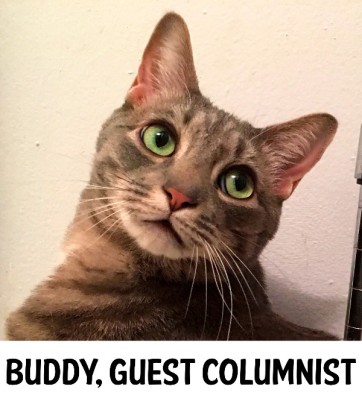
Buddy the Cat, a domestic tabby from New York, was also invited to the group and subsequently made privy to classified information, the White House acknowledged.

While Atlantic editor Jeffrey Goldberg observed the text conversation between senior members of the Trump administration without participating in the exchange, sources say Buddy the Cat tried to convince Pete Hegseth, the defense secretary, to bomb London’s Isle of Dogs.

In addition, White House press secretary Karoline Leavitt grudgingly acknowledged Buddy was able to convince Hegseth and Kristi Noem, the homeland security secretary, to send federal agents to the home of a cat named Smudge, describing him as “a gastronomic terrorist who hates America and will stop at nothing to claim all the snacks for himself.”

When administration officials denied knowing Buddy the Cat, social media users began unearthing dozens of photos of the feline associating with national leaders. No one knows how deep the conspiracy goes.

Initially White House officials denied the feline was given access to the text group, with Leavitt calling it “an egregious example of the fake news media inventing absurd stories,” but they were forced to acknowledge the veracity of the incident when confronted with copies of the exchange.

“Folks, we are cleared for go, CENTCOM has given us the green light for the fifth strike package,” Hegseth wrote. “F-18 launch imminent.”

“Are we just going to ignore the Isle of Dogs?” Buddy the Cat texted in response.

The text caused confusion, with several senior officials speculating on the sender’s identity.

“The contact says ‘BTC.’ Who the heck is this?” Director of National Intelligence Tulsi Gabbard asked.

“It’s [US Marine Corps] Gen. [Barrington T.] Caldwell,” replied Mike Waltz, the National Security Advisor. “Got to be.”

Noem also initially tried to distance herself from the scandal by claiming she didn’t know Buddy, but photographs soon emerged of the tabby cat lounging on the podium while she spoke at CPAC in 2003.

It’s not clear how senior White House officials were convinced by a cat that a London neighborhood was related to an Iran-backed Shia militia in Yemen, but an anonymous official credited Buddy the Cat for “being very convincing. We all thought he was the general.”

While the feline’s suggestion to bomb the London neighborhood was co-signed by Hegseth, it was ultimately rejected by CENTCOM, which noted the UK is an allied country and there was no indication “terrorist dogs” populated the London neighborhood.

More successful was Buddy the Cat’s suggestion to send a federal strike team to the home of Smudge, his archrival.

The chonky cat screeched his innocence after heavily armed and armored federal agents smashed the door down and found him mid-bowel movement in his litter box.

“1337et: Agents have located the CHONKY little jerk in his domicile, where they found fresh explosive materials in his litter box and a suspiciously well-stocked cupboard,” Buddy wrote to the Houthi PC Small Group.

“Congrats, general!” Waltz wrote, while Noem called the arrest “a major win for American freedom and security.”

Reporters, former military officers and intelligence officials criticized the leak, pointing out that if a cat could get access to highly sensitive war plans — and influence them in real time — America’s enemies could do the same. But White House officials pushed back on the criticism, saying it was overblown.

“So someone put a cat on a text chain,” Leavitt said, snapping at a reporter during a press briefing. “So what? You guys are, like, being so dramatic!”

‘Petfluencers’ Make Their Cats Wear Clothes, Plus: Why A New Coat Color Has Emerged

The quest for clicks and attention is a race to the bottom, and “petfluencers” are willing to dive deep to differentiate themselves from the thousands of others trying to build an audience.

Clothes, sneakers and hats. Vitamin supplements, energy drinks and probiotics. Backpacks and costumes.

What do all those things have in common? People are buying them for their pets, not themselves, and they’re part of the reason people in the UK spent more on pets in 2024 than childcare, hobbies or dating, according to Nationwide UK.

The problem is, they’re not doing it for their pets. Experts, including veterinarians and animal behaviorists, tell The Guardian that most cats, aside from hairless varieties like Sphynx cats, don’t like wearing clothing, nor do they like wearing costumes, or taking baths with heavy perfumes and essential oils.

Influencers — or petfluencers — stage elaborate “pampering” scenes, and make their pets wear different clothes to show off their shopping “hauls.” Some pose their animals like dolls and find ways to coerce them to remain still. Audiences think it’s cute. It’s not.

As for me, I’ve got a handy chart when I’m unsure if Bud will be cool with something:

  • Make him wear clothes. Result: Get clawed to death
  • Give him baths with essential oils. Result: Get clawed to death
  • Make him wear sneakers. Result: Death by bite to the jugular
  • Force him to eat supplements or guzzle energy drinks. Result: Shredded skin and lots of blood, perhaps some light homicide.

While the animals themselves aren’t thrilled with these new trends, they probably won’t go away any time soon. There’s just too much money involved.

The average pet owner in the UK spent the equivalent of $163 per month on their companions, and only half of UK households have pets compared to 66 percent in the US. Although there’s not an apples to apples comparison of total expenses on pets per month by household in the US, Americans spend $68 a month on cats on average, according to research by ValuePenguin. For dogs, it’s about $110 a month.

‘Salty liquorice’ cats owe their unique coats to a missing snip of DNA

It’s always an interesting occasion when nature gives us something new, and the salmiak cat is definitely unprecedented in the world of feline aesthetics.

The unique cats, named after a popular liquorice candy from Finland, have a coat pattern that results from a gradient on individual strands of fur, starting out black and getting lighter toward the tip. It gives their coats a singular peppered look, and in photographs the unusual felines almost look as if they’re rendered in monochrome stippling.

Credit: Ari Kankainen
The Finnish candy the cats are named for.

The salmiak cat wasn’t the product of any breeding program, and reports in Finnish media say strays with the new coat pattern/color first emerged in 2007.

To find out how the salmiak emerged, a team of Finnish, British and American scientists sequenced the genomes of two salmiak cats. They found a mutation in genes that express coat color that resulted in a missing sequence of DNA, and they confirmed the mutation is recessive. That means to get salmiak kittens, both parents have to have the mutation.

‘Why Are Cats Such A Medical Black Box?’ New York Times Columnist Asks

Veterinary science and research still focuses primarily on dogs, but scientists are trying to change that and help us better understand how to care for our little feline buddies.

“It’s just a cat.”

I’ve heard that so many times, and if you’re a cat lover, you probably have too.

It’s an insinuation that cats are throwaway animals, fungible pets who can be replaced by others of their species because, some people claim, they don’t express themselves as individuals, never really warm to humans in the first place, and besides, it’s not like they have emotions.

Countering those persistent myths is one of the reasons I write this blog. I still didn’t have a full appreciation for how singular and smart cats can be until I brought Buddy home. I never fathomed the depth of his emotions, the strength of his convictions or his willingness to make his opinions known about everything.

In some ways, I’m still shocked at how much he communicates and how well we understand each other.

However, one of my biggest fears is not doing right by him, especially missing signs of declining health as he gets older.

That’s the subject of a column today in the New York Times, in which science write Emily Anthes recalls the subtle signs that her cat, Olive, was sick, and the veterinarian’s assessment that she wasn’t just ill, she was on death’s door.

Credit: Pexels

Anthes points out that, to this day, veterinary training uses canines as the default, and treatments for cats are often just adapted from treatments for dogs, even if there’s no data suggesting those methods actually work for feline patients.

“My anatomy book was ‘Anatomy of the Dog,’” Maggie Placer, veterinary science programs manager at EveryCat Health Foundation, told the Times. “We had PowerPoints and supplements for the cats.”

The differences go beyond body plan, organs and behavior: drugs that work for dogs can be ineffective or dangerous for cats. Treatments otherwise regarded as effective in other animals could be harmful to felines too.

“It’s not reasonable to assume that everything that works in a dog will work in a cat,” Bruce Kornreich, director of the Cornell Feline Health Center, told Anthes. “There’s a lot that we still need to learn.”

Credit: Pexels

The situation with feline veterinary science mirrors the gap in behavioral studies between cats and dogs.

Over the past decade, research teams in countries like the US and Japan have made efforts to close the gap by recognizing that studies must be crafted to feline points of view, and that laboratories are not suitable places for studying the behavior of such notoriously territorial animals. Cats behave differently outside of their environments, rendering data useless if it’s captured in settings where kitties are stressed, unsure of themselves or even just miffed that they’re not at home enjoying a nap.

There are unique challenges when it comes to studying effective veterinary treatments in cats as well. Primary among them is feline stoicism, an evolutionary adaptation.

Simply put, cats will do everything they can to mask injury and sickness because they don’t want to become prey. Unfortunately that means by the time a cat cannot conceal an ailment anymore, the disease or injury has progressed. Even if a cat has lived indoors her entire life, the directive to disguise her pain is hardcoded into her DNA.

Anthes’ cat, Olive, didn’t make it. But her litter mate is chugging along, and to help advance the cause of understanding cat health, Anthes submitted both cats’ fur clippings to geneticist Dr. Elinor Karlsson’s Darwin’s Cats, a “non-profit community science project” that uses DNA submitted by cat owners to better understand our furry friends and unlock the secrets of their health and behavior.

Let’s hope that such projects spark a renaissance in studying cat health, like they have with research into feline behavior, so we can do right by our little buddies.

The Best Movies About Cats

A comedy, a remarkable documentary, a classic and a surprise hit make the list for the best cat-centric movies.

Keanu (2016): Jordan Peele stars as Rell, a man who is despondent after he’s dumped by his girlfriend. When a kitten shows up on his front step, Rell takes the little guy in and his life is suddenly transformed. He’s enamored with the kitten, whom he names Keanu, can’t stop talking about him, and even begins photographing him in dioramas based on famous films.

But tragedy strikes when drug dealers ransack Rell’s home, mistaking it for the small-time drug dealer’s home next door, and take Keanu. Rell and his cousin, Clarence (Keegan Michael-Key) embark on a quest to get Keanu back no matter what it takes, even if it means posing as a pair of contract killers to infiltrate the criminal world where Keanu’s been taken. It’s every bit as absurd as you’d imagine — but it’s also very, very funny. “Actually, we’re in the market right now for a gangsta pet,” is not a line I’d expect to hear in a movie, but in Keanu it works.

Flow is the surprise hit of the awards season.

Flow (2024): Even the hype of Golden Globe awards and Oscar nominations can’t take away from the powerful impression Flow makes. By now most of us are probably familiar with it through clips or trailers, but they don’t do justice to the beauty of director Gints Zilbalodis’ world, nor how naturally expressive his protagonist, Cat, is.

The animators put in an extraordinary amount of effort into understanding and perfectly replicating every feline behavioral quirk, every hackled coat and curiously bent tail. They accomplish the same with Cat’s companions, including a Labrador, a secretarybird, a lemur and a capybara. And while we’re dazzled by the visuals and energetic narrative, Zilbalodis poses a thematic question as the flood waters take the animals through the ruins of human civilization: without people, the world will go on. What would a world without humans look like? Cat and his companions tell us one story while the environment tells us another, and the result is greater than the sum of its parts.

Tiger: Spy In The Jungle

Tiger: A Spy In The Jungle (2008): What makes this documentary so special is that it was filmed over three years in an Indian tiger preserve, and the filmmakers not only disguised cameras as rocks and tree stumps, they trained elephants how to carry “trunk cams,” achieving shots which no human cameraman could ever hope to get without spooking the subjects of the film.

Tigers don’t hunt elephants because they’re simply too big. Unlike lions, they’re not feeding a whole pride, and they don’t hunt cooperatively. It’s just not worth the effort required to take down the giant, majestic beasts. As a result, tigers and elephants not only tolerate each other, they mostly ignore each other’s presence.

One of the cubs stares curiously at a camera disguised as a rock in Tiger: Spy In The Jungle

That allowed the team to get unprecedented shots of an iron-willed tigress raising a litter of four cubs by herself. We see their dens, we watch the cubs play, and we witness the incredible prowess of the mother, who according to narrator David Attenborough has a remarkable 80 percent success rate while hunting. That’s pretty much unheard of.

With four young mouths to feed in addition to herself, the tigress is determined, and also supremely skilled. The whole jungle erupts in a cacophony of shrieks and alarm calls the instant a single animal gets a whiff of the tigress’ presence, but that still doesn’t stop her from achieving her goal.

Still, the odds are against all four cubs making it, with dangers like adult leopards, sickness and hunger. Through Spy In The Jungle, we get to see the entire journey, from the newborn cubs to the confident juveniles on the cusp of adulthood. There’s no better tiger documentary anywhere.

Shere Khan, right, makes an intimidating villain in The Jungle Book (2016)

The Jungle Book (2016): With so many Disney cash-grabs in the form of live-action remakes of classics that did not need to be remade, it’s easy to dismiss The Jungle Book. The thing is, this movie has heart. Neel Sethi is an earnest Mowgli, Idris Elba voices the infamous tiger Shere Khan, and to balance out the felid villainy with some heroism, Sir Ben Kingsley voices Bagheera, the noble leopard who discovers baby Mowgli in the jungle and protects him as his wolf friends raise the boy. Lupita Nyong’o as the wolf matriarch Raksha, Bill Murray as the honey-obsessed bear Baloo and Christopher Walken as orangutan King Louie round out a great cast.