Readers Are Furious With Mag Over Severe Cat Neglect Story, PLUS: Buddy’s Le Handsome Club!

New York magazine’s article included difficult-to-read details about the severe neglect of a pet cat, and didn’t offer any reassurances that the forsaken feline was okay.

Happy Thursday! Before we get into today’s cat news, I’d like to share my current Google News search string, which has helped me keep my sanity over the last few weeks. It’s simple:

“cat -doja -vance -shot”

And voila, no more stories about Doja Cat, fewer blood pressure-raising articles about people who think shooting felines is a sport, and you’re mercifully saved from the 17,457th “think piece” about JD Vance and cat ladies.

The “relatable” column about severely neglecting a cat

New York magazine’s editors knew they were wading into a minefield with this week’s pet ethics issue, and the author of a story about neglecting her cat knew it too, which is why she took the preventative step of using a nom de plume.

In a column titled “Why Do I Hate My Pet After Having A Baby?” (later softened by the editors to “Why Did I Stop Loving My Cat When I Had A Baby?”), “Audrey” writes about severely neglecting her cat, Lucky, after having her first child.

She not only developed what she calls a “postpartum loathing” of Lucky, she admits to not feeding the poor feline for so long that Lucky ate plants out of desperation, then predictably threw up. The forsaken feline began eliminating on the floor because her litterbox was not being scooped. She lost “at least one tooth” and because even water was denied her, she had to drink out of the toilet. The life-threatening neglect and emotional abuse lasted months.

“If I treated a human the way I treated my cat, I would be in prison for years,” Audrey admits, describing Lucky’s own descent into depression as the cat became the scapegoat for all of Audrey’s negative feelings.

Cats (and dogs) understand a lot more than we give them credit for, especially when it comes to our emotional states, to which they are hyper-attuned because they are directly impacted. We’re talking about animals who have been companions to humans for 10,000 and 30,000 years, respectively. Not only does their companionship predate human civilization and the concept of recorded history, they have evolved to intuitively read human facial expressions and body language. They can even smell our pheromones, which means they’re often consciously aware of our moods before we are.

I’ll never forget what my brother said to me a few weeks after I adopted Bud, upon meeting the little guy for the first time: “You’re his whole world.” I’ve tried to make that world as loving, safe and fun for my cat as I can, because he deserves it. He’s given me back so much in return.

Adopting comes with responsibility. It’s not just about meeting an innocent animal’s basic needs, like food and water. It’s about providing our four-legged friends with good lives and never taking our bad days out on them.

“Audrey” says she tried to get rid of Lucky, leaving the windows of her home open, and because the original version of the story dealt almost exclusively with the author’s mental health, readers were disturbed by the lack of any follow-up on Lucky’s situation.

thecuttweet1

The negative reaction was so strong that New York’s editors took the unusual step of attaching a note to the story claiming they “confirmed the welfare of the cat prior to publishing the story.”

thecuttweet

That didn’t satisfy the magazine’s critics, who accused them of behaving “callously” by presenting the author’s abuse of Lucky as a “relatable” symptom of post-partum depression.

“Why are you ignoring one of the most controversial articles you’ve ever published instead of addressing it?” one reader wrote. “It’s not going to just go away – we will not forget … The people will not stop until that cat is safe and loved, and your publication is held responsible.”

Insisting the magazine’s editors be “held responsible” is a bit much, and I’m not a fan of censorship. The bigger issue is the lack of concern for the cat even in retrospect, and the attempt to normalize postpartum animal abuse, as if it’s just a thing people do. It feels like a missed opportunity to explore why such things happen, and to examine the problem with compassion for all involved, human and animal.

Buddy the Cat’s Le Handsome Club is now open to le handsome cats

This is really just an excuse to show off my latest poster promoting PITB, but readers will recognize the concept of Le Handsome Club from earlier satirical stories about the Budster.

Le Handsome Club
Le Handsome Club: The club for le handsome cats!

I’ve written before about “real Buddy” and “cartoon Buddy,” which is the version of him that exists in PITB’s world of absurd satire. Cartoon Buddy is real Buddy with his quirks, narcissistic qualities and amusing lunacy dialed up to 11.

Someone once asked me how to write a children’s book because they want to write one about their pets. Since I’ve never written a children’s book I wasn’t much help, but I did share the basic process for Buddesian hijinks: Imagine a situation, then imagine how Bud would respond to it if he could speak.

The more ridiculous, the better, and I think it’s worked out well, with stories about Buddy getting conned by a Nigerian prince’s cat, the ongoing saga of Los Gatos catnip cartel and the meowfia, Buddy’s disastrous first (and only) term as president of the Americats, and the Budster’s ongoing bromance with the jaguars of the Amazon.

So yes, Le Handsome Club. I could definitely see my cat, who thinks he’s Catdonis and Arnold Schwarzenegger rolled into one, founding a club for really, really, ridiculously good looking cats, to paraphrase Ben Stiller’s Zoolander.

Buddy
Very le handsome.

Buddy The Cat’s ‘The Art Of Napping’ Debuts Atop NYT Bestseller List

The book received glowing reviews for its comprehensive approach to the world of slumber and promises something for every type of napper.

A new book on napping from the world’s most prolific snoozer has taken the sleep enthusiast community by storm.

“The Art of Napping: The History and Technique of Dozing Off” by Buddy the Cat bills itself as “the world’s most comprehensive guide to taking a siesta” and a “manual on how to commit yourself to a lifestyle of leisure and laziness.”

It includes an illustrated history of sleep science, from its superstition-mired origins to the highly specialized field of modern-day napology, following the rich sedentary traditions of various cultures.

“The chapter contrasting ancient Sumerian nap-walking with Syracusan Somnambulism is not only heavy with detail, it’ll put you to sleep almost immediately,” said Rusty LeFelino, chaircat of the Snooze Studies Department at the University of Catlanta.

Nap on tatami mat
“Nap on tatami mat under cherry blossoms” by Hirotaro Buddishida, 1646, is one of many historical depictions of shut-eye included in The Art of Napping.

Reviewers were equally effusive with their praise.

“Buddy the Cat dozes headfirst into the world of segmented slumber, documenting everything from Chicago-Style Snoozing to indigenous bedding techniques pioneered by the jaguars of the Pantanal,” reads a starred review in Publisher’s Weekly. “Whether you’re a weekend warrior who enjoys drooling on your couch during baseball games or a committed napper who swears by episodic DaVinci Sleep, there’s something for everyone in this beautifully bound volume.”

The New York-based feline spent more than a year researching and getting paws-on experience for the book. He visited the California headquarters of Google with its famous employee nap pods, spent a week sleeping under the stars with the pumas of the Pacific Northwest, and interviewed lucid dreamers to find out whether it’s possible to nap within a nap a la Inception.

“Buddy leaves no pillow unturned in his quest for the truth, with spectacularly stale prose that will have even the over-caffeinated yawning into the back of their paws,” a reviewer for Narcolepsy Daily wrote. “Get yourself a cozy blanket, curl up with Buddy and let the Z’s commence.”

Jungle Napping
Southern Siesta: The author spent several weeks in the Amazon napping with jaguars, jaguarundis and ocelots, an experience described in a yawn-inducing chapter of The Art of Napping.
Sleeping_cat
“The ability to nap anywhere at any time is the mark of a master snoozer,” Buddy writes in his new book. Credit: Wikimedia Commons

Buddy Unravels Astonishing Conspiracy During Ayahuasca Trip

“I see it now!” Buddy exclaimed. “Everything is connected, and we are everything! Who else is hungry?”

PERU — Three hours after ingesting ayahuasca brewed by a jaguar shaman — and two hours after jaguar scouts found him running around the jungle while screaming about extradimensional Teletubbies — Buddy the Cat had unraveled an astonishing conspiracy, sources reported.

The New York-based cat, who had long sought to ingratiate himself with various groups of big cats, usually with disastrous results, finally found kinship with the tolerant jaguars in 2021 when he ventured into the Amazon and impressed the jungle-dwelling felids with his extensive knowledge of novel napping techniques. He also introduced the jaguars to turkey, and in return for his contributions to the jaguar nation, the big cats granted him the jungle name Kinich Bajo, which means “tiny sun-eyed one” in the ancient Yucatec dialect.

jaguarbuddies
Buddy with Canguçu, one of his jaguar buddies.

Buddy returned to the Amazon in October of 2023 to “spend time with my homies” and participate in an ancient jaguar shamanistic ritual involving tea brewed from ayahuasca, the powerful psychedelic used in indigenous ceremonies.

Clearing a small grove in the Amazon rainforest and using rocks to represent people, places and ideas, Buddy was able to find indisputable connections between the Annunaki, the defunct Blockbuster chain of video rental stores and NFL linebacker Barkevious Mingo.

“But where does the Vatican fit in?” Buddy asked, resting his chin on his right paw thoughtfully. “Could it be that Barkevious Mingo is the true pope, and he was speaking ex cathedra when he said Havarti cheese is the food of the gods? Is catkind really ready to accept a divine proclamation on yums that excludes turkey and gouda?”

Buddy and Jaguars
An artist’s impression of Buddy and jaguar elder Yguakina in the Amazon, piecing together great mysteries.

A pair of jaguar minders exchanged worried glances as they approached the tabby cat from both sides.

“Come back to the campfire, Kinich Bajo,” said Xbalanque, the older of the two, using the name jaguar elders had bestowed on the silver tabby. “Your work here can wait.”

Buddy didn’t take his eyes off the complex diagram of rocks, vines and leaves he’d carefully assembled. “Not while I’m so close!”

Xbalanque shook his head. “Where is Elder Yguakina?”

Buddy sighed.

“I had to send him away! He’d become consumed with this ridiculous theory involving Ragnar Lothbrok, the 1973 Pittsburgh Pirates and the Webb telescope,” Buddy said. “I don’t have time for such nonsense!”

As of press time, the Jaguar Nation of Iquitos Amazonia said Buddy was on the verge of a great discovery and will not emerge from the jungle until he’s connected the dots or the psychedelic brew wears off, whichever comes first.

buddy_jaguars2
Buddy with his jaguar buddies Xibalbá, left, and Ek B’alam.
Buddy and Jaguars
Buddy and Yguakina find a grove where they begin diagramming Six Degrees of Kevin Bacon. (Artist’s impression.)

Feds Nab Couple Selling Jaguar, Margay, PLUS: Cat Wins ‘Hambone’ Award For Derpy Accident

Giles the cat is recognized for the most ridiculous pet insurance claim of the year, while federal prosecutors use the new Big Cat Public Safety Act to go after alleged illegal wildlife traders.

A Texas man and his wife were arrested after allegedly selling a margay kitten and trying to sell a jaguar cub in a second deal, federal authorities said.

Rafael Gutierrez-Galvan, 29, and his wife Deyanira Garza, 28, whom prosecutors describe as “legal permanent residents,” sold the margay cub for $7,500 to an undercover agent, meeting him in the parking lot of a Texas sporting goods store on Aug. 24. On Sept. 26 Gutierrez-Galvan made plans to sell the jaguar cub to the same man, and agents arrested him and his wife en route to the meet-up, according to the U.S. Attorney’s Office for the Southern District of Texas.

Gutierrez-Galvan and Garza face federal charges under the new Big Cat Public Safety Act, which was signed into law in 2022. They can be sentenced to a maximum of five years in federal prison and ordered to pay a $20,000 fine if convicted.

Prosecutors did not say how the couple obtained the two wild cats or if they were working with anyone else.

jaguarmargray
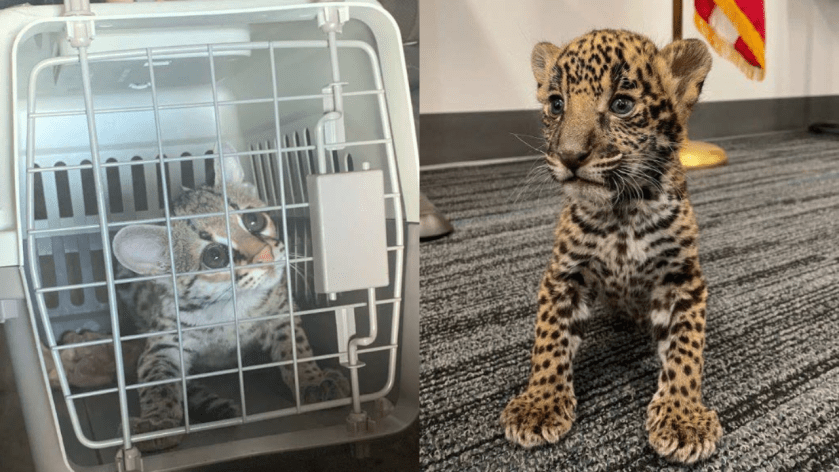
The margay kitten, left, and jaguar cub recovered from a Texas couple who are accused of illegally selling them. Credit: U.S. Attorney’s Office, Southern District of Texas

Jaguars are endangered and margays are threatened. Both are native to South America, although jaguars once ranged as far north as Ohio and Pennsylvania. Margays (leopardus wiedii) are small arboreal wildcats who thrive in the deep jungle, away from human interference. They’re typically smaller than domestic cats, with an average weight of six pounds, and are among the most sure-footed of all felid species.

Jaguars (panthera onca) are true big cats and the only extant big cat species native to the Americas. They’re under enormous pressure from Chinese poachers, who capture and kill them to use their body parts in traditional Chinese “medicine,” as well as local illegal wildlife poachers. Both jaguars and margays, as well as other cat species native to South America, are also endangered by habitat loss.

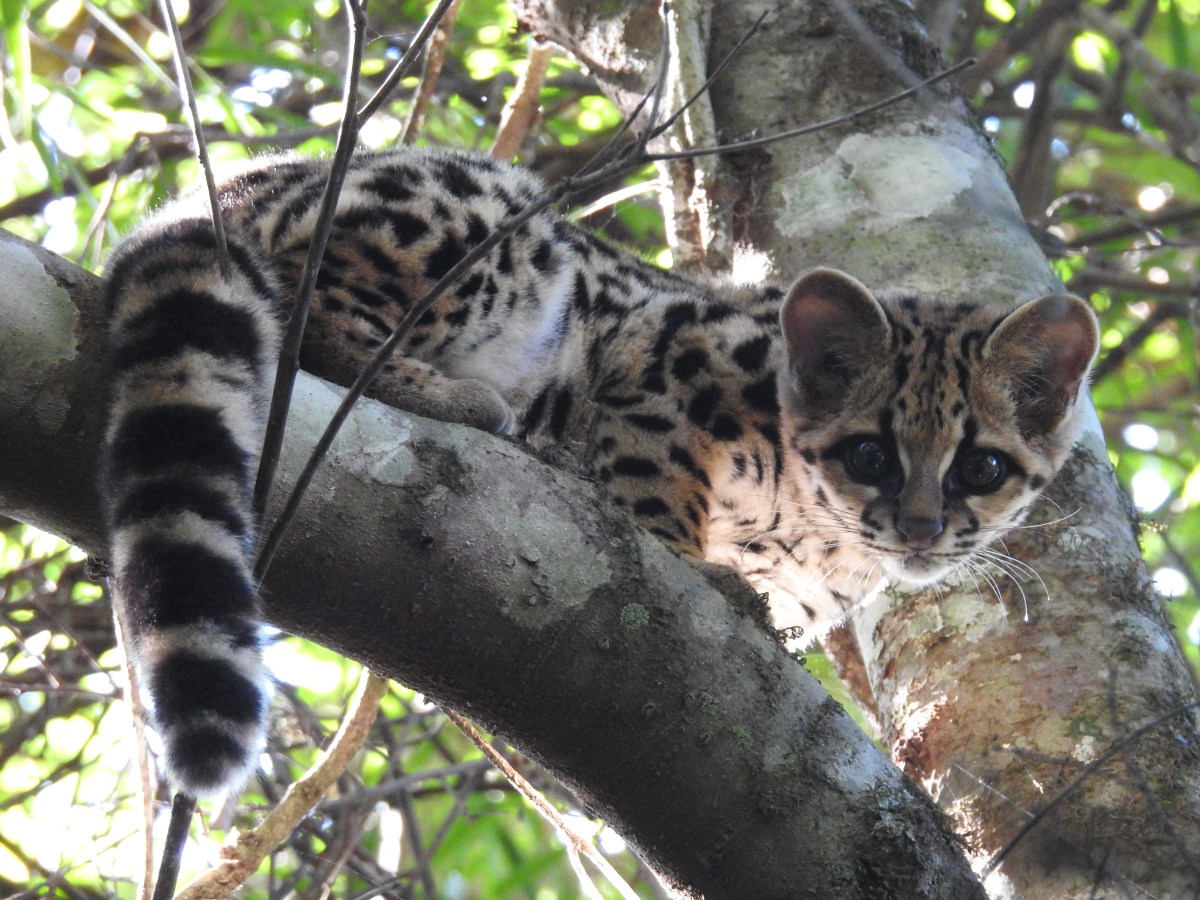
Header image of a margay in Rio Grande do Sul, Brazil, credit: Anderson Cristiano Hendgen via Wikimedia Commons

New York cat wins Hambone Award for most ridiculous pet insurance claim

The Hambone Award was started in 2009 when a family filed a pet insurance claim for their dog who got trapped in a refrigerator, suffered mild hypothermia and tried to make the best of the situation by eating an entire ham.

That inspired the Veterinary Pet Insurance Company, a subsidiary of Nationwide, to create the award and make it an annual event. The first recipient of the “honor” was Lulu, an English bulldog who ate 15 baby pacifiers, a bottle cap and part of a basketball, necessitating a trip to the veterinarian and an insurance claim.

This year the award went to Giles, a handsome black kitty who has a habit of hiding in a sofa bed and getting stuck there when one of his humans folds the bed back into the couch. His humans, Kaitlyn and Reid, always check to make sure Giles isn’t in the space beneath the bed when they fold it up, and had warned Reid’s visiting parents that the playful cat likes to hang out there, but they forgot to check and ended up smooshing Giles.

c1920_giles-hamboneaward
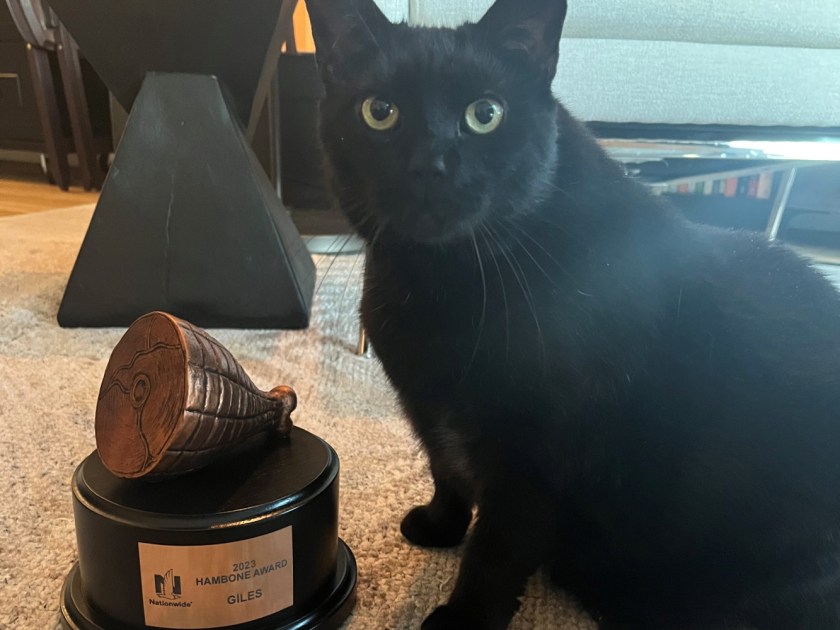
Giles poses proudly next to his Hambone Award. Credit: Nationwide

Luckily the little guy didn’t break any bones, but he did take a hit to the face pretty hard and needed stitches.

“I [had] no idea what’s going on—we got him in his carrier and ran him up the street,” Reid said. “Luckily, we have a wonderful vet hospital just around the corner from us, so we were able to take him right there. Fortunately, it wasn’t too bad. He did need some stitches … but he was the model patient, as he always is.”

Giles’ competition this year was mostly dogs, but the other feline finalist was Miko, a New Orleans cat who spotted a pair of doves nesting in a hanging plant just outside on the patio. Miko executed a Jordanesque leap and swatted at the doves, but as the birds fled one of them gave the bold cat a parting gift, pecking Miko in the face. Thankfully he wasn’t seriously injured.

For his exploits, Giles received a trophy and his humans will receive a gift card and a donation in their name to the pet charity of their choice.

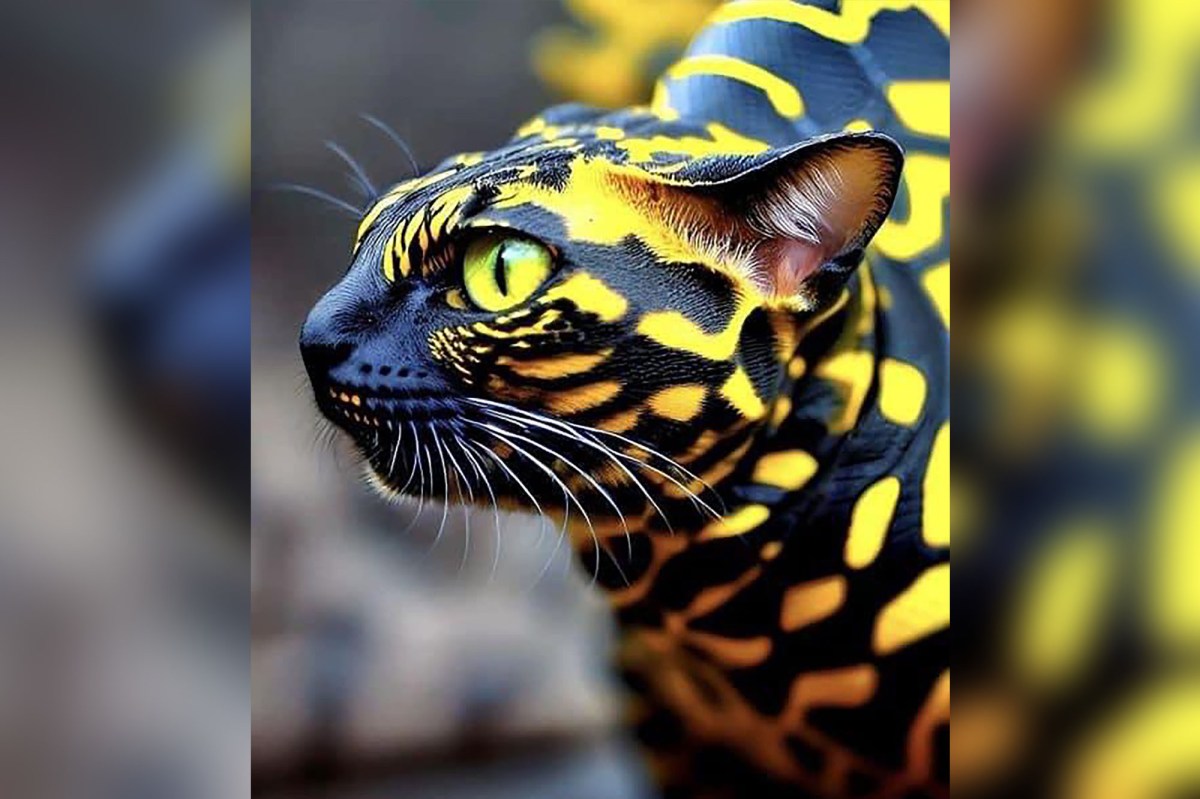
The ‘Snake Cat’ Is A Bad AI Fake

A viral image allegedly depicts a “snake cat,” described as an extremely rare species native to the Amazon rainforest.

Say hello to felis retrowavus, commonly known as the synthwave cat, one of the rarest species of felid on Earth.

Using the same technique GloFish employed to create bioluminescent neon fish for the pet market, scientists engineered felis retrowavus by extracting fluorescent proteins from jellyfish and inserting them into cat embryos, which incorporated the new proteins into their genome.

The result? A new species of cat that glows in fabulous colors like Tigerbrite Orange™, Electro Azure™, RadarGlo Green™, 1984 Pink™ and SithRed™!

Your brand new Neon Feline™ will run, jump and meow just like a regular cat, but unlike a plain old kitty, your Neon Feline™ will snuggle up with you at night and serve as your personal biological night light! Collect them all!

If that sounds like BS, that’s because it is.

Obviously.

Likewise, it should only take a second or two to realize the widely disseminated photo of a “snake cat” is a fake rendered by an AI.

The image has all the hallmarks of an AI generated image fail: Anatomical errors, fuzzy pixels where the AI struggled with the way light hits fur, a misshapen head and a nebulous, blurry background.

Although the media seems to be more obsessed with the snake cat hoax than people are (the snake cat image “mystified the internet,” the New York Post claims), after years of witnessing people take Onion stories seriously and confidently repeat misinformation online, I’m not really surprised when something like this makes the rounds.

The image was accompanied by a clever bit of writing claiming the cat isn’t well known because it’s native to the deep jungle of the Amazon, where scientists have difficulty tracking it. The text even offered a taxonomical name for the cryptid animal.

Enough people apparently fell for it that the staff at Snopes felt the need to debunk the image, even going as far as to check with a biologist who specializes in tropical fauna.

The original author of the snake cat post says he created the image and accompanying text to prove how easy it is for people to be fooled by AI-generated fakes. A noble goal if true, but I’m not sure everyone got the message.

In any case, the “snake cat” proves once again that AI, like all innovations, isn’t inherently good or bad. It’s what we do with the technology that counts.

Now can I interest anyone in a brand new Purple Velvet or Flaming Hot Cheetos SnuggleCat™?