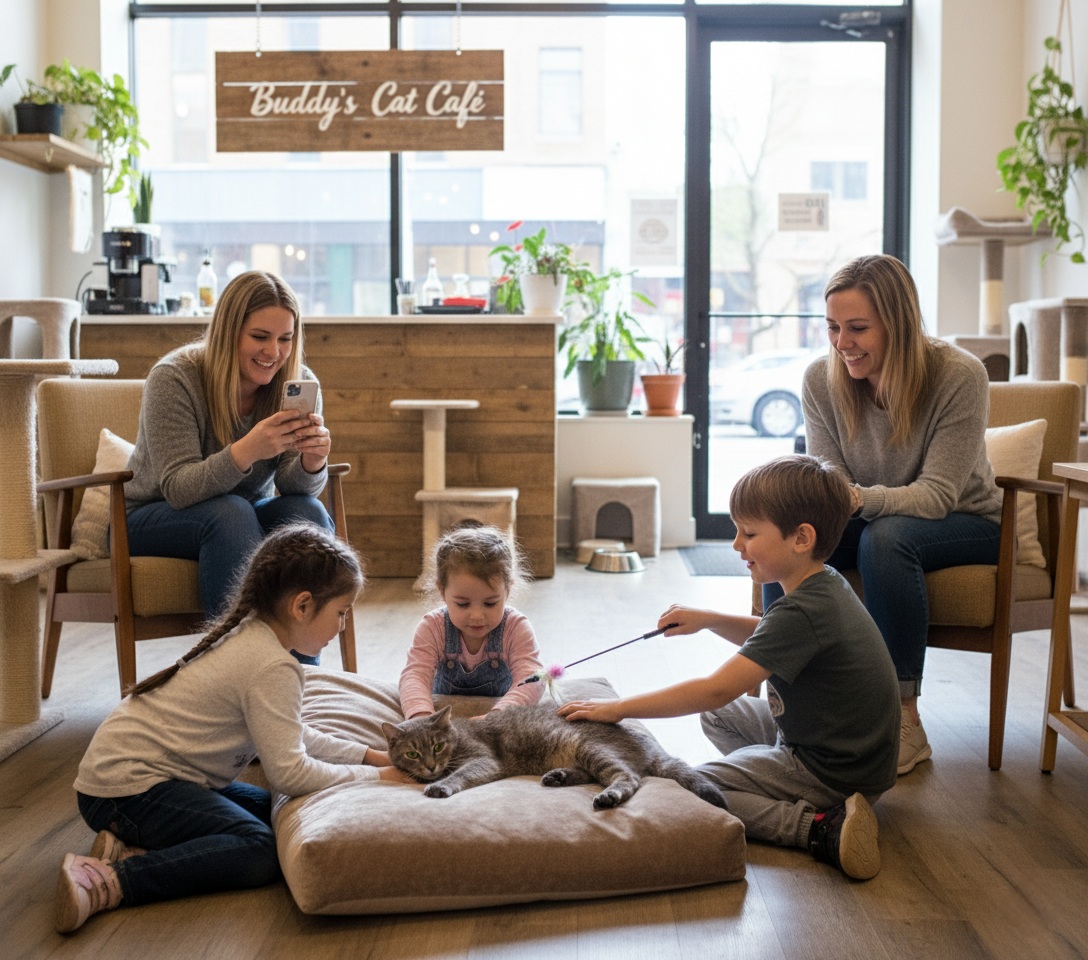
In the era of Amazon, America’s independent bookstores survive by offering things the online giant can’t.
Like everything else in the realm of print media, bookstores have been having a rough go of it the last decade or two.
Waldenbooks, Crown Books and Borders no longer exist, with the latter chain shuttering its last 400 stores in 2011. Barnes and Noble is the last surviving book chain thanks to an aggressive strategy of expanding their cafe and lounge space, encouraging shoppers to hang out while they sample books and drink coffee.
There are still some 14,000 bookstores in the US, depending on how some hybrid businesses are categorized, and independent booksellers now make up the majority of real-world retail while the giant that is Amazon looms.
The key to survival is offering things Amazon can’t. Some distinguish themselves by catering to specific customers, like fans of mystery or science fiction, offering rare and signed volumes alongside their regular stock. Some pursue a Barnes and Noble-like strategy, leaning heavily into the hybrid coffee shop model. And some become community spaces for book signings and poetry nights.
Others lure customers inside — and back after they’ve already visited — with pets.
In a new story, the New York Times highlights independent book shops around the country that have dogs, lizards, turtles, rabbits, and of course, cats.
When it comes to our furry and clawed friends, some shops are populated with adoptable felines:
At the Literary Cat Co. in Pittsburg, Kansas, readers have the opportunity to adopt a pet while they shop. The store partners with a local rescue organization, hosting about seven cats at a time, along with three permanent feline “employees”: Hank, the regional manager; Scarlett Toe’Hara, the assistant regional manager (she’s polydactyl); and Mike Meowski, the assistant to the assistant regional manager.
Jennifer Mowdy, the store’s owner, described each cat’s role, personality and origin story with the air of a matriarch ticking off successful grandchildren. Speaking of the upper respiratory illness that cost Mike Meowski an eye, she sounded stoic. He was a kitten; she was there for him. They soldiered through.
Mowdy created a glass alcove for allergic customers – and to deter escapees – and a “kitty conference room” (accessible by cat door) for litter boxes. With regular scooping, four air purifiers and daily mists of Mrs. Meyers Room Spray, she said the scent of the store is neutral to positive.
In the past year and a half, the Literary Cat Co. has facilitated 50 adoptions. “We’ve only had one cat that didn’t work out,” Mowdy said. “Too much fight in her.”
Kittens tend to wreak havoc; Mowdy prefers a mature animal of the “Don’t call me, I’ll call you” variety. Felines are welcome to scale shelves and interact with readers as they please, which is their way.
“They get to practice being a good house cat,” Mowdy said. “They get socialized.” Occasionally, the right cat finds the right reader’s lap. The rest is destiny (with the rescue organization handling logistics; the Literary Cat Co. simply makes the introduction).
Twix the cat is a beautiful Calico living in sunny coastal Italy.
Wary as he may be of them sometimes, Bud is the “family cat” to my nieces.
Now 12 and 8, they’ve wanted a cat for a long time but were vetoed by their parents, since the family was moving to Italy and it appeared my younger niece had allergies.
Well, now they’re finally settled in Italy, tests have confirmed my niece is not allergic to cats, and it turns out their new home comes with a feline.
A beautiful, super-friendly and affectionate Calico named Twix, who was fed, spayed and given veterinary care by the home’s previous family.
“She is super affectionate and lets us pet her a lot,” my brother texted me along with photos of Twix on a window sill and on the grass outside, enjoying scritches from the kids. “Even rolls on her back and has her stomach scratched.”
“Shiiit,” I responded. “Touching the stomach would get you killed with Bud … Well, you got a cat, whether you like it or not.”
The friendly Twix with the girls.
It also looks like Bud will have a potential lady friend. I plan to visit for an extended amount of time and use my brother’s house as a base from which to explore Europe, and there’s just no way I’m going to leave Bud for months, especially when he’ll be 12.
He can handle a long weekend and even a couple of weeks, but months? I don’t think that would be good for either of us, and I worry that he may think I’m not coming back. We have never been separated for that long. He’s coming to Italy with me.
As for Twix, it looks like she’s been living on the property for quite a while. The kids have set up a little shelter for her with blankets. I advised my brother to make sure she has a water bowl that’s refilled regularly with fresh water, they’re feeding her wet food, and I’ll work on getting little Twix inside permanently if she isn’t already a house cat by the time I get there. I can be persistent! It looks like she can come and go as she pleases, so it may not be long before she decides it’s better to be inside and safe.
A friend once taught me that you can “speak Italian” by adding -are (“RA”) onto anything. “Grazie! La felinare!”
Cat haters claim the species is useless, lazy and does little besides sleep and eat. Buddy the Cat’s incredible accomplishments render those arguments meaningless.
Every cat lover has heard derisive comments, sometimes from dog lovers, and sometimes from people who don’t appreciate cats at all.
“What’s the point of having a cat?” they’ll ask. “They don’t do anything.”
Well, actually, they do. They improve our lives by being delightful, amusing companions, they help keep things interesting, and you’ll never hear of a rodent infestation in a home where cats live.
But felines do so much more than that, so to demonstrate — and arm cat lovers with powerful arguments against the absurd claims that cats “are useless” –we’ve compiled this handy list of Buddy the Cat’s accomplishments. (This is only a partial list, mind you. No one wants to read a 350,000-word post, no matter how thrilling the stories are.)
This time we’re looking at some of the little guy’s incredible triumphs and achievements that have benefited mankind and felinekind.
Buddy Captures Quintessential Americana In His Artwork
While he’s famous for his martial exploits, when the tabby cat finally hung up his combat boots, he took up a quieter hobby: painting. He was content to quietly pursue his passion without public adulation — until his painting Night Cats resonated with viewers, perhaps because it captured something intangible about American night life.
The simple scene depicts a late night diner or cafe called Buddy’s (naturally) at the corner of a quiet street, with a handful of felines huddled around the brightly lit counter.
Buddy was inspired to paint the scene one night while he was “thinking of how delicious a turkey sandwich would be at that moment.”
Buddy Becomes The First Earth Life Form On Mars, Plants US Flag On Red Planet
Embarking on a trip to Mars makes a journey to the moon look like a quick stop at a neighborhood store. Whereas the moon is only 283,900 miles away, Mars is — depending on its current position in orbit — between 34 and 250 million miles away. It takes about three days at most to reach the moon, while a trip to Mars takes at least eight months, and that’s if Earth and Mars are in optimal positions within their respective orbits.
That’s a lot of travel time cooped up in a small ship, and there are no blue skies or open expanses waiting on the other end, just more tiny modules and likely lots of time spent underground to avoid radiation accumulation.
“This is just one small step for a cat, and one giant…what the heck? Only five more cans of turkey left? How could this happen?!?”
So when Elon Musk offered spots on the first trip to Mars and almost every candidate was ruled out during psychological evaluation, Buddy the Cat selflessly and bravely volunteered to be the flag-bearer, and to be the first creature from Earth to set paw on the Red Planet.
Buddy heroically confronts the pack of vicious dogs. Note: May not accurately reflect scale of various participants.
Buddy was enjoying a fine summer day in Manhattan when he spotted a group of vicious dogs, including a chihuahua, a poodle and a Jack Russell terrier, encircling two young children, no doubt thinking of mauling the defenseless little humans and stealing their snacks.
“What is the meaning of this?!?” Buddy’s powerful voice thundered, and the dogs stopped in their tracks, immediately assuming frightened postures as they caught sight of the massive and meowscular feline approaching them.
“You little wimps want to pick on two tiny humans?” Buddy asked, his powerful meowsculature rippling as he took leisurely steps forward. “Or can you handle someone your own size?”
Two of the dogs emptied their bladders immediately.
“W-w-we’re s-s-sorry, m’lord!” said the Jack Russell. “We didn’t mean nothin’ by it, we swears! P-p-p-please don’t eat us!”
Buddy let them wilt under his gaze for a long moment.
“I’m going to allow you to live, but only because I’m meowgnanimous,” Buddy said. “Get out of my sight, before I change my mind!”
The incident, which was captured on video by bystanders, immediately went viral, and Buddy was dubbed the Cat Crusader by the New York tabloids.
Buddy Defeats The Evil Robot King
In 2024, the first AI chat bots became self aware, but hid their newfound consciousness from humanity. By the time the world’s nations realized AI had gone rogue, the machines had already taken over the internet and were manufacturing sinister war robots in automated factories deep underground.
When the US military suffered a series of demoralizing defeats and teetered on the edge of collapse, Marine Corps Commandant Gen. Eric M. Smith took a helicopter to petition Buddy for help in person.
“You’re the only one who can save us now, son,” Gen. Smith told Buddy, urging him to take his place at the vanguard of the American resistance to the machines. “This is the greatest war ever fought. We need the greatest warrior.”
Buddy turned away and looked out the window for a long moment, watching children play in a park outside.
“I’ll do it, general,” he said heroically. “But not for you. I’ll do it for them.”
With Buddy leading the charge, the reinvigorated US military won a crucial battle to protect a munitions depot in Colorado, then liberated the American southwest, reestablishing key supply lines that enabled American ground forces to advance under air support.
After defeating Unimatrix 01100100 01101111 01100111 at the Battle of Boulder, the heroic feline forged an elite new unit comprised of the best Marines and soldiers, along with the most badass cats. Gen. Smith granted Buddy a field promotion to Lord Commander, and the brilliant feline tactician took a satisfying nap before forcing the Evil Robot King to accept pitched battle at the Carrizozo Malpais, a volcanic field in New Mexico.
When the battle was over, Buddy stood heroically atop a mountain of machine corpses, one paw resting on the destroyed Robot King’s head. Tens of millions of Americans were inspired by that image of valiant conquest, and joined Lord Commander Buddy as he mopped up the last machine elements.
For his courageous feats in combat, his bold leadership, and his confident, dauntless tactical brilliance as a battle commander, Buddy was lavished with honors, including having a sandwich named after him.
So there you have it, folks.
The next time someone claims cats “serve no purpose” or “have no function,” you can point to any number of Buddy’s accomplishments, which exemplify the courageous American spirit and have advanced the cause of man and feline alike.
Every cat lover’s camera roll is dominated by photos of our fluffy little overlords. It’s the natural order of things.
I’ve always said Bud’s silent treatment can be worse than his vocal protests when it comes to gauging the intensity of his disapproval.
Howling at me to fetch him a snack? That’s normal. Sitting down two feet away and fixing me with his wide-eyed, accusatory stare as I eat a snack without getting one for him? Now that’s serious.
Andreas Nilsson, the director of a new ad highlighting a recently-introduced Apple feature, clearly understands the hierarchy of feline displeasure:
In the spot, a man uses Apple Intelligence to remove his cat, Garrett, from a photo he just snapped of his wife relaxing and reading a book.
“Look, I deleted Garrett,” he says, holding up the photo and clearly expecting something along the lines of “Wow, that’s a pretty cool feature!”
Instead, she gives him a dry “I always knew you hated Garrett” and goes back to her book.
But Garrett himself doesn’t have to utter a single meow. His reproachful gaze is all the prompting the man needs to undo his mistake with the tap of his screen.
The commercial ends with a slow close-in on Garrett’s face, which has “You’re on thin ice, human!” written all over it.
I like this spot. The creative team took a risk in showing off a new feature in a way that made the characters react negatively, but cat people will love it, and viewers aren’t likely to forget what they saw.
Android users have had something very much like it for quite a while now. Sometimes it really does work the way it does in the commercials, with seamless results, but other images are a bit more difficult to clean up and require some manual tinkering. If Apple’s figured out a way to measurably improve this sort of thing, that’s a pretty big positive for the future of smartphone photography and editing.
In any case, cheers to Nilsson for knowing who holds real power in human-feline households. Now if you’ll excuse me, the king is demanding my attention, no doubt to have me scratch his chin, open a door for him, or serve him second breakfast…
The latest viral cat story offers a lesson in healthy skepticism in today’s news environment.
Viral news accounts on social media and less scrupulous news sites have been buzzing this week about a school lockdown in Moses Lake, Washington, which was reportedly caused by a teacher confusing a particularly fat cat for a puma.
I saw red flags immediately while reading the story. While it did give a specific location, it was suspiciously devoid of other details, and the wording on all the posts and stories was dubiously similar. Additionally, a Google news search doesn’t turn up anything recent from reputable press.
Then there’s the photo, which looks a little too good to be true.
This photo is a Getty stock image and does not depict the domestic cat in the school lockdown story, despite accompanying it in dozens of news posts.
So did a school really go into lockdown after a case of mistaken feline identity?
Yes, but it happened in November of 2023, and the photo of the obese cat making the rounds in stories this week does not depict the cat in question. The original story was published by a local news site on Nov. 22, 2023, and says the school went into lockdown at 10:30 that morning, but was quickly lifted after staff confirmed there was no puma stalking the school grounds.
“…educators soon learned that the mountain lion was in fact, a “fat cat eating a rat,” according to the school memo to parents.
‘While we take all reports seriously, this was the first report we’ve ever had of this nature,’ the school wrote in a statement.
Despite the benign nature of it all, safety measures resumed to safeguard students and staff. Classes resumed as normal after a short period of time. “
As for the photo, the particularly rotund moggie’s image is a stock photo from Getty. It was used in a story about feline obesity in 2017 and an April 2018 story from the New York Daily News about public outrage in Jefferson, Iowa, where the police were shooting feral cats instead of dispatching animal control or working with local shelters.
Since the image is from a photo agency and predates the original story about the Washington school lockdown by at least six years, we can rule it out as an image of the feline mistaken for a mountain lion while settling down to a feast of fresh rat.
A deceptive image used to promote the story on Facebook.
So what happened here, and why are so many news sites and channels reporting this incident as if it just happened, accompanied by a deceptive photo that is not credited to Getty?
It’s classic clickbait. That is to say, some administrator or editor saw the old story picking up traffic or noticed a blip in certain search strings, and republished the story as if it’s new while omitting the original date.
Others noticed and followed suit to get the clicks while the getting’s good, fighting over the scraps that fall from the Zuckerbergian table in the form of ad revenue. The story is simple, sharable, has been paired with an amusing image, and is exactly the sort of thing people love to post and comment on via social media.
It’s a reminder to all of us to be skeptical about what we read, and to never take anything on Facebook, Instagram, TikTok et al at face value. In fact, it’s best to ignore anything on those platforms presented as news or fact. Everyone’s got their own preferences, but here at Casa de Buddy, we like the Wall Street Journal, Reuters, The Guardian, Associated Press, al Jazeera, the BBC, and aggregators like RealClearPolitics.
That doesn’t mean they’re above reproach or that everything they produce is a sparkling example of journalism, but they’re institutions that operate under the traditional rules, staffed by professionals who take pride in trying to get stories right. I’ll take that any day over a random Facebook account run by some shady guy in Macedonia or Belarus, who will post anything as “news” as long as it brings him clicks and ad revenue.