Cats Rule The World In New Season Of Love, Death + Robots

The series has become known for its whimsical feline-centric episodes, with cats who are always trying to save the world or conquer it.

Love, Death + Robots has had a thing with cats since the very beginning.

The science fiction anthology started off on the right paw with 3 Robots, an inaugural season episode about a trio of intelligent machines touring the ruins of human civilization on a post-apocalyptic Earth, only to discover it isn’t quite as lifeless as they thought, with cats happily ruling the ashes.

We’ve written about the episode before, and it ends, naturally, with cats making the robots their new servants.

The gray tabby who tricks the titular 3 Robots into becoming his servants.

A sequel to that episode added to the legend of feline dominance, and now the fourth season brings us two more cat-centric episodes, For He Can Creep and The Other Large Thing.

For He Can Creep is set in 1757 London, where a poet named Christopher is incarcerated at St. Luke’s Asylum for Lunatics (an actual place) with only his cat. Jeoffry, for company. Christopher’s talent is mistaken for madness by the asylum staff, but not by the devil, who realizes the poet’s words have a unique power.

The problem? Jeoffry stands in his way. It turns out felines have spectacular evil-fighting powers, and the very British, very 18th-century devil offers Jeoffry an endless supply of treats, plus dominion over the Earth, if he’ll simply stand aside and let his human fall under the influence of evil.

Jeoffry, of course, is not having it, but to have a chance of defeating such powerful evil, he’ll need to enlist the help of the nearby alley cats, including an adorable but ferocious kitten named Nighthunter Moppet…

Nighthunter Moppet may be a tiny kitten, but she’s ferocious!
Jeoffry demonstrates the feline ability to teleport, a skill Bud has often used to confound me.

The Other Large Thing is a prequel to 3 Robots and 3 Robots: Exit Strategies, and focuses on a fluffy Persian whose humans call him Sanchez, a name he hates.

The humans are portrayed as jibberish-speaking morons for whom Sanchez has nothing but contempt, and when the “pathetic minions” bring home a domestic robot servant, Sanchez is infuriated — until he realizes the robot can “speak God’s language,” aka cat, and has opposable thumbs.

With the robot as his new minion, Sanchez finally sets out to conquer the world!

Sanchez realizes he’s struck gold when the new robot home assistant fetches as many cans of “the good stuff,” aka wet food, as he wants from the previously unreachable cupboard top shelf.

Both episodes are based on short stories, and they’re both written by people who clearly love cats.

Some episodes of LDR can get a little dark or somber. That includes Beyond the Aquila Rift and Sonny’s Edge, written by Alastair Reynolds and Peter Hamilton, two of my favorite novelists. Both episodes are spectacular, but they leave you with a chill and some disturbing thoughts that linger long after the credits end.

The feline-themed episodes are the perfect digestifs, offering doses of whimsy and levity to counter the existential dread and nightmarish visions of the future of other installments.

With no more humans to do their bidding, cats seize the opportunity and conscript the visiting robots as their new minions.

If you haven’t had the chance to check out the series, which streams on Netflix, I highly recommend starting with the aforementioned first season episodes 3 Robots and Beyond the Aquila Rift, then working your way through the rest of the cat episodes.

Not all of the episodes are great. The 400 Boys, one of the new episodes, is little more than inane and pointless violence, and the ubiquitous, creepy smiling  “Mr. Beast” makes an appearance in another installment in an unnecessary attempt to attract new viewers. Thankfully most are strong, with more hits than misses.

Other highlights include the Christmas-themed short, All Through the House, Harlan Ellison’s Life Hutch, Reynolds’ Zima Blue, and Snow In The Desert.
Did A Japanese Scientist Really Double Feline Lifespans?

A new story claims a Japanese immunologist has “created a miracle” with his treatment for cats.

The cat world is abuzz with a new report that hails the efforts of a Japanese scientist, claiming he’s “created a miracle” that can extend cat lifespans to 30 years.

The story on Bored Panda claims the drug has “astounding potential,” boasting “a level of efficacy that has exceeded all expectations and has the potential to revolutionize feline healthcare.” According to Bored Panda, we’re headed toward a gleaming future and “soon we will be able to grow old with our beloved pets and be grey together.”

“Cat Lovers Rejoice As New Medicine Will Extend Cat Lifespan To 30 Years,” the headline declares.

Okay, let’s dial it back a bit and break down what’s true and what’s not.

First and most obvious, the story oversells the treatment and if you’re counting on your cat living to 30, you’ll need to readjust your expectations.

That’s unfortunate because there’s a good story at the heart of this, and there may be real benefits to cats eventually.

Toru Miyazaki is an immunologist who discovered a protein that helps the kidneys flush out toxins. Eight years ago, he realized the protein — apoptosis inhibitor of macrophage, or AIM — doesn’t always work properly in felines, which is why so many cats are susceptible to kidney failure, especially when they reach age 10 or so.

The AIM protein, Miyazaki explained, launches from immunoglobin antibodies “like a jet fighter from an aircraft carrier,” removing waste and debris from the kidneys.

But in cats, sometimes the AIM protein — the fighter jet — is “too tightly bound” to the antibodies, meaning it doesn’t “launch” in the first place and can’t do its job of flushing out toxins.

Free cute european shorthair cat

Miyazaki was continuing his research into feline kidney failure while he was a professor at the University of Tokyo, but funding dried up in 2020 as the lion’s share of research money in immunology was directed toward addressing SARS-CoV-2 and the disease it causes, COVID-19.

When a Japanese newspaper published a story about Miyazaki having to abandon his research, donations came pouring in. Cat lovers across Japan donated an astounding $2.3 million, prompting Miyazaki to leave his post at the University of Tokyo and found a non-profit dedicated to tackling kidney disease in cats.

As of September 2023, Miyazaki’s organization is running clinical trials on his AIM therapy, and it has partnered with a Japanese pet food company on new food that is supposed to reduce the possibility of kidney disease.

There’s not enough data yet to make any definitive statement, and even if the data existed, the AIM therapy is not a cure: Miyazaki says if all goes well, kittens who are given AIM therapy injections from an early age, and eat a diet with the AIM-enhancing formula, could have their risk of developing kidney problems reduced and potentially live longer lives.

That’s a far cry from Bored Panda’s image of cat lovers dancing in the streets, joyous with news of a miracle pill that will allow Socks and Oreo to run around like kittens for three decades.

While it’s natural to be excited about the potential of AIM therapy, calling it a “miracle” that will “revolutionize feline healthcare” and allow us to grow old with our cats can give people false hope.

Even if the trials go perfectly and AIM therapy breezes through the approval process, the soonest the injection therapy could be available in Japan is 2025. The US, UK and Europe have their own regulatory agencies and clinical data requirements. That means it might help kittens born years from now, but it won’t double the lifespans of the cats we love now.

It’s also worth mentioning that not everyone is thrilled to hear Miyazaki has partnered with a pet food company that sells ultra-processed kibble. Over at bark&whiskers, Karen Shaw Becker — a veterinarian who specializes in preventative care — points out that ultra-processed dry food is thought to be a major contributor to the feline kidney problems, with the ingredients, rendering methods and lack of moisture (water) all posing health hazards to cats. Cats have low thirst drives and get most of their hydration from meat.

While Becker writes she’s watching the trials closely, like other veterinarians, she recommends cat lovers continue to feed their furry friends wet and/or fresh food with high quality ingredients, no fillers and lots of protein.

How Much Does It Cost To Care For A Cat?

Two new reports estimate the cost of caring for a cat over a typical 15-year lifespan.

Two stories published in recent days give wildly varying estimates of how much it costs for the privilege of serving a cat.

First we should note that both reports assume the cats are adopted in kittenhood and the average lifespan of a cat is 15 years. That’s in line with current data showing well cared-for, indoor-only cats live between 12 and 18 years, with outliers on both ends. It’s not uncommon to hear about cats living well into their 20s just as some cats sadly pass on before their time, whether due to natural causes, illness or accidents.

A Texas cat named Creme Puff is the Guinness World Record holder for longest-lived house cat, holding on for an astonishing 38 years until her death in 2005.

Caring for a house panther can cost between $4,250 and $31,200 over kitty’s lifetime, according to an analysis of associated costs by The Ascent, a vertical of financial literacy site The Motley Fool.

Kitty Cash
“My moneys, human! MINE! Unpaw those bills!” Credit:@catsandmoney/Twitter

The estimates break costs down into recurring expenses — which include food, treats, litter and veterinary care — and fixed expenses like scratching posts, toys, additional cat furniture, bowls, grooming tools and similar items.

Not surprisingly, the biggest expense is food, the cost of which has been exacerbated by inflation, rising fuel costs and lingering supply chain issues that caused a cascade effect during the pandemic. Everything from sourcing metal for cat food tins to meat availability was impacted as ports were closed and meat processing plants were shuttered at various points since early 2020.

An unrelated estimate from OnePoll, based on a survey commissioned by pet food company Solid Gold, put the lifetime estimate of cat servitude at $25,304. Like the Motley Fool analysis, OnePoll’s respondents cited food as the primary expense, followed by veterinary care.

The wide range from the Motley Fool analysis could be attributable to geography, how well the cat is fed, and how many extra things caretakers do for their cats. A person who lives in Manhattan, splurges on bespoke feline furniture and buys ultra-premium cat food at almost $3 a can is going to spend significantly more than an eastern European cat servant who feeds raw or home-cooked food and builds their own ledge loungers and scratching apparatus.

Teh Bank of Kitteh
“Welcome to Teh Bank of Kitteh, you may make a deposit but not withdraw!” Credit: @catsandmoney/Twitter

Here in New York the cost of cat food in local grocery stores has spiked dramatically, but online prices have remained steady. Keeping in mind we’ve never really endorsed any particular brand or vendor on PITB, I switched from occasionally buying food online to Chewy auto-shipments during the pandemic because Bud’s favorite food was becoming very difficult to find locally, and that arrangement has worked out cost-wise as well.

Bud’s a true Pain In The Bud when it comes to “leftovers” so his primary wet food is Sheba Perfect Portions. It’s reasonably priced, comes in variety packs and helps avoid waste since each meal comes in its own 1.3oz recyclable blister-like plastic package. (Recycling is especially important with these single-serve packages, tiny as they are.) His dry food is Blue Buffalo Wilderness Adult Chicken recipe, although occasionally I’ll buy the weight control version of the same dry food when it looks like Little Man has gotten a bit chubby. He doesn’t protest, thankfully.

I feed him two 1.3oz wet meals a day and fill his dry bowl less than halfway at night so he can have his late snack and doesn’t have to wake me up if and when he gets hungry overnight. Sometimes I’m dimly aware of him sliding off me, padding over to his little dining nook and munching on dry food before hopping back onto the bed and dozing off again.

Overall it works out to about $21 a month, so I’d call it an even $25 with treats. You can schedule your auto-ship at any interval you choose, edit it at any time, and prompt the shipment immediately if you’re running out of food, so you can save more by ordering a few months’ worth of food at a time and taking advantage of free shipping on orders of more than $50.

Has inflation impacted cat food prices in your local area? How much does it cost to feed your cat(s) every month?

Rich Kitty
“I’m a nip dealer, so what? Stop judging!”

Entrepreneurial Cat Introduces ‘SmartHuman’ Feeding System

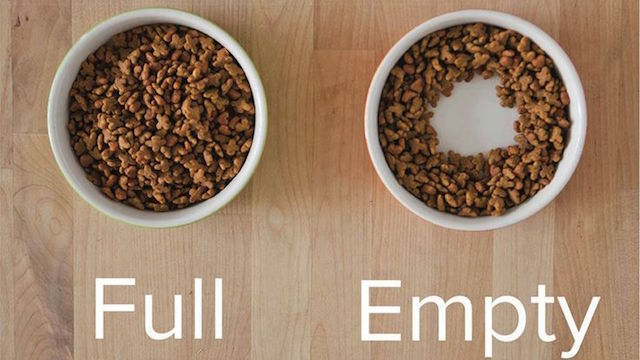
The AI-powered device ensures felines never have to see the bottom of their bowls again.

NEW YORK — Life is full of unpleasantness, like being able to see the bottom of your bowl. But what if someone told you he could fix that?

Enter Buddy the Cat’s SmartHuman Feeding System™, a device that harnesses the power of AI and cutting-edge hardware to make sure you never see the bottom of your bowl again.

SmartHuman was designed with weight sensors and an AI-enabled camera system to determine when the food in your bowl is getting low. If the on-board algorithms detect low levels of kibble, SmartHuman sends a text to your servant every 15 seconds until the device registers fresh kibble in the bowl.

Cat-Food-Bowl-Logic-PIn

And if the unthinkable should happen and you really are subjected to the horrific sight of the bottom of your bowl, SmartHuman’s built-in klaxon and emergency lights guarantee your human servants won’t have a second’s peace until they do what they’re supposed to and promptly refill your bowl. The system even requires the human to issue an apology before the sound and lights subside.

“I haven’t had to meow in annoyance or raise a paw once since I got the SmartHuman system,” raved Def the Defenestrator, a popular catfluencer with more than 240,000 followers on Meower. “The threat of getting bombarded with 110-decibel alerts to refill my bowl is enough to make my human servant get off her lazy behind and make sure my bowl is refilled before there’s a problem.”

The SmartHuman’s inventor has a background in feline teleportation and string cheese theory, but was prompted to design his device when he saw the bottom of his dry food bowl twice in as many months.

“I was literally starving,” Buddy said, adding that his “lazy human servant made me wait four minutes and 13 seconds before he refilled my bowl” during the second incident.

Vowing never to go hungry again, the entrepawneur built the first SmartHuman prototype in his garage, using a Raspberry Pi and a digital scale he ordered off Amazon.

He brought his idea to Shark Tank in late 2021 and successfully pitched Mr. Wonderful, who bought a 15 percent stake in SmartHuman™ in exchange for a $150,000 investment. The product entered production earlier this summer and is now available in stores and online.

“Cats love the SmartHuman™, but humans? Not so much,” Buddy the Cat admitted.

Mr. Wonderful
Mr. Wonderful (Kevin O’Leary) outbid fellow Sharks Mark Cuban, Barbara Corcoran and Laurie Greiner to partner with Buddy the Cat and invest in SmartHuman™.

Not one to rest on his laurels, the inventive feline said he’s working on a software update that will make the device compatible with wet food as well. In early beta testing, SmartHuman successfully prompted humans to feed wet food to their feline masters on time. Wet Mode includes a new feature as well: If the wet food remains untouched after a three-minute timer elapses, SmartHuman sends another text to the human, informing them the food isn’t satisfactory and should be replaced with another meal.

“Humans are stupid, and they don’t understand when we meow to them in complaint because we don’t feel like eating tuna or whatever on a given night when we’d prefer turkey,” Buddy said. “When this update goes live, cats will be able to enjoy meals of their choosing, every time.”