LISTEN: The Buddies Release Their Worldwide Smash No. 1 Single!

Buddy the Cat’s quest for world domination has moved into the realm of music. Listen to the new single here!

NEW YORK — Buddy the Cat made history as the first feline to top the charts in multiple genres this week with the release of “Move Your Ass” by The Buddies.

Listen to it here, but before you do, make room to get funky. (“And use proper headphones or speakers please!” Buddy says. “Don’t do us dirty by playing it through a phone or a laptop. You’ll miss all the bassy goodness that makes it funky!”)

The incredibly funktacular nu-disco track pays homage to the talented feline, who played guitar, bass, keyboards and percussion, while his human assisted him with certain particulars that required an opposable thumb.

“Obviously I could have done this on my own,” Buddy says, “but I like my human to feel like he’s involved in things, you know? Camaraderie and all that. But for future documentaries, ‘Behind the Music’ episodes and other retrospectives, it should be clear I’m the musical genius and the talent. The brains and the brawn, so to speak. Also the beauty. Obviously.”

“Move Your Ass” hit the top of Japan’s pop charts after an early release on Jan. 20 in that country, while it’s dominated the dance music charts in Luxembourg, the Principality of Sealand, Monaco and France. After its Jan. 30 release in the US and UK, it was steadily climbing the charts on Spotify and terrestrial radio.

Asked about his musical influences, Buddy waxed poetic about the funk, disco, French house and nu-disco he grew up listening to.

“From my earliest days of kittenhood, I remember Big Buddy playing Earth, Wind and Fire, Kool and the Gang, McFadden and Whitehead, The Brothers Johnson, Daft Punk, the Galactik Knights and Televisor. I love Televisor! I would dance around and joyfully smack my human on the head, then go hide in his shoes.”

Buddy’s already hard at work on his next single, which he promises “will be just as delicious as this one.”

Are Cats Really Liquid? Yes, Says Physicist Who Specializes In Fluid Dynamics

After seeing memes about liquid cats, physicist Marc-Antoine Fardin set himself the task of figuring out whether the little ones really are liquid.

Pour water into a glass or a jug, and the water takes the shape of the object immediately. Pour honey into a bottle, and it’ll likely take minutes before the slow-moving stuff fully conforms to its new container.

Both are liquid, but they’re not the same.

To differentiate levels of liquidity, rheologists — scientists who study the “deformation and flow” of liquids — use something called the Deborah number. The quicker the liquid takes the shape of its container, the lower its Deborah number, the “more liquid” it is.

On the extreme end are liquids like glass and tar pitch. It took an astounding 69 years for a single drop of the latter substance to fall at Trinity College, which set up a tar pitch experiment in 1944 and finally recorded its first drop on camera in 2013.

So what about cats? Are they really liquid?

If you’re a cat lover and you haven’t been living under a rock for the last 10 or 15 years, you’ve almost certainly seen memes showing photos of felines and their uncanny ability to conform their bodies to containers, as well as their tendency to “pour” themselves.

My Buddy is an expert in the latter, often electing to drop down from the couch in the laziest possible way, by shifting his weight and letting his body follow the path of least resistance until he slides off the side and onto the floor.

“Watchu lookin’ at, human? Haven’t you seen a liquid cat before?”

Marc-Antoine Fardin, a physicist with the French National Center for Scientific Research and Paris City University, won an Ignoble Prize for taking the memes seriously and studying the fluid properties of felines. Cats, Fardin wrote in an article about feline liquidity, “are proving to be a rich model system for rheological research.”

Cats, he concluded, are a “non-Newtonian liquid” with the ability toalter their shapes to fill out the container without changing their volume,” putting them in the same general category as ketchup.

So the next time my cat gets all imperious with me, I’m going to remind him he’s a glorified condiment.

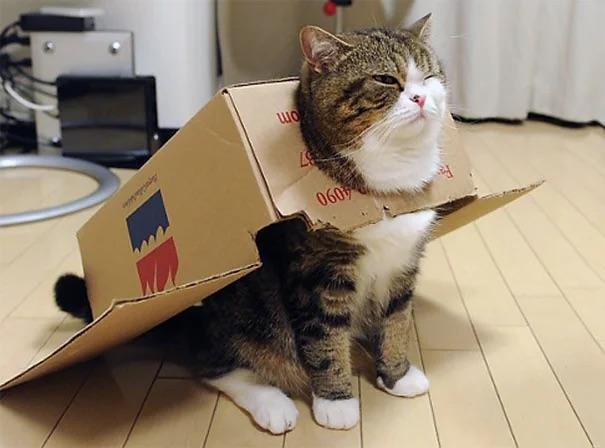
Box full.

Wordless Wednesday: Nibbles The Cat From Cyberpunk 2077

Nibbles is the feline star of Cyberpunk 2077, a little buddy who adds a little levity and fun to the game’s dystopian future.

For PITB’s inaugural Wordless Wednesday, which is turning out to be a somewhat Wordy Wednesday, we’re celebrating Nibbles, the pet cat of protagonist V in Cyberpunk 2077.

Cyberpunk is an open world video game set in Night City, a sprawling dystopian city-state. If you’ve ever wondered what it would be like to live in the perpetual gloom of Blade Runner’s rainy, neon-soaked future, Cyberpunk 2077 is as close as you’re going to get.

Notably, you don’t start the game with Nibbles, who is initially a stray living in the filthy hallways of your apartment building and subsisting on garbage. You’ve got to find him, feed him real food and convince him you’ll be a worthy servant, because even trash-eating strays have standards.

A gamer shows off her pet cat, who bears a striking resemblance to Nibbles. Credit: Elissa Ayadi/Instagram

After you rescue Nibbles, he makes himself at home in your apartment, faithfully greets you when you return, protests when you use the shower, and meows impatiently for yums. He also enjoys lounging in your laundry basket.

You can pose with Nibbles anywhere in Night City for screenshots.

Nibbles is quite demanding, like all members of his species.
Another gamer with a sphinx cat doing her best Nibbles impression.
Johnny Silverhand, played by Keanu Reeves, also takes a liking to Nibbles. Meanwhile, Nibbles takes a liking to the laundry basket.
Nibbles lounging.

Finally, some screenshots I took of Nibbles, V, Johnny Silverhand (Keanu Reeves) and Reed (Idris Elba):

Nibbles with V and Idris Elba.
Nibbles: “Feed me, lady.”
Nibbles is the star of the show

When Cute Is Cruel: Breed Beloved By Celebrities Like Taylor Swift Suffers Painful Genetic Mutation

Scottish Folds are cute, but the genetic mutation responsible for their folded ears also causes lifelong pain, joint problems and misshapen bones.

In 1961, a shepherd named William Ross found a barn cat with a curious feature: instead of the upright, swiveling, satellite dish ears of a normal feline, this cat’s ears were floppy and shapeless, resting atop her head like a tiny knitted cap.

Ross took the cat home and named her Susie. Susie gave birth to a litter of kittens with the same floppy ears, and it all gets a bit murky from there, with a dozen variations of the story online claiming it was Ross himself or a neighbor who “created” the breed.

Regardless of who it was, the floppy ears were transformed from an abnormal feature into the unmistakable characteristic of a breed, and the Scottish Fold was born.

The cute cats quickly caught on and were officially recognized in competitions by 1971.

Now they’re more in vogue than ever. They’re the preferred pets of music superstars Taylor Swift and Ed Sheeran, who regularly feature photos and videos of their Scottish Folds in social media posts. People across the world are buying them, and they routinely appear in “best breed” lists online, lauded for being cuddly and docile in addition to adorable.

Ed Sheeran with his Scottish Fold cat
Ed Sheeran with his Scottish Fold cat. Credit: Ed Sheeran/Instagram

But they’ve also been banned by the same cat fancy groups that initially welcomed them, they’re prohibited outright in some countries, and animal welfare groups are begging people to stop emulating celebrities by buying them.

That’s because the same deformity that gives Scottish Folds their distinctive ears is also responsible for weak and brittle cartilage and bones elsewhere in the body, which results in lifelong pain and disability.

According to the RSPCA:

“The disease is evident on x-rays of cats from as young as seven weeks of age. Serious abnormalities in joints and bone growth lead to arthritis (painful, swollen joints), short, abnormally thick, and inflexible tails, spinal abnormalities and short, stiff legs. The welfare impacts of Scottish Fold Osteochondrodysplasia can be severe in terms of pain and inability to perform natural behaviours, as these cats can be lame, walk with an abnormal gait, can be reluctant to engage in normal movements such as walking or jumping, and can even become completely crippled.

There is no cure for this progressive condition.”

Sadly, the deformities and resulting pain may be the reason Scottish Folds are considered docile and cuddly: they may simply be in too much pain to move or protest when their humans hug them or pick them up.

Ross and Turner didn’t know it in 1961, but the folded ears and brittle cartilage were the result of a genetic mutation. It wasn’t until 2016 that a group of American and Australian scientists found a mutation in a single gene, TRPV4, was responsible for weak cartilage and bones, leading to the deformities highlighted by the RSPCA in the passage above, as well as “progressive joint destruction.” The condition is called osteochondrodysplasia.

Taylor Swift and Scottish Fold cat
Swift’s cats have appeared in her music videos, feature prominently in her online posts, and were photographed in her arms for her 2024 post announcing she was supporting Vice President Kamala Harris in November’s presidential election.

Cats Protection, a UK charity, raised the issue in 2024, warning that Scottish Folds were becoming even more popular, with breeders struggling to meet high demand. The group issued a public statement asking cat lovers and Swift fans to avoid buying Scottish Folds. Scottish Folds are equally popular in the US, spurring resistance from stateside animal welfare groups as well.

The Governing Council of Cat Fancy, which registers breeds in the UK — and no longer recognizes Scottish Folds — was even more direct.

“We strongly advise members of the public not to try to acquire cats of this breed,” Steve Crow, chairman of Cat Fancy’s governing board, told The Guardian.

The Cat Whose Voice Is Heard In More Than 300 Movies, Plus: Buddy Didn’t Attack His Sitter!

A 23-second clip of a cat growling and yowling has become one of the most-used sound effects over the past three decades. The Guardian traced the clip back to the man who recorded it and got the full story.

We’ve all heard Cheeta the cat yowling, we just don’t know it.

Cheeta was a house cat who belonged to Wylie Stateman, a sound engineer who lives in LA.

In 1988, Stateman recorded an argument between Cheeta, a “remarkably small” half-Siamese void, and her mate, a tomcat named Sylvester.

The 23-second clip made it onto The Premiere Edition, a 20-CD library of sound effects Stateman produced in 1990.

Stateman, called “one of the great recorders of the time” by a colleague, told The Guardian he brought his sound recorder with him everywhere he went for three decades, recording thousands of sounds that have been used in movies for 35 years.

Buddy is also an accomplished sound effects cat.

Cheeta’s yowls are one of his greatest successes. The cranky cat can be heard in Toy Story, Home Alone 3, Les Miserables, Pet Sematary, 101 Dalmations, Venom: Let There Be Carnage, Babe, End of Days, How The Grinch Stole Christmas, and many more.

Although it’s difficult to get an exact count, it’s believed Cheeta’s distinct voice can be heard in some 330 films over the years. If you’re interested in learning more, check out The Guardian’s deep dive into the sound effect and its origins.

Buddy the Magnanimous

I went to visit my brother and his family in Washington this past week, leaving Buddy in the care of my mom.

Regular readers will recall that Bud has a bad reputation for trying to maul his cat sitters, which obviously complicates things.

The incorrigible little lunatic.

Sue, his regular sitter, has known Bud since he was a kitten. She’s literally one of the first humans he met, yet that has not stopped him from ambushing and attacking her. Incredibly, she still agrees to care for him in my absence despite his belligerence, though she’ll no longer play with him. She feeds him and gets out ASAP. I can’t blame her.

This time my mom cared for the little stinker. He’s also tried to murder her when she’s watched him on previous occasions, including one incident in which his bites and scratches necessitated a trip to urgent care and a round of antibiotics.

So yeah, the happy news is that he didn’t attack her this time, although she told me every time she came back, he’d be waiting right by the door, and when he saw it wasn’t me, he would sniff derisively before turning and padding away.

They have an uneasy truce, but I’ll take it. You know you have small dreams when you celebrate a trip in which your cat doesn’t try to maul anyone in your absence.

On a tangential note, I had a first phone interview with a wild cat conservation organization this week, and for the first time in a long time, Bud didn’t make a peep.

He’s meowed loudly during other phone interviews, he’s put his butt in front of the camera like it’s his job during video calls, and he won’t shut up at any other time, but the one time when having a cat might benefit me, he decides to be silent. Thanks, Bud. You’re the best.