With some muscle to back him up, Buddy the Cat becomes the scourge of the neighborhood.
NEW YORK — Taking refuge from the heat of an unusually humid early June day, cats and dogs alike were gathered around the neighborhood’s most popular watering hole when their quiet lapping was disturbed by a kittenish, falsetto-like meow.
“Coming through!” Buddy the Cat yelled. “Make way!”
The silver tabby ordered everyone to “vacate the premises,” declaring the water his “personal drinking spot.” One of the toughest cats on the block, a battle-scarred orange tom named Buster, continued drinking.
“Ahem!” Buddy said loudly. “Perhaps you didn’t hear me. Vacate the pond, Buster!”
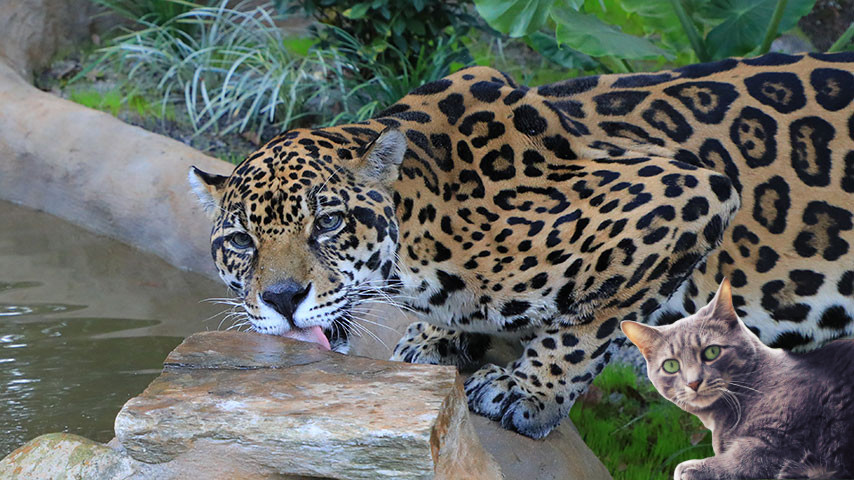
“Or else my jaguar is not going to be happy,” Buddy replied.
Buster began laughing, then caught sight of the enormous apex predator and backed up warily.
“That’s right!” Buddy said. “Back up if you don’t want to become a light snack, Buster!”
Ek B’alam, Buddy’s jaguar friend, raised a paw sheepishly.
“Um, do we have to threaten violence? I’m not interested in hurting…”
“Shhhh! Yes, yes we do have to threaten them!” Buddy whispered. “Let’s see that intimidating pose you do…great, now roar!”
The jaguar let loose a primal rumble, sending every cat, dog, bird and squirrel within a mile running for cover.
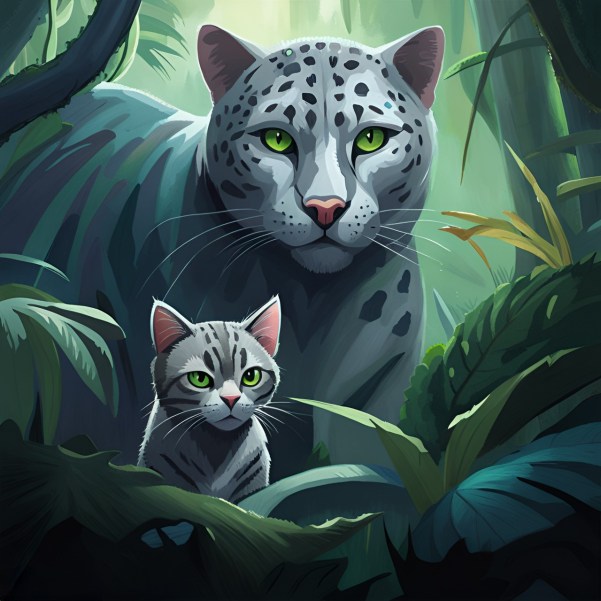
Buddy and Ek B’alam enjoying a prime drinking spot after bullying its previous occupants.
After enjoying a leisurely drink with the pond to themselves, Buddy and Ek B’alam took a lazy route to a nearby dog park where the pair terrorized a pitbull and a gang of Dobermans.
Witnesses said Buddy strolled into the Doberman circle, needled the dogs with insults and told them they’d have to hand over their treats promptly or face dire consequences.
“Oh yea?” the canine leader said, his tail twitching with anticipation. “Says who?”
“Says my jaguar!” Buddy said theatrically, holding both paws out like a magician.
The dogs paused, looked at each other and laughed uproariously.
“Get outta here, you pudgy little…oh! Oh! He’s really got a jag…I mean, I d-d-didn’t…”
Buddy feigned indifference as Ek B’alam padded out from behind a tree. The dogs emptied their bladders.
“You were saying something about me being pudgy, weren’t you? We don’t like insulting little mutts, do we, Ek B’alam?”
“No, we do not, Buddy,” the big cat replied.
“Sometimes we eat them for breakfast, don’t we, Ek B’alam?”
“Yes we do, Buddy. Better than bacon and eggs, with an agreeable aftertaste!”
The dogs whimpered, tails between their legs.
“Leave your toys and treats and scram!” Buddy said, making the canines flinch as he faked a leap toward them.
“You were right, this is kinda fun!” Ek B’alam said as he ate the dogs’ snacks. “Who do we terrorize next?”
Buddy rested his chin on his right paw thoughtfully.
“We could rob Los Gatos of every ounce of catnip they possess. We could put the fear of God into those ‘hunters’ who shoot at our puma buddies. I also have a revenge list of everyone who ever insulted me on the internet. That could be fun!”
As of late Tuesday night, local police scanner frequencies were buzzing with reports of two cats, one small and the other enormous, gleefully tearing apart industrial vacuum cleaners at a nearby Stanley Steemer shop.
The book received glowing reviews for its comprehensive approach to the world of slumber and promises something for every type of napper.
A new book on napping from the world’s most prolific snoozer has taken the sleep enthusiast community by storm.
“The Art of Napping: The History and Technique of Dozing Off” by Buddy the Cat bills itself as “the world’s most comprehensive guide to taking a siesta” and a “manual on how to commit yourself to a lifestyle of leisure and laziness.”
It includes an illustrated history of sleep science, from its superstition-mired origins to the highly specialized field of modern-day napology, following the rich sedentary traditions of various cultures.
“The chapter contrasting ancient Sumerian nap-walking with Syracusan Somnambulism is not only heavy with detail, it’ll put you to sleep almost immediately,” said Rusty LeFelino, chaircat of the Snooze Studies Department at the University of Catlanta.
“Nap on tatami mat under cherry blossoms” by Hirotaro Buddishida, 1646, is one of many historical depictions of shut-eye included in The Art of Napping.
Reviewers were equally effusive with their praise.
“Buddy the Cat dozes headfirst into the world of segmented slumber, documenting everything from Chicago-Style Snoozing to indigenous bedding techniques pioneered by the jaguars of the Pantanal,” reads a starred review in Publisher’s Weekly. “Whether you’re a weekend warrior who enjoys drooling on your couch during baseball games or a committed napper who swears by episodic DaVinci Sleep, there’s something for everyone in this beautifully bound volume.”
The New York-based feline spent more than a year researching and getting paws-on experience for the book. He visited the California headquarters of Google with its famous employee nap pods, spent a week sleeping under the stars with the pumas of the Pacific Northwest, and interviewed lucid dreamers to find out whether it’s possible to nap within a nap a la Inception.
“Buddy leaves no pillow unturned in his quest for the truth, with spectacularly stale prose that will have even the over-caffeinated yawning into the back of their paws,” a reviewer for Narcolepsy Daily wrote. “Get yourself a cozy blanket, curl up with Buddy and let the Z’s commence.”
Southern Siesta: The author spent several weeks in the Amazon napping with jaguars, jaguarundis and ocelots, an experience described in a yawn-inducing chapter of The Art of Napping.“The ability to nap anywhere at any time is the mark of a master snoozer,” Buddy writes in his new book. Credit: Wikimedia Commons
Roadside zoos persist despite recent law changes, but even the best zoos fail to provide adequate facilities and enrichment for big cats, the report found.
The Amur tigress at Bearsdley Zoo is the lone occupant of her enclosure, which is large by the zoo’s standards, outfitted with a pool, toys and other enrichment, but small compared to what her natural range would be.
When I visited last summer, I spent the better part of an hour watching her pace the perimeter of her enclosure, walking in an endless loop as if in a daze, never stopping, altering her stride or reacting to anything.
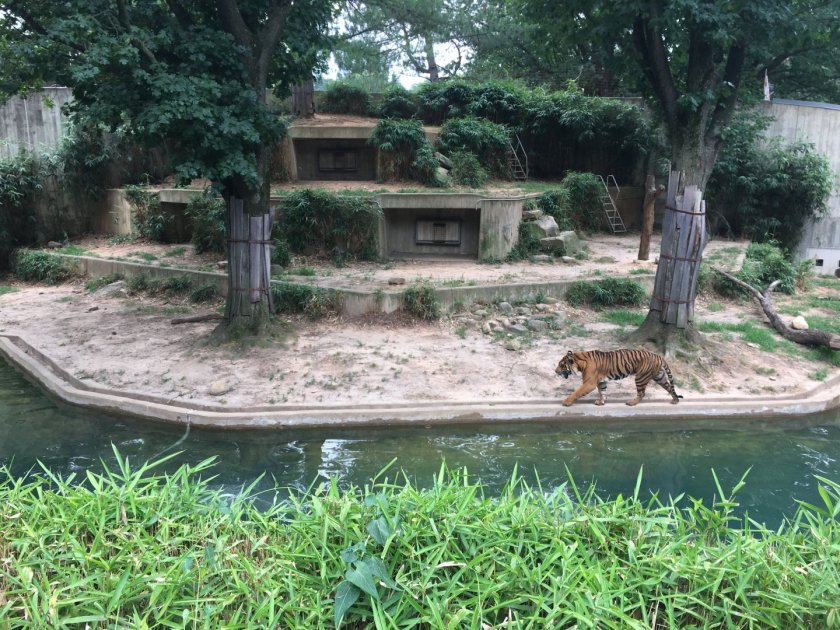
But what made me realize how bad captivity really is for big cats was what I saw at the Smithsonian National Zoo, a well-funded world class facility. The tigers there have two outdoor enclosures with a topographic design: they’re vertical spaces separated into tiers, with large trees and narrow “caves” for shelter from the elements. Both enclosures are surrounded by wide moats that ring the perimeter just inside the security fencing.
One of two similar Bengal tiger habitats in the Smithsonian National Zoo in Washington. Credit: ZooChat
It was feeding time on a hot summer day. Lionesses chowed down on large slabs of meat and licked blocks of ice, but the lone male tiger next door was pacing in a circle. He paced and paced, covering the same 10 to 12 feet, ignoring his food. I watched him for a long time. His behavior was a clear sign of zoochosis.
If a tiger in a national accredited zoo — where an entire team of keepers and caretakers is responsible for enrichment and welfare — suffers from clear signs of captivity-induced distress, what chance do tigers in other facilities have?
When we think of big cats suffering in captivity, we think of the roadside zoos where the Joe Exotics and Doc Antles of the world exploit them for financial gain, drug them, force them to take selfies with visitors and keep them in cruel conditions. But a new report from Born Free USA goes beyond roadside zoos and says big cat arrangements, even in the best zoos, are inappropriate, unhealthy and demoralizing for the animals.
“Unable to escape the crowds of humans, unable to follow some of their fundamental urges such as hunting and roaming over large distances, unable to fulfil their social needs – whether that be living solitarily or forming a pride with others – big cats show us their mental anguish by adopting abnormal behaviors,” reads the report [PDF], Clawing at the Cages. “These behaviors, known as stereotypies, manifest in obsessive pacing. Some big cats spend most of their days tracing the same, short, tedious route around their enclosures. This behavior is a recognized sign of stress, and only documented in captive animals.”
A captive jaguar. Credit: Yigithan/Pexels
The wild lives of animals like tigers are fundamentally at odds with the concept of zoos. In the wild, tigers range up to 50 miles in a single day, occupying vast ranges. Male tigers protect their home ranges, their mates and their cubs from other males as well as threats of all sorts.
That sort of lifestyle, which is hard-coded into their DNA, is not compatible with a guest-oriented operation in which habitats are designed primarily to give people the best view of the animals.
Lions might have it slightly better, though that’s arguable. As a social species they can interact with each other and they tend to have larger enclosures, but zoos rarely group animals according to their preferred family units or prides, instead matching individuals according to breeding plans as part of conservation efforts.
Yet even the conservation aspect is iffy, according to Born Free USA. Because of restrictions on “importing” animals and a population that is descended from just a handful of big cats, inbreeding is rampant. There’s a lack of scientific research on the captive zoo-held population, but the authors cite a 1983 study that found “six animals out of the approximately 1,000 Siberian tigers held in zoos in 1983 were responsible for 69.4% of the founder representation of the living population at that time. 70% of the population had a positive inbreeding
coefficient.”
Because little has been done to remedy that genetic bottleneck, “genetic viability remains low, and inbreeding of big cats in zoos can only have increased in the intervening years since these studies,” the report states.
Inbred cats suffer more health problems, don’t live as long and are much more susceptible to birth defects.
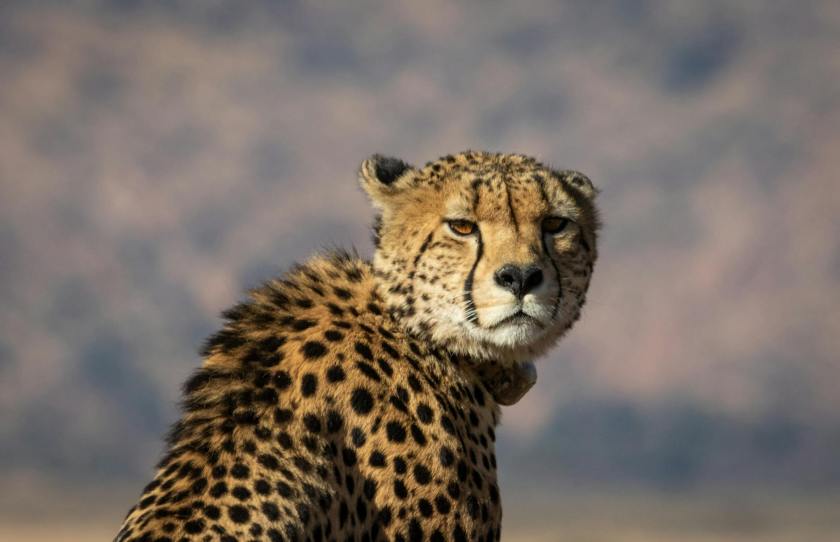
A cheetah. Credit: Magda Ehlers/Pexels
Despite the passing of the Big Cat Public Safety Act, Born Free USA’s report notes, roadside zoos still exist, and many of them have simply ignored the new laws because their operators know inspectors are overworked and lack manpower. Years can elapse between inspections, even at roadside zoos operated by serial offenders with long histories of keeping animals in abysmal conditions.
For example, Single Vision of Melrose, Florida — which bills itself as a “conservation” facility — openly flaunts its mistreatment of big cats with enormously popular video content from “Safari Sammie” on Youtube, TikTok and Instagram, despite the fact that it’s been the subject of dozens of violations and has an ignominious record when it comes to the health of its big cats. The facility was charged with 20 violations of animal rights laws in the previous two years, and has had multiple cases of animals dying due to neglect, yet continues to sell “experiences” in which “guests” can interact with heavily sedated tigers, jaguars, cheetahs and other wild cats.
In her videos, “Safari Sammie” — an employee of Single Vision — is routinely seen interacting directly with the apex predators, treating them like house cats and creating dangerous situations.
Other roadside zoos and animal “experience” operators continue to intentionally inbreed big cats to create “exotic” white tigers as well as ligers, tigons and other hybrids that aren’t found in the wild but are big attractions.
Overall, the report found:
Zoos fail to provide adequate environments for big cats, including lack of space, lack of ability to hide from public view, and the regular practice of locking big cats in tiny night quarters during the hours when zoos are
closed. The latter often results in big cats spending the vast majority of their time significantly confined.
Social and behavioral needs are not met in zoos. For example, solitary big cats are often forced to live with conspecifics, and social big cats are prevented from creating natural prides. Big cats are prevented from
hunting live prey – a behavior fundamental to them – while often housed alongside prey animals who also suffer stress from being forced to live near predators.
Inbreeding of big cats has become commonplace due to limited genetic diversity among captive populations, as well as unethical and deliberate inbreeding of color morphs such as white tigers and lions,
resulting in significant health issues for the cats involved.
Due to the inbreeding of big cats in zoos, as well as their habituation to humans, big cats kept in zoos are generally not candidates for release to the wild. As such, extensive and ongoing breeding programs simply serve to ensure that zoos remain “stocked” with these animals.
Monitoring of data on big cats in captivity is incomplete, with significant numbers of individuals disappearing from studbooks – the databases ostensibly responsible for tracking living big cats in captive facilities.
The licensing system intended to implement the Animal Welfare Act in the United States only achieves superficial monitoring of big cats in zoos, due in part to its risk-based assessment protocols as well as lack of meaningful
information in reporting that would allow effective public understanding and external expert oversight.
Despite the introduction of the Big Cat Public Safety Act in the U.S. in early 2023, some facilities continue to engage in dangerous activities with big cats, both in violation of, and in compliance with the new law.
Zoos around the world have killed healthy big cats due to overcrowding and lack of perceived usefulness to breeding programs. Other healthy big cats have been killed when human error or enclosure failure allowed their escape, or when attacked by conspecifics in their enclosures.
Due to all the issues above, and others, the overall health and welfare of big cats is compromised in zoos. This results in high mortality (particularly in infants), and recognizable signs of stress in the form of significant occurrences of stereotypic behaviors.
The report includes detailed anecdotes of typical problems in captive situations involving jaguars, lions, tigers and cheetahs, documents persistent problems with habitat design and security, and outlines loopholes and other problems with existing laws, which still don’t go far enough to ensure some of the world’s most iconic apex predators aren’t exploited and forced to endure lifelong misery.
You can find the report’s landing page, with links to a petition, a summary and the full text here.
Blurry photos and fleeting encounters keep the legend of big cats in the UK alive. Could there be leopards, pumas and other large cats roaming the countryside?
For all the advances in optics and camera technology over the last 20 years alone, there are two kinds of people who love blurry, low-resolution footage: UFO enthusiasts and people who are convinced the UK is like a cold, rainy Africa with big cats lurking in every bush and field.
To be a member of either group you’ve got to shut down critical thinking faculties, suspend disbelief and put faith in the highly improbable. (Or the impossible when it comes to people who insist little green men are zipping across the night sky in sleek ships that defy all we know about physics and aerodynamics.)
The UK’s big cat believers claim the country is home to a thriving native population of large felids. Some of them think they’re “panthers,” not specifying which species of cat they think is out there, while others claim jaguars, leopards or tigers are prowling the English countryside, spotted only fleetingly at the edges of fields or in the brush, and only by people who own two-decade-old Nokia flip phones with rudimentary cameras.
They believe a native, breeding population not only exists, but for centuries has eluded capture and avoided leaving compelling evidence.
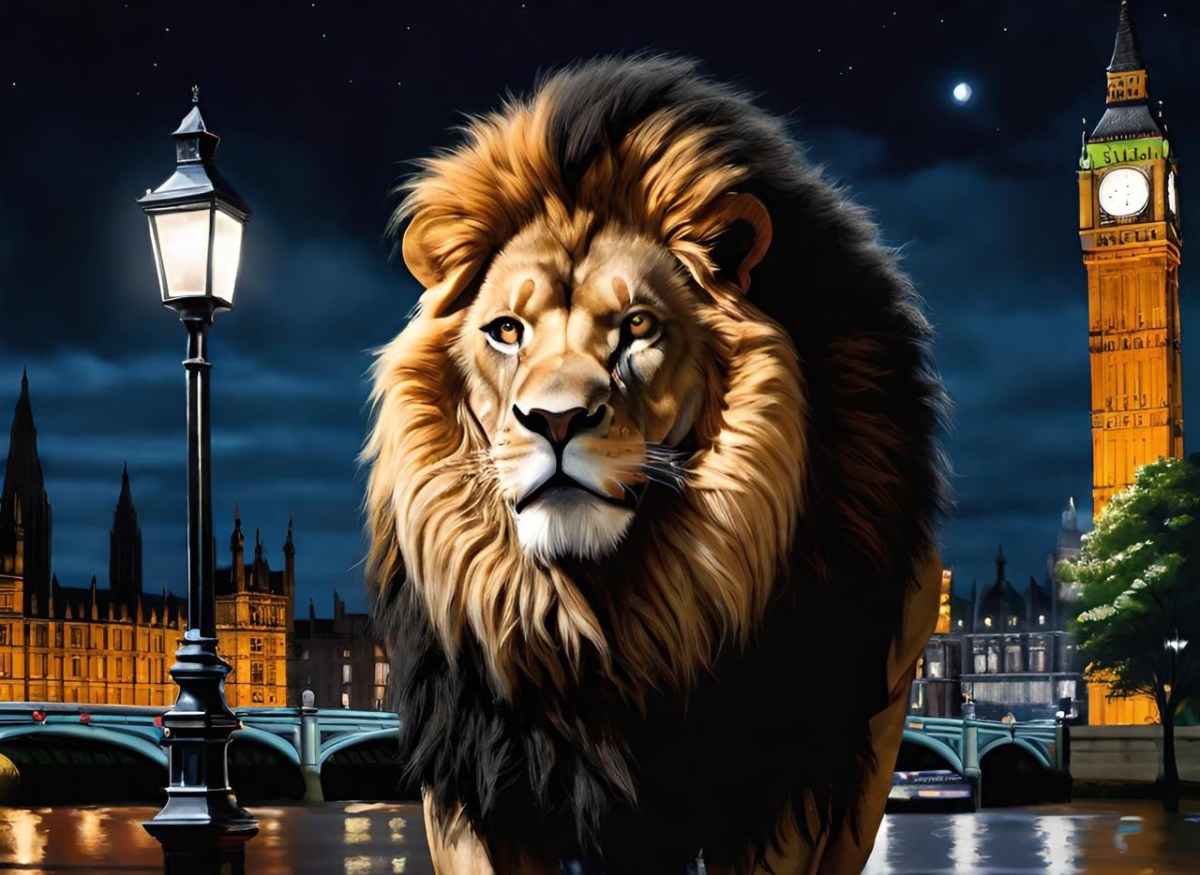
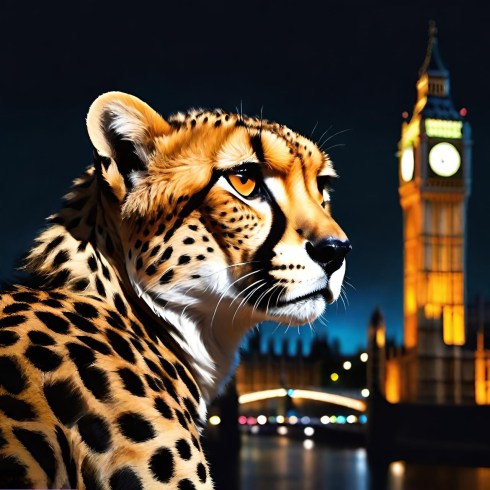
“Pardon me, mate, could you point me toward Aldersgate Street?”
The phantom cats have remarkable stealth abilities. They’ve never tripped a trail camera or appeared in a single frame of CCTV footage. Not a single tree marked for territory, not a single pile of cow bones picked clean by giant barbed tongues, not a single clump of panthera dung. Not even a hungry cub drawn into a village by the smell of barbecue on a summer night.
The reported sightings say more about human capacity for imagination — and how poor we are at estimating size over distance — than they do about the crypto-pumas and melanistic tigers some people swear they’ve seen.
When alleged big cats are spotted in the UK, they’re always seen fleetingly and from afar. When witnesses try to confirm what they’ve seen, the animals are gone.
“I was coming up to Jolly Nice from Oxford at around 7.50pm and the car in front of me was travelling at a steady pace. I looked to the verge of the other side of the road because I saw a bright pair of eyes low down. Upon further inspection, I suddenly realised there was a large outline of a low and stocky cat that was huge.”
That’s the testimony of a UK man who told the Stroud Times, a local newspaper, that he encountered a big cat a few minutes before 8 p.m. on Friday in Nailsworth, a town of about 5,600 people a little more than 100 miles west of London. His description mirrors that of others who say they’ve spotted large felids, mostly in the UK’s countryside and small villages.
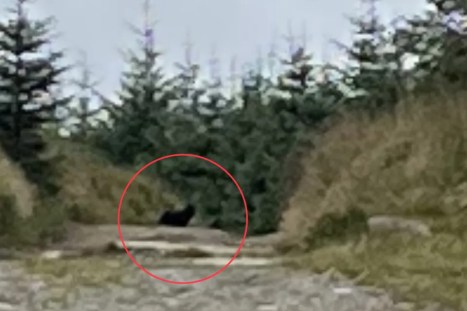
Photograph from a previous “big cat sighting.” It’s typical of the photos that surface with claims of leopards and pumas stalking the countryside. Blurred details and digital zoom make it difficult to gauge distance and scale.
The story’s headline reads: “Big cat expert’s verdict: beast spotted was a leopard.”
The expert in question is Rick Minter, an amateur biologist who has made UK big cat legends into something of a cottage industry by publishing books, hosting a podcast and frequently speaking to newspapers about the phenomenon. It’s not clear how Minter decided the animal in Friday’s sighting was a “black leopard,” but he’s said in previous interviews that he believes most alleged big cat sightings in the UK are leopards, with pumas accounting for most of the others.
Neither animal is native to Europe. Pumas range from South America to the American northwest and midwest, with isolated populations in places like Florida. Leopards are native to Africa and Asia, with ranges that overlap with lions on the former continent and tigers on the latter, mostly in India.
“I’m originally from San Diego, actually, but the expat life suits me and the British are very tasty.”
Some have floated the possibility that the mysterious felids are escaped pets who have successfully adjusted to the countryside. Minter says the evidence points to breeding populations.
If there are thriving populations, the cats would need to exist in numbers, with at least 50 on the extreme low end. If they’re escaped pets, the authorities would know.
Unlike the US, where big cat ownership was banned in the vast majority of states even before the recent Big Cat Public Safety Act was passed, owning a massive carnivore slash killing machine isn’t illegal in the UK. But owners have to register their animals, seek approval for the habitats and enclosures they’ve built, and submit to annual inspection.
There have been a handful of escapes over the decades and each time the authorities were able to capture or kill the animals, often tracking them via livestock kills. Pet tigers and leopards might be dangerous, but they’re still at a disadvantage compared to their wild brethren, meaning they go for the easy, guaranteed kills when they’re hungry. Nothing’s easier than a docile farm animal that’s never seen a big cat.
“Oi, wanna have a pint and watch Man U vs Arsenal on the telly?”
More recently, big cat hunters in the UK have tried to find more compelling evidence than a couple of blurry photographs of house cats out for a stroll. They’ve touted suspicious-looking pug marks, and in August 2022 found black fur on a barbed wire fence. According to the believers, a UK lab confirmed the fur belonged to a leopard, but there was no chain of custody, no documentation of how the sample was found and handled. Big cat experts remain skeptical.
— Big Cat Sightings In Scotland (@BCSI_Scotland) October 24, 2022
Indeed, Oxford’s Egil Droge, a wildlife conservationist, points out that in places where big cats live, you don’t have to go hunting for evidence. It’s everywhere.
“I’ve worked with large carnivores in Africa since 2007 and it’s obvious if big cats are around. You would regularly come across prints of their paws along roads. The rasping sound of a leopard’s roar can be heard from several kilometres,” Droge wrote, noting that leopards in particular are not discriminating about what they kill and leave ample evidence of their handiwork when they’ve hunted.
Still, as improbable as the sightings are, the big cat enthusiasts of the UK have one up on UFO enthusiasts and hunters of cryptics like Big Foot, the Loch Ness Monster and the Jersey Devil: the creatures they’re looking for actually exist and may surprise us yet.
“I see it now!” Buddy exclaimed. “Everything is connected, and we are everything! Who else is hungry?”
PERU — Three hours after ingesting ayahuasca brewed by a jaguar shaman — and two hours after jaguar scouts found him running around the jungle while screaming about extradimensional Teletubbies — Buddy the Cat had unraveled an astonishing conspiracy, sources reported.
The New York-based cat, who had long sought to ingratiate himself with various groups of big cats, usually with disastrous results, finally found kinship with the tolerant jaguars in 2021 when he ventured into the Amazon and impressed the jungle-dwelling felids with his extensive knowledge of novel napping techniques. He also introduced the jaguars to turkey, and in return for his contributions to the jaguar nation, the big cats granted him the jungle name Kinich Bajo, which means “tiny sun-eyed one” in the ancient Yucatec dialect.
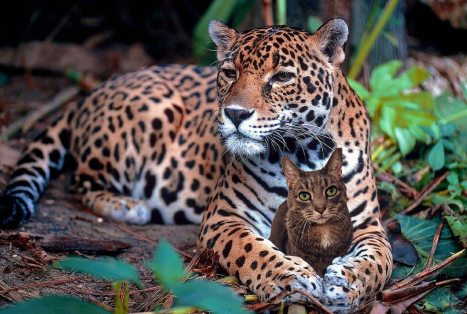
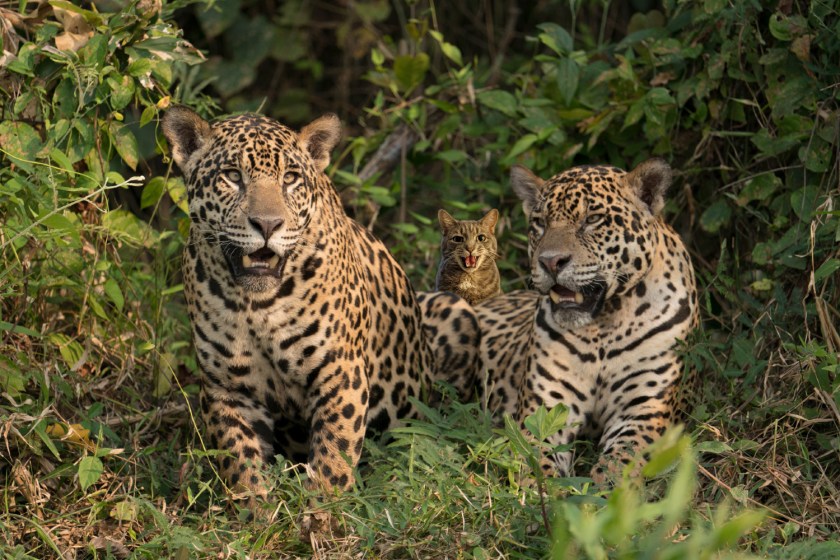
Buddy with Canguçu, one of his jaguar buddies.
Buddy returned to the Amazon in October of 2023 to “spend time with my homies” and participate in an ancient jaguar shamanistic ritual involving tea brewed from ayahuasca, the powerful psychedelic used in indigenous ceremonies.
Clearing a small grove in the Amazon rainforest and using rocks to represent people, places and ideas, Buddy was able to find indisputable connections between the Annunaki, the defunct Blockbuster chain of video rental stores and NFL linebacker Barkevious Mingo.
“But where does the Vatican fit in?” Buddy asked, resting his chin on his right paw thoughtfully. “Could it be that Barkevious Mingo is the true pope, and he was speaking ex cathedra when he said Havarti cheese is the food of the gods? Is catkind really ready to accept a divine proclamation on yums that excludes turkey and gouda?”
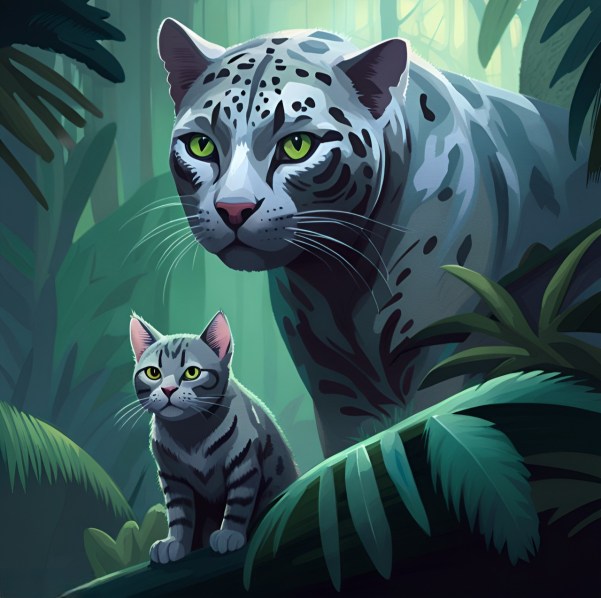
An artist’s impression of Buddy and jaguar elder Yguakina in the Amazon, piecing together great mysteries.
A pair of jaguar minders exchanged worried glances as they approached the tabby cat from both sides.
“Come back to the campfire, Kinich Bajo,” said Xbalanque, the older of the two, using the name jaguar elders had bestowed on the silver tabby. “Your work here can wait.”
Buddy didn’t take his eyes off the complex diagram of rocks, vines and leaves he’d carefully assembled. “Not while I’m so close!”
Xbalanque shook his head. “Where is Elder Yguakina?”
Buddy sighed.
“I had to send him away! He’d become consumed with this ridiculous theory involving Ragnar Lothbrok, the 1973 Pittsburgh Pirates and the Webb telescope,” Buddy said. “I don’t have time for such nonsense!”
As of press time, the Jaguar Nation of Iquitos Amazonia said Buddy was on the verge of a great discovery and will not emerge from the jungle until he’s connected the dots or the psychedelic brew wears off, whichever comes first.
Buddy with his jaguar buddies Xibalbá, left, and Ek B’alam.Buddy and Yguakina find a grove where they begin diagramming Six Degrees of Kevin Bacon. (Artist’s impression.)




 Pain In The Bud