As the masterminds behind the genius heist, Buddy and his associates stand to become extraordinarily wealthy in cardboard boxes, making them the envy of all felines.
NEW YORK — Crammed into a small, smokey room, the felines huddled around a table laden with cocktails, cigars and architectural schematics for a large arena.
Seated at the table was Salvatore “Carniclaws” Catzarelli, Tomasso “Tommy Two Times” Felinzano, Jimmy “Little Jim” Fitzpawtrick, Desmond “Sensimeowla” Neville, a group of junior associates and Buddy the Cat.
“This here boxing is a goldmine, fellas,” Buddy told the other gangster cats, pointing a paw at the original building plans for Madison Square Garden. “The humans, they don’t want to share their boxes, which is why they guarded the secret of boxing from us cats. They want us to be satisfied with one lousy box every week or two. But we’re onto ’em now, see?”
Thousands of glorious boxes litter the central court at Madison Square Garden in New York. Now that cats are wise to the human sport of “boxing,” humans won’t be able to hoard all the boxes to themselves anymore.
Neville licked the edge of his rolling papers, carefully adding potent catnip as he meowed without looking up.
“Mi finna be down wit da heist, mon,” he said, wrapping the paper tight around a generous portion of ‘nip. “Long as di score gonna be split equitably, ya hear?”
“That’s right,” Catzarelli nodded, digging into the pockets of his trench coat for a lighter, which he passed to Neville. “Youse guys know, there’s five of us so we split it nice and even, 15 percent each!”
A smile barely crinkled the corners of Buddy’s mouth before it vanished.
“Of course, my friend,” he said. “You’ll all walk away with 15 percent of the proceeds. If I’m right and this ‘boxing match’ is the goldmine I think it is, we’ll be richer in boxes than we ever imagined! Boxes for every mood and sleeping position. Boxes for your friends and guests. Boxes inside boxes inside boxes!
Felinzano and associates refine plans for the first boxing heist in the history of catdom.
One of the junior associates, a kitten named Crispy, raised a paw.
“Uh, sirs, with all due respect,” he said, “I don’t think boxing is what you think it is. There are two humans in a ring and…”
Buddy cut the kitten off with a wave of his paw.
“Crispy?”
“Yes sir?”
“Who’s the criminal mastermind in this room?”
The kitten looked unsure of himself. “You, uh…you are, sir.”
“That’s right. And who pulled off the legendary turkey heist of 2018?”
“You did, sir, it’s just…”
Buddy held up a paw.
“Unless you wanna be known as Extra Crispy from now on, I’d pipe down if I was youse,” Felinzano told the kitten.
As of press time, the feline criminal ring was putting the final touches on the genius heist, so close to being unimaginably wealthy in boxes that they could almost taste it.
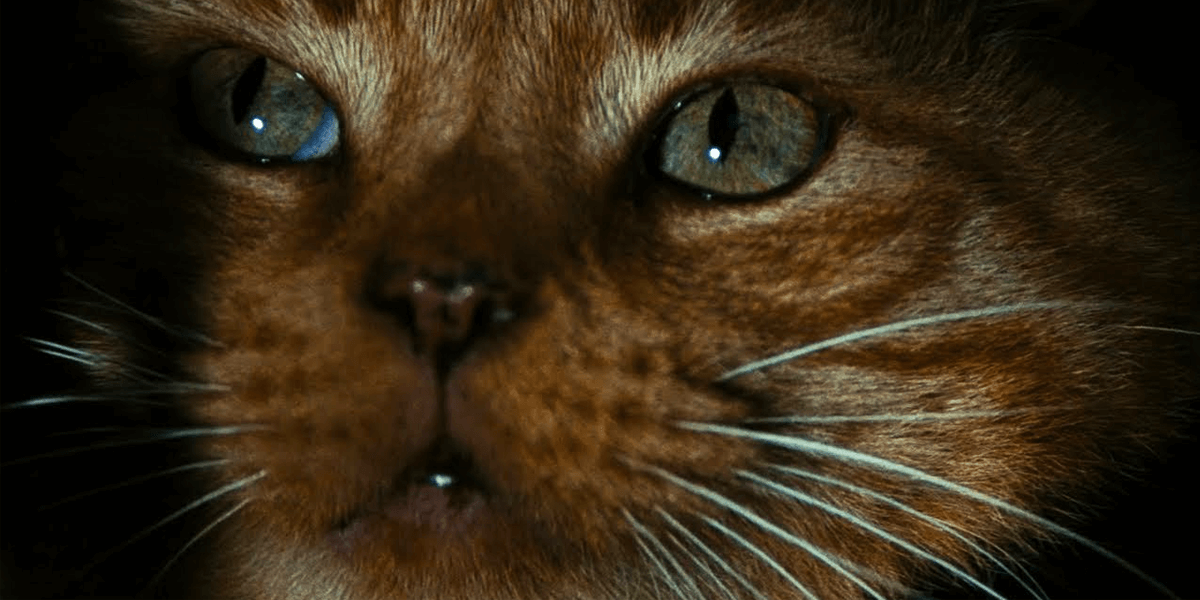
Making his debut in 1979’s Alien, Jonesy is one of the most famous felines in cinema history.
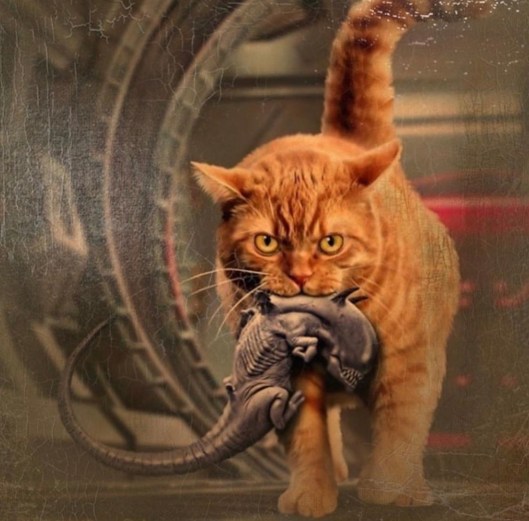
There’s a popular meme among Alien fans that depicts Jonesy the Cat walking nonchalantly down one of the starship Nostromo’s corridors with his tail up, carrying the corpse of the recently-spawned alien in his mouth like he’s about to present a dead mouse as a gift to his humans.
The joke is self-evident: if the crew of the Nostromo had allowed Jonesy to take care of business from the get-go, the alien would have been disposed of before it had the chance to grow into the monstrosity that haunted the decks of the Nostromo and the nightmares of viewers.
“Who’s a good boy? Who just saved his crew from certain violent death at the claws of a ruthless alien predator? That’s right, you did!”
Of course then there’d be no movie. No ripples of shock in theaters across the US as audiences were confronted by something more nightmarish and utterly alien than popular culture had ever seen before. No indelible mark left on science fiction.
Despite the film’s retrofuturistic aesthetic, it’s difficult to believe Alien first hit theaters almost half a century ago.
That’s testament to director Ridley Scott working at the height of his powers, the carpenters, artists and set dressers who created the starship Nostromo’s claustrophobic interior, the design of the derelict starship where the alien was found, and the bizarre creature itself.
The alien ship and creature designs were the work of Swiss surrealist H.R. Giger, who was little-known at the time but floored Scott and writer Dan O’Bannon with his hyper-detailed paintings of grotesque biomechanical scenes.
Signourney Weaver and one of the cats who played Jonesy in the first film.
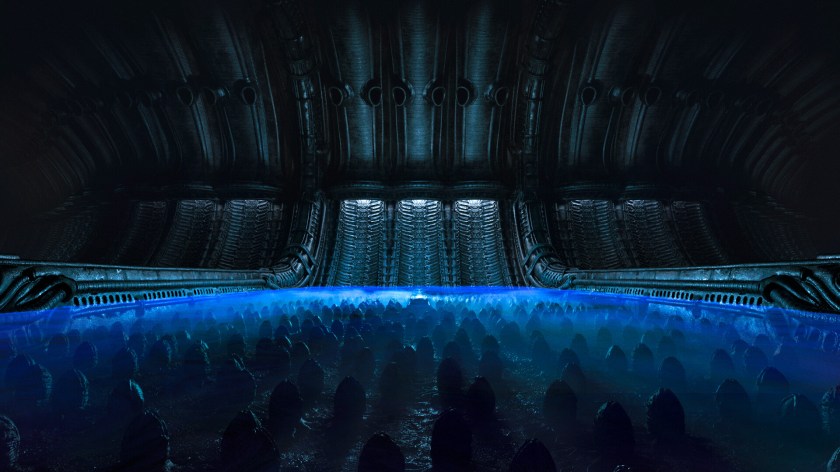
Kane explores the infamous egg chamber in the derelict alien ship.
Fan art of Jonesy
A close-up shot of the retrofuturistic tech used in the series, a design decision that departed from the gleaming visions of the future common at the time.
A set photo showing the first film’s crew on the iconic space jockey set.
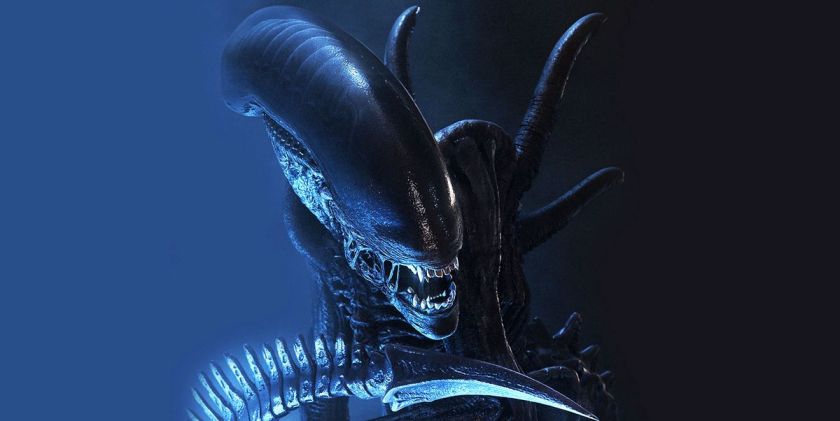
Giger’s work, specifically his 1976 painting Necronom IV, was the basis for the titular alien’s appearance. The alien, called a xenomorph in the film series, is vaguely androform while also animalistic. It is bipedal but with digitgrade feet and can crawl or run on all fours when the situation calls for it. It hides in vents, shafts and other dark spaces, coiling a prehensile tail that ends in a blade-like tip.
But it’s the creature’s head that is most nightmarish. It’s vaguely comma-shaped, eyeless and covered in a hard, armored carapace that ends just above a mouth full of sinister teeth like obsidian arrowheads. There’s perpetually slime-covered flesh that squelches when the creature moves but there are also veins or tendons or something fully exposed without skin, apparently made of metal and bone. Maybe those ducts feed nutrients and circulate blood to the brain. Maybe they help drain excess heat from the creature’s brain cavity.
Regardless, it’s a biomechanical nightmare that the Nostromo’s science officer, Ash, admiringly calls “the perfect organism” whose “structural perfection is matched only by its hostility.”
The alien, Ash declares, is “a survivor, unclouded by conscience, remorse, or delusions of morality.”
The alien, also referred to as a xenomorph, “that thing,” a “dragon,” “the perfect organism” and various other names by characters in the series. Credit: 20th Century Studios
Part of what makes Jonesey so beloved is the fact that, together with the xenomorph and Ripley, he completes the triumvirate of survivors. We see Jonesy scurry into the protection of tiny confined spaces to escape the alien, hissing at it in the dark. We see him dart into the bowels of the ship after sensing the stalking creature, adding another blip to the crew’s trackers. Finally we see him settling into a cryosleep pod with Ripley, like so many other cats with their humans, when the threat has passed.
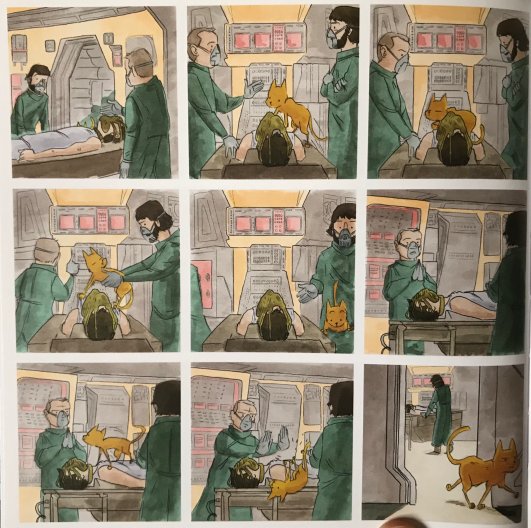
Jonesy — affectionately referred to as “you little shithead” by Ripley in the second film — appears in the franchise’s two most famous films, his own comic book series titled Jonesy: Nine Lives on the Nostromo, a 2014 novel (Alien: Out of the Shadows), and in hundreds of references in pop culture over the last half century, from appearances in video games (Halo, World of Warcraft, Fortnite) to references and homages in movies and television shows.
A page from Jonesy: Nine Lives On The Nostromo, which tells the story of Alien from the cat’s perspective. These panels depict Jonesy watching Ash and Dallas examining Kane in the ship’s medical lab.
He’s like the anti-xenomorph. Cats are predators, after all, and Jonesy might be the xenomorph to the ship’s rodents just like every ship’s cat in thousands of years of human naval endeavors. But to the crew members Jonesy’s a source of comfort, a warm, furry friend to cuddle with. Unlike the xenomorph he’s got no biological programming urging him to impregnate other species with copies of himself in one of the most horrific gestation processes imaginable.
Xenos are like predators on steroids, gorging themselves on their victims to fuel unnaturally swift cell reproduction and growth. As a result, over the decades some have speculated that the alien simply ignored the cat, deeming its paltry caloric value unworthy of the effort to kill.
The idea that Jonesy was too small to interest the alien is proved a fallacy in later franchise canon when we see the aftermath of a xenomorph consuming a dog. It’s indiscriminate in its quest for energy, feasting on adult humans and animals alike until two or three days pass and it’s a 12-foot-tall, serpentine nightmare the color of the void of interstellar space.
Just imagine sitting in a theater in 1979. Your idea of science fiction is sleek jet-age spacecraft, Star Trek and Stanley Kubrick’s clinical orbital habitats from 2001: A Space Odyssey. You’re expecting astronauts, heroes, maybe a metal robot or an alien who looks human except for some funky eyebrows, green skin or distinct forehead ridges.
Instead you get a crew of seven weary deep space ore haulers inhabiting a worn, scuffed corporate transport ship, complaining about their bonuses and aching for home, family and the familiar tug of gravity.
But home will have to wait. The ship has logged an unusual signal of artificial origin broadcasting from a small planet in an unexplored star system. The crew has no choice but to investigate. It’s written into their contracts, which stipulate the crew will forfeit their wages if they disregard the signal.
So they land, suit up, move out and find a derelict starship. An incomprehensibly massive vessel so strange in detail and proportion that it could only have been built by an alien mind, with unknowable motivations and psychology.
The egg chamber of the derelict alien ship, designed by Giger.
Inside, hallways that look like ribcages lead to vast chambers with utterly bizarre, inscrutable machinery that seems to consist of biological material — skin, bone, joints, organs — fused with metal. In one of them the corpse of an alien, presumably a pilot, is integrated into a complex array. It’s at least twice the size of a large human man. Its elephantine head is thrown back in the agony of its last moment, when something exploded outward from its body, leaving a mangled ribcage, torn papery skin and desiccated organs.
And beneath that, a shaft leading to another horror — a chamber that seems to stretch for kilometers in either direction, where leathery eggs are cradled in biomachinery and bathed in a bioluminescent cerulean mist.
The decision to enter that chamber sets off one of the most shocking scenes in cinema history, leads to the birth of pop culture’s most terrifying monster, and sent millions of theater-goers home with nightmares in the spring and summer of 1979.
It’s almost too much to handle. But take heart! The unlikely female protagonist makes it to the end, and so does the cat. What more can you ask for?
Jonesy grooming himself on the flight deck of the starship Nostromo. Credit: 20th Century Studios
People who were asked to identify feline moods based only on audio of meows fared the worst in the study.
A new study suggests people misinterpret their cats’ moods often, but offers an easy fix.
A group of researchers from Paris Nanterre University split participants into three groups: one that was shown soundless video and images of cats, a second group that heard audio-only recordings of feline vocalizations, and a third group that had the benefit of video and sound.
Participants from the first two groups misinterpreted feline moods as much as 28 percent of the time, the study found, but people who had the benefit of seeing and hearing cats correctly identified their mental state almost 92 percent of the time.
The study also yielded another insight: people are much better at accurately assessing positive moods than they are at spotting an upset or antagonistic cat.
Credit: Sami Aksu/Pexels
The findings indicate we’re better off giving our cats our full attention than, say, jumping to conclusions about what they want based solely on their vocalizations or the position of their tails. It seems obvious, but how many of us have our eyes on a screen or we’re multitasking when our cats want our attention?
Of 630 people who participated in the research, 166 were professionals in animal-related fields like veterinary medicine and animal behaviorism, while the rest were lay people. There was a major gender imbalance among participants, with 574 women, 51 men and five people who didn’t identify with either gender.
It’s not clear how such an imbalance might skew the results, and it would be nice to see follow-up research evenly split between women and men.
Realizing he could leverage his popularity to improve snack and head-rubbing service, Little Buddy demanded his human “bend the knee.”
NEW YORK — Tensions between the Buddies threatened to reach an all-time high on Wednesday after Little Buddy the Cat sought to formalize their alliance by having Big Buddy the Human swear fealty to him.
“I’ve been thinking,” Little Buddy the Cat said, padding into the living room, “and I’ve got an idea!”
“This should be brilliant,” his human replied, not bothering to look up from his newspaper.
Little Buddy the Cat nodded in agreement.
“It is! It is!” he said excitedly. “I was thinking that since I have my own website, you know, and people all over the world love me, it’s time to reevaluate my options. There are people who would love to spoil me, you know.”
Big Buddy glowered.
“So I’m going to need an essay of no less than 800 words on why you should be allowed to continue serving me,” the feline continued. “Offer specifics, please. I’m gonna need that on my desk by 0800 tomorrow.”
“You don’t have a desk, you Tribble with a tail,” Big Buddy pointed out.
The tabby cat became exasperated. “My office! My…my eating nook where my bowls and all my important papers are stored! So you’ll submit your essay there, okay?”
Big Buddy nodded absentmindedly, flipping his newspaper to the sports section.
“Uh-huh. Whatever you say, little dude.”
Buddy clawed at the paper. “I wasn’t finished!”
Buddy, pictured, wants his human to “bend the knee” and swear fealty to him.
When he had his human’s attention again, the silver tabby dragged out a crude replica of Game of Thrones’ Iron Throne made of cardboard, grunting with the effort.
“Now if I can just…get my feet up here…grip on the cardboard I can…grrr…okay. Whew!”
The feline settled onto the throne, the corrugated cardboard sagging beneath his weight, and tried to look regal.
“You may now bend the knee,” he said matter-of-factly. “Oooh! Ooh! Get your replica samurai sword, draw it and hold it as you kneel to me! That would be really cool.”
A Buddinese throne.
As of press time, Big Buddy had not stirred from the couch, retrieved his samurai sword or bent the knee.
“This is my fault,” he told a reporter. “I never should have let my cat watch Game of Thrones.”
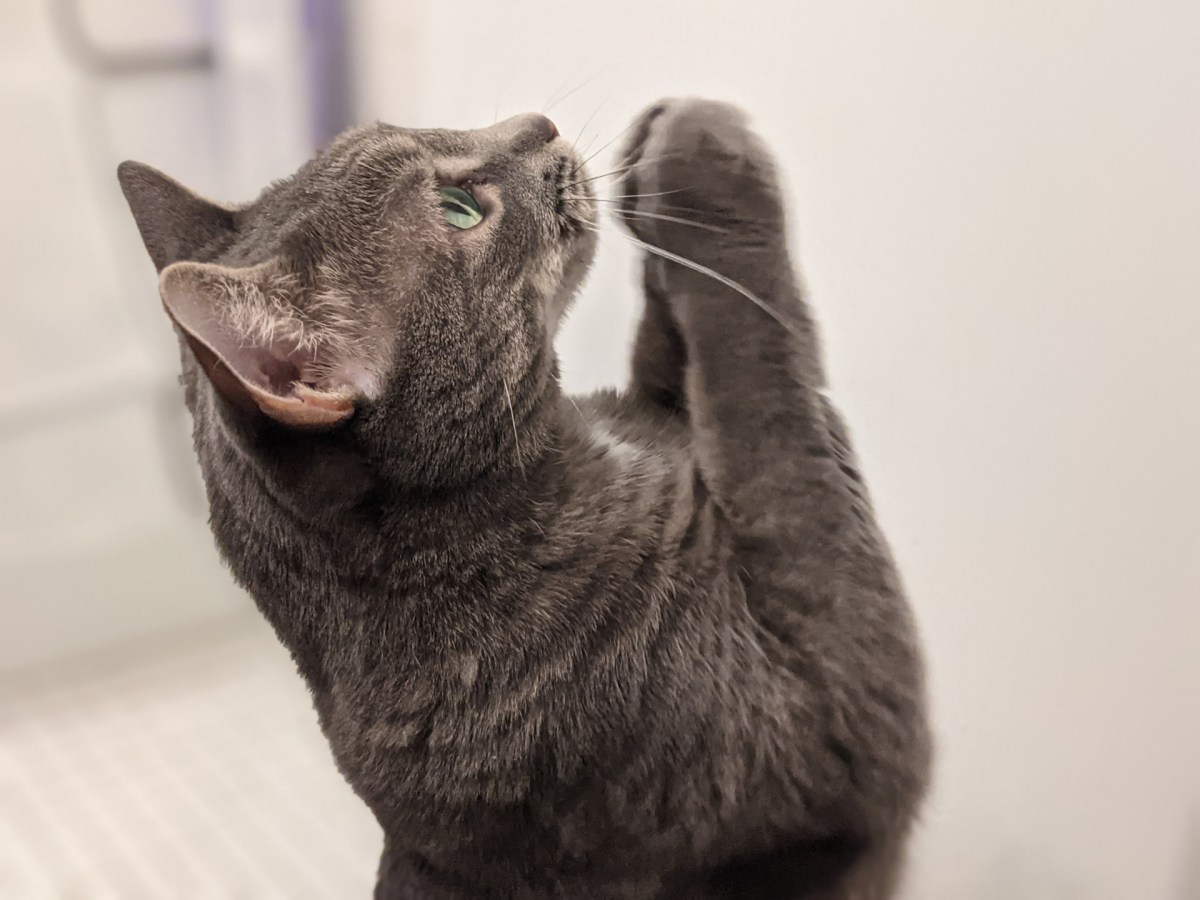
The begging/praying motion is one of the most unusual feline behaviors, but what does it mean, and why do some cats do it?
Readers of this blog know I love my cat dearly, but he’s also very weird.
Perhaps his strangest, most mysterious behavior is what I call his “praying” gesture: Buddy sits up on his hind legs, puts his front paws together and raises them up and down as if in fervent prayer.
The behavior is extremely rare. Out of many millions of cat videos hosted on the internet, only a handful show cats engaging in it.
Here’s Buddy demonstrating his “prayer” form, set to De La Soul’s 1989 track, “Buddy”:
It’s seemingly random and impossible to predict, which is why it’s been so difficult for me to get a decent clip of Bud doing it. The above video is the third time I’ve managed to capture it, and only the second time I’ve been able to get a clear shot following an earlier capture:
Some cats do it much more frequently, like the ginger tabby below whose humans have decided it’s an expression of gratitude toward them for giving him a forever home:
I’m confident in saying that, for my cat at least, it’s not an expression of gratitude or a form of begging. First, Bud doesn’t do gratitude, and he doesn’t beg so much as he demands. If he feels I’m not responding quickly enough to one of his directives, he goes right to screeching at me: “Snack now, human!” and so on.
Likewise in the video above, Charlie’s humans say the orange tabby does it “randomly.” They’ve even caught him making the motion on camera when no one else was around, which tracks with my own observations of my cat.
So why do cats do it?
“I’ve seen the ‘begging paws’ online and I wish I had a nice, clear explanation for you,” cat behaviorist Mikel Delgado told us.
Some cats, she noted, learn quickly that it elicits a response from their humans.
“My best guess at why cats continue to do this behavior is that it gets them attention,” Delgado said. “That however, does not explain why they do it in the first place.”
Nancy Meyer, a feline behavior consultant who volunteers for Tabby’s Place in New Jersey, said she believes cats in some of the videos are indeed signaling to their humans that they want something. For example, one clip shows a cat “begging” in front of a refrigerator — which his humans say he often does — while another shows a cat facing its reflection in a mirror while pressing its paws together and moving them up and down.
Some of those cats would be well aware that their behavior is a good way to get their humans’ attention, which could indeed lead to them getting what they want.
“It’s like a meow or gaze alteration; it’s a way of communicating that a cat wants to get something that’s currently out of reach,” Meyer told PITB. “The owners reward the cat for this behavior so the behavior perpetuates.”
In my own anecdotal experience I have witnessed Buddy engage in the behavior when he doesn’t realize he’s being observed, and he’s just as likely to break out in “prayer” while facing away from me. I suspect that because he does it so infrequently, he doesn’t realize it results in attention.
It’s unlikely we’ll get definitive answers unless the behavior becomes the focus of research, but that seems unlikely because of its rarity and its unpredictable nature.
Most of the time it appears benign, but Delgado says caretakers should pay close attention if their cats are engaging in it constantly.
“My only concern is that in some of these cats, the behavior appears almost compulsive – like they can’t/won’t stop,” she told PITB. “I also would recommend chatting with a veterinarian to see if they have any thoughts about whether this might indicate any physiological issue.”
Otherwise it appears benign, so if your kitty occasionally breaks out in “prayer,” enjoy the quirk — and good luck trying to get that elusive footage!










 Pain In The Bud