Felines Evaluate Human Looks, Temperament And Behavior At 8th Annual People Fancy Show

Cats judged their humans based on appearance, obedience and other categories at the Jacob Javitz Center in Manhattan.

NEW YORK — Marvin Wheeler was on all fours, with a pair of cats holding his mouth open with their paws and another wrapping a tape measure around his waist.

“The torso should be medium in proportion to the rest of the body,” a ginger tabby said, “while the snout –“

Wheeler yelped as the tabby gave his nose a firm slap with her paw.

“– should be slender and no more than half an inch above the top lip.”

Wheeler grunted as a Maine Coon shoved him off the table, and a trio of feline judges held up scorecards, awarding the engineer from New Jersey a 5.5, 6, and 5 out of 10 respectively.

“Does anyone have any objections?” asked the master of ceremonies, a rotund Norwegian forest cat named Milo.

Wheeler’s feline shook her head, and Milo leaned forward toward his mic. “Next!”

Feline judges award scores to one of the competitors at the 8th Annual People Fancy Show.

“Bring her up, fellas,” he continued, gesturing toward several cats escorting 53-year-old Martha Silverwind to the stage.

“Okay, next we have a librarian from Toronto, Canada, who is here for her first human show. We’re gonna be evaluating her on temperament, hair color, obedience training…”

More than 1,000 people were examined and judged by cats this weekend at the Jacob Javitz Center in New York for the 8th Annual Human Show sponsored by the Human Fancy League of America and the Society For Better Homes For Felines.

Helena Chione, an astronomer from Houston, Texas, waits for to be evaluated by judges on Saturday at the Jacob Javitz Center in New York, site of the 8th Annual Human Show. Her feline, Clyde, entered her in the Best Temperament category.

Ronald Greer, a dermatologist from Grewnwich, Conn., patiently waited for his turn while relaxing in his cage, which held a small bowl of cereal, a bottle of Poland Spring water and a chamber pot.

“I saw an ad for the show, and I thought, ‘Simba, why not see how Ronnie stacks up against other humans?'” Greer’s feline told a reporter. “I’ve been training him for more than two years now, and I’d say he responds maybe 80, 85 percent of the time I call him. Ideally I’d like to get it as close to 100 percent of the time as possible, because I don’t like to repeat myself when I’m hungry. But you know how it is with these humans. They have minds of their own.”

Simba sat outside Greer’s crate, encouraging the human to groom himself before the judges called his number.

Last year’s best in class in the age 20 to 29 bracket was Louisa Rey, a writer for Spyglass Magazine. Feline judges praised Rey’s responsiveness when commanded to serve snacks and commended her dark brown mane, describing it as “an ideal for a human of her age and gender” and complimenting her cat, Marcy, for “doing an outstanding job training her.”

Singer Taylor Swift took home honors in the 2024 People Fancy event for performing the best tricks, including one sequence, described as “adorable” by the judges, in which she giggled, cheered and smiled as she pretended to be fascinated by an American football game.

This year’s favorite in the best tricks category is Jonah Grayer, a 31-year-old attorney from Long Island, NY. Grayer, a magician by hobby, cocked his head to one side as his cat, Sebastian, rested a paw on his cage.

“Who’s a good boy,” Sebastian asked, dropping a cheeseburger slider into Grayer’s cage. “Who’s the best boy in the world? Jonah is! That’s right! Now let’s impress those judges!”

Amazing Cats: Ocelots Love Trees, Water And Calvin Klein’s Obsession For Men

Ocelots, one of the western hemisphere’s most adaptable cat species, are often mistaken for young jaguars.

In 1999 biologists from the Dallas Zoo were lending a hand on a project to monitor and protect America’s ocelots, who primarily range in southern Texas.

With limited resources, the team was trying to keep the wild cats in a protected area and get them to use paths where camera traps had been installed. One tried and true method was to use scents, but what could attract ocelots?

“Sort of on a lark, one of our research assistants produced a bottle of Obsession,” Dallas Zoo’s Cynthia Bennett said at the time.

The felines loved it. Members of the research team watched astounded as the scent magically transformed previously ignored objects into items of sudden fascination.

The cats happily rubbed their cheeks and bodies against anything sprayed with the stuff.

“It´s a little embarrassing to watch, actually,” Bennett said. “It does make you wonder what´s in the perfume.”

(It’s probably civetone, a synthetic version of a pheromone produced by civets used as a binder in the Calvin Klein scent.)

Credit: Victor Landaeta/Pexels

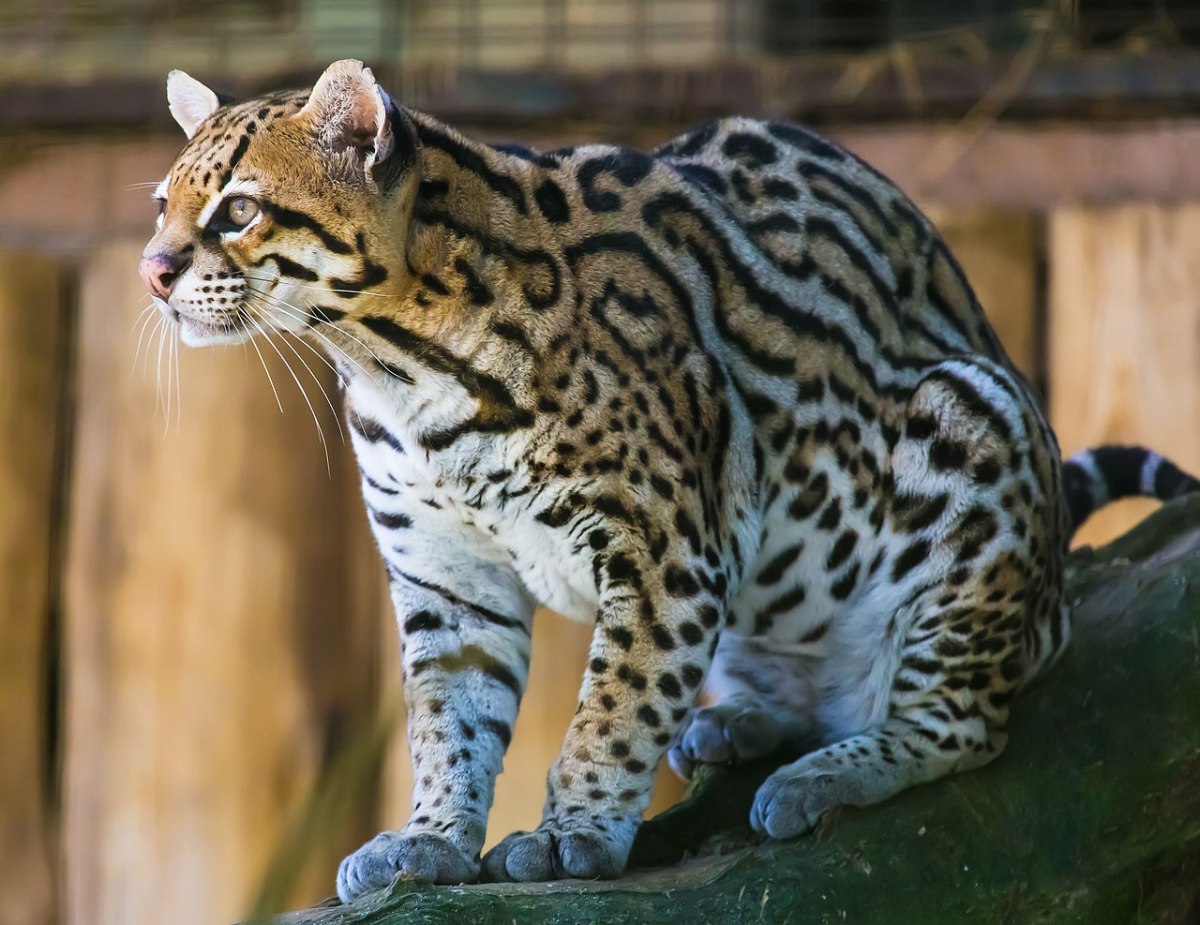
In addition to their predilection for cologne, ocelots are known for enjoying water, hunting by twilight, and napping in trees. The medium-size felids, who weigh up to 40 pounds in the wild, are also easily recognizable by their big eyes, the dark rings that surround them, and the way those markings become twin stripes that sweep over their foreheads.

Perhaps most striking are their large, wavy rosettes, which sometimes get them confused for young jaguars. In several indigenous South American languages, ocelots and jaguars share a name or have very similar names.

An ocelot kitten. After a gestation period of about three months, ocelot moms give birth to as many as three kittens. Credit: Wikimedia Commons
An ocelot resting in a tree. Like other leopardus species, ocelots are proficient climbers. Credit: Wikipedia Commons

Ocelots have another quality that may lead people to confuse them with jaguars: they’re fond of water and they’re considered strong swimmers. That allows them to master their habitats, which often include rivers winding through rainforests and mangrove swamps.

The resourceful cats are adept predators on land and they can also pluck fish out of rivers.

An ocelot going for a dip. Credit: yellowlime_des/Reddit

Ocelots are categorized as a species of “least concern” by the IUCN (International Union for Conservation of Nature) but that doesn’t mean they’re thriving. Like pumas, the species is adaptable and can survive in varied surroundings. Still, ocelots contend with the same pressures other species experience, including habitat loss and fragmentation, hunting and poaching.

And while they can’t get enough of Calvin Klein’s Obsession for Men, maybe that’s a good thing.

According to zookeepers and wild cat experts, ocelots have a uniquely funky body odor which is amplified by their prodigious scent-marking. They want everyone to know where their territory is.

For zookeepers, the cats’ Obsession obsession could pull double duty as olfactory enrichment in their habitat — and a way to mitigate the stink.

Credit: Wikimedia Commons

Name: Ocelot (leopardus pardalis)
Weight: Up to 40 pounds, with limited sexual dimorphism (males are slightly larger)
Lifespan: Up to 20 years in captivity
Activity: Crepscular, nocturnal
Habitat: Claims territory in places where prey, water and dense ground cover are plentiful but the species is adaptable and survives in varied biomes

Want more Amazing Cats?

Amazing Cats: The ‘Fire Tiger’ Is The Stuff Of Legend
Amazing Cats: The Adorable Colocolo, Feline Of The Pampas
Amazing Cats: The Sunda Clouded Leopard
Amazing Cats: The Mysterious Marbled Cat
Amazing Cats: The Rusty Spotted Cat
Amazing Cats: The Jaguar, ‘He Who Kills With One Bound’
Amazing Cats: The Puma, Adaptable Survivor

Facebook Is Flooded With Hoax Posts About A Supposed Black Mountain Lion

The purveyors of the deceptive posts want you to click, share and argue with other users about the veracity of the photos.

Not only is he the rarest puma in existence, he’s more well-traveled than most humans.

The mountain lion in question has a black coat, unprecedented for his species, and has been popping up all over Facebook. He’s photographed from the passenger seat of a truck cab, his tail in an unbothered curl, crouched amid the brush near a rural road.

Some posters claim they spotted the formidable feline in Mississippi. Others attribute the image to a sister-in-law who lives near Houston or a daughter in Charleston. A user in Louisiana claimed they took the photograph near the bayou, while another places the cat in Wyoming and claims he’s the first-ever documented “shadow cougar.” (Our friend Leah of Catwoods drew our attention to the images last week after seeing posts placing the cat in the south.)

In case it isn’t obvious, all the claims are full of it.

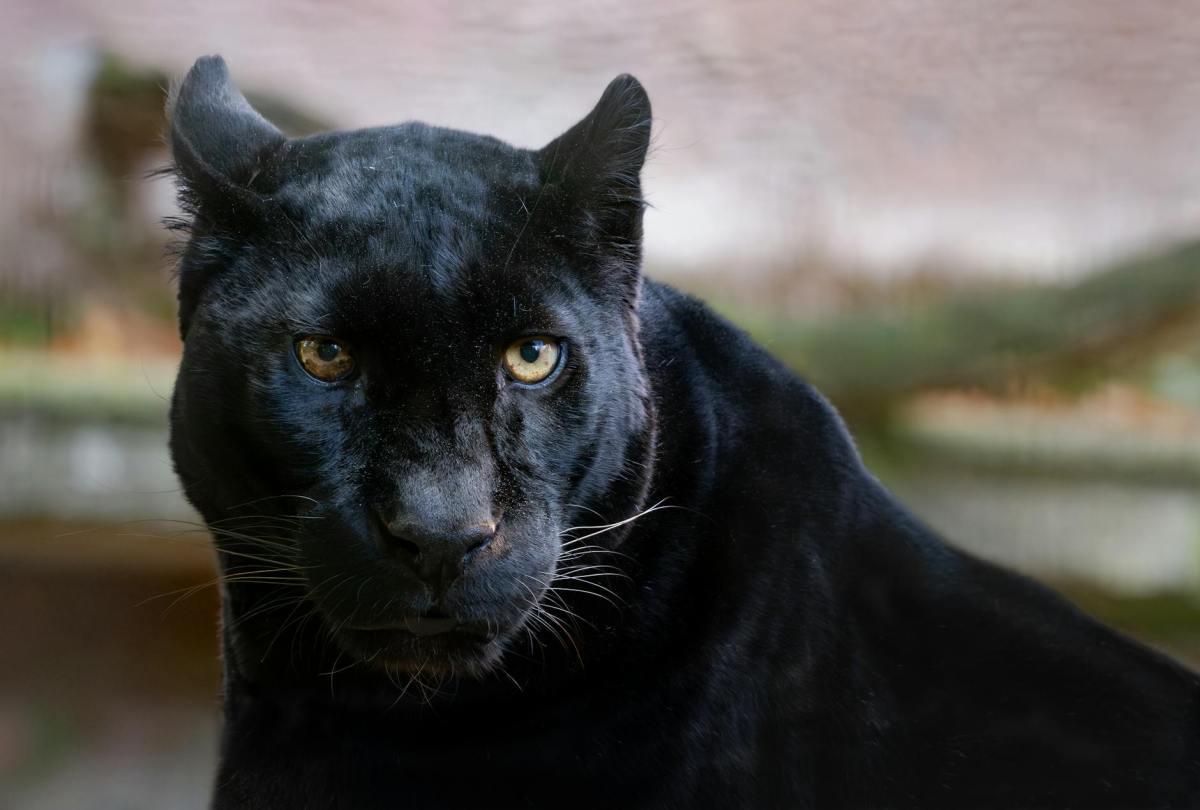
There is no such thing as a melanistic (black) mountain lion, and the big cat in the photo has the physical characteristics of a leopard, an animal that is not native to this hemisphere, let alone this continent.

The real story here is that Facebook remains a fountain of misinformation and Meta (its parent company) doesn’t care. Unscrupulous users will do anything to get attention and the clicks that come with it, and the average Facebook user is happy to indulge them, driving clicks by resharing the hoax content and juicing its algorithmic value by engaging in endless arguments with fellow users about the veracity and provenance of the photos.

Alleged big cat sightings are perfect for this sort of thing because they pique people’s natural curiosity, there’s a whiff of danger — especially when the poster claims the animal was spotted locally — and most people aren’t aware of telltale differences between cat species.

In many ways, the blurrier and more indeterminate the photo, the better: like Bigfoot and the Loch Ness monster, the idea of phantom cats is most fertile in the imagination.

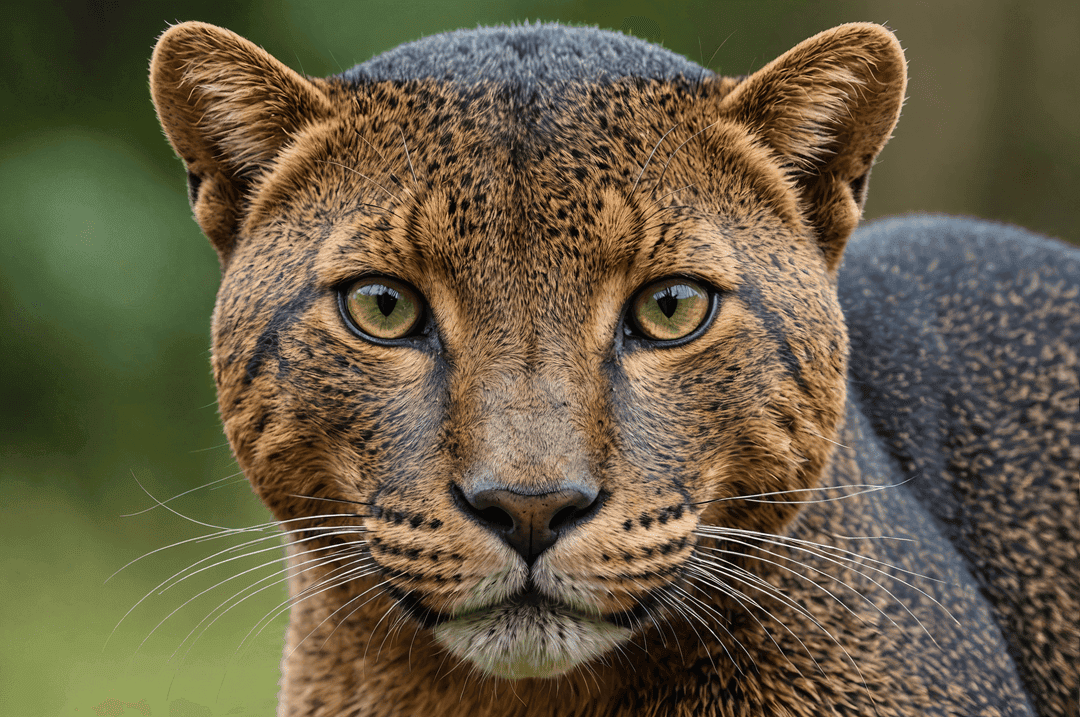
These days you don’t even need a photo to get in on the click-baiting action. I asked Gemini to create an image of a jaguar-like big cat walking along a rural road at night, and this is what the LLM gave me:

In the image prompt, I asked it to make it look like an amateur photo taken with a midrange smartphone camera, but if we really wanted to get artistic, it’s simple enough to add noise, maybe some motion blur and digital artefacts to the image to make it look more like an authentically crappy, rushed shot of an unexpected animal.

Here’s the result of some simple efforts to en-crapify the “photo” further:

To give the image urgency and encourage people to engage with it, I can make it local and claim it was recent. Errors of grammar, spelling and punctuation add a nice seasoning of authenticity, along for feigned concern for others as the reason for sharing:

“Folks – just wanted to tell ya’ll to mind your pets an make sure of you’re surroundings bc theres a big cat on the lose!! my cousins GF took thus friday nite on Route 9 a few mile’s south of Dennies. a real honest to goodness black panther! BE SAFE!!!”

There’s a dangerous animal on the loose in your area! You know what you have to do: share it so others can bring their pets safely inside and stop their kids from playing outdoors, at least until it looks like the predator has moved on.

It’s your duty as a good American!

Since it doesn’t seem to matter if a quick reverse image search can settle the question of where an image came from, it’ll be interesting to see if anyone lifts the above image and text.

At the very least, maybe a few people who do think to run a search will find their way here, read about the hoax, and save themselves from getting drawn into online debates about the existence of cryptid cats.

The Swiss Have A Unique Way Of Stealing Cats: By Feeding Them! PLUS: More Fun Claims About Litter Boxes In Schools

In Switzerland you can be charged with a crime and face significant fines for feeding other people’s cats. Meanwhile. the “kids identifying as cats” culture war rumors are back and as inane as ever.

The Swiss seem to take cat theft pretty seriously, to the point where they’re perfectly willing to drag people to court for feeding other people’s cats.

That’s what happened to a 68-year-old woman in Zurich who is accused of being so nice to Leo, a neighbor’s cat, that the little guy decided her house was now his house.

According to local media reports, a Zurich prosecutor wants to fine her 3,600CHF (Swiss francs), which is $4,370 in ‘Merican greenbacks! That’s a lot of money for giving a cat some Temps and cans of tuna.

To be fair, Leo’s original family isn’t happy, especially because they specifically asked the woman to stop feeding their cat. She can’t claim she accidentally adopted him, since she let him into her apartment and even installed a cat flap for him, according to Swiss media reports.

“Cases like this are increasingly ending up in court because the rightful owners report the “feeders”. Under Swiss law, cats are “other people’s property” and systematic feeding and giving a home to another person’s cat is considered unlawful appropriation.

But if a neighbour’s cats are only fed occasionally, this is not a punishable offence in Switzerland.”

There’s really not enough information to form an opinion about this particular case. Was Leo mistreated or not getting enough to eat? Did his new human have designs on him from the beginning? Did she just think she was doing the right thing?

“Gimme the nomnoms, human!” Credit: Wikimedia Commons

As for me, this is another good reason to keep Bud inside. If I let him roam the halls of the building unsupervised, he’d probably start a bidding war between me and neighbors in two or three other apartments, making it clear that whoever supplies him with the most delicious and most frequent snacks will enjoy the great honor of serving him.

Kids identifying as cats: the fake controversy that won’t die

Just a quick recap, for anyone who hasn’t been keeping up on this uniquely American culture war spectacle: Politicians of a certain stripe really like rumors about kids identifying as cats, so much so that they’ve confidently asserted it’s happening all over America, telling anecdotes about it while on the campaign trail during the 2020, 2022, and 2024 political cycles.

That encompasses two presidential elections and a midterm year, but it’s not relegated to federal cycles. State-level pols love to talk about it too.

It’s a culture war dog whistle, and politicians from both parties love stuff like this because it gets everyone all riled up, which means no one’s talking about all the grift, insider trading and other fun activities our “leaders” involve themselves in.

The thing is, to date not a single one of the claims has been backed up by proof. I know this because I’ve investigated every one of them, and invariably they turn out to be rumors. I’ve gotten emails and comments telling me I’m a fool for debunking the claims, and I’ve literally begged people to give me a real example of cat-identifying kids dropping deuces in litter boxes, but again, all the claims collapse under minimal scrutiny.

Every time a politician has told a story about allegedly cat-identifying kids and litter boxes in schools, it follows the same pattern: they insist it’s true, double down on the claim, try to change the goalposts, and finally, they grudgingly admit they can’t point to a single example.

In a week or two, we go from righteous condemnation and fury to “Well, my wife’s best friend teaches sixth grade, and she said she heard from a teacher in another district that kids were meowing in class.”

Furries outside a convention, not a school. Credit: Furscience

Texas state Rep. Stan Gerdes is in the righteous condemnation stage after introducing the Forbidding Unlawful Representation of Roleplaying In Education Act, aka the FURRIES Act.

Gerdes wants to ban meowing, hissing, barking, litter boxes, leashes and animal costumes from school grounds and events, but in his wisdom he’s excluded school mascots and Halloween costumes.

He is, however, fast approaching the “my cousin’s best friend’s co-worker said” stage, after he couldn’t point to a single cat- or furry-related incident when pressed during a committee meeting on May 1. He eventually named a school district, saying he’d gotten a “extremely concerning” and verified account of an incident there, only for the district to issue a statement saying it didn’t happen.

Gerdes did call to ask if there were litter boxes in the school, the district said, and when he was told there was not, he insisted a manual check of all school bathrooms, which also came up empty. Let’s see how long he sticks to his story before he finally admits he has no proof.

‘Swift And Lethal’: Cats Have No Defense Against Bird Flu, And It Keeps Showing Up In Their Food

Bird flu is killing cats domestic and wild, in captivity and in nature. Experts are sounding the alarm, warning people not to feed their cats raw food, allow them to drink milk, or let them roam outside where they can easily catch the virus by going after small prey.

Highly Pathogenic Avian Influenza, the clinical name for bird flu, is a danger to all animals, but for cats it’s a virtual death sentence.

Only a handful have survived infection thanks primarily to early diagnosis, intervention and round-the-clock veterinary care. In the vast majority of cases, the virus burns through its feline victims in three or four days.

Bird flu has become even more deadly for felines of late. Of the 126 domestic cats killed by H5N1 since 2022, according to the US Department of Agriculture, half of them have have died in 2025 — and it’s only been three months.

Notably, that total doesn’t include captive wild cats and big cats, such as the 20 pumas, bobcats, tigers and other felids who succumbed to the virus at the Wild Felid Advocacy Center, a sanctuary in Washington state. Nor does it include cats living in the wild, like two pumas in the same state that died in December.

To appreciate the true scope of the problem, the more illuminating statistic may be 82 million, which is the number of chickens “culled” — killed — in the US since 2022 because they were infected or raised at facilities where other birds tested positive for the virus.

Factory farming compounds the matter: more than 1.6 million egg-laying hens and 337,000 “pullets” — chickens less than a year old — were “depopulated” at a single facility in Texas last year. As staggering as those numbers are, Texas’s Department of Agriculture noted the figure merely “accounts for approximately 3.6% of the company’s total flock.”

Per the USDA:

“To provide context on the overall size of the U.S. poultry flock, there are more than 378.5 million egg-laying chickens in the United States. In 2023, more than 9.4 billion broiler chickens and 218 million turkeys were processed in the United States.”

If there ever was an example of putting too many eggs in one basket, this is it. American food supplies are vulnerable with so much concentrated in the hands of so few companies, a lesson the general public is learning the hard way now after eggs peaked at record prices last month. Things have cooled off a bit since then, but shoppers aren’t getting any benefit as grocery chains continue to charge a premium: the nationwide average for a dozen eggs was $5.90 in February, but stores in some states are still charging $10 or more.

It also raises questions about the sustainability and ethics of eating animals. Humans slaughter more than 75 billion chickens every year, and projections indicate there will be three billion more of us by the mid-2080s.

Meat from infected chickens can still end up in your cat’s bowl

Media reports about culling give the impression that those birds are removed from the food chain, but that’s not entirely true. The pet food industry has always cut corners by harvesting meat not fit for human consumption, a category that includes everything from the carcasses of sick animals, to “meat by-products” that can include beaks, hooves, eyes, hearts and other organs.

So while the culled chickens won’t show up in shrink wrap at the grocery store, they are making it into the pet food supply chain. Most pet food is “rendered,” cooked at such high temperatures that potential pathogens have been destroyed.

But an increasingly bigger slice of the market has been claimed by companies selling “premium” raw food — and that’s been the primary infection vector for domestic cats, particularly indoor cats who otherwise would have little or no exposure to the virus. (Cats who spend time outdoors can catch bird flu by preying on infected animals, just as wild cats do, and barn cats have caught it by drinking the milk of infected cattle.)

Cats are mostly lactose intolerant, and should not be given cow’s milk, despite the common misconception that it’s healthy for them.

“The animals that were depopulated could potentially have ended up in the food chain for pets,” Laura Goodman, an assistant professor at Cornell University’s Baker Institute for Animal Health, told NBC News. “It’s not uncommon for substandard meat to end up in the pet food chain.”

That’s what happened to Tim Hanson’s beloved cat, Kira, who died in February after eating raw food from a company called Wild Coast. The company has recalled the product, Boneless Free Range Chicken Recipe. It’s one of four recalls in the last month alone.

Hudson is suing Wild Coast for the veterinary bills — about $8,000 — and said he was devastated that Kira, whom he called “the happiest cat,” is gone. He said he thought he was doing right by her by feeding her the expensive raw food, but now urges people to avoid feeding their cats raw food at all costs.

“I don’t want any more cats dying,” he said. “Hopefully people can learn from Kira’s passing.”

Top image via Pexels. All other images via Wikimedia Commons