Animal Rights Groups Are Begging For This UK Influencer To Be Banned From Owning Pets

The woman has been dubbed a “serial killer” of animals after eight of her pets and one of her horses met early ends, and several others simply disappeared. She’s part of an unfortunate trend of influencers and quasi-celebrities popularizing exotic pets, with “ownership” of the animals frequently leading to tragedy.

So apparently Katie Price is some sort of proto-Kardashian, a pioneer of the “famous for being famous” genre of hybrid reality/online celebrity, to use the term loosely.

Wikipedia says she got her first taste of fame in the 90s posing topless for British tabloid newspapers before moving on to loftier pursuits, like appearing on Big Brother and holding court on important topics, like whether toes have bones.

The background really doesn’t matter, except to establish that Price is someone with a lot of money, minimal common sense and extraordinarily poor judgment who has gotten so many of her pets killed or injured, PETA and other animal rights groups in the UK have begged politicians to write new laws preventing serial pet-killers from purchasing more animals.

Sort of a “10 strikes and you’re out” rule, if you will.

Four of Price’s dogs have been hit by cars, including one killed by a pizza delivery driver on her property. Another got stuck in an electric armchair and was crushed after Price gave him cannabis oil, pleading ignorance on its effects.

Previously, one of her breed cats was euthanized under mysterious circumstances at five months old, her rare chameleon fell ill and died because he wasn’t kept in a properly heated enclosure, and her “guard dog” was apparently intentionally killed by someone, although the information on that death comes from Price so there’s no way of telling what the actual circumstances were.

A horse Price owned was killed on the same road where two of her dogs met their end, which would bring the tally to nine depending on whether you consider a horse a “pet.”

Price, pictured this year.

There have also been animals — kittens, puppies, animals gifted by boyfriends, fiances, and friends — who were featured on Price’s social media feeds as babies and never heard from again, according to the UK’s Mirror. Some of them were given away to assistants and acquaintances. The fates of the others are unknown.

Price currently owns at least four chihuahuas and five Sphynx cats. An incident with one of the Sphynxes has animal lovers and welfare groups renewing calls to prevent her from buying new pets. (Price, like so many social media influencers, exclusively purchases breed pets for thousands of dollars each.)

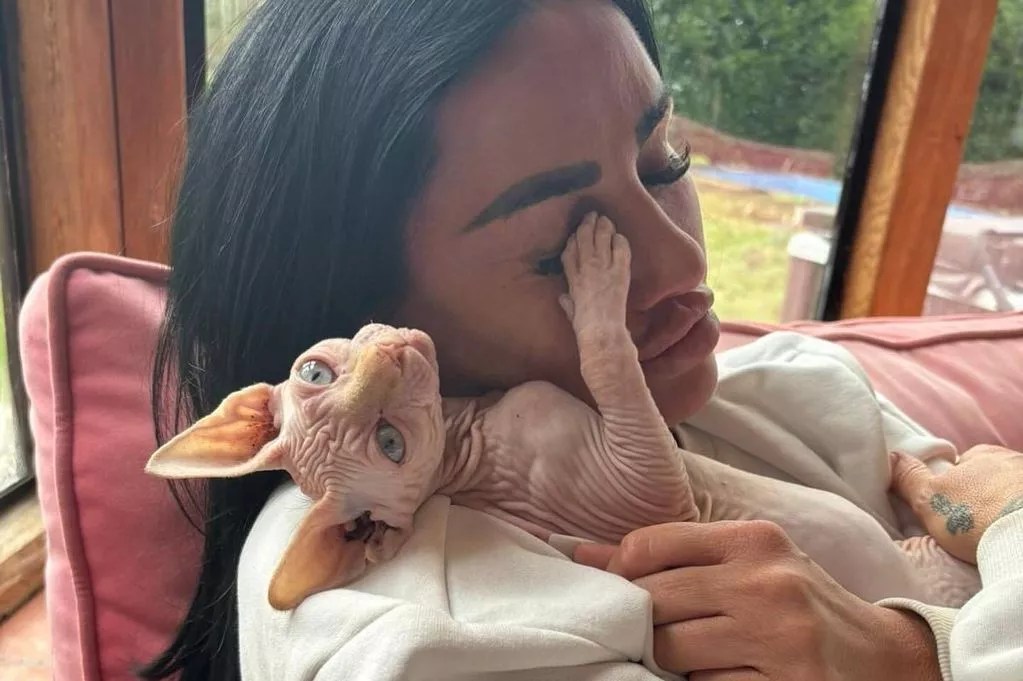
In a new video posted online, Price — who has been dubbed a “serial killer” of animals by PETA — makes duck lips at the camera and rubs one of her Sphynx cats, Kevin, explaining that the little guy suffered sunburns.

“Oh Kevin you have been in the sun today, you have got sun burnt despite us putting sun cream on you… look at his little face,” Price said in the video. A caption written by Price claims “Trying to keep the cats out of the sun is hard work.”

A screen shot from Price’s recent video in which she shows one of her cats who suffered sunburn during the ongoing heat wave.

The latest incident is drawing fresh attention to a petition that calls for the UK government to step in to stop Price from owning animals.

As of July 10, there were 37,728 verified signatures on the Change.org petition, which mentions a number of additional disturbing incidents involving Price’s pets. One accusation claims Price’s guard dog — it’s not clear if it was the dog who was killed, or a new guard dog — bit the tail off one of her cats.

“Anyone who warns Katie not to hurt the animals she takes in might as well be screaming into the wind, for all she seems to care,” PETA’s Elisa Allen said. “And here we go again: her cat is sunburnt – something she was likely warned about when acquiring a gimmick cat, bred to look odd and be hairless.”

For her part, Price claims the deaths and unfortunate incidents that have befallen animals in her care are simply the result of bad luck and circumstances outside her control. Her representatives have also accused animal welfare groups of using the influencer’s fame to raise money.

That has not changed the narrative as new incidents continue to pile up. In a 2023 live TikTok stream, Price allegedly slapped her then-puppy, Tank — who she’s since discarded — for sitting on a hoodie. “Get off! You’re sitting on my jumpers, my jumpers that I love,” Price said after the sound of a loud slap off camera, leaving viewers fuming.

Price is not alone in the world of influencers, quasi-celebrities, Real Housewife types and entertainers who apparently view animals as disposable amusements.

Hilaria Baldwin, Alec Baldwin’s wife, has earned the nickname “Cruella Seville” from her detractors for her alleged treatment of her breed cats and dogs. The nickname is a play on the character Cruella de Vil from 101 Dalmations and the Spanish city of Seville, where Baldwin claimed to have roots before claiming she was born in Mallorca.

Baldwin with two of her Bengal kittens. New kittens have appeared in her Instagram posts several times in recent years, apparently replacing older Bengals she’d purchased previously.

Baldwin, you may recall, was enthusiastically Spanish until she wasn’t. She was essentially exiled from celebrity-adjacent society in 2020 after Twitter users dug up videos of her fluctuating accent and performative “forgetting” of English words like cucumber, outlet and onion. Former classmates, acquaintances and friends came forward to say she was the Boston-born Hillary Hayward-Thomas and didn’t go by Hilaria — or speak with an accent — until around 2010, when she met Alec Baldwin.

But the actor’s wife never stopped posting to social media, and in addition to animal lovers calling foul on videos that show her allegedly mishandling her dogs, her online posts show a rotating cast of Bengal kittens. Critics have called for action against Baldwin for her alleged treatment of animals, as well as buying Bengals despite the fact that it’s against the law to keep them as pets in New York City. PETA, which previously worked with Alec and Hilaria Baldwin on a publicity campaign, also called on the couple to stop buying exotic pets.

In the music world, mainstream pop artists like Justin Bieber and Rihanna have both come under fire for purchasing baby monkeys — a capuchin in the case of Bieber, and a slow loris for Rihanna.

The Rihanna incident, in which she shared a photo of herself with a slow loris pet to social media, resulted in raids on illegal wildlife markets in Thailand, where Rihanna allegedly acquired the animal. There are nine subspecies of slow loris, ranging from vulnerable to critically endangered in conservation status, per the World Wildlife Fund.

Rihanna posing with a slow loris, a nocturnal, arboreal animal that is notably the world’s only venomous primate. The venom glands are removed from slow lorises sold on the illegal wildlife market. People continue to poach and sell them despite their declining numbers in the wild.

Bieber named his monkey Mally OG and famously ditched the then-infant in Germany in 2013, when officials there seized the primate from his private plane after it touched down in Munich, citing his lack of permits and purchase records for the animal. (They essentially accused Bieber of buying Mally on the illegal wildlife market.)

“Honestly, everyone told me not to bring the monkey. Everybody,” Bieber told GQ magazine in an interview several years later. “Everyone told me not to bring the monkey. I was like, ‘It’s gonna be fine, guys!’ It was the farthest thing from fine.”

Bieber with his pet capuchin monkey, Mally OG, who was just an infant when he was ripped from his mother’s arms so he could be sold to the pop singer.
Bieber with another capuchin monkey as part of a skit in which he joked about German authorities seizing his first monkey pet.

The singer said he’d return for his pet after retrieving the paperwork from one of his US homes, but he never did, and Mally OG was placed in a sanctuary after a long rehabilitation period.

In a follow-up story five years later, Asta Noth of Serengeti Wildlife Park said Mally was still trying to imitate human speech, and didn’t know how to communicate with his own species. That’s a common problem with monkeys who are former pets, as they do not understand the complex social dynamics of troops and family units.

His developmental problems stem from the fact that “he was taken away from his mother and natural family way too early,” Noth said. “He did not learn to be a monkey.”
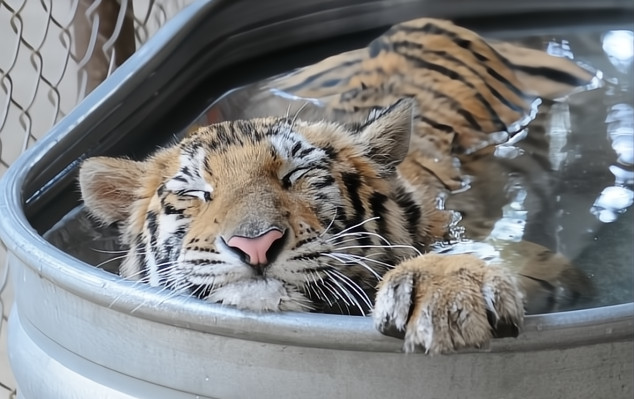
Wordless Wednesday: Awesome Photos Of Tigers Swimming!

For tigers, going for a dip on a hot day is pure bliss.

Most cats wouldn’t go near water if even if you lured them with a giant spread of catnip and Temptations on an inflatable table.

But tigers? They love it. Here are some shots of the world’s biggest cats taking a dip.

A Malayan tiger named Azul going for a swim at the Bronx Zoo. Credit: Julie Marsen Laher, Wildlife Conservation Society

Siberian tigers in a tub at a sanctuary in Russia. Credit: digger03/Flickr

This meme made me laugh.

Aasha was rescued from a traveling circus after an inspector found her sickly, suffering from ringworm and only 30 pounds at 8 months old. She’s flourished since she was brought to a sanctuary where she’s been given proper care, a good diet and a calm environment. Aasha is also pictured in the feature photo up top.

A tigress and her cubs cooling off in a river in India. Credit: Sandesh Kadur

Sundarban tigers are a subspecies of the Bengal who live in mangrove forests and are well-adapted to swimming. This Sundarban tiger was spotted on a wildlife tour in India. Credit: Soumyajit Nandy/Wikimedia Commons

This tiger cooled off on a hot day at the Dortmund Zoological Garden in Dortmund, Germany. Credit: Hans Stieglitz/Wikimedia Commons

Bird Flu Kills 20 Big Cats At US Sanctuary And Prompts Pet Food Recall

Cats of all kinds are at risk of avian flu infection if they hunt birds outdoors, consume raw meat or drink unpasteurized milk.

In a tragedy that underscores how vulnerable cats of all types are to bird flu, more than half the big cats residing at a sanctuary in Washington were killed by the virus in less than a month.

Twenty cats in total died at the Wild Felid Advocacy Center, including five servals, four bobcats, two Canada lynx and a Bengal tiger.

Only 17 cats are left at the sanctuary, according to its operators.

Mark Matthews, the sanctuary director, called the H5N1 avian influenza a “wicked virus” that killed the cats in his organization’s care within 24 hours of each animal contracting it.

“We’ve never had anything like this,” Matthews said, adding that he and his staff are accustomed to cats in their care dying of old age after living long, happy lives.

In California, Gov. Gavin Newsom declared a state of emergency on Dec. 18 after infected birds were found at more than two thirds of the state’s dairy producers.

cows in barn
California’s dairy industry has been hit hard by the spread of bird flu, with more than half the state’s dairy producers impacted. Credit: Ralf R/Pexels

As of Dec. 26, bird flu had infected 65 Americans, the majority in California.

And the virus has now resulted in its first pet food recall, with Northwest Naturals pulling its turkey recipe “raw diet” food. A cat in Oregon died after consuming the food, according to the Oregon Agriculture Department.

As we noted in our earlier post about the variant of avian influenza, there’s no reason to panic. Even if you live on the west coast, the chances of your cats being infected are small.

But it’s probably a good idea to make sure your cats remain indoors, as health authorities warn cats can contract the virus directly by catching and eating birds. In one case, health officials believe three indoor cats may have caught the virus after killing mice in their home.

In addition, the American Veterinary Medical Association advises caretakers to avoid giving their cats milk, which they should not be drinking anyway, and raw meat. Domestic cats are generally lactose intolerant, and while cats can be infected with bird flu by eating raw poultry, they can also contract the virus by eating raw meat from other animals.

As Registration Deadline Looms, Big Cat ‘Owners’ Face A Reckoning

The days of tiny backyard enclosures for big cats are over.

The passage of the Big Cat Public Safety Act has been a massive win, resulting in the end of the wild cat trade in the US and the cruel practice of taking cubs from their mothers for use in roadside zoo petting attractions.

But there’s another, often-overlooked component of the new law that’s about to result in big changes for captive tigers, jaguars, pumas and other wild cats.

While current “owners” of big cats were grandfathered in under the BCPSA, they have until June 18 to register with the federal government, and with registration comes requirements, inspections and minimum standards of living for the wild felids.

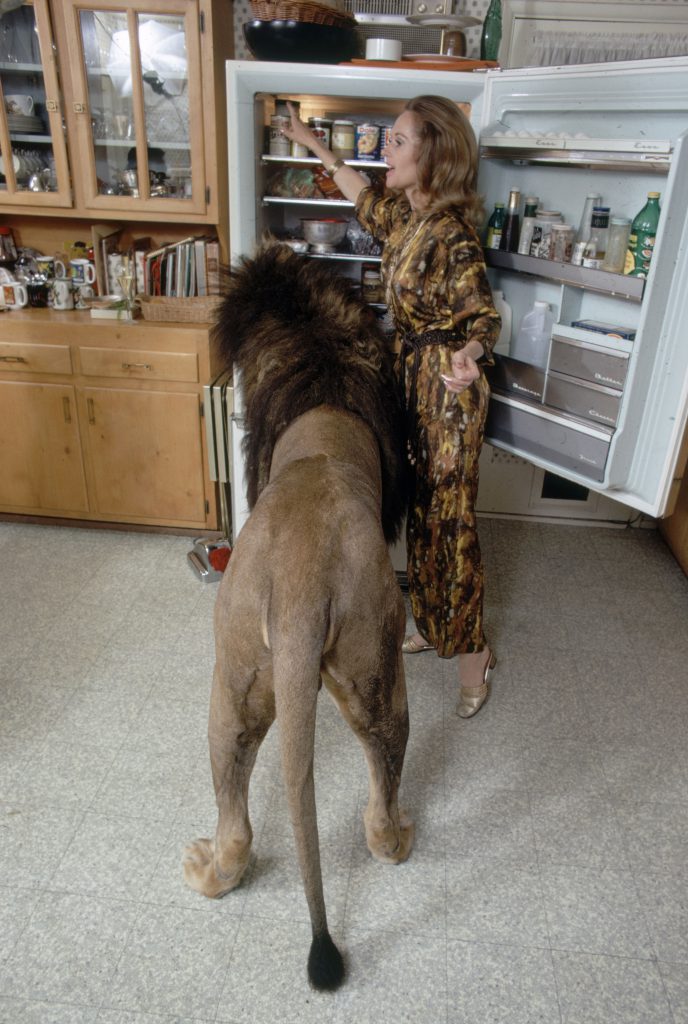
In other words, most of the people who “own” the estimated 20,000 privately held big cats are about to get a rude awakening. The days of tiny makeshift enclosures in backyards are over, as is the practice of keeping big cats in the home as if they’re domestic felines. (With apologies to Tippi Hedren, who once owned as many as 60 lions and tigers, and at 93 years old still has “13 or 14” big cats, according to her granddaughter, actress Dakota Johnson.)

141028-neil-lion-12-688x1024
Tippi Hedren with one of her lions in a vintage LIFE magazine photo. Hedren kept the lion and other big cats as pets in her home.

If people who have possession of big cats don’t register with the U.S. Fish and Wildlife Service, they’ll have their animals taken away. Likewise for people who don’t provide adequate enclosures that not only provide enough space, but are built to contain the apex predators.

As a result, sanctuaries are bracing for an influx of tigers, lions, jaguars, leopards, cheetahs, snow leopards, clouded leopards and pumas, all of whom are protected under the Big Cat Public Safety Act.

Experts anticipate a significant number of big cat “owners” could try to part with their animals if they can’t or won’t provide adequate enclosures, and the government is already cracking down on people who are trying to sell their “pets.”

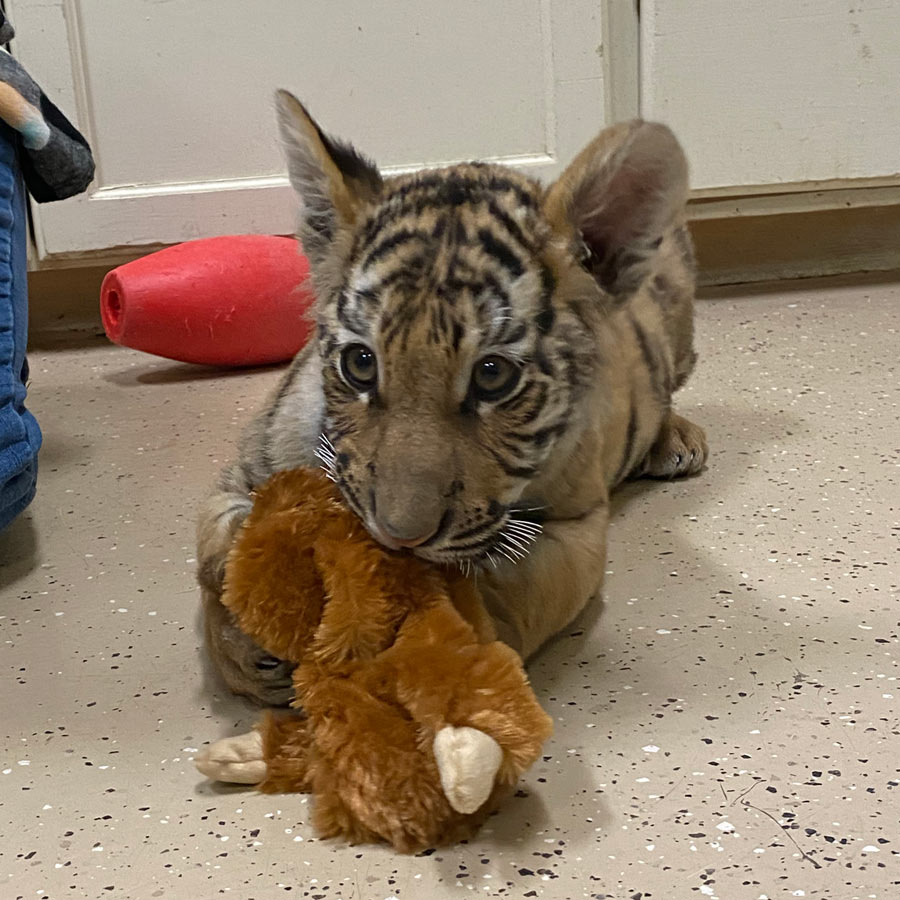
A tiger cub named Indy is one of the first to be taken out of private hands and placed in an accredited sanctuary. Indy was recently sold by her original “owner” and the man who purchased her for $25,000 tried to flip her, advertising the cub online.

Authorities moved in and found Indy in a dog kennel in a closet inside the man’s Arizona home. Police, who said they could hear Indy “moaning” from inside the closet, also seized an alligator and a dozen snapping turtles.

Tammy Thies, founder of the Wildcat Sanctuary in Sandstone, Minn. — Indy’s new home — said the cub is lucky she wasn’t confined to the small space for long.

“Many of the cubs we get are suffering from metabolic bone disease, malnutrition, sometimes they have such long confinement that they don’t have use of their back end, so Indy’s a lucky one,” Thies told WKQDS, the local Fox affiliate.

indytiger
Indy was found in a tiny cage in a man’s closet. Now she’s enjoying sunshine in an accredited sanctuary. Credit: Wild Cat Sanctuary

Indy arrived in May and has adjusted well to her new home in less than a month, according to the sanctuary. A page dedicated to tracking her progress has photographs of her meeting another tiger cub for the first time and playing in the grass.

As the deadline fast approaches, we hope Indy’s story is just one of many, and big cats who have suffered for years in tiny enclosures, under the “care” of people who aren’t qualified to keep them, find their way to accredited sanctuaries so they can live out the rest of their lives in sunshine, feeling grass and earth underneath their paws, with enrichment programs created by professionals who care about their well-being.

It’s about time.

tiger in shallow photo
Credit: Richard Verbeek/Pexels.com

Things Are Looking Up For This Shy Orphaned Puma As He Settles Into A New Home

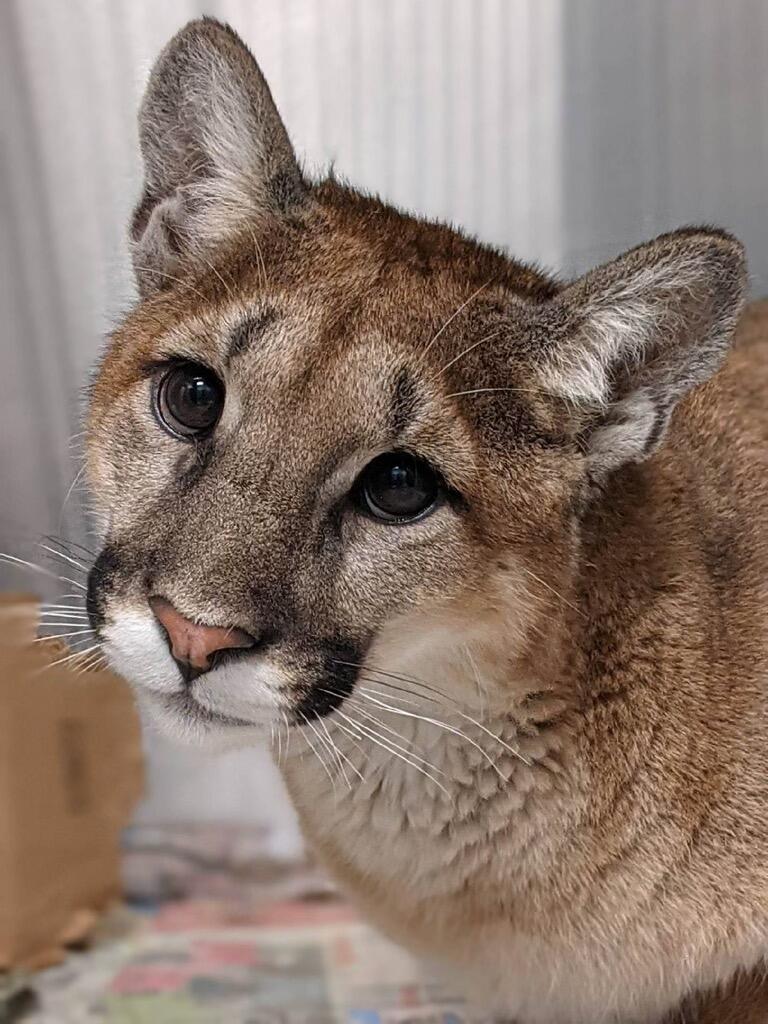
Nicholas was orphaned and severely injured as a cub as he and his mother tried to cross a busy highway. He’s settling into his new home, where he will have his own habitat, den and even his own pond.

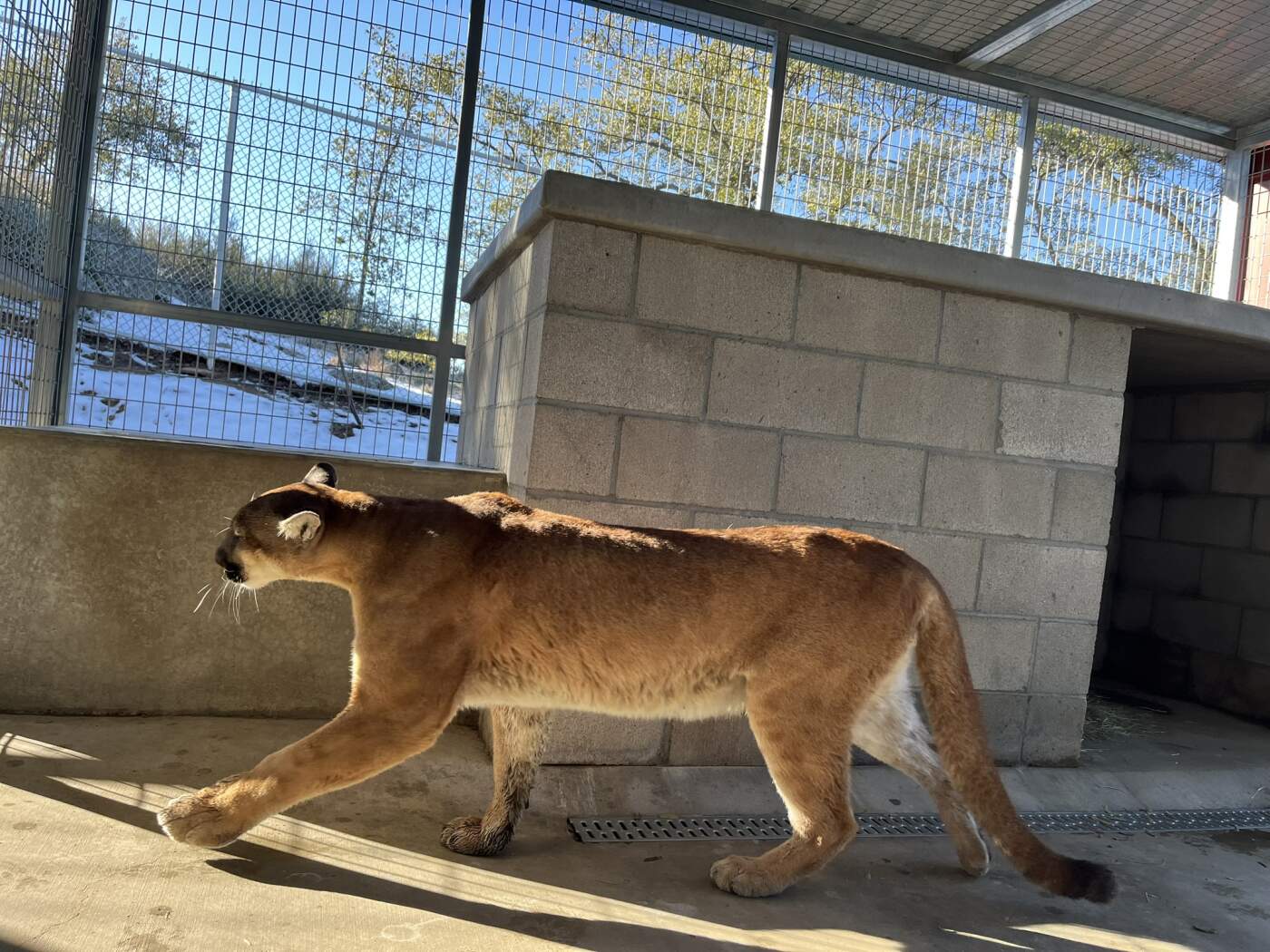
Nicholas the mountain lion has a beautiful home waiting for him with his own pond, a rock den, a grassy area where he can run around and several other little hideaways where he can enjoy some privacy and naps.

But first the three-year-old puma will have to clear quarantine and become more comfortable with his new surroundings and new caretakers.

“He’s doing really well but he’s still very scared, he’s a very timid cat, so we’re just taking it really slow, day by day and the keepers are taking some quiet time with him,” said Bobbi Brink, the founder of San Diego County-based Lions, Tigers and Bears, Nicholas’ new home.

Nicholas the Mountain Lion
Nicholas stretches his legs in quarantine as he awaits the move to his own habitat. Credit: Lions, Tigers and Bears

The golden-coated feline with an expressive face has had a tough journey to the 93-acre sanctuary that will be his permanent home.

In 2020 when he was just a cub, Nicholas was following his mother across a busy highway when both were struck by a car. Nicholas was badly injured and his mom was killed in the collision, an unfortunately common fate for members of their species as their longtime habitats are increasingly fragmented by new developments and highways.

Because they require about two years with their mothers to learn how to survive on their own, it’s almost impossible to release orphaned pumas back into the wild. Unlike, say, the orphaned orangutans of Borneo and Sumatra, who can usually be taught to successfully fend for themselves because humans can show them how to physically manipulate their surroundings, there’s no way to teach orphaned pumas how to select prey, stalk, pounce and deliver kill bites.

A sanctuary in northern California provided a home for Nicholas for about three years, but recently went bankrupt, so the staff at Lions, Tigers and Bears secured him, prepared a habitat for him and took on the Herculean task of transporting him to San Diego County.

Nicholas’ case is even more complicated because he has lasting neurological damage from the car crash that killed his mother, including a pronounced head tilt that worsens when he’s scared.

Brink told PITB it’s normal for cats like mountain lions to be spooked by the commotion and uncertainty of a move, as well as leaving everything they know behind. Nicholas is simply obeying his wild instincts, which urge him to be guarded. But he’s got a loving team of caretakers who will work with him, as well as veterinary specialists who are well versed in caring for animals with neurological damage.

“Sometimes it can take (animals like Nicholas) a month, sometimes it can take three months to build up that trust,” Brink said. “His biggest need is he’s very afraid, so we’re gonna have to work around his fear so we don’t scare him more.”

Nicholas the Mountain Lion
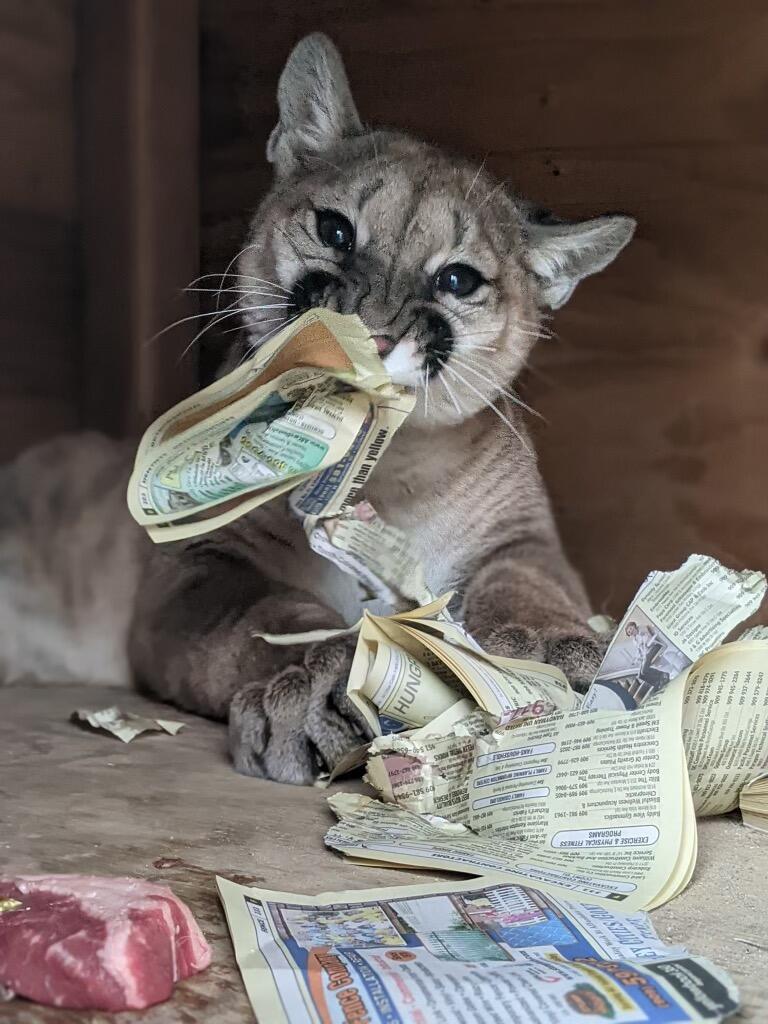
Despite their impressive size, pumas are more closely related to domestic cats than the big cats of the panthera genus. Like their house cat cousins, pumas enjoy tearing up paper and playing with toys. Credit: Lions, Tigers and Bears

While Nicholas will have his own habitat and can keep to himself as much as he likes, recent observations of his secretive species have shown that pumas have “secret social lives,” and Nicholas will have the opportunity to meet and interact with other mountain lions if he’s comfortable with it.

Pumas — which are known by the scientific name puma concolor and are also called mountain lions, cougars, panthers, catamounts, screamers, painters, gato monte and many other names — are among the most adaptable felids in the world and range from the southernmost edge of South America to just over the Canadian border. They’re able to thrive in mountains, tropical regions, deserts, forests, human-adjacent rural areas and even in urban population centers, as the famed “Hollywood Mountain Lion” P-22 did for more than a decade in Los Angeles.

Their ability to adapt has served them well in a changing world, but they’re not immune to the pressures of human expansion.

In California their habitats have been carved up by the state’s busy and deadly highways, leaving the cats in genetically isolated pockets. Pumas who strike out in search of their own ranges are extremely vulnerable to vehicle traffic. P-22 famously crossed several of the world’s busiest highways to reach his eventual home in LA’s Griffith Park, but others like Nicholas and his mom aren’t so lucky.

Solutions like the $90 million Wallis Annenberg Wildlife Crossing, currently under construction in Los Angeles County, can connect fragmented ranges and give pumas, coyotes, foxes, deer, rabbits and other animals safe passage. But experts point out that they are just one component in a long-term solution that must include more careful zoning, fences to funnel animals toward safe crossings, and options like tunnels that run under highways, since not all animals will use overpasses.

As planners and wildlife experts figure out new ways to ensure the survival of wildlife in an increasingly crowded, human-dominated world, sanctuaries like Lions, Tigers and Bears play a crucial role by caring for the innocent animals who are injured, displaced and rescued from bad circumstances.

To learn more about Lions, Tigers and Bears or support their ongoing efforts to provide safe, stimulating and comfortable homes for wild animals, visit the non-profit’s site. To receive updates on Nicholas and the other animals at the sanctuary, follow Lions, Tigers and Bears on Instagram and Facebook. Readers who live in the California area can book guided educational tours or visit during one of the sanctuary’s special events. Thanks to Bobbi Brink and Olivia Stafford for allowing PITB to tell Nicholas’ story. All images and videos of Nicholas courtesy of Lions, Tigers and Bears.