With some muscle to back him up, Buddy the Cat becomes the scourge of the neighborhood.
NEW YORK — Taking refuge from the heat of an unusually humid early June day, cats and dogs alike were gathered around the neighborhood’s most popular watering hole when their quiet lapping was disturbed by a kittenish, falsetto-like meow.
“Coming through!” Buddy the Cat yelled. “Make way!”
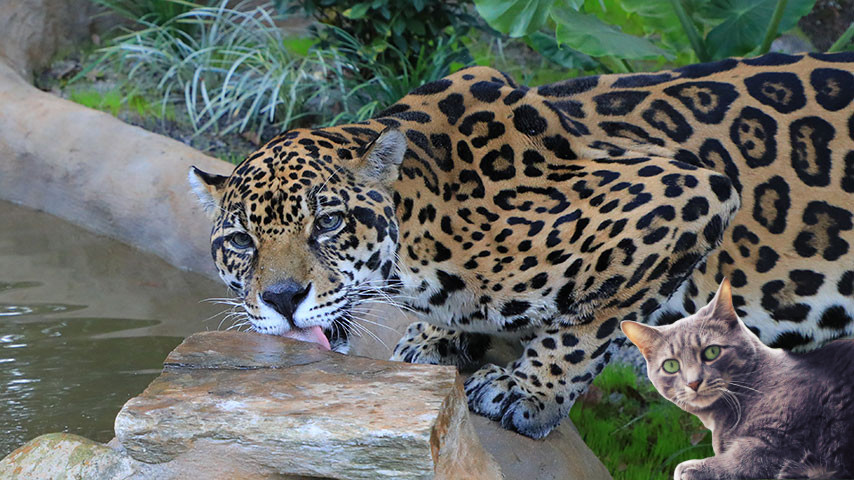
The silver tabby ordered everyone to “vacate the premises,” declaring the water his “personal drinking spot.” One of the toughest cats on the block, a battle-scarred orange tom named Buster, continued drinking.
“Ahem!” Buddy said loudly. “Perhaps you didn’t hear me. Vacate the pond, Buster!”
“Or else my jaguar is not going to be happy,” Buddy replied.
Buster began laughing, then caught sight of the enormous apex predator and backed up warily.
“That’s right!” Buddy said. “Back up if you don’t want to become a light snack, Buster!”
Ek B’alam, Buddy’s jaguar friend, raised a paw sheepishly.
“Um, do we have to threaten violence? I’m not interested in hurting…”
“Shhhh! Yes, yes we do have to threaten them!” Buddy whispered. “Let’s see that intimidating pose you do…great, now roar!”
The jaguar let loose a primal rumble, sending every cat, dog, bird and squirrel within a mile running for cover.
Buddy and Ek B’alam enjoying a prime drinking spot after bullying its previous occupants.
After enjoying a leisurely drink with the pond to themselves, Buddy and Ek B’alam took a lazy route to a nearby dog park where the pair terrorized a pitbull and a gang of Dobermans.
Witnesses said Buddy strolled into the Doberman circle, needled the dogs with insults and told them they’d have to hand over their treats promptly or face dire consequences.
“Oh yea?” the canine leader said, his tail twitching with anticipation. “Says who?”
“Says my jaguar!” Buddy said theatrically, holding both paws out like a magician.
The dogs paused, looked at each other and laughed uproariously.
“Get outta here, you pudgy little…oh! Oh! He’s really got a jag…I mean, I d-d-didn’t…”
Buddy feigned indifference as Ek B’alam padded out from behind a tree. The dogs emptied their bladders.
“You were saying something about me being pudgy, weren’t you? We don’t like insulting little mutts, do we, Ek B’alam?”
“No, we do not, Buddy,” the big cat replied.
“Sometimes we eat them for breakfast, don’t we, Ek B’alam?”
“Yes we do, Buddy. Better than bacon and eggs, with an agreeable aftertaste!”
The dogs whimpered, tails between their legs.
“Leave your toys and treats and scram!” Buddy said, making the canines flinch as he faked a leap toward them.
“You were right, this is kinda fun!” Ek B’alam said as he ate the dogs’ snacks. “Who do we terrorize next?”
Buddy rested his chin on his right paw thoughtfully.
“We could rob Los Gatos of every ounce of catnip they possess. We could put the fear of God into those ‘hunters’ who shoot at our puma buddies. I also have a revenge list of everyone who ever insulted me on the internet. That could be fun!”
As of late Tuesday night, local police scanner frequencies were buzzing with reports of two cats, one small and the other enormous, gleefully tearing apart industrial vacuum cleaners at a nearby Stanley Steemer shop.
Caleb Carr credits cats for showing him love during his difficult childhood when he was frequently beaten by his father.
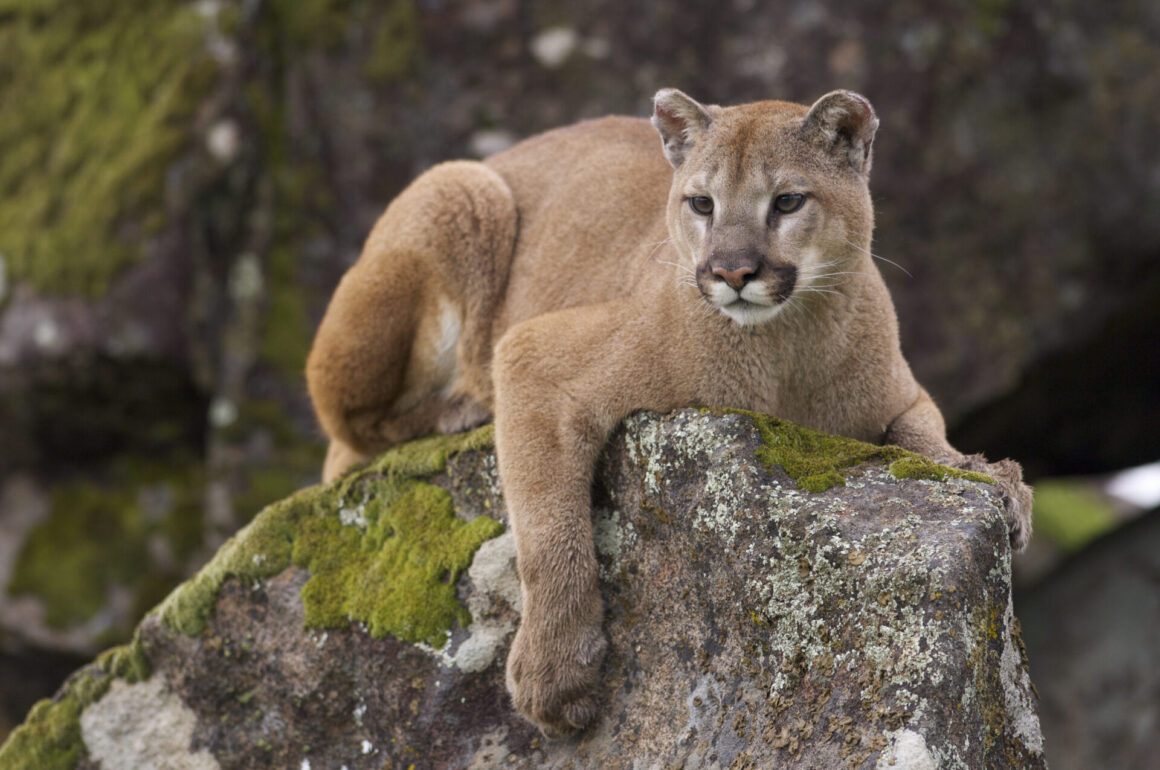
A “mountain lion” spotted near a trail in Ventura County, California, was actually just a house cat, authorities said this week.
California’s Department of Fisheries and Wildlife dispatched staff to the area in question, the Los Padres trail in Thousand Oaks, after neighbors there reported what they thought was a baby mountain lion. One family had footage of the interloper captured on a doorbell camera.
The alleged puma turned out to be a house cat, which is a surprisingly common outcome when authorities look into alleged mountain lion sightings. Despite their size, pumas are genetically closer to felines — small and medium-size cats that can purr and meow — than they are to panthera, the genus that includes tigers, lions, jaguars and leopards.
Their gait is almost identical to that of familiar felis catus, their golden coats can look dark at night, and cats can look like pumas — or the other way around — when there’s not enough visual context to gauge the animal’s size, especially in footage captured on cell phones and security cameras, which are almost always equipped with digital zoom instead of the true optical variety.
We know what you’re thinking: this house cat must have been an impressive specimen if it was mistaken for a puma, so there’s a good chance it was Buddy. However, we can confirm that Buddy the Cat definitely was not wandering around California this week.
Novelist found solace in the company of cats
Author Caleb Carr passed away on May 23, and the Los Angeles Times has a nice tribute to him by a reporter who bonded with Carr over their shared love of cats. The writer, 68, had been suffering from cancer for some time.
Carr was known for his crime thrillers (The Alienist, The Angel of Darkness) and military history books, and he spent part of his career teaching military history at Bard College in New York. (Just a short ride from our own alma mater, Marist College.)
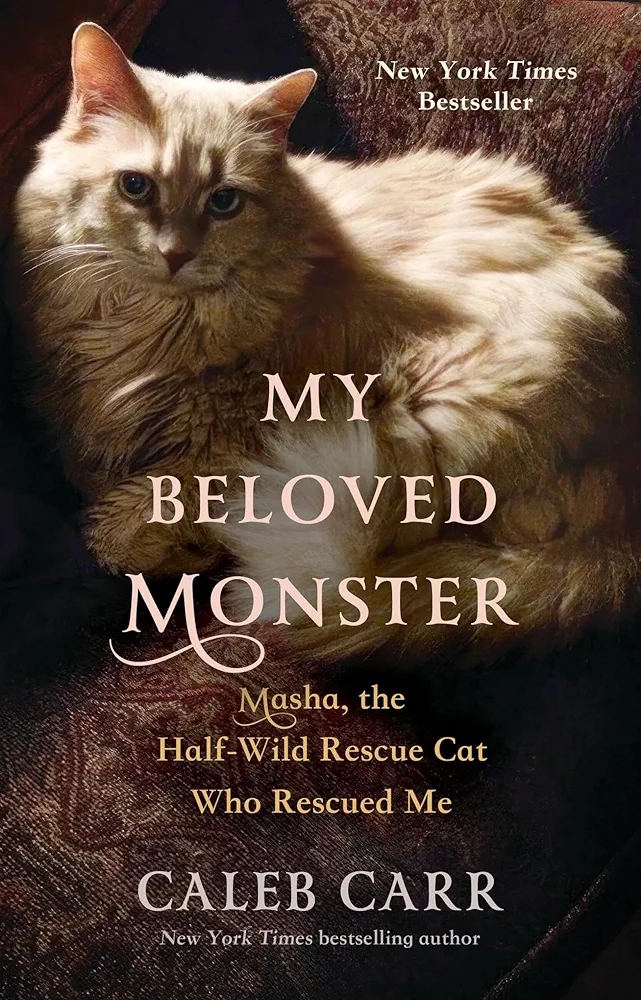
Carr’s last book is a tribute to his cat and her species.
Despite his publisher requesting another crime thriller, Carr decided his last book would be about a cat. Specifically his rescue cat Masha, who helped him through difficult times, and the cats of his childhood who comforted him when he was beaten by his father, Beat Generation figure and author Lucien Carr.
“It’s amazing to think about it now, but there were cats, and other animals, that were trying to make me feel better,” Caleb Carr told the Times. “The idea of that was so at odds with everything I was experiencing.”
Carr credits those felines for helping him avoid the abyss, telling the interviewer he “could have been one of those dead-eyed drone troublemakers that comes out of an abusive household very easily, if it hadn’t been for cats.”
Some people were disappointed that Carr didn’t have another novel like The Alienist in him, but Little, Brown publisher Bruce Nichols liked the idea, and the finished book was titled My Beloved Monster: Masha, The Half-Wild Rescue Cat Who Rescued Me.
The new puma will have big paw prints to fill if it decides to make its famous predecessor’s range its own. People in Los Angeles are thrilled to have another mountain lion prowling the Hollywood Hills.
When the mountain lion known as P-22 died in late 2022, people in Los Angeles were so distraught they painted murals of him on building facades, buried him after a indigenous tribal funeral and even held a festival in his honor.
The famous feline had already been the subject of books, documentaries and an iconic photograph by National Geographic’s Steve Winter. The image showed P-22 in mid-stride, perfectly centered in a small pool of light beneath the Hollywood sign in the hills of Los Angeles at night. It was a natural symbol of wildlife adapting and surviving.
The love for P-22 wasn’t only based on the incredible fact that a mountain lion had established his “range” in Griffith Park, an oasis of wilderness surrounded by urban landscapes. The puma had to cross Interstate 405 and Route 101, heavy-traffic highways that are famously lethal to his species, to get there. For the next decade he skillfully avoided cars and trucks as he went about his business, popping up on trail cameras or in the backyards of Los Angelinos.
Now there’s a potential successor to the vacant throne.
The new puma isn’t collared and wildlife experts don’t know where it came from, but like P-22 it had to cross several dangerous highways to reach the city.
It’s not clear yet if the mountain lion is male or female. Jeff Sikitch, a biologist with the National Parks Service who is part of an ongoing, decades-long study of pumas, told the Los Angeles Times that he thinks the cat is likely a young male, but there’s not much to go on so far except for witness sightings and a low-resolution video taken by a man who lives in an apartment building near the edge of Griffith Park.
“Will this cat be as skilled as P-22 was at avoiding cars for a decade?” the National Wildlife Federation’s Beth Pratt told the BBC. “We don’t know what’s going to happen here.”
The only images of the newcomer so far are grainy video stills, but Griffith Park itself has trail cameras that are used to monitor wildlife. Credit: Vladimir Polumiskov
For now, wildlife officials are waiting and watching to see if the potential puma successor puts down roots in P-22’s old hunting grounds or tries to make the dangerous trek out of the city.
If the new puma decides to stay, it will enjoy plentiful deer and a benefit most members of its species do not have — a local population that understands mountain lion attacks are extraordinarily rare, and will support them by giving them a wide berth.
On the other hand, despite the 4,000 acres of Griffith Park and the residential neighborhoods below, the cat’s inherited range would be much smaller than what’s typical for the species. Like humans cramming belongings into apartments, pumas sacrifice space when they live in or around cities.
Suzanne Pye, a local who admired P-22 from afar, said she welcomes the newcomer and isn’t worried about attacks on people. The presence of a mountain lion after almost 18 months without one prowling the hills, she said, will add “a frisson of excitement to the morning hikes.”
A close-up of P-22 in 2019, when he was briefly captured for a health check-up. Credit: Wikimedia Commons
Have you ever wanted to own or design your own zoo?
Visitors to Buddy’s Tropical Paradise are greeted by friendly staff who man the entrance, a broad vertical garden shaped like an arch that straddles the main path leading inside.
When they walk through the gate a new vista opens up before them: tiered tropical gardens, waterfalls, and wide boulevards lined with palm trees and flowers. They hear the rumble of big cats calling to each other in the distance and monkeys shrieking as they fling themselves from branch to branch.
Welcome to Buddy’s Tropical Paradise!
A monorail carries passengers above, its tracks looping over animal enclosures and threading tunnels that emerge amid the terraced jungle, eateries and souvenir shops.
And straight ahead, the first exhibit: a sprawling habitat occupied by jaguars who are enjoying some yums and will probably have a nap in a few minutes.
Buddy’s Tropical Paradise doesn’t exist in the real world, of course. It’s my first attempt at fully functional, guest-attracting park in Planet Zoo, a simulator that allows you to do practically anything you can think of.
You can design your own habitats, enclosures, buildings and scenery. Fancy a monorail that laps the entire zoo? You can do that. Picturing a 1940s style Tarzan-themed jungle boat ride where visitors can see caiman, capuchin monkeys and jaguars up close? Start carving up the river, my friend!
A Bengal tiger stalking the tall grass in Planet Zoo.Lunch time in the jaguar habitat, followed by the all-important nap time.
As the zoo’s architect, you’re responsible for everything. You’ll need veterinary facilities, animal quarantine, keeper huts. You’ll need to staff your park with veterinarians, keepers, security officers, maintenance staff and mechanics.
And don’t forget the vendors to run the souvenir shops and man the food stalls, where your guests can grab hot dogs or cool off with slushies on a hot day.
A suitable home for your animals
Designing a habitat is about a lot more than reserving space for your animals. You’re tasked with picking the right barriers, mindful of which species can climb or leap great heights. A good habitat should reflect the animal’s home in the wild with appropriate flora, temperatures the species thrives in and a feeding system that mimics the way they’d naturally obtain food.
Elephants cool off in their enclosure in Planet Zoo. Every habitat must be designed with the right atmosphere, flora, terrain, shelter and enrichment appropriate for the species it houses.A wide view of my orangutan habitat. Two orangutans are at the base of the stone steps in the distance.Cheetah sisters.
Then there’s enrichment. Trees for your monkeys to climb, ponds for your tigers to take a dip, bushes for your elephants to strip. Different species enjoy different toys and challenges. An ice block with meat in the middle would hit the spot for carnivores on a hot summer day, but your pandas will want bamboo.
Designing habitats and getting them just right is not only fun, it’s an intuitive way to learn about the needs of individual species and how they live.
The leopard learning incident
My first stab at building a leopard enclosure was a disaster. It looked pretty enough with its Hindu-inspired temple architecture and pond. There were plenty of scratching posts and trees that could withstand claws.
I installed a sprinkler to help the big cats cool off, designed a series of raised platforms for them to climb, and scattered enrichment items all over the habitat. The leopards had balls to bat around, boxes to sit in, rubbing pads, logs and rocks to climb, and plenty of cover and shade.
But when I had the leopards brought into the zoo, through quarantine and into their exhibit, I realized you can’t just design a home for animals from an aesthetic perspective. I’d used several plant and tree species that weren’t native to leopard habitats, the terrain was wrong and I hadn’t paid any mind to ambient temperature.
Making those mistakes was truly educational. When your animals aren’t happy in Planet Zoo, protesters show up, and it’s up to you to read the alerts about where you went wrong and how to remedy your mistakes. It’s an intuitive and fun way to learn about each species and the environments they thrive in.
The escaped jaguar
I’m still learning the ropes, although I do have a basic knowledge of the way the game is designed thanks to some time playing Frontier’s theme park building game, Planet Coaster. The first time I tried to build a jaguar enclosure, I forgot to wall off a viewing cave with protective glass, which my guests did not appreciate.
Even though jaguars don’t like to confront humans, a big cat is a big cat, and the game sent me urgent warnings as people ran for the exits. When I found the escaped jag, he was lounging not far from his enclosure, watching people freak out.
Enrichment is a key aspect of habitat design. Toys, puzzles, obstacles, climbing platforms for arboreal species, ponds for animals who like to get wet — they’re all necessary to keep animals healthy and happy.
In real life it’d be a disaster, but I was able to revert to a previous save, make sure the viewing cave was sufficiently protected, and this time around I placed only two jaguars — a male and a female — in the large enclosure.
After a while, while I was tinkering with an exhibit meant for capuchin monkeys, the game sent me an alert: the female jaguar was pregnant! She gave birth to two energetic, curious cubs who are currently having fun chasing each other around the enclosure and going for dips in their pond.
Part of the main boulevard in Buddy’s Tropical Paradise, viewed at night. Players are responsible for everything you see here — lighting, shops, flowers and plants, benches, waste baskets and more.Shops and a monorail station in an unfinished Asia-themed area of the zoo.
As in real life, the game has you source animals from an international pool, with information on breeding and genetics so you can contribute to conservation. When you adopt animals, their first stop is the veterinary facilities for examination, then quarantine. When they pass quarantine, you can have your staff release them into their enclosures.
It took me several hours to familiarize myself with the basics, design an entrance and a main boulevard for the guests, create some tiered gardens with eateries and shops, and get my jaguar and orangutan exhibits up and running.
My monorail currently runs out of track a quarter of the way through the park, and my river boat ride looks pretty cool, with dense jungle, towering trees and the ruins of Mayan temples not far from shore, but completing it will require appropriate barriers to keep the animals in as well as building out more scenery.
A jaguar in her habitat.
I’ve got my sights set on an elephant exhibit next. It will be necessarily huge, so it’s good to reserve the land early and plan smaller exhibits and facilities around it. I’d also like to put the elephants, lions, zebra, giraffes etc into one Africa-themed section of the park, while the tigers, giant pandas and snow monkeys will be housed in an Asia-themed section, with buildings that reflect the architectural styles of countries like Japan and China.
There are also aquatic exhibits, animals for your own reptile house and aviaries. Those enclosures are more complex than the relatively straightforward orangutan exhibit, for example, so I’ll have to spend some time figuring out what makes a good home for peacocks, sharks and komodo dragons.
So far I’ve resisted the temptation to make one giant felid park, with snow leopards, pumas and cheetahs joining the tigers, lions, jaguars and others. Of course I did name it Buddy’s Tropical Paradise, so I may be forced down the all-cat road if Bud gets his say.
Planet Zoo is not a traditional video game. There are no winners or losers, and there’s no “end state” unless you intentionally include one.
It’s more relaxing and much slower-paced than your typical game, and it’s a great feeling when you’ve managed to take something from your imagination and perfect the design. When you want to check your progress or just admire your own work, you can set the camera to follow guests and watch as people stroll through your zoo, taking in the sights and sounds.
In that sense it’s more like a virtual model train set or living diorama. You can load up the game and tinker with your zoo when you’ve got a spare 15 minutes, or spend a few hours getting absorbed in the finer details of how to keep pangolin and red pandas happy.
Planet Zoo is appropriate for all ages, although its depth and complexity would probably be a lot for younger kids. In that case, it’s probably best to have an adult guide them so they understand the game is built on interlocking systems: exhibits need power and water, shops need staff, veterinary surgeries need veterinarians and so on.
It’ll have enormous appeal to kids who enjoy Lego, Minecraft and other building games, so if you’ve got a little builder in your life, this could be a good fit. But make no mistake, there’s a lot here for adults to enjoy too.
PITB verdict: Four out of five paws!
The only thing keeping Planet Zoo back from a five-paw rating is the DLC (downloadable content) scheme, which requires users to pay extra for certain “packs” containing extra animals, scenery pieces and scenarios. That’s a problem plaguing the larger video game industry, but if you wait for a sale, the normally $44.95 game can be had for as low as $11.24 on Steam. DLC is likewise discounted. Steam’s summer sale is a great opportunity to get games like this for a fraction of their normal price. This year’s summer sale is scheduled for June 27, though it’s possible Planet Zoo could be put on sale before then as well.
Blurry photos and fleeting encounters keep the legend of big cats in the UK alive. Could there be leopards, pumas and other large cats roaming the countryside?
For all the advances in optics and camera technology over the last 20 years alone, there are two kinds of people who love blurry, low-resolution footage: UFO enthusiasts and people who are convinced the UK is like a cold, rainy Africa with big cats lurking in every bush and field.
To be a member of either group you’ve got to shut down critical thinking faculties, suspend disbelief and put faith in the highly improbable. (Or the impossible when it comes to people who insist little green men are zipping across the night sky in sleek ships that defy all we know about physics and aerodynamics.)
The UK’s big cat believers claim the country is home to a thriving native population of large felids. Some of them think they’re “panthers,” not specifying which species of cat they think is out there, while others claim jaguars, leopards or tigers are prowling the English countryside, spotted only fleetingly at the edges of fields or in the brush, and only by people who own two-decade-old Nokia flip phones with rudimentary cameras.
They believe a native, breeding population not only exists, but for centuries has eluded capture and avoided leaving compelling evidence.
“Pardon me, mate, could you point me toward Aldersgate Street?”
The phantom cats have remarkable stealth abilities. They’ve never tripped a trail camera or appeared in a single frame of CCTV footage. Not a single tree marked for territory, not a single pile of cow bones picked clean by giant barbed tongues, not a single clump of panthera dung. Not even a hungry cub drawn into a village by the smell of barbecue on a summer night.
The reported sightings say more about human capacity for imagination — and how poor we are at estimating size over distance — than they do about the crypto-pumas and melanistic tigers some people swear they’ve seen.
When alleged big cats are spotted in the UK, they’re always seen fleetingly and from afar. When witnesses try to confirm what they’ve seen, the animals are gone.
“I was coming up to Jolly Nice from Oxford at around 7.50pm and the car in front of me was travelling at a steady pace. I looked to the verge of the other side of the road because I saw a bright pair of eyes low down. Upon further inspection, I suddenly realised there was a large outline of a low and stocky cat that was huge.”
That’s the testimony of a UK man who told the Stroud Times, a local newspaper, that he encountered a big cat a few minutes before 8 p.m. on Friday in Nailsworth, a town of about 5,600 people a little more than 100 miles west of London. His description mirrors that of others who say they’ve spotted large felids, mostly in the UK’s countryside and small villages.
Photograph from a previous “big cat sighting.” It’s typical of the photos that surface with claims of leopards and pumas stalking the countryside. Blurred details and digital zoom make it difficult to gauge distance and scale.
The story’s headline reads: “Big cat expert’s verdict: beast spotted was a leopard.”
The expert in question is Rick Minter, an amateur biologist who has made UK big cat legends into something of a cottage industry by publishing books, hosting a podcast and frequently speaking to newspapers about the phenomenon. It’s not clear how Minter decided the animal in Friday’s sighting was a “black leopard,” but he’s said in previous interviews that he believes most alleged big cat sightings in the UK are leopards, with pumas accounting for most of the others.
Neither animal is native to Europe. Pumas range from South America to the American northwest and midwest, with isolated populations in places like Florida. Leopards are native to Africa and Asia, with ranges that overlap with lions on the former continent and tigers on the latter, mostly in India.
“I’m originally from San Diego, actually, but the expat life suits me and the British are very tasty.”
Some have floated the possibility that the mysterious felids are escaped pets who have successfully adjusted to the countryside. Minter says the evidence points to breeding populations.
If there are thriving populations, the cats would need to exist in numbers, with at least 50 on the extreme low end. If they’re escaped pets, the authorities would know.
Unlike the US, where big cat ownership was banned in the vast majority of states even before the recent Big Cat Public Safety Act was passed, owning a massive carnivore slash killing machine isn’t illegal in the UK. But owners have to register their animals, seek approval for the habitats and enclosures they’ve built, and submit to annual inspection.
There have been a handful of escapes over the decades and each time the authorities were able to capture or kill the animals, often tracking them via livestock kills. Pet tigers and leopards might be dangerous, but they’re still at a disadvantage compared to their wild brethren, meaning they go for the easy, guaranteed kills when they’re hungry. Nothing’s easier than a docile farm animal that’s never seen a big cat.
“Oi, wanna have a pint and watch Man U vs Arsenal on the telly?”
More recently, big cat hunters in the UK have tried to find more compelling evidence than a couple of blurry photographs of house cats out for a stroll. They’ve touted suspicious-looking pug marks, and in August 2022 found black fur on a barbed wire fence. According to the believers, a UK lab confirmed the fur belonged to a leopard, but there was no chain of custody, no documentation of how the sample was found and handled. Big cat experts remain skeptical.
— Big Cat Sightings In Scotland (@BCSI_Scotland) October 24, 2022
Indeed, Oxford’s Egil Droge, a wildlife conservationist, points out that in places where big cats live, you don’t have to go hunting for evidence. It’s everywhere.
“I’ve worked with large carnivores in Africa since 2007 and it’s obvious if big cats are around. You would regularly come across prints of their paws along roads. The rasping sound of a leopard’s roar can be heard from several kilometres,” Droge wrote, noting that leopards in particular are not discriminating about what they kill and leave ample evidence of their handiwork when they’ve hunted.
Still, as improbable as the sightings are, the big cat enthusiasts of the UK have one up on UFO enthusiasts and hunters of cryptics like Big Foot, the Loch Ness Monster and the Jersey Devil: the creatures they’re looking for actually exist and may surprise us yet.