Buddy claims he’s a tiguar, not a domestic cat, and says allowing him outside is tantamount to Queen Daenerys allowing her dragons to roam the countryside in Game of Thrones.
Dear Buddy,
Dude. Everyone’s getting so uptight lately about making sure we stay inside. We’re predators! We should be running our neighborhoods, but no, our humans want to “protect” us.
As a famously fierce and ripped feline, what’s your take?
Frustrated in Fallbsurg
Dear Frustrated,
I empathize with you, I really do, but the way it was explained to me is that I’m a terrifying cat with huge meowscles, and by keeping me indoors, my human is protecting dogs, humans and other lower life forms from my potential wrath.
“Do they let tigers and jaguars run around New York?” Big Buddy asked me.
“Uh, no, I guess they don’t,” I said.
“Of course not. And that’s exactly why we can’t have you roaming the neighborhood. Think of the quandary Daenerys Targaryen had in Game of Thrones when her dragons were feasting on livestock from the farms of her subjects!”
And he’s right. A Buddy on the loose would cause all sorts of panic and other problems. I don’t want to be responsible for what happens when a bunch of humans freak out and go recklessly running in every direction, terrified I’m going to catch them.
If it takes sacrifice on my part to keep people comfortable, then I’m willing to endure the hardship of living indoors with a servant who heeds my every beck and call. It’s just the honorable thing to do.
Your friend, Buddy
Buddy the Tiguar
Dear Buddy,
Hey, pal! How have you been?
Friendly in Florida
Hey Friendly,
I’ve been handsome, how have you been?
Buddy
Dear Buddy,
You’re not a tiger! Or a jaguar! You’re a chubby, sedentary, spoiled house cat with an enabler of a human who encourages your delusions of being a powerful big cat!
Just stop already, it’s embarrassing!
Cringing In Connecticut
Dear Cringing,
First of all, I am a tiger/jaguar, or a tiguar if you will. I just haven’t hit my growth spurt yet. My human assures me it’s gonna happen.
I also asked my human if it’s true that he’s “an enabler” who encourages my supposed delusions. His response: “That’s absurd. Who’s a big, bad cat? You are, aren’t you? Yes, you are!”
So obviously you’re a hater and soon you’ll see me prowling the jungle with David Attenborough talking about how dangerous I am! Just wait!
Cats of all kinds are at risk of avian flu infection if they hunt birds outdoors, consume raw meat or drink unpasteurized milk.
In a tragedy that underscores how vulnerable cats of all types are to bird flu, more than half the big cats residing at a sanctuary in Washington were killed by the virus in less than a month.
Twenty cats in total died at the Wild Felid Advocacy Center, including five servals, four bobcats, two Canada lynx and a Bengal tiger.
Only 17 cats are left at the sanctuary, according to its operators.
Mark Matthews, the sanctuary director, called the H5N1 avian influenza a “wicked virus” that killed the cats in his organization’s care within 24 hours of each animal contracting it.
“We’ve never had anything like this,” Matthews said, adding that he and his staff are accustomed to cats in their care dying of old age after living long, happy lives.
In California, Gov. Gavin Newsom declared a state of emergency on Dec. 18 after infected birds were found at more than two thirds of the state’s dairy producers.
California’s dairy industry has been hit hard by the spread of bird flu, with more than half the state’s dairy producers impacted. Credit: Ralf R/Pexels
As of Dec. 26, bird flu had infected 65 Americans, the majority in California.
And the virus has now resulted in its first pet food recall, with Northwest Naturals pulling its turkey recipe “raw diet” food. A cat in Oregon died after consuming the food, according to the Oregon Agriculture Department.
As we noted in our earlier post about the variant of avian influenza, there’s no reason to panic. Even if you live on the west coast, the chances of your cats being infected are small.
But it’s probably a good idea to make sure your cats remain indoors, as health authorities warn cats can contract the virus directly by catching and eating birds. In one case, health officials believe three indoor cats may have caught the virus after killing mice in their home.
In addition, the American Veterinary Medical Association advises caretakers to avoid giving their cats milk, which they should not be drinking anyway, and raw meat. Domestic cats are generally lactose intolerant, and while cats can be infected with bird flu by eating raw poultry, they can also contract the virus by eating raw meat from other animals.
PLUS: Today’s the deadline for UK residents to get their cats microchipped under a new law that levies a hefty fine for people who don’t comply.
Another day, another story about a person who can’t tell if the cat they’ve brought inside is their own or a random lookalike.
In this case, a woman named Amber Porter says her indoor-only cat bolted outside, and after a few hours she was able to bring him back in — only to have doubts about whether he’s actually her cat. Meanwhile, an identical-looking black cat is hovering around Porter’s home, and she’s trying to lure it inside.
“I’m still a little worried about it,” Porter said. “I have fully convinced myself I have the wrong cat but I also think I do have the right one.”
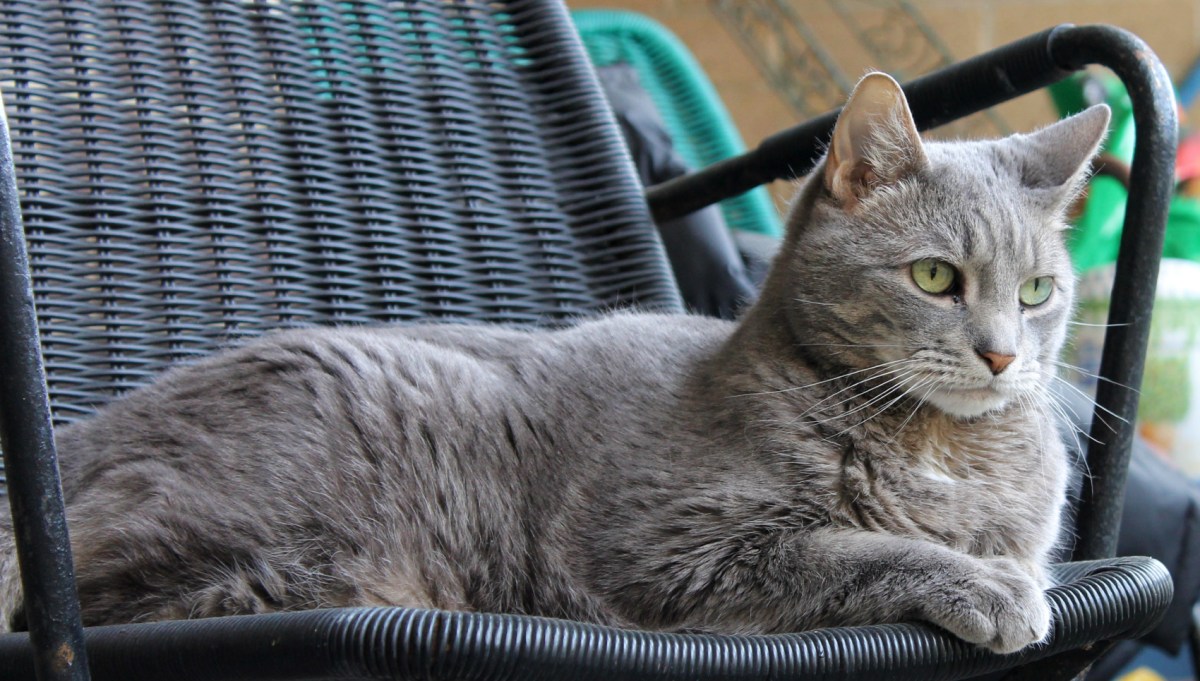
This absolutely blows my mind. If someone asked me how long it would take to determine if a gray tabby is Buddy, I’d say approximately half a second. It’s not because of his “bib,” that unique white tuft of hair on his chest, or his pronounced muzzle, although both would offer confirmation.
It’s his behavior, his mannerisms and movement, the fact that if we were separated, he’d meow loudly the second we’re reunited and I’d hear that familiar half-trill, half-meow he does that seems to be Buddesian for “Hello, servant!”
In any case, I hope Amber Porter figures out which cat is hers, and the story looks like it’ll have a happy ending because she says she intends to keep both cats.
Today’s the deadline to get your cats microchipped in the UK
A reminder to our British readers: today, June 10, is the deadline to have your cat microchipped under a new law that makes chips mandatory.
If you’re caught with an unchipped cat, the fine is a hefty £500, or about $635 in ‘Merican greenbacks. That’s some serious chop, so get your little buddy chipped!
“Chip me, human!” Credit: FOX/Pexels
Alice Potter, a cat welfare specialist with the RSPCA, told Sky News that microchips with up-to-date information are the biggest factor in reuniting cats with their humans when the former go missing.
“On average, 11% of all cats coming into the RSPCA’s care are still not microchipped. We’ve also rescued cats who have been microchipped but the details haven’t been kept up to date, which is arguably even more frustrating as it means cats spend a long time in our care whilst we fruitlessly try to contact the owner with out-of-date information,” Potter said.
“However, we’ve also seen countless stories of cats that have been reunited with their owners thanks to a tiny microchip – showing what this change of legislation will achieve for animal welfare.”
If cats are like small children emotionally and intellectually, is it ethical to give them a mind-altering drug?
That’s a question posed in a new article in The Conversation, and it’s something I’ve never really considered before.
It’s generally accepted that our little buddies are more or less equivalent to small children in terms of intellect and emotional intelligence. In fact kittens develop much more quickly than human children and come to certain understandings — like theory of mind and object permanence — considerably earlier than young kids do.
They also seem to possess some sapient qualities. My niece was born a year before Bud, for example, but in their early interactions he understood she was still developing motor skills and did not intend to cause him harm. I have photos of a young Buddy, still a kitten, cautiously allowing her to touch his fur and being uncharacteristically gentle with her.
There’s growing evidence that pet cats are “kittens in perpetuity.” Not only do their behaviors toward us mirror their behaviors toward their mothers — like meowing and using us as a “secure base” when faced with uncertainties — but they depend on us completely. We care for them, in turn, at least in part because they have neotenous (baby-like) features, which trigger our protective instincts.
Bud is basically a “kid,” so is it ethical for me to give him a potentially mind-altering substance?
Catnip isn’t really a drug
While some catnip companies lean into the whole “marijuana for cats” thing, naming catnip after famous marijuana strains, selling it in gag pharmaceutical bottles and even calling themselves “dispensaries,” those are marketing efforts aimed at us servants. As the authors note, it’s not accurate to consider catnip the equivalent of a drug.
It’s not physically addictive, its effects only last a few minutes and cats can’t overdose on the stuff. In fact the primary “danger” of giving too much catnip is your four-legged friend getting desensitized completely to the effect, which is why it’s an occasional treat, not a routine pick-me-up.
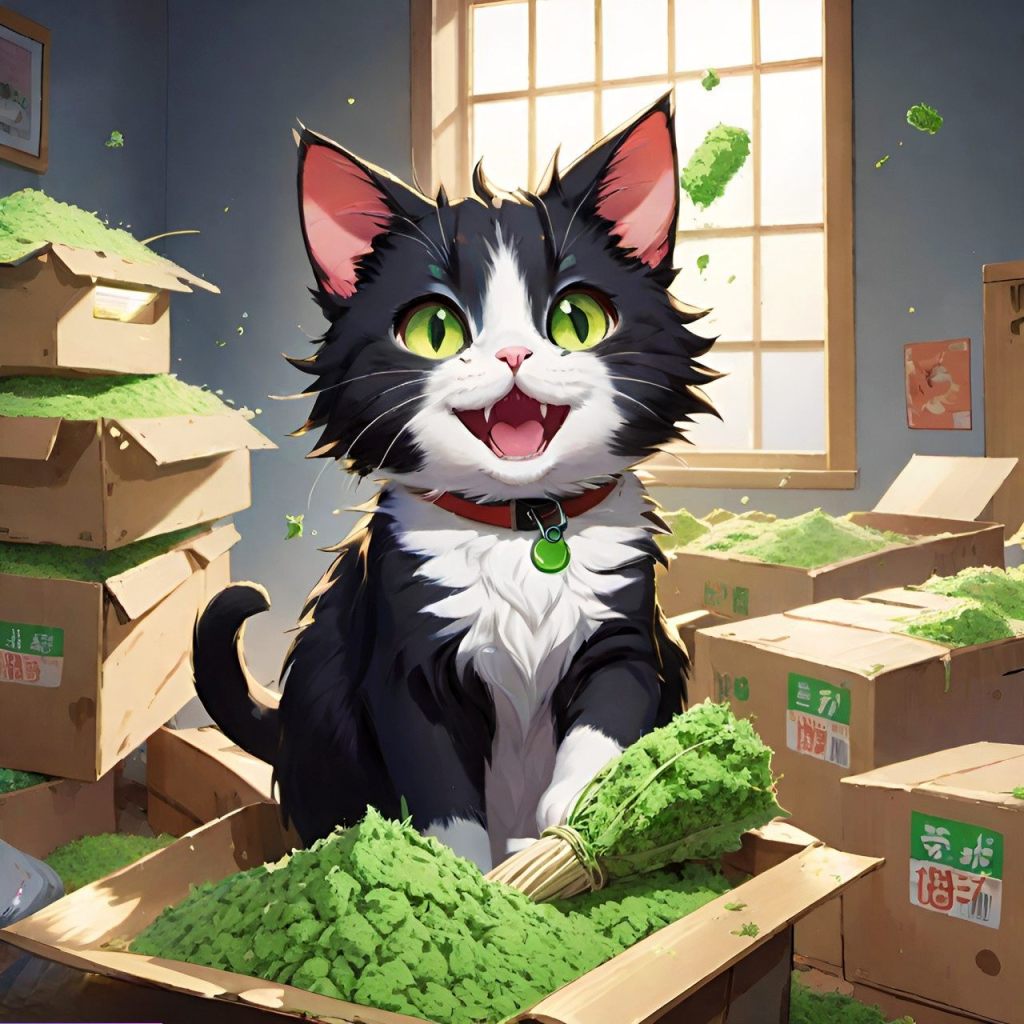
Meowijuana Catnip Company really leans into the whole “weed for cats” thing with catnip packaged like marijuana.
Catnip “won’t induce psychosis and won’t lead to addiction or withdrawal symptoms,” wrote authors Anne Quain, a professor of veterinary science at the University of Sydney, and Mia Cobb, a research fellow at the University of Melbourne’s Animal Welfare Science center.
We don’t have to worry about cats driving on the stuff, and they have no responsibilities to speak of so catnip and silver vine can’t impact important decisions. If they have any deleterious social effects, they end at making our furry friends drool, look silly and rendering them even more drowsy than usual.
The mysteries of the nip effect
But what about a kitty’s subjective experience? How does catnip make your feline overlord feel?
We don’t have a very good answer to that question other than what we can observe, which is that they love the stuff. (Some cats don’t respond to catnip but are put in a state of bliss by silvervine. Some respond to both. A small number may not derive much pleasure from either of the plants.)
Even when they aren’t technically impacted by it, cats seem intrigued by the scent and use their secondary olfactory receptor, the vomeronasal organ, to do that odd-looking “mouth-sniffing” thing they do.
Buddy loves catnip and silver vine. I keep his ‘nip in an out-of-reach cabinet, inside a sealed container, which is itself inside an air-tight plastic bag. Bud can be in a deep sleep yet within seconds of opening it he’ll appear like an overly enthusiastic djinn who thinks the wish thing works in reverse, meowing impatiently and trilling with anticipation as I set the good stuff down for him.
That’s as close to consent as we’re going to get from cats, and I think we can safely conclude Bud’s response is “Hell yes! Gimme that sweet ‘nip and silver vine blend!”
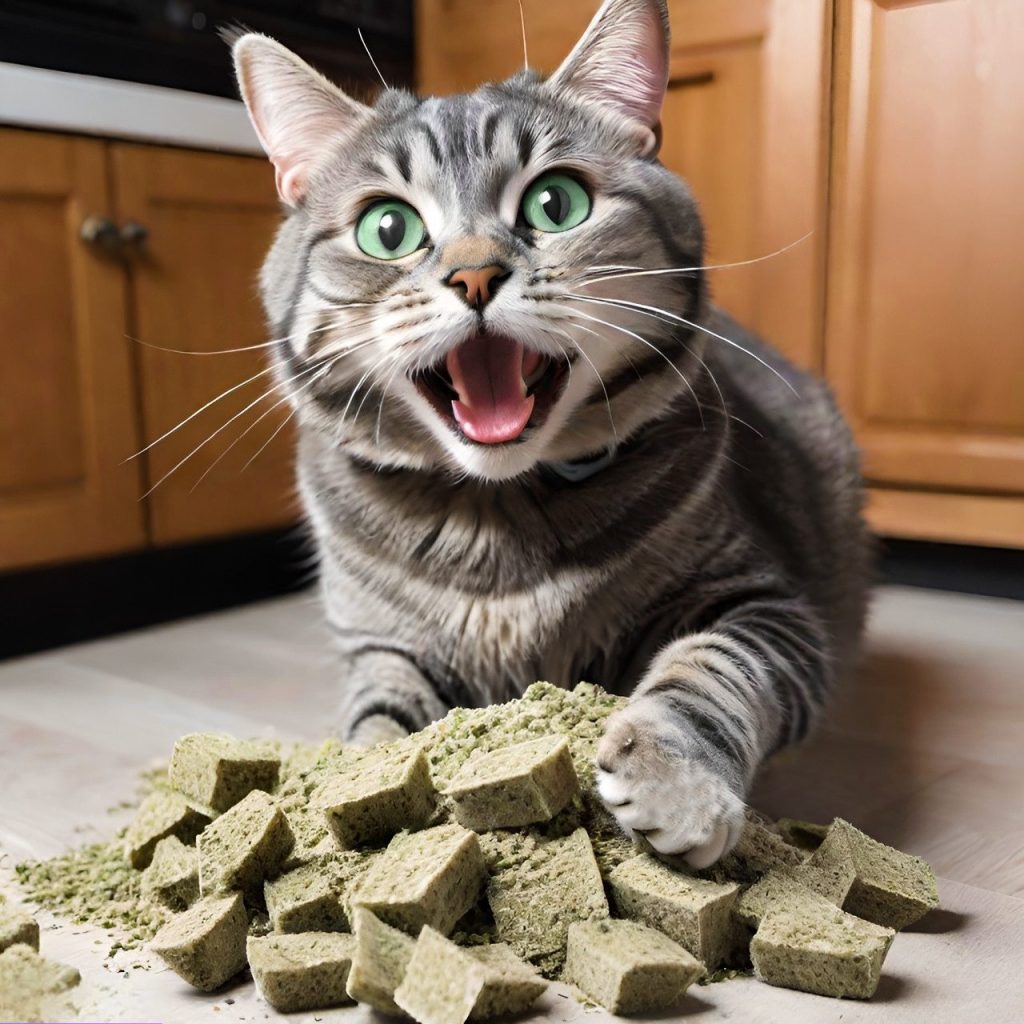
He gobbles the stuff down, by the way, so YMMV on your feline overlord’s reaction. The conventional wisdom is that cats who sniff catnip get more animated while cats who eat it tend to roll around in bliss and meow.
Making life more interesting for your fuzzy liege lord
Which brings us to the final point: catnip and silver vine are ultimately enrichment tools that help make indoor life more exciting for our little buddies, like toys, cat furniture, boxes, intriguing smells and most importantly, time playing with us.
We don’t talk about it enough, but keeping our cats stimulated and happy indoors is important, especially as pressure mounts for everyone to keep their felines inside. If your local area isn’t enforcing curfews and outright bans, it seems only a matter of time before they follow states in Australia, New Zealand and Europe in passing new laws. Every day there are news articles detailing the efforts of city councils and town boards to deal with outdoor, unmanaged feline populations, and it’s a safe bet that most of those elected officials will not have the welfare of the animals high on their list of priorities.
If we want to avoid cruelty toward cats, getting our own pets comfortable with living indoors is a good first step to making sure government doesn’t become involved.
What does it mean to “own” a cat? If you believe a cat is neglected, can you take custody? As UK law changes, those questions need answers.
For the second time this week, two people are fighting over a cat after the original “owner” received a request from a microchip company to confirm another person’s claim on the feline.
Charlotte Sawyer of Swindon, a town in southwest England, told her local newspaper she was livid when she got the request to sign over her claim to one-year-old Oreo.
“I can’t believe the audacity of this person trying to steal our beautiful cat,” she told the Swindon Advertiser.
But Sawyer readily admitted Oreo was going out for days and sometimes weeks at a time before returning home, and she hasn’t seen him for four months now.
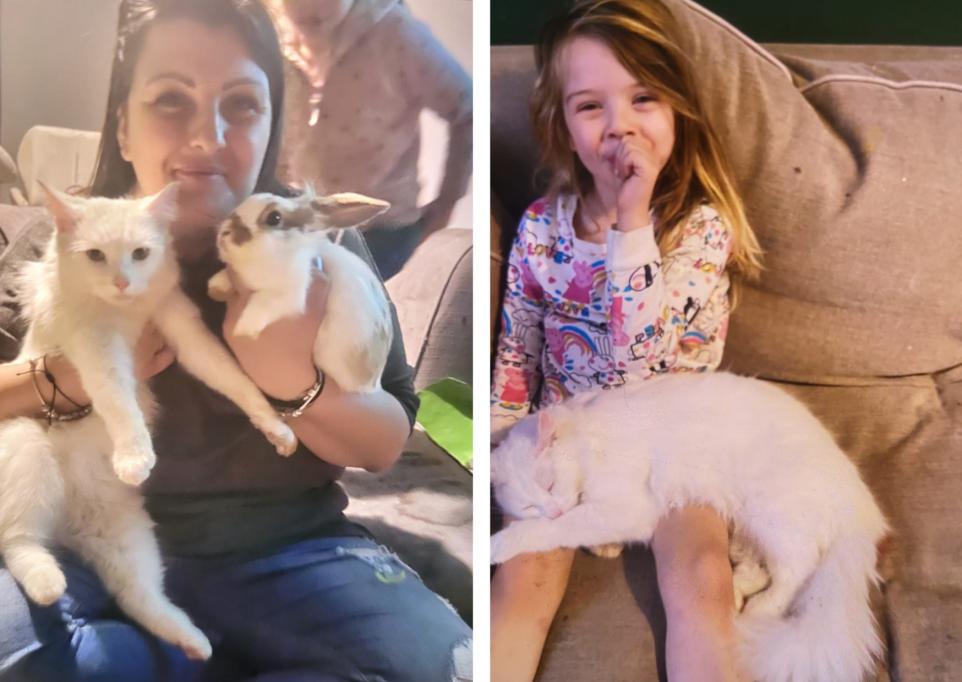
Charlotte Sawyer, left, with her cat Oreo and a pet rabbit. Sawyer’s daughter, right, with Oreo. Credit: Charlotte Sawyer via Swindon Advertiser
Like many cats in the UK, Oreo not only had access to the outdoors, he was accustomed to coming and going as he pleased. Other families were feeding him, and it’s likely he made the rounds among several houses before returning home. Because “home” is a nebulous concept in this instance, it’s not the first time someone has asked Sawyer to relinquish custody of Oreo.
“A woman claiming to be someone who looks for missing cats once knocked on my door and handed me a form asking for permission to change Oreo’s microchip,” Sawyer said. “I wanted to rip it up, I was furious, and told her he was my cat. Now it’s happened again. At least it’s provided some reassurance that he’s still alive.”
While I feel for anyone who loses a pet, I don’t know how someone who truly loves a cat can accept the kitty being gone for days or weeks at a time, not knowing if he’s in danger, hurt or still breathing. That kind of arrangement isn’t in the cat’s best interests, and it’s not compatible with our responsibility to ensure the welfare of our four-legged friends, an obligation all of us take on when we adopt our pets.
The people who encountered Oreo likely thought he was a stray or an abandoned former pet. If they’re requesting a change to microchip registration, it probably means they spent their own money to take the little guy to the vet, where the chip was discovered and scanned.
This is emphatically not a blanket criticism of UK norms regarding outdoor access, by the way. Americans cannot claim moral superiority. In the past week or so we’ve had a Pennsylvania man kill a cat with a blow dart because the feline “was trying to kill my birds,” a vulgar approximation of a human being in New Jersey “repeatedly raped” his pet cat before torturing her to death, and some deranged lunatic in Florida used a cat as target practice, leaving 30 pellets lodged in the innocent animal’s little body.
That represents a tiny fraction of the cat abuse stories from the last 10 days and I’ve omitted the worsted examples because I know we have readers who can’t handle this stuff. (I can’t either, which is why I paused my Google News alerts for most of the past two weeks.)
My point here is not to shock. It’s to underscore the fact that we have absolutely no moral authority when it comes to telling people in other countries how to care for animals.
A cat exploring outdoors. Credit: Openverse
Moral authority concerns aside, the two examples of ownership claims by microchip this week raise important questions about the definition of “ownership” and what it means to properly care for a cat.
Like many cat lovers I don’t like the term “owner” and I describe myself as a caretaker, but where the law is concerned, ownership is important concept because it determines who has claim over the animal. The law views cats and dogs as property, whether we like it or not. That’s why animal welfare statutes fall under agriculture and markets law in many US states instead of the criminal code, and it’s why so many of those laws need updating.
Cat culture across the Atlantic is different in that the majority of people who have cats believe our furry friends must have access to the outdoors to live a complete, fulfilled life. In the US, 63 percent of cat caretakers keep their felines strictly indoors, while in the UK it’s virtually the opposite, with 70 percent allowing cats to roam outdoors. Not all definitions of outdoor access are equal: Some people allow only supervised outdoor time in the backyard (or “garden”), some make sure their kitties are safely indoors by nightfall, while others have cats who return at their own whim.
There are also differences regarding geography, traffic density, the prevalence of natural predators and the nature of city life that account for how much outdoor access they allow their cats.
As the UK sets a June 2024 date for the mandatory microchipping of pet cats, disputes like this are going to become more common, which means people would be wise to make sure their cats’ microchips have up-to-date information and have readily available proof that they own their felines. If cat owners don’t establish the criteria for what it means to “own” a feline, the government will.






 Pain In The Bud