For the first time, the Budster has a patch of matted fur. Luckily, because this is a frequent problem for cats, there’s a lot of detailed advice out there about what to do.
Ruh roh!
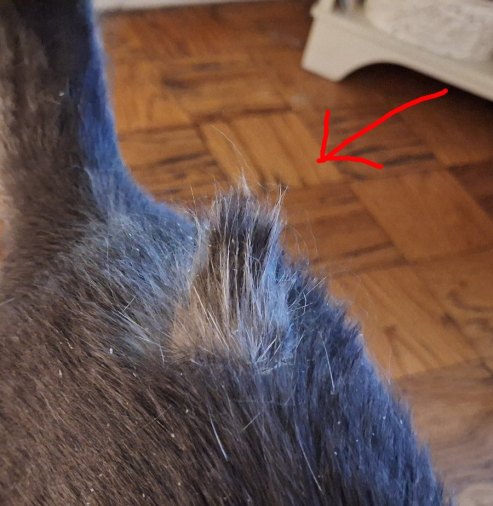
In a first for him, Bud’s got a patch of matted fur. While it’s clear he understands I’m trying to help him, he’s not particularly keen on my efforts to comb it out.
He’ll tolerate limited brushing, but after a few attempts he pulls away. I don’t think it’s a sore spot in general. He hasn’t minded when I examined the area and he doesn’t pull away if I scratch his lower back, but his limited tolerance for the brush and his body language all say he’s uncomfortable with repeated attempts to clear the fur.
The dandruffy stuff is from the combing and looks like dead skin. His coat is normally clear of anything like that.
The mat is hard, like the bristles of a paint brush that hasn’t been cleaned properly. Bud’s white underfur is much more visible in the matted area as it sticks up.
After reading about matting in cats and the causes, I don’t think we’re dealing with fleas or an infection. I realize indoor cats can get fleas, but I very rarely see the little guy scratching himself and there’s no indication he’s in any general discomfort.
My best guess is that he’s, ahem, maybe still a little too much on the chubby side and can’t groom the area as he did when he was a younger, slimmer feline, before he moved down to Florida, joined the Del Boca Vista retirement community for cats and immersed himself in the exciting world of bocce.
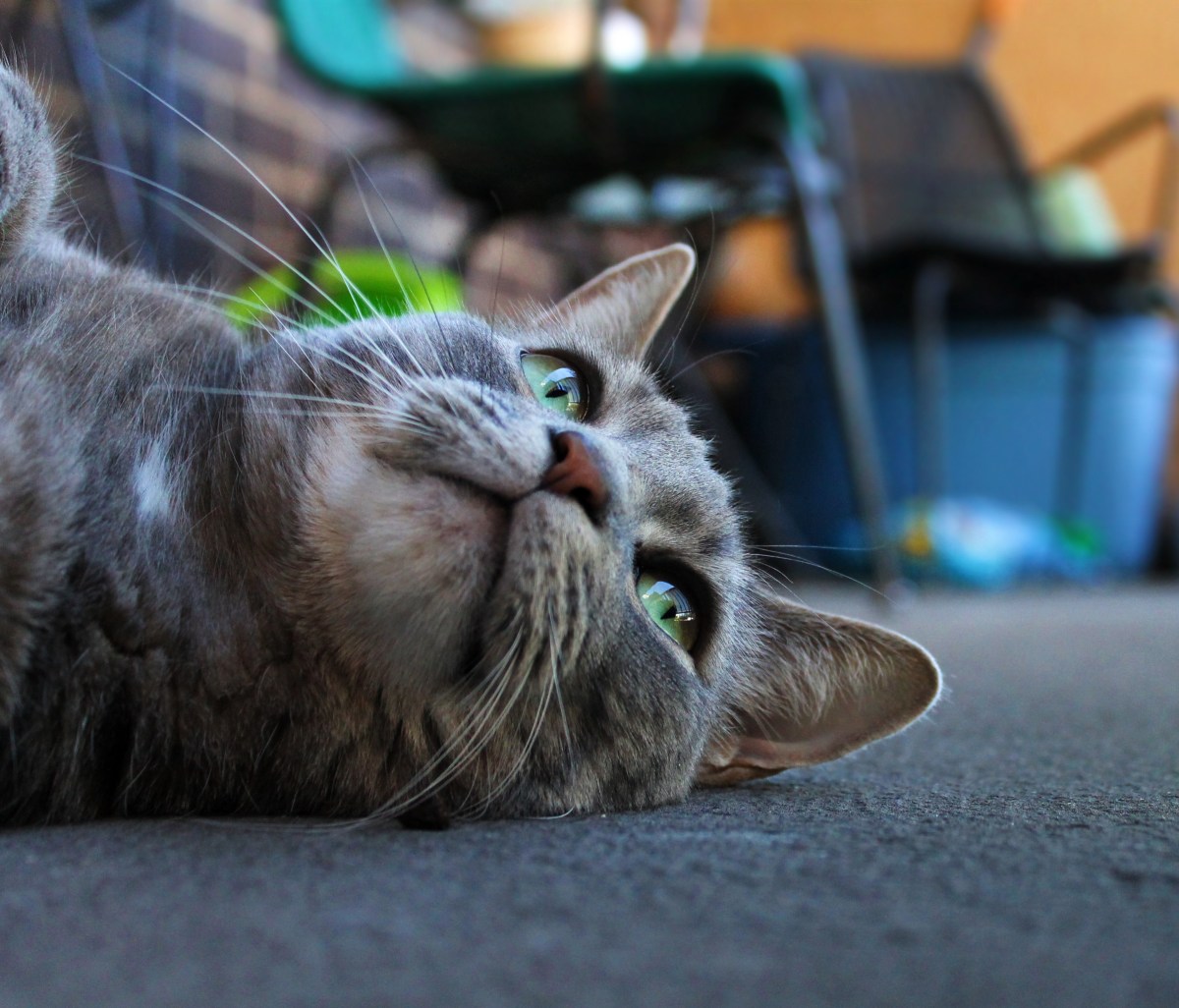
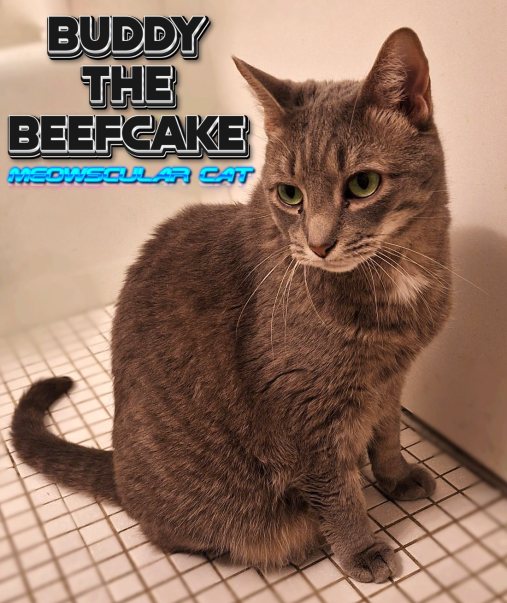
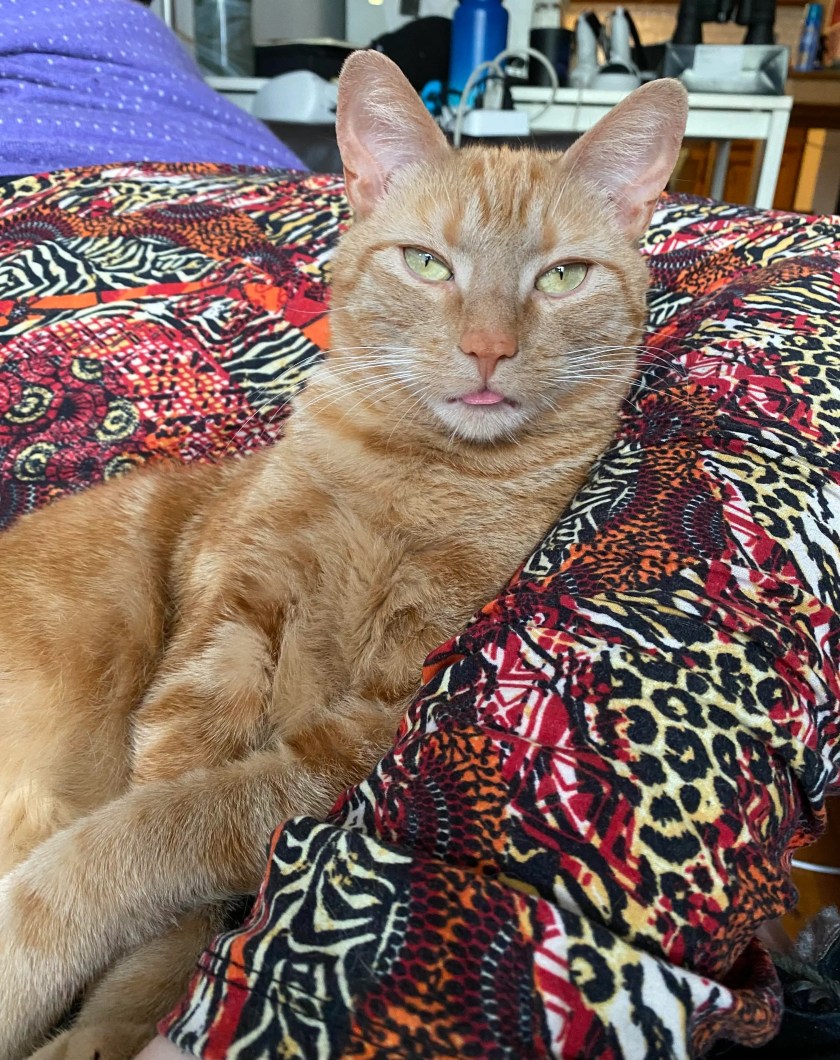
As you can see, he doesn’t look chubby and his coat is otherwise very healthy.
He’s a tiger!
Of course any talk of weight issues is very hush-hush around here. Officially, Buddy has the physique of an athletic tiger. Anyone who vocalizes doubts about that does so at their peril.
Right now my plan of attack is to get a fine metal comb specifically for jobs like this. I’ll try to remedy it with short brushing sessions and encouragement in the form of treats and praise for Bud being such a brave little guy.
If that doesn’t work, the next step would be a groomer or veterinarian. These things don’t resolve themselves, unfortunately, and the longer they’re allowed to persist, the worse the problem becomes.
Blurry photos and fleeting encounters keep the legend of big cats in the UK alive. Could there be leopards, pumas and other large cats roaming the countryside?
For all the advances in optics and camera technology over the last 20 years alone, there are two kinds of people who love blurry, low-resolution footage: UFO enthusiasts and people who are convinced the UK is like a cold, rainy Africa with big cats lurking in every bush and field.
To be a member of either group you’ve got to shut down critical thinking faculties, suspend disbelief and put faith in the highly improbable. (Or the impossible when it comes to people who insist little green men are zipping across the night sky in sleek ships that defy all we know about physics and aerodynamics.)
The UK’s big cat believers claim the country is home to a thriving native population of large felids. Some of them think they’re “panthers,” not specifying which species of cat they think is out there, while others claim jaguars, leopards or tigers are prowling the English countryside, spotted only fleetingly at the edges of fields or in the brush, and only by people who own two-decade-old Nokia flip phones with rudimentary cameras.
They believe a native, breeding population not only exists, but for centuries has eluded capture and avoided leaving compelling evidence.
“Pardon me, mate, could you point me toward Aldersgate Street?”
The phantom cats have remarkable stealth abilities. They’ve never tripped a trail camera or appeared in a single frame of CCTV footage. Not a single tree marked for territory, not a single pile of cow bones picked clean by giant barbed tongues, not a single clump of panthera dung. Not even a hungry cub drawn into a village by the smell of barbecue on a summer night.
The reported sightings say more about human capacity for imagination — and how poor we are at estimating size over distance — than they do about the crypto-pumas and melanistic tigers some people swear they’ve seen.
When alleged big cats are spotted in the UK, they’re always seen fleetingly and from afar. When witnesses try to confirm what they’ve seen, the animals are gone.
“I was coming up to Jolly Nice from Oxford at around 7.50pm and the car in front of me was travelling at a steady pace. I looked to the verge of the other side of the road because I saw a bright pair of eyes low down. Upon further inspection, I suddenly realised there was a large outline of a low and stocky cat that was huge.”
That’s the testimony of a UK man who told the Stroud Times, a local newspaper, that he encountered a big cat a few minutes before 8 p.m. on Friday in Nailsworth, a town of about 5,600 people a little more than 100 miles west of London. His description mirrors that of others who say they’ve spotted large felids, mostly in the UK’s countryside and small villages.
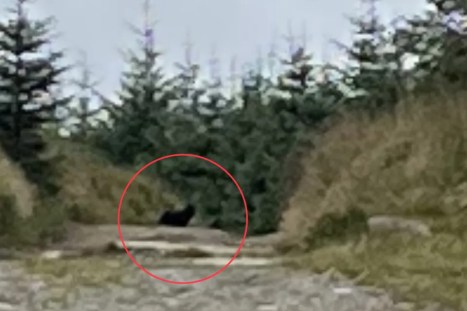
Photograph from a previous “big cat sighting.” It’s typical of the photos that surface with claims of leopards and pumas stalking the countryside. Blurred details and digital zoom make it difficult to gauge distance and scale.
The story’s headline reads: “Big cat expert’s verdict: beast spotted was a leopard.”
The expert in question is Rick Minter, an amateur biologist who has made UK big cat legends into something of a cottage industry by publishing books, hosting a podcast and frequently speaking to newspapers about the phenomenon. It’s not clear how Minter decided the animal in Friday’s sighting was a “black leopard,” but he’s said in previous interviews that he believes most alleged big cat sightings in the UK are leopards, with pumas accounting for most of the others.
Neither animal is native to Europe. Pumas range from South America to the American northwest and midwest, with isolated populations in places like Florida. Leopards are native to Africa and Asia, with ranges that overlap with lions on the former continent and tigers on the latter, mostly in India.
“I’m originally from San Diego, actually, but the expat life suits me and the British are very tasty.”
Some have floated the possibility that the mysterious felids are escaped pets who have successfully adjusted to the countryside. Minter says the evidence points to breeding populations.
If there are thriving populations, the cats would need to exist in numbers, with at least 50 on the extreme low end. If they’re escaped pets, the authorities would know.
Unlike the US, where big cat ownership was banned in the vast majority of states even before the recent Big Cat Public Safety Act was passed, owning a massive carnivore slash killing machine isn’t illegal in the UK. But owners have to register their animals, seek approval for the habitats and enclosures they’ve built, and submit to annual inspection.
There have been a handful of escapes over the decades and each time the authorities were able to capture or kill the animals, often tracking them via livestock kills. Pet tigers and leopards might be dangerous, but they’re still at a disadvantage compared to their wild brethren, meaning they go for the easy, guaranteed kills when they’re hungry. Nothing’s easier than a docile farm animal that’s never seen a big cat.
“Oi, wanna have a pint and watch Man U vs Arsenal on the telly?”
More recently, big cat hunters in the UK have tried to find more compelling evidence than a couple of blurry photographs of house cats out for a stroll. They’ve touted suspicious-looking pug marks, and in August 2022 found black fur on a barbed wire fence. According to the believers, a UK lab confirmed the fur belonged to a leopard, but there was no chain of custody, no documentation of how the sample was found and handled. Big cat experts remain skeptical.
— Big Cat Sightings In Scotland (@BCSI_Scotland) October 24, 2022
Indeed, Oxford’s Egil Droge, a wildlife conservationist, points out that in places where big cats live, you don’t have to go hunting for evidence. It’s everywhere.
“I’ve worked with large carnivores in Africa since 2007 and it’s obvious if big cats are around. You would regularly come across prints of their paws along roads. The rasping sound of a leopard’s roar can be heard from several kilometres,” Droge wrote, noting that leopards in particular are not discriminating about what they kill and leave ample evidence of their handiwork when they’ve hunted.
Still, as improbable as the sightings are, the big cat enthusiasts of the UK have one up on UFO enthusiasts and hunters of cryptics like Big Foot, the Loch Ness Monster and the Jersey Devil: the creatures they’re looking for actually exist and may surprise us yet.
What does it mean to “own” a cat? If you believe a cat is neglected, can you take custody? As UK law changes, those questions need answers.
For the second time this week, two people are fighting over a cat after the original “owner” received a request from a microchip company to confirm another person’s claim on the feline.
Charlotte Sawyer of Swindon, a town in southwest England, told her local newspaper she was livid when she got the request to sign over her claim to one-year-old Oreo.
“I can’t believe the audacity of this person trying to steal our beautiful cat,” she told the Swindon Advertiser.
But Sawyer readily admitted Oreo was going out for days and sometimes weeks at a time before returning home, and she hasn’t seen him for four months now.
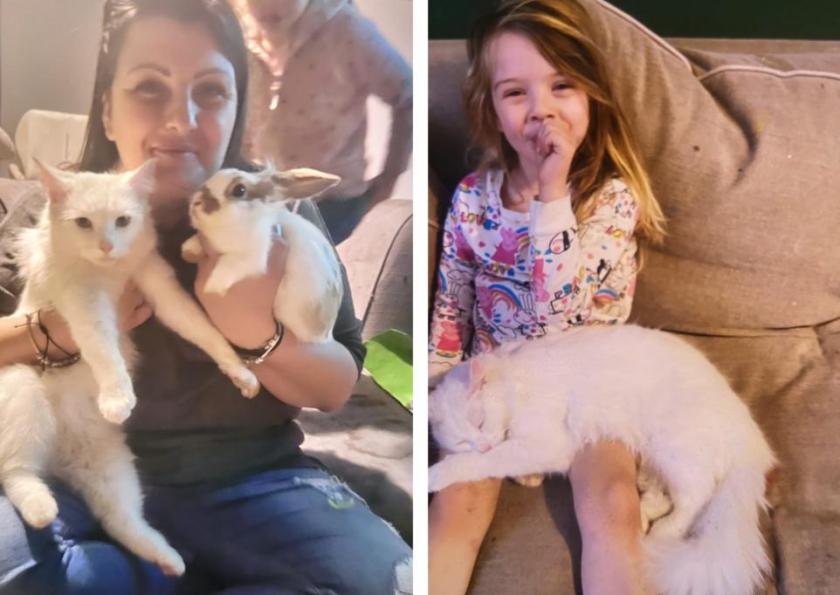
Charlotte Sawyer, left, with her cat Oreo and a pet rabbit. Sawyer’s daughter, right, with Oreo. Credit: Charlotte Sawyer via Swindon Advertiser
Like many cats in the UK, Oreo not only had access to the outdoors, he was accustomed to coming and going as he pleased. Other families were feeding him, and it’s likely he made the rounds among several houses before returning home. Because “home” is a nebulous concept in this instance, it’s not the first time someone has asked Sawyer to relinquish custody of Oreo.
“A woman claiming to be someone who looks for missing cats once knocked on my door and handed me a form asking for permission to change Oreo’s microchip,” Sawyer said. “I wanted to rip it up, I was furious, and told her he was my cat. Now it’s happened again. At least it’s provided some reassurance that he’s still alive.”
While I feel for anyone who loses a pet, I don’t know how someone who truly loves a cat can accept the kitty being gone for days or weeks at a time, not knowing if he’s in danger, hurt or still breathing. That kind of arrangement isn’t in the cat’s best interests, and it’s not compatible with our responsibility to ensure the welfare of our four-legged friends, an obligation all of us take on when we adopt our pets.
The people who encountered Oreo likely thought he was a stray or an abandoned former pet. If they’re requesting a change to microchip registration, it probably means they spent their own money to take the little guy to the vet, where the chip was discovered and scanned.
This is emphatically not a blanket criticism of UK norms regarding outdoor access, by the way. Americans cannot claim moral superiority. In the past week or so we’ve had a Pennsylvania man kill a cat with a blow dart because the feline “was trying to kill my birds,” a vulgar approximation of a human being in New Jersey “repeatedly raped” his pet cat before torturing her to death, and some deranged lunatic in Florida used a cat as target practice, leaving 30 pellets lodged in the innocent animal’s little body.
That represents a tiny fraction of the cat abuse stories from the last 10 days and I’ve omitted the worsted examples because I know we have readers who can’t handle this stuff. (I can’t either, which is why I paused my Google News alerts for most of the past two weeks.)
My point here is not to shock. It’s to underscore the fact that we have absolutely no moral authority when it comes to telling people in other countries how to care for animals.
A cat exploring outdoors. Credit: Openverse
Moral authority concerns aside, the two examples of ownership claims by microchip this week raise important questions about the definition of “ownership” and what it means to properly care for a cat.
Like many cat lovers I don’t like the term “owner” and I describe myself as a caretaker, but where the law is concerned, ownership is important concept because it determines who has claim over the animal. The law views cats and dogs as property, whether we like it or not. That’s why animal welfare statutes fall under agriculture and markets law in many US states instead of the criminal code, and it’s why so many of those laws need updating.
Cat culture across the Atlantic is different in that the majority of people who have cats believe our furry friends must have access to the outdoors to live a complete, fulfilled life. In the US, 63 percent of cat caretakers keep their felines strictly indoors, while in the UK it’s virtually the opposite, with 70 percent allowing cats to roam outdoors. Not all definitions of outdoor access are equal: Some people allow only supervised outdoor time in the backyard (or “garden”), some make sure their kitties are safely indoors by nightfall, while others have cats who return at their own whim.
There are also differences regarding geography, traffic density, the prevalence of natural predators and the nature of city life that account for how much outdoor access they allow their cats.
As the UK sets a June 2024 date for the mandatory microchipping of pet cats, disputes like this are going to become more common, which means people would be wise to make sure their cats’ microchips have up-to-date information and have readily available proof that they own their felines. If cat owners don’t establish the criteria for what it means to “own” a feline, the government will.
Smells loves boxes just as much as any other cat, but his affinity for tight spaces almost landed him in Florida, a long way from his home in Brooklyn.
It was a tuft of orange hair poking out from the zipper of a carry-on suitcase that first alerted a TSA agent that something weird was going on.
The agent, who was processing a traveler departing from New York’s JFK airport on Tuesday morning, then consulted an x-ray scan, confirming the suitcase contained some unusual cargo — a ginger tabby cat tucked in among toiletries, snug and napping comfortably in the enclosed space.
An x-ray scan revealed Smells tucked snugly into the suitcase. Credit: TSAThe incriminatory tuft of orange hair that gave away Smells’ hiding spot. Credit: TSA
As for the traveler, the cat didn’t belong to him, nor was he aware kitty had climbed inside. It turned out he had been a house guest of friends living in Brooklyn, and the cat named Smells had slipped into the luggage before he left for home, for what is a suitcase if not just another box?
The TSA confirmed the story with the cat’s owner before letting the traveler board his Florida-bound flight.
“An officer called and asked if I wanted to press charges” said Alix, Smells’ 37-year-old human. “He wanted to know if there was any reason [the passenger] was trying to steal my cat and go to Florida.”
A TSA security agent opens the suitcase to reveal its unauthorized would-be stowaway. Credit: TSA
After Alix assured the TSA agent that Smells “really likes to check out boxes” and definitely would have climbed in on his own, she hired a driver to retrieve the kitty, who was unperturbed by the adventure.
“I was worried he’d be freaked out but he wasn’t even meowing on the way back,” Alix told the New York Post. “I went to give him some extra treats and he acted like nothing had happened.”
As for the TSA — which often deals with more serious finds like guns and drugs secreted into passengers’ luggage — the saga of Smells was a welcome change that gave them a good story and some laughs.
“On the bright side,” TSA spokesman Lisa Farbstein wrote on Twitter, “the cat’s out of the bag and safely back home.”
Do you have a plan for your cats if the unthinkable happens?
I’ve already made my family swear to me that, should something happen to me, one of them is to take Bud and treat him as an extension of me.
That’s because, as handsome and delightful and meowscular as the little guy is, he can also be a little terror at times, and God forbid he ends up in a shelter, scared and confused, then lashes out at a staffer and gets condemned to the needle.
We’re talking about a cat who has attacked his cat sitter repeatedly, smacked an admirer for petting him too long, and — while he has improved dramatically over the years — has bitten and scratched me many times, usually when he’s freaked out about something.
I love him. Someone else may not. He has to stay with someone who loves me enough to treat him like a part of me, someone who knows how much he means to me.
Although I’m not a fan of linking to TikTok, this video is a reminder why it’s so important to make arrangements. Sunny here found herself at Orange County Animal Services after her human mom died, and she’s not doing well. In addition to losing the human she loved and only home she knew, she’s now in a scary new place with new people and animals, confined to a tiny enclosure.
Photographer Albert Harris, who shot the video, said the shelter has received an application to adopt Sunny since he posted the video online, so let’s hope the distraught kitty finds a new home quickly:
Sunny needs your help. And it’s not 💩 on the blanket. It’s just treats but she is stressed not to eat them. She is at Orange County Animal Services! #catsoftiktok#sheltercat#cattok