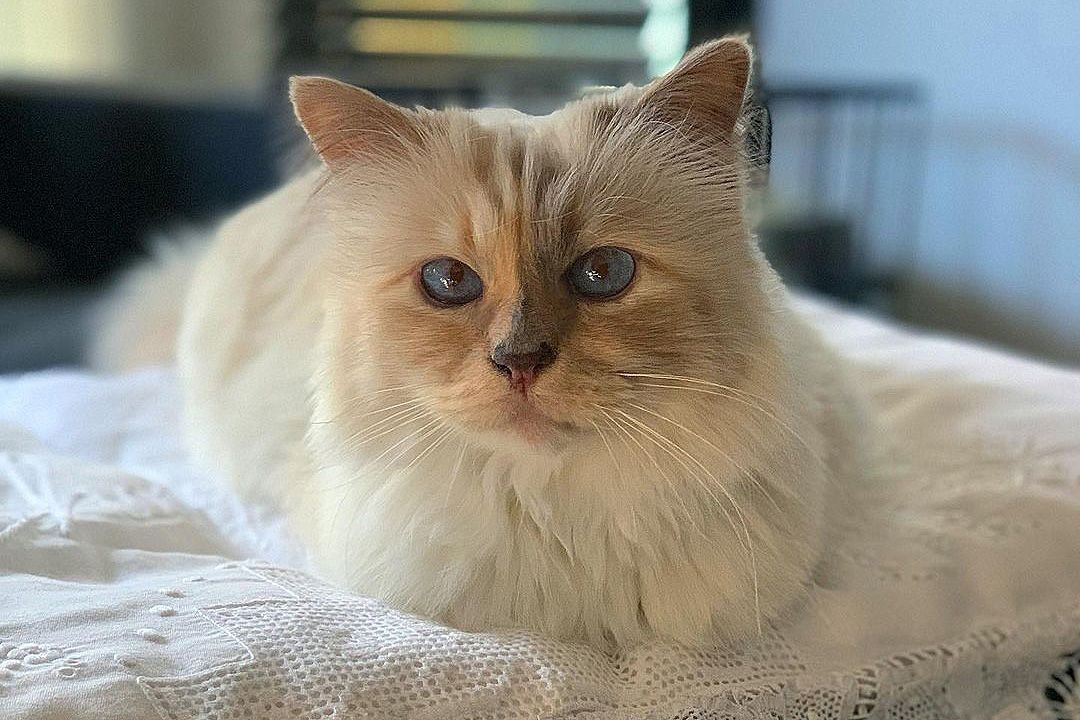
Suitors are lined up for the cream-coated Burmese feline, who inherited an estimated $13 million fortune when her fashion designer human died.
Simba may have stolen a kiss with Choupette at the end of a moonlight walk, and Oreo may have scored by bringing her to a candle-lit hot tub, but most of the toms on The Bachelorette: Choupette remained focused on shading Buddy.
Perhaps because he’s widely viewed as a frontrunner for the affections of the cream-furred Birman, other toms hoping for her paw in marriage claimed they were not impressed by Buddy’s antics.
The silver tabby’s date with Choupette consisted of a simple meal of turkey pate, some after-dinner grooming and couch-scratching, and finally a bird-watching session, with both felines chirping away at a flock that had chosen an epic oak nearby.
“It’s almost like he’s saying ‘I don’t care about your fortune, Choupette, I’m here for you,’ which is frankly revolting,” said Loki, a four-year-old British shorthair. “Everyone knows I’m the only one who really cares about Choupette.”
Choupette has appeared on the covers of almost every major fashion magazine in the world, usually in the arms of supermodels.
Choupette, the famous companion and muse to late German fashion designer Karl Lagerfeld, is worth an estimated $13 million thanks to her inheritance.
The young season got off to a rough start last week with confusion during the rose ceremony.
“What’s this for?” contestant Tux said after Choupette gave him a rose.
“She’s sending you home, dude,” said Jasper, a handsome Maine Coon.
“Wait, I thought that was the immunity idol,” Buddy interjected.
“It’s not an immunity idol, dummy!” Jasper said. “Wrong reality show. Sheesh, don’t you watch Real Housewives?”
The cats argued about it for several minutes until an angry Choupette told them to stop their meowing, and in the end it was Oliver, a seven-year-old Chartreux, who was sent home.
“Oh yeah, well I didn’t want a stupid rose anyway!” Oliver said, belching loudly as he left the mansion.
Choupette’s next decision may have been made for her when Garfield, a ginger tabby, said the quiet part out loud in a poem he wrote about the feline heiress.
“Oh Choupette, your fur is so creamy,” Garfield recited, “your eyes are so blue, and your fortune is so dreamy. Our mansion will have scratchers on every…”
“Stop!” Choupette said, turning to the producers. “Send him home!”
“Choupette, my love! Don’t do this!” Garfield called over his shoulder as two burly tigers hauled him away. “Was it something I said?”
Guitarists, synth players and other musicians can get their meow on with this unique FX pedal.
As a guitarist I’m partial to pedals, FX and other gear that can imbue the instrument with the funkiness of the wah or the satisfying crunch of harmonic distortion.
But this? This is something I never expected.
Meet The Meowdulator, an FX pedal that does precisely what it sounds like it does.
Created by B’s Music Shop and pedal-maker Cusack Music, the Meowdulator is a monophonic guitar synth, meaning it plays single “notes” similar to a Moog. That means you can’t strike a chord and get a chorus of discordant meows, but you can for example play a solo that sounds like a cat in heat — if you want to. (The “Little Mew” setting sounds like an octaver in meow, generating multiple voices, but still triggered by plucking single strings.)
Brian of B’s Music Shop called the pedal “maybe the craziest thing I’ve ever collabed on.”
“It’s glitchy sometimes, it’s its own animal,” he said in a video demonstrating the new pedal. “But it’s a little kitty cat and we hope it makes you happy and you have some fun with it.”
My favorite of the seven presets demoed in a Youtube video is “Acid Kitty Synth,” which generates a funky, wah-like meow. In the right hands, something awesome can be done with it. I can imagine Acid Kitty Synth breathing life into an Earth, Wind and Fire style or Televisor-esque track, compelling the listener to hit the rewind button while asking “Did I just hear what I think I heard?”
Finally, there’s a “hidden feature” — if you hold down the bottom-most button, the pedal will purr. Perhaps it’s something to work into the rhythm of a track or give the audience a relaxing vibe between songs while playing live?
The Meowdulator retails for $199 and is expected to ship in mid-July. Those of you who fall into the cat lover/guitarist venn diagram overlap can pre-order now.
Now can someone make a puma scream pedal? Ratatat, a New York duo and one of my favorites, has a thing for working the screams of the iconic cat into their tracks, and it makes me love them even more.
Caleb Carr credits cats for showing him love during his difficult childhood when he was frequently beaten by his father.
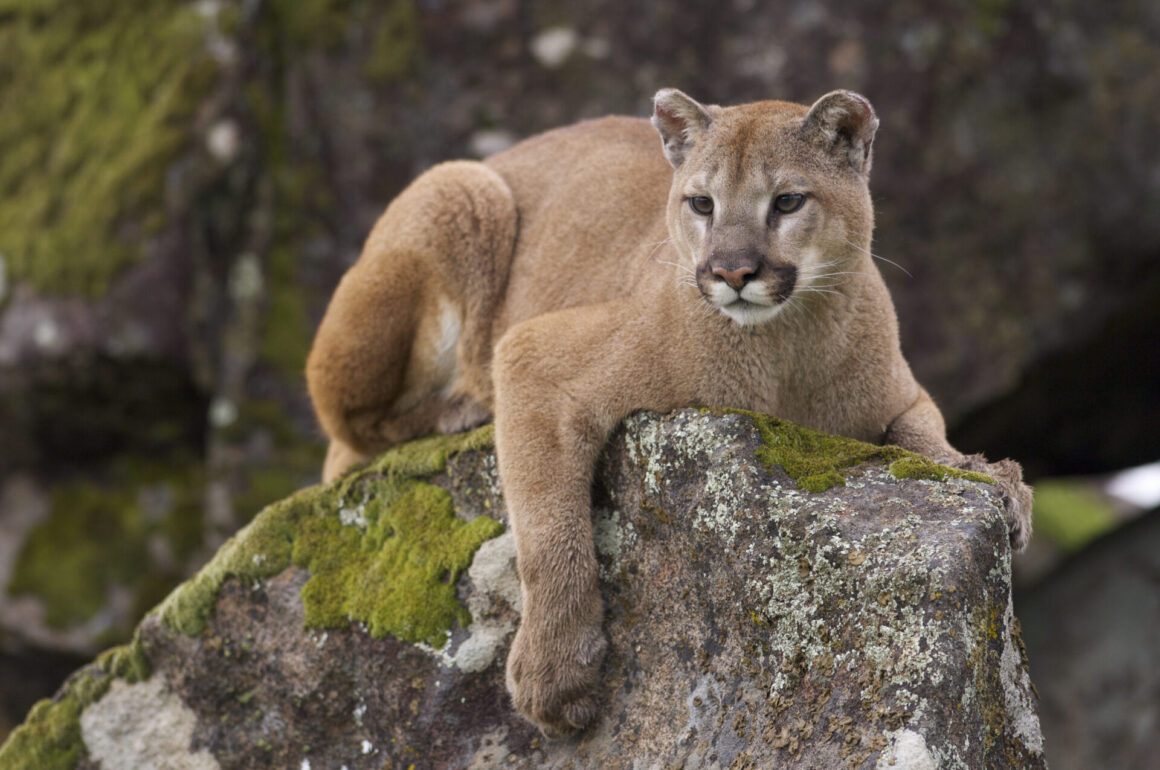
A “mountain lion” spotted near a trail in Ventura County, California, was actually just a house cat, authorities said this week.
California’s Department of Fisheries and Wildlife dispatched staff to the area in question, the Los Padres trail in Thousand Oaks, after neighbors there reported what they thought was a baby mountain lion. One family had footage of the interloper captured on a doorbell camera.
The alleged puma turned out to be a house cat, which is a surprisingly common outcome when authorities look into alleged mountain lion sightings. Despite their size, pumas are genetically closer to felines — small and medium-size cats that can purr and meow — than they are to panthera, the genus that includes tigers, lions, jaguars and leopards.
Their gait is almost identical to that of familiar felis catus, their golden coats can look dark at night, and cats can look like pumas — or the other way around — when there’s not enough visual context to gauge the animal’s size, especially in footage captured on cell phones and security cameras, which are almost always equipped with digital zoom instead of the true optical variety.
We know what you’re thinking: this house cat must have been an impressive specimen if it was mistaken for a puma, so there’s a good chance it was Buddy. However, we can confirm that Buddy the Cat definitely was not wandering around California this week.
Novelist found solace in the company of cats
Author Caleb Carr passed away on May 23, and the Los Angeles Times has a nice tribute to him by a reporter who bonded with Carr over their shared love of cats. The writer, 68, had been suffering from cancer for some time.
Carr was known for his crime thrillers (The Alienist, The Angel of Darkness) and military history books, and he spent part of his career teaching military history at Bard College in New York. (Just a short ride from our own alma mater, Marist College.)
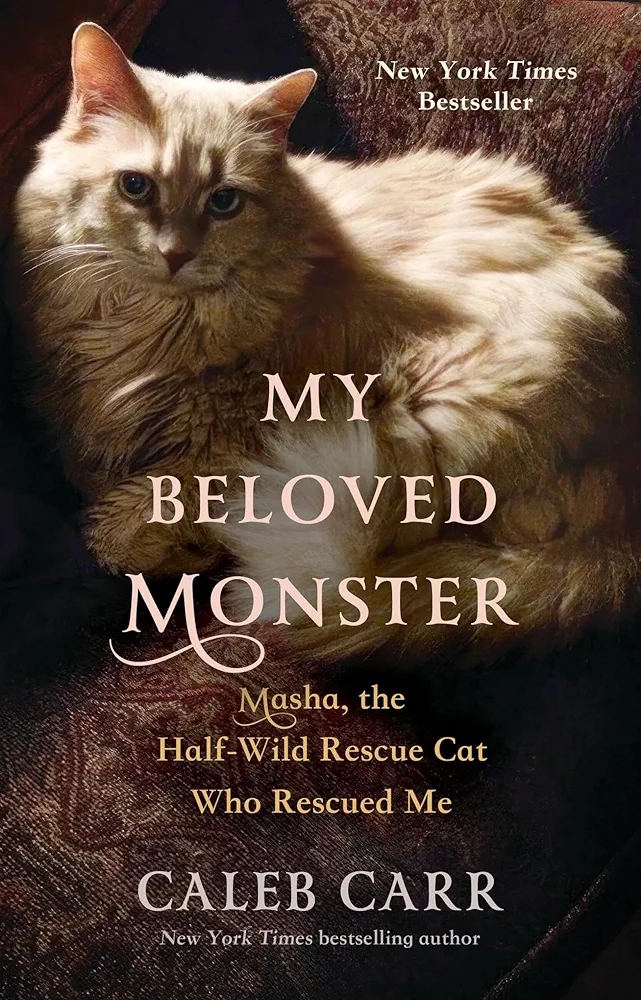
Carr’s last book is a tribute to his cat and her species.
Despite his publisher requesting another crime thriller, Carr decided his last book would be about a cat. Specifically his rescue cat Masha, who helped him through difficult times, and the cats of his childhood who comforted him when he was beaten by his father, Beat Generation figure and author Lucien Carr.
“It’s amazing to think about it now, but there were cats, and other animals, that were trying to make me feel better,” Caleb Carr told the Times. “The idea of that was so at odds with everything I was experiencing.”
Carr credits those felines for helping him avoid the abyss, telling the interviewer he “could have been one of those dead-eyed drone troublemakers that comes out of an abusive household very easily, if it hadn’t been for cats.”
Some people were disappointed that Carr didn’t have another novel like The Alienist in him, but Little, Brown publisher Bruce Nichols liked the idea, and the finished book was titled My Beloved Monster: Masha, The Half-Wild Rescue Cat Who Rescued Me.
Kristi Noem thought she was burnishing her image as America’s tough cowgirl politician by telling the story of how she shot her hunting dog. Instead, she united the country in disgust.
Before a commercial publishing house sends a book off to print — especially a political memoir expected to create buzz and move copies in high volume — dozens of sets of eyes have looked over the manuscript.
The author — in this case the author and ghostwriter — her PR team, consultants, editors, fact-checkers, attorneys and test readers all have eyes on the text as they prepare it for the printers.
Thanks to Politico’s reporting, we now know several of those people — including the ghostwriter, the imprint’s editors and her own advisors — actively discouraged South Dakota Gov. Kristi Noem from including an ugly anecdote about shooting a “problem” dog in her book, but Noem was insistent on using it. She thought the story would burnish her brand and appeal to rural voters, signaling that she’s a salt of the earth type who doesn’t balk at making hard decisions.
That was an epic miscalculation, and as the fallout continues with backlash from Americans across the political spectrum, it shows the days of thoughtless disregard for animals are over in the US, at least as far as public life goes.
South Dakota Gov. Kristi Noem. Credit: Wikimedia Commons
As most people know by now, Noem wrote about how she shot a 14-month-old dog named Cricket on her family farm for “ruining a hunt” and going after a neighbor’s chickens. Cricket, Noem wrote, was “worthless as a hunting dog” because she got overly excited and went into sensory overload during a pheasant hunt that Noem wanted to be memorable for a group of guests.
“I hated that dog,” she says in the book, via her ghostwriter, before describing how she dragged the excited puppy out of her truck and into a gravel pit, then ended the Cricket’s 14-month-old life with a gunshot to the face.
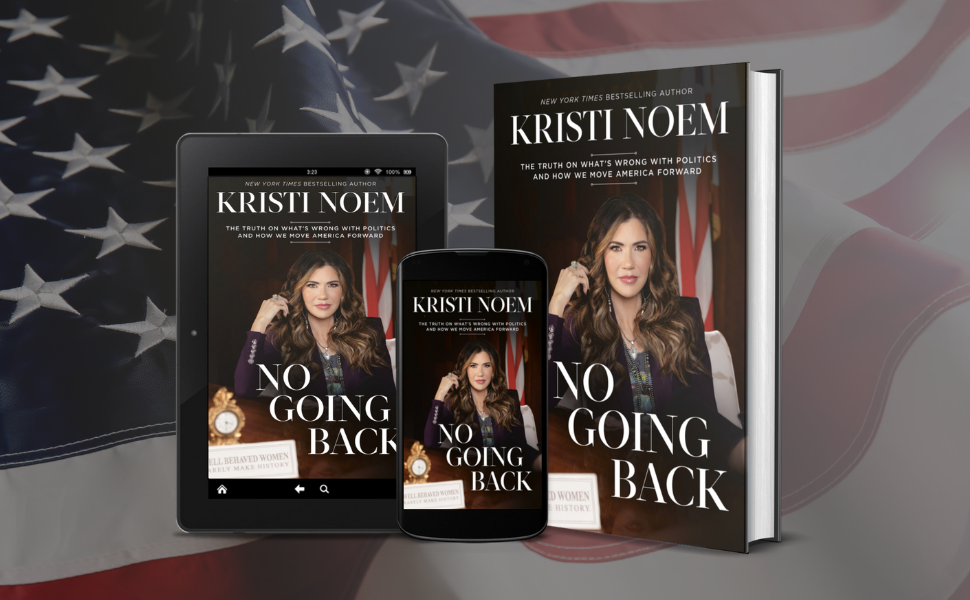
In a series of disastrous interviews over the past week, Noem has tried to reframe the story as an example of the hateful “fake news” media digging for dirt on her, but not only did the South Dakota governor enthusiastically include the dog-killing story in her new book, she was so confident it would win her points that she used the story as a teaser in social media posts and other marketing for No Going Back. (It’s her second book and follows 2022’s Not My First Rodeo: Lessons from the Heartland. Noem really wants people to think she’s the embodiment of a Yellowstone character, a CrossFitting avatar of the real America.)
Noem thought she’d be hailed as the farm girl hero she wants to be, an image she’s cultivated during a political career that’s taken her from the state house to South Dakota’s lone congressional seat and, in 2019, the governor’s mansion.
Noem’s book, No Going Back.
I’ve spent my entire life in urban and suburban environs and I’ve essentially taken a Jainist attitude toward animal life. I’ve never hunted an animal and never will, so I’ll defer to longtime South Dakota scribe and hunter Kevin Woster, who thoughtfully writes about the experience of raising hunting dogs and the challenges it involves.
Woster believes Noem put a puppy in situations that would challenge even an experienced hunting dog, says the dog’s “shortcomings” were the fault of her owners, and thinks the dog could have had a long and happy life with a little patience and love. (It’s also worth pointing out that by killing chickens, the dog was doing precisely what Noem trained her to do. It’s not the dog’s fault Noem didn’t differentiate between the types of birds she wanted Cricket to attack.)
Other rural scribes have echoed those sentiments and pointed out that even on farms, being forced to kill an animal is a solemn and personal thing. Even if Noem had justification, it’s one thing to handle a regrettable situation and another thing entirely to choose to celebrate it in a memoir, even using it as a marketing teaser.
Politics is performative, and Noem isn’t alone in that respect. Here in New York our disgraced former governor, Andrew Cuomo, speaks in a heavy New York accent that borders on parody. During the pandemic, he once interrupted Dr. Anthony Fauci to muse about how Fauci was the “Al Pacino of COVID” and Cuomo himself was the Robert DeNiro of the killer virus, then derailed an explainer on safety measures to wax poetic on the Italian bakeries of the Bronx’s Arthur Avenue and “the old neighborhood,” as if Cuomo grew up playing stickball on the street in Brooklyn instead of ping-ponging between New York, D.C. and Albany when his dad was a three-term governor.
George W. Bush, the scion of a generational political family and son of a former president, grew up in Connecticut. But he wanted the American public to see him as a cowboy, so he affected a Texas accent, peppered his speech with folksy-sounding nonsense and famously landed a fighter jet on an aircraft carrier to declare an end to the Iraq War on May 1, 2003, 18 years before the last US combat units left the country.
Politicians put on these costumes because voters respond to them. But the backlash against Noem — who’s now banned from 20 percent of the land in her own state and also in hot water for allegedly inventing anecdotes about North Korean dictator Kim Jong Un, French President Emmanuel Macron and former UN Ambassador Nikki Haley — proves that, like a prince choosing to don a Nazi uniform for Halloween, a politician’s choice of costume says a lot about her judgment and values. In this case even the people of America’s heartland, the voters Noem was condescending to with her book, were horrified by the ambitious governor’s callous disregard for animal life.
The fallout has apparently destroyed any chance that Noem could be chosen as a vice presidential candidate on the Republican ticket, and term limits mean the sun is setting on Noem’s time as a “public servant.” Good riddance.
Lupita Nyong’o not only shares the screen with a feline co-star in the new film A Quiet Place: Day One, she’s also a devoted cat mom to a ginger tabby named Yoyo.
Although I haven’t seen most of Lupita Nyongo’s movies — I really liked her performance in Us and her voice work in Disney’s Jungle Book remake — I’m a big fan now that I know she’s a cat lover.
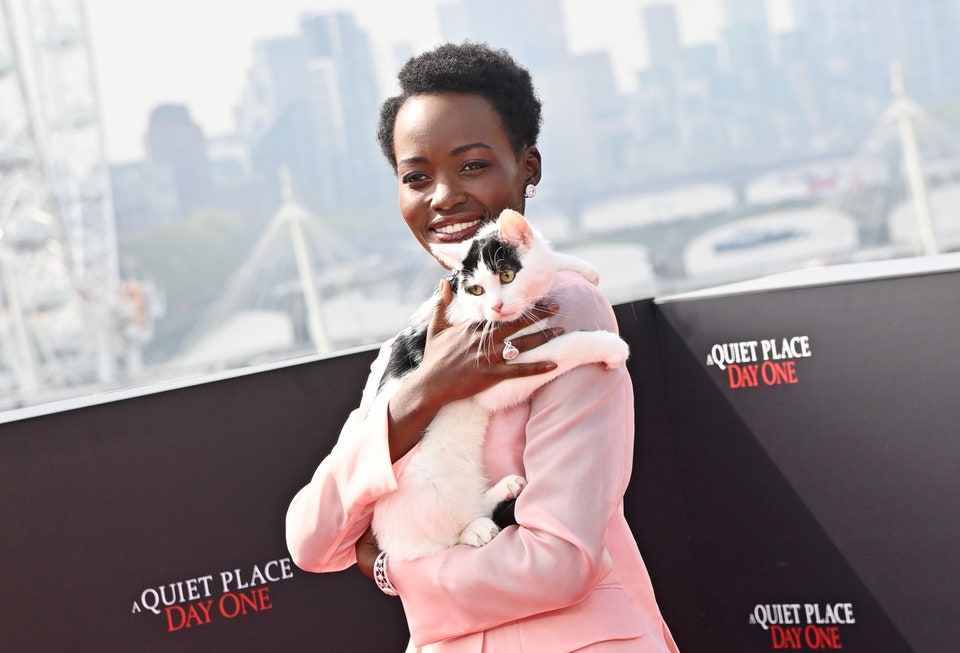
Nyong’o took to the red carpet for the premiere of her newest film, A Quiet Place: Day One in London on Wednesday, and her plus-one was a cat named Schnitzel, who also stars in the movie. Photos show Nyong’o posing along co-star Joseph Quinn, smiling as she cradles Schnitzel in her arms.
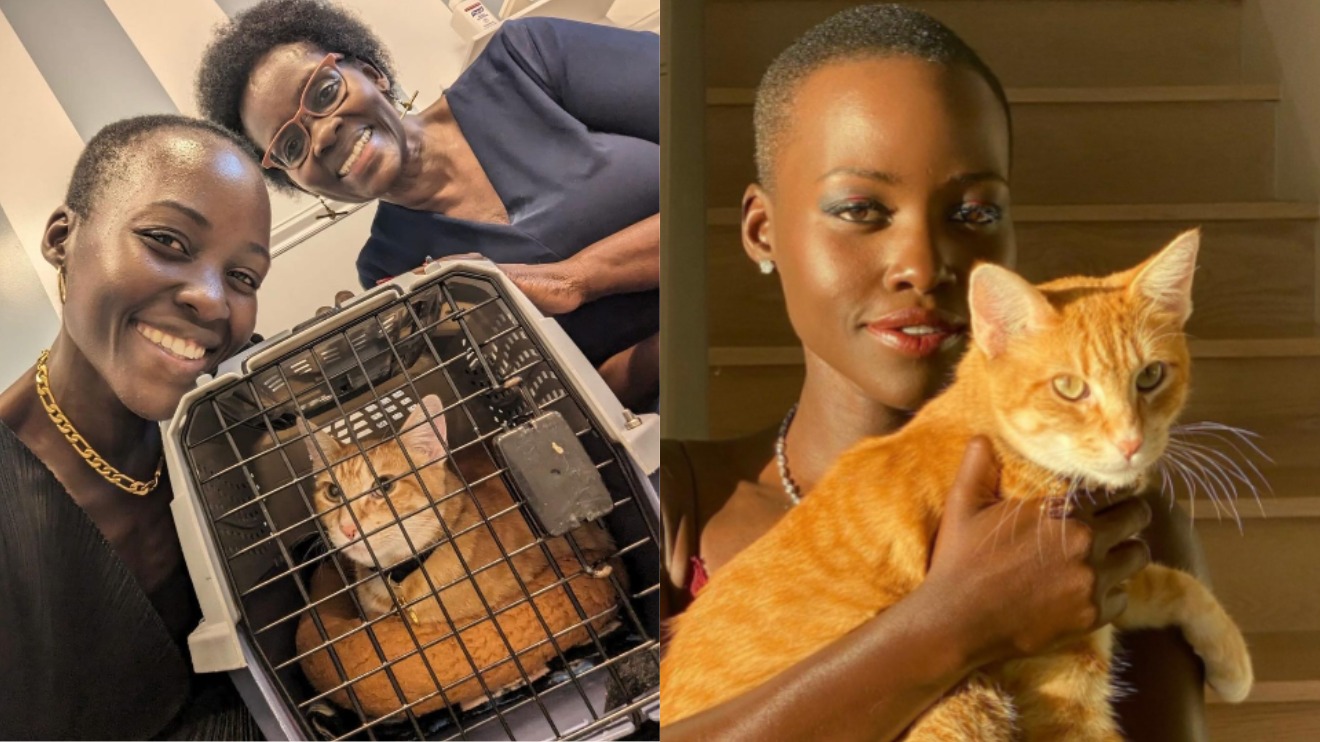
Lupita Nyong’o with her cat, Yoyo. In addition to posing with a cat on the red carpet premiere of her new film, Nyong’o proudly dotes on Yoyo and mentions him often. Credit: Lupita Nyong’o/Instagram
A Quiet Place is a 2018 film about a family that lives a completely silent life on a farm after the civilization has fallen to monstrous creatures that can’t see but are exceptionally sensitive to sound.
The film received nearly universal positive reviews for its use of sound — and the complete absence of it for long stretches — as a tension-building device, and a 2020 sequel continued the story.
Day One, which hits theaters on June 28, promises audiences a look at how the creatures appeared and civilization collapsed.
Schnitzel’s role isn’t entirely clear, but if it’s anything like 2022’s Prey, cats will fill their usual niche as predators, highlighting the difference between terrestrial and extraterrestrial hunters.
Caring for a cat in a world like A Quiet Place could be a double edged-sword: a super vocal cat like my Buddy wouldn’t last very long unless he quickly learned to keep a lid on his constant commentary, but cats are also incredibly sensitive to things that pass beneath the notice of us humans.
Thanks to their incredible hearing, exceptional sense of smell, the advantage of an extra olfactory organ and whiskers that pick up even the slightest stirring, felines are keenly aware of their surroundings.
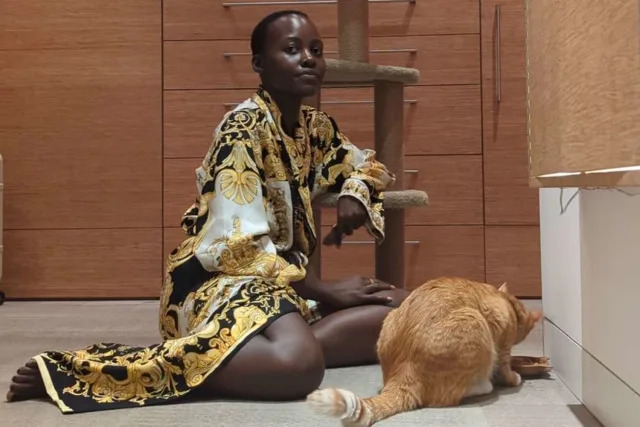
As for Nyong’o, while Schnitzel is not her cat, she’s the proud cat mom of Yoyo, an orange tabby she fostered in late 2023. It only took her three days of fostering the little guy before she realized “I could not give him up,” she said last year shortly after the adoption was made official.
“I never understood people whose phones were full of photos and videos of their pets — now I am one of those people,” she wrote when she adopted the tabby. “It may look like I saved Yoyo, but really, Yoyo is saving me.”
Lupita Nyong’o with Yoyo. Credit: Lupita Nyong’o/Instagram