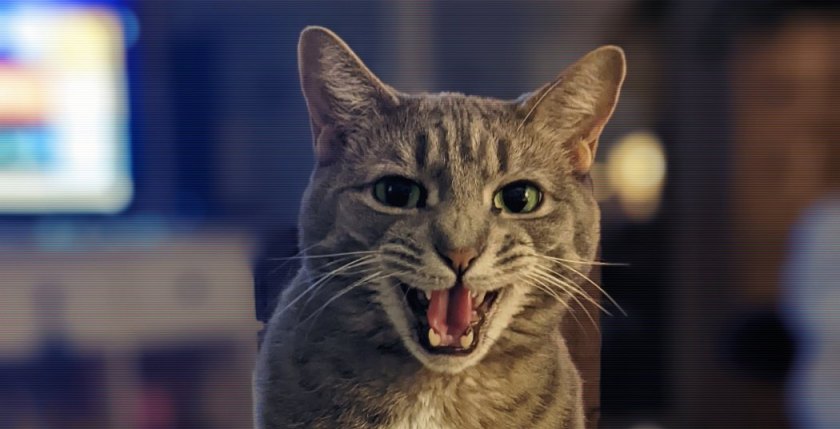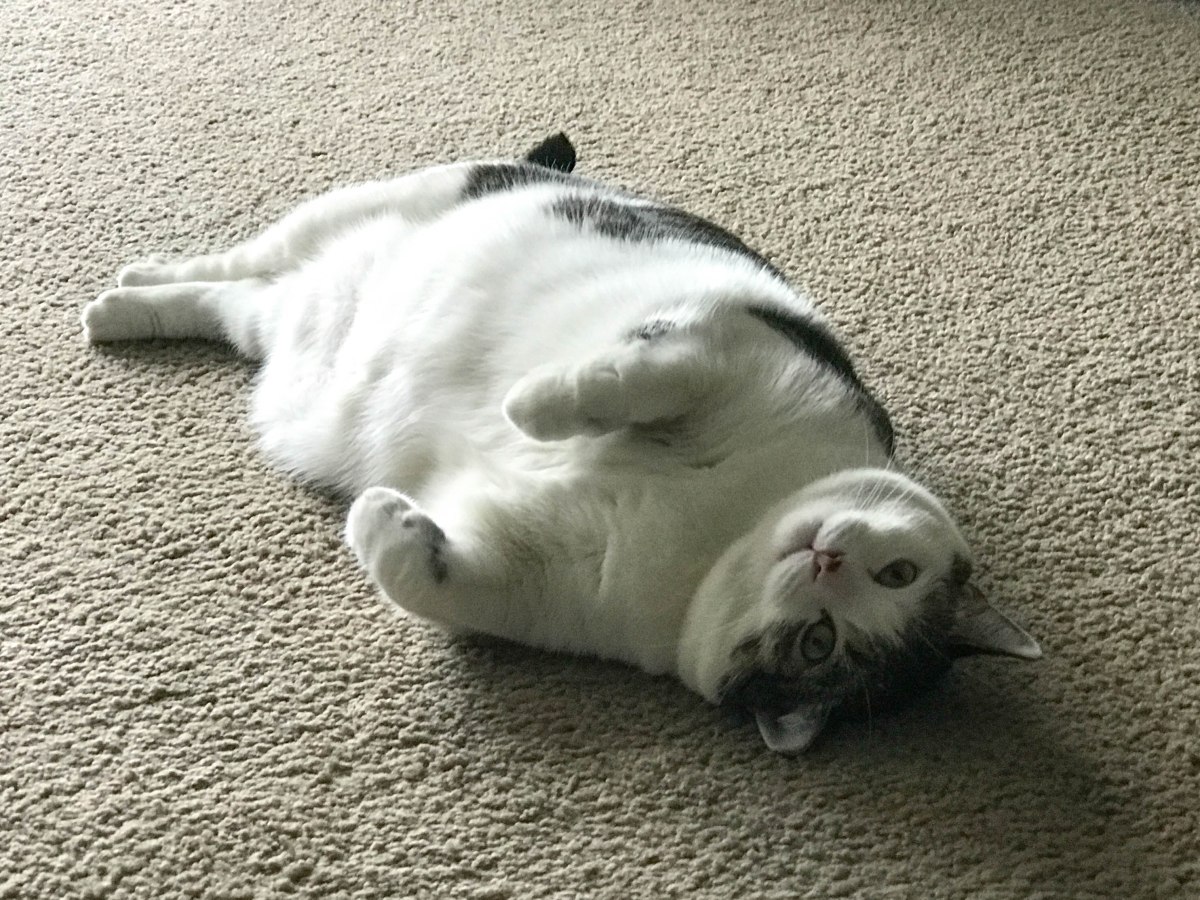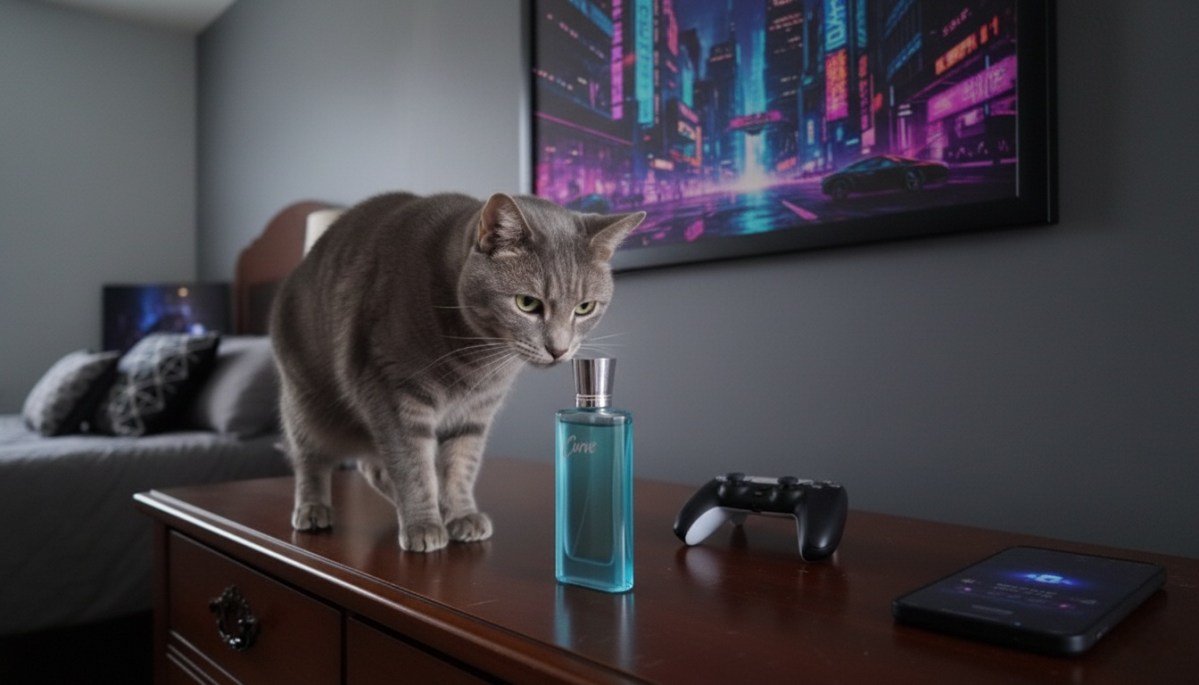
After learning that wildcats — including jaguars, tigers and ocelots — love Calvin Klein’s Obsession for Men, Buddy the Cat explores the world of colognes to find one that drives domestic kitties crazy.
Earlier we wrote about the accidental discovery that ocelots respond enthusiastically to Calvin Klein’s Obsession for Men. Subsequent experiments proved jaguars and tigers are particularly fond of the scent as well.
Then a reader’s comment posed a question so obvious, we’re ashamed we didn’t think of it ourselves: do domestic kitties like colognes?
To find out, we asked Buddy the Cat, aka Little Buddy, to evaluate several fragrances. He’s taken the assignment seriously and provided thoughtful analysis, giving us just a hint of what it’s like to have an incredibly keen feline sense of smell.
Dolce and Gabbana Pour Homme
“The first ecstatic whiff takes me back to kittenhood. Days napping in the sun and chasing flies. Fresh cut grass and fragrant foliage. I was so deep into my reverie that the base notes nearly bowled me over when they arrived suddenly in their regal glories, like a king’s entourage without a herald. Rich cedar and musk evoke hours spent luxuriating in the potent funk of my human’s sneakers. Quiet woods and spices, like a litter box a day after feasting on rabbit, gently whisper of naps. Buddy likes this one!”
Cool Water by Davidoff
“Its initial briny hints conjure impressions of a dock at low tide, fish baking in the sun while a graybeard captain lights his pipe. Through confident middle notes, its warm embrace gently tugs you inward, like an antiquarian beckoning you inside a rare book shop with a rodent infestation. Aged leather book bindings and dark oak react provocatively with the paw-licking intensity of decadent mouse urine. Meowgnificent!”
Jaguar by Jaguar
“A carnival of candy for the nose, like accompanying your human to the bathroom post-Chipotle! The first hints arrive furtively, like a disguised aristocrat casting nervous glances as he makes a beeline for a brothel. Then it asserts itself in force: an army of jaguars advancing in the moonlight, their meowscles rippling in the silver mist, scent-marking in unison! Musk, civetone, ammonia. Pheromonic bliss!”
Drakkar Noir by Guy Laroche
“Powerful but restrained, like a certain silver tabby in his carrier, a single spritz of this magnificent scent conjures memories of halcyon days as a young feline. Mid notes whisper of woods and spices, a grove of wild catnip undulating in a summer breeze. Underneath it all is an unshakable foundation of warmth, like being swaddled in my human’s t-shirt after it’s been worn on a humid 97 degree day.”
Tyrannosaurus Rex by Zoologist
“Bergamot and verdant iridescence arrive as our olfactory escorts, ushering us in to a delectably frisky gourmand accord. It’s as if we’re drifting on chocolate seas with vanilla currents playfully nudging us to shore where beefy undertones await. Umami! Steaks sizzle, beckoning our noses toward the grill, stomachs rumbling. A most delicious scent!”
So there you have it. T Rex emerges as the winner in this round, but can it compare to mainstays by Yves Saint Laurent and Giorgio Armani? Only Buddy can tell us. Tune in next time as we accompany the Budster on an aromatic journey!
Positive contact with our furry friends releases happy chemicals for both human servant and feline master, improving their bond.
Happy Cater, uh, unday!
We’ve got no immature cat humor for you today, but I thought PITB readers might be interested in this essay from The Conversation, which despite its ominous title actually goes into some detail about research showing the positive effects of bonding with a cat.
Affection between you and your feline friend results in a burst of oxytocin — the happy brain chemical — for both of you.
But crucially (and here’s where I feel validated for constantly preaching this), your cat enjoys the benefit only if the little one is securely attached and is not forced into interaction.
I’ve said it so many times, I feel like a broken record, especially because the web is saturated with articles that ask “How Can I Make My Cat Like/Love Me?“
And the answer, of course, is that you can’t.
That’s part of what makes cats so awesome. We have to earn their trust and affection, and a major part of that process is respecting our cats’ feelings. That means we let them come to us, we stop petting them when they’ve had enough, and we don’t prevent them from leaving when they decide they want to lay on the couch or the floor instead of our laps.
Credir: TIVASEE/Pexels
Cats grant us benefits beyond oxytocin boosts, of course, and the linked article goes into that as well. It’s well worth a read, even if you’re an old pro at cat whispering.
President Buddy: Not Funny!
It’s obvious I model President Buddy’s behavior after a certain someone in addition to dialing his own traits up to 11, but in the wake of recent news, a story I’d written no longer feels funny.
Not because it was offensive, but because satirizing current events just feels inappropriate with all that’s been going on, from our extreme polarization and political violence, to the sad state of global affairs.
At the same time, I spent quite a bit of time making another denomination of Cat Dollars, and since there’s no longer any satirical story for it, I figured I’d share it here.
President Buddy sure does like seeing his portrait everywhere. This time I skipped the powdered wig and gave him a more modern appearance:
Meowster Money and Meowster Delicious are the treasurer and secretary of yums, respectively. A thousand cat bucks is a lot of cans! (Or snacks.)
In the meantime I’ve been working on some designs I hope to turn into t-shirts and possibly other things like prints. They range from a regal-looking lion to a jaguar roaring in the night with a retrofuturistic feel. Watch this space for more details in the near future!
Scientists have uncovered the elusive mechanisms behind coat color expression, opening the door to a new question: is fur pigment connected to personality?
When Professor Hiroyuki Sasaki retired, he wasn’t done with science. He just wanted to use it to better understand his cats.
The Japanese geneticist raised more than $73,000 from Japanese and international cat lovers and put together a team, including partners from the US. Then he began the hard work of scrutinizing feline DNA to find out why some cats are orange, and why most all-orange cats are male while virtually all calico and tortoiseshell cats, whose coats have splotches of orange, are female.
It turns out there’s no genetic instruction telling the fur to take on an orange pigment — it’s the absence of a segment of DNA, which governs pigment production, that does it.
In other words, ginger cats are mutants.
Most fully-orange cats are male because the mutation removes the DNA segment in the X chromosome. As males have X and Y chromosomes, they only need the mutation in the single X chromosome for their coats to express in that shade.
Lots of cat lovers swear that coat color and temperament are connected.
Females have an XX chromosomal arrangement, so they need the mutation in both chromosomes to turn tangerine. If the mutation only shows up in one chromosome, you get patches of the color instead of a consistent coat.
That explains why 80 percent of ginger cats are male, and why only one in 3,000 calicos and tortoiseshells are male. A male cat would need an extra X chromosome, XXY, to be born with a calico or tortoiseshell coat. One of the side effects, however, is sterility.
Scientists estimate only one in a thousand male calicos/tortoiseshells can reproduce and pass their unique mutations on.
It’s not just coat color either. The mutation impacts skin and eye color, which is why a ginger cat might have a pink nose compared to the terracotta shade of a void cat or a silver tabby.
Are orange cats really more friendly and silly?
So how does this relate to temperament, and the many people who attest to a particular personality associated with orange cats? Some people say ginger tabbies are more loyal, affectionate and social than cats of other coat colors, but they’re also more prone to doing boneheaded things.
The stereotypes have picked up steam online, where people often share memes depicting orange felines as earnestly derpy, but they may be on to something — or at least, it can’t be ruled out until we know more.
Ginger cats are not the sharpest claw on the paw, according to popular memes.
Because of the missing piece of genetic code, a specific gene, ARHGAP36, isn’t “expressed.” Like so many genes, scientists don’t fully understand everything ARHGAP36 impacts, or how alterations can lead to unexpected changes elsewhere.
“Many cat owners swear by the idea that different coat colours and patterns are linked with different personalities,” Sasaki told the BBC. “There’s no scientific evidence for this yet, but it’s an intriguing idea and one I’d love to explore further.”
While the sensational claims have spawned headlines around the world, a closer examination raises more questions.
According to dozens of articles, a pair of new studies throws doubt on the commonly-held view that cats self-domesticated 10,000 years ago by helping themselves to rodents invading human grain stores.
The conventional wisdom for some time has been that house cats are the domesticated ancestors of felis sylvestris lybica, the African wildcat. Their genomes are nearly identical, it’s often difficult even for experts to tell the species apart, and they’re much more tolerant toward humans than the comparatively hostile felis sylvestris, the European wildcat.
But two new papers are raising eyebrows for their fantastic claims that feline domestication was actually human-driven and began about 5,000 years ago in Egypt.
Specifically, the papers claim cats were sacrificed en masse by the cult of Bastet, an Egyptian feline goddess, guiding the species toward domestication in a way that doesn’t quite make sense with what we know of evolution.
Bastet was originally depicted with the head of a lion, but the imagery around her evolved as she became a more prominent deity in the Egyptian pantheon. Later glyphs depicted her with the head of a domestic cat or African wildcat.
There are two main elements to the new claim:
The earliest grave in which a cat was buried with a human was dated to about 10,000 years ago, and was found in Europe. But an analysis of the cat’s remains indicate it had DNA somewhere between a wild cat and a domestic feline. That, the authors claim, throws into doubt the idea that cats drifted into human settlements, drawn by the presence of rodents.
If domestication was closer to 5,000 years ago, that would coincide with the rise of the cult of Bastet, the Egyptian cat goddess, around 2,800 BC.
Instead of the feel-good, fortuitous sequence of events the scientific community has accepted as the likely genesis of our furry friends, the authors of the new papers claim aggressive and fearful traits were essentially murdered out of the feline population by Bastet cultists who sacrificed cats in large numbers and mummified their corpses.
Neither paper has been peer-reviewed yet, and experts on ancient Egypt, genetics and archeology have already begun pushing back.
The new timeline, they say, doesn’t quite add up, with cat mummies found throughout different periods in Egyptian history, not just during the height of Bastet’s popularity in the Egyptian pantheon. Bastet’s popularity came approximately 700 years later than the authors claim the sacrifices began, and early imagery of the felid goddess depicts her with a lion head. It wasn’t until later centuries that Bastet was represented with the features of a domestic cat.
The powerful Pharaoh Budhotep I, considered an apocryphal king by some, sent a fleet of ships to the Americas to bring back turkey, according to legend. Credit: The Royal Buddinese Archaeological Society
Separate from timeline concerns is the lack of historical evidence. Cats were revered in ancient Egypt, and while there are an abundance of cat mummies — as well as the mummified remains of many other animals — that does not mean the cats were ritually sacrificed.
Indeed, archaeological, hieroglyphic and anthropological evidence all show cats enjoyed elevated status in the Egypt of deep antiquity, long before the nation became a vassal state of the Greeks, then the Romans.
Cats were associated with magic, the divine and royalty, and cats who were the favored pets of Egyptian elites were given elaborate burials. Like Ta-miu, Prince Thutmose’s cat who is known for her grand sarcophagus decorated with images of felines and prayer glyphs meant to guide her to the afterlife.
Cats were sacred companions to the Egyptians
When cats are found buried with humans, the more common explanation is that those cats were the pets and companions of those humans. If the authors of the two new papers want to prove their claim that cats were ritually sacrificed by the tens of thousands — slaughter on a scale that would influence evolution — they’ve got a lot more work ahead of them. (And the burden of proof rests squarely with them, as the originators of the claim.)
Not only does their research attempt to change the origin stories of kitties to an ignominious tale of human barbarity, if we take their assertions at face value, we’re talking about a case of “domestication by slaughter.”
While it may be true that the earliest evidence of companion cats outside of North Africa revealed hybrid DNA, that doesn’t cast doubt on the commonly-accepted view of feline domestication, it strengthens it. Domestication is a process that takes hundreds of years if not more, and it occurs on a species level, so it makes perfect sense that cats found in burial sites from early civilization would be hybrids of domestic and wild. Those felines were of a generation undergoing domestication, but not quite there yet.
A detail from the sarcophagus of Ta-miu, Prince Thutmose’s beloved cat.Ta-miu, Prince Thutmose’s beloved cat, was buried in an elaborately decorated sarcophagus with glyphs and offerings meant to guide her to the afterlife. Thutmose, son of Amenhotep III and Queen Tiye, lived in the 14th century BC.
Killing off docile cats?
Which brings us to another significant problem with the claim: if the ancient worshipers of Bastet were selecting the most docile and easiest-to-handle wildcats for their sacrifice rituals, as claimed, then they would be influencing evolution in the other direction.
In other words, they’d be killing off the cats who have a genetic predisposition toward friendliness, meaning those cats would not reproduce and would not pass their traits down. It would have the opposite effect of what the papers claim.
So despite the credulous stories circulating in the press and on social media, take the assertion with a grain of salt. Something tells me it won’t survive peer review, and this will be a footnote about a wrong turn in the search for more information on the domestication of our furry buddies.
Cats would like human civilization to return to the good old days.
Sheba and a geneticist who specializes in cats are looking for felines descended from ancient Egypt’s royal buddies.
“You may call me Budtum Ra Budhotep Bhufu Amun Buddeses, human. Now serve me!”
Bud’s already enormous ego just got a little bigger after I used Sheba’s Pharaoh Cat Finder to analyze his pharaohness.
The online tool says he’s up to 75 percent pharaoh:
I didn’t do it entirely out of altruism to give the little guy an ego boost. The winner of the Pharaoh Cat contest gets a lifetime supply of Sheba, and Bud’s been eating Sheba for 10 years. We’ve never endorsed any particular cat food here on PITB, partly because every cat is different, some have special nutritional needs and what works for one furry overlord may not work for another.
But as food motivated as he is, Buddy cannot scarf down more than half a can of wet food at a time, and he’s an enormous pain in the Bud when it comes to leftovers, so Sheba’s Perfect Portions saves me from wasting food.
While the online Pharaoh Cat Finder tool looks like it may be RNG combined with clever marketing, there’s a genetic basis for the search. The company is working with Dr. Leslie A. Lyons, a geneticist who specializes in the DNA of our furry little friends at the University of Missouri’s Feline Genetics and Comparative Medicine Lab.
The legendary funerary mask of pharaonic feline Buddankhamun Budstet Ra Budshepsut, Buddy’s royal Egyptian ancestor. Credit: The Grand Museum of Magnificent Feline Stuff
Lyons was part of a research team that extracted DNA from mummified cats buried in ancient Egyptian tombs and sequenced their genetic code.
While the project verified that the Egyptians domesticated cats long before they began mummifying them and affording them revered status, Lyons says a DNA sequence from the ancient felines “has only been found in cats in Egypt and the U.S., unlocking even more questions to be explored.”
“We are looking at mitochondrial DNA only found in these pharaoh cats and a few cats in the U.S. So it’s really hard to find these cats, hence this hunt with Sheba pet food,” she said. “We’re on that quest to find the cats that went from Egypt into the U.S. and are the divine cats of the pharaohs. They should be worshiped like they were.”
The Temple of Amun Bud is guarded by gold statues of domestic cats instead of sphynxes. Credit: National Gallery of Buddesian Artifacts
I don’t think there’s any doubt that the aptly named Dr. Lyons is on team cat.
So here’s to hoping Bud gets a lifetime supply of Sheba, and Dr. Lyons is successful in her quest to find the elusive pharaoh cat lineage. In the meantime, we should probably start work on an impressive new pyramid here in the US, lest we disappoint our new feline pharaoh.