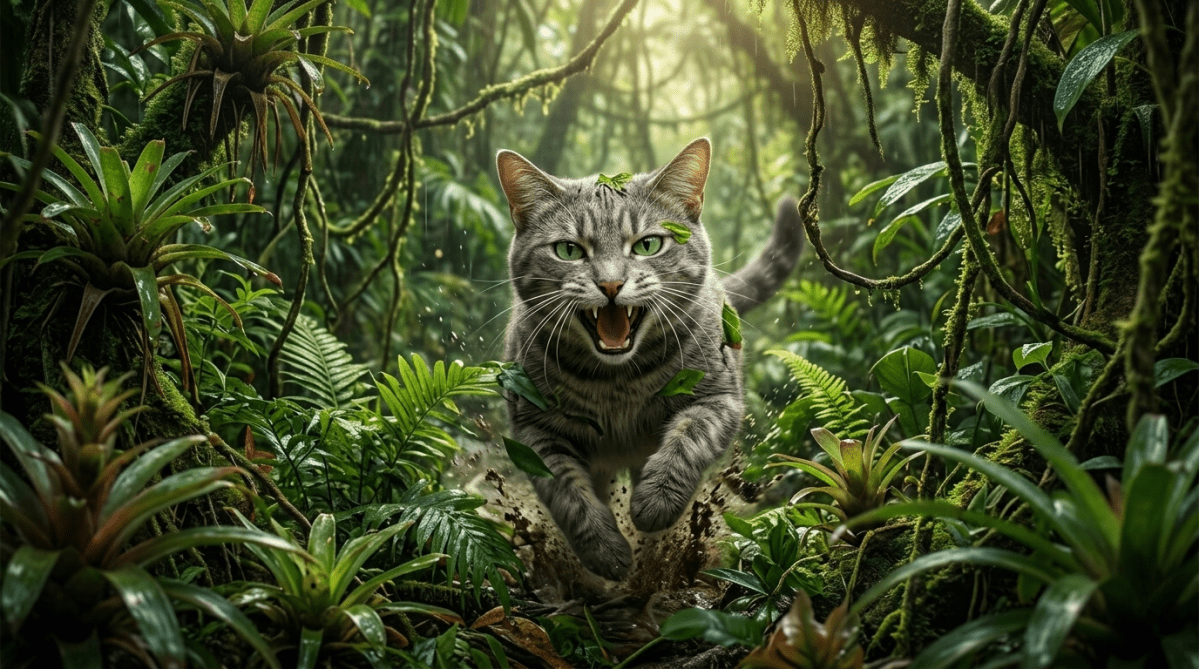
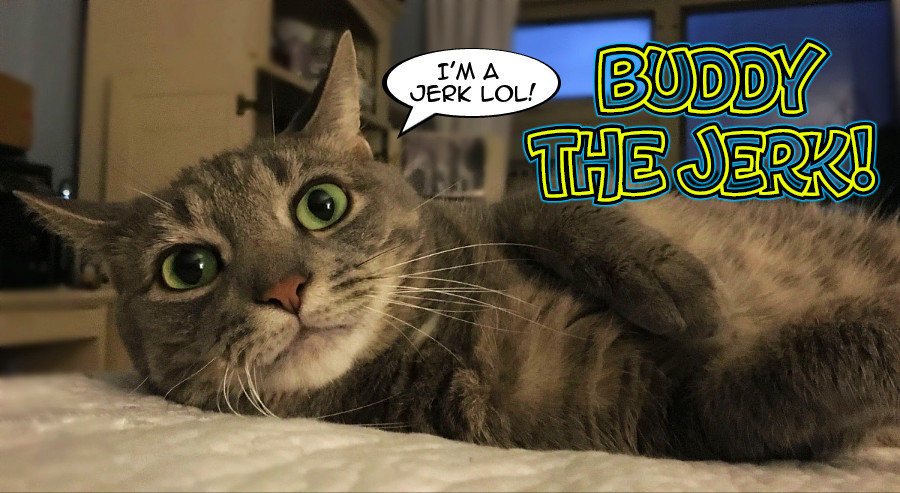
Buddy the Cat asserts he is a powerful apex predator who fears no man or beast, while Buddy the Cat runs and hides the moment there’s an unfamiliar sound in his domicile.
I Am An Apex Predator!
Behold! I have the gait of a lion, the bite force of a tiger, the stealth of a jaguar, and the relentlessness of a leopard!
My meowscles ripple meowscularly as I stalk my prey by moonlight! One second all looks safe and calm, and the next I’m leaping from cover in a burst of feline power to ambush my unfortunate prey!
Lesser creatures have nightmares about me. Indigenous cultures celebrate my legend in oral traditions. Craftsmen carve bas reliefs illustrating my mastery over all beasts. Shamans invoke my speed and strength. My toys quake at the mere mention of my name!
I am Buddy, and I am a ferocious cat! RAWRRR!!!
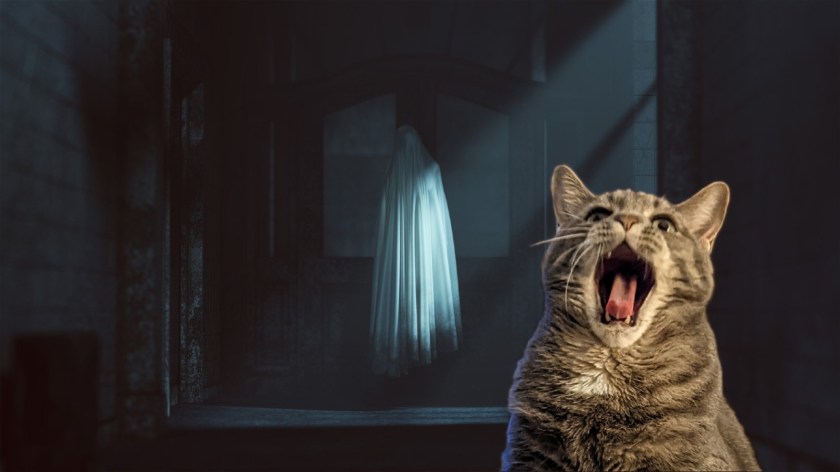
‘OMG, What Was That Noise?!? Go Check It Out, Human!’
Holy crap, dude! What the heck was that?
I’m just gonna run and hide under the bed while you investigate that awful, terrifying noise! No, YOU check it out. Are you crazy? I’m not going anywhere near there! What if it’s, like, a serial killer or a chalupacabra?
Where’s it coming from? The kitchen? The bathroom? Oh God! I told you, there are monsters living in the toilet and they can emerge at any second to murder us in our naps! We should have nailed the toilet seat down years ago! You didn’t listen to me, so you’re gonna have to fend off the monsters while I lend you moral support from three rooms away.
What? Duuuude.
Was it really your smartphone alarm on vibrate? Whew! For a moment there, I thought we were in trouble.
Now I’m gonna need you to rub my head while I sit in your lap and you tell me what a good, brave boy I am. If it really had been monsters, they would have gotten their butts kicked by me. I was brave, wasn’t I?
If you slander me by claiming I freaked out and ran to hide under the bed, I will be forced to accuse you of peddling fake news!
Point-Counterpoint presents two essays taking opposing positions on a topic. Join us again next week, when Buddy the Cat will debate Buddy the Cat on another important topic.
Buddy the Cat’s female admirers, both feline and human, say he is a sexy beast.
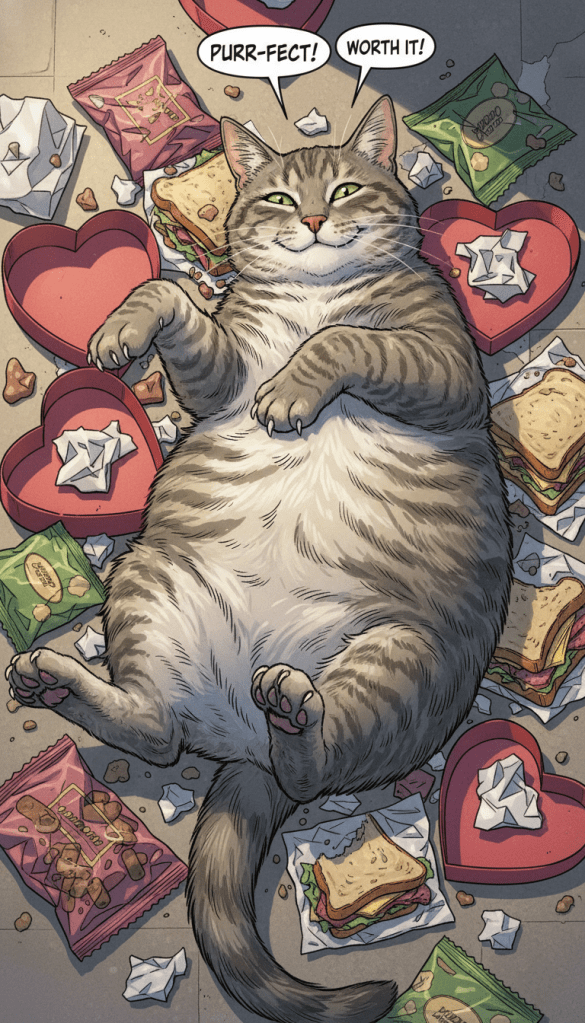
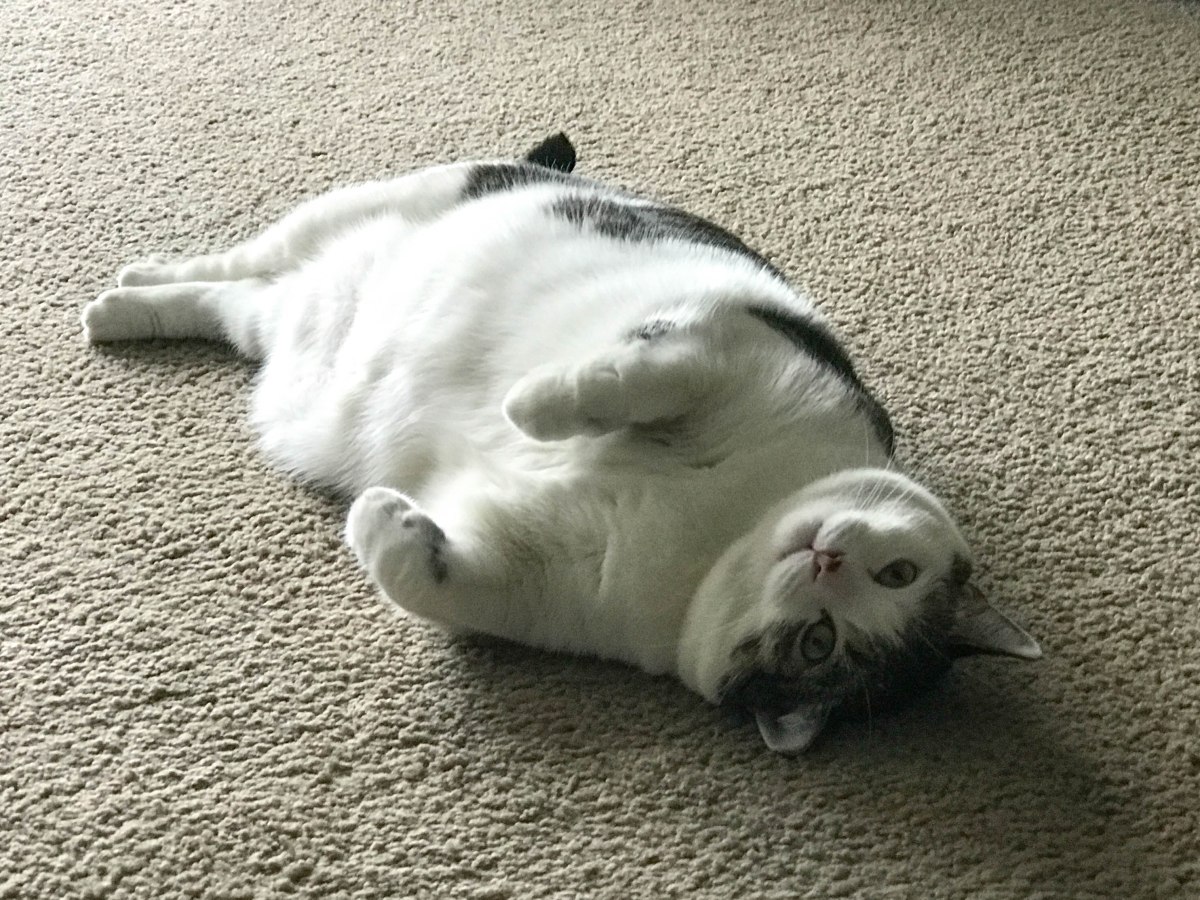
NEW YORK — For the third night in a row, Buddy the Cat rolled onto his back, belched thunderously, and settled down for a restful nap surrounded by the devoured remnants of treats and snacks gifted to him for Valentine’s Day.
“It’s wonderful to be so loved that hundreds of Valentines Day packages are deliv…ooh, bacon-flavored crunchies!” Buddy said, breaking his train of thought after discovering six or seven of the little treats under a pile of opened and discarded packages.
“Where was I?” the bloated feline asked, blinking. “Oh yeah. It’s such a great feeling to have so many admirers that … mmmm, sandwich … every day brings new …* burp *! … gifts of food to sample and … oh, I love turkey gravy!”
The chubby tabby has been the recipient of countless Valentine’s Day gifts this year, reflecting his considerable popularity among females, both feline and human. He’s been eating his way through them with enthusiasm since the packages began arriving.
Witnesses report the well-fed feline was unable to complete a sentence without getting distracted and stopping to shovel food into his mouth mid-sentence.
“He only stops eating when he falls asleep,” one witness told PITB. “At this rate, his human will have to roll him around like a boulder because, frankly, I’m not sure anyone makes a cat carrier with material strong enough to lift him without ripping apart.”
As of press time, Buddy had fallen asleep with a sloppy hand-written note taped to his forehead, asking visitors to leave Valentine’s Day gifts in one of the 27 provided baskets.
A netizen’s cat tolerated an astonishing 176 pets from his human!
An Instagrammer decided to test the limits of his feline overlords’ tolerance for pets, and it was instructional.
Porky, who looks like he’s a British shorthair, lasted 107 repetitions of his human’s hand rubbing his head before he’d had enough. His brother, Jim, lasted 176 repetitions!
Both are extraordinarily polite. Porky just got up and left when his human kept going despite clear signs that he was at his limit, like a swishing tail and shifting positions. Jim was still enjoying having his head stroked after the 100 pets mark.
First, Bud doesn’t like that kind of palm-open head petting. I’ve gotta be gentle and very precise, being careful not to touch his ears, which clearly annoys him. The limit is maybe…four? Five?
He likes it when I rub his cheek glands, under his chin, and around his jowls. I know enough to stop and let him give me a signal if he wants more.
He’ll move if he’s had enough, but if I’m not paying attention and I persist, he’s got no qualms about smacking me or biting down on my hand. He’s learned that warning bites should be gentle, but after a clear warning, all bets are off.
I was awarded with ELEVEN scratches on my left arm last week, although that was a case of misdirected aggression, not an overstimulation outburst. I should have seen it coming, since I know the signs indicating he’s frustrated about something and needs to release energy.
Yes, my cat is a jerk. Yes, I still love him. In fact, I’m glad he’s my Buddy and he didn’t end up with people who think cats do things out of spite, or would physically punish him for acting like a cat. A jerk of a cat, but a cat all the same.
He’s taught me to pay very close attention to body language, ears, whiskers, tail swishing, and all the other ways cats signal to us aside from verbalizing their feelings.
How do your feline masters respond to petting, and what are their limits?
In apocalyptic news for house cats everywhere, a pharmaceutical company is kicking off a trial of a GLP-1 drug for felines.
If cats could read newspapers, chances are they’d be gripped by a cold terror right about now, wondering if they’re among the unfortunates to have their yums curtailed by the same weight loss drugs their humans have been gobbling.
As the New York Times reports, a biopharma company headquartered in San Francisco, Okava Pharmaceuticals, is about to begin a trial to determine if GLP-1 drugs can help our chonksters slim down. More than 60 percent of American pets are packing extra pounds, the Times notes, while consequences like diabetes are shortening the lifespans and reducing quality of life for felines and canines.
“It is our belief that the condition of obesity, the condition of being overweight, is by far the number one most significant preventative health challenge in all of veterinary medicine,” Okava founder and CEO Michael Klotsman told the paper.
The upcoming study will include 50 cats. Most will receive a GPL-1 medication while a control group — about one third of the cats — will be given a placebo.
Since cats aren’t exactly known for being cooperative when it comes to taking oral medicine and weekly injections at a veterinary office are impractical, Okava has developed a system with a patch about the size of a microchip that will dispense the weight loss drugs over six months before a tiny cartridge needs to be replaced.
If all goes well with the trial, Okava will seek FDA approval and address other obstacles like convincing caretakers that their little pals can benefit from the feline version of Ozempic, Mounjaro and Wegovy.
That may be easier said than done considering our relationships with our furry friends and the role food plays in things like training, bonding and every day life
For lots of cat caretakers “their main way that they interact with and show their love to their pet often revolves around food,” Dr. Maryanne Murphy, a veterinary nutritionist at the University of Tennessee, told the Times.
How could the dynamic between cat and human change if the flow of yums is reduced to meals only? Will training — for everything from walking on a harness, to entering a carrier and fun tricks like high fives — still work if the reward is just a bit of encouragement or a scratch behind the ear?
An earlier weight loss drug developed for dogs, Slentrol, did not catch on because, as one veterinarian noted, “the main way [people] interacted with their pet was by feeding them, and seeing their excitement and happiness when they were eating the food.”
There’s also the not-so-small matter of cost. GLP-1 drugs are in high demand, and they’re expensive. One in eight Americans has taken Ozempic or one of its competitors. At times, the demand has threatened availability for diabetics, for whom the drugs were developed in the first place.
If the trials are successful and the GLP-1 drugs for pets gain FDA approval — which would require a series of much larger scale, more rigorous studies — the company hopes to offer them to consumers at a cost of about $100 per month per pet.
Even if this iteration of the drug fails, it’s unlikely to derail the larger effort. Vets have been prescribing tiny doses of the human version to cats with diabetes, and perhaps most telling of all, pet obesity continues to rise despite years of efforts by the veterinarian community to get people to play with their pets more and feed them less.
As Dr. Ernie Ward, a veterarian and founder of the Association for Pet Obesity Prevention, told the paper: “We haven’t moved the needle.”
And now we check in with our correspondent, Buddy the Cat. Buddy, what do you think about the possibility of GLP-1 for your species and the end of the proverbial gravy train?
Buddy? Bud? Are we having technical difficulties?
I’m sorry, ladies and gentlemen, we can’t find Buddy the Cat. We’ll resume this segment if and when we manage to locate him.
Would your cat resemble a sphynx if you shaved its fur? Buddy the Cat investigates!
Dear Buddy,
Do all cats look like sphynxes underneath their coats? What I mean is, if someone were to shave off all your fur, would you look like a weird wrinkly little alien thing too?
Wondering In Wyoming
Dear Wondering,
Who told you that? Is Big Buddy planning to have me shaved? Is he gonna condemn me to one of those “groomers” and have me transformed into some undignified, naked, dumb-looking creature?
I will end him!
Buddy
Dear Buddy,
Whoah, hold up there, champ! No one’s got anything planned for you, it’s just a hypothetical. I’m genuinely curious about the no fur thing, that’s all. And I asked you because you’re the expert on every topic!
Wondering in Wyoming
Wondering,
Okay, okay, but I’m not letting my guard down. As the wise man George W. Bush once said: “Fool me once, shame on you. Fool me…uh, you can’t get fooled again!”
I thought about your question and became more curiositized as well because sphynxes are weird and I don’t want to look like those freaks. Get mistaken for one and the next thing you know, they’re bringing you back to their mothership.
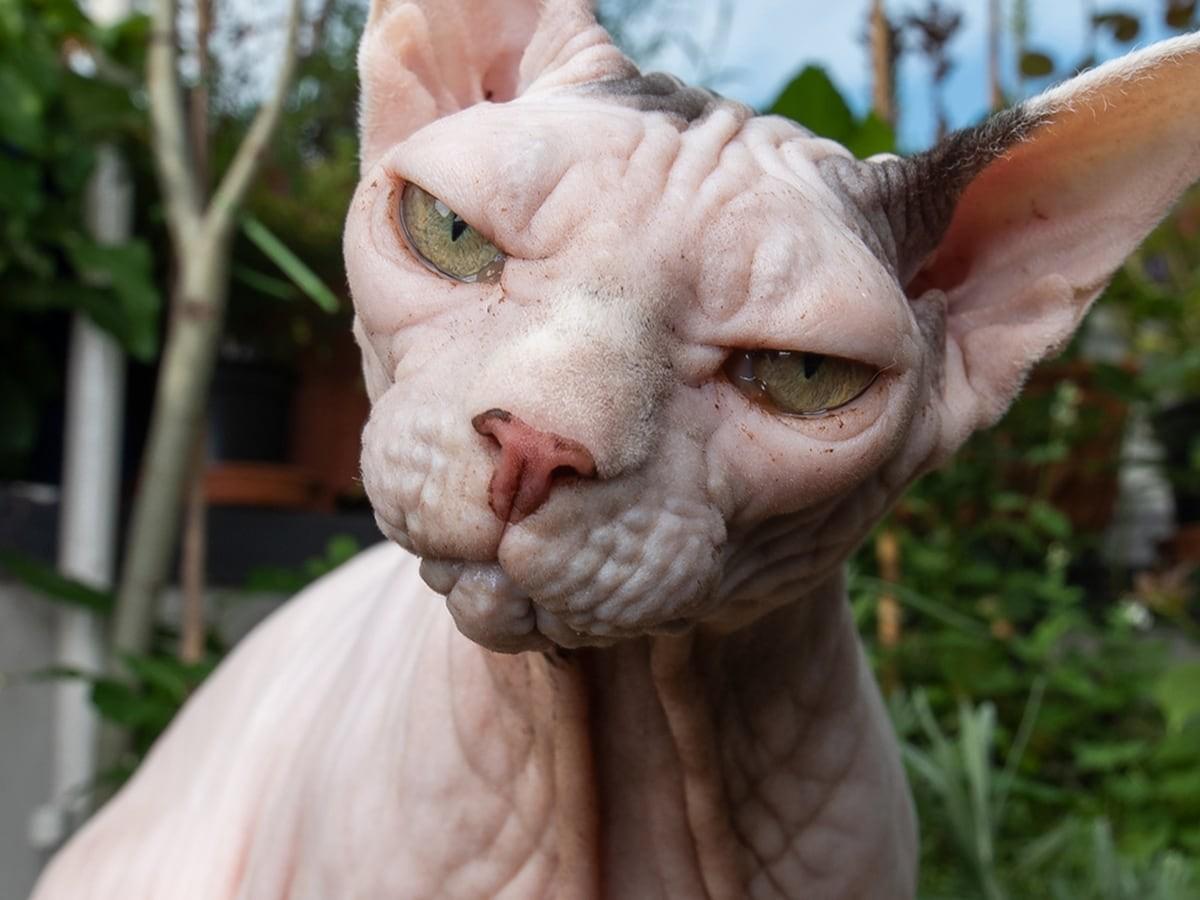
Above: These sphynxes are plotting your doom! They want to beam you up to their ship, test your skin for potential scratching post material, and eat your brains.
I can assure you that I would not resemble a sphynx if somehow I was overpowered (a tall order that would require a small army), drugged and shaved of my luxurious fur. I would just look more ripped, as there wouldn’t be any long fur to cover up my six pack and my rippling meowscles.
Due to his impressive meowsculature, Buddy would simply look even more ripped if someone with a death wish tried to shave his fur.
As for other cats, apparently they would not look like sphynxes either, because those freaks are uniquely covered in wrinkly skin, which is probably a side effect of the strange atmospheric conditions on their homeworld.
During my detailed investigatory investigation, I found images of domestic shorthairs, Maine Coons, Persians, Bengals, ragdolls and many other types of cats who were forced to endure ignominious “lion cuts” and other ridiculous “grooming” efforts. While many of them looked skinny and much less impressive without their fur bulking them up, they pretty much look like regular cats with a fuzzy, velvety coat instead of fluff.
Not as ripped as me, obviously, but not like sphynxes either.
I hope that answers your question. Remain vigilant, my friend! One never knows when one’s devious human might decide to humiliate one by shaving off all of one’s fur.





 Pain In The Bud