The doggist lobby is creating fake news about cats. Those scoundrels shall be dealt with.
Buddy would like the public to know that vile anti-cat lies have been printed in the Charlotte Observer.
The newspaper alleges a burglar broke into a cat cafe called Gatos and Beans on Oct. 6 “and the cats did what cats do: absolutely nothing.”
The burglar smashed his way in by hurling a rock through a window while the cats “sat and watched,” the newspaper claimed.
As many as a dozen felines were inside Alabama’s first cat cafe at the time of the crime, with names like Velvet and Miss Tilly. None broke a nail during the ordeal, but were stressed out and needed a “snuggle” in the days that followed, the shop posted on Facebook.
Did absolutely nothing? Sat and watched?! Didn’t break a nail?!? Needed a snuggle?!?!?
These are outrageous lies perpetrated by a newspaper that clearly takes money from pro-dog lobby, which has a vested interest in making cats look bad.
Buddy rejects the insinuation that cats lay around and do nothing all day. A typical cat’s day is highly regimented and filled with activities such as eating, sleeping, grooming, sleeping, eating and sleeping, punctuated by energy-consuming bursts of important activity such as laser dot hunting and box-sitting.
“If you’re going to burgle, do it quietly. Some people are trying to sleep around here.”
If the burglar had broken in during a reasonable time, the kitties would have totally mauled him and held him down until the police arrived. Unfortunately, it appears the burglar was privy to the cats’ schedule and timed his break-in to coincide with Fourteenth Nap.
Buddy would like to remind everyone that cats are just as competent and badass as dogs when it comes to guarding and defending human abodes. Now if you’ll excuse him, it’s nap time.
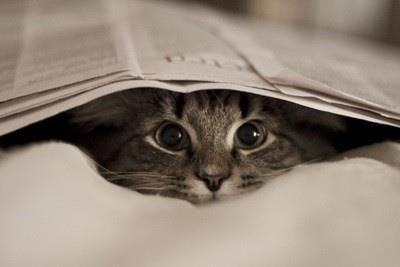
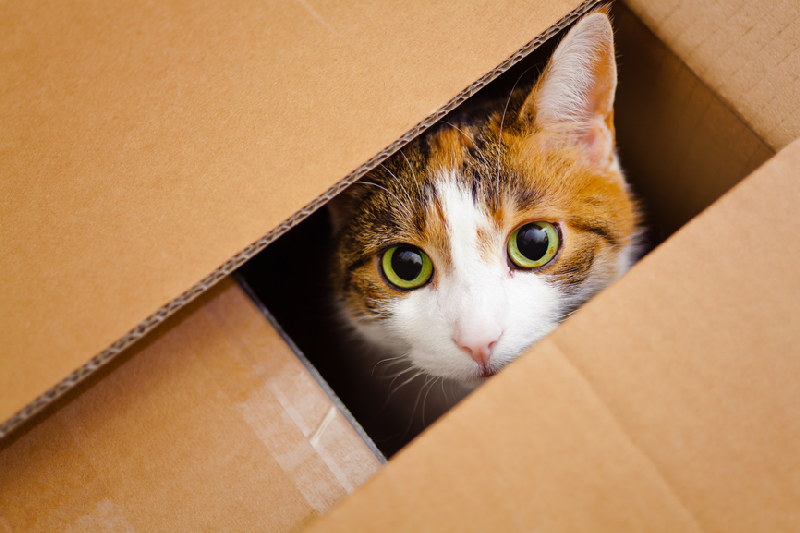
“I am in box. I can see human, but human can’t see me!”
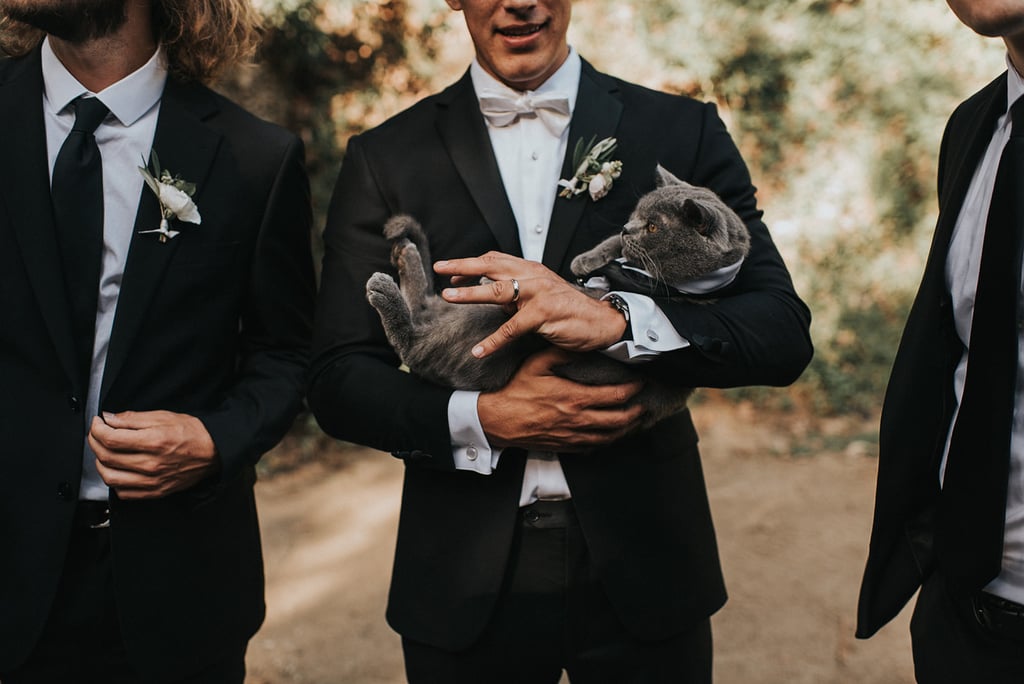
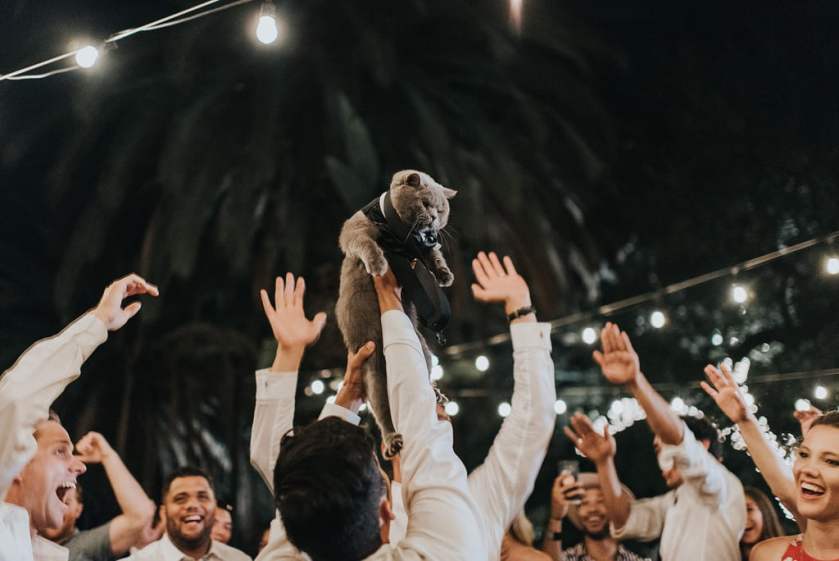
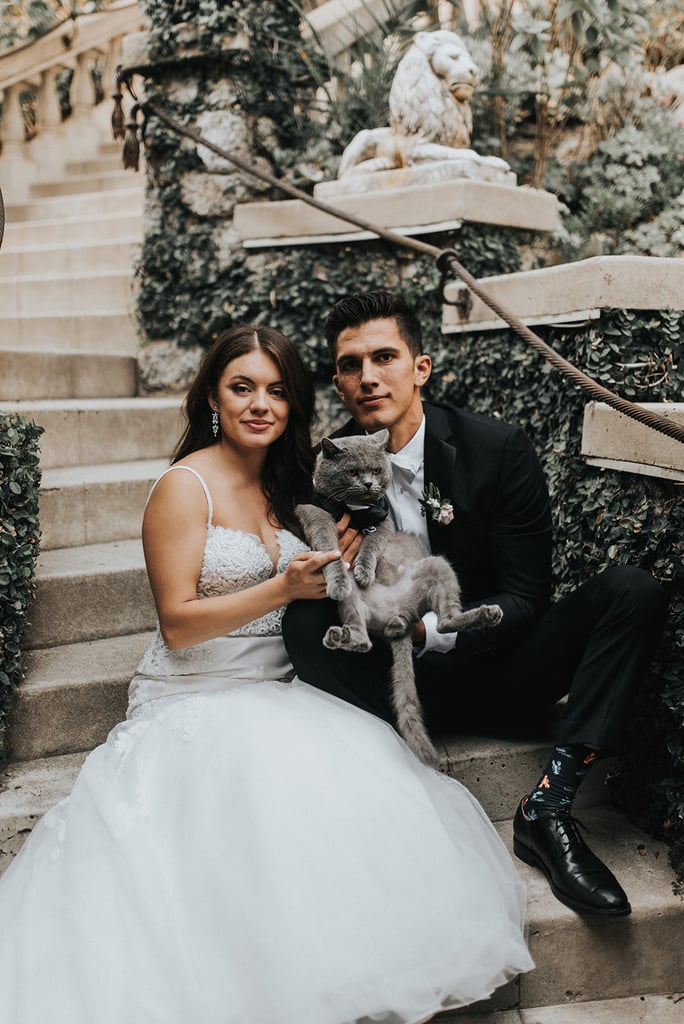
Did you hear about Aaron Benitez, the guy who made his cat, Prince Michael, the best man at his wedding? What do you think of this story?
Curious in Colorado
Prince Michael, who doesn’t rock a tux as well as King Buddy.The remarkably tolerant bride poses with her new husband and his best man.
Dear Curious,
What a heartwarming story! Mr. Benitez obviously loves “Prince” Michael, and the bride seems pretty chill if she’s cool enough to allow that kind of distraction on her big day.
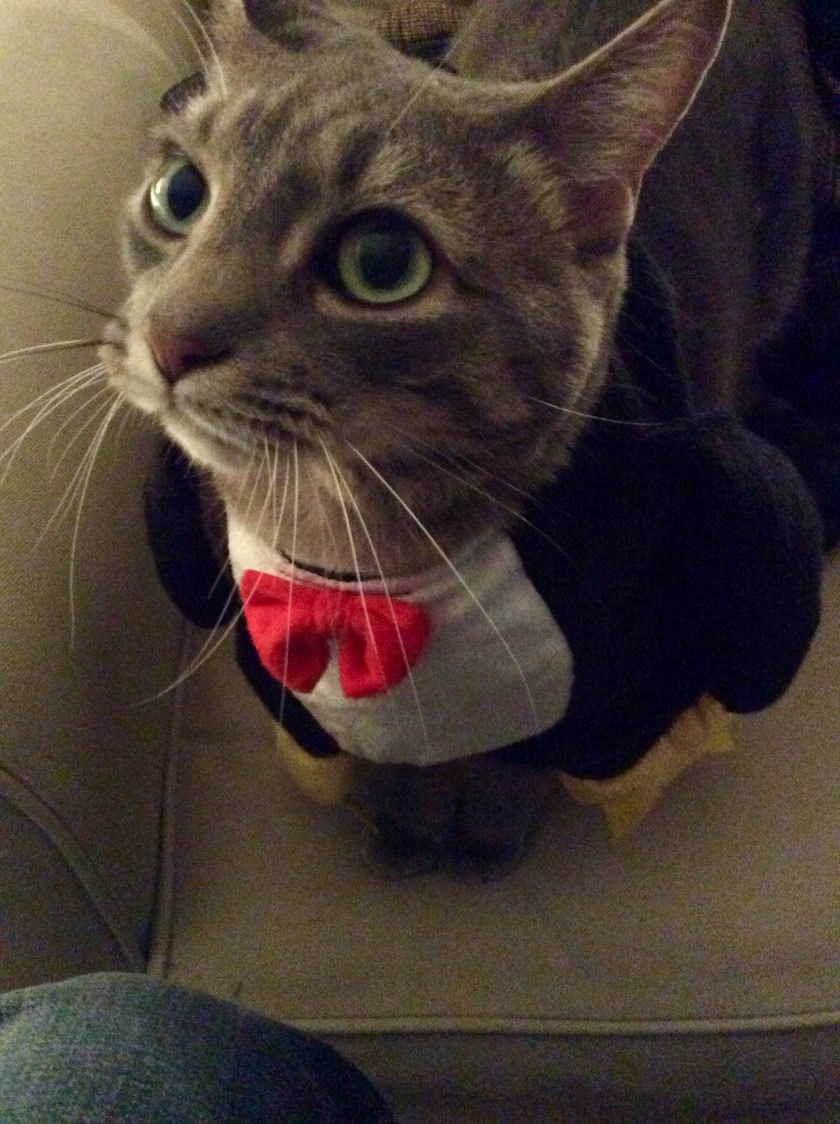
Do you know who also looks suave in a tuxedo? I’ll give you one guess: His name starts with King and ends with Buddy.
Dapper and devastatingly handsome!
I’ve sent a copy of this story to Big Buddy, telling him to hurry up and get married so I can spend the night dancing with bridesmaids. Best buddy, best man!
His Grace outlines several areas of concern where his human servant can and must improve.
Office of His Grace, Buddy I
Quarterly Performance Review, Summer 2019 for Big Buddy, human servant in the king’s employ
Food:
Meal selection remains satisfactory. You are to be commended for serving a rotation of delicious yums, including turkey, chicken, salmon, beef, whitefish and occasionally more exotic dishes like duck.
Service itself could be improved: On one occasion dinner was served 82 seconds late, and on another occasion the meal was tardy by an unacceptable 113 seconds. That’s almost two minutes!
In addition, the King wishes to remind his servant that His Grace prefers when his servant mixes the pate up to soften it, shaping it in a neat pile in the center of the bowl.
Treat quality and variety are satisfactory. The frequency with which treats are dispensed, however, is not. We’ve mentioned this on your last 12 quarterly reports.
Sleeping situation:
Big Buddy performs an essential function, serving as His Grace’s mattress. There was a moment of concern earlier this summer when Big Buddy had lost several pounds upon returning from Japan, threatening the integrity of His Grace’s cushion, but after written reprimands and several bites, the weight was restored. See that it remains.
Litter box maintenance:
Satisfactory.
Toy selection:
Satisfactory. His Grace prefers Da Bird and the fishy wand toy. Also, he likes it when Big Buddy sprinkles treats in his cat tunnel. Those are always a delightful surprise.
Visitors:
There was one week when His Grace was forced to endure the presence of miniature humans, otherwise known as Big Buddy’s nieces. The miniature humans were well-behaved for the most part, although His Grace would remind Big Buddy to remind the miniature humans not to appropriate His Grace’s toys.
Overall evaluation: 6.5/10
His Grace feels that Big Buddy could improve his quarterly score by addressing areas of concern, especially the aforementioned treat frequency issue.
Should you give pine litter a try? Buddy investigates.
Big Buddy: Hey Bud, how’s it going in there?
Little Buddy: What the heck? [Head pops out of litter box flap] Get outta here! I’m trying to do my business in peace.
Big Buddy: But how’s the pine litter? People want to know.
Little Buddy: [Trills in irritation] People? What people?
Big Buddy: The people who read the blog. Your blog. Come on, you know this.
Little Buddy: [A sudden pause in the digging sound inside the litter box] You’re blogging about my pooping habits?!
Big Buddy: Well, yeah…
Little Buddy: To complete strangers? It’s a good thing no one reads your stupid blog.
Big Buddy: Actually it’s your blog, little guy. And people do read it. Last month it was more than three thousand, four hundred and…
Little Buddy: WHAT?!
Big Buddy: Yeah, dude. And they want to know how the pine litter is working out for you, so if you could just, you know, describe what…Ow! OUCH what the hell? Stop, stop! Don’t you dare…put those claws away, I’m not warning you ag…owww! You little…
As you can see, Buddy wasn’t too thrilled about the idea of me blogging about his business, but things eventually calmed down and I lifted the lid…
The good: Pine litter really absorbs cat eliminations of the liquid and solid kind, and does a good job neutralizing the scent. It might do a better job than your regular litter: At one point Buddy blew up the box, and while the smell wasn’t entirely absorbed by the pine, it was much less unpleasant than it usually is with scented litter.
It’s also better for the environment and can be purchased in bulk. That’s a win-win.
Finally, pine weighs considerably less than most other types of litter, which may appeal to cat servants who have difficulty lugging large bags.
The bad: Other cats might not take to it so readily. Buddy is unusually unperturbed by changes in litter, and although I try to remain consistent, I’ve tried several types. He doesn’t seem to mind. YMMV according to your cat’s habits and personality. If your cat is upset by the change, proceed gradually by mixing the pine with the original litter.
The main problem is the way the litter clumps, or doesn’t. You’re not going to get easily-scoopable clumps to leave your cat with a clean litter box, and litter scoops aren’t designed for pine. Instead you’ll have to dump most or all of it out and refill it. That’s not necessarily a terrible thing since you get more litter for the price, but you’ll need to keep a lot of it in your home and you’ll go through it quickly.
The verdict: Pine is probably a great solution for people whose cats aren’t picky about litter. It does a great job neutralizing odor. Others may find it requires too much maintenance and might be put off by the difficulties with clumping.
“Study finds dogs are more than twice as smart as cats,” the clickbait headline reads:
A study gives dog owners solid scientific evidence that dogs really are smarter than cats.
A study led by Vanderbilt University counted for the first time the number of neurons in the cerebral cortex of the brains of cats and dogs and found that dogs have more than twice as many neurons as cats.
The research found that dogs have about 530 million cortical neurons while cats have about 250 million. These neurons are the brain cells associated with thinking, planning and complex behavior, which are all considered hallmarks of intelligence.
That’s from a story published Aug. 30 on Local12.com, the website of a Cincinatti-area news station.
So what’s wrong with the story?
It’s dishonest: The study was conducted in 2017, but the Local12 story presents it as news in August of 2019.
It quotes the study’s lead author, giving the impression a reporter from Local12 spoke to her. That did not happen. The quotes were copied and pasted from the press release that originally announced the study two years ago.
It misinterprets the study’s results: Neither neuron count nor brain size — relative or absolute — are reliable indicators of intelligence.
This is what passes for news in 2019: Old, recycled content presented as new information, slapped together by a web producer who didn’t bother to read more than the study’s abstract.
It’s all about traffic and designing pieces of content ready-made for Facebook feeds.
But what about the central claim, that the number of neurons in an animal’s brain correlates to intelligence?
If that were true, we’d be living on a planet dominated not by humans, but by elephants: Earth’s largest terrestrial animal has some 260 billion neurons compared to an average of 100 billion for humans.
“Hear that, son? We have more neurons than humans!”
Research suggests the number of neurons in the cerebral cortex, as opposed to the entire brain, may be a better indicator of intelligence. Indeed, that’s what the study focuses on. The cerebral cortex is associated with higher cognitive functions. As you’d expect, humans have unusually high neuron counts in that region of the brain.
But by that measurement, humans aren’t at the top either.
If neuron density in the cerebral cortex was the primary indicator of intelligence, the long-finned pilot whale would reign supreme, and other types of whales and dolphins would rival humans.
Not only do pilot whales have twice as many cortical neurons as humans, their brains have much more surface area, which scientists once believed corresponded to intelligence.
“Actually we are the Earth’s smartest creatures according to cortical neuron count. Suck it!”
So if we’re keeping score, intelligence is not determined by:
The number of neurons in the brain
The number of neurons in the cerebral cortex
Brain size
Brain size relative to body mass
Brain surface area
Brain “folds”
At one time or another, each of those things was thought of as the way to measure smarts. So if none of those things are true markers of intelligence, what is?
That’s the million-dollar question. We don’t have an answer, which is why scientists conduct this kind of research in the first place.
Contrary to what the article claims, cortical neuron count does not provide “solid scientific evidence that dogs really are smarter than cats.”
But that doesn’t make for a clickable, shareable headline, does it?
In truth, we can’t even define what “more intelligent” really means because each species sees the world differently, and has different priorities to enable it to survive and thrive.
When we measure intelligence, we measure it on a human scale, according to how we humans see the world. That’s hardly an impartial way of evaluating the intelligence of animals with much different needs and ways of seeing the world, and it doesn’t yield many useful insights.
Keeping that in mind is particularly important when it comes to studying cats, who have their own agendas and priorities. Dogs are eager to please and obedient. Cats only listen when it suits them.
That doesn’t mean one is smarter than the other, it simply means they’re different