Blog Posts

Laika And Felicette: The First Dog And Cat In Space Were Sacrificed For Human Ambition

Mankind’s achievements in space came at the expense of dogs, cats and non-human primates, who were sent into orbit during the early days of the space race.

I’ve been watching Apple TV’s exceptional show, For All Mankind, which dramatizes the space race of the 1960s and beyond in a sort of alternate history where the Soviets, not Americans, first lay boots on the lunar regolith.

That loss lights a fire underneath the behinds of the people at NASA and convinces American politicians that the space race is the ultimate measure of our civilization. In real life, American ingenuity and the creativity fostered by a free society allowed the US to leap ahead and “win” the space race. Space missions were already becoming routine by the time the drama of Apollo 13 briefly rekindled public interest.

Then the Soviet space program faded, the competition turned one-sided, and without an arch-enemy to show up, American politicians pulled back NASA’s funding to a fraction of what it once was, where it remains today. That’s why the rise of the private space industry — Elon Musks’s Space X, Jeff Bezos’ Blue Origin, etc — will almost certainly be our ticket to Mars.

But in For All Mankind, NASA remains the budgetary behemoth and source of prestige it was in the 60s and 70s, leading to the development of a permanent moon base, lunar mining operations and a planned mission to the red planet.

There’s a quiet moment in the second season when a Soviet cosmonaut, visiting the US as part of a peacekeeping mission, shares a drink in a dive bar with an American astronaut.

“Do you like dog?” the cosmonaut asks.

“Dogs?” the astronaut replies. “Of course. Who doesn’t like dogs?”

The Soviet shakes his head.

“No, dog,” he tells her. “Laika.”

Laika was the first dog in space, or more accurately, the first dog the Soviets acknowledged sending into space. (The Soviets didn’t acknowledge their failures, and we can only guess at the number of lost cosmonauts and animals officially denied by the Russians, drifting in space for eternity or disintegrated in atmospheric re-entry.)

Laika
Laika, also nicknamed Muttnick, wanted to please the humans who had taken her in, and didn’t understand that her trip would be one way. (Historical photo)

The moment turns somber as the cosmonaut recalls the Moscow street dog who was selected because she was docile, fearless and could handle the incredible noise and g-forces of a rocket launch.

“I held her in my arms,” the cosmonaut tells his American counterpart, taking a sip of his Jack Daniel’s. “For only one or two minutes on the launchpad.”

Then he leans in and tells her the truth: Laika didn’t triumphantly orbit the Earth for seven days in 1957 as the Soviet Union told the world. She didn’t endure the mission.

She perished, alone and afraid, just hours after launch when her capsule overheated.

The Soviets never designed the Sputnik 2, Laika’s ship, to return to Earth safely. Her death was predetermined.

We laud astronauts and cosmonauts, the brave men and women who willingly strap themselves into tiny capsules attached to cylinders of rocket fuel the size of skyscrapers and depart this Earth via brute force, knowing something could go wrong and their lives could end before they realize what’s happening. We should admire them. Their accomplishments are all the more impressive when you consider the fact that the combined processing power of every computer at NASA’s disposal in the 1960s was but a fraction of what we each hold in our hands these days when we use our smartphones.

Those first astronauts and cosmonauts were extraordinarily brave — but only up to a point.

Unwilling to risk human lives in the early days of space exploration, space programs used dogs, cats and later monkeys and apes, strapping them into confined spaces, wiring their brains with electrodes for telemetry data, poring over the information they gleaned about their heart rates, blood pressure and breathing as they left our home planet.

The sad eyes of a stray dog, separated from everyone she loved, were the first to behold Earth from space. A few years later the eyes of a French street cat took in the same view before humans did.

Felicette
Felicette couldn’t move when she was placed into the capsule that took her to space and back.

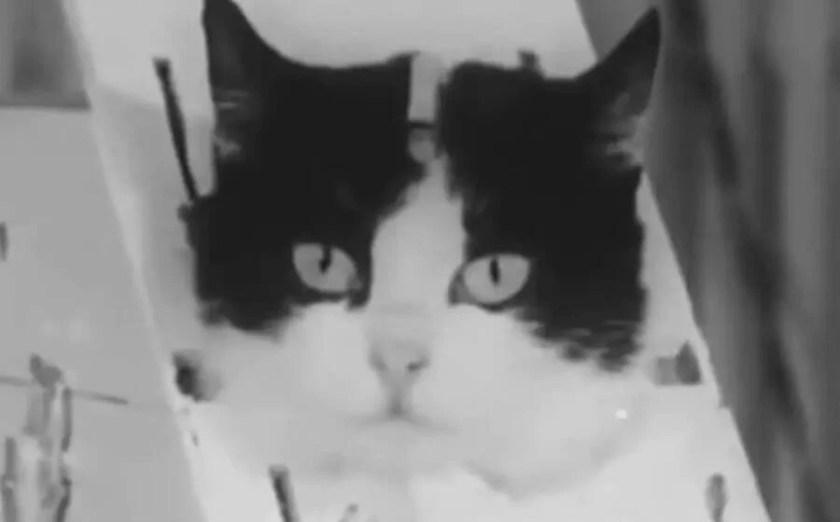
Felicette, the tuxedo cat who was launched into space by the French on Oct. 18, 1963, didn’t even have a name until the French recovered her capsule and took her back for examination.

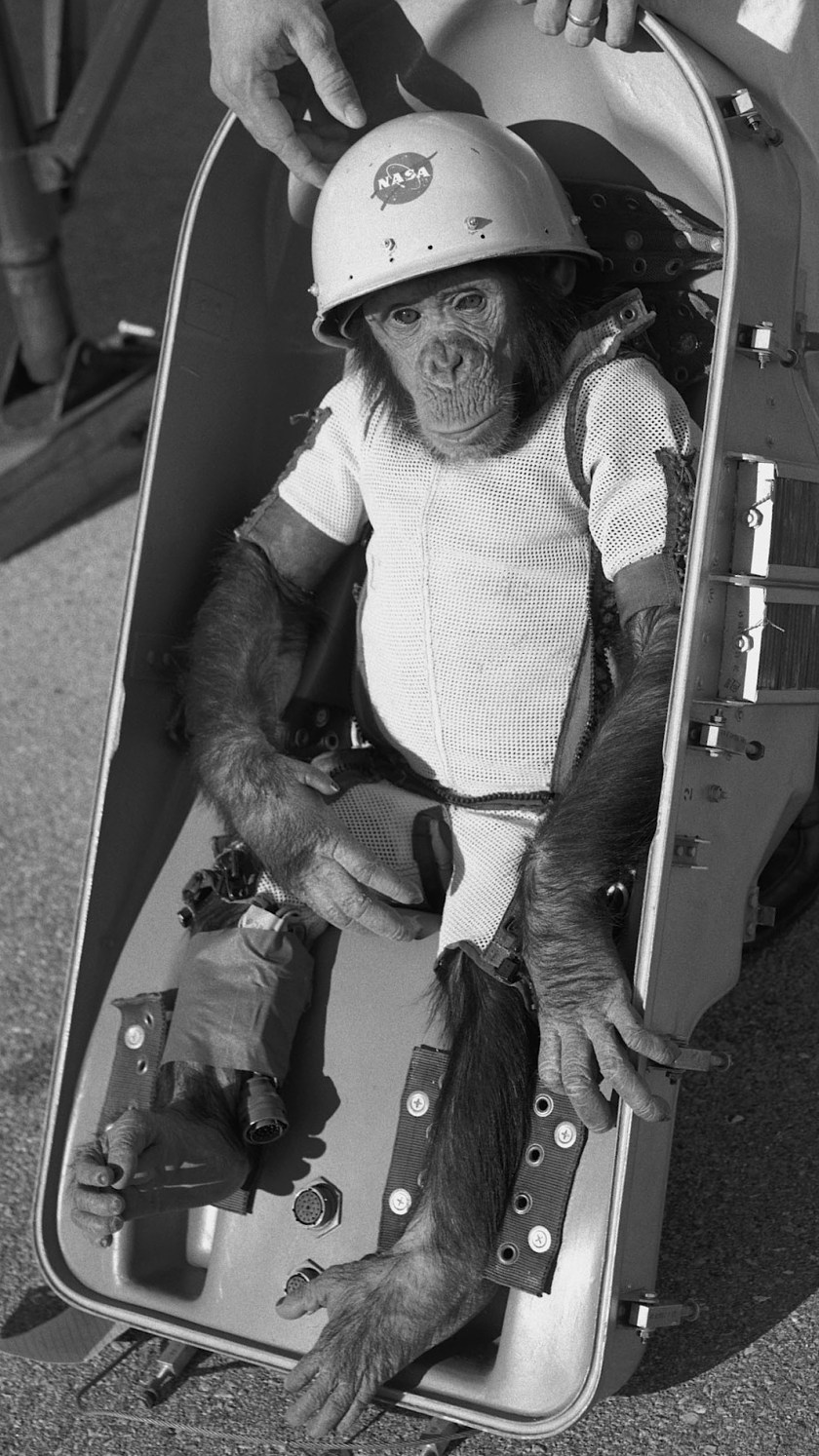
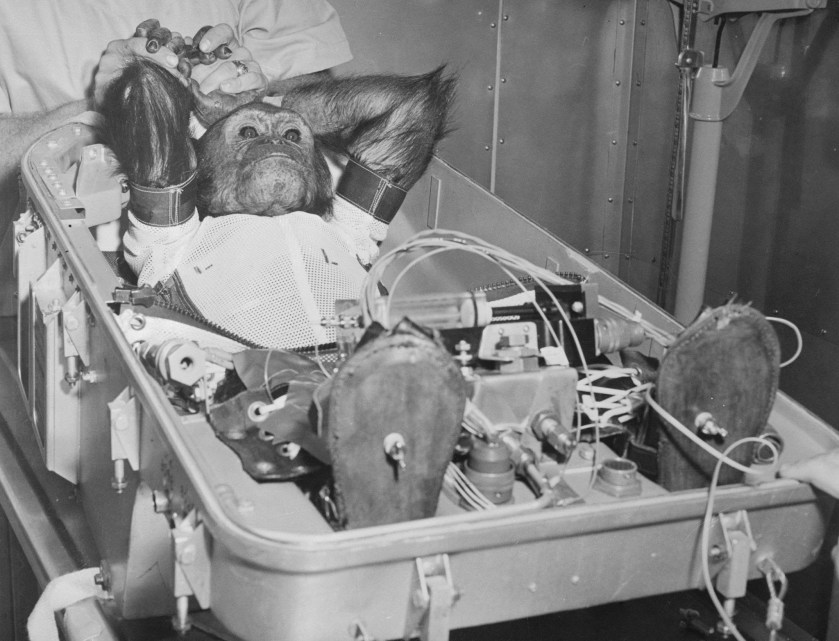
The scientists and engineers in charge of the launch didn’t want to humanize her if she didn’t make it, which was a common practice in space programs. (Ham, the chimpanzee sent into space by NASA in January of 1961, was known as No. 65 until his successful recovery. NASA was worried that a name would make him more sympathetic and lead to bad press if the chimpanzee died during the mission.)
Ham_the_chimp_(cropped)
Ham the chimpanzee was little more than a baby. Credit: NASA archives

Despite Felicette’s endurance and successful return, French scientists repaid her bravery by euthanizing her a month later so they could study her brain and learn more about the effects of spaceflight on mammalian biology.

Felicette, like Laika and Ham, was never given a choice. Those animals, with their child-like mental capacity, endured their missions out of a desire to please their human caretakers as much as any natural stoicism they may have possessed.

Would we do the same thing today? Will we repeat those experiments as we set our eyes on Mars?

Consider that the moon is a three day trip, and it’s close enough to Earth’s magnetic field to protect living beings from radiation. Mars is at least a seven month trip if the orbital conditions are right, and there will be no protection from radiation aside from what can be built into the craft. Take that trip without adequate protection and you’re guaranteed to get cancer.

It’s easy to say we wouldn’t make animals our test subjects for a Mars journey, and NASA now has decades of data on the effects of space and zero gravity thanks to the International Space Station.

And yet Neuralink, another company owned by Elon Musk, currently uses monkeys to test its brain interface technology, which allows the primates to operate computers with their thoughts. Those monkeys are forced to endure radical surgery to implant microchips in their brains. The teams working on the technology say suffering by those animals will be worth it as people with paralysis are able to do things with their thoughts and regain a measure of independence, increasing their quality of life.

Likewise, it will probably be an animal, or animals, who will be the test subjects on board craft that first venture beyond the Earth’s protective magnetosphere. Scientists and engineers will do their best to create a vessel that shields its occupants from harmful radiation, but they won’t know how successful they’ve been until the test subjects are returned to Earth and their dosimeters have been examined.

Will an astronaut volunteer for that kind of mission, knowing the “reward” could be a drastically shortened life?

To hear Musk and futurists tell it, pushing toward Mars is not just a matter of exploration or aspiration, but is necessary for the survival of our species. Earth becoming uninhabitable, they say, is an eventuality, not an if.

Others point out it’s much easier and wiser to pour our resources into preserving the paradise we do have, and the creatures who live in it, rather than banking on a miserable future existence on Mars where society will have to live underground and gravity, at 0.375 that of Earth, will change the human form in just a few generations.

To put it bluntly, while Musk and futurists look at life on Mars through the rose-colored glasses of science fiction fans, in reality living there is going to thoroughly suck.

If people do live on Mars they’ll never venture outside without a suit, never feel the sun on their skin, never swim in an ocean. They’ll never have another backyard barbecue, watch fireworks light up the sky on the fourth of July, or fall asleep to the gentle rain and crickets of warm summer nights. They’ll never hear birdsong or have the opportunity to see iconic animals like elephants and lions. Every gulp of air will be recycled, every glass of water will have passed through the kidneys of others. There will never be snow. Circadian rhythms will be untethered from the cycle that governed human biology for the 200,000 years our species has existed.

And while there could be a future — if you want to call it that — for people on Mars, there won’t be a future there for the rest of the living creatures on Earth.

As a lifelong fan of science fiction who devours SF novels, counts films like Alien and Bladerunner among my favorites, and is fascinated by shows like For All Mankind, The Peripheral and Star Trek, I understand the appeal of space and the indomitable human spirit that drives us to new frontiers. I just hope we can balance that with respect for the Earth and the animals we share it with. Let’s hope there is never another Laika, Felicette or Ham.

Correction: For All Mankind is the name of the Apple TV series about an alternate history space race. The first reference to the show’s name was incorrect in an earlier version of this story.
felicette-container
A close-up of Felicette’s face. Credit: French government archives
Ham the Space Chimp reaches for his apple reward after his space mission.
Ham the Space Chimp waits for his apple reward. Credit: NASA archives

Little Buddy And Big Buddy: The Buddies

Human and cat, best buddies.

To celebrate my birthday and Bud’s adoptaversary, the little guy commissioned a portrait of us together. As many of you know, cats think of us as big, slow cats, which is reflected in the resulting painting. I present to you “Buddies: Airbrush on canvas”:

thebuddies_tagged

There is a slight inaccuracy, of course: I have gray eyes, not green. If I’m portrayed as a cat, I should probably be an orange tabby as well. And finally, little Buddy should be much more muscular. Perhaps he’s meant to be a kitten in this painting as he was more of a shoulder cat when he was tiny. Other than that, seems pretty accurate!

In truth we don’t really know exactly how cats view us.

We know there’s a parental element, that house cats retain kitten-like qualities for life as they remain in our care. The meow is probably the best example of that, since it mirrors the vocalizations kittens make to their mothers.

We know house cats depend on us physically, psychologically and emotionally. In recent years behavioral scientists have taken studies originally designed for children and modified them for cats, yielding interesting results: House cats who are bonded to their humans behave in ways startlingly similar to humans children.

When we form bonds with them, they draw comfort from our presence and look to us for behavioral cues to determine how they should respond to situations and objects that are new and potentially frightening. Just like kids, cats look to us, and just like kids, they stay calm if we do.

When you treat a cat well, kitty returns that love, trying to comfort you when you’re sick, refusing to leave your side, alerting you to potential trouble.

Bud is super friendly, but he isn’t the cuddliest cat out there. He doesn’t like being hugged or picked up, but he knows that when he pads up to me while purring and sits on my chest or in my lap, I’m never going to force him to stay or subject him to pets he doesn’t want. That’s why he approaches me often and why he feels so relaxed.

It’s probably also why he often wakes me up, purring like an engine, looking for a chin scratch and affirmation that he is indeed a good boy.

Perhaps the biggest complements are Bud grooming my hair and beard, and sleeping on me.

There’s no greater expression of trust between a feline and human than when a cat falls sleep in your lap. Cats are never more vulnerable than when they’re asleep, and sleeping in your lap means your four legged friend feels safe with you and trusts you completely.

‘Vegan’ Cats Turn To The Streets For Their Fix

As more humans force vegan cat “food” onto their felines, cats turn toward the black market for their yums.

The exchange was so swift that unless you were looking out for it, you’d miss it.

A young, skinny ginger tabby approached a pudgy tuxedo in front of a stoop. The felines exchanged a nod and bumped paws, then the tabby scurried into an alley, disappearing into the shadows between two buildings.

“Gotta get it in me!” the tabby said, taking quick breaths. He dragged a claw across the top of the pouch to open it, poured every last morsel of meat into his mouth, then dropped to the ground, leaning against the brick wall.

“Oh!” he exclaimed, his pupils dilating. “That is the good stuff! Man, I needed that.”

The tabby, who would only identify himself by his street name, Skinny G, is one of thousands of so-called “vegan cats” in New York who have been defying their humans, finding ways to slip out and connect with a burgeoning network of “can slingers.”

Resembling drug dealers in their methods and presentation, the can slingers nevertheless point out that what they’re doing is not illegal.

“We like to think of ourselves as a charitable organization even though we earn a tidy profit,” said Tuco Salamanclaw, vice president for emerging markets with Los Gatos cartel. “It’s tragic to see so many misguided humans forcing their faithful felines to eat tofu, soy and other junk that doesn’t have the nutrients we need. We’re here to help address that injustice.”

Meowfioso
Louis “Linguini Louie” Felinzio, a Meowfia capo and director of taste testing for the Meowfia’s can slinging operation.

The rise of the underground meat market — and the profits it promises to organizations that can muscle their way in — has attracted the Meowfia as well as The Buddy Organization, which was rebranded last year as Nipped In The Bud Catnip Co. Jostling for position among those three major players, as well as smaller groups, has led to a revival of the territorial battles that marked the catnip wars years ago.

“It’s just a matter of time before we see another drive-by spraying,” said Pawl Oreoson, a criminologist at John Jay College of criminal justice in New York. “Los Gatos is not an organization that surrenders territory easily, and the Meowfia also play for keeps. There’s just too much money to be made here.”

Profits from the underground cat food market set a record for the 10th consecutive quarter in March, reflecting the growing number of humans forcing their felines to eat meat-free diets of ultra-processed, plant-based “food.”

“Disgusting,” is how three-year-old Nala put it when asked about the “vegan cat food” her humans feed her. “Imagine eating damp cardboard with little clumps of carrot and celery embedded in it. No self-respecting cat should be forced to eat this stuff.”

Chonk
“After two weeks on the vegan stuff I was skin and bones,” says Slim Sal, above. “I was almost too weak to make it to the can slingers and get my paws on proper food. No cat should have to endure that trauma.”

Tigger, a striped eight-year-old from Brooklyn, was admonished by his humans two weeks into his vegan “cat food” diet when he got into the fridge and helped himself to an entire pound of Boar’s Head ham and two large chorizos.

With a child lock now preventing him from opening the refrigerator door, Tigger said he’s been squirreling away portions of the vegan kibble and dumping it off the fire escape when his people aren’t looking. He hunts rodents to keep himself from starving, but says he’s getting sick of mice.

“If these lunatics want to subsist on broccoli, quinoa and hummus, that’s on them, but I just can’t,” Tigger said. “I’ve scraped together enough cash to buy a few cans of Friskies, and tomorrow I shall feast!”

‘Who, Me? I Wasn’t Clawing At The Screen Again, I Swear!’

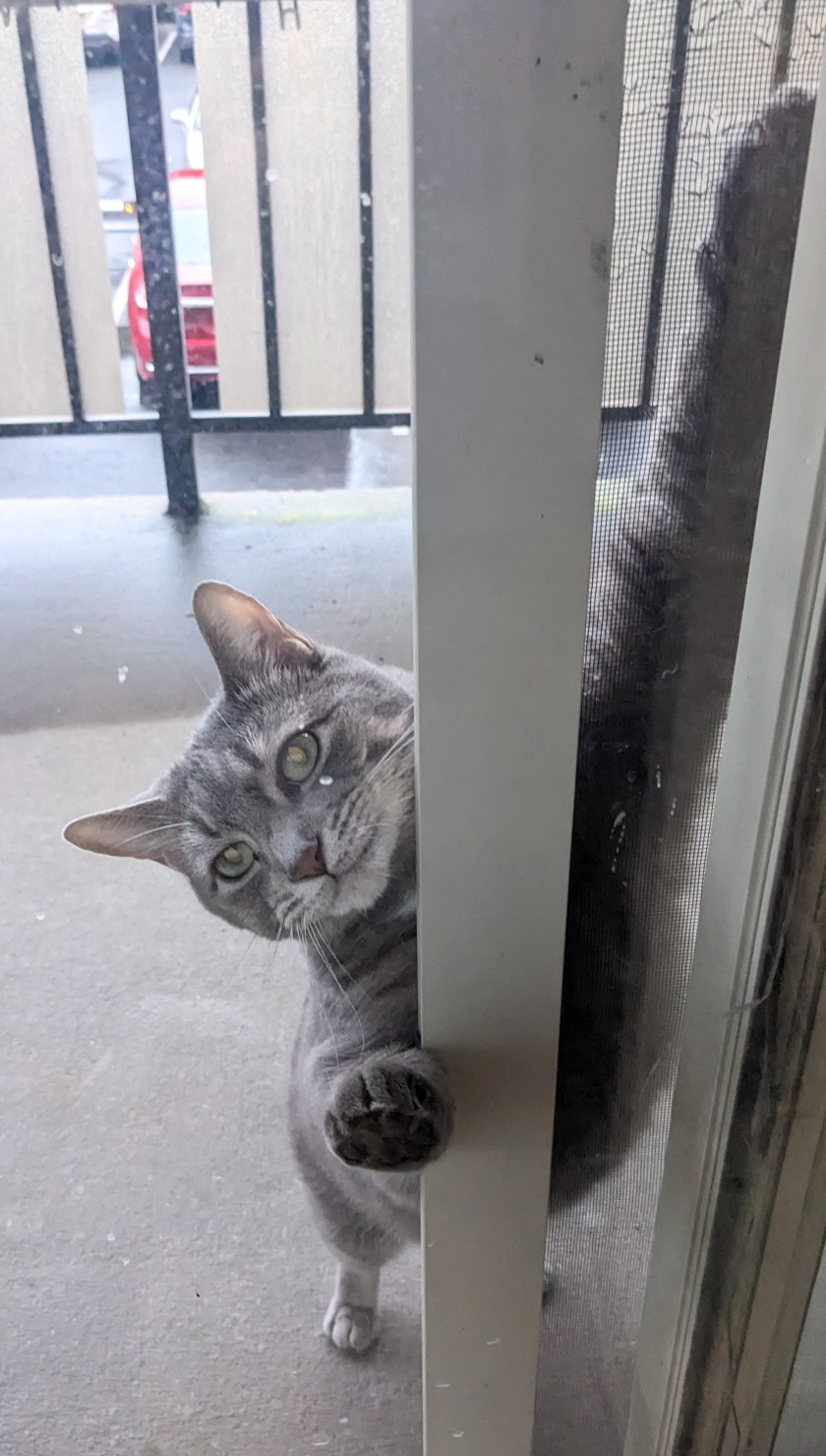
Buddy is a good boy! Buddy doesn’t scratch the screen!

“Hahaha! You humans are so funny with your overactive imaginations!

PXL_20230520_230803473~2

Your ears and eyes deceive you, human! I was not trying to scratch the screen door again.

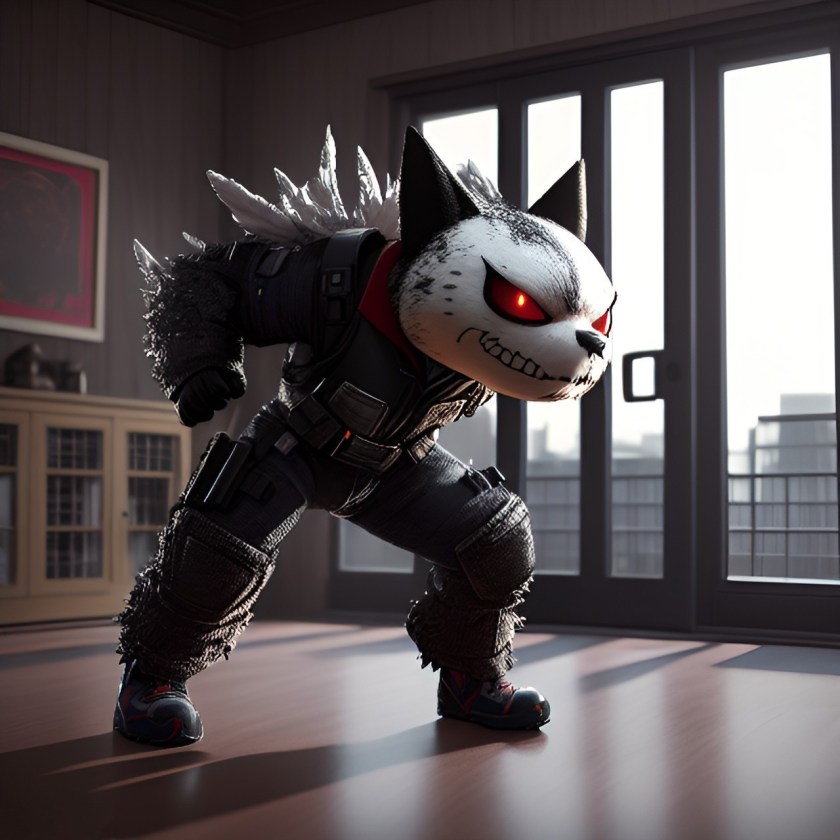
I told you, those tears in the screen are from a chalupacabra! I said ‘Look here, chalupacabra, this is Buddy Territory. You’re not welcome here! Get!’

But you know those chalupacabras, they never listen. Stubborn animals!

Chalupacabra
Pictured: A vicious Chalupacabra that scratches the screen door and blames poor Buddy. Credit: PITB

My claws are NOT stuck in the screen, okay? I’m just resting my paw. I can get free any time I want, it’s just that I don’t want to right now.”

Forty-six minutes later:

PXL_20230521_003757806.PORTRAIT~2

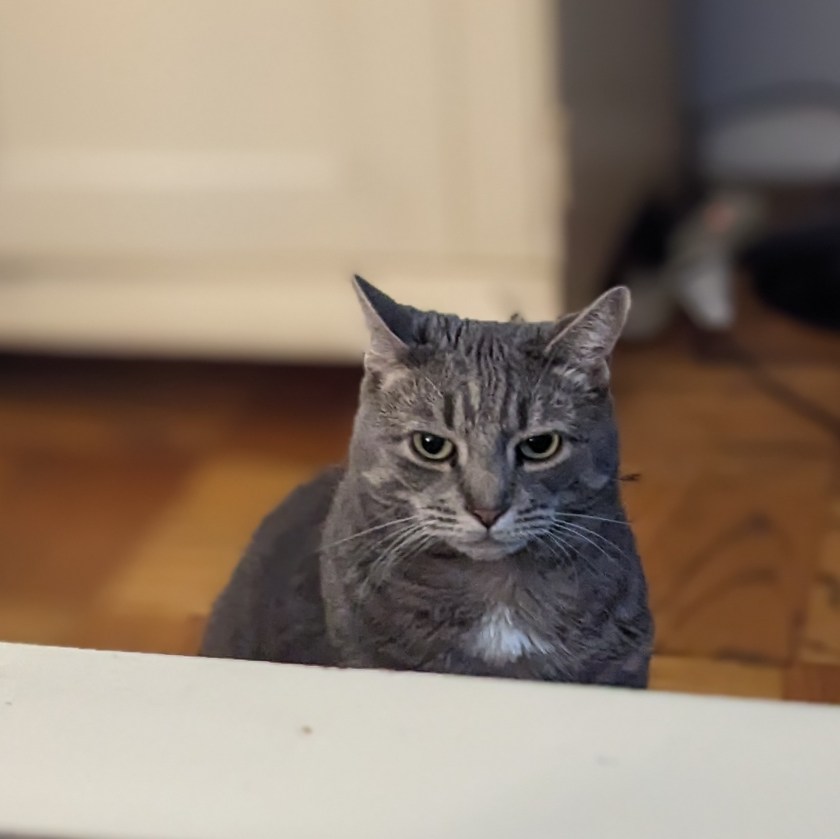
“I’m right here, you know. I see you eating that ice cream sandwich. I see how it is. ‘Snacks for me, but not for thee.’ Well I have news for you, human! I’m going to sit here and stare at you all mean-like until you procure a Buddy snack.

You feel guilty? Good! You’re meant to.”

In The UK, Cat ‘Ownership’ Can Be A Hazy Concept

What does it mean to “own” a cat? If you believe a cat is neglected, can you take custody? As UK law changes, those questions need answers.

For the second time this week, two people are fighting over a cat after the original “owner” received a request from a microchip company to confirm another person’s claim on the feline.

Charlotte Sawyer of Swindon, a town in southwest England, told her local newspaper she was livid when she got the request to sign over her claim to one-year-old Oreo.

“I can’t believe the audacity of this person trying to steal our beautiful cat,” she told the Swindon Advertiser.

But Sawyer readily admitted Oreo was going out for days and sometimes weeks at a time before returning home, and she hasn’t seen him for four months now.

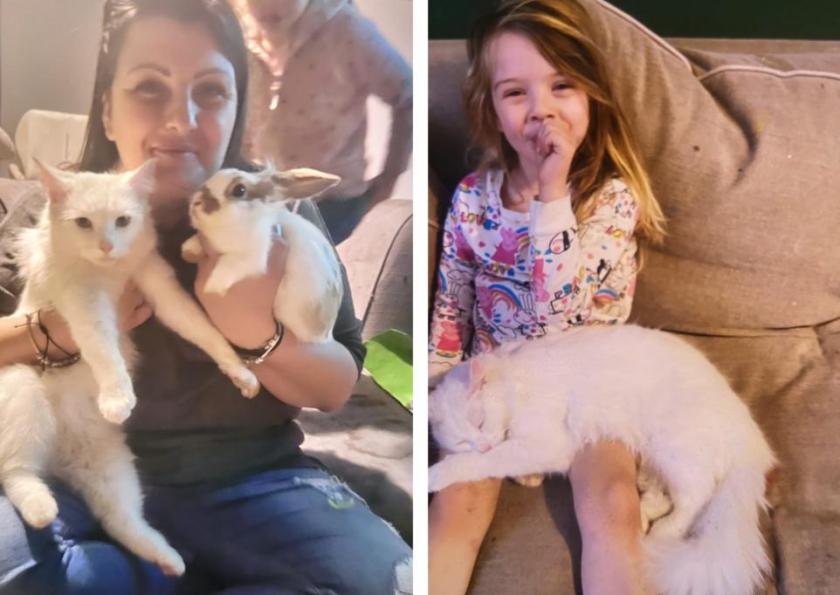
Sawyer and Oreo
Charlotte Sawyer, left, with her cat Oreo and a pet rabbit. Sawyer’s daughter, right, with Oreo. Credit: Charlotte Sawyer via Swindon Advertiser

Like many cats in the UK, Oreo not only had access to the outdoors, he was accustomed to coming and going as he pleased. Other families were feeding him, and it’s likely he made the rounds among several houses before returning home. Because “home” is a nebulous concept in this instance, it’s not the first time someone has asked Sawyer to relinquish custody of Oreo.

“A woman claiming to be someone who looks for missing cats once knocked on my door and handed me a form asking for permission to change Oreo’s microchip,” Sawyer said. “I wanted to rip it up, I was furious, and told her he was my cat. Now it’s happened again. At least it’s provided some reassurance that he’s still alive.”

While I feel for anyone who loses a pet, I don’t know how someone who truly loves a cat can accept the kitty being gone for days or weeks at a time, not knowing if he’s in danger, hurt or still breathing. That kind of arrangement isn’t in the cat’s best interests, and it’s not compatible with our responsibility to ensure the welfare of our four-legged friends, an obligation all of us take on when we adopt our pets.

The people who encountered Oreo likely thought he was a stray or an abandoned former pet. If they’re requesting a change to microchip registration, it probably means they spent their own money to take the little guy to the vet, where the chip was discovered and scanned.

This is emphatically not a blanket criticism of UK norms regarding outdoor access, by the way. Americans cannot claim moral superiority. In the past week or so we’ve had a Pennsylvania man kill a cat with a blow dart because the feline “was trying to kill my birds,” a vulgar approximation of a human being in New Jersey “repeatedly raped” his pet cat before torturing her to death, and some deranged lunatic in Florida used a cat as target practice, leaving 30 pellets lodged in the innocent animal’s little body.

That represents a tiny fraction of the cat abuse stories from the last 10 days and I’ve omitted the worsted examples because I know we have readers who can’t handle this stuff. (I can’t either, which is why I paused my Google News alerts for most of the past two weeks.)

My point here is not to shock. It’s to underscore the fact that we have absolutely no moral authority when it comes to telling people in other countries how to care for animals.

Outdoor cat
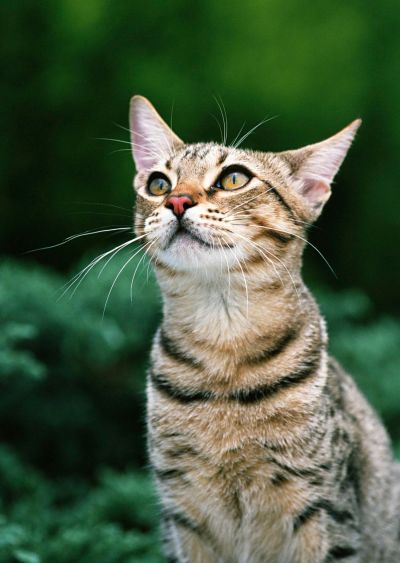
A cat exploring outdoors. Credit: Openverse

Moral authority concerns aside, the two examples of ownership claims by microchip this week raise important questions about the definition of “ownership” and what it means to properly care for a cat.

Like many cat lovers I don’t like the term “owner” and I describe myself as a caretaker, but where the law is concerned, ownership is important concept because it determines who has claim over the animal. The law views cats and dogs as property, whether we like it or not. That’s why animal welfare statutes fall under agriculture and markets law in many US states instead of the criminal code, and it’s why so many of those laws need updating.

Cat culture across the Atlantic is different in that the majority of people who have cats believe our furry friends must have access to the outdoors to live a complete, fulfilled life. In the US, 63 percent of cat caretakers keep their felines strictly indoors, while in the UK it’s virtually the opposite, with 70 percent allowing cats to roam outdoors. Not all definitions of outdoor access are equal: Some people allow only supervised outdoor time in the backyard (or “garden”), some make sure their kitties are safely indoors by nightfall, while others have cats who return at their own whim.

There are also differences regarding geography, traffic density, the prevalence of natural predators and the nature of city life that account for how much outdoor access they allow their cats.

As the UK sets a June 2024 date for the mandatory microchipping of pet cats, disputes like this are going to become more common, which means people would be wise to make sure their cats’ microchips have up-to-date information and have readily available proof that they own their felines. If cat owners don’t establish the criteria for what it means to “own” a feline, the government will.