Your cat’s taste in music may or may not align with your own.
Before we get into today’s cat news, I received an email asking why there hasn’t been much Buddy on the site lately.
Fear not, friends of Buddy! The little guy is down in the Amazon visiting his jaguar pals, but he’ll be home in time for the most important holiday of the year, Turkey day. He wouldn’t miss it for the world!
Buddy with a jaguar buddy in the Amazon, where there’s a special felid conference on new napping techniques.
A smiling cat?!
A story on Space.com says people see a “smiling cat” in images of a nebula, although we’re not so sure.
The nebula in question is Sh2-284, or Sharpless 284. It spans about 150 light years and sits about 15,000 light years from our star system near the edge of the Milky Way, in an outer spiral arm.
From a certain orientation, there may be suggestions of cat-like ears and eyes, although if there is a smile, it’s crooked and deranged-looking. Maybe the cat’s on pain pills from the vet?
There’s an opportunity here, since the nebula doesn’t have a nickname. The Buddy Nebula has a nice ring to it!
Here’s an image from NASA:
This spectacular picture of the Sh2-284 nebula has been captured in great detail by the VLT Survey Telescope at ESO’s Paranal Observatory. Sh2-284 is a star formation region, and at its centre there is a cluster of young stars, dubbed Dolidze 25. The radiation from this cluster is powerful enough to ionise the hydrogen gas in the nebula’s cloud. It is this ionisation that produces its bright orange and red colours. This image is part of the VST Photometric Hα Survey of the Southern Galactic Plane and Bulge, led by Janet Drew at the University of Hertfordshire in the UK.
In Star Trek there’s always a convenient nebula nearby when the Enterprise — or Voyager, Titan or Discovery — needs to “hide” from some well-armed belligerent, and science fiction in general creates the impression that they’re like space swamps.
In reality nebulas are regions where the interstellar medium — the space between stars — is filled with gas, cosmic dust and inert matter. Some are stellar nurseries — places where stars are “born” — and some are the remnants of dead stars and the planets that orbited them.
They can seem to glow red, orange, green or blue depending on the elements present. Some of them reflect starlight while others are like filters, with the gases and dust lending their color to the nebulae structure.
Cats are pretty well-represented in the cosmos, from a human perspective. From the cat’s paw nebula to the Cheshire Cat galaxies, to the Lynx, Leo and Leo Minor constellations, astronomers have seen cats in the sky for millennia.
Does music help cats relax?
Although the research is limited, some studies have indicated certain genres of music can help our little buddies chill out. And if research into the canine response to music is any indication, we should expect to see more evidence for cats enjoying tunes.
When it comes to what kind of music is most effective, studies point to classical music with a slow tempo, as well as reggae and soft rock “with simple rhythms, slower tempos and no heavy percussion,” according to a new story from the BBC.
Just listening to some meowsic!
A 2016 study looked at the effect of music on 12 female cats who were recovering from spay surgery. The research team played “three different genres of music: classical music (CM), ‘Adagio For Strings (Opus 11)’ by Samuel Barber; pop music (PM), ‘Torn’ by Natalie Imbruglia; and heavy metal (HM), ‘Thunderstruck’ by AC/DC.”
The team measured heart rate, breathing rate and pupil dilation, concluding that classical music was most effective, followed by the Imbruglia song and AC/DC last. (Maybe next time they can slide The Tony Danza Tapdance Extravaganza in there for some extra fun.)
Anecdotally, Bud did not respond well to composer David Teie’s Music for Cats, but he hangs out and nods along to funk, classic 90s New York hip hop, retrowave, nu-disco, reggae and certain kinds of rock, which is almost certainly because he grew up hearing that stuff with me.
So maybe there’s a nature vs nurture element to feline musical preferences, although I wouldn’t hold out hope for cats who enjoy the Tony Danza Tapdance Extravaganza. Some things are best left alone.
Would your cat resemble a sphynx if you shaved its fur? Buddy the Cat investigates!
Dear Buddy,
Do all cats look like sphynxes underneath their coats? What I mean is, if someone were to shave off all your fur, would you look like a weird wrinkly little alien thing too?
Wondering In Wyoming
Dear Wondering,
Who told you that? Is Big Buddy planning to have me shaved? Is he gonna condemn me to one of those “groomers” and have me transformed into some undignified, naked, dumb-looking creature?
I will end him!
Buddy
Dear Buddy,
Whoah, hold up there, champ! No one’s got anything planned for you, it’s just a hypothetical. I’m genuinely curious about the no fur thing, that’s all. And I asked you because you’re the expert on every topic!
Wondering in Wyoming
Wondering,
Okay, okay, but I’m not letting my guard down. As the wise man George W. Bush once said: “Fool me once, shame on you. Fool me…uh, you can’t get fooled again!”
I thought about your question and became more curiositized as well because sphynxes are weird and I don’t want to look like those freaks. Get mistaken for one and the next thing you know, they’re bringing you back to their mothership.
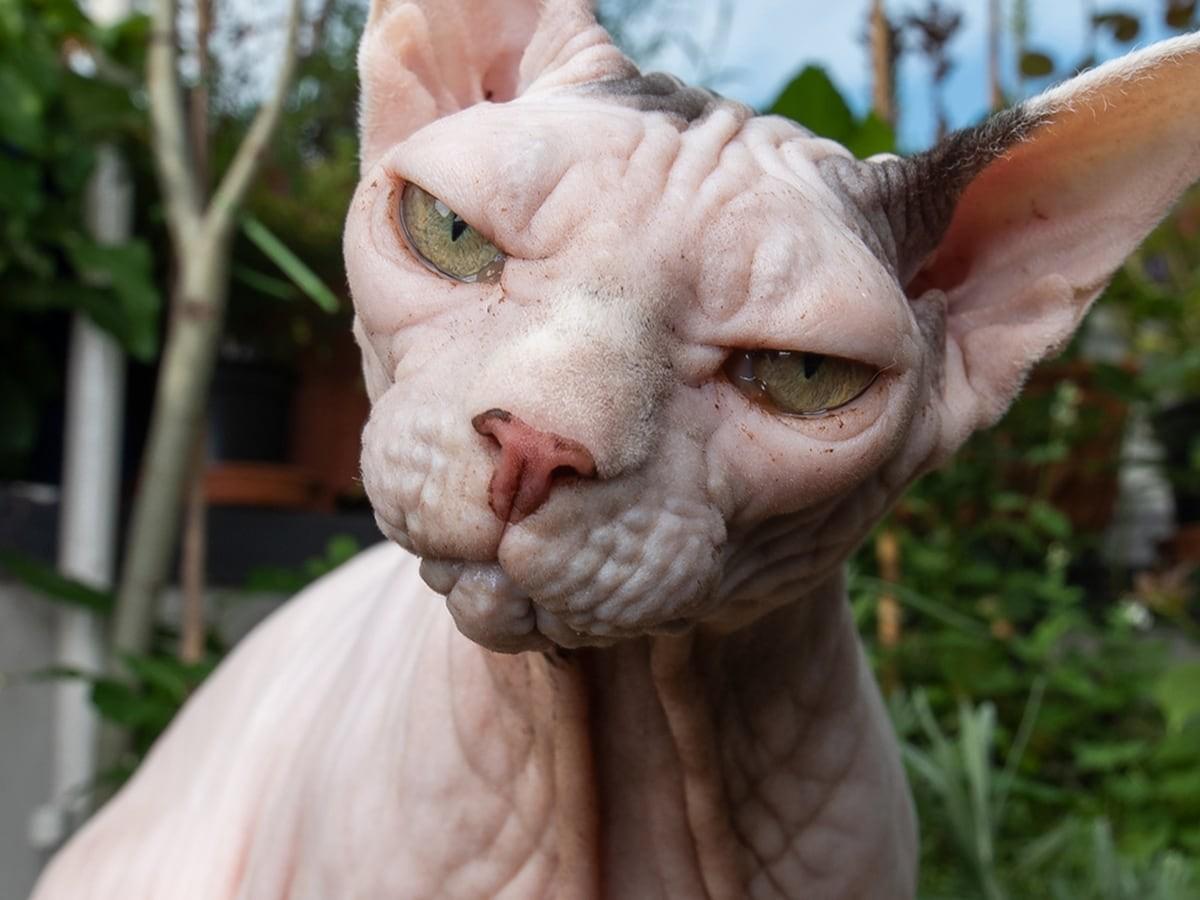
Above: These sphynxes are plotting your doom! They want to beam you up to their ship, test your skin for potential scratching post material, and eat your brains.
I can assure you that I would not resemble a sphynx if somehow I was overpowered (a tall order that would require a small army), drugged and shaved of my luxurious fur. I would just look more ripped, as there wouldn’t be any long fur to cover up my six pack and my rippling meowscles.
Due to his impressive meowsculature, Buddy would simply look even more ripped if someone with a death wish tried to shave his fur.
As for other cats, apparently they would not look like sphynxes either, because those freaks are uniquely covered in wrinkly skin, which is probably a side effect of the strange atmospheric conditions on their homeworld.
During my detailed investigatory investigation, I found images of domestic shorthairs, Maine Coons, Persians, Bengals, ragdolls and many other types of cats who were forced to endure ignominious “lion cuts” and other ridiculous “grooming” efforts. While many of them looked skinny and much less impressive without their fur bulking them up, they pretty much look like regular cats with a fuzzy, velvety coat instead of fluff.
Not as ripped as me, obviously, but not like sphynxes either.
I hope that answers your question. Remain vigilant, my friend! One never knows when one’s devious human might decide to humiliate one by shaving off all of one’s fur.
There are also categories for top Hollywood-inspired names (Bill Murray, Jack Sparrow), nostalgia-influenced names (Moog, Sega), and nature/space themed names, like Orion and Supernova.
Luna and Milo are the top female and male cat names in 2025, according to an analysis by Rover.
There are several different lists each year sourced from databases like pet insurance registrations or data from microchipping companies, but Rover’s list is based on its own records, which include millions of registrations on the pet services site.
There’s quite a bit of overlap, as expected, and familiar names top this year’s list, including Lilly, Lucy, Nala, Pepper, Willow, Cleo and Daisy for female cats. For male cats, Leo, Oliver, Charlie, Loki, Max, Simba, Jack and Smokey are among the most popular.
Notably absent was the name Buddy.
“What do you mean Buddy is not on the list?” Buddy the Cat said when told about the new data from Rover. “I shall find out who is responsible for these vile heresies and punish them with my righteous fury as the Emperor of Catkind! Muahahaha.”
Click here to view the overall top names list for cats and here for an index of the top trending names broken down into categories like pop culture, sports, nature and nostalgic names. The latter includes names like Bitcoin, Jpeg, Moog (after the monophonic synthesizers invented by Robert Moog), Amiga (after the 80s computer system), Sega and C-3PO.
How do you ensure people will heed warnings to steer clear of nuclear waste storage sites thousands of years in the future? One outlandish proposal involves genetically engineering domestic cats to glow in the presence of radiation.
Imagine you’re a person living five thousand years downstream.
Maybe civilization collapsed and restarted, maybe records were lost, or maybe like Etruscan, Harappan and proto-Elamite, the languages we speak today will be long forgotten.
At any rate, if you discover a forceful warning left by your ancestors from the deep past, would you understand it without translation or cultural context?
And if you’re the one tasked with leaving the message, how would you do it?
The message has to be enduring. It must be recorded in a format that will withstand the tests of time, conquest and natural disasters. The message must be comprehensible without cultural context, because we have no idea how language will shift in the future or whether our descendants will enjoy the knowledge that comes with continuity of records.
Lastly, the message must be both compelling and absolute in its meaning, because its content is vitally important: This site contains nuclear waste. Do not under any circumstances excavate or disturb the contents of this facility. It will lead to sickness, suffering and death.
The traditional trefoil warning sign is unlikely to scare anyone off. The new radiation hazard sign, right, seems unambiguous, but so do warnings on Egyptian tombs.
How do you phrase that in a way our naturally curious species will heed the message?
We certainly didn’t heed the warnings on the tombs of King Tut and other pharaohs. For all we know, humans of the future might believe the hidden chambers deep in Yucca mountain or buried 3,000 feet underground are filled with fabulous treasures and wonders beyond imagination.
They might interpret the warnings as superstition, meant to ward off looters, “grave robbers” and anyone else who might be motivated to break in. They might see the care and effort that went into encasing the objects and conclude there must be something very much worth preserving inside.
Or they might be driven by simple curiosity, as so many human endeavors have been.
A tour group visiting the incomplete Yucca Mountain nuclear waste storage facility. Credit: Daniel Meyer/Wikimedia Commons
Arguments about how to warn the future are at least as old as the Manhattan Project (1942) and the first nuclear power plants (1954 in the USSR, 1958 in the US), but there weren’t serious efforts to come up with a plan until the 1970s, when scientists, historians and other thinkers began to engage in formal efforts to find a long-lasting solution.
Some of the ideas are boring, some are impractical, and some are absurd, like an idea to create a “garden of spikes” atop nuclear material waste sites, to discourage people from settling in the area or excavating.
Unfortunately, one idea that’s still being kicked around is the concept of the radiation cat, or raycat.
Knowledge and language may be lost to history, signage may be destroyed, physical obstacles may be removed. But one constant that has endured, that has seen empires rise and fall, and has existed long before Stonehenge and the pyramids of Giza, is the human relationship with cats.
They’re now valued as companions, but we still use them as mousers on ships, in heavily populated cities, in ancient structures and on farms and vineyards.
They’re embedded so deep into our cultural psyche that it would not be outlandish to think the archaeologists of the future may conclude the internet was constructed primarily to facilitate the exchange of images of cats.
Even the first high-bandwidth deep space transmission was a video of a cat, so in a very real sense, the dawn of a solar system-wide internet was heralded by an ultra high definition clip of an orange tabby named Taters, beamed back to earth from the exploratory spacecraft Psyche, which was 19 million miles away when it transmitted Taters on Dec. 11, 2023.
Consider also that the basic felid body plan — shared by domestic kitties, tigers, pumas, black-footed cats and the 37 other extant species — has barely changed in 30 million years, because cats are extremely successful at what they do.
In other words, cats aren’t going away, and domestic felines have a place in every human society.
So philosophers Françoise Bastide and Paolo Fabbri conceived of the “living warning” in 1984. The idea is to alter the genetic code of felis catus so that the animals glow or change color in the vicinity of nuclear waste, using minuscule levels of radiation as the trigger.
There are natural precedents for this, including bioluminescence and several species of octopus that radically change colors and patterns on their skin to evade predators.
The second component, once the genetic code has been altered, is the creation of folklore: songs, stories and myths that will endure through time, warning people to keep cats close, treat them well, and run like hell if they change color because it means something terrible, something evil beyond imagination, is nearby.
To ensure the folklore of feline Geiger counters endures, an idea by linguist and semiotician Thomas Sebeok would be incorporated. Although empires and states rise and fall, there’s one organization that has survived for 2,000 years preserving a unified message: the Catholic church.
Sebeok proposed an atomic priesthood, an order that would pass the knowledge down through generations, continually seeding culture with stories and songs of glowing felines.
Spent nuclear fuel rods are stored in on-site pools at the facilities where they were used, but pools are meant only as temporary storage solutions. Credit: Wikimedia Commons
If this stuff sounds wacky, that’s because it is. We won’t figure out a way to ensure a message is received and understood thousands of years in the future without considering some off-the-wall plans.
Of course messing with the genetic code of any animal raises serious ethical questions.
We don’t have the right to play God and tinker with the genetic code of extant species. We don’t fully understand the immediate consequences for the health and happiness of cats, and we know almost nothing about the long-term effects on the species.
I’d also argue that we have a special relationship with cats and dogs, one that exceeds any obligations we may feel toward our primate “cousins” or other non-human animals.
Cats and dogs have been living with humans for a combined 40,000 years. They have been molded by us, they are dependent on us, and all that time in human proximity has led to unique changes.
No animals on this planet can match them when it comes to reading human emotions. Our little buddies pick up on our emotional states before we’re consciously aware of them partly because of their robust sensoriums, and partly because as their caretakers, our business is their business.
A clip of a cat named Taters was the first data burst transmitted to Earth using NASA’s upgraded deep space network. Credit: NASA/JPL
We bear a responsibility to both species and the individual animals. It’s not just the fact that without them, our lives would feel less meaningful. It’s the indisputable fact that without them — without dogs who flushed out prey on yhr hunt and guarded small settlements, without cats who prevented mass starvation by hunting down rodents — we would not be here.
Cats and dogs play a major role in the story of the human race. We are indelibly linked. Their DNA is not ours to tinker with, and they are not tools we can repurpose at our convenience.
Thankfully the US Department of Energy has never endorsed the concept of raycats. While there is a website advocating for a raycat program and small groups around the world dedicated to its propagation, the interest is mostly academic.
The Raycat Solution, which maintains a site dedicated to the idea, has a FAQ which says its supporters are serious about its potential usefulness, but for now most experts see it as a thought experiment and reminder that the problem must be dealt with eventually. At some point NIMBY will have to yield to reality, and wherever the US ends up storing nuclear waste, it’ll need to be secured, sealed and marked.
The goal is for the message to endure at least 10,000 years, at which point scientists say the radiation will be minimal.
That’s assuming that the future holds the collapse and rebuilding of human civilization, or at least a technological backslide in which the majority of our species’ knowledge is lost.
We like to think things will be brighter than that and instead of glowing to warn people of danger, cats of the far future will be where they belong — with their human buddies, exploring new frontiers on starships with plenty of comfortable napping spots.
Header image depicts the Alvin Ward Vogtle Nuclear Power Plant in Georgia, the largest nuclear plant in the US. Image via Wikimedia Commons/NRC
[1] The nuclear waste storage facility at Yucca Mountain was initially funded and approved by congress in 2002, then was canceled and de-funded in 2011 after significant pushback from people who live in Nevada, along with their representatives in congress. Plans for the site have changed several times in more than two decades, leaving the US with no central, secure site to store nuclear waste.
The proposed program would offer free spay/neuter and vaccinations for bodega-dwelling felines, who would be considered working animals.
Walk into a New York bodega and chances are you’ll see a cat snoozing on the cash register, chillin’ on the counter or sitting on a windowsill while watching the busy streets.
New York City’s bodega cats are beloved, viral sensations who are celebrated in Instagram feeds and coffee table books, but they exist in a legal gray area.
The law technically forbids them, but the fine for having a cat is the same as the fine for a rodent infestation. The latter increases for every violation while the former does not.
So it’s a no-brainer: adopt a cat, keep your place rat-free, maybe pay a fine. Or suffer a rodent infestation, which is not only awful, it can be stubborn and rack up thousands in fines if there’s even a whiff of a rat when inspectors make subsequent drop-ins.
No one bothers to hide bodega cats. In fact they’re more likely to use them as mascots for their shops, uploading photos of the little ones taking well-deserved breaks from rodent-hunting and encouraging regular customers to interact with them.
Since local activists pushed for legalizing the mascots/hunters, they’ve found support in the city council, a councilman willing to put a bill for vote, and a plan.
“Bodega cats embody the New York spirit: friendly, welcoming, and anti-rat,” councilman Keith Powers said. “I’m proud that my legislation will codify them into city law and provide resources to keep them healthy. It’s time to remove the legal limbo that our furry friends have been living under for far too long and legalize them once and for all.”
The city would officially recognize and register bodega cats. In return, the bodega owners get free spay/neuter and vaccinations for their cats. And instead of looking for the existence of felines in a store and issuing a fine, inspectors would check on the welfare of the furry exterminators in addition to their usual inspections.
It’s win-win, it’s already got some early support, and it would improve life for thousands of animals across the city.
“Keith Powers’ bill would allow them to come out of the shadows,” perennial mayoral candidate and local fixture Curtis Sliwa told amNY. “No longer would there be the constant fear that the NYC Department of Health would visit and issue fines and sometimes threaten bodega owners that they might remand the bodega cat to a shelter.”
New York’s city council discussed the proposed law last week. There isn’t a date set for a vote yet, but we’ll happily follow up when we learn more.