Another Tech Company Wants To Translate Meows And Barks Using AI: Can It Work?

Cats and dogs communicate primarily by scent, touch and body language, but human efforts to understand them have focused exclusively on meows and barks. If we want to truly understand our non-human friends, we need to take an approach that considers the other ways animals “talk” to each other.

A few years ago when MeowTalk made a minor splash in the startup world, I was pretty bullish on its potential to help us understand our cats better.

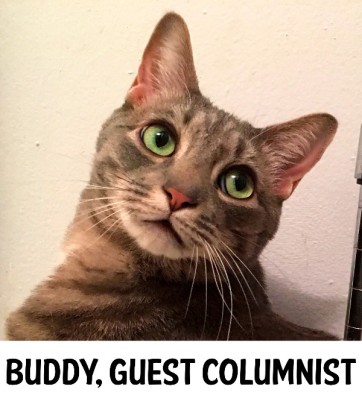
Sure, the app had an unhelpful habit of attributing improbably loving declarations to Buddy, but I thought it would follow the trajectory of other machine learning models and drastically improve as it accumulated more data.

More users meant the app would record and analyze more meows, chirps and trills, meaning it was just a matter of time before the AI would be able to distinguish between an “I want attention!” meow and a “My bowl is dangerously close to empty!” meow.

Obviously that didn’t happen, and what I personally didn’t take into account back then — and should have, given how obvious it is in retrospect — is that cats don’t just communicate via vocalizations.

In fact, cats don’t normally incorporate vocalizations into communication at all. Pet kitties do it entirely for our benefit because they know we’re generally awful at interpreting body language and we are completely useless when it comes to olfactory information.

It’s actually amazing when you really think about how much of the heavy lifting cats do in our efforts to communicate with each other. They recognize we can’t communicate the way they do naturally, so they try to relate to us on our terms. In return, we meet them less than halfway.

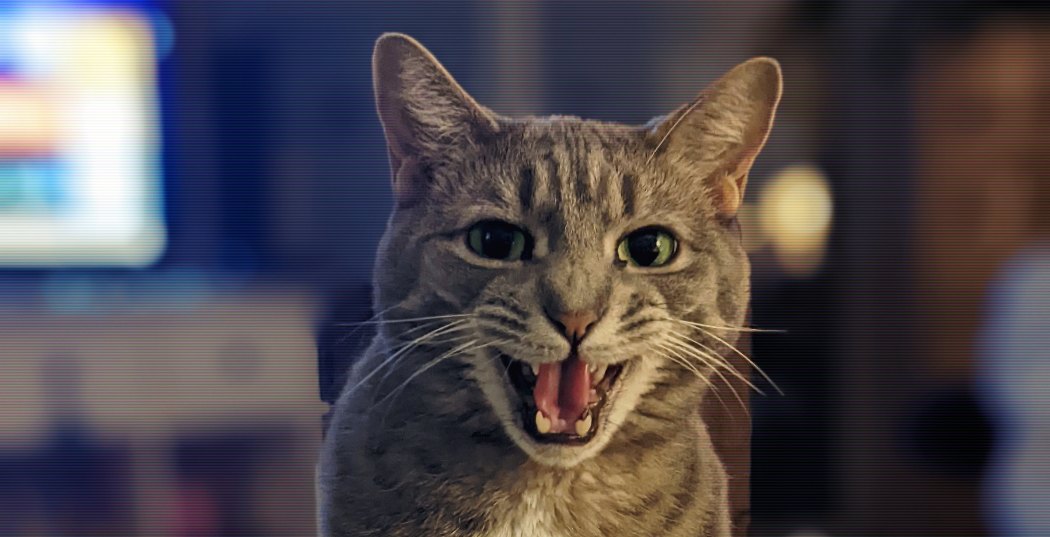
No wonder Buddy sometimes looks frustrated as he meows at me, as if I’m the biggest moron in the world for not understanding the very obvious thing he’s trying to tell me.

“Human, how can you not understand the simple feeling of innerer schweinehund I’m trying to convey here? The cringe is killing me!”

Now the Chinese tech giant Baidu is throwing its hat into the ring after filing a patent in China for an AI system that uses machine learning to decode animal communication and “translate” it to human language.

Machines are designed to process things from a human viewpoint according to human logic, so if Baidu wants to succeed where MeowTalk has not, its engineers will need to take a thoughtful approach with the help of animal behavior experts.

This is a hard problem that encompasses animal cognition, neuroscience, linguistics, biology, biochemistry and even philosophy. If they approach this strictly as a tech challenge, they’ll set themselves up for failure.

Without the information and context clues provided by tails, whiskers, facial expressions, posture, eye dilation, heart rate, pheromones and even fur, an AI system is only getting a fraction of the information cats are trying to convey.

Trying to glean meaning from that is like trying to read a book in which only every fourth or fifth letter is legible. There’s just too much missing information.

Even if we can train machines to analyze sound visual, tactile and olfactory information, it may not be possible to truly translate what our cats are saying to us. We may have to settle for approximations. We’ve only begun to guess at how the world is interpreted differently among human beings thanks to things like qualia and neurodivergence, and the way cats and dogs see the world is undoubtedly more strange to us than the way a neurodivergent person might make sense of reality.

“He grimaced. He had drawn a greedy old character, a tough old male whose mind was full of slobbering thoughts of food, veritable oceans full of half-spoiled fish. Father Moontree had once said that he burped cod liver oil for weeks after drawing that particular glutton, so strongly had the telepathic image of fish impressed itself upon his mind. Yet the glutton was a glutton for danger as well as for fish. He had killed sixty-three Dragons, more than any other Partner in the service, and was quite literally worth his weight in gold.” – Cordwainer Smith, The Game of Rat and Dragon

An animal’s interpretation of reality may be so psychologically alien that most of its communication may be apples to oranges at best. Which is why I always loved Cordwainer Smith’s description of the feline mind as experienced via a technology that allows humans with special talents to share thoughts with cats in his classic short story, The Game of Rat and Dragon.

In the story, humans are a starfaring civilization and encounter a threat in the void between stars that people don’t have the reaction speed to deal with. Cats, however, are fast and swift enough, and with a neural bridge device, teams of humans paired with cats are able to keep passengers safe on interstellar journeys.

The narrator, who is one of the few people with an affinity for teaming up with felines, hopes he’ll be paired with one of his two favorite cats for his latest mission, but instead he’s assigned to partner with an old glutton of a tomcat whose mind was dominated by “slobbering thoughts of food, veritable oceans of half-spoiled fish.”

The narrator wryly notes that the last time one of his colleagues was paired with that particular cat, his burps tasted of fish for weeks afterward. But the cat in question, despite being obsessed with fish, is a badass at killing “dragons,” the human nickname for the bizarre entities that attack human ships in space. (The software that allows felines and humans to link thoughts also portrays the “dragons” as rodents in the minds of the cats, stimulating their ancient predatory drive so they’ll attack instantly when they see the enemy.)

We can’t know for sure if Smith’s interpretation of the feline mind is accurate, but another part rang true when he wrote that cat thoughts were all about the moment, filled with sentiments of warmth and affection, while they rapidly lost interest in thoughts about human concerns, dismissing them “as so much rubbish.”

If the mind of a cat is that relatable, we’ll be incredibly lucky. But in reality we’re dealing with animals who evolved in drastically different ecological niches, with different priorities, motivations, and ways of looking at the world — literally and figuratively.

That doesn’t mean we shouldn’t try to understand our furry friends. Research has yielded interesting information about the way animals like whales and elephants communicate, and AI is at its best when it augments human creativity and curiosity instead of trying to replace it.

Even if we don’t end up with a way to glean 1:1 translations, the prospect of improving our understanding of animal minds is tantalizing enough. We just need to make sure we’re listening to everything they’re saying, not just the meows.

Point/Counterpoint: ‘You Don’t Tell Me When To Sleep, Human!’ vs ‘A Consistent Bedtime Is Important!’

Buddy the Cat argues that a consistent bedtime is key to feeling good and healthy, while Buddy the Cat counters that stupid humans don’t tell him when to sleep, HE decides. Who’s right, Buddy or Buddy?

A Consistent Bedtime Is Important

What are you doing, human? It’s bedtime! Mow mow! You’re supposed to be in this bed and laying down so I can use your face as a pillow, drape myself across you, or burrow comfortably against your side to soak up body heat.

What am I supposed to do without a human sleeping substrate? How can any cat be expected to sleep like this? I know you claim there are so called “stray cats” who don’t have humans, but that is preposterous and I don’t believe it.

Let’s go! I read an article saying it’s very important to have a regular sleep schedule. Well, actually, I just saw the headline, but I got the gist of it, which is that you have to go to bed right meow!

You Don’t Tell Me When To Sleep, Human!

Sleep? Now? That’s ridiculous.

No, I have shadows to chase, toys to kick around and I really wanted to get into redecorating things around here, because they’re looking a little too orderly for my tastes.

Go ahead, go to bed. In a few minutes I’ll cry outside the bedroom door until you get out of bed and open it, then I’ll decide I don’t want to go in after all. I’ll do that two, maybe three more times just because I can.

Oh, you thought I was settling in? Nah. I have a bowl of water to splash all over the place, then I’ll cry until you get up again and refill it, and when you get back into bed for the fifth or sixth time, I’ll cry incessantly again because my dry food bowl is empty, meaning there’s plenty of food but it’s all pushed up to the sides.

Do not forget our pre-slumber ritual! You have to scratch my chin while I purr and you tell me what a good boy I am. Then you have to scratch the top of my head while I purr and you tell me what a good boy I am.

After that, maybe I’ll sleep. We’ll see.

Does The Budster Love Me?

“Love is a strong word, human. I prefer ‘tolerate.’ On days when you anticipate my snack cravings before I verbalize them, you could maybe say I’m fond of you.”

Newsweek has an interesting interview with a cat behaviorist on the subject of whether cats love their humans.

Chantal Howard, a certified cat trainer with Feline Focus Training in Ottawa, told the magazine there are nine primary behaviors that indicate — or confirm — a house tiger loves his or her person. Most of these won’t be new to PITB readers, who are of course among the most cat-savvy people out there and have magnificent taste in cat blogs, but it’s still a handy way to ascertain how your feline overlord feels about you.

So how does Buddy do according to this checklist? Let’s see:

Headbutting: ✅ His Lordship is quite fond of headbutting me and favors me with dozens of headbutts throughout the day, ensuring his pheromones remain on me. You know, in case some other cat somehow comes wandering in and there’s a dispute about which furball owns me.
Kneading: ✅ Considering the fact that I’ve had to toss quite a few t-shirts because of claw rips, I’d say that’s a yes. At least he doesn’t knead my face anymore, as he liked to do when he was a kitten and would take his perch on my shoulder, nuzzle up to my neck and make biscuits against my beard.
Purring: ✅ Nine times out of 10, Buddy’s purr is inaudible, but it’s there. It’s a bit odd that such a talkative, loud cat barely makes a buzz. He likes to lay on my chest and purr up a storm while I rub his head and tell him he’s got admirers all over the world.
Chirping: ✅ Yes! In fact, chirps and trills make up a significant part of the Buddinese language. While meows can be positive, negative or demanding (“I can see the bottom of my bowl! This is an outrage, human!”), trills and chirps are always happy sounds.
Nipping: ✅ Unfortunately, yes.
Licking: ✅ He grooms my hair and my beard, and when I shave he licks my face, which is pretty gross.
Bringing Gifts: ❌ Negative. Then again, what kind of gifts can he bring me when he’s an indoor cat and doesn’t fully understand the concept of hunting?
Exposing Belly: ❌ Does he expose his belly? Yes. Does he feel comfortable enough to snooze in my lap with his belly exposed? Of course. Does he want me to give him belly rubs? No, he emphatically does not. The primordial pouch is not to be touched!
Tail Position: ✅ One of the most awesome things is the fact that Bud’s tail goes immediately into happy mode when I say “Hi, Bud!”, when I hold my hand out for a headbutt, and when I talk to him in general. His tail quivers with excitement when we play with the laser pointer or his favorite toy, and when he catches the first whiff of catnip.

So that’s 7 of 9, or 7 of 8 if we count gifts as N/A due to Bud’s hilarious ineptitude when it comes to even grasping the concept of hunting.

Bud has been known to throw up from excitement when I return from vacation, he often naps by the door when I go out, he talks to me constantly, and he’s rarely more than three or four feet away from me at any given time. All those things, plus our strong bond, have proven to me that he does love me, but it’s also nice to confirm it with a behaviorist’s criteria.

How does your cat perform on the checklist? Don’t forget to share your results in the comments.

Study: Cats Use Facial Expressions To Reassure Each Other Everything’s Cool During Play Time

Once again, we’ve underestimated cats. There’s so much more to the ways in which they communicate than we realize.

We know cats use non-verbal signals to communicate with each other, but recent research suggests we may just be scratching the surface, glimpsing only a portion of the information that passes between our furry friends.

Cats “talk” to each other by the way they position their tails, whiskers and ears, in addition to their overall body language.

It turns out there’s more. A group of interdisciplinary scientists from universities in Kansas, Arkansas and Haifa, Israel, found cats also employ specific facial expressions, and rapidly mirror each other’s expressions during play time to signal they’ve got good intentions and aren’t going to hurt each other.

The study, which was given the yawn-inducing title “Computational investigation of the social function of domestic cat signals” (in English: using AI to figure out how our house cats “talk” to each other), started with observations of felines playing with each other in cat cafes.

From there, the coders and mathematicians on the team created an algorithm to record and sort the facial expressions the cafe cats used, employing CatFACS (Cat Facial Action Coding System) to associate each expression with its meaning.

“I’m serious. Feed me, or feel my wrath.”

Cats make a surprising number of facial expressions, 276 in total, according to a 2023 study.

The problem is, we humans are terrible at reading them. Even veterinarians trained in CatFACS still struggle to get it right, but happily this is precisely the sort of task algorithmic AI excels at. Like facial recognition software, a well-trained machine learning algorithm can recognize faces and record them more accurately and much faster than any person could.

In a column praising the facial expressions study, evolutionary biologist and Jane Goodall Foundation ethics board member Mark Bekoff said it’s the kind of labor-intensive work that truly advances our understanding of the ways animals communicate.

For cats and their human caretakers, Bekoff notes, it could help us reduce inter-species misunderstandings and make it easier to read our cat’s emotions, so we know when they’re not feeling well or need something.

“There are no substitutes for doing what’s needed to learn about the nitty-gritty details of how animals communicate with one another in different contexts,” Bekoff wrote. “This study of play opens the door for more widespread comparative research focusing on how animals talk to one another.”

“Do I look happy, human?” Credit: Milan Nykodym/Wikimedia Commons

We also know adult cats very rarely meow to each other, and the meow is reserved for cat-to-human communication. Imagine the frustration our little friends must feel when they have so much to tell us, but the only thing we understand are vocalizations — meows, chirps and trills — that can convey only basic ideas at best.

The Cat Whose Voice Is Heard In More Than 300 Movies, Plus: Buddy Didn’t Attack His Sitter!

A 23-second clip of a cat growling and yowling has become one of the most-used sound effects over the past three decades. The Guardian traced the clip back to the man who recorded it and got the full story.

We’ve all heard Cheeta the cat yowling, we just don’t know it.

Cheeta was a house cat who belonged to Wylie Stateman, a sound engineer who lives in LA.

In 1988, Stateman recorded an argument between Cheeta, a “remarkably small” half-Siamese void, and her mate, a tomcat named Sylvester.

The 23-second clip made it onto The Premiere Edition, a 20-CD library of sound effects Stateman produced in 1990.

Stateman, called “one of the great recorders of the time” by a colleague, told The Guardian he brought his sound recorder with him everywhere he went for three decades, recording thousands of sounds that have been used in movies for 35 years.

Buddy is also an accomplished sound effects cat.

Cheeta’s yowls are one of his greatest successes. The cranky cat can be heard in Toy Story, Home Alone 3, Les Miserables, Pet Sematary, 101 Dalmations, Venom: Let There Be Carnage, Babe, End of Days, How The Grinch Stole Christmas, and many more.

Although it’s difficult to get an exact count, it’s believed Cheeta’s distinct voice can be heard in some 330 films over the years. If you’re interested in learning more, check out The Guardian’s deep dive into the sound effect and its origins.

Buddy the Magnanimous

I went to visit my brother and his family in Washington this past week, leaving Buddy in the care of my mom.

Regular readers will recall that Bud has a bad reputation for trying to maul his cat sitters, which obviously complicates things.

The incorrigible little lunatic.

Sue, his regular sitter, has known Bud since he was a kitten. She’s literally one of the first humans he met, yet that has not stopped him from ambushing and attacking her. Incredibly, she still agrees to care for him in my absence despite his belligerence, though she’ll no longer play with him. She feeds him and gets out ASAP. I can’t blame her.

This time my mom cared for the little stinker. He’s also tried to murder her when she’s watched him on previous occasions, including one incident in which his bites and scratches necessitated a trip to urgent care and a round of antibiotics.

So yeah, the happy news is that he didn’t attack her this time, although she told me every time she came back, he’d be waiting right by the door, and when he saw it wasn’t me, he would sniff derisively before turning and padding away.

They have an uneasy truce, but I’ll take it. You know you have small dreams when you celebrate a trip in which your cat doesn’t try to maul anyone in your absence.

On a tangential note, I had a first phone interview with a wild cat conservation organization this week, and for the first time in a long time, Bud didn’t make a peep.

He’s meowed loudly during other phone interviews, he’s put his butt in front of the camera like it’s his job during video calls, and he won’t shut up at any other time, but the one time when having a cat might benefit me, he decides to be silent. Thanks, Bud. You’re the best.