The semi-arboreal marbled cat is arguably the most elusive feline on the planet.
Dear readers, before you think this is a joke entry about Bud, let me emphasize we’re talking about the marbled cat, not the well-marbled cat.
“I am NOT chubby, I am meowscular!”
“I’ve never heard of a marbled cat,” you might be thinking, and there’s a good reason for that.
These little guys are incredibly elusive, live far from most humans and are found only in Asia. They’re extremely difficult to track and locate in the wild and haven’t been the subject of any comprehensive field study, granting them an air of mystery in an era when you can find almost anything you want to know about almost any animal with a few clicks.
There’s a whole lot we don’t know about marbled cats, including their behavior in the wild, how long they gestate, what they eat and how they’ve successfully adapted to so many varied habitats.
Credit: Wildcats Magazine
The singular species is semi-arboreal. Almost all cats can climb trees. The problem is getting down afterward, which is why so many domestic cats get stuck in trees. They can’t descend head-first and they’re wary of descending tail-first, which makes them vulnerable. Marbled cats have unusually flexible claws that enable them to descend head-first with ease, so they don’t balk at climbing. Their large paws keep them sure-footed on tree limbs and they’re confident off the ground.
In 2011, a trail camera in Indonesia was tripped by a marbled cat, finally giving us a close-up view:
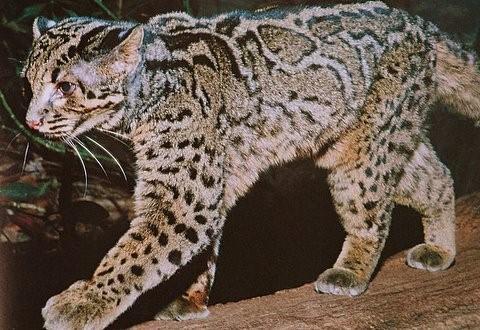
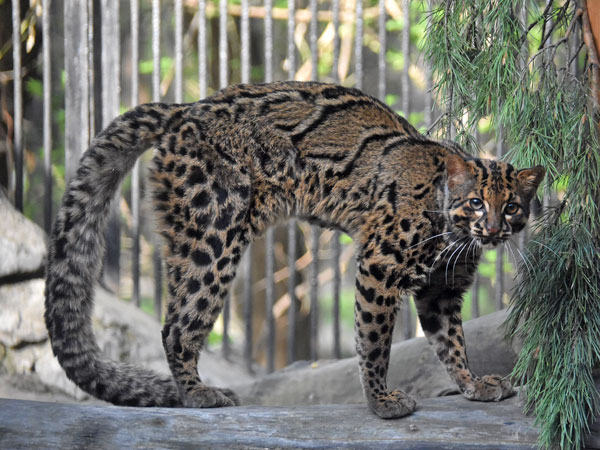
The striking felines are sometimes called “miniature clouded leopards,” and you can clearly see why.
The species is native to the eastern Himalayas, mostly in Nepal, Bhutan, Myanmar and tiny corners of China and India, as well as countries like Thailand, Cambodia and Indonesia. They’re extremely adaptable and live in a variety of habitats, from the forests of high-elevation mountain slopes to the humid jungles of Indonesia’s Borneo and Sumatra.
Marbled cats are about the same size as domestic cats, but they’ve got incredibly big, fluffy tails that are longer than their own bodies, which serve as formidable counter-weights for their tree-hopping. Their ears are a bit more round than the ears of their domestic cousins. They tend to have larger paws, and they have unique clouded coat patterns that are unlike any breed of domestic feline or close wildcat relatives.
Despite their relatively large natural habitat and the difficulty in pinning down population numbers, conservationists estimate there are fewer than 10,000 marbled cats. They’re threatened by the same deforestation by the palm oil industry that has devastated orangutan and clouded leopard habitats, although their strongholds in steep, high-elevation forests are safe for now. Marbled cats are listed as endangered by some authorities and as near-threatened by others, though like all wildlife their numbers are in decline.
The importers are accused of jacking up prices almost 16 fold on FIPV drugs they illegally imported from China, the FDA says.
FIPV is pretty much a guaranteed death sentence for cats, and the only way to cure it is with an experimental drug that doesn’t have FDA approval.
Oregon’s Nancy Ross and Nicole Randall of Texas knew that, and as importers selling the cure via the popular Facebook group FIP Warriors, the FDA says they banked on the desperation of people who would do almost anything to save their cats — including forking over vast sums of money.
Ross and Randall are now accused by the FDA of smuggling GS-441524 from China, where it’s manufactured illegally, and hiking the price by almost 16 times what they paid for it as they served as the middle women between desperate cat owners and the suppliers in Hong Kong.
Feline infectious peritonitis kills some 95 percent of cats it infects, and veterinarians often tell their clients with FIPV cats that while they can’t prescribe GS-441524, they will help administer it, track their cats’ progress through bloodwork and hopefully save feline lives — if the clients obtain the drug themselves.
FIP Warriors — now in its fifth incarnation as FIP Warriors 5.0 on Facebook — is where people with FIPV cats go to find suppliers. The group has more than 43,000 members, and the FDA says Randall made millions off of them, charging as much as $385 for vials of GS-441524 she obtained for between $25 and $45 from manufacturers in Hong Kong and mainland China.
Randall sold $9.6 million worth of GS-441524 to clients in the US, according to the FDA. Per The Oregonian:
“A spreadsheet found in Randall’s Google email showed customer orders of at least 58,460 vials and 236,836 pills of GS-441524 from July 2020 through June 6, 2022, the affidavit said.”
PITB spoke to several people who paid thousands of dollars for GS-441524 after their cats were diagnosed with FIPV. All of them said they were surprised by the news of the FDA’s investigation, and said they were given various reasons for why the drug was so expensive to acquire.
One customer from Texas, whose cat Seth began his regimen in July of 2020, told PITB she doesn’t regret spending the money to cure Seth, but she “can see how the people saw our desperate situation and took advantage of us.” She was told prices were at a premium because of scarcity.
“It was a very stressful time for us, and every time we needed to refill, they charged us more,” she said. “They knew we couldn’t say no.”
Another woman, whose kitten was diagnosed with FIPV in 2021, “was told that the prices were set because they ensure the medication was purchased from a trusted source.”
As a college student at the time, she used her savings and crowdfunded the other half, paying more than $5,000 for her kitten’s treatment. She said she doesn’t think the administrators of the group were ripping her off, since they had FIP cats of their own, and likely didn’t know the importers were making huge profits. She trusted the seller — who was not Ross or Randall — because the group vouched for that person, assuring her they supplied real pills.
“Of course, I don’t think this is a valid justification for hiking up prices up to 16x the amount,” she told PITB, “but I’m sincerely hoping the individual [accused by the FDA] had a valid reason for setting the prices that she did.”
Others paid even more exorbitant prices: a British woman we interviewed for a story about FIPV in 2022 said she paid about £7,000, or $9,400 at the time.
FDA investigators said they intercepted shipments from China and Hong Kong disguised as COVID masks, cat shampoo and chewable medicine for pets, and the Oregonian report says the shipments were listed as “essential oils” and “beauty products” in import documents.
Randall and Ross have not been charged criminally, but they are now targets of a civil asset forfeiture case:
“The government seized five of Randall’s bank and brokerage accounts and her 2022 Tesla Model Y car last year based on a warrant signed by a federal magistrate judge in Oregon.
The warrant identified the bank accounts and car as proceeds from the “crime of smuggling” and subject to forfeiture, according to the affidavit. It also alleged Randall, now 35, used the proceeds to buy several properties, including a ranch in Leander, Texas, in July 2021.”
While the FDA’s affidavit went into detail regarding Randall’s earnings, it describes shipments sent to Ross but does not specify how much she may have made in profit. An attorney for Randall told The Oregonian that the Texas woman will fight the civil asset forfeiture.
The illegal market for GS-441524 exists because the drug’s creator, Gilead Sciences of California, declined to submit it to the FDA for approval. That’s because it’s chemically similar to another drug the company makes, remdesivir, which was floated as a possible treatment for COVID-19. The company was worried any snags in a potential approval process for GS-441524 would also ensnare remdesivir, according to reports, putting the latter drug in limbo during the pandemic.
Now that the pandemic has retreated to much lower levels of infection and death, it’s not clear if Gilead Sciences will reconsider its FIPV medication, but there may be hope in the form of alternate treatments. A report from the American Animal Hospital Association (AAHA) says scientists at the University of California-Davis and UC San Diego are working on several promising therapies, including a potential treatment using CRISPR gene-editing technology.
But until another cure or treatment passes trials and earns FDA approval — a process that could take years — people with FIPV-diagnosed cats remain at the mercy of strangers on the internet, spending thousands of dollars per regimen and hoping the drugs they buy are the real deal.
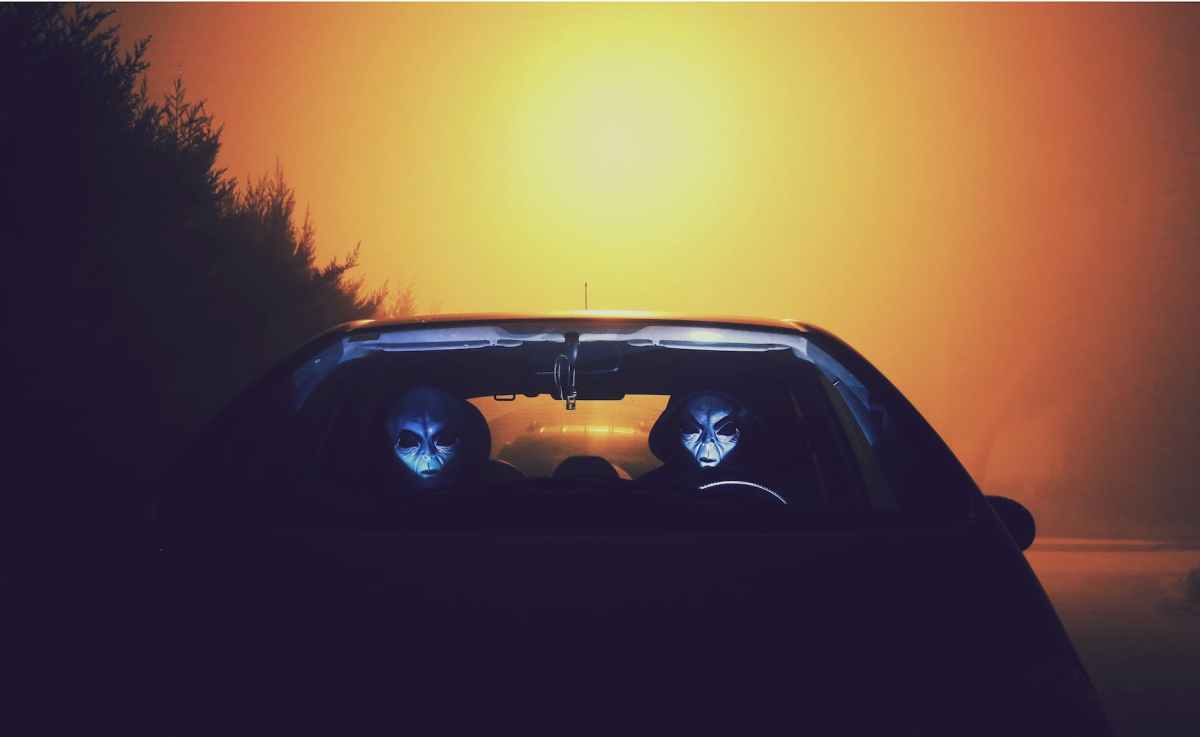
What do felines make of the spy-slash-UFO drama that has consumed the popular imagination for the last week?
The humans have been freaking out about a big balloon flying over Humanland, believing other humans sent it to spy on them. But some humans think aliens are behind the nefarious balloons, and they’re not balloons at all — they’re super sneaky alien craft sent here to scout ahead for an invasion. What do you think?
“If I wanted caviar for breakfast, I would have told you. Stick with the schedule.” – Versace, 13, show cat
“You gonna eat that hedgehog?” – P-84, 1, puma
“Hey up, mates. What’s this, then? Can’t we just fire a few fecking missiles at them and get on with it?” – Liam Gallagher, 8, British cat
“Allow the aliens to land. They look delicious.” – Zanzibar, 5 months, apprentice murderer
“We need a bunker, do we have a bunker? Well why didn’t you BUILD a bunker? Do I have to think of everything?!?” – Buddy the Cat, 8, ex-president of Americats
“This is clearly the work of the aggressive regime in Luxembourg. We should invade, confiscate all their cheese and make them a vassal state.” – Cicero Nash, 4 1/2 months, couch stylist
Genetics, gene-editing and cloning have rapidly matured since the days of Dolly the Sheep, which means we have less time than we think to grapple with some heady moral questions.
Should scientists resurrect long-extinct species? Is it ethical to clone thousands of animals who will not live, but have their organs harvested for human patients?
Those are some of the questions people are asking as the cloning industry — once relegated to producing one-off copies and genetically identical versions of deceased pets for wealthy clients — is expanding with new capabilities.
This story by the BBC’s David Cox provides an informative, brief history of cloning before pivoting to the current state of the industry and how it could continue to evolve.
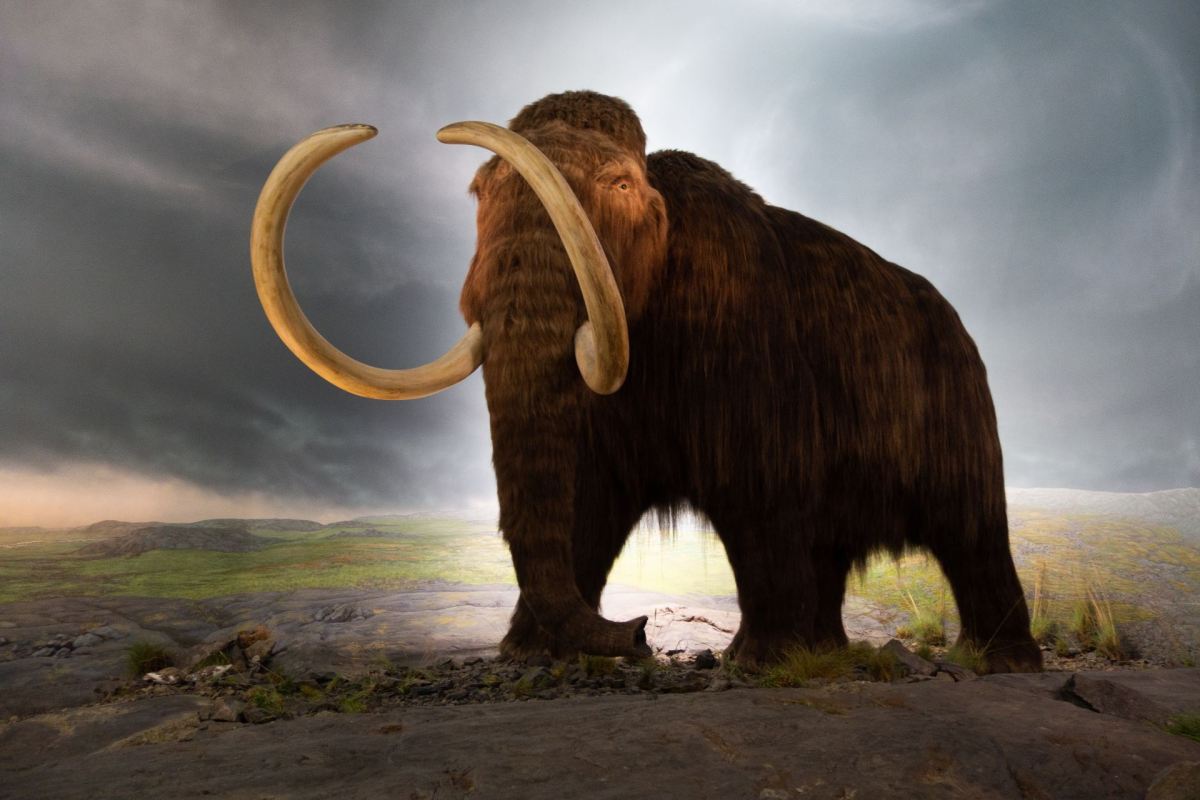
Two of the most fascinating prospects have to do with conservation. One company, Colossal, is working on bringing back the extinct woolly mammoth, while other scientists are turning to cloning as a way to prevent the extinctions of species like the white rhino, which is functionally extinct without any breeding pairs left living.
Scottish scientists shocked the world when they cloned Dolly the Sheep in 1996.
As with anything in science, innovations in cloning unlock new applicative branches, and scientists have partnered with the medical field to address human health concerns. Some, like the practice of editing genes to prevent diseases in newborns, tend to fly under the radar. But others, like the push to adapt organs from animals like pigs so they can be replacements for human organs, are much more controversial and have met opposition from animal welfare groups.
Then there’s the elephant in the room, no pun intended. What about cloning humans?
Right now no one’s gone down that route, at least not publicly, because of the inevitable backlash. What’s happening deep in the bowels of clandestine medical facilities in nations with murky ethics laws is another question entirely.
I am opposed to human cloning, but I don’t believe it will remain the immutable taboo some people think it is. Someone will break the dam, and while that pioneer will likely get raked over the coals, the bell cannot be unrung. Things change so fast these days that what’s shocking one day merits a shrug the next, and it’s possible the world will be introduced to a man or woman one day before it’s revealed the person is, in fact, a clone. (Not unlike the way the world was introduced to Imma, a Japanese influencer and model who exists only digitally.)
Imma has more than 400,000 Instagram followers, she models the latest fashions and she appears in adverts for products like beverages and watches, but she doesn’t exist. She’s a digital creation.
They’ll be the Dolly the Sheep of the human race, and ethicists won’t get a say in whether they should exist because it’s already been done.
“See how normal they are?” people keen on cloning will say. “They’re just regular people. Are you going to tell them they shouldn’t live?”
But before that, it looks like the movie Gattaca will become reality, and people will order up a great baseball player or a child with intuitive musical genius just like they might commission a piece of art or a custom car job. Gene editing with CRISPR is surprisingly trivial.
Of course, it won’t be lost on people that we’re cloning humans when there are millions of unwanted, uncared-for street kids in the third world, not to mention people who live without the consideration of their fellow human beings in every nation. Just like it hasn’t escaped the notice of activists that South Korea and China are leaders in cloning pets, yet dogs and cats are also food in those countries.
What separates the dogs and cats bound for restaurant kitchens from the dogs and cats having their cells preserved for cloning?
Nothing except for their individual value to humans, just like pure luck separates a cat who finds a loving home from a cat who ends up euthanized with a needle. We are a fickle species.
Yet both the beloved pet and the unwanted shelter cat are sentient, experience intense emotions and have their own thoughts. That’s not conjecture, it’s fact as confirmed many times over experimentally, but it shocks a lot of people. Our education system has not done right by the billions of non-human minds we share our planet with.
These rhesus macaque infants were cloned in a lab in China. The remaining barriers to human cloning are ethical, not technological.
I’ve thought about what might have happened if Buddy had been adopted by someone else, and what his fate may have been. I love the little guy, but it’s possible that someone else may have viewed him as an annoyance, a loud and incessantly chatty cat who needs an inordinate amount of attention and affection, sometimes lashes out, and needs to be surrendered.
Likewise, unwanted cats have languished in shelters for months before viral posts spark interest in them, and suddenly offers to adopt come in by the hundreds from across the globe. Nothing about those cats changed, but humans formed an emotional attachment to them after learning their stories.
Of course, the ethics of how we treat and consider animals can change depending on where you’re sitting. If you’re young, healthy and energetic, your view may be radically different than the person sitting on an organ donation waiting list, knowing their time may be up before a new liver or kidney becomes available. Suddenly a seemingly simple moral calculus becomes murky and complex.
There’s strong evidence that people who take the first steps toward cloning their beloved cats and dogs spend time wrestling with the ethics of the decision as well. Texas-based ViaGen, the western leader in commercial cloning, told the BBC that 90 percent of its clients are not people who have gone through with cloning, but have only taken the initial step of preserving their pets’ cells for $1,600.
And what of the mammoths? Bringing them back from extinction isn’t as simple as filling in the gaps in their genome, implanting gene-edited eggs in female elephants and hoping gestation takes care of the rest. Mammoths are social animals. Will an elephant mother raise a mammoth baby? Where does that mammoth baby belong? Without a herd of its own kind, can it be happy?
We can’t ask the mammoths, and even if we could, it might not be up to them anyway. As one paleogeneticist put it to NPR last year: What if the technology isn’t used to resurrect the mammoth, but to save the elephant? Does the end justify the means in the latter situation, but not the former?
Mammoth, Dolly the Sheep and rhesus macaque images credit Wikimedia Commons
The “kids identifying as cats” claims are popping up everywhere ahead of midterm elections. Why are we dragging cats into our culture wars?
The physicist Michio Kaku was a guest on a radio show and was answering a question about possible intelligent life visiting Earth when Joe Rogan interrupted him.
“The three pyramids are aligned with Orion’s belt,” Rogan said. “Do your research, man. Look it up.”
Rogan, who was into 9/11 truther conspiracies at the time, went on to explain how the Egyptians couldn’t possibly have built the pyramids on their own, and that aliens helped them align the positions of the giant structures to correspond to important celestial features.
Here was Kaku, one of the brightest minds in human history, co-founder of string field theory, a man whose textbooks are required reading for PhD-level physics students, getting talked over and “educated” by a pothead who rose to fame hosting a game show in which he forced contestants to eat cockroaches.
Rogan’s source was rock solid if you’re the type of person who thinks ancient aliens traveled thousands of lights to the Earth of deep antiquity to teach human beings how to stack stones on top of each other: Rogan’s friend’s wife, who works at the school district, insisted the litter box story is true.
Like previous claims of school administrators gone mad in service to alleged furries, Rogan’s claim was intentionally nebulous and unverifiable. He didn’t name the school, the district or the teacher. We have to take his word for it.
If you like that sort of thing, I have good news for you! Rogan’s in great company.
Marjorie Taylor Greene — the congresswoman who once claimed “Jewish space lasers” were responsible for California wildfires, the shining testament to US education standards who warned “the Gazpacho police” will imprison patriotic Americans, the genteel stateswoman who said scientists are creating fake meat in “Peach tree dishes” to “zap” Americans — has also warned of the apparently widespread practice of furry school children shitting in litter boxes.
Heidi Ganahl, GOP nominee for Colorado governor:
"they're mute and they don't talk, they growl and meow. it's bizarre. that's an extreme example but it's happening." pic.twitter.com/be2syn012e
Not to be outdone, Rep. Lauren Boebert has co-signed the cat conspiracy, telling donors that evil cat-loving people are hell bent on destroying wholesome American values by unleashing cat-identified children on an innocent and unsuspecting public.
Say it enough and it becomes true
The claims have been repeated so many times that they’ve spread to school board meetings and state legislatures across the country, perpetuated by gerontocratic leaders who think The Onion is a real news source. Two current gubernatorial candidates, in Colorado and Minnesota, have also repeated the claim.
“Schools are not disclosing that they are allowing children who identify as snakes, cats, whatever, they’re providing litter boxes for the [student] cats,” a Tennessee state representative said during a hearing in September. “And obviously it’s very disruptive to the learning process. If a child has that much of a self-identity issue they probably need a different environment, and it’s creating a lot of anxiety, a lot of confusion with the children who are boys and girls.”
“But Big Buddy,” you might be thinking, “I thought you said PITB was apolitical and you’re a moderate?”
It is, and I am.
I dislike all ideology equally because it invites people to abdicate their responsibility to think for themselves. I believe our two-party system and the divisiveness it fuels could be the ruin of our great nation, particularly at a time when polls show up to half the US population expects to fight in an ideologically-driven civil war. I worry that we are doing precisely what our enemies want by feuding amongst ourselves. Indeed, we know for a fact that “troll farms” in countries like Russia and China exist to sow the seeds of division and crank up poisonous political rhetoric online.
But I’m also against pure, abject, mind-boggling, depressing, Idiocracy-style stupidity and the idea that anything is true if someone says it is. Neither party has a monopoly on this kind of thing.
In particular, I’m not a fan of injecting cats into the American culture wars. (Although it’s not just cats at this point. A Texas school district was forced to deny rumors that administrators were allowing “furries” to eat out of dog bowls in school cafeterias.)
Three minutes of two state lawmakers in Tennessee insisting this week in a hearing that there is a “crisis” of kids identifying as cats and peeing in litter boxes in school hallways “across the state” pic.twitter.com/DDHWKIJtLz
We already fail these innocent creatures in myriad ways, from allowing declawing and doing little to improve weak animal welfare laws, to tolerating the idea that it’s perfectly acceptable for people to shoot cats with arrows, BBs and real firearms as some grotesque form of entertainment.
Now people want to use cats as the rope in a perverse game of cultural tug-of-war, which could further degrade their status and lead to more proxy violence against them.
Cats are vulnerable, and are already targets of hate
Violent criminals, including the perpetrators of the recent mass shootings in Uvalde and Buffalo, often get their start by killing cats before “graduating” to humans.
Cats are also frequent victims of redirected anger, with studies showing they’re abused and killed in domestic violence situations because they’re viewed as extensions of the feminine, or simply because killing them causes emotional distress to the people who care for them.
Politics have pervaded and infected so many things, cats and dogs are now staked to territory on either side of the political fault lines.
So how long will it be before an Alex Jones type claims the government is using cats to spy on Americans? The best conspiracy theories always have a nugget of truth to them, after all, and in the 1960s the CIA tried — and failed, spectacularly — to use cats implanted with transmitters to spy on Soviet officials.
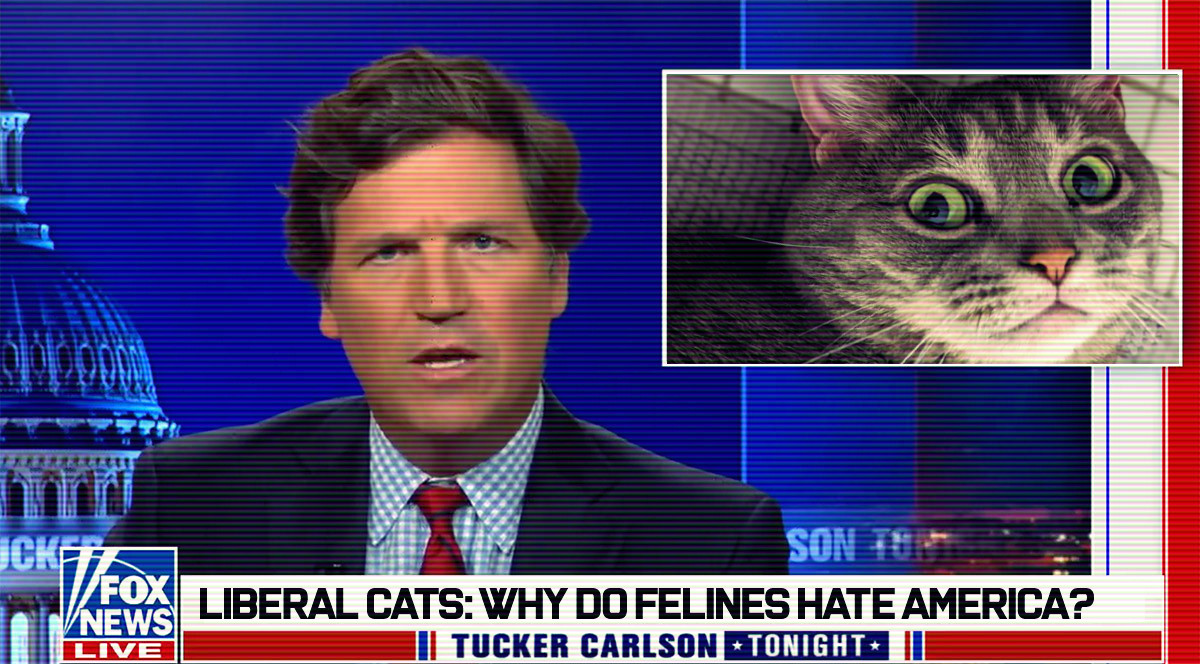
How long before a Boebert or a Greene tells a crowd that it’s their patriotic duty to shoot “liberal cats” on sight? How long before Tucker Carlson follows up one of his thrilling UFO/crop circle/cow mutilation investigative specials with a breathless exclusive about America-hating cats?
“Why do so many cats want to see America burn? Why do cats like to line their litter boxes with the American flag? Does the government allow cats to vote? Hey, I’m just asking questions!”
If you think that’s outlandish, I’d point out that we’ve been there, done that.
Tucker Swanson Carlson has already claimed that “decadent rich people” who “detest the country” like to plot America’s downfall from cat cafes. Those evil America-haters stroke cats and sip lattes while “working through the night to destroy” our great nation, Carlson told his viewers. I’m not making this up.
Europeans almost extirpated domestic cats in the middle ages when people were convinced they carried the Black Plague, and cats had even bigger targets on their backs after the Inquisition’s most overzealous prosecutors insisted felines were used in Satanic rituals.
Likewise, my Google News alert for cat-related articles shows a depressing, never-ending feed of stories about people chugging beer and shooting cats with BB guns, mystery killers strangling neighborhood kitties and “hunters” who put arrows through these sentient, innocent animals who have the mental and emotional capacity of three-year-old human children.
And there’s already plenty of nonsense online about how our choice of pet reflects our political beliefs, as well as unhinged rants about the kind of people who prefer cats. There are even research studies about the intersection of politics and attitudes toward companion animals, and research shows certain people consider cats “liberal” because they don’t adhere to social hierarchies and don’t recognize authority.
Is it really a stretch to imagine some 85, deep into a case of Miller High Life, taking target practice at neighborhood cats because he sees them as evil, feminine, America-hating animals? Are we sure it doesn’t happen already?




 Pain In The Bud