The animated feature about a cat surviving an apocalyptic flood has racked up awards and earned universal acclaim.
It’s been quite a year for Latvian animator Gints Zilbalodis and Cat, the star of Flow.
Their film won an Oscar for best animated feature film, racked up wins at the Golden Globes and smaller film festivals, became the most-watched film in Latvian history, snuggled its way into the hearts of audiences in the US, Europe and Asia, and enjoys incredibly rare universal accolades from critics and viewers alike, scoring 97 and 98 percent with each group respectively on film review site Rotten Tomatoes.
Now Cat has officially recognized his Oscar by doing precisely what his species loves to do. In a short video posted by Zilbalodis, Cat smacks the golden statue off the railing of his boat and onto the deck, to the annoyance of his lemur buddy.
The puma, also known as the mountain lion, cougar, screamer, panther, catamount, suçuarana, pangui, American lion and dozens of other names, looks like a big cat but is genetically closer to our domestic Feline friends.
Credit: Merazonia Animal Refuge of EcuadorCredit: Wikimedia CommonsCredit: Elizabeth LucasCredit: Wikimedia CommonsCredit: Wikimedia CommonsCredit: Wikimedia Commons
Click images for full high resolution versions. Baby puma image credit Elizabeth Lucas. Prints available here.
Is your cat a genius or not the sharpest claw on the paw? The University of Maine’s Cat Lab wants your help as researchers seek to measure feline intelligence.
Buddy apparently has brawn and brains, according to a “cat IQ test” by researchers at the University of Maine.
The test is a survey designed by the people who work at the university’s Cat Lab, and it aims to employ some of the same techniques used to measure the intelligence of young children and dogs.
The test asks questions about memory, how closely felines read nonverbal cues from their humans, how attuned they are to human emotions, whether they’ve learned tricks, and whether they’ve improvised solutions to obstacles they’ve encountered.
I gave each question serious thought and tried to eliminate my own bias to the best of my ability.
“This is your brain on catnip. Any questions?”
For example, there’s absolutely no question Buddy is extremely communicative, curious, bold and friendly. He’s also figured out things on his own, like how to open doors and how to best manipulate me for as much food as possible. I’ll never forget watching with fascination when, as a kitten, he figured out how to wedge his body against the frame of my bedroom door with his feet while using his front paws to turn the handle.
On the other hand, he’s a hilariously inept hunter, he’s done some spectacularly dumb things, and he went through a whole phase in which he “boxed” the cat in the mirror before figuring out it was a reflection of himself.
I can still hear the “THWAP THWAP THWAP!” of his little kitty paws against the glass and his accompanying trills as he did battle with himself. To be fair, that was also in kittenhood, and he eventually figured out there was no other cat.
As I’ve detailed in this blog previously, Bud also seems to possess the precision of an atomic clock when it comes to meal times, and if I so much as shift in my chair as meal time approaches, he springs up and trills at me like “Are we going to the kitchen? Come on, dude, it’s Food O’clock! I want turkey, beef or tuna!”
According to the survey, Buddy has an IQ of 64 on a max-70 scale, good enough for the “Felix Forecaster” tier and just below “The McGonagall Mastermind.”
It’s probably for the best that he’s not in that very top tier anyway. We’re talking about a cat intelligent enough to understand I hate the sound of the flap on his litter box squeaking on its hinges, and has subsequently weaponized it to get me out of bed. If he gets any smarter, I’ll probably wake up to a machine that slaps me every time I hit the snooze button.
You can take the survey on behalf of your own cat(s) here. Don’t forget to share your results!
The more bunk studies claim cats are driving wildlife to extinction, the more people in media and government call for extreme measures to contain them.
Seventy nine cats.
That’s how many felines stood in for the entirely of the UK in a 2022 study, which is the genesis for the claim that cats kill 270 million birds and small animals in that country.
Using GPS collars, owner questionnaires and samples of prey brought home by those 79 outdoor cats, a research team from the University of Reading applied data from a mix of studies dating as far back as 23 years ago, extrapolated and massaged numbers using things like “kernel density estimates” and “generalized mixed models,” and came up with that 270 million figure, which is cited routinely and credulously by UK media.
Actually, their estimate was between 140 and 270 million. An earlier study put the number at 92 million, and a 2016 study estimated UK cats kill 55 million birds and small animals. That’s a range of 215 million!
The Reading team even quotes the infamous US meta-analysis that claims domestic cats kill as many as 4 billion birds and 22.3 billion mammals a year here. That paper, as skeptics in the science community have noted, has virtually no relationship with reality, involves no original research, and relies on data from unrelated studies and surveys in which cat owners were asked to rate their pets’ hunting prowess on a point scale while imagining what the little ones get up to when they’re outside.
All of this is to say that aside from the thorough, labor-intensive and expensive D.C. Cat Count, which brought together cat lovers, birders and scientists to work cooperatively, the 2022 UK study and its counterparts in the US and Australia are exercises in pushing an agenda masquerading as honest academic research.
That’s how we get editorials like The Spectator’s “We need a cat lockdown now” by Zoe Strimpel. Though the tone isn’t tongue in cheek, I can’t imagine Strimpel dislikes cats nearly as much as she claims, and the post was probably written with wry anticipation for the click-generating fury of cat lovers indignantly sharing it on Facebook and X.
Still, it quotes the Reading study without skepticism and portrays cats as furry little wretches who abuse their human caretakers with their claws and their disdain while gleefully eating their way through endangered birds.
A cat stares down a mouse. Credit: Wikimedia Commons
Cats are predators, that much we can agree on, and outdoor cats are much more likely to negatively impact local wildlife, for obvious reasons.
Likewise, I can understand the concern with cat culture in the UK, where allowing pet cats to roam outside is the norm.
But every time the media cites the above-mentioned studies, more people are given an inaccurate impression of feline ecological impact, and more lawmakers at the local and national level consider “solutions” ranging from prohibiting people from keeping pet cats, as a government commission in Scotland recently proposed, or exterminating them outright, as some Australian states and municipalities in New Zealand have tried to do.
It’s worth pointing out that there is no data, not even a single study, showing that air-dropping poisoned sausages or arbitrarily shooting cats actually has any positive impact on birds and small mammals. All it does is terrorize sentient, intelligent domestic animals who have real emotions and experience real fear and pain.
The primary drivers of declining bird and small mammal populations — including habitat loss, environmental destruction, wind turbines and glass buildings — have nothing to do with cats. We have killed off 73 percent of the planet’s wildlife since 1970 and every species of iconic megafauna — from orangutans and gorillas to tigers and pangolins — is headed toward extinction. Are domestic cats responsible for that too, or can we be adults and fess up to our role as the main antagonist here?
An orange tabby and a mouse. Credit: Wikimedia Commons
Strimpel actually goes even further, claiming cats don’t have real affection for their caretakers and are more like psychopaths, faking love because it gets them what they want, primarily food and shelter.
Dogs have true affection for their humans but cats do not, she additionally claims, while adding that cat people are undateable because they share qualities with the “loutish and numerous creatures” they care for.
There was a time when I would have been ambivalent about Strimpel’s attitude toward cats, if not her cavalier treatment of basic facts. But then a drool-happy, friendly tuxedo cat showed me I could interact with his species without my allergies going haywire, and a tiny gray tabby kitten became my animal cognition teacher while blindsiding me with love.
Now every time I hear about some psychopath abusing cats, or terribly misguided politicians advocating a plan to kill millions of domestic felines, I think about my Bud. I think about how he cries for his Big Buddy when he’s hurt or stuck, how he meows and trills with excitement when he experiences something new, and how he began shaking, then threw up from overwhelming relief and happiness the first time I returned from a vacation after adopting him.
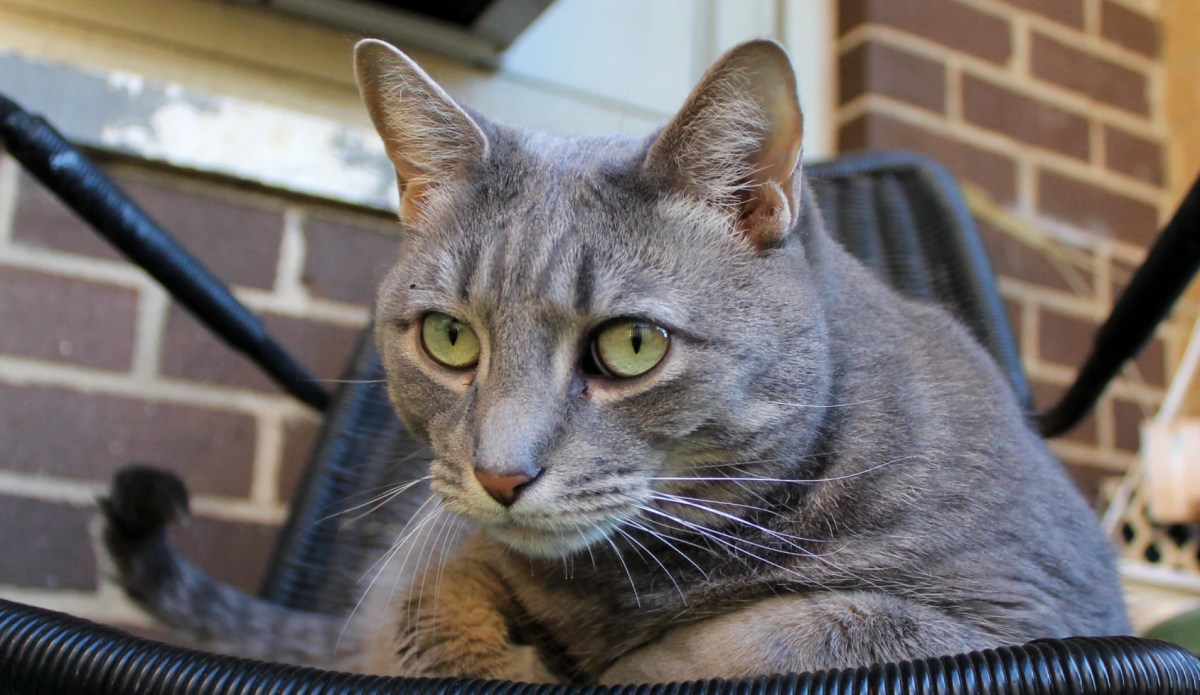
Buddy the Cat chillin’ on the balcony in the summer. Credit: PITB
He’s got a vibrant mind in his little head, with strong opinions and emotions. So does every cat on the street, in a shelter cage, and in the cross hairs of a birder or biologist playing God by “culling” or “harvesting” cats to protect another species.
Real science, not activism packaged as science, has proven that many times over in recent years. If people want to do harm to cats because they think birds and other animals will benefit, the burden of proof is on them to show not only that their methods work, but that the results could somehow justify the fear and misery they would inflict on innocent animals to achieve their goals.
Cats are obligate carnivores who don’t have a choice. We do.