Archie the cat, with his love of exercise, is the anti-Buddy.
This is unbelievable.
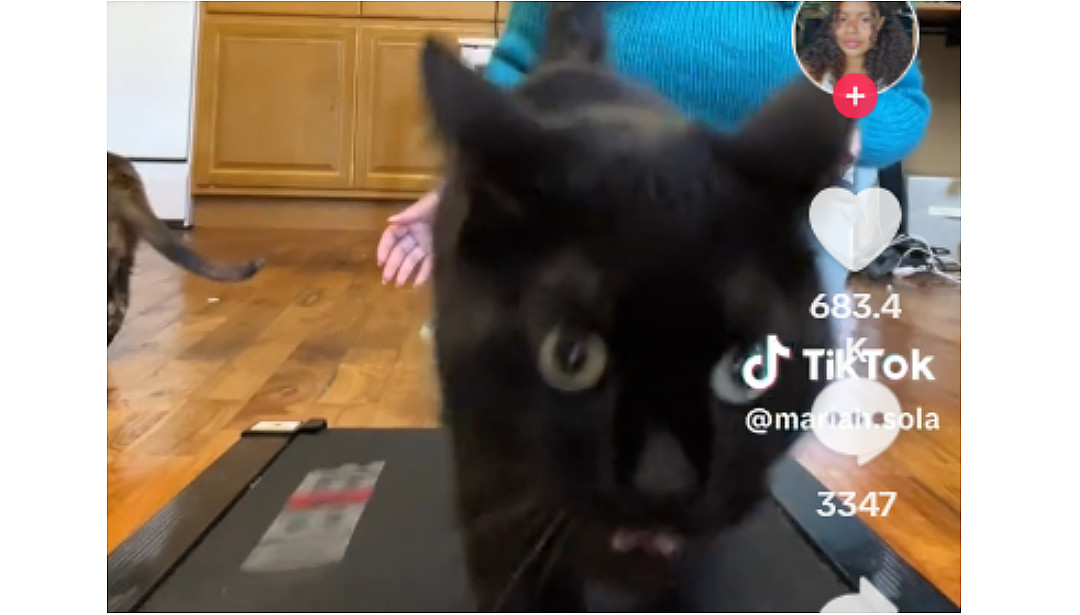
A three-year-old cat named Archie, who also hails from New York, loves running on his human’s treadmill. Mariah, his 27-year-old servant, keeps a close eye on the little guy while he gets his run in to make sure he doesn’t get hurt, but he seems entirely unperturbed and pumps his little legs, keeping a steady pace:
Honestly, I can barely comprehend this. Bud would be more likely to engineer a treadmill into an automated system to deliver snacks to him so he doesn’t have to lift a paw. He is, after all, remarkably dedicated to the craft of being as lazy as possible.
Cheers to Archie for showing not all cats are loafing blobs!
Flow’s Cat has improved things for his fellow voids, who are drawing more interest from adopters.
This video is bonkers!
A cat who is definitely not Buddy stared down a bear and made the ursine interloper retreat in fear in a confrontation caught on camera.
The stand-off happened in Pike County, Pa., and the cat’s name is T’Challa, after the titular hero of Marvel’s Black Panther franchise.
“I think perhaps this young bear woke this kitty cat up because he was not happy that he was sharing his deck with him when he woke up and he expressed himself,” said the homeowner whose security cameras caught the exchange.
After T’Challa made a series of feints, the bear — who is orders of magnitude larger — beat a hasty (for a bear) retreat.
Well done, T’Challa! Someone get that good boy a treat!
Go with the Flow
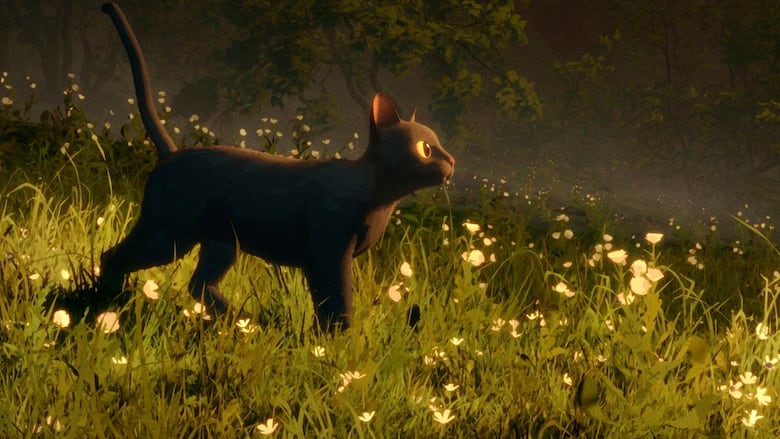
Part of what makes Flow so spectacular — aside from the breathtaking visuals, clever narrative and the strange world it portrays — is how endearing its star, Cat, is.
The little guy shows enormous resilience as he survives a biblical flood, gets chased by a flock of angry secretary birds, learns to swim, and finds his confidence in situations that would terrify any feline. He’s incredibly expressive, revealing his emotions with every twitch of his tail and whiskers, as well as his distinctive meow and, most of all, his bright yellow eyes.
He’s also the first feline star to win an Oscar and a Golden Globe, as well as many other film awards for the universally praised film.
Now he’s got another accomplishment to his name: he’s improved the way people view black cats, who have long been the victims of absurd human superstition and have a hard time finding forever homes because of the stigma.
Credit: Live RIGA
Animal welfare organizations are reporting heightened interest in black cats (good), but not a manic rush to adopt them as has happened when other species and breeds are popularized in films. (Bad, because those pets are often discarded when the novelty wears off.)
In other words, Cat may have inspired something close to parity in adoptions in some places.
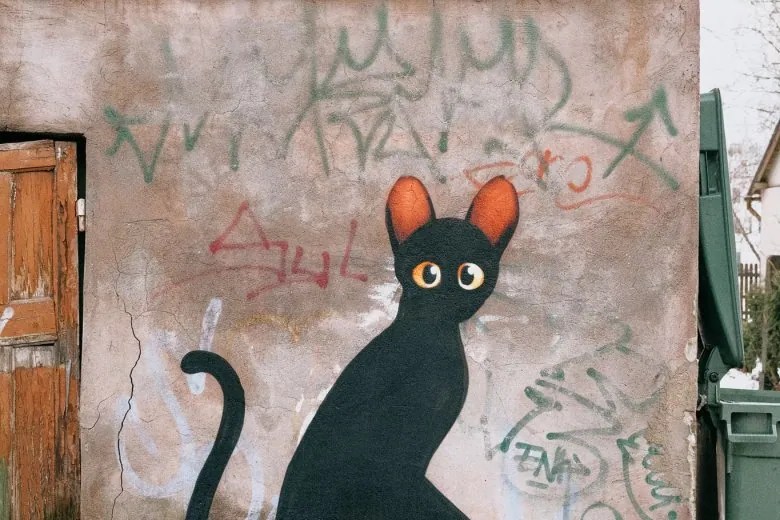
Cat is beloved in director Gints Zilbalodis’ home country of Lithuania. The capital, Riga, is now adorned with street art of the little guy, including a statue sitting atop a major monument in the heart of the city.
The animated feature about a cat surviving an apocalyptic flood has racked up awards and earned universal acclaim.
It’s been quite a year for Latvian animator Gints Zilbalodis and Cat, the star of Flow.
Their film won an Oscar for best animated feature film, racked up wins at the Golden Globes and smaller film festivals, became the most-watched film in Latvian history, snuggled its way into the hearts of audiences in the US, Europe and Asia, and enjoys incredibly rare universal accolades from critics and viewers alike, scoring 97 and 98 percent with each group respectively on film review site Rotten Tomatoes.
Now Cat has officially recognized his Oscar by doing precisely what his species loves to do. In a short video posted by Zilbalodis, Cat smacks the golden statue off the railing of his boat and onto the deck, to the annoyance of his lemur buddy.
It’s easy to mistake house cats for larger wildcats when photos and videos are blurry and lack familiar items to establish a sense of scale. The same phenomenon is responsible for UFO sightings and cryptid creatures like the Loch Ness Monster.
Recently several reports have been making a big deal about blurry videos of black cats, claiming they’re “black mountain lions” or “black panthers” roaming in places like Missouri and Louisiana.
The footage of the first video was shot in Missouri, where pumas once ranged, were extirpated in the 20th century, and have returned in small numbers in recent decades. Like most photos and videos of cryptid or unidentified animals, this one is blurry, taken from a distance, and lacks any object near the animal to provide a sense of scale. The second video is simply a black house cat with her kitten in rural Louisiana.
Our brains are pattern recognition machines and when the information we’re looking for — be it spatial, detail or contextual data — isn’t present, our minds tend to fill in the gaps. That’s the reason why we see faces in clouds, creatures in shadows, men on the moon and the Virgin Mary on grilled cheese sandwiches. (The technical term for “perception imposing meaningful interpretation on a nebulous stimulus” is “pareidolia,” from the Greek for “instead of” and “image.”)
Compounding the problem is the fact that the word “panther” is one of the most confusing of felid descriptors, a word that vaguely refers to physically large cats but doesn’t refer to any particular species, coat pattern or color.
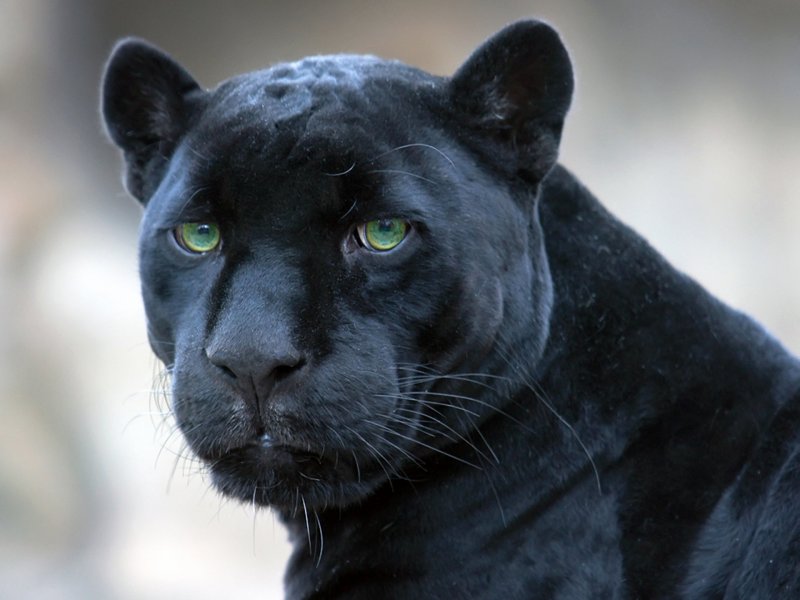
Big cats can be voids too, like this stunning black jaguar in Scotland’s Edinburgh Zoo. Credit: Wikimedia Commons
Above: A jaguar, a leopard, a puma (mountain lion) and a melanistic jaguar. Although jaguars and leopards look nearly identical, jaguars are stocker with thicker limbs and have blotches inside their rosettes, while leopards do not.
The word panther can refer to a puma, a jaguar or a leopard, but only the latter two species can have melanistic (black) coats.
Contrary to popular belief, even a black cat’s fur is not entirely black — you can still see the rosettes and spots of their coat patterns up close and in certain light conditions.
This jaguar’s rosettes and spots are visible in direct light. Jaguars in the wild are rarely seen so close or in “perfect” conditions, making it difficult to see coat markings of melanistic members of the species. Credit: Wikimedia Commons
However, jaguars don’t range in Missouri, leopards are not native to the Americas, and if someone indeed spotted one of the very rare pumas in Missouri, it could not be black because melanistic pumas do not exist.
Mountain lions (Puma concolor in taxonomic nomenclature) are physically large and are the second-biggest cats by size and weight in the western hemisphere after jaguars, but they are not technically “big cats” because they are not part of the pantherinae subfamily. Pumas cannot roar like big cats, but they’re capable of the classic wildcat “scream,” and they can even meow like small cats.
By process of elimination — and the cat’s physical shape — we can conclude the Missouri video shows a house cat that looks larger because there’s nothing nearby to give us a sense of scale.
This piece of a grilled cheese sandwich sold for $28,000 on eBay in 2004 because bidders believed the Virgin Mary’s face miraculously appeared on it. Credit: eBay
It may seem unlikely that someone confuses a house cat, which weighs an average of 10 pounds, with a puma, which weighs on average more than 100 pounds, with the largest males pushing 220 pounds.
But it happens all the time even in close encounters, like the incident this summer in which a man riding a dirt bike swore he was ambushed by a puma only for DNA to establish beyond doubt that his attacker was a domestic kitty. For what it’s worth, he still swears it was a mountain lion.
If you enjoy reading content from Pain In the Bud, please consider whitelisting us from your browser’s ad blocker. Thanks!
PLUS: Today’s the deadline for UK residents to get their cats microchipped under a new law that levies a hefty fine for people who don’t comply.
Another day, another story about a person who can’t tell if the cat they’ve brought inside is their own or a random lookalike.
In this case, a woman named Amber Porter says her indoor-only cat bolted outside, and after a few hours she was able to bring him back in — only to have doubts about whether he’s actually her cat. Meanwhile, an identical-looking black cat is hovering around Porter’s home, and she’s trying to lure it inside.
“I’m still a little worried about it,” Porter said. “I have fully convinced myself I have the wrong cat but I also think I do have the right one.”
This absolutely blows my mind. If someone asked me how long it would take to determine if a gray tabby is Buddy, I’d say approximately half a second. It’s not because of his “bib,” that unique white tuft of hair on his chest, or his pronounced muzzle, although both would offer confirmation.
It’s his behavior, his mannerisms and movement, the fact that if we were separated, he’d meow loudly the second we’re reunited and I’d hear that familiar half-trill, half-meow he does that seems to be Buddesian for “Hello, servant!”
In any case, I hope Amber Porter figures out which cat is hers, and the story looks like it’ll have a happy ending because she says she intends to keep both cats.
Today’s the deadline to get your cats microchipped in the UK
A reminder to our British readers: today, June 10, is the deadline to have your cat microchipped under a new law that makes chips mandatory.
If you’re caught with an unchipped cat, the fine is a hefty £500, or about $635 in ‘Merican greenbacks. That’s some serious chop, so get your little buddy chipped!
“Chip me, human!” Credit: FOX/Pexels
Alice Potter, a cat welfare specialist with the RSPCA, told Sky News that microchips with up-to-date information are the biggest factor in reuniting cats with their humans when the former go missing.
“On average, 11% of all cats coming into the RSPCA’s care are still not microchipped. We’ve also rescued cats who have been microchipped but the details haven’t been kept up to date, which is arguably even more frustrating as it means cats spend a long time in our care whilst we fruitlessly try to contact the owner with out-of-date information,” Potter said.
“However, we’ve also seen countless stories of cats that have been reunited with their owners thanks to a tiny microchip – showing what this change of legislation will achieve for animal welfare.”





 Pain In The Bud